Dujia Reports Alibaba Cloud's Musetu App for Concert Memories
Dujia reports that Alibaba Cloud launched Musetu in November to turn concert photos and videos into beat-synced clips, collages and social captions, with daily free quotas for some AI features. The article also examines the limits of this occasional-use tool.
Dujia has learned that Alibaba Cloud launched an AI assistant app called Musetu in November.
Although its name contains Muse, this Muse is not that other Muse. Rather than pursuing general-purpose conversational large models, it positions itself as a concert-memory assistant, turning photos and videos from live events into ready-to-share social content in one click.
Viewed simply as a product, Musetu is a typical niche, occasional-use tool, serving only the creation of social content after a show. But this unassuming app can also be read as an industry signal:
Large technology companies are stepping outside intense competition in general-purpose models and turning to specific scenarios, putting multimodal capabilities into lightweight consumer products.
What Is Musetu?
Musetu's proposition is straightforward: Turn concert photos and videos into a ready-made package for WeChat Moments.
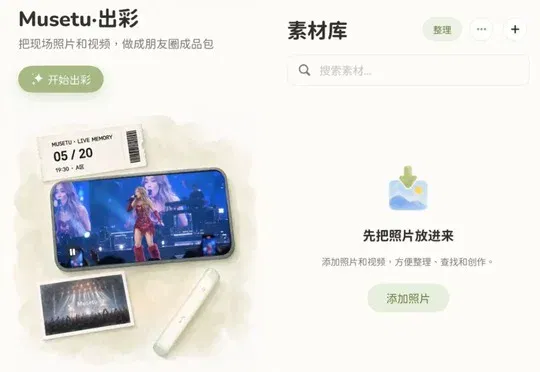
The app has a soft, fresh, hand-drawn visual style, with three fixed tabs at the bottom: Create, Media Library and Me. The structure is very simple, without complicated menus.
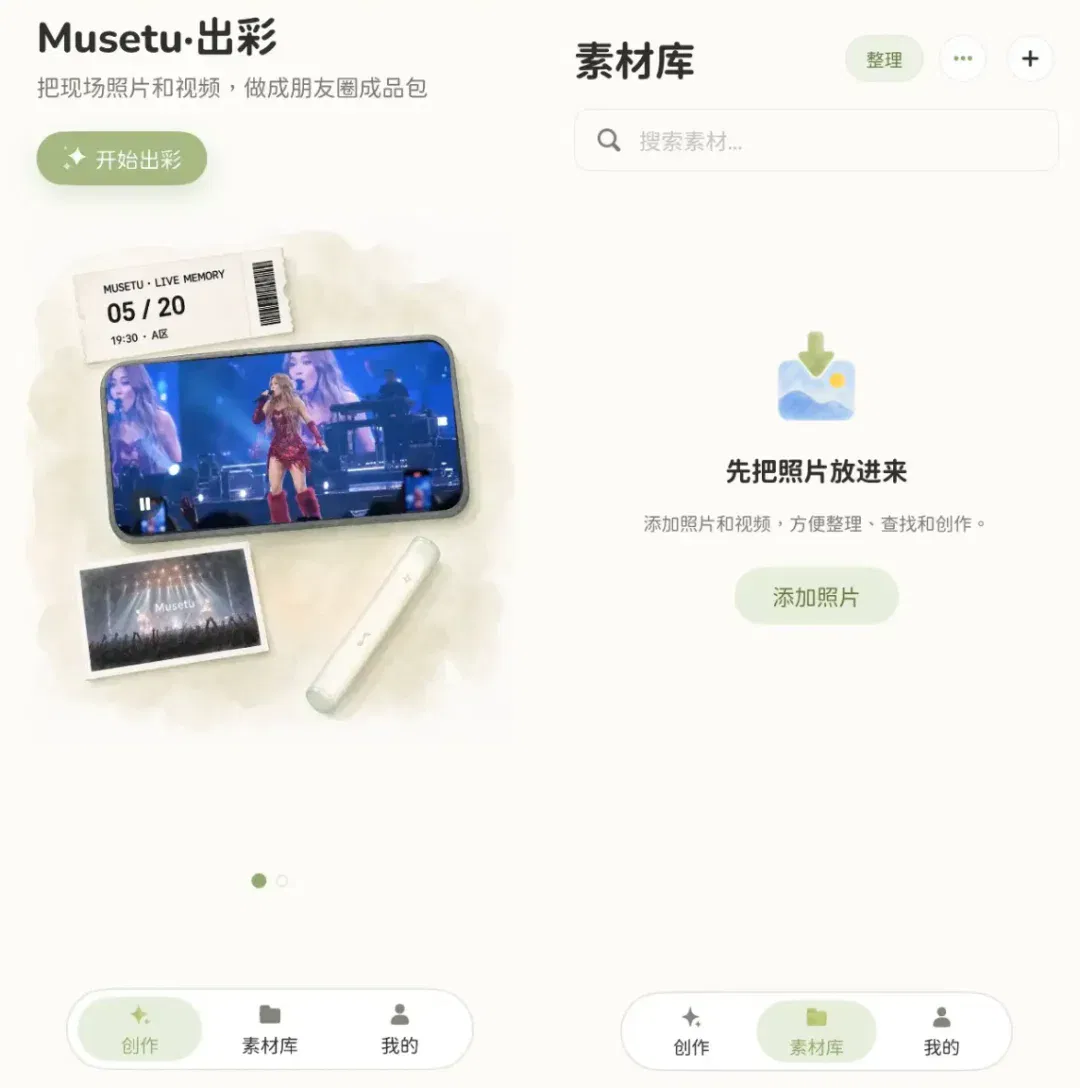
Caption: Screenshot from the Musetu app.
The workflow is lightweight. Users can import concert material directly from their device's photo library or upload it to the app's media library in advance for centralized management. After selecting photos and videos, they enter a generation panel with three categories: moving images, image creations and text for posting.
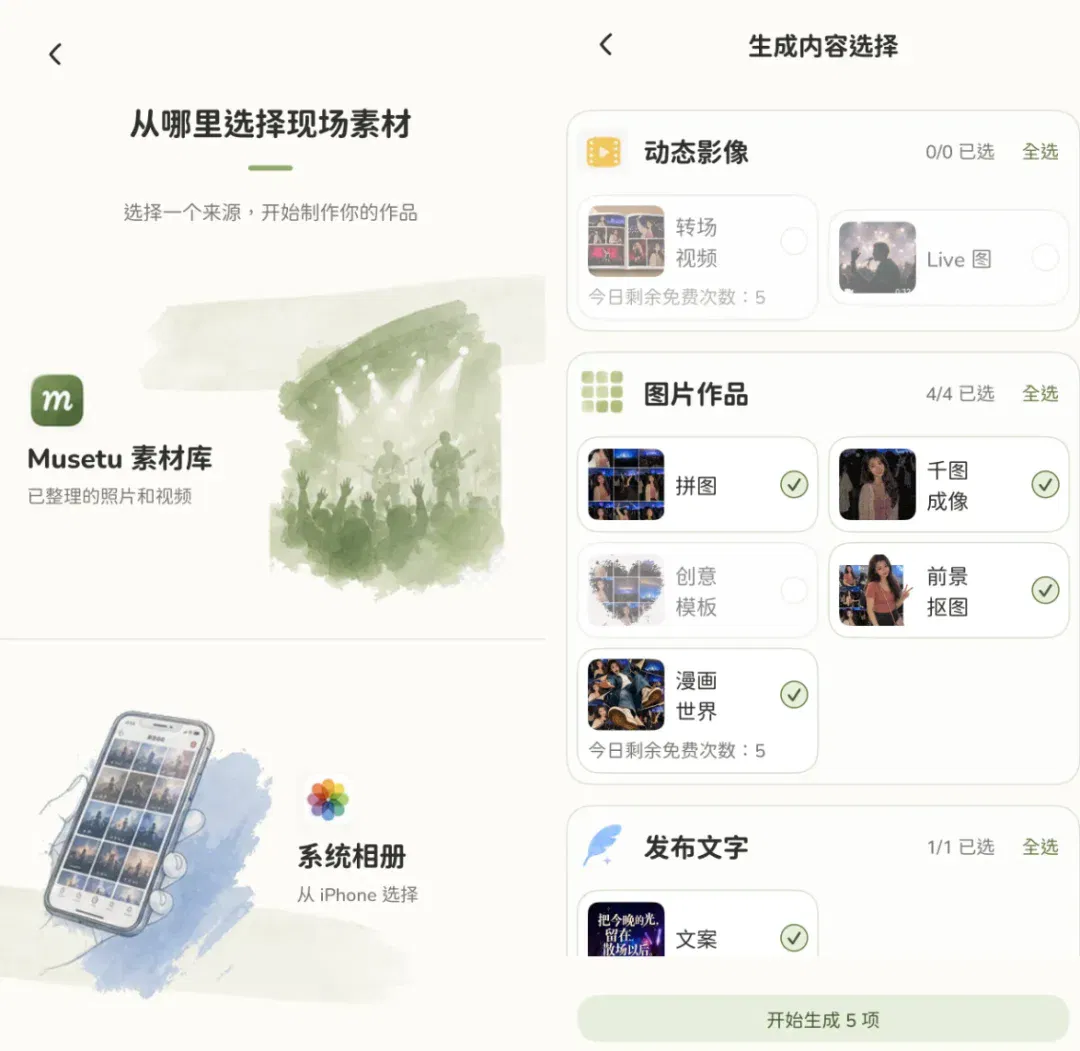
Caption: Screenshot from the Musetu app.
The moving-image section supports beat-synced transition videos and Live image generation. Image options are more varied, with templates for collages, photo mosaics, foreground cutouts and comic worlds. A companion copywriting feature automatically creates atmospheric captions suited to Xiaohongshu and WeChat Moments. Some AI generation features have daily free quotas, lowering the barrier to trying them.
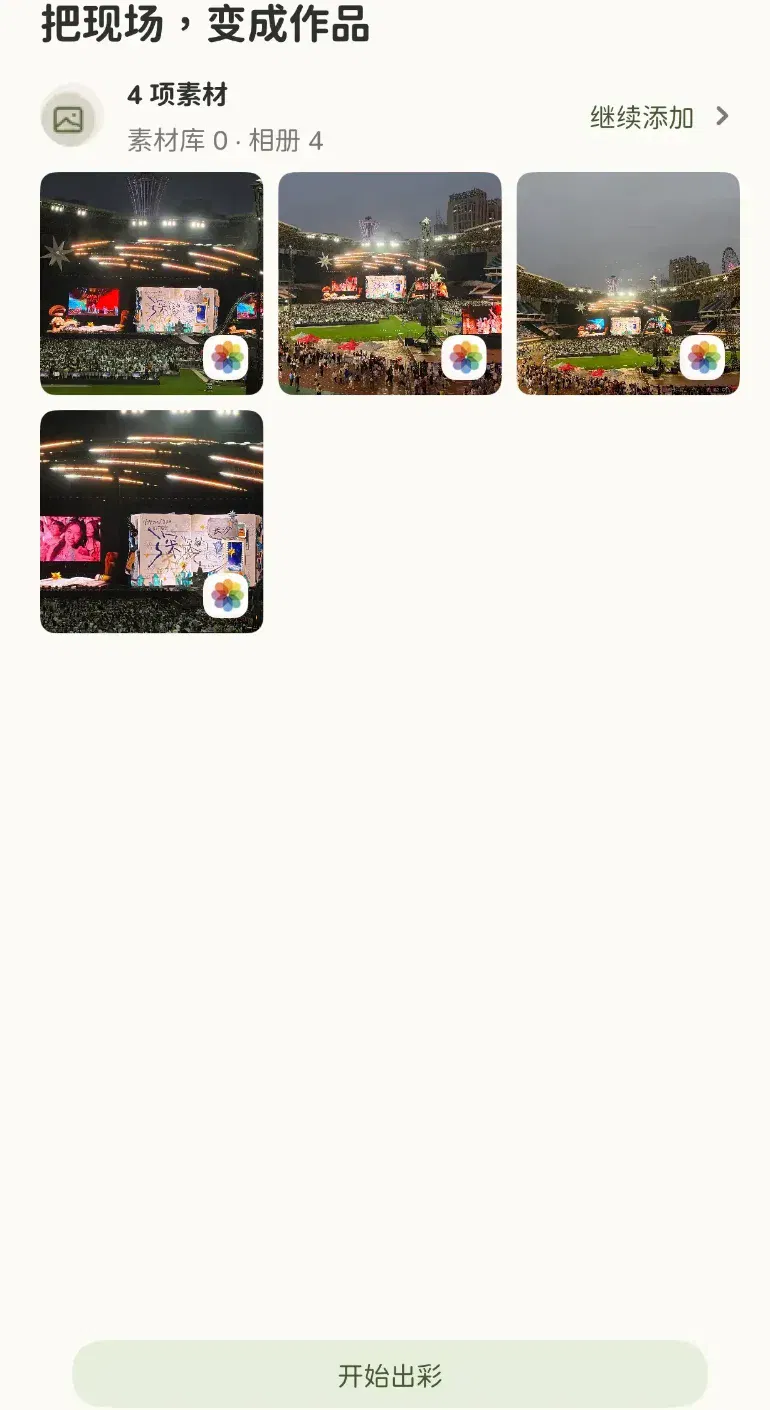
Caption: Screenshot from the Musetu app.
The product does not include the extra general-purpose AI capabilities of question answering, document work or drawing. Every feature centers on one scenario: posting to social media after a show. Getting started is easy, with no need to learn editing software. Upload material, select the desired effects and generate results in batches with one click. Creations are saved in the personal account area.

Caption: Screenshot from the Musetu app.
The product nevertheless has limits tied to its scenario. It is a typical event-triggered tool, focused on concerts, and is difficult to use frequently in everyday life.
Why Would Alibaba Build an App for Such a Niche?
Dujia argues that, as similar general-purpose AI assistants crowd onto the market, Alibaba Cloud's decision to target concert memories represents a differentiated approach to deployment.
- First, it avoids the fiercely competitive market for general-purpose large models. General AI assistants have high customer-acquisition costs and struggle with retention. Concertgoers, by contrast, form a precisely defined group with strong emotions and a strong desire to share. After a show, large numbers of photos and videos pile up in their libraries. Editing, arranging layouts and writing captions are common pain points, making it easier for a vertical tool to attract users and establish a distinctive identity.
- Second, it tests consumer scenarios through a lightweight product. Musetu draws on Alibaba Cloud's multimodal capabilities to recognize concert scenes, audio rhythms and portraits, then perform image-to-image generation, image-text understanding and stylized generation. The app effectively packages cloud-based large-model capabilities into a lightweight consumer product, refining multimodal understanding in real entertainment settings rather than leaving it in laboratories and enterprise services.
- Finally, it connects with a booming offline entertainment consumption chain. Concerts and music festivals have flourished in recent years, and users' sharing extends the experience of attending a show. Musetu targets that post-event sharing stage, an effort to engage consumer entertainment audiences directly. It also faces an inherent challenge: whether an occasional-use tool can move beyond being abandoned once its immediate purpose is served, and whether it can expand into other offline settings such as theater, exhibitions and camping, will determine how far the product can go.
This article was originally published on the WeChat public account Dujia, by Dujia.
Related topics
After reading
Join the AINRK community
Read how to join the community and connect with people working in AI.
Related articles
Continue reading related topics and articles in this category.
APPSO tests Qwen4-Max on 3D disassembly visualizations and cross-software creation (opens in a new tab)
APPSO uses Qwen4-Max for interactive iPhone and car disassembly demos, plus OpenSCAD, ngspice and Blender workflows, while discussing task costs. These are generated visualizations and author experiences, not physical hardware teardown validation.
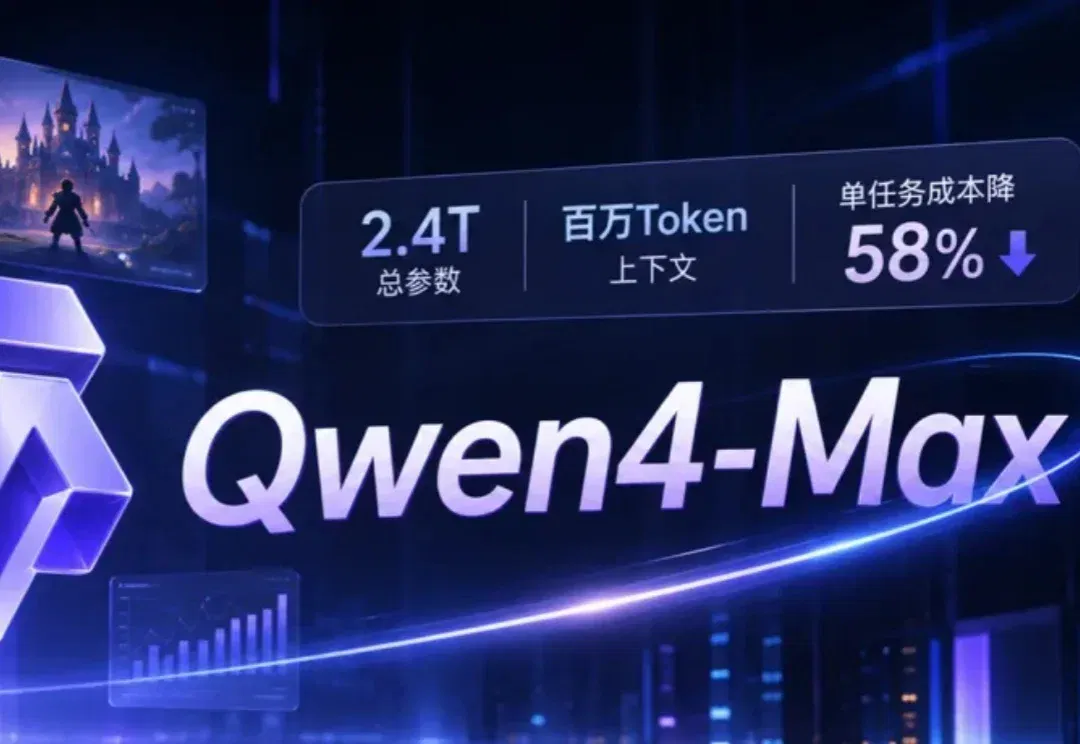
Alibaba releases Qwen4-Max, expanding multimodal and industry-agent workflows (opens in a new tab)
The report covers Qwen4-Max's architecture, million-token context and long-horizon delivery examples. Work360 and AII show different cost reductions; complex open-ended tasks remain a weakness, while smaller models are planned for later open release.

Alibaba plans Hong Kong spin-off of T-Head; standalone financials and valuation await disclosure (opens in a new tab)
Alibaba says T-Head has filed a confidential listing application and plans a spin-off through a global H-share offering. ChinaVenture reviews its chip business and commercialization; the valuations cited are market estimates.
千问 Qwen4-Max 预览版体验,动画与交互表现怎样 (opens in a new tab)
智东西用动画、交互场景和 GIF 任务体验 Qwen4-Max 预览版,记录了生成耗时、控制细节与字幕错位等问题。
Qwen Code 1.0 Preview 发布,融合 Qoder 的 Harness 能力 (opens in a new tab)
Qwen Code 1.0 预览版开放融合后的运行框架,以事件组织会话、工具与反馈。团队保留稳定分支,并计划继续完善分布式扩展和任务接续。