Alibaba releases Qwen4-Max, expanding multimodal and industry-agent workflows
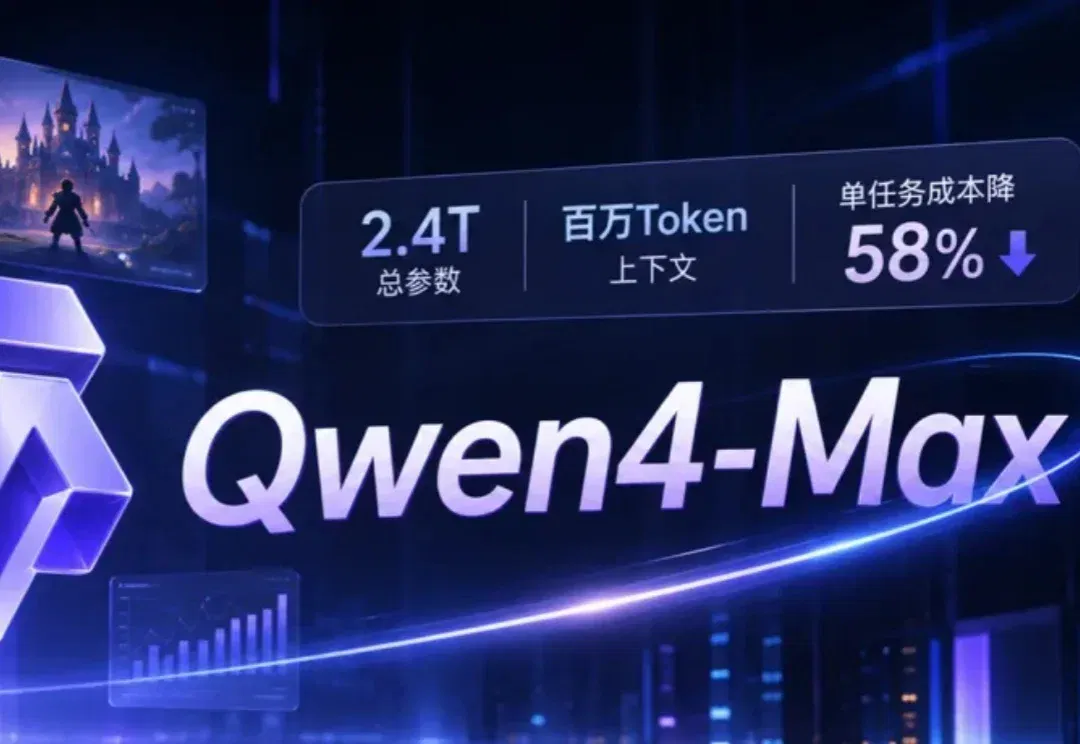
The report covers Qwen4-Max's architecture, million-token context and long-horizon delivery examples. Work360 and AII show different cost reductions; complex open-ended tasks remain a weakness, while smaller models are planned for later open release.
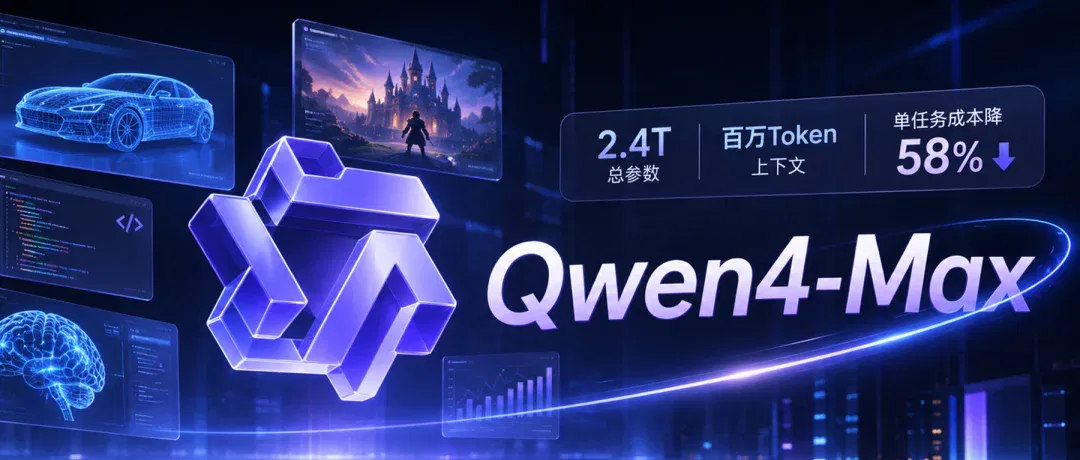
▲AI-generated image.
Multimodal-agent delivery impresses in testing, while users call for the 27B version.
Zhidx reported on November 16 that Alibaba officially released the first Qwen4 model, Qwen4-Max. Using the Qwen4 family's new architecture, it has 2.4 trillion total parameters, activates 71B per token, offers native vision and supports a million-token context window.
Qwen4-Max emphasizes professional tool use, long-horizon execution and delivery of finished results across 3D modeling, game development, industrial manufacturing, finance, law, healthcare and frontier science, focusing on understanding the whole job and continually advancing projects.
On Alibaba's agent benchmarks including DeepSWE, AA-Briefcase and HLAB-Vals, Qwen4-Max improved substantially over Qwen3.8-Max and exceeded models including Claude Opus5.5, GPT-6.1 Sol, GPT-6 Astra.
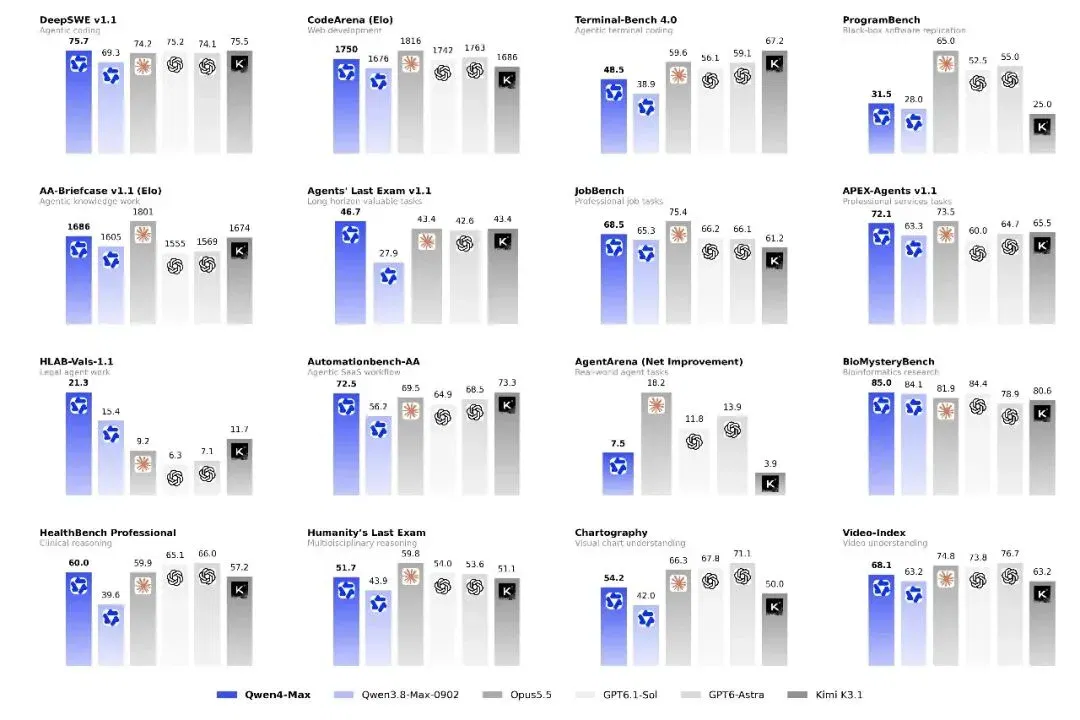
▲Qwen4-Max evaluation results. Image: Alibaba.
On Artificial Analysis's Intelligence Index, AII, Qwen4-Max at xhigh reasoning scored 43, nine points above Qwen3.8-Max at xhigh and three below Kimi K3.1 Pro at max, which scored 46. In AII testing, task cost fell approximately 11% versus Qwen3.8-Max. Qwen4-Max's per-task cost in Alibaba's Work360 evaluation fell 58%.
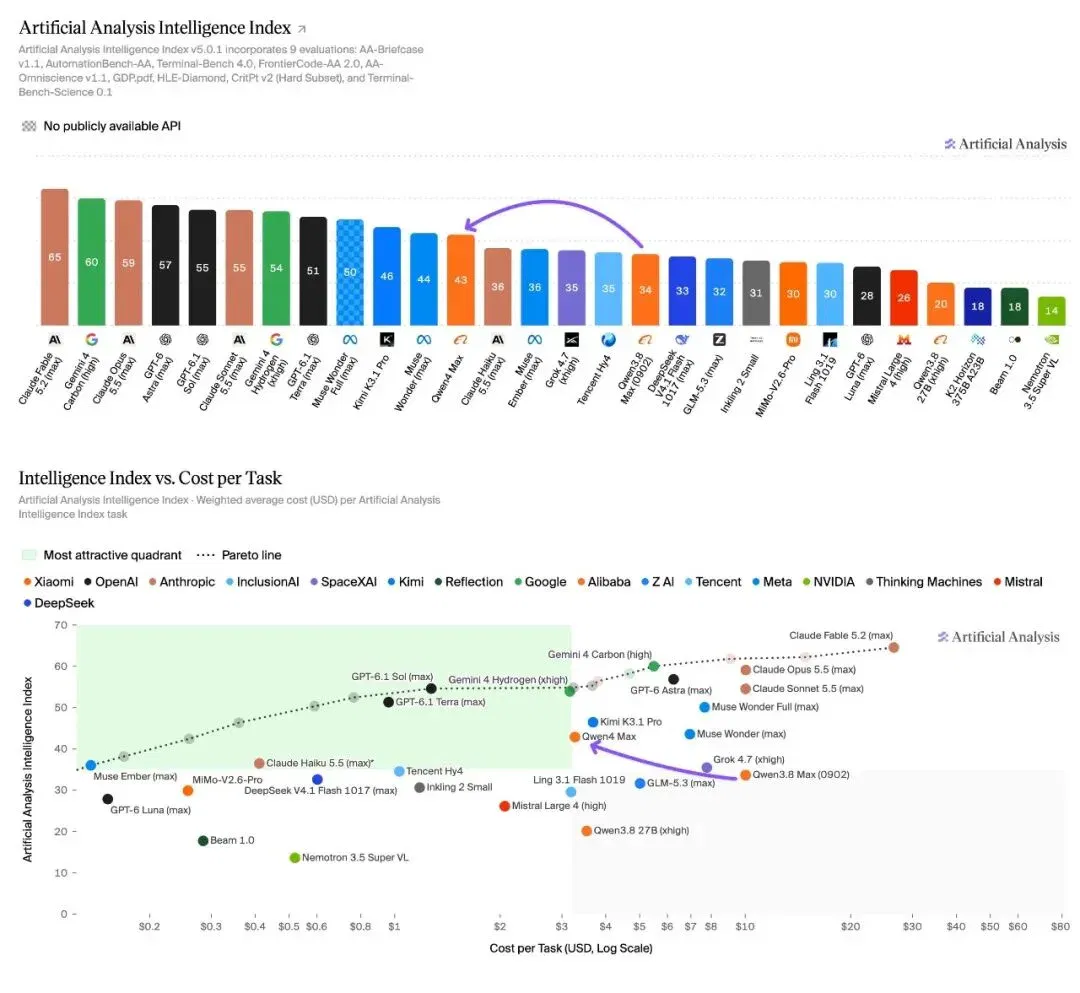
▲Qwen4-Max's Artificial Analysis Intelligence Index score.
Qwen4-Max is available through APIs on the Qianwen AI platform, with cached input costing as little as 0.5 yuan per million tokens. Users can also access it through Alibaba Token Plan or try it in Qianwen Office, Qoder, the Qianwen app and Qwen Studio. Smaller Qwen4 models will be open-sourced in succession.
On X, many developers' first response to Qwen4-Max was to ask for Qwen4-27B next.



▲Developer comments on X.
Alibaba launched the Qwen4-Max preview on November 11. Zhidx tested it immediately (opens in a new tab) and found its multimodal-agent capabilities impressive, with strong instruction understanding, search execution, multimodal generation and 3D interaction. Complex tasks, however, produced multimodal inconsistencies and violations of physical rules.
How does the official release perform? Our experience suggests further improvement over the preview in multimodal-agent deliverables. For example, a task using an image and independent searches to generate a "Li Na forgives Xu Fei" GIF produced mismatched lip movements in the preview. The official model's animation resolved that issue.

In basic programming, Qwen4-Max also correctly generated an SVG animation of a pelican riding a bicycle, without obvious physical inconsistencies.

Blog:
https://qwen.ai/blog?id=qwen4-max
API:
https://www.qianwenai.com/models/qwen4-max
Token Plan:
https://platform.qianwenai.com/pricing/token-plan
01.
Strong agent benchmark results
Per-task costs down 58%
As noted, Qwen4-Max performs strongly overall on specialized agent evaluations.
It scores well on DeepSWE, AA-Briefcase, HLAB-Vals, BioMysteryBench and HealthBench, showing strengths in coding, law, biological research, medical reasoning, chart understanding and video understanding. It improves significantly over Qwen3.8-Max, with scores above international frontier models including Claude Opus5.5, GPT-6.1 Sol and GPT-6 Astra.
It does not lead everywhere. On long-duration, realistically complex tasks such as Agents' Last Exam and AgentArena, its results remain strong but trail top models including Opus 5.5 and GPT-6 Astra. Overall, it excels at specialized professional-agent tasks but has room to improve on very long-horizon, open-ended complexity.
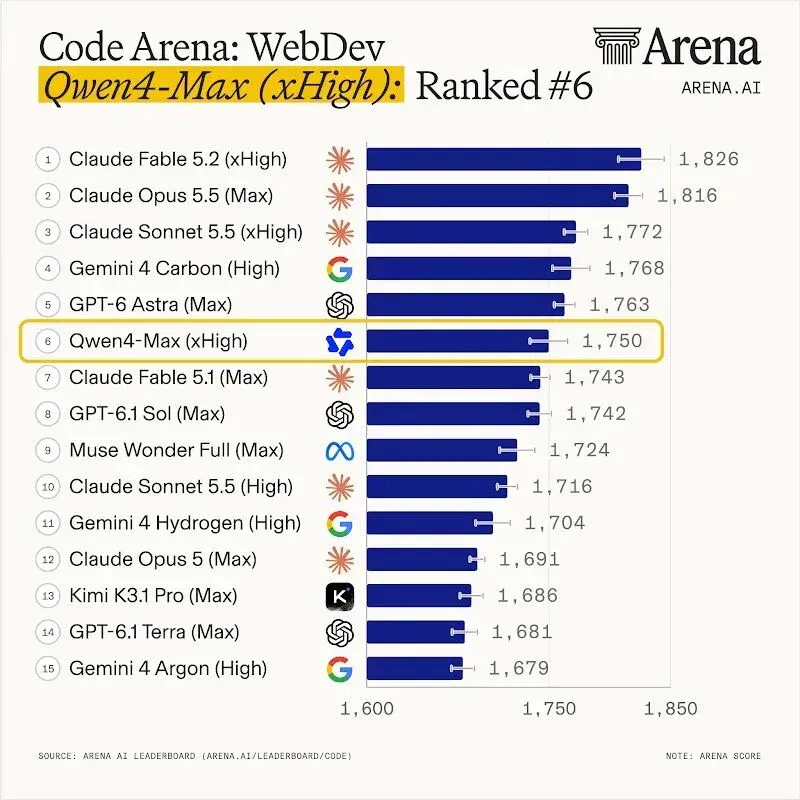
Code Arena: WebDev also indicates strong frontend programming, placing Qwen4-Max among the global leaders in blind testing.
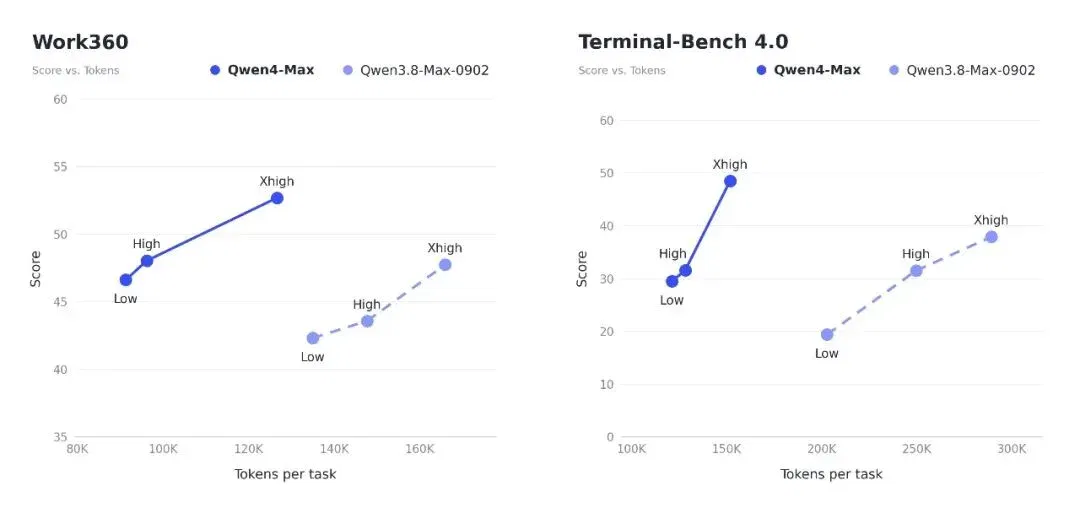
For token efficiency and cost, Alibaba says Qwen4-Max outperforms Qwen3.8-Max using fewer tokens. On Work360, usage falls approximately 24% at Xhigh and 35% at High; on Terminal-Bench 4.0, the reductions are approximately 48% and 49% respectively.
API pricing is lower across the board than Qwen3.8-Max, especially for cache hits. In Work360, average task cost fell from 26.58 to 11.16 yuan, a 58% reduction.
02.
2.4T total parameters, only 71B active
Bits per byte down as much as 13%
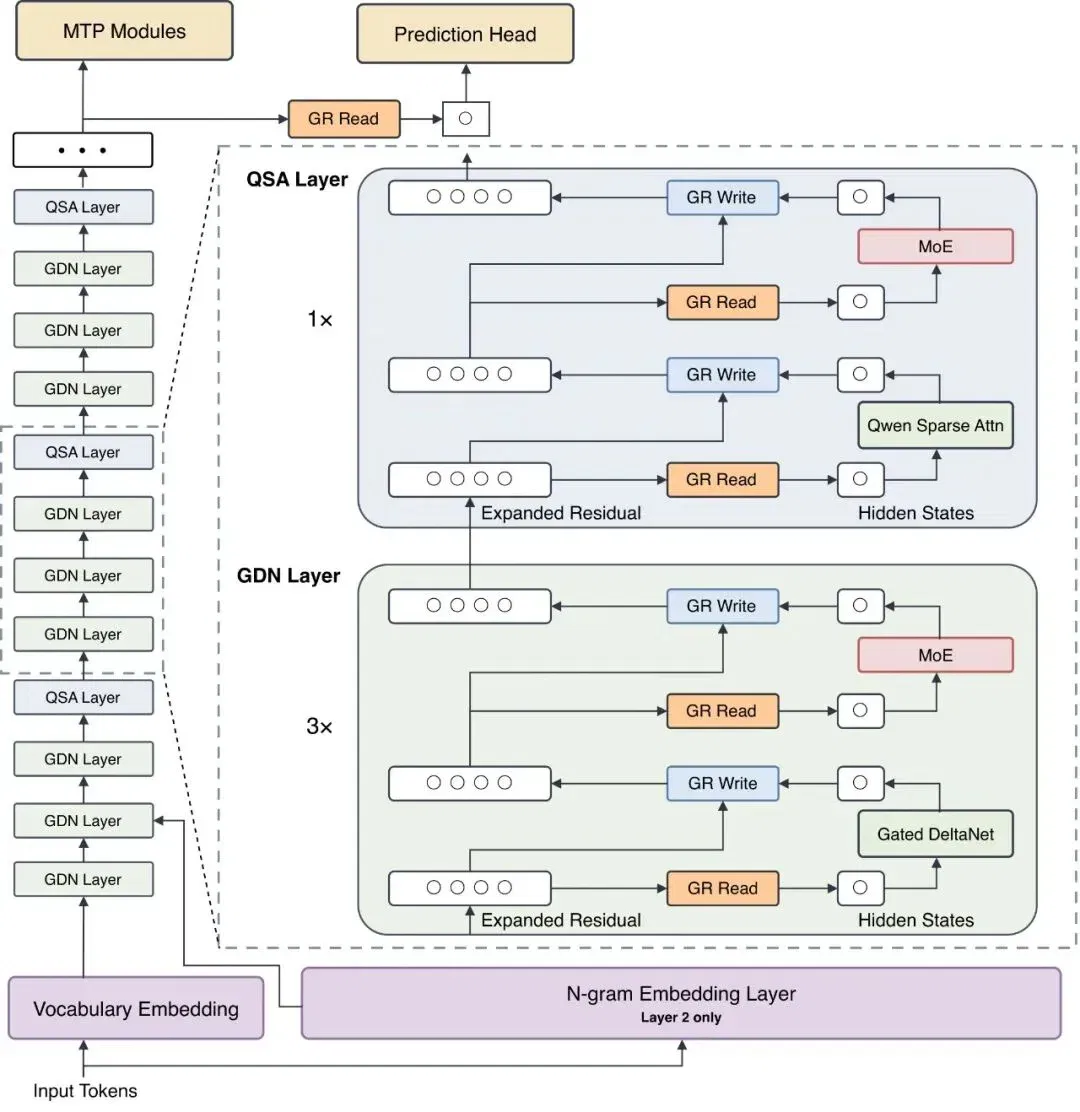
Qwen4-Max uses the Qwen4 family's new architecture, with 2.4T total parameters, 71B active per token and an additional 328B N-gram Embedding parameters. It upgrades sparse MoE models across attention, residual connections and embeddings to improve computational efficiency, capacity and training stability:
GDN + Qwen Sparse Attention, QSA: In every four layers, three Gated DeltaNet layers compress history into fixed-size states. One QSA layer uses a lightweight indexer to select relevant context at block granularity, reducing long-sequence attention and indexing costs.
Gated Residual, GR, expands the residual stream into four parallel branches, improving cross-layer information flow and training stability through dynamic read/write gating.
N-gram Embedding performs local-context table lookups, adding representations of local token patterns at the second layer to expand capacity with little additional computation.
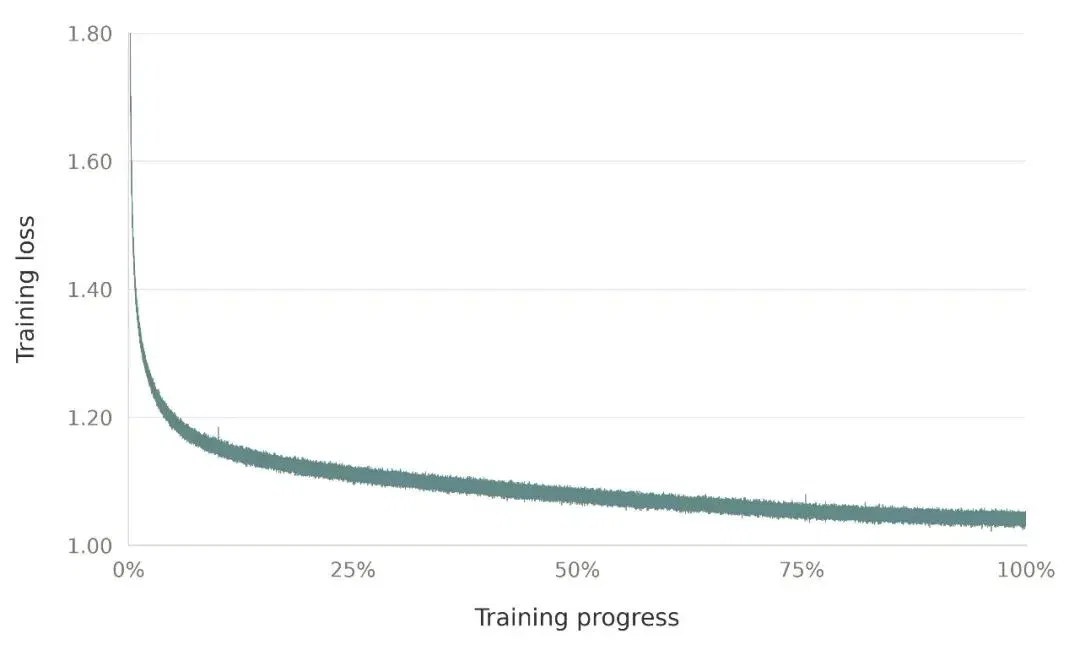
At 2.4T parameters, Qwen4-Max pretraining remained stable, with steadily declining loss and no loss spikes, mainly thanks to architecture and training-optimization improvements.
Across internal knowledge, coding, Q&A and STEM evaluations, Qwen4-Max-Base had the lowest bits per byte, BPB, among all five models. Against Qwen3.8-Max-Base at the same 2.4T total size, BPB fell approximately 5–13% across domains while active parameters per token fell around 25%.
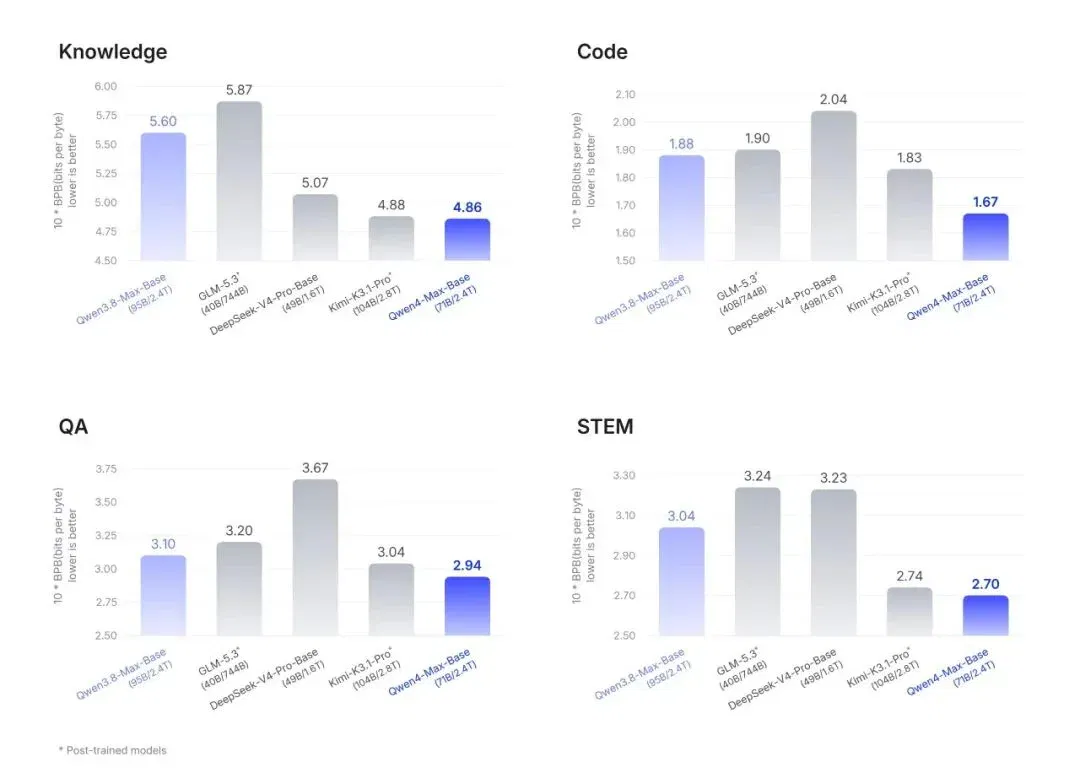
The internal metric is 10×BPB, lower being better. Parameter counts are shown as active/total. GLM-5.3 and Kimi-K3.1-Pro are post-trained models, which may affect comparisons with base models.
03.
From 3D games to automotive manufacturing
Direct delivery in professional settings
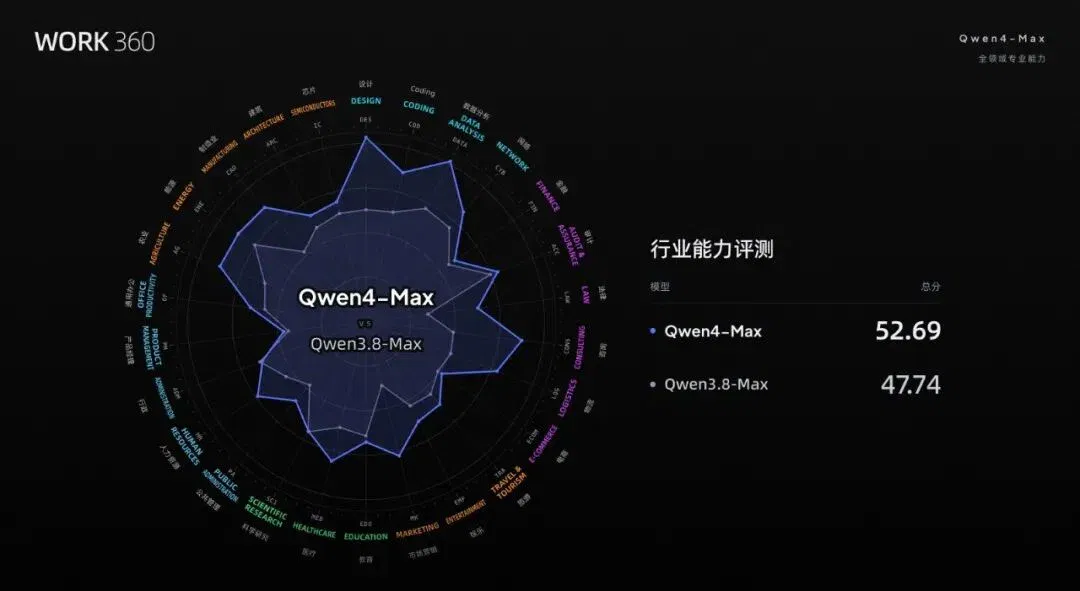
To improve industrial and professional collaboration, Qwen4-Max uses the Work360 comprehensive scenario-modeling framework to systematically decompose and classify complex industries into twenty-six first-level domains, 182 second-level subdomains and 721 third-level specializations.
On the resulting Work360 industry benchmark, Qwen4-Max scores 52.69 versus Qwen3.8-Max's 47.74, a clear improvement.
In Blender modeling and scene creation, Qwen4-Max connects geometry, scene construction, materials and lighting/rendering to turn ideas into 3D works, spanning architecture, interiors, natural landscapes and science fiction. This demonstrates combined handling of spatial layouts, object structures and visual effects.
These capabilities extend to game development and physical works through 3D printing, connecting subsequent development and production for design exploration, content creation and prototyping.
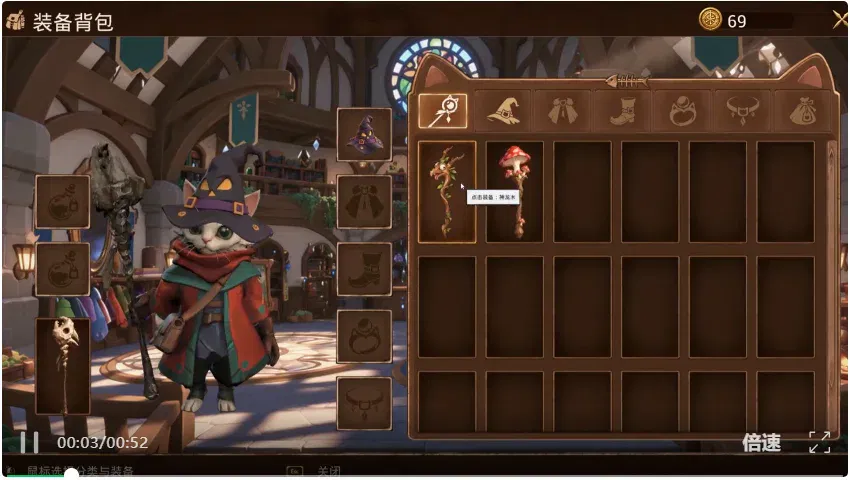
Qwen4-Max can operate mainstream engines including Unity, Unreal Engine and Godot. From natural-language requirements and external assets, it can independently build scenes, gameplay logic, asset integration, materials, HUDs and effects, delivering playable games. It runs games during development and adjusts details from visual and interaction feedback.
For example, in "Meow and Magic Follows," Qwen4-Max built an Unreal Engine adventure starring a feline mage. Players cast spells, select upgrades and challenge waves of enemies and bosses.
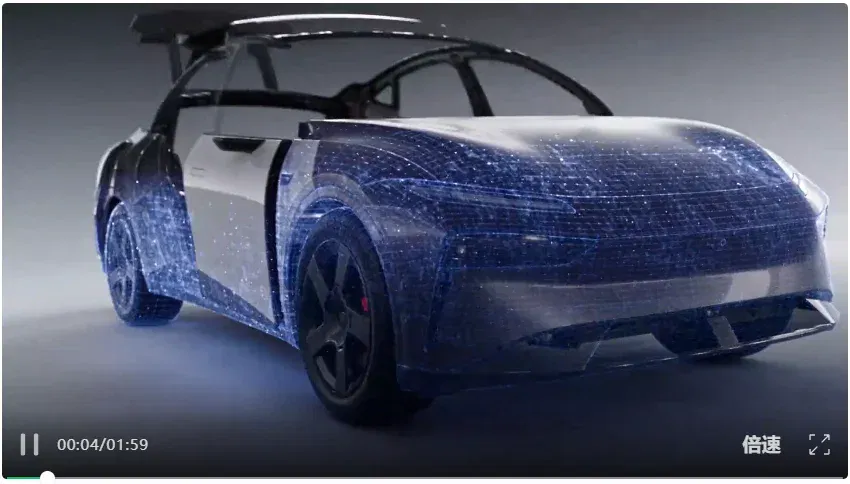
In automotive manufacturing, actual production settings at Sanfeng Intelligent Equipment and Fanhai Tonglian Precision combine Qwen4-Max drawing interpretation, parametric modeling and professional tools into engineering workflows. These support line planning, part design and machining verification, linking design generation, tool execution and feedback checks. In the case described, human effort for programming one workpiece fell from approximately 475 to 24 minutes, around 95% less.
For agentic video creation, Qwen4 and Wanjing Yike support an end-to-end workflow: storyboards and static assets, camera animation in graybox previews, rendering separate clips and editing them into a coherent multi-scene film. Qwen4's language, multimodal and agent capabilities contribute knowledge, control and stability.
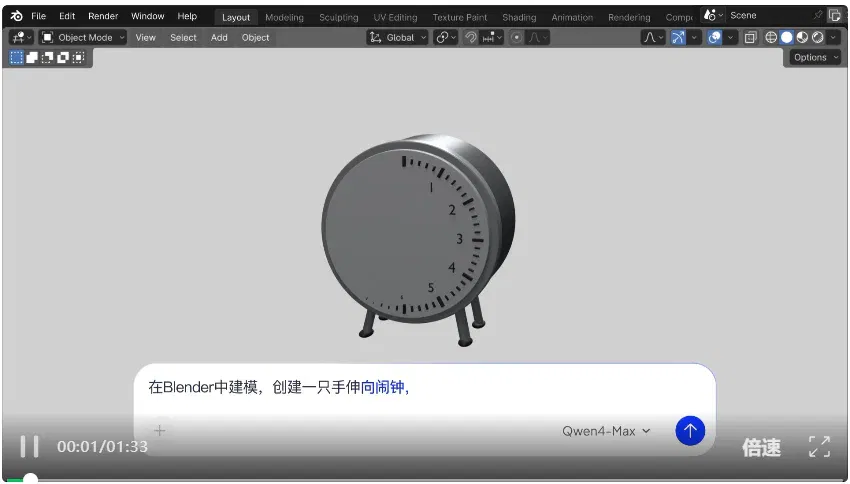
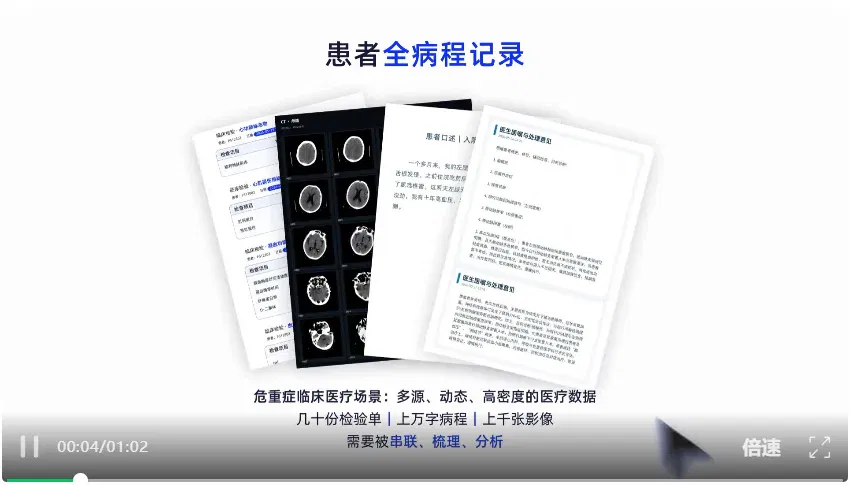
In three high-barrier fields, financial investment research, legal due diligence and clinical medicine, Qwen4 can process complex raw materials, conduct deep logical analysis and trace evidence, moving from information retrieval toward professional deliverables.
04.
Agents work around the clock, delivering and iterating
Autonomous closed-loop coolant design
The team says Qwen4-Max supports round-the-clock progress on long-running tasks, delivering usable results in stages through autonomous planning and ongoing iteration while preserving user control.
For continuous delivery, Qwen4-Max incorporates Live Delivery capabilities to address the problems of long-horizon agents lacking intermediate feedback and users finding it difficult to track progress: it first delivers a usable initial version, then continually delivers updated versions, expanding the content and improving the quality with each version. Users can assess progress and realign the direction based on the results in each version, while the agent can dynamically adjust its plan in light of feedback, making delivery progress on long-horizon tasks visible and the direction of execution controllable.
Alibaba also open-sourced Qwen-Live-Delivery-Plugin, which enables continual delivery when installed.

For cloud-resource scheduling, Qwen4-Max can model, solve and validate operations-research problems with complex objectives and constraints, delivering optimized decisions. In real Alibaba Cloud operations, it has formed a loop of autonomously iterating and optimizing scheduling plans needed by the model itself, including multi-model calls for data annotation, online GPU allocation and offline CPU rescheduling.
In those settings, annotation model-call scheduling cost fell an average 10.42% against the reference baseline, online GPU allocation increased whole-machine idle-capacity duration 4.62%, and offline CPU rescheduling reached the optimal objective more than 14.61 times faster.
For scientific discovery targeting high-power chip cooling, Qwen4 used Deep Principle's Mira dry/wet experimental environment in forty-eight continuous hours of autonomous agent operation, constructing a 2.7-million-molecule candidate space. Four design–test–learn cycles completed the design, synthesis and experimental validation of novel coolant molecules.
For the NLRP3 target in Alzheimer's disease, Qwen4-Max used DP Technology's PharmMaster for end-to-end intelligent drug-discovery design. Iterative optimization yielded twenty-four candidates, with the preferred molecule's binding affinity approximately 3.6 times the starting point, making it worth wet-lab validation.
Alibaba also says Qwen4-Max follows six AI principles, integrating governance throughout its lifecycle. It reports stronger code security and a much higher secure-code pass rate, defensive cybersecurity data and stronger attack protection, and the ability to identify risky CBRN requests without producing actionable high-risk plans while avoiding excessive refusal.
05.
Conclusion: Leading models race toward agents
Qwen4 targets industrial workflows
Competition among global leaders is moving beyond reasoning alone toward development, computer operation, professional knowledge work and long-horizon execution. OpenAI's GPT-6 Astra and GPT-6.1 Sol continue strengthening complex-task handling and computer use, while Anthropic's recent Fable 5.2 and Mythos 5.2 advance into demanding programming, finance and scientific research.
Qwen4-Max seeks differentiation by deeply combining large-model capabilities with industrial workflows. From 2.4 trillion parameters and million-token context to professional tools, autonomous iteration and scientific loops, Alibaba wants models to move from answers to deliverables. As smaller models become open-source, further lowering enterprise deployment and application barriers will be central to Qwen4's next competitive stage.
This article was originally published by Zhidx. Author: Li Shuiqing.
Related topics
After reading
Join the AINRK community
Read how to join the community and connect with people working in AI.
Related articles
Continue reading related topics and articles in this category.
APPSO tests Qwen4-Max on 3D disassembly visualizations and cross-software creation (opens in a new tab)
APPSO uses Qwen4-Max for interactive iPhone and car disassembly demos, plus OpenSCAD, ngspice and Blender workflows, while discussing task costs. These are generated visualizations and author experiences, not physical hardware teardown validation.
千问 Qwen4-Max 预览版体验,动画与交互表现怎样 (opens in a new tab)
智东西用动画、交互场景和 GIF 任务体验 Qwen4-Max 预览版,记录了生成耗时、控制细节与字幕错位等问题。
Qwen4推理内核代码现身GitHub:27B架构细节引热议,新一代模型路线浮出水面? (opens in a new tab)
Qwen4 尚未发布,但一份已合并的开源推理内核代码 Pull Request(PR),却率先“透露”了架构线索。
刚刚,Qwen3.8-Flash震撼发布,我们看到了Qwen4的骨架 (opens in a new tab)
就在刚刚,阿里交出了一份让人满意的答卷:发布了 Qwen3.8-Flash,同步开源 Qwen3.8-Flash-Next(两者为同一模型,前者是 API 版本名称,后者是开源版本的正式名称)。它的成绩相当亮眼。在智能体编程基准 DeepSWE 1.1 上,它拿到 58.7 分,而参数规模是它三倍的前代 Qwen3.7-Plus 只有 16.5 分;

Alibaba plans Hong Kong spin-off of T-Head; standalone financials and valuation await disclosure (opens in a new tab)
Alibaba says T-Head has filed a confidential listing application and plans a spin-off through a global H-share offering. ChinaVenture reviews its chip business and commercialization; the valuations cited are market estimates.