Former Qwen intern Zhang Xuanming co-founds Alps Lab to explore recursive self-improvement

Qbit reports that former Qwen post-training research intern Zhang Xuanming is co-founding Alps Lab to explore cognitive models and RSI. Its first funding round is in preparation; a valuation above US$100 million is a target, not a completed financing result.
Another young entrepreneur described as a “prodigy” has entered the red-hot field of RSI, or recursive self-improvement.
Qbit ROBO has learned that Zhang Xuanming, who worked with the “subjectivity and interactivity” research group in Qwen’s post-training team, left the team in early October this year and is preparing a startup as a co-founder.
The startup, Alps Lab, develops cognitive artificial intelligence and next-generation foundation models, with RSI among its key areas of exploration.
RSI is currently a popular direction for AI startups and investment. Its central vision is to involve AI in the research and development of the next generation of AI, creating a loop in which “AI improves AI” to accelerate progress.
In its latest development, Alps Lab is preparing its first funding round, targeting a valuation above US$100 million.

Researching model subjectivity and interactivity at Qwen
Born in 2003, Zhang Xuanming graduated with his bachelor’s degree this year. He joined Qwen in February 2026 to work on model post-training.
Within the post-training team, he worked in the “subjectivity and interactivity” research group, a small team that had seven members at its largest.
Because Zhang had not yet graduated when he joined Qwen, his formal role there remained that of an intern research scientist.
During his undergraduate studies, Zhang was selected for the Excellent Engineer Education and Training Program and rotated through research teams at Peking University and Tsinghua University.
In 2024, he transferred to the University of Wisconsin–Madison to study information science as an undergraduate, while also taking computer science courses at Stanford University.
Before joining Qwen, Zhang interned with ByteDance’s Flow team and Zhipu’s Emohaa team. He also served as a student researcher with Amazon’s AGI team and as a Research Fellow at Anthropic.
Through his research, he met Lin Junyang, then head of Qwen’s large-model effort, during NeurIPS 2025.
Put simply, Zhang’s research on “subjectivity and interactivity” at Qwen focused more on whether users subjectively found a model useful than on its performance on specific benchmark tasks.
“Subjectivity” concerns whether a model can understand a user’s needs and preferences; “interactivity” concerns how it handles incomplete requests and objectives that keep changing across multiple turns of conversation.
In Zhang’s view, large language models, like embodied models, also have a degree of sim2real gap. The benchmark settings in which large models are evaluated often differ from the situations in which users actually use them.
His main work at Qwen was to evaluate model performance in real user scenarios.
For example, ordinary users often cannot describe their intentions clearly enough when using a model, and may change their minds as a conversation unfolds. The model needs to accommodate the way they express themselves and adjust subsequent responses in real time over multiple turns.
Zhang’s startup, however, is not limited to that direction.
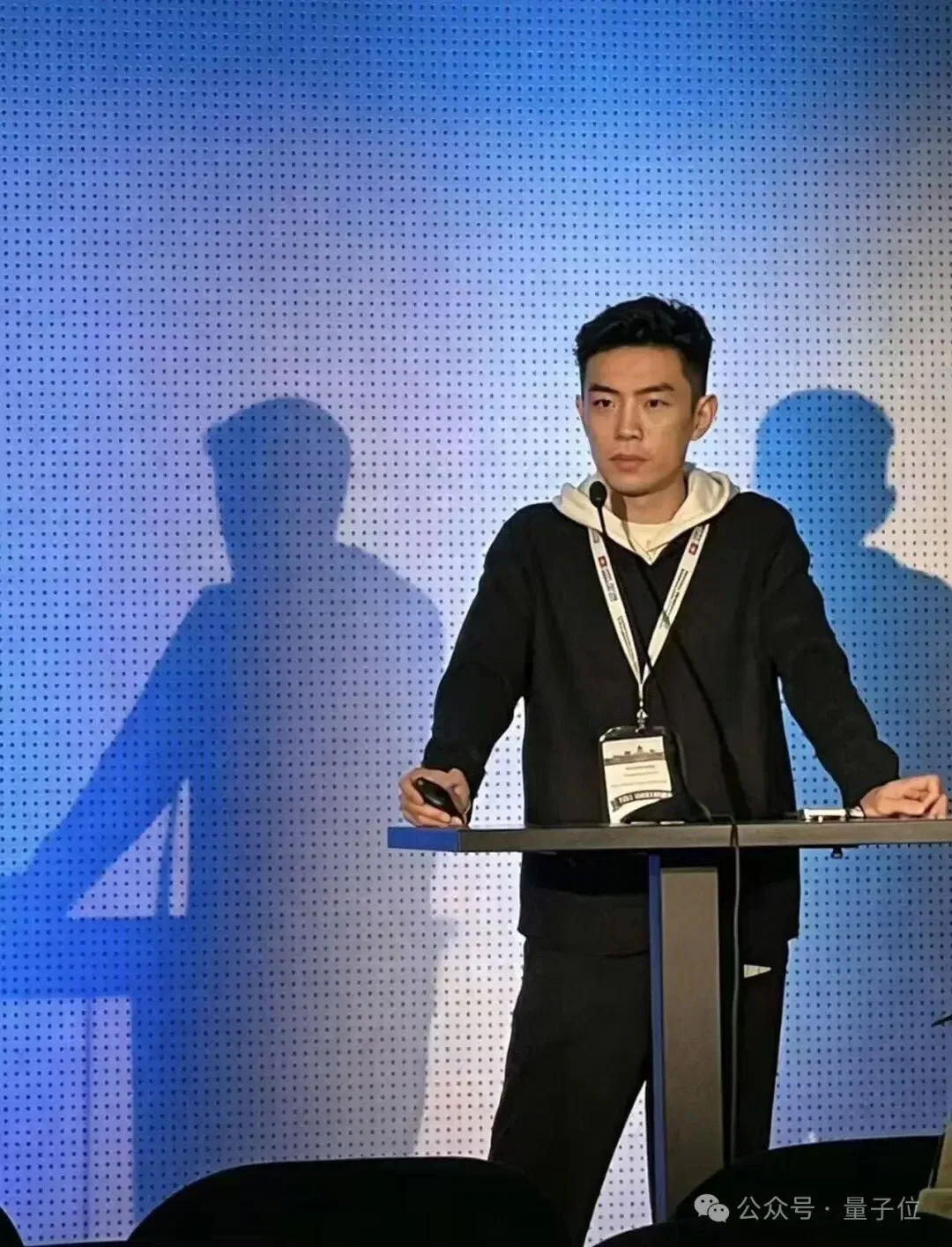
Planning a startup around “cognitive models”
The core product of Alps Lab is a “cognitive model.”
Alps Lab formally began work in late September this year, with Zhang as co-founder and chief cognitive scientist.

According to Zhang, Alps Lab aims to build foundation models from first principles whose cognition evolves through collaboration between the digital and physical worlds. The goal is to involve AI in innovation, rather than merely optimize within predefined problems and evaluation criteria.
The company calls this direction the “Cognizer”. In its vision, the same cognitive mechanism could connect reasoning, code and simulation in digital environments, as well as interact with physical equipment such as robots and laboratory instruments. It would test its judgments against actual outcomes, then apply the resulting methodology to subsequent tasks.
Specifically, this relies on two technologies: next cognitive pattern prediction and test-time recursive learning.
“Cognizer” is a concept coined by the team, which has identified RSI as its path of evolution.
This is also the direction in AI innovation that has attracted the greatest attention and enthusiasm since the beginning of 2026.
Having AI improve AI is becoming a new focus
RSI is undoubtedly one of the hottest and most alluring keywords in today’s AI industry.
Foreign and Chinese companies, large technology groups and startups, language-model developers and physical AI companies alike almost invariably bring up RSI. It is reminiscent of the enthusiasm for world models in the first half of the year.
This wave of interest reflects a shift: developing the next generation of AI faster and at lower cost is becoming a new focus of competition.
That is because improvements in model capabilities depend not only on computing power and data, but also on researchers formulating questions, designing experiments and judging results.
As AI gradually becomes capable of programming, debugging and analyzing experiments, the research and development process itself is beginning to become a target of automation.
If an improved AI is better at carrying out the next round of research and development, technological progress could form a self-reinforcing cycle.
That gives companies of different kinds a reason to place their bets.
But RSI research is only just beginning. Between improving efficiency on individual tasks and achieving sustained, effective recursive self-improvement, many questions still need to be tested.
Why has Alps Lab chosen this moment to start a company?
In Zhang’s view, today’s AI giants derive their core advantage from being AI native, while the next generation of companies will be RSI native. Architecture is the central task in RSI, he argues, and it tests the capacity for innovation, leaving opportunities for startups.
Alps Lab is currently raising its first funding round, already targeting a valuation above US$100 million.
This article comes from Qbit, written by Lin Fangzhou.
Related topics
After reading
Join the AINRK community
Read how to join the community and connect with people working in AI.
Related articles
Continue reading related topics and articles in this category.

Selling as AI Products Converge: Rox, Decagon, and Granola Leaders Discuss GTM (opens in a new tab)
On The Crew Podcast, sales leaders from Rox, Decagon, and Granola discuss hiring, enterprise accounts, and commissions. They favor one AE owning large accounts from the first sale through expansion, while recognizing different needs for smaller customers.

Mo Gawdat on AI-Native Products, Vibe Coding and Rethinking User Workflows (opens in a new tab)
Former Google X chief business officer Mo Gawdat argues for redesigning software around users' goals and working with technical partners. His account of two people building Emma in nine months, and views on small teams and AI-linked layoffs, remain personal claims.

Founder Show Singapore presents eight AI startups and their commercialization plans (opens in a new tab)
Founder Park covers eight teams in education, virtual pets, agent collaboration, game creation, video, authorization, forecasting and growth. Product capabilities, business metrics and plans largely reflect the participating teams’ presentations.

Young people in the AI hackathon boom: startup chances, education choices and selection pressure (opens in a new tab)
Intelligent Emergence interviews participants, organizers and investors about funding opportunities and dropout narratives, alongside project homogeneity, contract constraints and elusive hopes of upward mobility.

Meitu's Xinhong Wu on AI apps: deepen vertical use cases and control model and monetization costs (opens in a new tab)
AI Product Aying distills a podcast's lessons on product choices, small-team validation, subscriptions plus service fees and global markets, alongside reflections on the author's own startup.