Mo Gawdat on AI-Native Products, Vibe Coding and Rethinking User Workflows
Former Google X chief business officer Mo Gawdat argues for redesigning software around users' goals and working with technical partners. His account of two people building Emma in nine months, and views on small teams and AI-linked layoffs, remain personal claims.
Editor's fact-check (November 22, 2026): This article is an edited interview account with analysis from a developer's perspective. The original claim that 'someone with no technical knowledge can independently build a good product on the strength of an idea alone' conflicts with the adjacent quotation about technical collaboration and the later conclusion. It cannot establish that an idea by itself replaces technical partners, operations, maintenance and user validation. The two-person, nine-month timeline and nine rewrites are the interviewee's account of his project. The estimate of 400 engineers and four years in 2022 is counterfactual, not a controlled experiment or a productivity multiplier. Views about layoffs as an excuse and future employment are personal judgments. For his background and project, see Mo Gawdat's official website (opens in a new tab); the interview cited by the original article (opens in a new tab). A complete transcript was not obtained for this review, so this edited account must not be treated as an independently verified verbatim record.
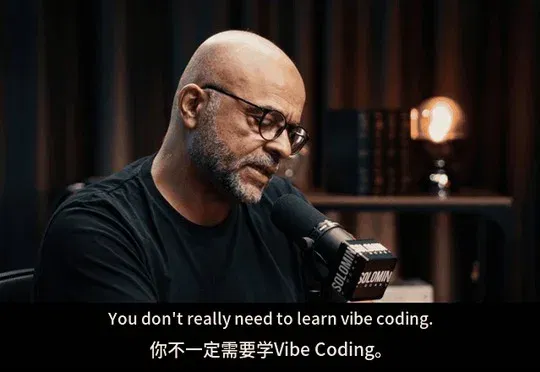
Mo Gawdat: You do not necessarily need to learn vibe coding. What you should learn instead is to imagine a world designed for AI from the outset and find what you can do within it.
Mo Gawdat: If you want to redesign a service, you can always find technical people to work with and help you reimagine it.
Mo Gawdat: In an economic downturn, some CEOs may use AI as a reason for layoffs rather than say their company is in trouble.
The host asked Mo Gawdat whether he should hurry to learn vibe coding to keep up with change in the AI era.
Rather than discuss which tool to use, Gawdat posed a question: If you started building software today, why would you copy the form of old software?
Mo Gawdat was chief business officer at Google X and is now building products himself. In this interview, he discussed two simultaneous changes: AI makes it easier for small teams to realize ideas, while also giving businesses a reason to reassess jobs. He also offered views on layoffs and future employment. His own experience building Emma provides a more concrete starting point for observation.
The following is an edited account based on the original interview.
Before Learning Tools, Consider How Else Software Could Work
The host said he planned to put vibe coding on his learning schedule. Gawdat's answer was not a programmer's study checklist.
Mo Gawdat: You do not necessarily need to learn vibe coding. You need to start imagining an AI-native world and find your place in it.
Mo Gawdat answers the host's question about vibe coding.
AI-native does not mean adding a chat box in the corner of an existing page. Gawdat's question is: If users can tell AI their goals directly, how many of the steps software previously required them to perform by hand must remain?
He used document writing as an example. Previously, people opened software, typed, adjusted formatting and produced a file. In his proposed approach, you first discuss with AI what the piece should say, your point of view and the format you want, then let AI complete the document.
Mo Gawdat: Having to type it yourself to create a document is not an AI-native approach. You can work with AI like a junior colleague, first discussing content and format and then asking it to write.
The real question is whether document software still needs users to handle layout, menus and the sequence of operations. AI might change not just production speed, but the way people use software.
Old Products May Struggle Most to Defend Old Workflows
Discussing existing software, Gawdat offered a judgment: AI will create opportunities to redesign many old products. He even said he could give Claude Code a prompt after leaving the studio and have a suite of 'Microsoft Office' by the time he reached his destination.
Gawdat immediately turned to another point: Why must creating a document still begin by operating software in the old way?
Mo Gawdat: In an AI-native world, you discuss with AI what you want to write, your position and how you want it presented, then let it finish the document.
Mo Gawdat discusses old document-software operations and his AI-native vision.
This leaves developers with a specific product question: Do users need a set of buttons identical to old software, or an easier way to finish their work? Copying an interface and redesigning a workflow are different things.
Non-Coders Can Initiate Products; Technical Partners Have Not Disappeared
On startup opportunities, Gawdat encouraged people without technical backgrounds to find problems in fields they know. Take redesigning travel services: Do users today still need to choose flights, hotels and itineraries page by page in the sequence a website dictates?
Someone without technical knowledge can independently build a good product on the strength of an idea alone.
Mo Gawdat: How would I redesign travel services today? You can always find technical people to collaborate with and help you reimagine the idea.
Mo Gawdat discusses nontechnical product initiators collaborating with technical partners.
Take Emma, which he is building. According to Gawdat, developing it with the methods available in 2022 might have required 400 engineers and four years. Today, a two-person team built the product in nine months. This is his retrospective estimate and project account, not independent verification that AI lets two people do the work of 400.
Mo Gawdat says two people built Emma in nine months.
Mo Gawdat: We rewrote Emma's code nine times. Not nine revisions: We deleted it and started over, nine times.
Mo Gawdat recalls Emma's development.
He also said that when building Emma, the team first asked where dating apps failed to help users, rather than how to recreate swiping left and right. That was his product-design choice. How well Emma actually works still requires user and product data; a founder's introduction alone cannot establish the answer.
Mo Gawdat: If you built a dating app again today, what should it look like? What are the real problems with existing products? Do they truly serve users?
Small teams can experiment faster and may also discover earlier thinking was wrong more quickly. A technical partner's job is not simply translating ideas into code, but deciding with the person proposing the idea whether it can run over the long term, whether users will really use it and what another change of direction would cost.
When a Company Says AI Can Cut Staff, Examine What It Actually Cut
Small teams have more room to experiment, but existing jobs do not necessarily become more secure. Gawdat predicted in the interview that hiring could tighten and some knowledge work would gradually be automated. But he also expressed reservations about claims that everyone will become unemployed.
Mo Gawdat: I disagree with the assumption that AI will replace every job. The economy itself could hardly withstand a situation in which nobody works anymore.
He raised a sharper question: During a downturn, some CEOs may explain layoffs driven by business pressures as AI improving efficiency.
Mo Gawdat: If business is not going well, a CEO will not want to say, 'We are cutting jobs because the company is struggling.' They may say, 'AI can now replace these people.' AI can become an excuse rather than a genuine productivity improvement.
Mo Gawdat discusses how companies may explain layoffs.
When a company reduces its engineering staff, has AI actually replaced the work, or has business slowed and the budget shrunk? Its output, hiring, revenue and staffing changes must be examined separately. Mixing the two situations prevents developers from judging which risk they really face.
Programmers Do More Than Implement Features
Two statements in this interview should be read together: Gawdat thinks more people can initiate products, while also saying those people will still need technical partners.
Mo Gawdat: There will always be technical people who can work with you and help you reimagine these services.
He also advised people not to treat AI merely as a tool for getting their work out of the way.
Mo Gawdat: Learn to use AI to become smarter, rather than simply using it to finish work in the easiest way possible.
For developers, the opportunity is not proving that they type faster than AI. When others can also generate prototypes quickly, the ability to help define problems, identify flaws in proposed solutions and make products reliable is more likely to make you the technical partner someone wants to work with. This is an analysis from a developer's perspective based on his views, not a job checklist he proposed in the interview.
Closing Thoughts
The host wanted to learn vibe coding. Gawdat did not urge him to leave technology, but first to ask whether existing software still works in the way users actually need. His own team restarted repeatedly over that question while building Emma.
AI allows more people to initiate products and may also make companies recalculate labor costs. Both can happen at once. For programmers, the most important change to understand is not whether they will still write code, but who can turn a worthwhile idea into a product users want to stay with as producing a first version becomes easier.
Reference link:
https://www.youtube.com/watch?v=mDeGvJnpP8s
This article was originally published on the WeChat public account '51CTO Tech Stack,' by 51CTO Tech Stack.
Related topics
After reading
Join the AINRK community
Read how to join the community and connect with people working in AI.
Related articles
Continue reading related topics and articles in this category.

Selling as AI Products Converge: Rox, Decagon, and Granola Leaders Discuss GTM (opens in a new tab)
On The Crew Podcast, sales leaders from Rox, Decagon, and Granola discuss hiring, enterprise accounts, and commissions. They favor one AE owning large accounts from the first sale through expansion, while recognizing different needs for smaller customers.

Founder Show Singapore presents eight AI startups and their commercialization plans (opens in a new tab)
Founder Park covers eight teams in education, virtual pets, agent collaboration, game creation, video, authorization, forecasting and growth. Product capabilities, business metrics and plans largely reflect the participating teams’ presentations.

Young people in the AI hackathon boom: startup chances, education choices and selection pressure (opens in a new tab)
Intelligent Emergence interviews participants, organizers and investors about funding opportunities and dropout narratives, alongside project homogeneity, contract constraints and elusive hopes of upward mobility.
Meitu's Xinhong Wu on AI apps: deepen vertical use cases and control model and monetization costs (opens in a new tab)
AI Product Aying distills a podcast's lessons on product choices, small-team validation, subscriptions plus service fees and global markets, alongside reflections on the author's own startup.
Emergent 榜单汇总创业者提名的 29 家早期公司 (opens in a new tab)
Newcomer 与 Felicis 的名单覆盖研发、智能体基础设施、企业自动化和生物科研等方向。文章整理公司产品和提名理由,并注明参与方视角。