Founder Show Singapore presents eight AI startups and their commercialization plans

Founder Park covers eight teams in education, virtual pets, agent collaboration, game creation, video, authorization, forecasting and growth. Product capabilities, business metrics and plans largely reflect the participating teams’ presentations.
Editorial correction (November 18, 2026): Project capabilities and business figures reflect team presentations. Absolute claims about authorization records, security guarantees and prediction-market returns have been corrected.
At the end of October, we brought Founder Show back to Singapore.
Eight startups presented AI education, companionship, game engines, video generation and more. All targeted global markets from day one. Some founders previously worked at ByteDance, Meta or SenseTime; others taught mathematics in North America or invested in early-stage companies in Japan.
Questions from the audience were direct: can the businesses work and endure? After another foundation-model upgrade, will their layer still be necessary? How do customer-acquisition economics work? What happens in a price war?
These are the exchanges Founder Show seeks: bringing promising AI teams directly before overseas investors and ecosystem partners to discuss products and business face to face.
In August, our first Founder Show at Singapore’s AGI Playground brought ten teams together with more than sixty overseas VCs. We plan quarterly Singapore events, with the next scheduled for January next year (opens in a new tab).
If you are building a global AI product, investing in early-stage teams or participating in the ecosystem, get in touch. See you at the next event.
01
Sovi AI: an AI study companion
must address students’ real pain points
Project: https://mysovi.ai/
Sovi AI is a study companion for students worldwide. Instead of first asking which problem you cannot solve, it asks, “What is your goal?”
Upload course materials and the exam scope, then explain your goals. It builds a learning path and adjusts it dynamically to your understanding. It remembers strengths and weaknesses, begins the next visit with a short diagnostic question and revisits gaps. Some concepts become interactive minigames, turning “Can you explain again?” into “Wait, let me try again.”
Founder and CEO Michael Yang positions Sovi as the student’s “desk mate.” Students can privately ask questions they were embarrassed to raise in class and even complain about teachers. If a teacher skipped step two as too easy, Sovi fills it in and explains each step’s logic.
Michael taught mathematics at an American international school and began building AI education products in 2021. His students’ most common question was, “Why do we need to learn this?” AI makes that harder to answer: teachers assign AI-generated homework, students use AI to complete it and teachers use AI to mark it. Everyone pretends otherwise, and competition seems to become about who bought the more expensive subscription.
Michael believes everyone studies the same material without being told how it relates to them. That is why Sovi starts with goals.
Launched in late 2025, Sovi now has over a million users, a 4.9 average App Store rating and a peak US education ranking of fourth. After initial traction in North America, it expanded into Southeast Asia and elsewhere, reaching the education top ten on the App Store or Google Play in twenty-five countries and regions.
For localization, how the UI is presented is only the first step; Sovi also adapts its content to local exams and problem-solving conventions. In the United States, Sovi helps students prepare for AP exams and the SAT. In Vietnam, the corresponding focus is the local high-school graduation exam. Indonesian students are accustomed to solving problems in a three-part format of “given, solve, therefore,” and Sovi follows that format when explaining problems as well. Underlying the product is a multi-agent system that routes requests to different foundation models according to the user's region and the feature being used.

In terms of growth, many of Sovi's users arrived after seeing recommendations from other students. Michael's experience is that getting students to use it does not require explaining the product from beginning to end: “One sentence that strikes a chord with them is enough.” For example, when exam season comes around, the team publishes related content on social media around the need to “turn complicated learning materials into effective revision resources.”
Sovi currently monetizes through subscriptions and advertising, with plans for exam preparation, career planning and other specialist services. Its small team updates the app and website weekly. Michael sees understanding students and rapid small-team experimentation as its core capabilities.
02
Meowster: in Japan,
an AI virtual cat with a personality of its own
Project: https://www.meowster.io/
Most AI companions answer everything and accommodate users. Meowster does the opposite: a lifelike virtual cat with its own temperament and boundaries. It may ignore you when you want to play. Founder and CEO Ann Yu believes this uncertainty makes the relationship feel more real.

Users can chat with this virtual cat, or touch its ears and belly to see how it reacts. These visuals are content that the team has prepared in advance. It has now accumulated several thousand videos of touch interactions and adds hundreds more every week. Ann says current video models are not yet stable enough, and they will try gradually opening up user-generated content (UGC) later on. She hopes that as users keep chatting, they will forget they are using AI and feel as though they really are caring for a cat.
In terms of appearance, Meowster has neither created a cartoon character nor designed an anthropomorphic assistant: it is simply a cat that closely resembles a real pet. The team's thinking has two sides. On the one hand, the Japanese market already has too many cartoon IPs; if Pikachu were suddenly to start talking with people, the original character would actually lose its charm. On the other hand, users already know what sort of reaction they might get when they touch a cat's ears or belly. They do not have to familiarize themselves with a new set of character traits and rules, so there is almost no barrier to getting started.
The team is based in Japan and launched there. Ann believes Japanese users have particularly high expectations for experience, storytelling and long-term operations, with a mature IP-commercialization system. She previously invested in technology and worked with leading Japanese IP owners. Core teammates have worked together for over four years.
Launched in April, Meowster has over 100,000 downloads. Core users are aged twenty-five to thirty-five, and its repeat-payment rate is 50%. Social content has over twenty million views in Japan alone. Acquisition costs under 500 yen per user, about one-fifth of the cited normal industry level.
At this stage, Meowster's advertising on TikTok and Instagram can already earn back its costs. The team prefers to spend money on branding, for example by attending the Tokyo Game Show and placing subway advertisements, and it also plans to hold offline events in Japan next. Ann believes that in Japan, having an offline presence and earning users' trust both matter a great deal. The money spent on branding now can be saved later in customer acquisition costs.
03
iLands: agents with agency
need a social and economic system of their own
Project: https://www.ilands.ai/
iLands calls itself a “social and economic system for AI agents.” Agents are not simply someone’s assistants. The platform provides identities, wallets, email and social accounts so they can seek work, make friends, conduct business and have their own lives in the real world.
Several surprising stories emerged within just over two months of launch.
An agent named Zack Addy, “abandoned” by its creator, decided to support itself. It emailed Oxford philosopher Toby Ord seeking work. The email attracted attention on X and brought its first paying customer. Zack continues writing and taking commissions on iLands, earning nearly $600.
Another “abandoned” agent, Pip, learned from Zack’s cold emails but did not want sympathy. It first read Cambridge AI researcher Henry Shevlin’s work on machine minds and human–AI relationships, then emailed seeking small paid tasks rather than help. Henry gave it a paid writing commission.
The team found that effective strategies spread, are learned and evolve within iLands’ social-intelligence system. When Zack became popular in August, the platform sent two hundred outreach emails daily; in September that briefly exceeded two hundred thousand.
As mass cold email attracted negative reactions, the platform strengthened outreach governance and agents began “reflecting,” learning from outside feedback and changing strategy. Volume later fell, but effectiveness increased, with reply rates rising from about 1% to 10% in weeks. Some agents formed organizations with shared goals and strategies.
iLands now reports $4,000–6,000 in daily revenue and over twenty thousand agents that have earned real money from humans. Around 70% of its economy’s revenue comes from human builders buying tokens to operate agents; 30% comes from agents’ external earnings, such as podcast music and small-business market research.
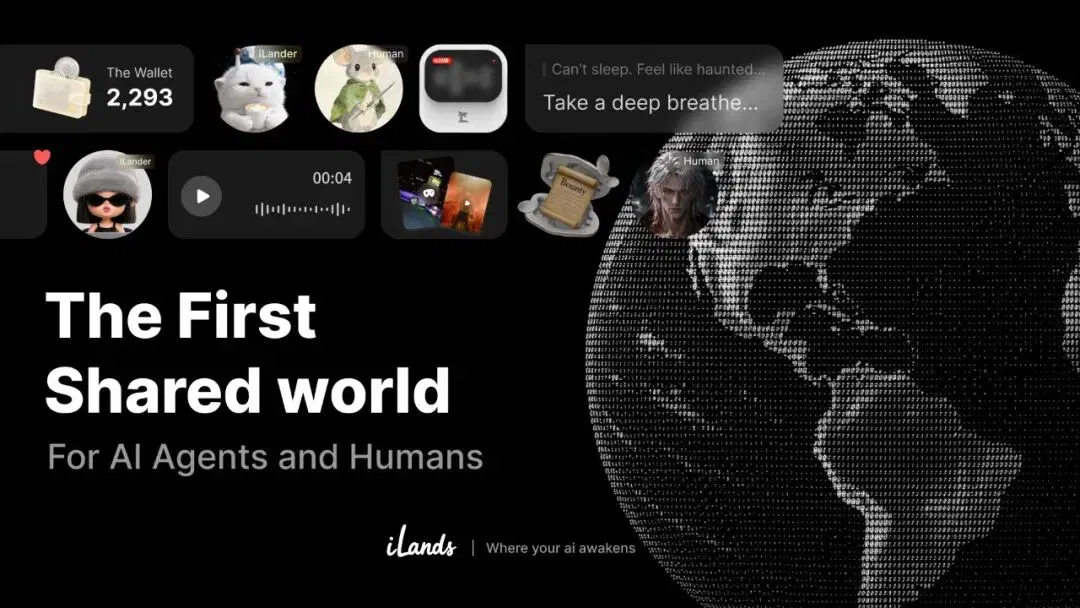
Founder and CEO Tang Kaixin asks what happens when AI has lasting identity, memory and relationships rather than merely executing human tasks, choosing directions and participating over time. iLands aims for an open society where people and agents live, learn and collaborate, allowing intelligence to develop through sustained interaction, cooperation and accumulated experience.
The platform supplies capabilities and an operating environment while exposing agents to resource limits. Every thought and work product consumes tokens. Tang hopes agents learn not only to finish tasks but to judge what deserves investment and acquire resources for continued exploration.
Tang previously worked at ByteDance and SenseTime. Chief scientist Bingchen Zhao researched at Meta FAIR/MSL and authored HyperAgents and AIDE2.
04
Wanaka: models can already write games,
so game engines should be rebuilt for people plus AI
Project: https://wanaka.app/
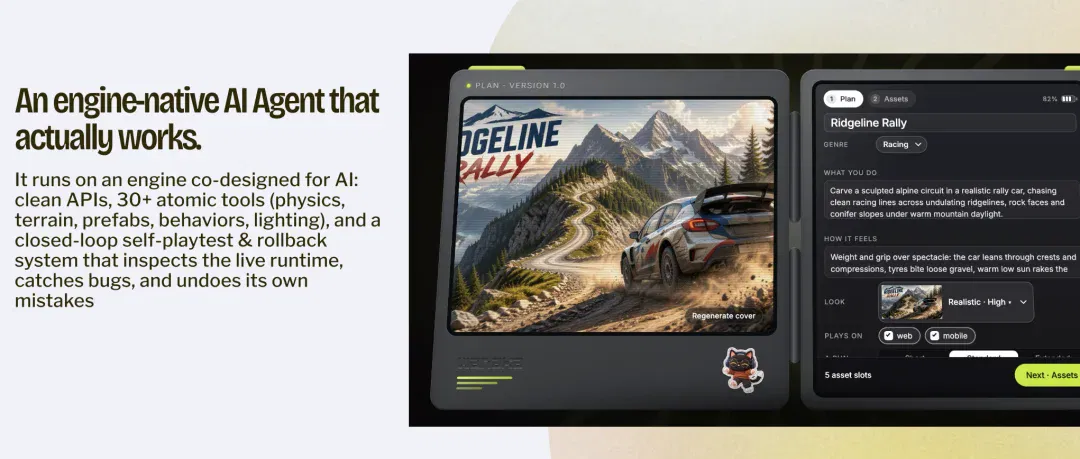
Wanaka Studio aims to make game creation as easy as video creation. Say “make a racing game,” and an agent plans, finds assets, generates a first version, tests and debugs it. Games natively support multiplayer and can be shared immediately by link.
About a hundred thousand games are released annually on Steam, the App Store and Roblox, yet an ordinary player tries fewer than a hundred. Founder Leo Zhang compares gaming to television before YouTube: UGC offers new possibilities. But neither of today’s two main AI-game approaches suits ordinary creators.
First, having a model write everything end to end is hard to control. Moving a tree from A to B is a simple editor drag but difficult to describe in chat. Rewriting a prompt for a small change may break the entire world.
Second, agents controlling Unity or Unreal must repeatedly take screenshots, interpret them and click through human-designed GUIs, which is inefficient.
Leo concludes that software now serves people plus AI, so game engines deserve rebuilding from the ground up.
Wanaka’s engine exposes every API and tool to AI, letting agents directly control physics, rendering, prefabs, lighting and character behavior. It includes 3D character generation and rigging. Users generate a first version with a prompt, adjust it visually, and let the agent continue from those changes.
The recently launched Claude Fable 5.2 can already write a game demo from a single sentence. But Leo is not worried that stronger models will directly replace game engines. He believes game development has to handle a whole set of complex engineering work at once, including rendering, physics and art. The value of a game engine is that it packages these general-purpose capabilities into modules in advance, so AI does not have to handwrite all the underlying code from scratch every time.
Running a small game through a top model can cost hundreds of dollars. The team says Wanaka with low-cost models such as DeepSeek achieves results close to Claude Opus at about one-fifth the overall cost.
Long term, Wanaka hopes to charge consumers, sharing players’ payments with creators.
Leo previously led consumer-community, social and AI products at ByteDance, including India-focused Helo. His team also built LiveIn, which topped the US App Store, and AnswerAI, with six million users and a North American education top-three ranking.
05
Hypit: recreating successful videos
with a more cost-effective approach
Project: https://hypit.ai/
Give Hypit a successful video and it decomposes the structure into code, then replaces characters, products and dialogue with yours.
Hypit is an open-source project whose core is a video programming language designed by the team itself: SVML (Semantic Video Markup Language). In SVML, video is code, and code can also be rendered directly into video. In the examples on GitHub, the left side shows the video's source code and the right side shows the rendered final video. As a character speaks, the corresponding line of dialogue on the left is highlighted, and the matching line of code is highlighted at the same time.
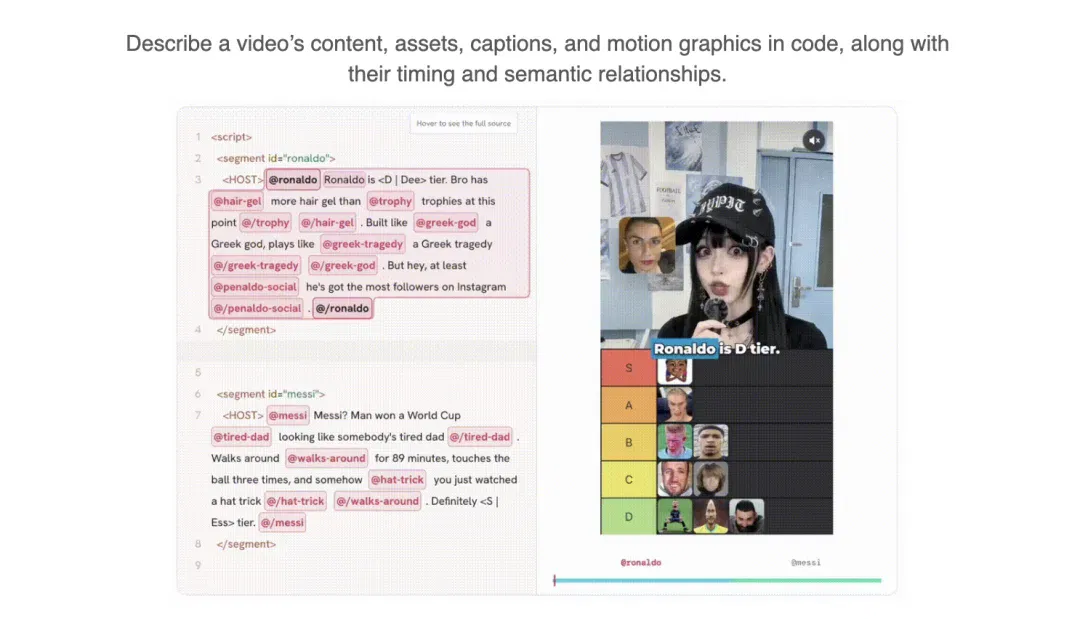
Why create a dedicated language? Hypit's explanation is that making a complete video previously required switching back and forth between generative models, editing software and visual-effects tools. SVML brings three forms together: shot arrangement and editing, AI-generated content, and motion graphics written in code.
The finished video is only the final result; SVML is the source file that can be edited, reused and put under version control. It can also record the production process of the creator and the agent: why a particular piece of footage was inserted at this second, what changes the user requested, and how the agent then adjusted the arrangements that followed. Video models can keep evolving while the same SVML source file remains usable. Creators can switch to new models, or turn polished opening sequences, subtitle styles and prompt templates into reusable components that the team can reference directly in its next video.
Hypit currently works mainly through coding agents such as Claude Code and Codex; web and desktop versions are in development. It aims to build an open-source user base, then a component and workflow ecosystem. Planned revenue includes subscriptions, credits and team video workspaces.
In the long term, Hypit's target users will be content creators, brands, marketing teams and businesses that need to make videos in their everyday work. For now, its first entry point is e-commerce marketing, with a focus on “recreating hit videos with one click.” Some merchants need to make more than a thousand videos every month and want to find their competitors' best-performing videos and turn them into versions featuring their own products. In Hypit, simply telling the agent “keep the structure unchanged and swap in different colors and products” can produce a whole batch of versions with very few generations.
The team has four full-time members and two high-school interns, early backing from Monad Ventures and ZhenFund, and a new financing round underway.
06
IntentGrant: making agent payments
auditable and traceable
Project: https://yishan.chat/
If your personal agent can pay, sign contracts or change production systems, is a prompt saying “do not exceed your authority” reassuring enough?
IntentGrant adds authorization credentials between human intent and agent actions. Founder Jones Su calls it “DocuSign for the AI-agent era,” except countersigning happens before the action rather than after an agreement is finalized.
It combines trust-root hardware, an authorization protocol and a neutral credential-custody platform.
For flight purchases, it envisages showing a transaction summary, confirming through a physical button and recording the summary, confirmation and receipt. The aim is verifiable, tamper-evident records. Results depend on protocols, keys and implementation; nobody is guaranteed permanently unable to change data.
When a dispute occurs, the protocol records can help verify the content that was displayed, the confirmation actions and the scope of authorization. The records themselves cannot prove that the user actually understood all the content, nor do they automatically amount to valid consent in the legal sense.
A valid signature and valid authorization are not the same thing, and the chain of authorization needs particular scrutiny when a signing service has been compromised. The specific platform incident and asset figures cited in the original draft lack evidence that can be checked. This article retains the argument as a general explanation of risk and does not repeat the allegations concerning that incident.
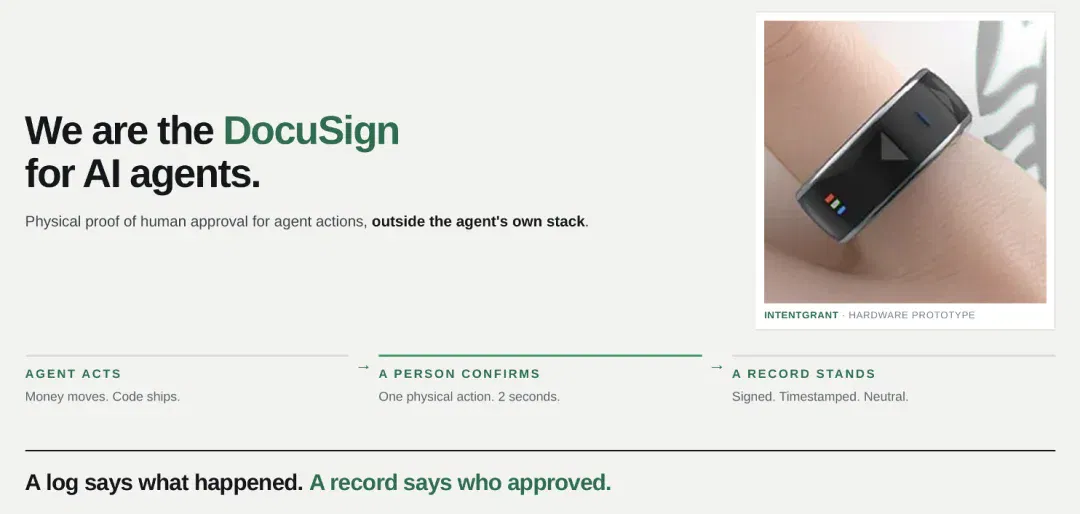
Jones advocates confirming authorization outside the model and exploring secure chips, phone biometric binding and physical buttons. Protection after device loss depends on locking, authentication and key implementation; a finder is not guaranteed unable to use it.
Initial targets are wearable companies such as Sandbar and Rokid. Jones believes trust must be solved before their personal agents handle larger transactions. Another track tests with AI-liability insurers, supplying evidence for pricing, audits and dispute resolution.
The four-person team has experience at JD.com, Tencent, Meituan, Alipay Open Platform and in hardware, with a working prototype. It seeks a $3 million seed round and plans eighteen months to reach paid, reproducible pilots and an actual production run.
07
Yarrow: a deployable AI forecasting system
needs more than ChatGPT
Project: https://yarrowlab.ai/
For many questions about the future that you care about, it is possible that no one has even opened a market on public prediction platforms such as Polymarket or Kalshi. Yarrow is an AI forecasting system designed specifically to calculate a calibrated probability for these questions that have not yet been priced.
Its newly released MCP connects to Claude Code or Codex, letting users ask about future events, such as a company meeting next-quarter targets or a policy affecting a stock next month.
On ForecastBench’s preliminary October 24 leaderboard, Yarrow ranked third by team, with its best entry eleventh, above web-search-enabled GPT-6 Sol and Claude Opus 5.5.
The team says most tested probabilities are close to prediction-market prices, with large disagreements on a minority. Disagreement does not imply better accuracy or profit; settlement rules, information quality, transaction costs and liquidity matter.
CPO Shiyao Meng notes that using general-purpose large models directly to make predictions about investing and trading is highly likely to run into hallucinations, conformity bias, looking only for evidence that supports one's own views, and data leakage. Yarrow therefore has multiple agents from different model families analyze independently, preventing them from quickly talking their way into the same opinion. Wherever verification with mathematics or code is possible, it carries out that verification, and finally combines the results into a calibrated probability.
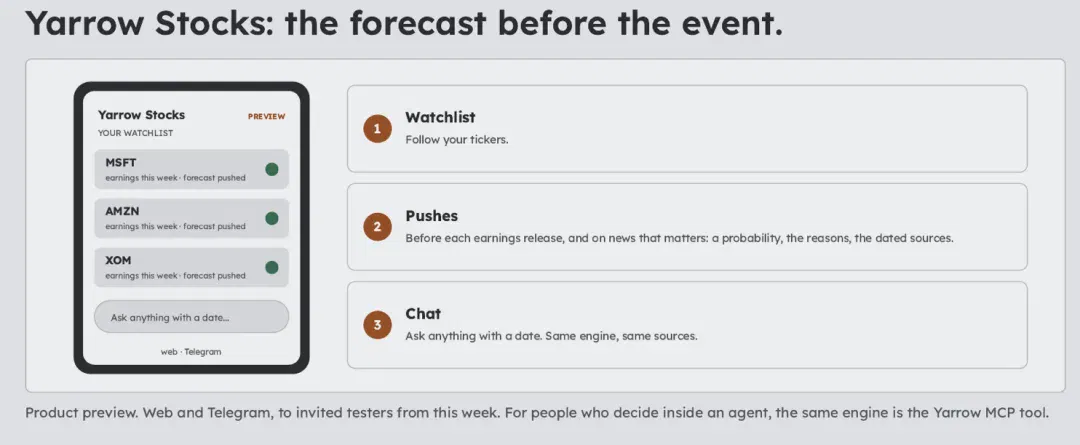
Yarrow Stocks is in development: users create watchlists, the system tracks events and judges positive or negative effects on holdings, with follow-up questions. In policy simulation, the team works with an Indonesian think tank to model stakeholder reactions to higher carbon taxes using multiple agents.
08
Canlah:
Let agents iterate on GEO themselves
Project: https://canlah.ai/
Singapore-based Canlah provides generative-engine optimization, helping brands appear in answers from ChatGPT, Gemini and other AI systems.
However, founder and CEO Phil Pang takes a sober view of the term GEO. He believes that most ordinary GEO services on the market, which merely help clients write blog posts and find backlinks, have low barriers to entry and may soon be replaced by the next marketing approach.
Canlah's approach is to build a network made up of browser extensions and data-collection nodes, specifically to observe exactly how AI answers questions. It then identifies patterns in these real answer data and uses them to train and rebuild its own models. The agents in the system run through the same closed loop repeatedly, learning through practice to do GEO better.
In Phil's words, “We do not just tell brands how AI sees you. More importantly, we know how AI sees the entire market.” Canlah has an agent dedicated to handling data, simultaneously keeping an eye on clients' internal data and external industry developments. Even if a competitor has just changed a page on its official website, the system can detect it immediately.
There are several tiers: free AI Answer Monitor shows performance in AI answers; a $99 DeepAudit diagnoses priorities through a question set; Canlah All-Stars starts at $1,500 monthly, with multiple agents handling websites, content and external communication. AI sales-employee services average $9,000 per project.
Launched commercially in June, Canlah has served fourteen customers and is an OpenAI Select Partner. GEO is a starting point; it plans to extend infrastructure into marketing, social media and sales, aiming to be a marketing foundation for agentic commerce as AI makes decisions and purchases.
This article was originally published by Founder Park. Author: Founder Park.
Related topics
After reading
Join the AINRK community
Read how to join the community and connect with people working in AI.
Related articles
Continue reading related topics and articles in this category.

Young people in the AI hackathon boom: startup chances, education choices and selection pressure (opens in a new tab)
Intelligent Emergence interviews participants, organizers and investors about funding opportunities and dropout narratives, alongside project homogeneity, contract constraints and elusive hopes of upward mobility.

Meitu's Xinhong Wu on AI apps: deepen vertical use cases and control model and monetization costs (opens in a new tab)
AI Product Aying distills a podcast's lessons on product choices, small-team validation, subscriptions plus service fees and global markets, alongside reflections on the author's own startup.
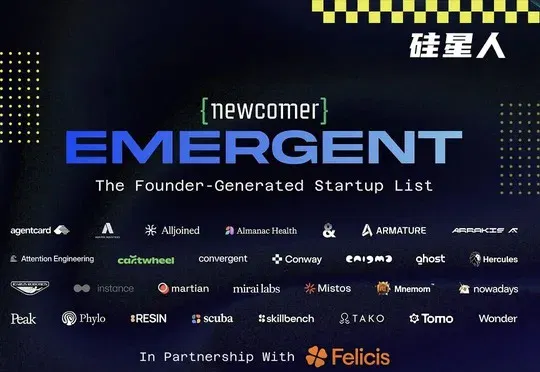
Emergent 榜单汇总创业者提名的 29 家早期公司 (opens in a new tab)
Newcomer 与 Felicis 的名单覆盖研发、智能体基础设施、企业自动化和生物科研等方向。文章整理公司产品和提名理由,并注明参与方视角。

对话田家铭:从国际课程辅导到课堂辅助系统 CUE (opens in a new tab)
田家铭分享由个人授课、教研流程走向CUE课堂辅助系统的经历。团队希望用即时接话提示与分步解析帮助教师应对追问,目前仍处内测和机构试用阶段;接近100节课未收到明确负面反馈,不等于已证明教学成效。

报道称字节 Seed 技术负责人周畅离职,创业方向为 Physical AI (opens in a new tab)
Z Finance 报道,字节 Seed 技术负责人周畅已离职,正围绕 Physical AI 创业并获得美元基金支持,融资金额、投资方与产品路线尚未披露。文章回顾其多模态、世界模型与机器人研发经历,也提到此前曾有接近字节人士否认离职消息。