SenseTime’s Dahua Lin: 20% of resources go to frontier research with no product outlet
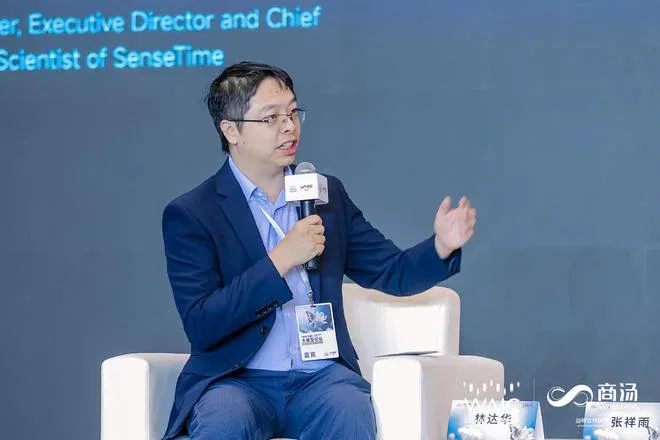
Dahua Lin discusses SenseTime’s choice of hundred-billion-parameter models, Seko’s focus on creation and its 20% resource allocation to frontier research without a product outlet. He stresses user feedback loops and spatial and multimodal exploration; industry forecasts reflect his judgments.
Editorial verification: This article preserves the interview questions and answers as edited by Founder Park. All industry judgments and company experiences below are attributed to Dahua Lin. For the claims that GPT-6 uses a Recurrent Transformer, that flagship models incorporate large amounts of embodied data, and about their performance in controlling robots, no confirmation from OpenAI’s public technical materials was obtained in this review. Even where the interviewee speaks with certainty, these should be treated as his conjectures based on community information or public demonstrations, rather than disclosed architectures, training recipes or generalization results on physical robots. “Catching up to 80%–90% within a few months” and “the era of distillation is over” are his forecasts, not verified progress or evidence that distillation techniques have ceased to work. The 20% is the proportion of resources he says is devoted to exploratory frontier research; the seven-to-eightfold user growth and cost examples have not been independently financially verified. The “inverse scaling law” is limited to the spatial tasks and recipes he was testing at the time. Official research also discusses positive scaling after data curation, so it must not be generalized into a law for all spatial tasks. Profit and loss must be understood separately under their different financial reporting measures; this interview does not establish that the core business has become consistently profitable. OpenAI’s public GPT-6 launch materials (opens in a new tab)SenseTime’s explanation of conditions for spatial scaling (opens in a new tab)Original SenseNova-SI research (opens in a new tab)
At this point in the large-model arms race, training costs have become a bottomless pit with no stopping point. Overseas, people are already talking about 10 trillion parameters, while major Chinese companies are imagining models with 2 trillion or 5 trillion.
How can the economics be made to work? SenseTime co-founder and chief scientist Dahua Lin’s answer is not more parameters, but a “closed loop.” In his view, blindly competing on parameter counts is unhealthy. “Everything needs a closed loop to iterate effectively. Otherwise, you are only chasing leaderboard scores, which is very dangerous.”
Over the past few years, SenseTime has made several key trade-offs. It internally debated whether to build a 2-trillion-parameter model, but ultimately chose the several-hundred-billion scale for more efficient iteration. Its earliest general-purpose chat product was judged not to be a strategic priority by the end of 2023, prompting a shift toward office work and video creation. After Seedance 2.0 launched early this year, the team was briefly unsure of its direction, before finally focusing on “creation” itself. Seko’s user base subsequently grew seven- to eightfold.
What has not changed is the commitment to original work and foundational R&D. To this day, SenseTime sets aside 20% of its resources “without calculating short-term returns” for exploratory frontier research with no product outlet at all. Spatial intelligence is one such area, and it led the team to encounter an inverse scaling law: on some tasks, more data and larger models actually produced worse results.
This also points to Lin’s more fundamental view of intelligence itself. Intelligence is essentially people interacting with the world. Language is a high-density medium, but language alone is incomplete.
In a recent video-podcast interview, Lin reviewed the reasoning behind SenseTime’s choices across two AI cycles and answered several central questions: why does following the US and “racing to copy” produce no compounding returns? And why does he say “the era of distillation is already over”?
The following conversation was edited and condensed by Founder Park.
01
Betting on models with hundreds of billions of parameters:
without a closed loop, models are only chasing leaderboards
Q: How does the cost structure of this round of large models differ from the previous AI race?
Dahua Lin: This time, models’ general capabilities have made a real, qualitative leap.
Customization costs have fallen sharply. Some customization is still needed, which is why the concept of FDE exists, but the burden is indeed much lighter. With support from productivity tools such as AI coding tools, costs will come down.
The real costs lie at the two ends: one is the cost of serving, meaning token prices. The other is training costs.
On training costs, there is an assumption in the industry that may not hold: spend an enormous amount to train a very good model, and it can serve every purpose, with the costs amortized through large-scale commercialization later. But what we see in the industry is that training costs remain high. It is not because the models are not good enough; it is because if you do not keep training the next one, someone else will overtake you.
Competition, or the rat race, forces you to keep investing heavily and training the next model again and again. Training costs never stop, and they keep growing. Just in the past couple of days, major Chinese companies have been saying that people overseas are already talking about 10 trillion parameters, and everyone is starting to imagine models with 2 trillion, 3 trillion or 5 trillion parameters. Training costs can never be amortized downstream. That is the predicament we face now.
Q: If more parameters are better, will a handful of large models eventually take everything?
Dahua Lin: No. I have always told people that there is a three-way trade-off here, perhaps even an impossible triangle: cost, generality and specialization.
Generality is how many things a model can do. Specialization is how deeply and reliably it can perform a particular task, and how high its success rate is. Technically, it may indeed be possible to train a super-large model that is both highly general and extremely specialized at every task. The price is a very large model, with very high training and serving costs.
Something a smaller model can do for one yuan might be done about as well, or better, by a large model, but it costs 100 yuan. That is because it also has 100 other functions you do not use, and you have to pay for those too.
Many everyday workplace scenarios can be handled by medium- or lightweight models. If an 8B or 32B model can do the job well, why should I pay OpenAI or Anthropic for the tokens?
When competition is very intense, cost pressure becomes substantial. Models that sacrifice some generality for lower costs will have a very large and sustainable market. Even OpenAI offers models in several sizes rather than using one model for every workload. There are more than 3 million models on Hugging Face, doing many different things.
Q: Many AI-native large-model startups are caught here. On one hand, they have to answer to capital markets and investors, continually training base models to prove they are still at the global SOTA frontier. On the other, to stay alive, they start building “sweet-spot models,” earning revenue first in small use cases where they can achieve PMF. Resources are finite—which basket should they put their eggs in?
Dahua Lin: I think it is good for the industry that people are becoming more pragmatic. Everyone blindly competing on parameter counts is not a healthy state of affairs.
Two things show that the industry is moving in a healthier direction.
First, people are choosing model sizes more pragmatically. Professor Jie Tang also mentioned earlier that there is no need to pursue a trillion parameters immediately. An excellent model with enough parameters is very valuable too, such as the Flash-class models now doing much of the work in many office tasks.
Second, people are returning to the quality of pretraining data. Some teams have trained models with 2 trillion or 3 trillion parameters that seemingly still cannot beat today’s models with a few hundred billion. The reason is poorly curated data, full of impurities and conflicting material that cancels out efficiency gains. They have huge parameter counts, yet perform worse than a Flash-class model with a few hundred billion parameters. Expensive and unsatisfactory—that is fatal, and they will be “eliminated.”
In this more rational state, people do not necessarily compete around a particular metric. They start from value to the end user and consider how to deliver it efficiently. That can actually take them further.
Q: Since SenseTime was founded, have you ever been led by the expectations of capital markets and investors? When did you start thinking about finding your own pace again?
Dahua Lin: Frankly, SenseTime may not have the loudest voice in today’s large-model market, but we have always followed the path we believe is right. The ultimate vitality of any technology comes from whether it truly creates value.
The key is not how many points you gain on a particular benchmark. You may be the SOTA today and no longer be so next month; that does not endure. What truly lasts is not a particular technical point or parameter count, but whether you have truly established a lasting place with users.
We also discussed building a larger, 2-trillion-parameter model. If we really wanted to, we would have the opportunity and sufficient resources. But that decision carries an opportunity cost: put most of your resources into it, and nothing else has resources left. No decision is simply right or wrong. Given your resources and time window, the question is which combination of things will produce the best progress toward your goal.
There are two paths now. One is to go from 500 billion parameters to 1 trillion, 2 trillion or 5 trillion, betting that increasing the parameters will let you outperform others. Of course, there may be several companies in China capable of building a 5-trillion-parameter model.
The other path is to keep the parameter count in the hundreds of billions and continually improve training, architecture and data quality. Resource consumption per iteration is to some extent proportional to parameter count. Choose a model that is a fraction of the size, and iteration becomes several times more efficient. More importantly, this leaves us more resources to explore differentiated paths. If we find a different scaling paradigm in the future, we may also scale to a trillion parameters along that new paradigm. But competing at the trillion-parameter level by piling in resources along the traditional path is not the ideal choice for us.
Recently everyone has been releasing Flash models: GLM-5.3 Flash, DeepSeek 4.1 Flash, and Google’s Flash. They have all been popular. DeepSeek 4.1 Flash performs better than 4.0 Pro, showing that Flash models with hundreds of billions of parameters still have substantial room to improve.
Perhaps one day we will truly hit a capacity bottleneck, and then we will have to move further. This is more a question of timing and judgment.
Q: Beyond timing and judgment, is there a difference in conviction between these two paths?
Dahua Lin: I believe parameter count remains a very important foundation. More parameters bring a higher ceiling.
But if you have 10 years to iterate gradually, you might get very close to the ceiling for a given parameter count. Now, though, a new model comes out every two or three months, so the criterion becomes where it can get to in two or three months.
SenseTime’s most important lesson over more than a decade is that everything needs a closed loop to iterate effectively. Otherwise, you are just chasing leaderboard scores, with no iteration.
Take reinforcement learning as a theoretical example; there is a profound principle here. One approach is to go a very, very long way on one thing, obtain more complete feedback, and then update the parameters once. Another is to take small, rapid steps and maintain frequent iteration. Over the long run, the latter gives better results.
So whether we are training models or planning R&D, we pay close attention to iteration speed. We must iterate fast enough, and in the right direction. To get the direction right, you have to have users. Otherwise, iterating against benchmarks is very dangerous.
02
Competing in a different position from Seedance:
focusing on “creation” brought eightfold user growth
Q: In finding a real closed loop with users, did the arrival of large models reshape SenseTime’s thinking about what it wanted to give users?
Dahua Lin: We did not already have some grand, precise strategic judgment two or three years ago. SenseTime’s path was made by walking it, not by thinking it out in advance. I think that is very important.
Professor Tang (Xiao’ou Tang) said this is a process of climbing a mountain. You do not know what scenery you will see at the summit, or where the fork will be a kilometer ahead. But you cannot spend every day just thinking about that; you have to move forward first. At an annual meeting, he said that if you take each step well, you will eventually reach somewhere better than where you are now.
A strong conviction at SenseTime is to respect young people’s creativity in accordance with scientific principles. Many product and technology teams are allowed to use a small amount of resources to do things that neither Xu Li nor I know about. We know they are doing things we do not know about, and many surprises come from there.
We do not decide in advance that we must invest heavily in A or B. We look at whether a product, if done really well, could achieve strong organic growth; only then do we increase investment. We will not force an immature product to a level it should not yet occupy simply because leadership wants it. Once it matures, we give it a push so it can gain momentum faster.
SenseTime’s earliest large-model product was neither today’s Raccoon nor Seko. It was the conversational product SenseChat, launched in early 2023. At the time, SenseChat was built much like other chat products. When one version was ready, I gave it to my wife to try. She was away on a business trip, and her first question was which restaurants within five kilometers were worth recommending.
Most user conversations are not asking whether a photograph contains a cat or a dog. They are about concrete problems in life: which hospital to visit, where to eat, or how to drive somewhere. To answer those questions, the model is only a processor; it also needs a great deal of information as input. SenseTime has not built a search engine, nor does it have data like Dianping’s.
So by the end of 2023, we had decided that chat was not our strategic priority.
At the time, Xu Li established CNI, Content and Interaction, as the large-model product business group. He believed the changes brought by models concerned both content and how people interact with it. Content in turn falls into two types: work content and entertainment content for consumption.
That led to the office-focused Raccoon and the video creation platform Seko. All the major companies have recently been saying they want to build for office work; we started two years ago.
Q: ByteDance, Tencent and Alibaba are all entering office productivity, bringing traffic and the user bases of Feishu, DingTalk and Tencent Docs. Will the money SenseTime’s Raccoon earns eventually go to those big companies?
Dahua Lin: If you stand still, sooner or later you will be squeezed out by upstream or downstream players. There is no doubt about that.
The big companies make office productivity their top priority and pour enormous resources and traffic into it. At this stage, we will not pit our weaknesses against their strengths. We do not have a traffic pool that large.
But the ultimate purpose of office AI is to create value. Helping users handle documents or make a few PowerPoint presentations provides relatively shallow, tool-like value. On the smile curve, resources are at one end and outlets at the other; tools in the middle are often squeezed by both ends. Still, however they squeeze, there are always gaps they cannot fill, leaving room for tools to survive.
The central question is how, taking ultimate value as your guide, you can work all the way through an industry. We find that even the very best models have many gaps when they handle specific problems. The key is to have a closed loop. A closed loop lets your understanding grow faster than the capabilities of base models, so you can always find room for the next step.
Q: What position was Seko in when Seedance 2.0 came out early this year?
Dahua Lin: We were very unsure of our direction then, and even wondered whether to carry on. When I met investors or attended industry conferences, everyone asked the same question: how are you different from Seedance? Can you beat it?
Frankly, if we compete purely on video-model generation quality, we cannot match Seedance 2.0. It is an enormous model backed by heavy investment from ByteDance, and its generated clips are cinema-grade. Seedance really has done an excellent job.
Later, we clarified one thing. We had spoken to many downstream creators, and what they ultimately wanted to produce was not a 30-second clip, but a 100-episode short drama. Getting from a good 30-second clip to a 100-episode drama is a complete creative process. You have to consider the script, storyboards, character prototypes and character movements. It involves an entire process of the creator’s own thinking and creation. You finish all those things first, then use Seedance to render them.
So in our system, Seedance and other models are simply video generators.
In our understanding, creation and generation are entirely different concepts. Creation is much bigger than generation, with much more room to work. We focus on building a good creative process, incorporating technical strengths such as unified understanding and generation, interleaved text-and-image thinking, and consistent character appearances across episodes. Then, using Seedance’s rendering capabilities, we create a very clear distinction.
The industry now broadly recognizes that there is still a lot to do before Seedance can be used directly for end-to-end film and television creation. Most people do not have enough know-how to assemble the whole system. Seko provides that system.
After we clarified this, Seko actually retained considerable vitality. Our user base has grown seven- to eightfold this year, and we have started earning quite a lot of money too. So Seko and Seedance are not substitutes for one another; they occupy different positions.
03
Training models:
following the US and “racing to copy” brings no compounding returns
Q: Looking at competition at the model level, over the past year Chinese large models have taken an open-source path very different from the US. Chinese open-source models such as DeepSeek, Kimi and Qwen can now challenge the top American closed-source models. Why has open source become such a mainstream path in China?
Dahua Lin: Many people in this field, many of my peers, are very good people. But choosing open source certainly also involves self-interest. Open source happens to align those two things.
Open source is free, and people can download and deploy it themselves, making it easier to gain influence than with closed source. In this era, influence is extremely valuable.
When I previously promoted open source at Shanghai AI Laboratory, as a research institution we were under no pressure to make money. But in a company, any technology leader proposing open source will certainly be asked by management: “Why are you open-sourcing it? What will it bring to company revenue?” You can say it builds a reputation or attracts talent, but neither can be put into a quantitative formula to calculate revenue. Because these economics were unclear, many companies were very hesitant about open source in the early days.
The turning point was DeepSeek. Its open-source releases brought enormous influence, and every company saw that open source is the most direct route to gaining industry influence today—especially for startups seeking higher valuations. With that influence, a team can raise money and attract top talent. When companies choose open source out of their own interests, the objective result is a very good open-source ecosystem.
Q: After teams such as DeepSeek and Kimi went open source, people noticed that Chinese models seemed to improve in both iteration speed and performance. Is there a logical connection?
Dahua Lin: There is a connection to some extent. Open source helps technology spread.
What does model iteration actually involve? Training the final model on the data accounts for only about one tenth of model R&D costs. The remaining 90% goes into all kinds of experiments, trying different recipes and techniques. Open source and open weights let technology circulate faster. When experimenting, teams can choose the most promising of the community’s latest releases to test and adapt. That significantly speeds up the search for the most advanced and best techniques.
This is also why China can remain so close despite the huge gap with the US in total funding for large models. Chinese people are very smart. Once they know a path works, they can identify a concrete technical solution very quickly. The worst situation is not knowing where the path lies.
Q: The top US models are closed source and do not disclose complete technical details. Why can Chinese teams work out a solution so quickly just from knowing they have “made it work”?
Dahua Lin: Because many technical principles are shared. Everyone has some guesses and ideas about the broad technical approach.
For example, when DeepSeek-R1 came out in 2025, it validated reinforcement learning with verifiable rewards, or RLVR—in other words, repeatedly using answer correctness for reinforcement learning. Before that, people had tried all sorts of methods. Once the R1 paper appeared, although some details were not fully described, the broad direction was there. Other teams only needed a number of targeted experiments to fill in the remaining details and make the path work.
Another example is the recent GPT-6. The community widely suspects that it uses a Recurrent Transformer, with a token going around the network several times before coming out. Previously this was still a very academic line of exploration. Now OpenAI has put it into a flagship model, which shows it has been validated. Many academic papers already provide concrete approaches; what remains is to figure out the details and scale up.
Another example is embodied intelligence. Previously, people thought it required a VLA or the more recently discussed World Action Model. No one dared believe that directly using a large language model to drive a robot could work.
Now people see OpenAI feeding large amounts of embodied data into its flagship large model, with very good results in controlling robots, and that has had a major impact on the entire embodied-intelligence industry. Next, everyone will put resources into collecting embodied data and training it into a somewhat larger LLM.
I believe they may be able to reach 80% or 90% of its level within a few months. Because the path is clear, and there is a reasonably plausible approach. You do not have to experiment with 100 methods; you only have to experiment with this one.
Q: By that logic, is China destined to follow the US step by step forever, innovating by imitation?
Dahua Lin: Many companies are indeed doing that. What are they competing on? Speed.
When something new comes out of the US, they compete to produce a Chinese counterpart in the shortest possible time and capture a niche in the domestic ecosystem.
But honestly, racing to copy is exhausting, because others are racing too. When OpenAI or Anthropic releases a new technique, within two or three months a whole bunch of things appear in China claiming to use that approach. Whether they are fully developed or not, they rush to claim an ecosystem niche. If only one company were competing for it, the niche might go to that company. Instead, 10 companies are competing—just like RSI now, with a whole bunch of people working on it.
I am not saying this is bad. Optimizing and innovating along the mainstream paths opened up in the US brings immediate results and has laid a positive foundation for applications and ecosystems. But everyone piling into whatever looks promising does not create long-term value. A company’s long-term competitiveness comes from sustained compounding, not constantly following trends. If you follow a path long enough and go deep enough, others will find it very difficult to reach your level on that path.
The hard part is whether you can hold to your convictions when the path you choose is not the hottest or most mainstream one in the market. If China is to make a more lasting contribution to international technological competition, it must develop some things that are different and its own. That was also Professor Tang’s ideal when he founded SenseTime.
DeepSeek, for example, still follows the standard LLM paradigm at the broad level, but I greatly admire how deeply it has worked on architecture. It has done extremely in-depth work on infrastructure and pushing architectural performance to the limit, so DeepSeek’s models stand out in LLM architectural efficiency.
04
The era of distillation is already over:
the bottleneck now is creating new problems
Q: One of the most disputed terms in the industry this year is “model distillation.” Some voices in the West say Chinese models have caught up so quickly because they distilled Western models.
Dahua Lin: Training agentic models now requires constructing large numbers of trajectories that record the entire process of a model completing a complex task. They can easily run to hundreds of thousands or millions of tokens. Humans cannot write them token by token, and they are difficult to construct with scripts too. The model being trained does not yet have strong agentic capabilities, so other models inevitably have to be used to construct training trajectories.
And it is not just one model, but the most cost-effective combination of many models, developed through iteration over time. Some are foreign and some are Chinese, but a larger proportion are our own models or Chinese open-source models.
Q: Do foreign models also distill Chinese models?
Dahua Lin: Yes. They also construct chains of thought using complex systems that may include DeepSeek, Qwen or Zhipu. It is hard to say exactly what they use. They do not disclose their technical approaches, but there are indications that some trajectories contain traces of Chinese models. That does not mean they copied Chinese models; it means a particular Chinese model may be better suited to constructing certain trajectories.
Q: If you use no one else’s models at all, what is the first-principles approach?
Dahua Lin: Find experts in the industry or field and have them write it out word by word. That is the highest form of distillation; it is just expensive. US labs have also paid many industry experts high salaries to write these things. The essential point of constructing data with models is to reduce data-construction costs.
Q: Some in the industry say that, since the second half of the year, US models have become increasingly difficult to distill. They no longer lay out the full thinking process, forcing Chinese teams to find large numbers of human experts to work backward and fill in the intermediate reasoning gaps. Will that hold back Chinese models’ iteration speed?
Dahua Lin: So far, the industry does not seem to have slowed its iteration because of this. Two or three new models still come out every month, and performance improves quickly. Honestly, I think we have already moved beyond the so-called era of distillation.
There are several stages of model learning. The earliest was pretraining: crawl all the text on the internet, arXiv and Common Crawl, and learn from it. Later came the so-called data exhaustion: everything that could be crawled had been crawled, and crawling a little more brought little benefit.
Then came chain of thought: construct step-by-step problem-solving processes so models can learn patterns of thinking. In 2023, with traditional SFT, you could crawl a pile of questions and answers online, fill in the answers, and train on them. Each example cost only a few hundredths or tenths of a yuan, almost negligible compared with pretraining. Later, with reasoning chains of thought that could solve math problems, the cost of collecting a single trajectory rose to tens of yuan.
This year, people want models to complete specific tasks—agentic tasks. Constructing a long trajectory for a complex task now costs thousands of yuan apiece, comparable to hiring a lawyer for two hours and having them write out their thinking step by step.
The existing stock of problems and chains of thought has basically been used up. The central bottleneck now is producing new problems. We may need to construct thousands, tens of thousands or even hundreds of thousands of real working environments and scenarios, letting models explore, learn and complete tasks within them.
Q: The low-hanging fruit has been picked, and reaching the higher fruit requires people to construct real environments. Does China have an advantage here?
Dahua Lin: Yes. There is tremendous diversity in our lives and industries.
And the bottleneck here is not compute, but people. China has the world’s most abundant engineering talent. If these people shift from their original jobs to constructing these environments, that could create a kind of strategic advantage over the US. The key is whether Chinese companies can fully use that advantage.
05
We discovered an “inverse scaling law” in spatial intelligence
Q: If following trends and racing to copy brings no long-term compounding returns, let us return to SenseTime’s own research priorities. What matters most to you today in deciding whether a research direction is worth pursuing?
Dahua Lin: I have always felt there must be something more fundamental. It does not necessarily have to be called theory, nor do we seek to explain it with complicated mathematical formulas. But when solving a completely different problem, we must ask what the most basic underlying principles really are.
I will not stop at tweaking data or parameters using existing methods. When existing methods cannot solve a problem well, I want to trace all the way back to why they cannot.
For example, SenseTime builds models and products itself, but even today, SenseTime still devotes 20% of its resources to exploratory, forward-looking research with no product serving as an outlet at all. Spatial intelligence is one such area. We started last year, and early this year released several models that perform very well in spatial intelligence (note: SenseNova SI).
Q: Why did you choose spatial intelligence at the time?
Dahua Lin: We discussed one question extensively internally: what exactly are the things that models such as GPT and Gemini cannot do well, or cannot do at all?
We tested them, then had to ask another level deeper: were these areas where they fell short at the time simply a matter of adding some data? If OpenAI, Google or Anthropic just had not added that data yet, and adding it along their existing path would solve the problem, the direction might have application value, but it certainly would not provide a foundation for innovation at the level of principles.
There was only one thing we found highly unusual. At the time, everyone believed in scaling laws: more model parameters and more data meant better task performance.
But on certain spatial-intelligence tasks, we found an “inverse scaling law”: the more data and the larger the model, the worse it performed.
Q: What tasks?
Dahua Lin: We found an aspect of spatial intelligence called perspective-taking. Suppose I see something now: how would what I see differ if I looked from another angle, moved farther away, or moved closer?
Humans have a natural judgment about this. If I move farther away, I expect objects in my field of view to become smaller. If my viewpoint changes, what I see changes too.
But all the multimodal models at the time—including Google Gemini, which had been pursuing native multimodality early on and was already among the best performers—had no concept of different scales, perspectives or views.
The models had simply recorded large numbers of associations between images and semantics. For example, this is a black sheep. From far away it is a black sheep, and close up it is a black sheep; the model knows it is a black sheep. But it has no sense that “the same black sheep will look different from another angle.”
We tested whether there was simply not enough data in this area, adding more relevant data. The results became increasingly confused. Without spatial relationships established in that data, adding more of it strengthens the semantic associations, and the model increasingly relies on fixed semantic concepts to explain everything it sees. The more data is added, the more entrenched those semantic priors become.
At the time, I liked to give an example that the latest models may have fixed by now. Show a photo with six fingers to the mainstream models of the day—we tested GPT, Gemini and Grok—and they all answered that there were five fingers. The model’s first reaction was “this is a hand.” Having seen “a hand should have five fingers” 100,000 times in its corpus, it would immediately answer five.
This is a very fundamental problem. The model relies only on a semantic translation and then performs subsequent reasoning based on that translation.
Q: You come from CV, or computer vision, and did a lot of vision work at MMLab early on, then moved into LLM pretraining right away. Looking at researchers from language and vision backgrounds now, do their priorities still differ?
Dahua Lin: They have become so deeply integrated that it is hard to distinguish who originally worked on LLMs and who on CV. Many former CV researchers now work on LLMs, and some former LLM researchers have turned to spatial intelligence.
I have noticed a different change instead. Whenever I ask friends at industry conferences what they are working on this year, the answer is often different from last year. People are changing direction so quickly.
In the earlier, more academic era, people could stay with a direction longer, because trends in the field were not so extreme. In the first half of this year, everyone thought coding was most important, and that you were falling behind if you were not doing coding. Then in June and July, GPT produced some impressive 3D results, and everyone thought they should work on 3D rendering. Even a company like Zhipu, which has always focused on LLMs, has some 3D rendering examples in its latest version. Many people keep adjusting their direction to follow trends.
The pace of R&D iteration has also been heavily disrupted. Vast amounts of capital and commercial considerations have poured in, and everyone releases new models every two or three months, creating enormous pressure. The window for deeply investigating a new possibility has been severely squeezed. In an era like this, being able to settle down and pursue exploration over a longer cycle is exceptionally valuable.
DeepSeek, for example, will not insist on releasing something merely because three months have passed. It has its own rhythm for exploration and breakthroughs.
Our own NEO-unify architecture, unifying understanding and generation, also took a year of gradual groundwork. Although there is an order-of-magnitude gap between SenseTime’s resources and OpenAI’s, we always reserve some resources—regardless of how great or small the business pressure is—for things we believe are right based on first principles. Important opportunities for differentiation are nurtured there.
The direction GPT-6 is taking today happens to demonstrate the value of the path we have been building on for a year or two in advance. I think people will soon see SenseTime produce something different from other teams in the industry.
06
Scientists starting companies:
learning to keep making money
Q: SenseTime released its interim report a month ago, sparking considerable market discussion. Official statements described it as achieving profitability for the first time, while some media emphasized that it was still loss-making on an adjusted basis. If you were to explain candidly to outsiders whether SenseTime is making money, how would you answer?
Dahua Lin: We can look at this dynamically. Under different financial measures, we have achieved profitability by some measures and substantially narrowed losses by others. But whichever measure you use, SenseTime’s overall profitability is improving continuously. That is a very solid fact.
Rather than using various financial maneuvers to achieve an accounting profit at one particular point, only to return to losses next year, what we really care about internally is whether SenseTime is becoming a healthier, more vibrant company.
Take our “1+X” strategy. Whether in the AI 1.0 era or today’s large-model era, new opportunities to apply AI in industries keep emerging. But cultivating any new industry direction takes time, and inevitably involves a period of losses. There are only two choices: do it, or do not.
If you do not, you cut it off, potentially missing the chance for something to grow into a towering tree after short-term losses. If you do, you may be unable to carry the enormous financial burden of so many business lines.
Many product and research teams at SenseTime genuinely want to do things well, so they can be quite aggressive when asking for resources. Inside the group, a team might ask leadership for 50 people. But we say: if you become a company that has to survive independently in the market, and we help you raise funding, how many people would you take with you? They say five.
Market competition is harsh, but it is very good for founders’ growth, and the business becomes healthier and more dynamic. It is no longer simply asking for resources to do things whose long-term value has not been thought through. SenseTime also holds stakes in these companies and has earned good returns. Its overall ability to withstand risk has become very strong, leaving more room to experiment, make mistakes and do things of long-term significance.
Q: SenseTime is called the “Whampoa Military Academy” of the AI industry. For example, Junjie Yan left to build MiniMax. Why could that not happen within SenseTime?
Dahua Lin: Actually, it is part of the same lineage. We inherited Professor Tang’s very open approach to talent. Take my own case. When Professor Tang recruited me to study at the Chinese University of Hong Kong, he said he was willing for CUHK to be a way station in my academic career, or even a stepping stone. His goal was for me to spend two or three years there, do good work, and then recommend me to MIT. He ultimately delivered on that.
SenseTime has nurtured many excellent people, which shows that its internal environment is vibrant. People who emerge from the SenseTime ecosystem have the vitality to find their own niche in an era of dramatic change. Professor Tang said something I think is excellent: “life will find its way out”—life finds its own path. The path it ultimately takes may not be the one originally imagined, but it will find room to keep developing.
Q: In SenseTime’s early years, the industry loved debating “whether scientists can succeed as entrepreneurs.” In today’s large-model wave, scientists and top researchers starting companies have instead become mainstream. Can someone be both a good scientist and a good entrepreneur?
Dahua Lin: I see no inherent logic that makes the two incompatible. But entrepreneurs from research backgrounds must break out of their ingrained ways of thinking from research.
Before Qingqiu left to found Moqi Intelligence, he invited me to lunch at a restaurant beside the office specifically to ask for my advice. I told him then that there were several hurdles to cross in going from a scientist who does excellent research to a CEO who achieves major business results.
The first hurdle is moving from technical understanding to product understanding. Many researchers think: my technology is great, so you should use it. But users think: if you do not solve my problem, why should I use you? Looking for nails with a hammer in hand is very painful.
That is why Professor Tang said empathy is very important. Put yourself in the other person’s position: they also have KPIs and revenue pressures. If you do not solve their problem and take up their time, what gives you the right? This is a shift from starting with your own ego to understanding other people’s needs.
The second hurdle is moving from being useful to making money. Most projects in the AI 1.0 era were useful. But when the numbers were added up, spending exceeded revenue, which meant a loss. Turning useful technology into a commercially viable business model is a lesson all today’s fast-growing large-model startups must learn.
The third hurdle is moving from making money to continuing to make money. Especially in China, once you make money, others think they can make that money too. Everyone enters, competes for customers and starts price wars, squeezing what was five yuan in profit down to one. Customers also bring in another supplier because they cannot depend entirely on you. You need a more stable ecosystem and lasting competitive barriers.
None of these issues is easy, and even at SenseTime we do not have good answers to every one.
In many successful ventures started by professors, the professor is not the CEO. The CEO is often their student or a young person they have mentored. Two Hong Kong professors are exemplary: one is Professor Tang, and the other is Professor Zexiang Li, who supported his students in founding DJI.
A professor’s deepest ideal is often to nurture people and help them succeed. When that tree branches out, the resilience and vitality of the whole system are actually strongest.
Q: How does SenseTime maintain its capacity for innovation internally?
Dahua Lin: I now have a major ambition: to make our team the “dream team” of Chinese AI. Salaries at SenseTime Research are definitely not the highest in the industry, and there is even a gap with ByteDance. But our attrition rate is very low for the industry, and many attempts to poach people have failed.
The most important reason is that we spend a great deal of time shaping our research culture. In an excellent team culture, everyone works toward a shared technical ideal that is challenging and sufficiently forward-looking, rather than trying to beat their colleagues in an internal horse race.
I can say with great confidence that departmental walls within SenseTime Research have almost ceased to exist. Although the institute has more than a dozen subdepartments with slightly different emphases, all our major R&D directions are pursued by fully integrated teams spanning several of those departments.
Many media reports describe major companies such as Tencent and Alibaba starting to merge their multimodal and language-model teams. From outside, that looks like a major organizational move. But we had already done it naturally by mid-2024, because everyone agreed that one model should handle both multimodal and language tasks. Later, when we pursued unified understanding and generation, the original generation team agreed with that goal, and we quickly formed a main research direction with dozens of people.
We did not even change their administrative organizational structure at all. People stayed in their original departments, but as long as they shared the same technical vision, they worked together seamlessly.
Many innovations arise when boundaries between fields are crossed, and that requires an organization without barriers. SenseTime may not have the most resources in the industry, but we have an excellent organizational foundation in this respect.
07
Language is not all of intelligence:
RSI is only one means of growing intelligence
Q: Returning to intelligence itself, for a long time large models have been driven primarily by LLMs. Many in the industry’s “LLM camp” believe language is the key to intelligence, and adding more modalities instead lowers a model’s IQ. How do you see this debate?
Dahua Lin: In a sense, that is not entirely wrong. Truly native multimodality—input and output across all modalities—is extremely difficult, and its ceiling remains very high even today.
After these years of development, large language models have accumulated very clear prior engineering experience to draw on, so they can advance faster.
Multimodality does not inherently lower intelligence. But exploring a path that brings multimodality and language together without diminishing intelligence requires considerable time and effort.
Q: Behind this is a more fundamental question: how does AI understand the world and acquire intelligence?
Dahua Lin: The AI researchers I know have different understandings of this.
Many indeed believe language is central. It has progressed faster and attracted more attention in industry. That is a fact.
Some young researchers who have long worked on foundational vision say that before humans had language, writing or programming, they could already hunt and sustain themselves through visual observation and their senses.
If we trace intelligence back to its origins through the strictest first-principles reasoning, intelligence is essentially people interacting with this world through senses such as hearing, vision, smell and touch. So some researchers say we should simply pursue purely visual intelligence, without even language.
I have reservations about purely visual intelligence. I strongly agree that language has a higher density of intelligence. In developing language, humans formed a symbolic system, structured the most important knowledge, and embedded it in that linguistic system. Language is a high-level medium distilled through human evolution, with the greatest intellectual density and efficiency. For programming and logical thinking, it is far more efficient than other modalities.
My point is simply that LLMs can take intelligence to a very high level, but language alone is incomplete. For example, being in a bustling city center feels very different from being in a quiet mountain forest, but it is difficult to describe the surroundings clearly even in 10,000 characters of text. In the park outside my window, every leaf, every flower and every texture cannot be expressed in language.
We have a recent piece of work being submitted to ICLR that proposes the concept of a spectrum. Language contains high-frequency, high-density information, but there is also much information that has not been condensed into language and complements it.
Take a very simple example. Photograph someone, give the picture to the best multimodal model, and ask it to write a 2,000-character description of the person’s appearance in as much detail as possible. Then have an image-generation model draw it. The result will absolutely be a different person.
The person’s image contains fine visual features that determine their identity, which language simply cannot carry. In real life, you do not need to describe to everyone what your wife and children look like; you just let them take a look. For such things, images convey information far more efficiently than language.
Language is more efficient for some things, such as programming and logical thinking. Images are more efficient for others, such as aesthetic perception, rapid judgments of spatial structure, and conveying fine visual features. Only by effectively integrating them to work together can more complete intelligence emerge.
Q: By that standard, where has intelligence driven by large models reached over these past three-plus years?
Dahua Lin: It has developed very rapidly, but unevenly.
In mathematics, programming and long-horizon tasks that can be written as sequences of text and code, models have already surpassed ordinary people. The recent performance of OpenAI and Anthropic in mathematical competitions has even exceeded the top human level.
But spatial and physical intelligence are still at a relatively early stage. Robots are much faster than before, but can still perform only simple actions. AI in digital spaces can already help you handle many things, but if you ask a robot to set up all the filming equipment at today’s interview, it may not yet be capable of that. There is still much work to do in moving from digital intelligence to physical space.
Q: Looking ahead from where we stand, how can intelligence keep expanding its boundaries and grow as fast as possible? What do you think of the current enthusiasm for RSI, or recursive self-improvement?
Dahua Lin: The most important question for intelligence now is whether it can keep expanding its boundaries, in breadth or in depth.
In breadth, as discussed earlier, we hope to develop a genuine understanding of what roles modalities beyond language play in intelligence, and where their boundaries and complementarities with language lie. That understanding will largely define the future development of intelligence and determine where resources and effort should go to achieve more complete intelligence beyond today’s boundaries.
In depth, the question is how to make intelligence grow as quickly as possible. A very popular term now is RSI, recursive self-improvement. What I want to say is that RSI is only one means of growing intelligence.
Many people may not understand RSI’s bottleneck. Going from humans training models to models training themselves makes the training process more automated. But what is the ultimate benefit of automation? Is it doing fewer experiments, or freeing up people’s energy?
Evolution still requires enough observations and experiments. The biggest problem now is that obtaining those observations and experimental data points remains very expensive: you have to run training, experiments and large amounts of data. But humans themselves evolve very quickly. To acquire a new skill, I do not need a complete, full-fledged training run. I have basic common sense.
Machines are very capable, but when we return to the actual process of evolving, learning and improving, today’s AI is still very far from humans. Unlocking the secret behind this would substantially reshape the landscape of AI development and competition today.
Perhaps only when we find a more efficient, human-like way to evolve can we gradually approach the true boundaries of intelligence. With today’s very crude approach, we may consume enormous resources and ultimately face an explosion of trajectories. I think questions remain about whether the current path will necessarily take us to the destination we hope for. People believe there is room to extrapolate because current development has not yet reached a ceiling. But how far can that extrapolation go? I do not think it is necessarily infinite.
This article comes from “Founder Park,” written by “Founder Park.”
Related topics
After reading
Join the AINRK community
Read how to join the community and connect with people working in AI.
Related articles
Continue reading related topics and articles in this category.
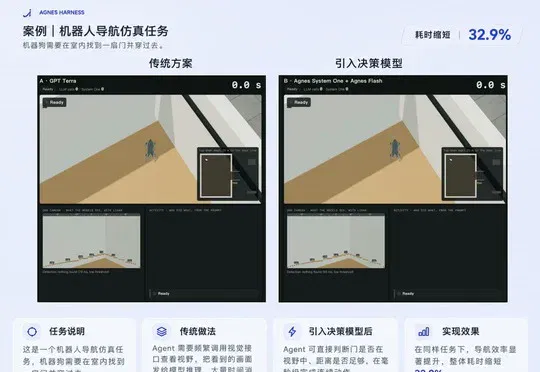
Agnes open-sources agent harness and outlines TTT adaptation and Playbook iteration (opens in a new tab)
Agnes AI released Agnes Harness, separating LLM reasoning from a decision model, and outlined TTT and controlled Playbook iteration. Nine team-reported system benchmarks and simulation cases do not isolate the harness's gains or establish general real-world reliability.
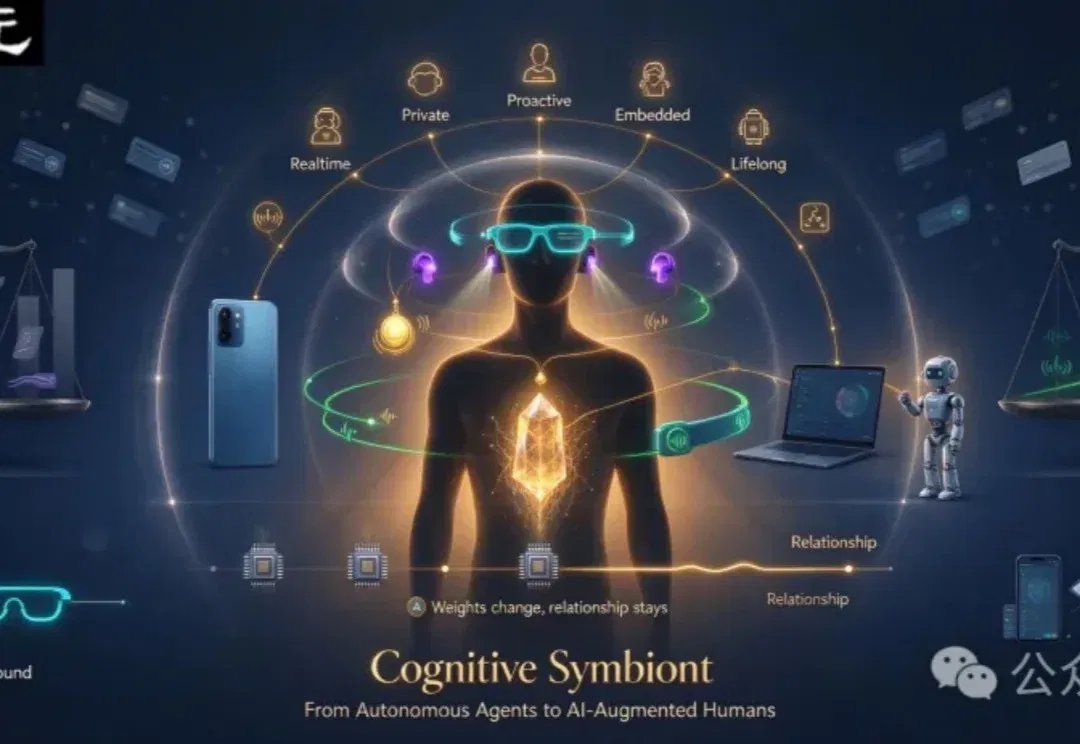
Oxford researcher proposes cognitive symbionts for wearable AI augmentation and governance (opens in a new tab)
Hao Fei's perspective paper proposes cognitive symbionts and AI-Augmented Human Intelligence, covering long-term memory, wearables, proactive help and governance. Privacy, low latency and lifelong companionship are design goals, not verified product guarantees.

SingularityBench tests AI infrastructure optimization; Opus 5.5 exceeds five selected baselines (opens in a new tab)
SingularityBench compares agents with selected systems on six infrastructure tasks. Opus 5.5 with Claude Code scores about 1.25 overall; this does not establish complete recursive self-improvement or superiority over all human engineering.
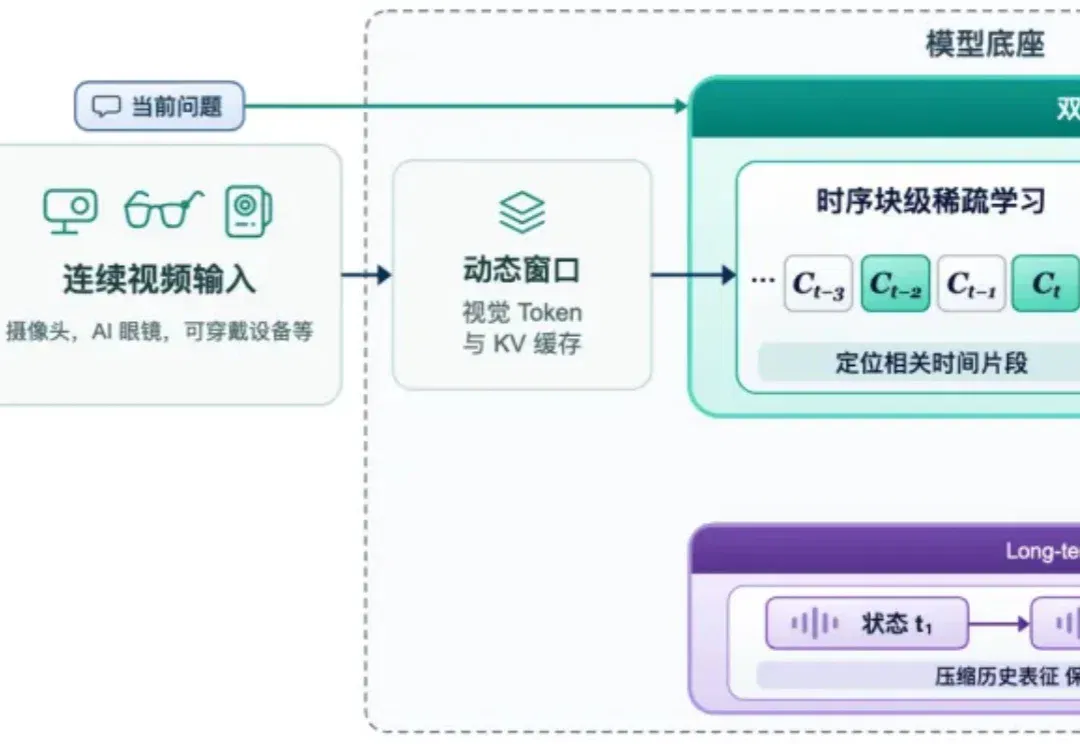
Weitu AI presents a streaming-video brain combining sparse perception and long-term memory (opens in a new tab)
Weitu AI selects temporal segments and spatial features to control compute costs, reporting OVBench and S-EMBER results and exploring continuous video understanding for glasses, offices and industry. Outcomes depend on devices, deployment and task conditions.
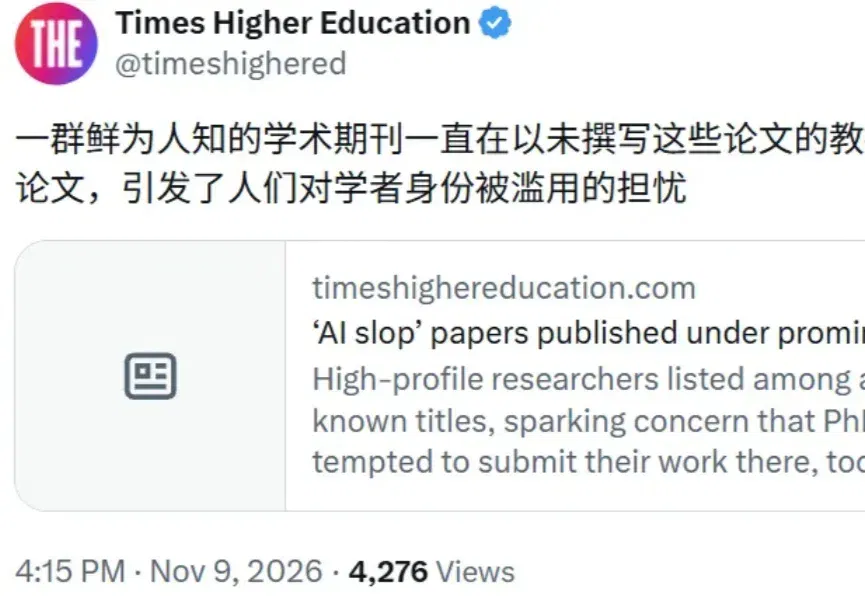
Report traces falsely attributed papers and journals’ misuse of researchers’ names (opens in a new tab)
Synced summarizes a THE investigation and researchers’ responses about false authorship, indexing and verification. The journals’ lack of response remains attributed to the source; AI-detector scores alone cannot establish origin or identity.