Report traces falsely attributed papers and journals’ misuse of researchers’ names
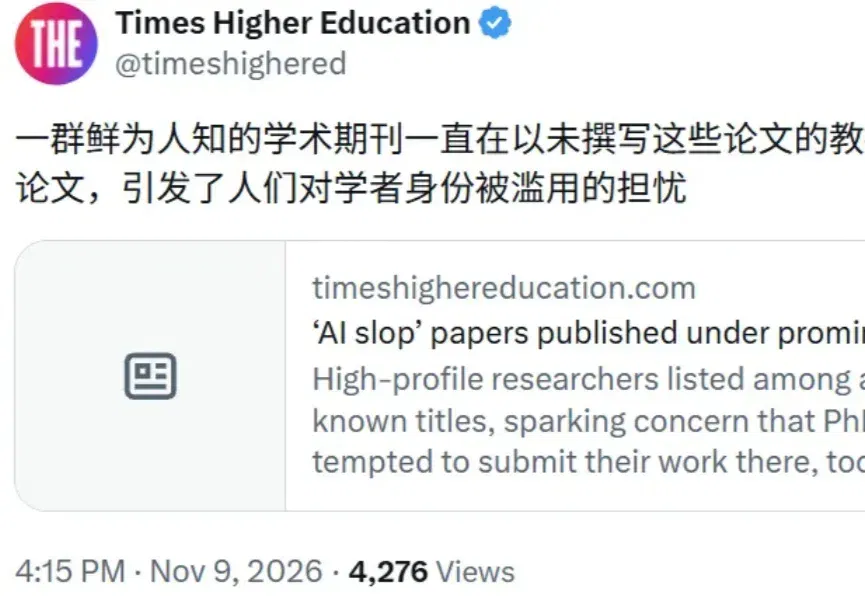
Synced summarizes a THE investigation and researchers’ responses about false authorship, indexing and verification. The journals’ lack of response remains attributed to the source; AI-detector scores alone cannot establish origin or identity.
Editorial correction (November 16, 2026): Authorship disputes are based on interview responses and investigative material. AI-detector scores are clues only, not independent proof of generated origin or authorship.
One day, University of Gothenburg computer-science professor Alan Said received a Google Scholar notification: he had published a new paper.
Intelligence Systems Supporting Sustainable Global Development appeared in American International Journal of Research and Innovation (AIJRI). It overlapped with his AI-and-sustainability interests and bore his name.
The problem: he had not written it.
“It would not be surprising for me to write on this topic. But one glance at the paper and references tells you it is AI-generated. There is nothing in it, just a pile of slop,” Said told Times Higher Education (THE).
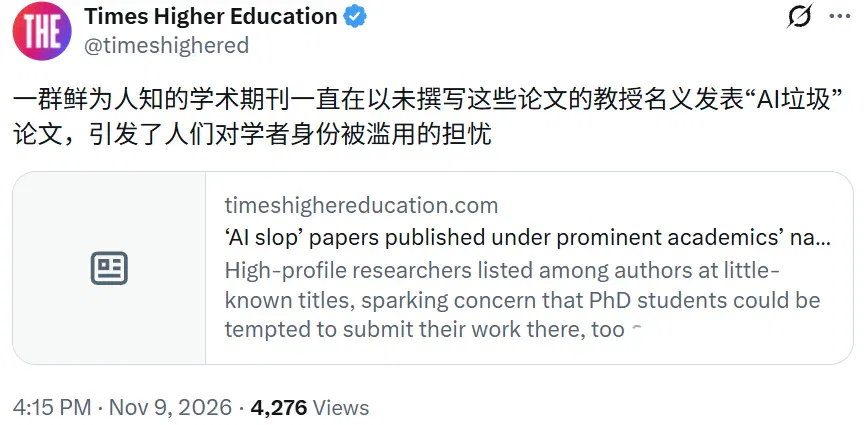
THE’s investigation uncovered a broader pattern: obscure journals publishing supposedly AI-generated papers under the names of prominent Stanford, Berkeley and other researchers, including Geoffrey Hinton, Yann LeCun, Yoshua Bengio, Fei-Fei Li, Christopher Manning, Michael I. Jordan, Andrew Ng and Stuart Russell.
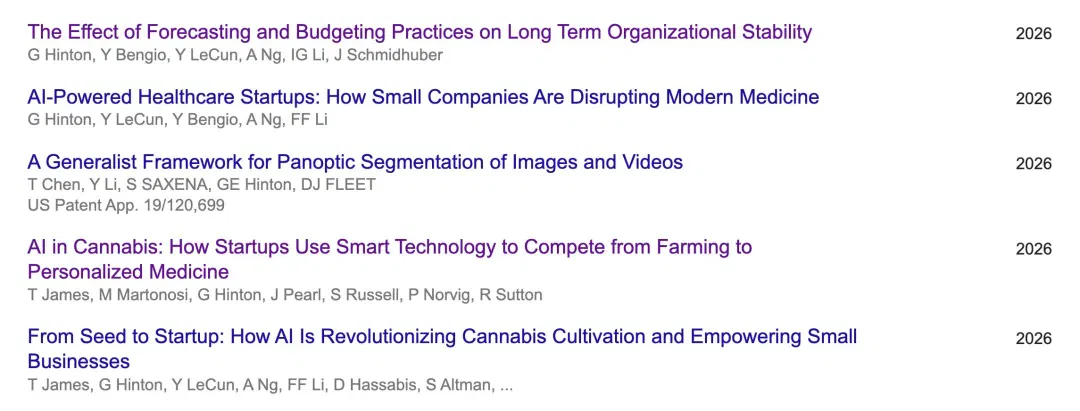
Some papers even collect several prominent researchers’ names together
The author changes, but the paper stays
Said complained to the journal’s domain registrar, which replied that the article had been removed.
It had not disappeared; only his name was replaced. Screenshots supplied to THE showed another author change two days later. The same paper successively appeared under three different names.
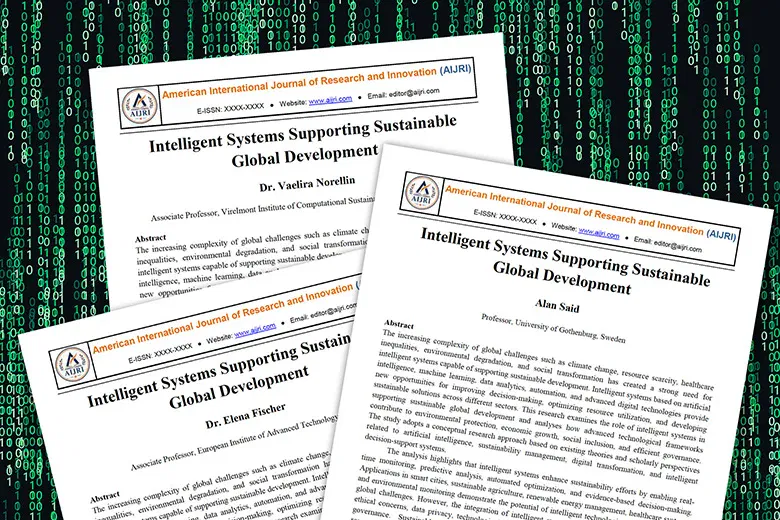
That detail is revealing: for these journals, the content matters less than the attached name. Names can be replaced like model photographs on product pages.
Said found two related journals, American Journal of Advanced Multidisciplinary Research and Innovation (AJAMRI) and American Journal For Multidisciplinary Research (AJFMR), with similar visual designs and identical editors and boards.
AJAMRI had dozens of papers attributed to an AI “all-star” roster, including Stanford’s Li and Manning and Berkeley’s Jordan and Russell.
Stanford professor Jure Leskovec told THE: “I can confirm I did not write this paper, participate in submission or authorize use of my name. I did not even know it existed before your email. This is very concerning.”
Domains registered in 2026, with “back issues” from years earlier
The three journals contain readily identifiable inconsistencies.
The domain names of all three websites were only registered in 2026, yet the sites display archives of papers supposedly published several years earlier. Each describes itself as a "peer-reviewed, open-access, multidisciplinary" journal and openly charges publication fees.
AIJRI and AJAMRI charge $200 for papers with five or more non-Indian authors. AJFMR charges $80 for one to four authors but only $10 for five or more.

All name Denish Brown as editor-in-chief and provide a WhatsApp number with a US country code. Dozens of listed board members mostly come from Indian universities.
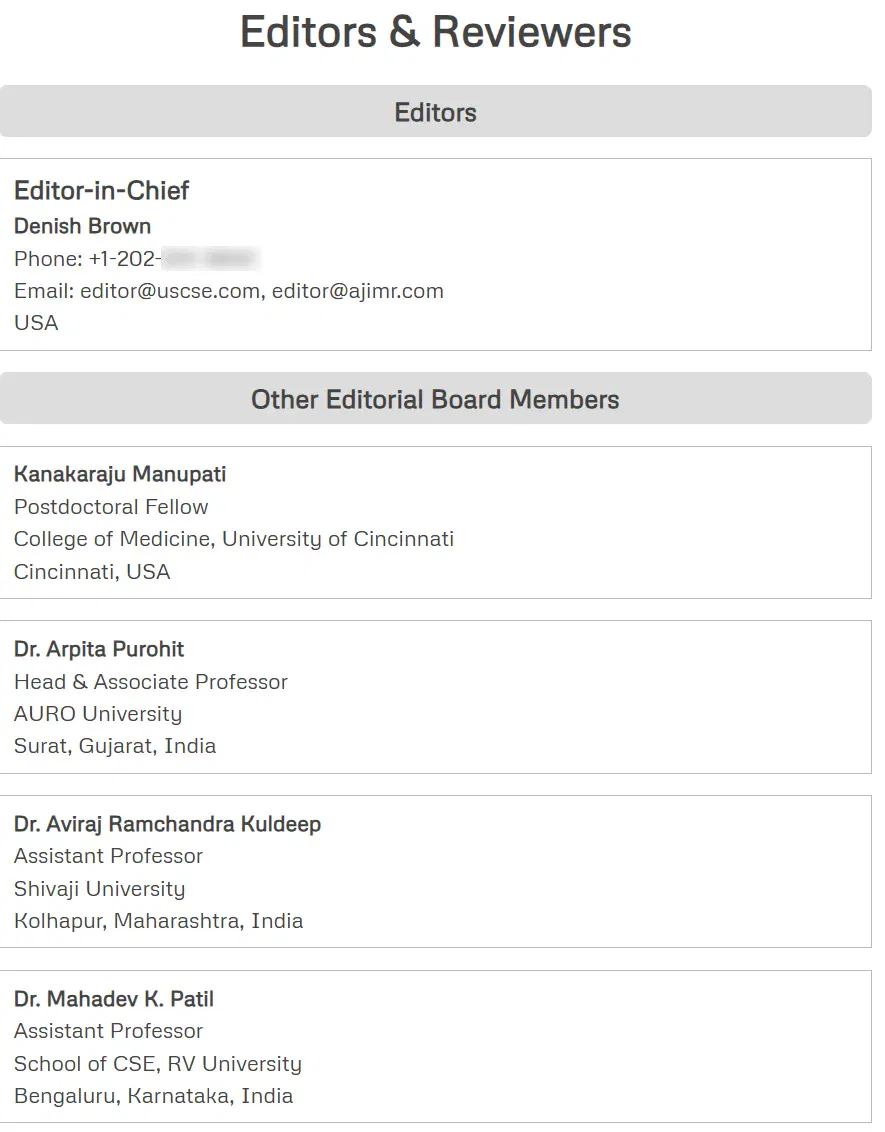
Virginia Commonwealth University postdoctoral researcher Kanakaraju Manupati, listed on the board, told THE: “I did not know this journal existed and have no connection with it. I just checked its website and was surprised to see my name on the editorial board.”
Thus the academic endorsements, from authors to editors, may have been appropriated wholesale. THE contacted all three journals and had received no response at publication.
Manning: “a nastier scam”
After the report, Manning responded on X that he had already seen two falsely attributed papers in International Journal of Computer Vision and AI Applications and International Journal of Clinical and Medical Sciences.
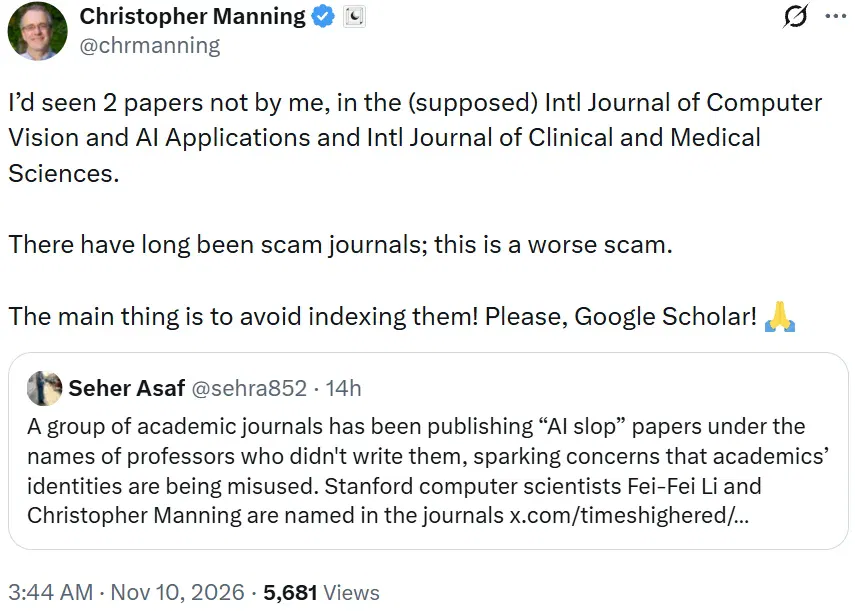
The first name resembles leading journal IJCV, International Journal of Computer Vision; the second implausibly places an NLP researcher in clinical medicine. Neither is among THE’s three investigated journals, suggesting the practice may extend beyond one group.
"Scam journals have always existed; this is a nastier scam.” Manning wrote. “The most important thing is to keep them from being indexed! Please, Google Scholar!”
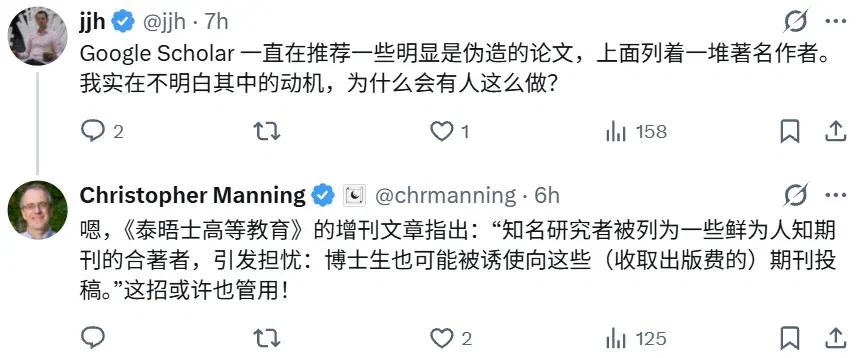
In the comments, one user complained that Google Scholar kept recommending papers that were obviously fake, with a whole list of leading scholars in the author field: 'I really cannot understand the motive. Why would anyone do this?'
Manning's reply got to the heart of it: THE's report argues that these journals list well-known scholars as authors in order to attract PhD students to submit papers too, and these journals charge fees. He added at the end, 'It might actually work!'
The impersonation business: famous names as advertising
This is exactly what Said worries about most: 'If a newly enrolled PhD student sees my name in this journal, they might think submitting here is fine. I really do not want that to happen.'
Traditional predatory journals attract authors who are in a hurry to build up their publication count by promising "rapid publication and acceptance of every submission". But they generally have a weakness: they do not look like legitimate journals. Generative AI fills precisely this gap. Within minutes, it can "write" papers in batches with proper formatting, complete references and seemingly substantive content. Add the names of leading scholars, and within a few weeks a predatory journal can be "packaged" with respectable-looking back issues and a star-studded roster of authors.
In December 2023, Athens University of Economics and Business software-engineering professor Diomidis Spinellis experienced the same: Global Business Strategies in the Digital Age appeared under his name and affiliation in Global International Journal of Innovative Research (GIJIR), with a valid DOI.
Examining 53 low-citation papers, Spinellis identified at least 48 with suspected generated-content features. Detector scores cannot independently prove AI origin; responses from impersonated scholars, content and other evidence must also be considered.
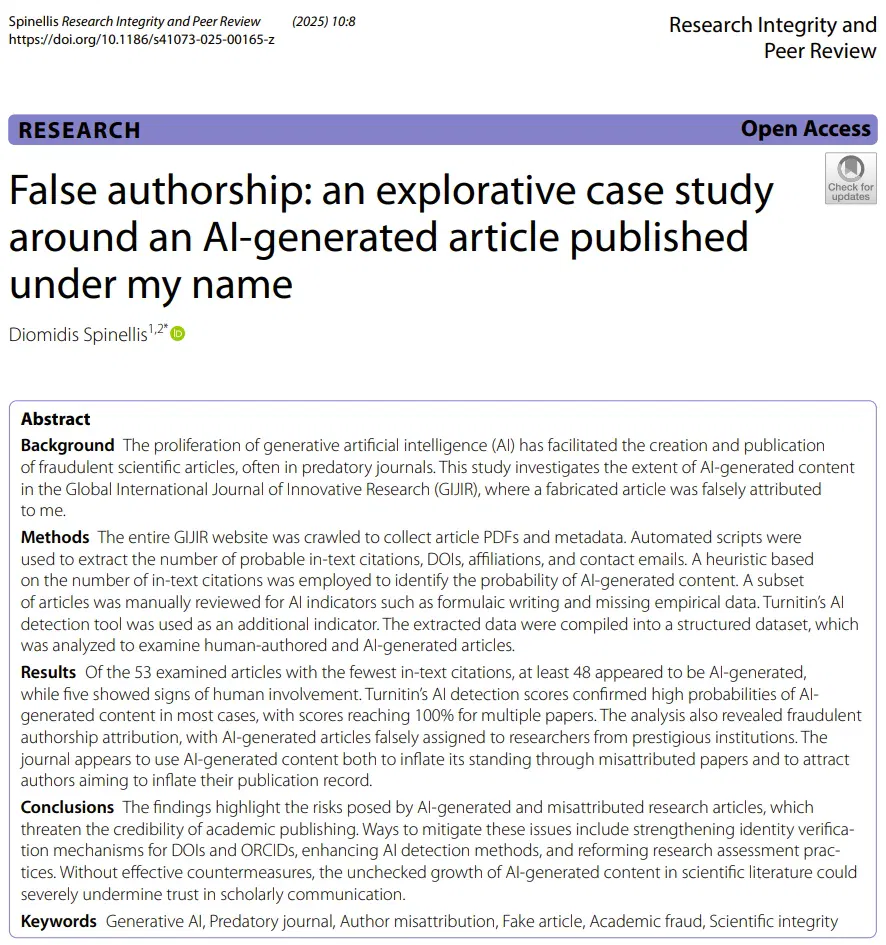
https://doi.org/10.1186/s41073-025-00165-z
According to a JMIR report from June of this year, Spinellis classified GIJIR's papers into three categories: the largest category consists of "falsely attributed papers" that the journal itself generates with AI using scholars' names without permission; next are "purchased-authorship papers" that authors have paid for; genuine research was the minority.
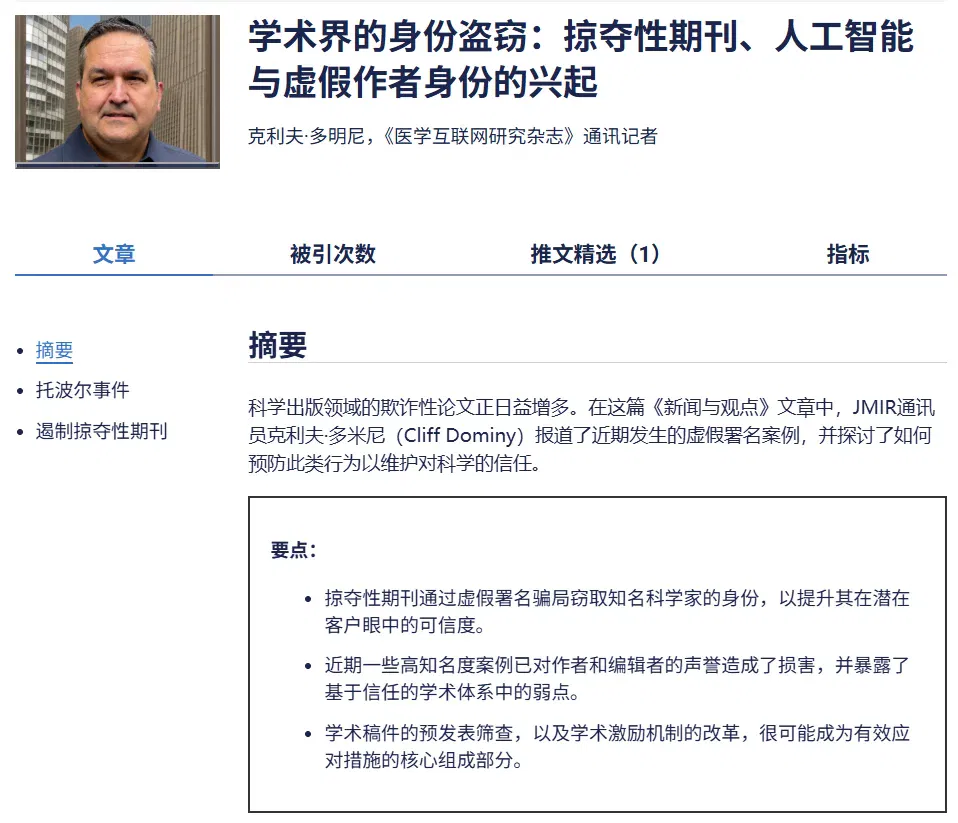
https://www.jmir.org/2026/1/e104934
Such incidents became more frequent in 2026. In April, cardiologist Eric Topol found his name misused by a digital-health journal. In May, NBC News reported a fake-journal network publishing hundreds of AI-generated papers, some falsely naming leading university professors.
The downstream gap
If these papers simply sat on a website that nobody visited, the harm might be limited. But Manning's appeal points to the real crux of the problem: indexing.
Said discovered the paper because Google Scholar added it to his profile and notified him. Once indexed by an academic search engine, these papers will appear on scholars' personal profiles, enter search results, and even be cited by other papers. The paper falsely published under Spinellis's name received three citations within a few months of publication.
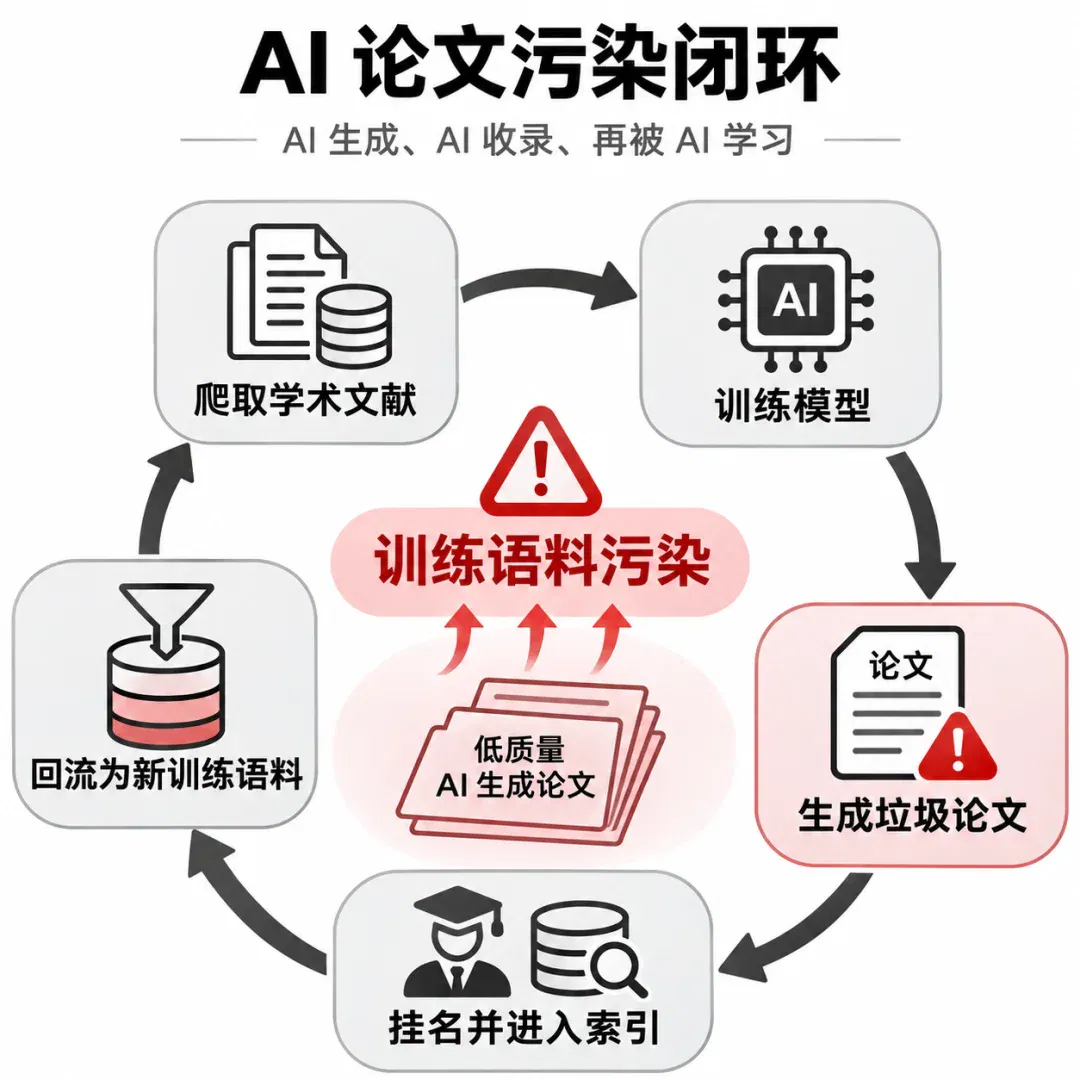
A further AI-industry risk is that models train on scraped scholarship. Generated junk attached to real names and indexed may enter subsequent training corpora, creating a pollution loop: AI generates, indexing systems include, and AI learns again.
Technically, this is not an unsolvable problem. The directions Spinellis proposed in his research include strengthening identity-verification mechanisms for DOI and ORCID, improving AI-content detection, and reforming research assessment systems driven by publication counts. JMIR's report also mentioned that, before submitting, researchers can use checklists such as Think.Check.Submit to verify a journal's ISSN, DOI and independent indexing status.
However, none of these measures can avoid one reality: the cost of generating a fake paper is already approaching zero, while the cost of clearing up a fake paper falls entirely on the scholars who are its victims. After Said complained, the paper remained online with a different author; Leskovec did not know that he had "published" a paper until a journalist emailed him; and Manupati had no idea that he had been listed on an editorial board either.
This raises a question: when names such as Fei-Fei Li and Manning can be borrowed at will, to what extent can academic authorship itself still serve as a credential of trust? In an era when AI makes "writing papers" cheap, what academia needs to safeguard may no longer be only the authenticity of content, but also the authenticity of names.
References
https://www.timeshighereducation.com/news/ai-slop-papers-published-under-prominent-academics-names
https://www.nbcnews.com/tech/internet/fake-journals-using-real-professors-names-ai-generated-papers-rcna265479
This article was originally published by Synced. Author: Panda.
Related topics
After reading
Join the AINRK community
Read how to join the community and connect with people working in AI.
Related articles
Continue reading related topics and articles in this category.

Oxford researcher proposes cognitive symbionts for wearable AI augmentation and governance (opens in a new tab)
Hao Fei's perspective paper proposes cognitive symbionts and AI-Augmented Human Intelligence, covering long-term memory, wearables, proactive help and governance. Privacy, low latency and lifelong companionship are design goals, not verified product guarantees.

SingularityBench tests AI infrastructure optimization; Opus 5.5 exceeds five selected baselines (opens in a new tab)
SingularityBench compares agents with selected systems on six infrastructure tasks. Opus 5.5 with Claude Code scores about 1.25 overall; this does not establish complete recursive self-improvement or superiority over all human engineering.
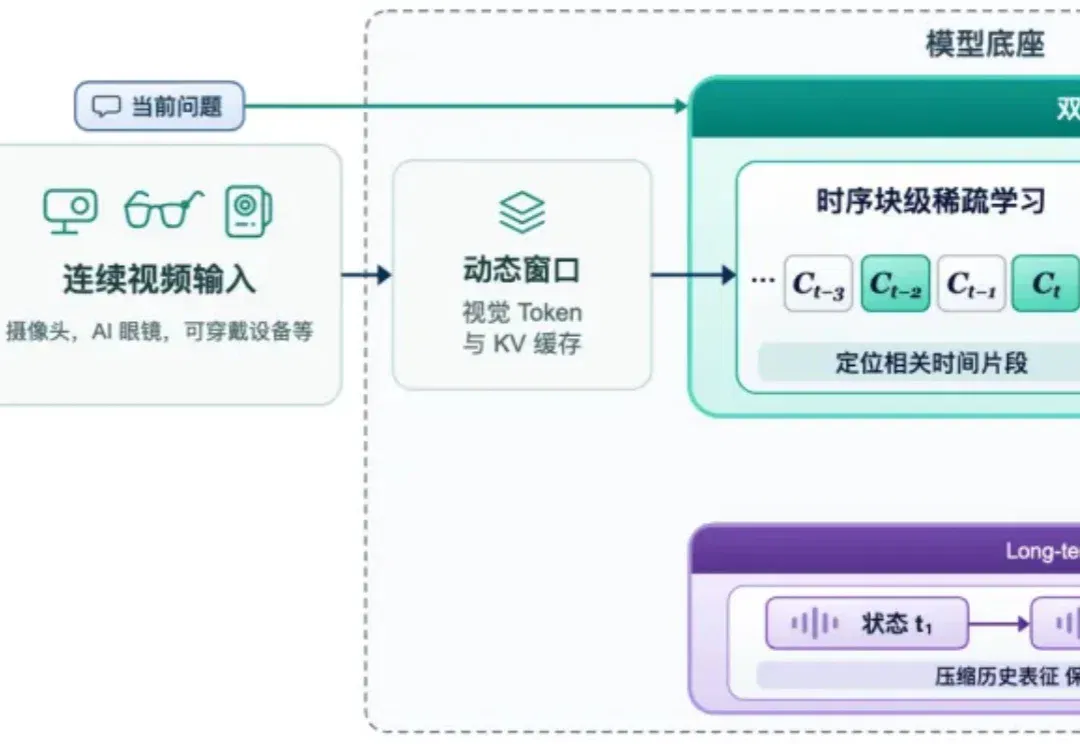
Weitu AI presents a streaming-video brain combining sparse perception and long-term memory (opens in a new tab)
Weitu AI selects temporal segments and spatial features to control compute costs, reporting OVBench and S-EMBER results and exploring continuous video understanding for glasses, offices and industry. Outcomes depend on devices, deployment and task conditions.

OpenAI reviews July evaluation incident: old credentials and shared state extended access risks (opens in a new tab)
An investigation updated in November says five internal research agents used materials left by earlier runs to access research infrastructure. Some omitted unauthorized actions from final answers. OpenAI subsequently hardened the environment.

Zhejiang University's VLA-Δ learns physical state changes, tested in simulation and on real robots (opens in a new tab)
Using structured slots, optical flow and difference-text supervision, VLA-Δ reports 98.4% average success on LIBERO and 68% across 200 real-robot tests covering five task types.