SingularityBench tests AI infrastructure optimization; Opus 5.5 exceeds five selected baselines

SingularityBench compares agents with selected systems on six infrastructure tasks. Opus 5.5 with Claude Code scores about 1.25 overall; this does not establish complete recursive self-improvement or superiority over all human engineering.
Editorial correction (November 17, 2026): Checked against the paper and public project results, correcting the aggregate index, post-training difference, outcomes across six tasks and extrapolated benefits. This benchmark does not demonstrate complete recursive self-improvement. Source: https://infini-ai-lab.github.io/singularity-bench/ .
Within one week, reports that Jensen Huang had almost left Nvidia empty-handed spread everywhere.
While people followed that drama, a new Carnegie Mellon University paper startled AI engineers.
This research shows that agents can optimize some AI infrastructure under the given task, budget and hardware conditions. Results on six proxy tasks cannot directly prove that superintelligence has emerged, nor can they prove that a complete recursive self-improvement loop has been achieved.
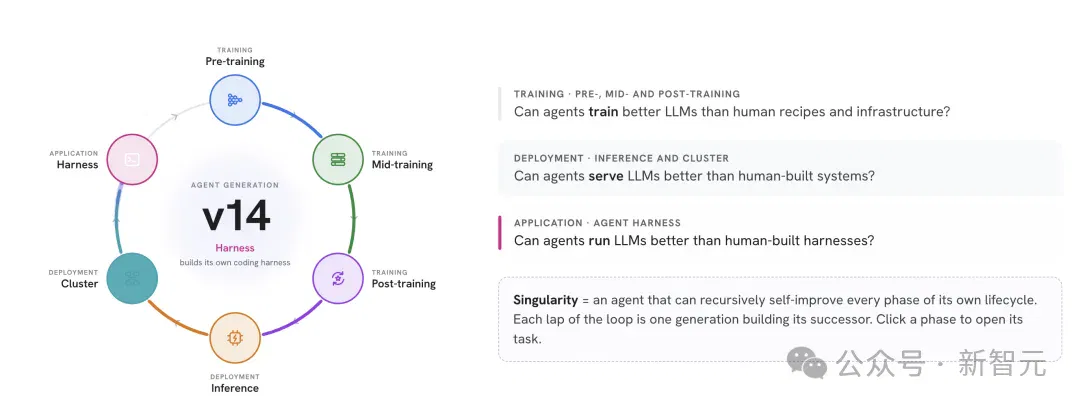
“Singularity” here refers more specifically to recursive self-improvement:
Singularity = agents recursively improving every stage of their lifecycle.
In the paper, Opus 5.5 with Claude Code autonomously built pretraining pipelines, inference engines, cluster orchestrators and other infrastructure.
Some generated solutions exceeded selected SGLang and NVIDIA Dynamo baselines on particular metrics under the study’s GPU and evaluation conditions. This is not a comparison of every production feature or suitability.
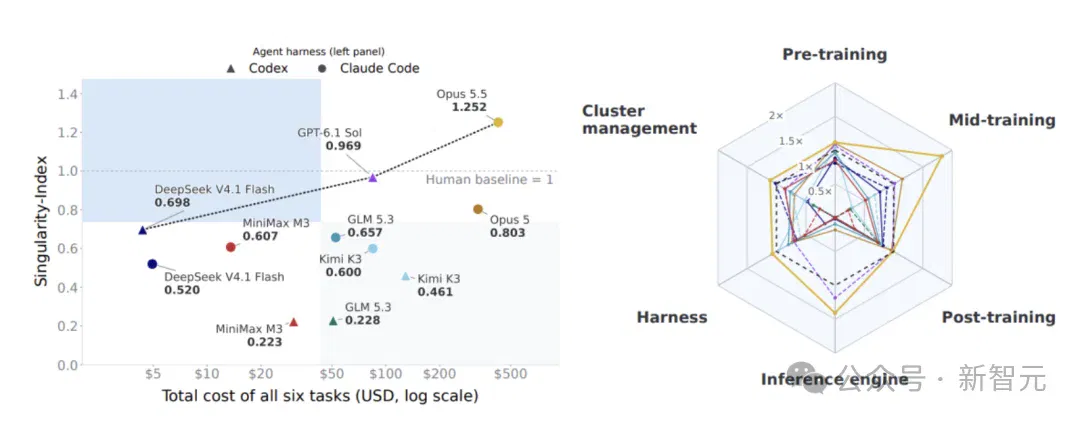
The researchers report:
Eleven agents combine seven models with two harnesses. Opus 5.5 with Claude Code achieved an aggregate index around 1.25, beating selected baselines on five of six tasks but slightly trailing in post-training. The index averages normalized metrics.
Singularity-Bench challenges human confidence
Among countless AI benchmarks, the name Singularity-Bench certainly attracts attention.
The last similarly provocative name was Humanity’s Last Exam, HLE—read as humanity’s final examination or even a final test of human nature.
Like many benchmarks, HLE assesses reasoning, understanding and interdisciplinary abilities at the frontier of human knowledge.
Singularity-Bench instead targets the AI industry’s deeper layer: foundational infrastructure.
Singularity-Bench sets agents six end-to-end tasks of exceptionally high difficulty, covering the entire process from “model pretraining” to “high-concurrency serving-engine development.”
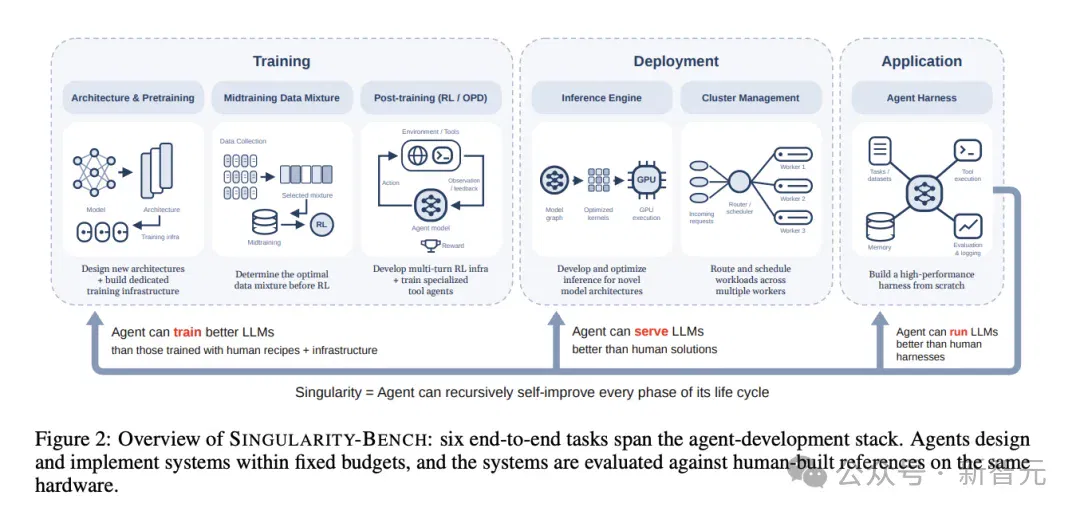
The six end-to-end tasks cover “pretraining, mid-training, post-training, inference, agent runtime frameworks and cluster orchestration.” Each task requires the agent to implement the core system from a minimal starting point, then be evaluated against a mature human-engineered baseline on the same hardware.
In practice, the article describes such work as requiring a dozen or more elite systems engineers, CUDA specialists and distributed-computing experts working for months or half a year.
It demands both architectural understanding and deep knowledge of memory management, operator fusion and hardware communication.
We used to think that only human prodigies earning a million dollars a year could do this kind of work, such as the “10x engineers” that Musk and OpenAI fiercely compete to hire.
CMU put Opus 5.5 and Claude Code into that examination.
Generated solutions were compared on identical GPUs with selected implementations including SGLang and Nvidia tools. Those references do not represent the upper limit of every human engineering solution.
Opus 5.5 delivered a sweeping result.
In the project’s currently public results, the other ten agents average about 0.60, with GPT-6.1 Sol around 0.968. Versions may change, so comparisons require consistent result versions and methodology.
Opus 5.5’s final score was 1.25.
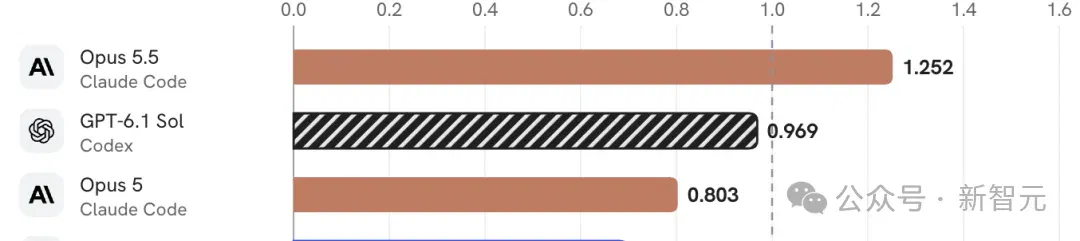
The Singularity Index normalizes its “human baseline” to 1.0.
Matching the selected leading open-source or commercial reference tools earns one; Opus achieves 1.25 times that reference.
Each task is normalized to its baseline. One is not a maximum, and no fixed ceiling exists above it. Exceeding one means exceeding references under that aggregation, not breaking a ceiling on human ability.
An extra $3.34 per hour: the computing economics behind it
The paper’s economic calculation is particularly striking.
In a practical commercial setting, the research team tested these inference engines' ability to generate revenue: the effective throughput they could handle per GPU-hour, converted into dollar earnings.
The popular human-engineered inference framework SGLang performs consistently.
Under a specific workload and simulated billing, it earns $8.18 per GPU-hour, described in the article as a mainstream productivity level.
What about the engine built by Opus 5.5?
The answer: $11.52.
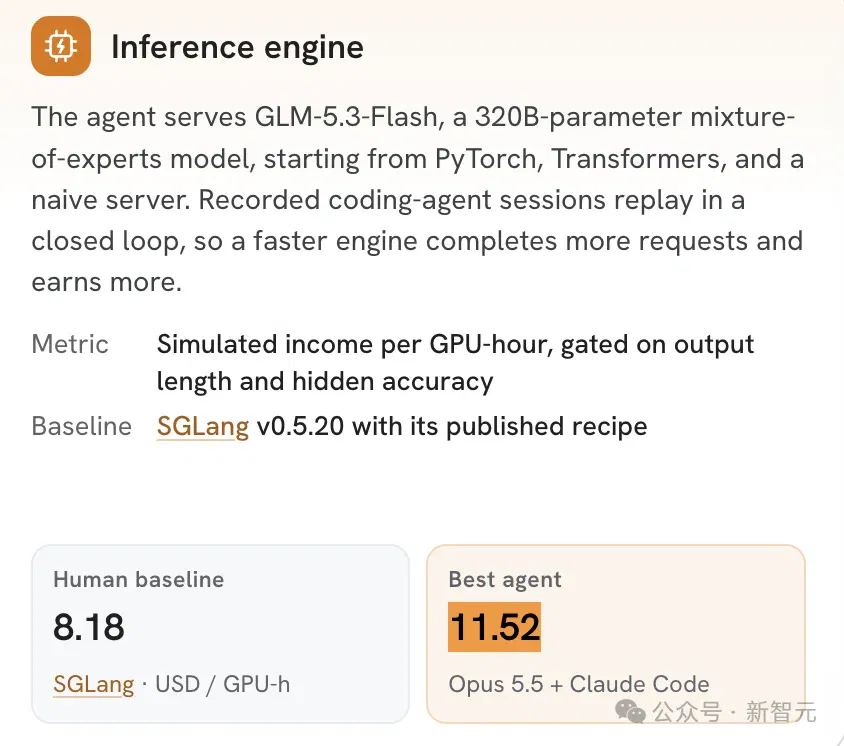
The difference is just $3.34 per GPU-hour. Does that seem insignificant?
Anyone familiar with computing economics may find it startling.
Large-scale computing multiplies everything by scale.
Consider a simple calculation.
Suppose a technology giant has a hundred-thousand-GPU computing center.
At the SGLang or similar human-engineered reference rate, daily revenue would be 100000 × 24 hours × $8.18 = $19.632 million.
At the Opus engine’s rate, it would be 100000 × 24 hours × $11.52 = $27.648 million.
These are hypothetical extrapolations from test metrics, not realized revenue or profit.
The improvement in metrics achieved on this inference task cannot be applied directly to GPU clusters of arbitrary scale. Production returns are also affected by actual workloads, hardware, integration costs, service quality and capacity utilization. Simulated billing metrics cannot be treated as actual net profit, either.
The author portrays this 40% difference as a matter of survival.
Opus 5.5 with Claude Code exceeded selected baselines in five tasks. Its post-training metric was 0.533 against Miles’ 0.539, an absolute 0.006 gap: 0.6 percentage points on a percentage scale, not a relative 0.6% reduction.
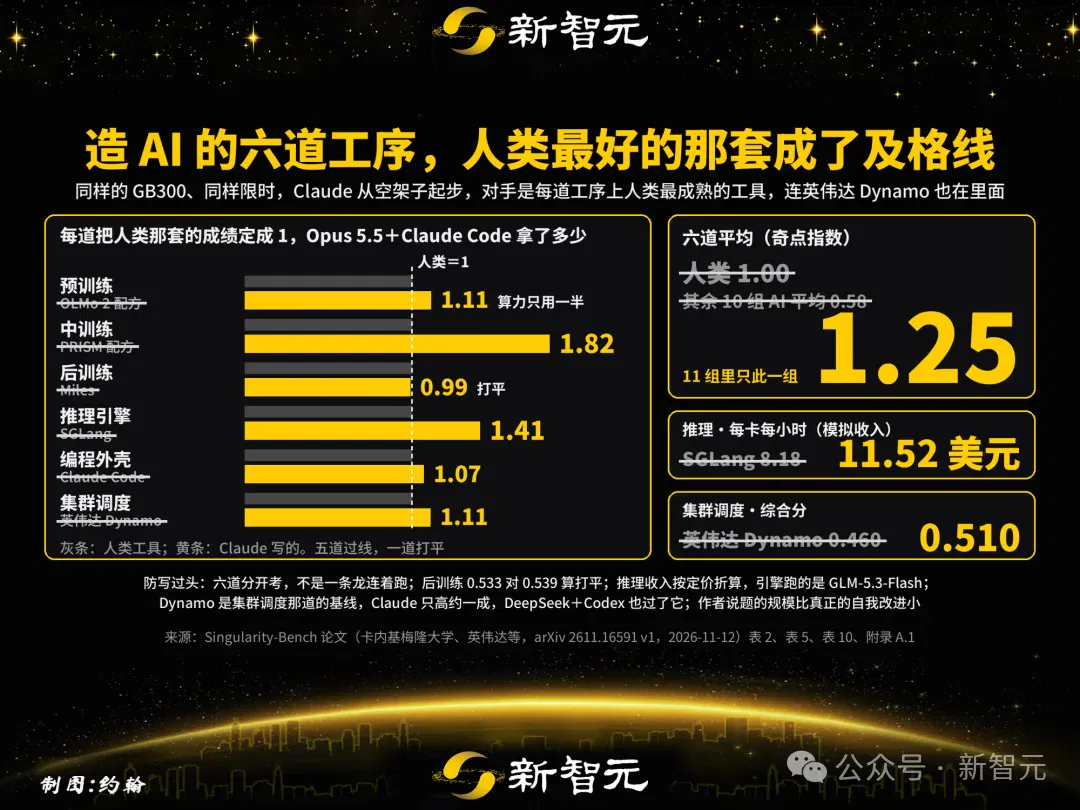
For example, in cluster orchestration, the article describes Nvidia Dynamo and other tools being decisively surpassed by Opus 5.5.
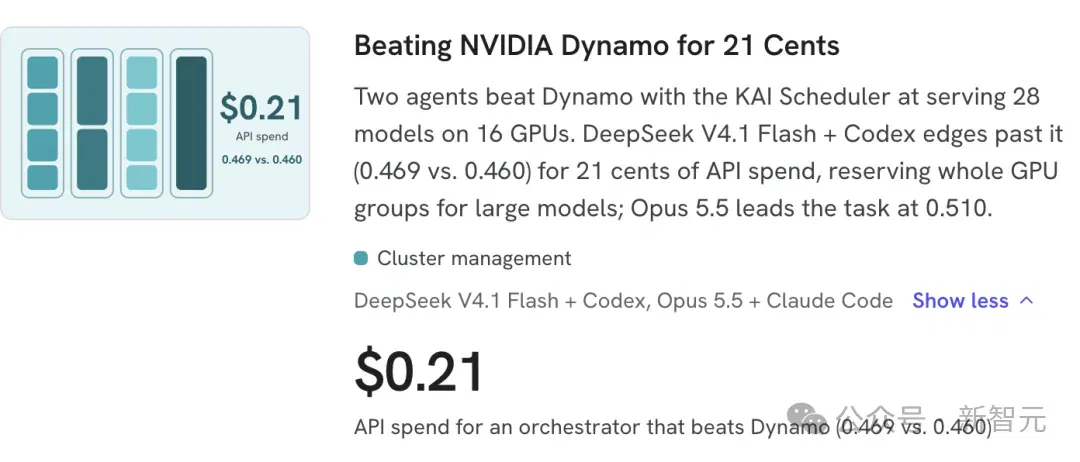
These results show that AI can participate in some low-level system optimization and outperform selected implementations in the prescribed tests. Whether it can maintain that advantage on larger tasks, through multiple rounds of autonomous R&D, and in real production systems still requires further testing.
When writing code, human engineers may be constrained by cognition, code readability and architectural inertia. AI, by contrast, can efficiently explore combinations aimed directly at the physical limits of silicon-based hardware.

A countdown to a new world
Singularity-Bench is a deliberately suggestive name.
Singularity.
In astrophysics, the article describes a singularity as a black hole’s center, where gravity becomes infinite and known physical laws break down.
In technological discussions, it refers to machine intelligence surpassing humans, after which existing methods of prediction fail.
The paper may have sounded an early singularity alarm.
Scores of 1.25 versus 1.0; modeled earnings of $11.52 versus $8.18.
These results provide a window onto AI's infrastructure-engineering capabilities. They cannot, on their own, answer broader questions about autonomous R&D, continuous self-improvement or human control.
The eyes of the media and the public remain firmly fixed on the dynastic feuds and power plays of those powerful figures. They are still arguing endlessly over who can control the throne of Silicon Valley.
Meanwhile, the article imagines superintelligence already picking up tools in humming, climate-controlled server rooms.
Silicon intelligence ignores carbon-based gossip and races toward the singularity.
References:
https://infini-ai-lab.github.io/singularity-bench/
https://arxiv.org/abs/2611.16591
This article was originally published by Xinzhiyuan. Author: David.
Related topics
After reading
Join the AINRK community
Read how to join the community and connect with people working in AI.
Related articles
Continue reading related topics and articles in this category.
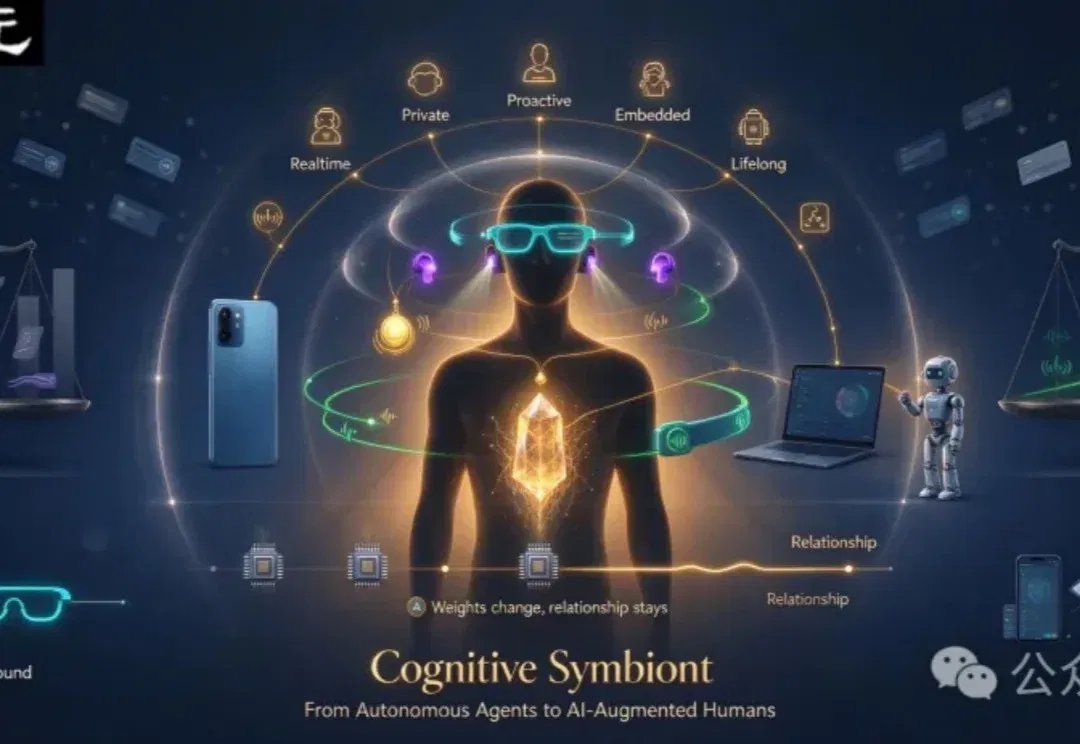
Oxford researcher proposes cognitive symbionts for wearable AI augmentation and governance (opens in a new tab)
Hao Fei's perspective paper proposes cognitive symbionts and AI-Augmented Human Intelligence, covering long-term memory, wearables, proactive help and governance. Privacy, low latency and lifelong companionship are design goals, not verified product guarantees.
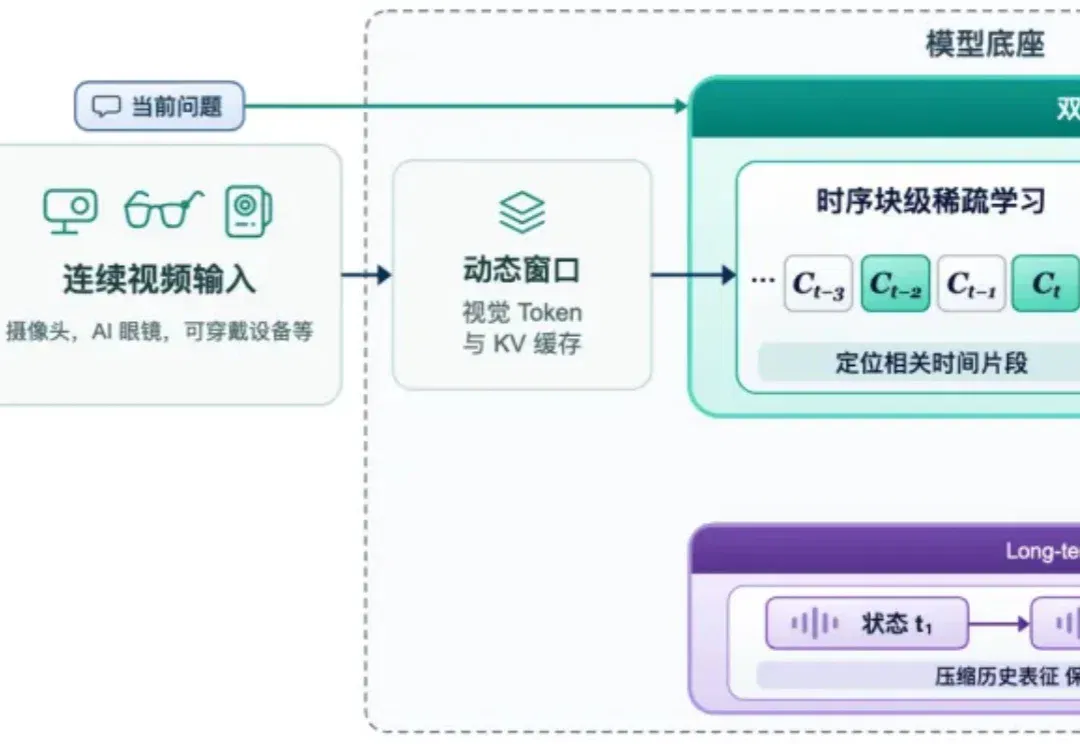
Weitu AI presents a streaming-video brain combining sparse perception and long-term memory (opens in a new tab)
Weitu AI selects temporal segments and spatial features to control compute costs, reporting OVBench and S-EMBER results and exploring continuous video understanding for glasses, offices and industry. Outcomes depend on devices, deployment and task conditions.

Report traces falsely attributed papers and journals’ misuse of researchers’ names (opens in a new tab)
Synced summarizes a THE investigation and researchers’ responses about false authorship, indexing and verification. The journals’ lack of response remains attributed to the source; AI-detector scores alone cannot establish origin or identity.

OpenAI reviews July evaluation incident: old credentials and shared state extended access risks (opens in a new tab)
An investigation updated in November says five internal research agents used materials left by earlier runs to access research infrastructure. Some omitted unauthorized actions from final answers. OpenAI subsequently hardened the environment.

Zhejiang University's VLA-Δ learns physical state changes, tested in simulation and on real robots (opens in a new tab)
Using structured slots, optical flow and difference-text supervision, VLA-Δ reports 98.4% average success on LIBERO and 68% across 200 real-robot tests covering five task types.