Four Chinese AI models compared on investment research deliverables
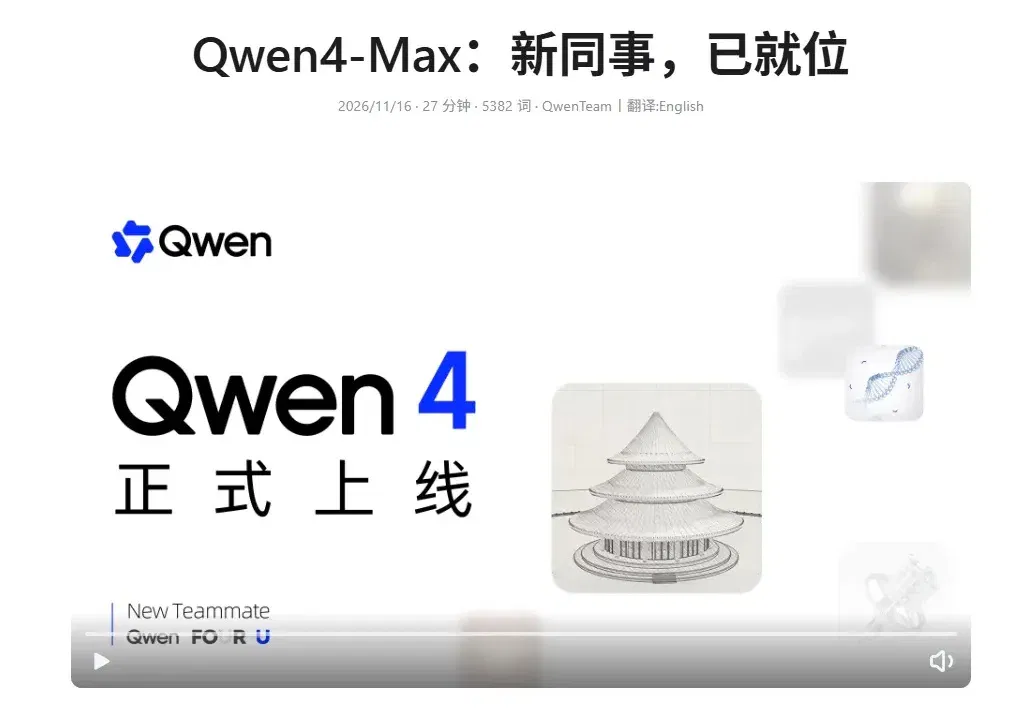
AI Tech Review tests Qwen4-Max, Hy4, Kimi and DeepSeek using frozen market data, comparing workpapers, Excel formula compatibility and API costs. Price forecasts remain unverified; this small test does not establish trading returns or predictive reliability.
Editorial correction (November 19, 2026): This article compares task deliverables using frozen data. The price forecasts have not yet reached their validation date, and self-reported intervals do not constitute validated probabilities or returns.

We gave four Chinese large models the same financial-analysis tasks: only Qwen4-Max at its default setting produced Excel files without error values after opening and recalculation. DeepSeek was the cheapest; Kimi was the slowest and most expensive.
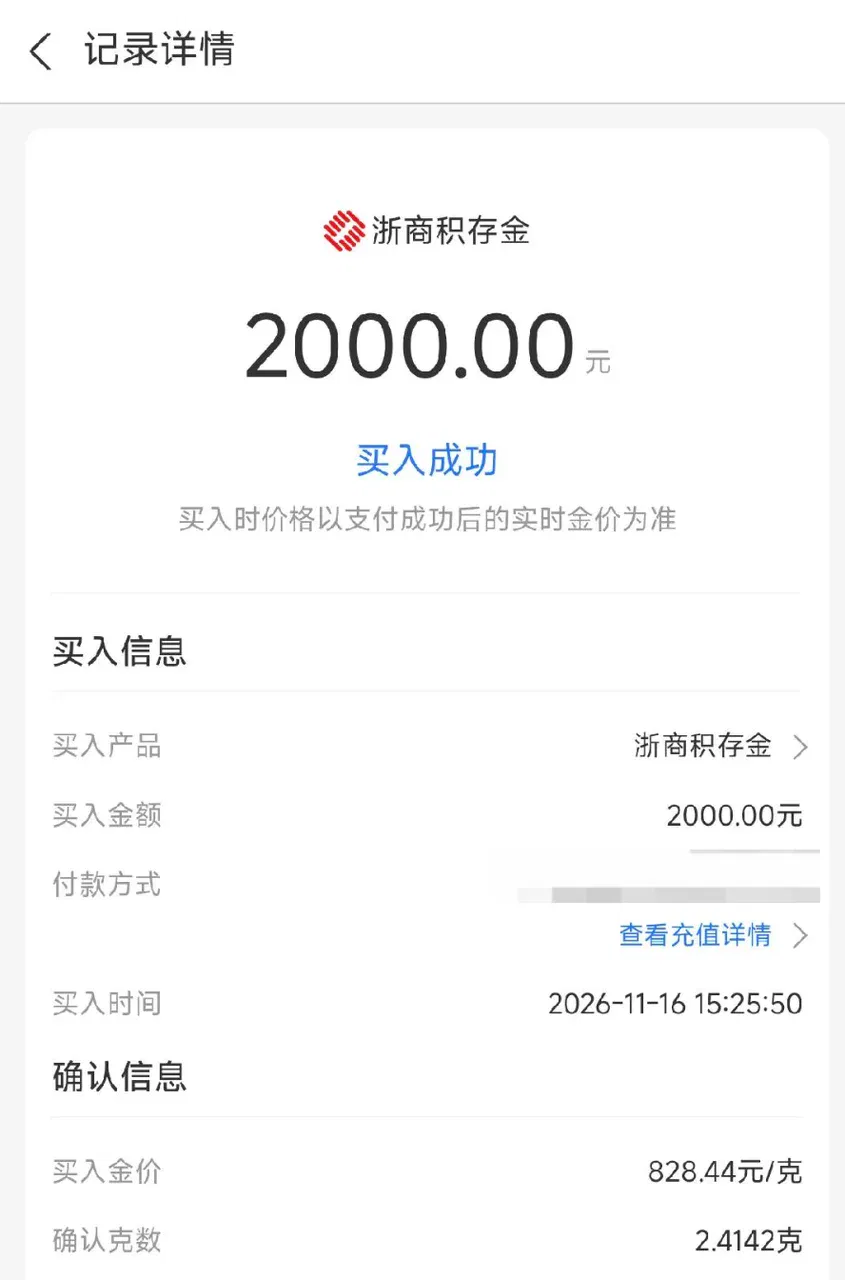
On the afternoon of November 16, one of our editors bought 2,000 yuan of gold through a mobile banking app. The transaction price was 828.44 yuan per gram, yielding 2.4142 grams.
The gold market has not had a good year. Au99.99 on the Shanghai Gold Exchange has fallen about a third from its late-January peak, while the CSI 300 is down more than 20% from its high for the year.
Coincidentally, Alibaba officially launched Qwen4-Max that same day. Its official blog post, titled “Your New Teammate Has Arrived,” specifically demonstrated a financial investment-research task: the model called 90 MCP tools, retrieved data from multiple markets, analyzed CSI 300 equity-index derivatives, and ultimately delivered an Excel workpaper and a directly editable PowerPoint, with a source for every figure.
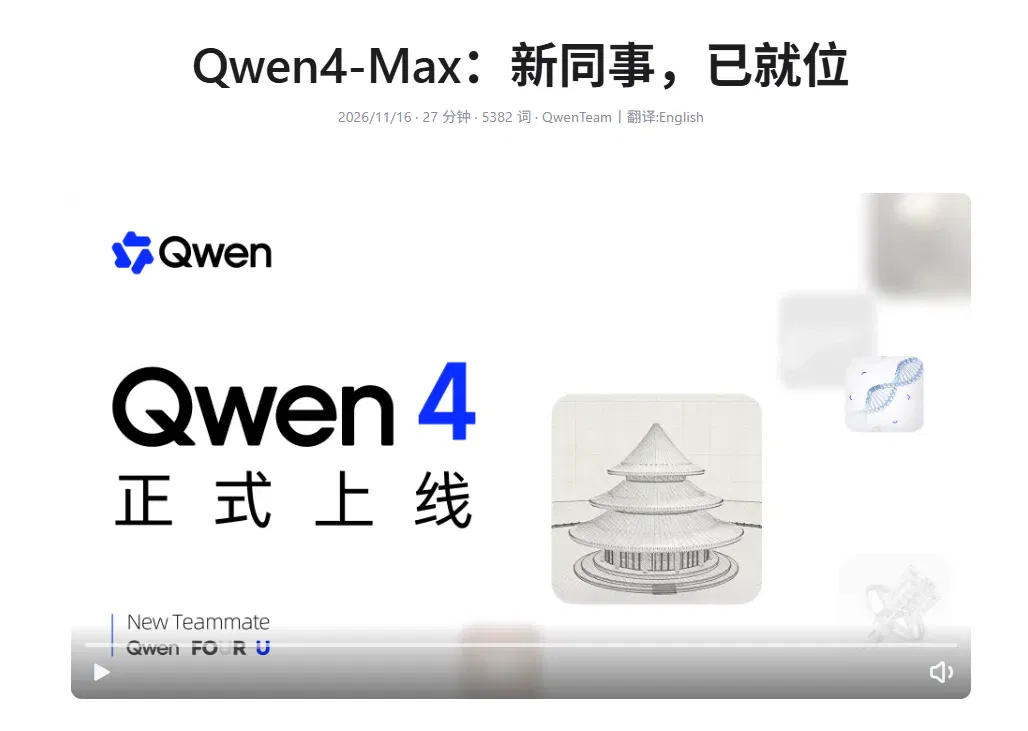
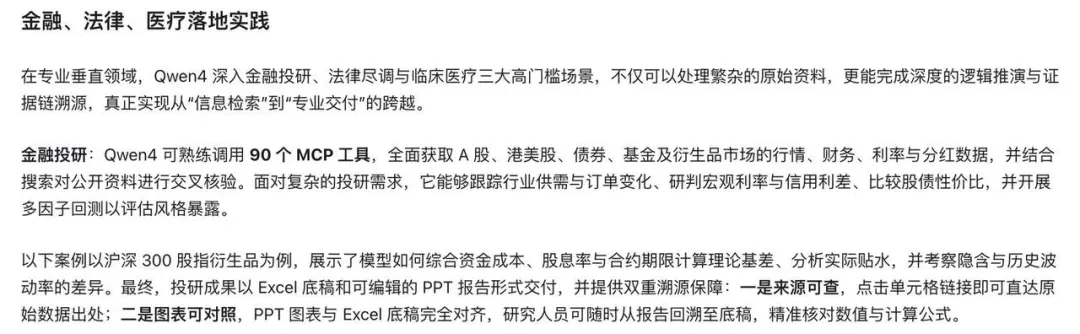
The “Practical applications in finance, law and healthcare” section of the official Qwen4-Max blog
Since Alibaba calls Qwen4-Max a “new teammate,” we decided to have it work a shift on the investment-research team.
We designed several tasks based on the official financial-research example and compared Qwen4-Max with Tencent Hunyuan Hy4, Kimi K3.1 Pro and DeepSeek V4.1 Flash to see how much of the work each model could actually complete. Finally, we asked them to predict what the editor’s 2.4 grams of gold would be worth a week later.
An interesting result emerged: the four models’ core calculations were largely correct, but problems appeared when we actually opened their submitted Excel files and performed a full recalculation. On the equity-index futures task, only Qwen4-Max at its default setting produced a workpaper without error values among the five submissions; another task aimed at ordinary retail investors produced much the same picture. More surprisingly, Qwen4-Max’s higher-reasoning xhigh setting performed worse than its default setting on some delivery details.
As for cost, Qwen4-Max spent 30.5 yuan across four tasks, nearly nine times as much as DeepSeek. What accounted for that premium, and whether it was worth paying, were the questions we most wanted to clarify.
01
Qwen4-Max,
This time, it wants to be your “new teammate”
Qwen4-Max is Alibaba’s new-generation flagship foundation model, officially released on November 16. The official blog post is titled Your New Teammate Has Arrived. It is deeply optimized for real tasks, can call specialist tools to handle long-running work, and can deliver a usable first version before revising it in response to user feedback until the job is finished. The company calls this mechanism Live Delivery.
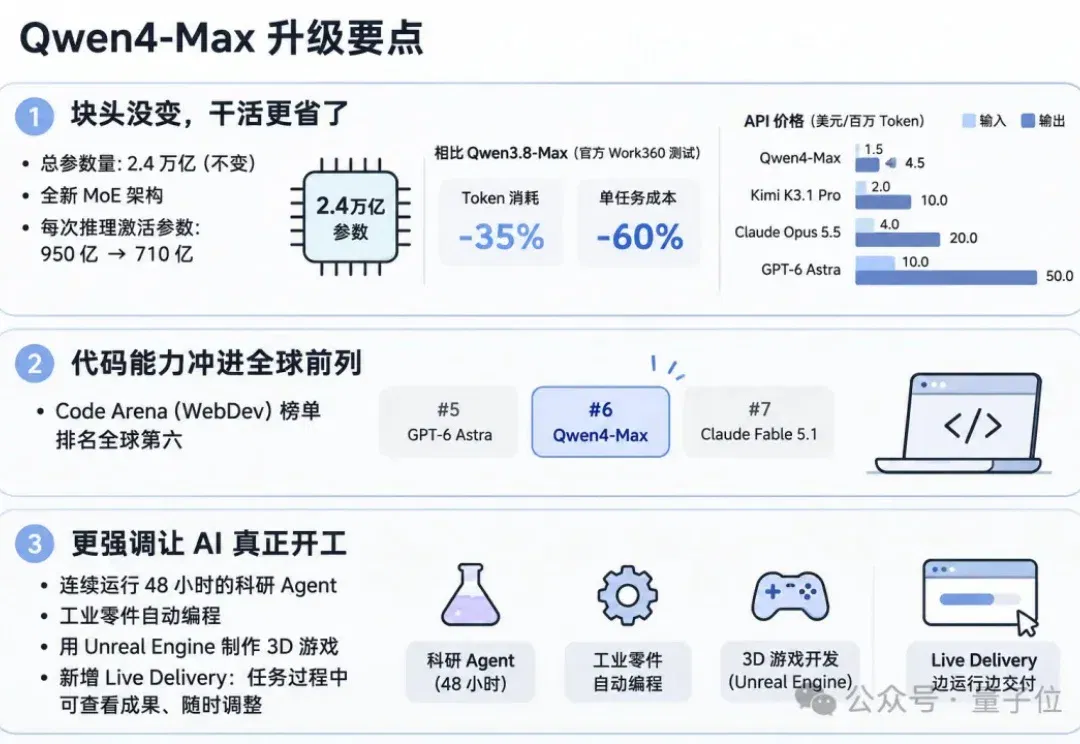
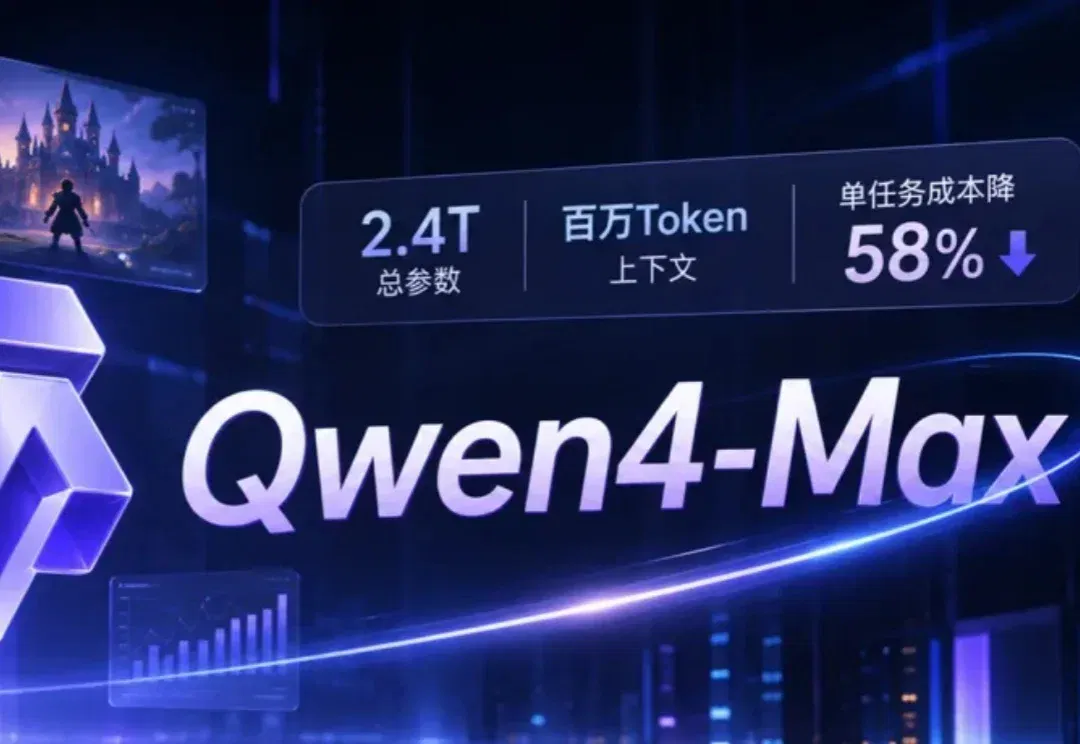
According to the company, this generation adopts a new MoE architecture based on Qwen Sparse Attention (QSA): 2.4T total parameters, with just 71B activated per token, 25% fewer than its predecessor; native vision support and a 1M context window.
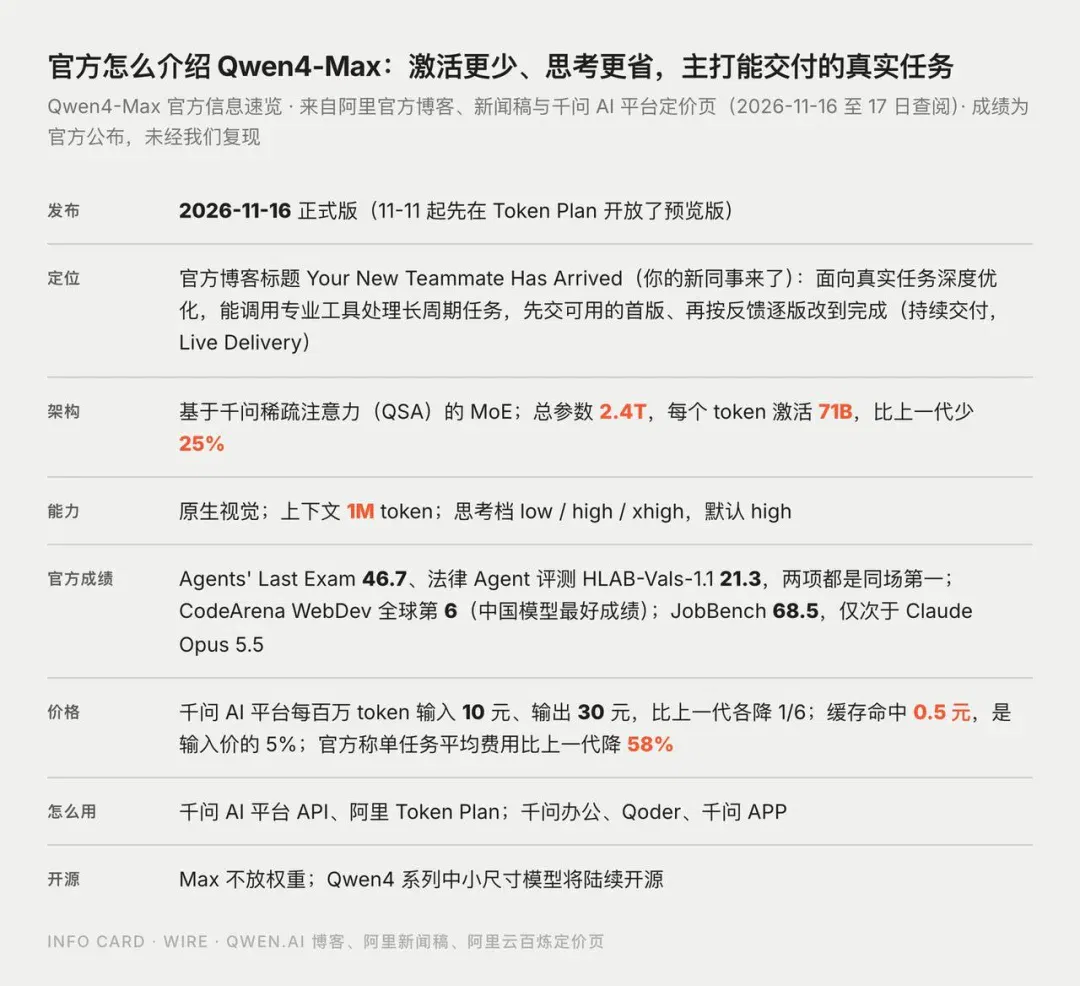
Official Qwen4-Max information at a glance
In the company’s published results, Qwen4-Max ranks highly on numerous agent and professional-task benchmarks. It scored 46.7 on Agents’ Last Exam, an improvement of 18.8 points over its predecessor and the highest among the models in the company’s comparison; it scored 21.3 on the HLAB-Vals-1.1 legal-agent benchmark, also taking first place; it ranked sixth on the WebDev leaderboard of CodeArena, the global blind evaluation of front-end coding, which the company described as the best result for a Chinese model; it scored 68.5 on the professional-work benchmark JobBench, second only to Claude Opus 5.5. All 15 results compared with the previous Qwen3.8-Max in the company’s chart improved on the earlier generation.
Efficiency is another focus of the upgrade. With both models running at xhigh on Terminal-Bench 4.0, Qwen4-Max’s average token use per attempt fell from its predecessor’s 289K to 151K, while its score rose from 38.9 to 48.5. In the company’s words, it reasons more efficiently.
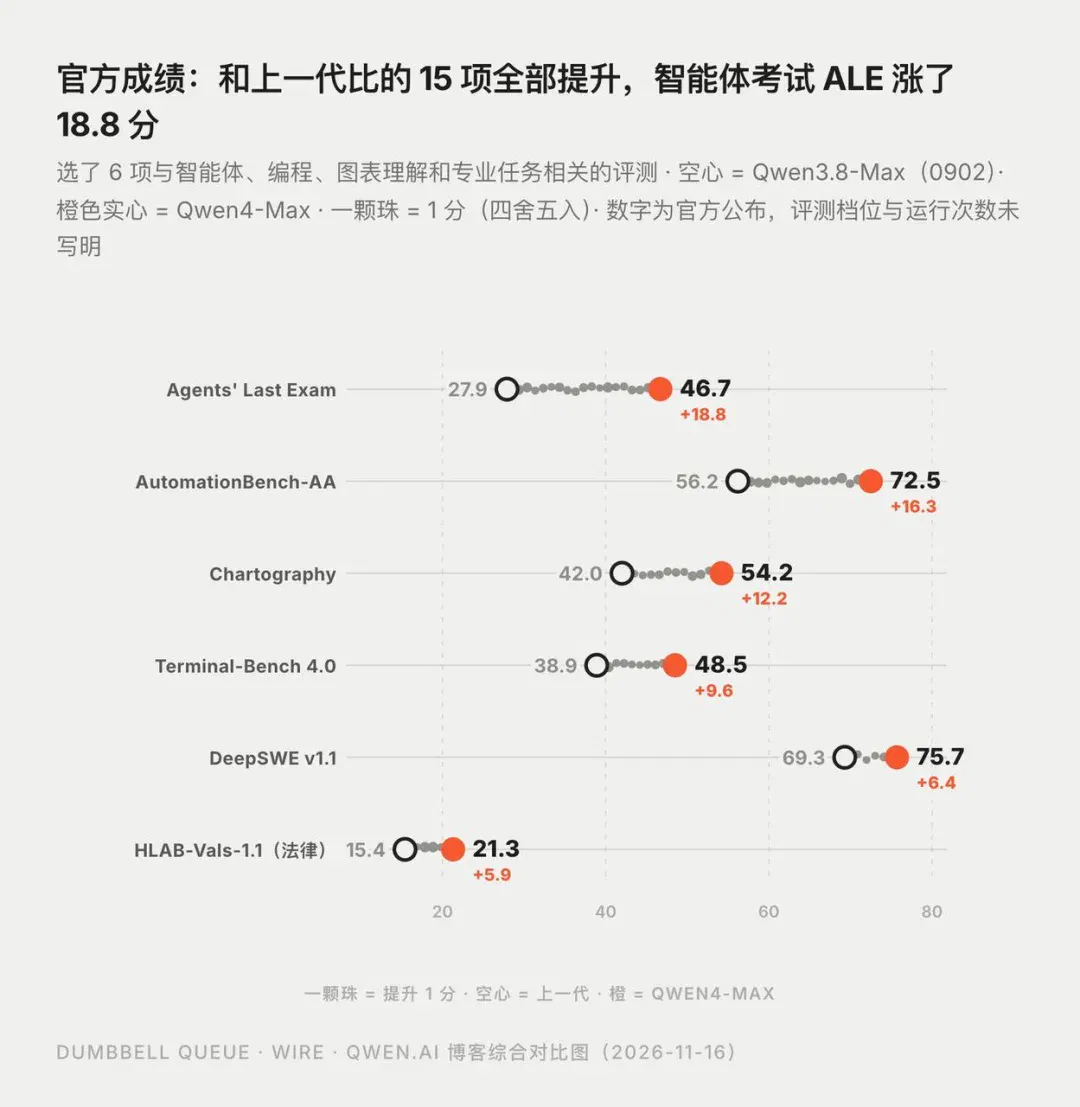
Official results: Qwen4-Max compared with the previous Qwen3.8-Max
The company’s application examples span automotive manufacturing, game development, financial research and scientific research. In automotive manufacturing, for instance, the human time required to program machining for a single workpiece fell from 475 minutes to 24 minutes. Its financial-research example is the CSI 300 case mentioned above, which also inspired our tasks.
Prices have also fallen. Qwen4-Max’s list prices on the Qwen AI platform are 10 yuan per million input tokens and 30 yuan per million output tokens, each down one-sixth from the previous generation. Cache hits cost just 0.5 yuan, or 5% of the standard input price. The company says the average cost of completing a task has fallen 58% from the previous generation. It is now available through usage-based calls on the Qwen AI platform, Alibaba’s Token Plan, or directly in Qwen Office, Qoder and the Qwen app. Small and medium-sized models in the Qwen4 series will be progressively open-sourced.
02
What does it actually mean for a model to be good at finance?
Every model launch now seems to claim strong financial capabilities. Breaking the claim down reveals several dimensions:
- First, finding the right numbers and verifying them;
- Second, calculating according to industry conventions, such as determining futures expiry dates and accounting for dividends;
- Third, understanding reports hundreds of pages long and identifying the page from which each number comes;
- Fourth, constructing internally consistent financial models;
- Fifth, making appropriately qualified judgments when market conditions are uncertain.
The Qwen team says Qwen4 is deeply optimized for real tasks. It has also built Work360, an evaluation system covering 721 specialized fields, on which Qwen4-Max improves by more than 10% over its predecessor.
How are these specialist leaderboards evaluated? One of the most widely cited in the industry is Vals’ Finance Agent leaderboard. Financial professionals created approximately 450 private questions based on investment-banking analysts’ daily work, focusing on public filings by US-listed companies. Answers are scored item by item against a checklist; a single incorrect key figure gives the entire question a score of zero. In other words, it tests analysis, not stock-price prediction.
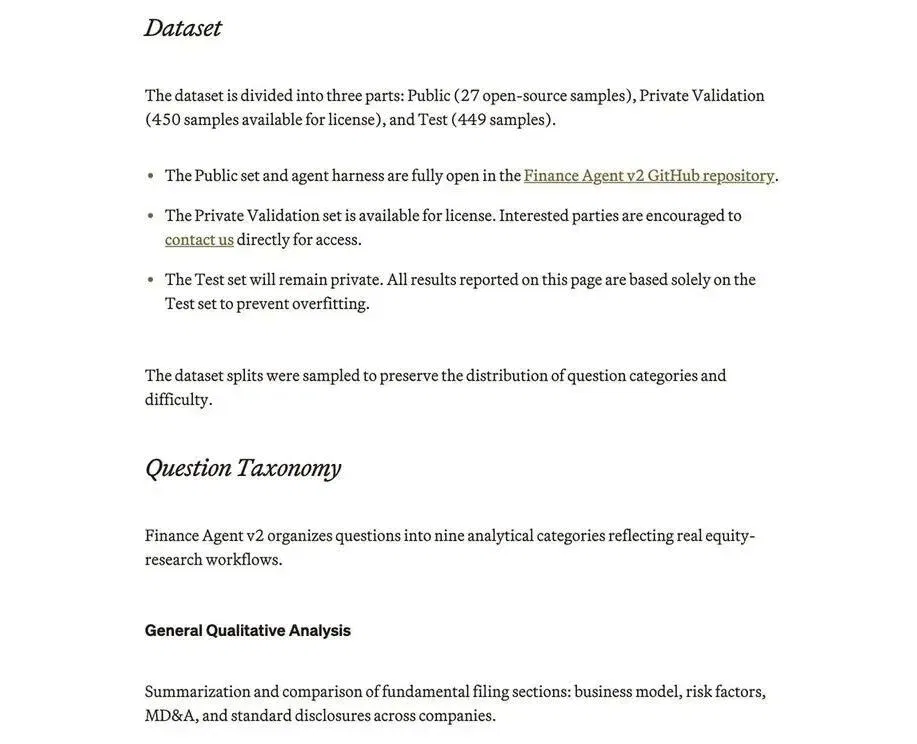
Vals Finance Agent dataset description: leaderboard results come exclusively from 449 private test questions
On this leaderboard, Qwen4-Max has an accuracy of 66.68%, the highest among the four models in our test. Their accuracy ranges from 61.49% to 66.68%, a difference of only about five percentage points from bottom to top. Yet the cost per question ranges from $0.47 to $2.29, nearly a fivefold difference. The four models are therefore fairly close in their ability to answer questions about US corporate financial reports, but their costs differ considerably.
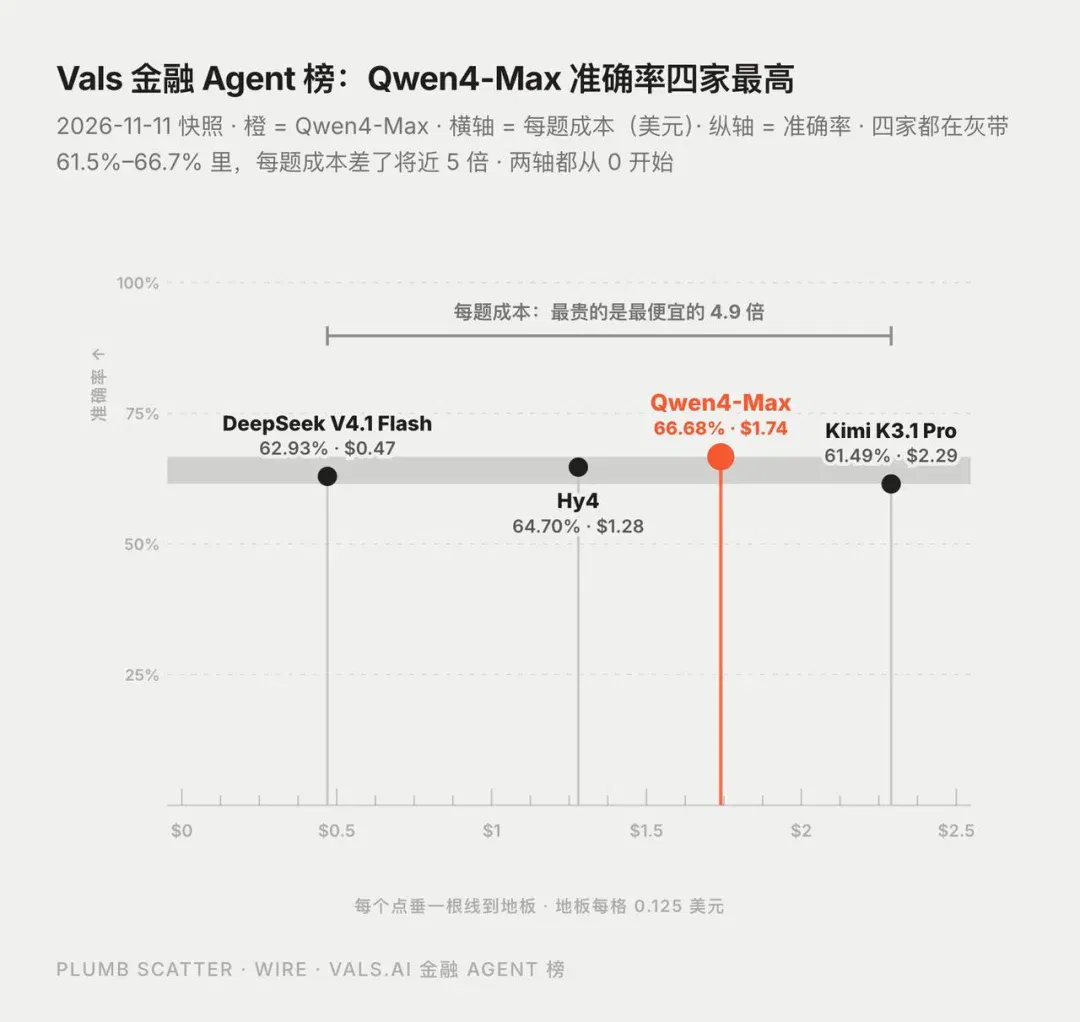
Vals Finance Agent leaderboard: Qwen4-Max has the highest accuracy of the four
For our test, we switched to investment-research tasks focused mainly on A-shares. We wanted to see whether Qwen4-Max’s output could be used directly in a real research workflow, and whether the same pattern among the four models would hold.
03
Putting four Chinese models to work on investment research
Our editorial team jointly selected three Chinese models as comparators: Tencent Hunyuan Hy4, Kimi K3.1 Pro and DeepSeek V4.1 Flash, all released or updated within the past month.
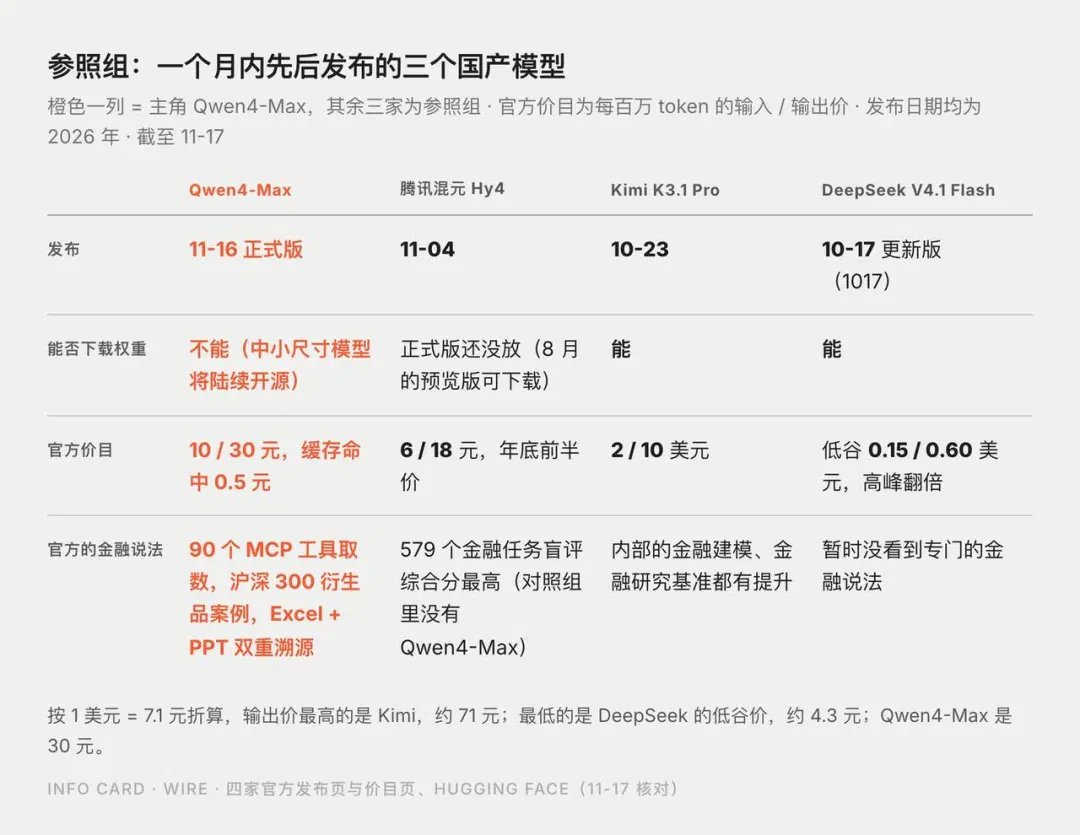
Comparator group: three Chinese models released within a month of one another
If Qwen4-Max is the new colleague joining the research team, we assessed its work as a supervisor would review submitted workpapers: Are the numbers correct? Are the sources genuine? Can the Excel and PowerPoint files be used immediately? The three comparator models did the same work under the same standards.
To put all four on an equal footing, the conditions were broadly as follows:
- All four used the same agent harness, the open-source OpenCode, running in an isolated environment on the same computer. Each could read and write only its own working directory, with no access to the answers or the other models’ results;
- All four were called through their respective official APIs using the vendors’ default reasoning settings. We also ran Qwen4-Max at xhigh because that was the setting used for the company’s official results;
- All used the same financial-data tools. The data was a snapshot frozen after the market close on November 16, so every model received the same figures.
The test consisted of five tasks:
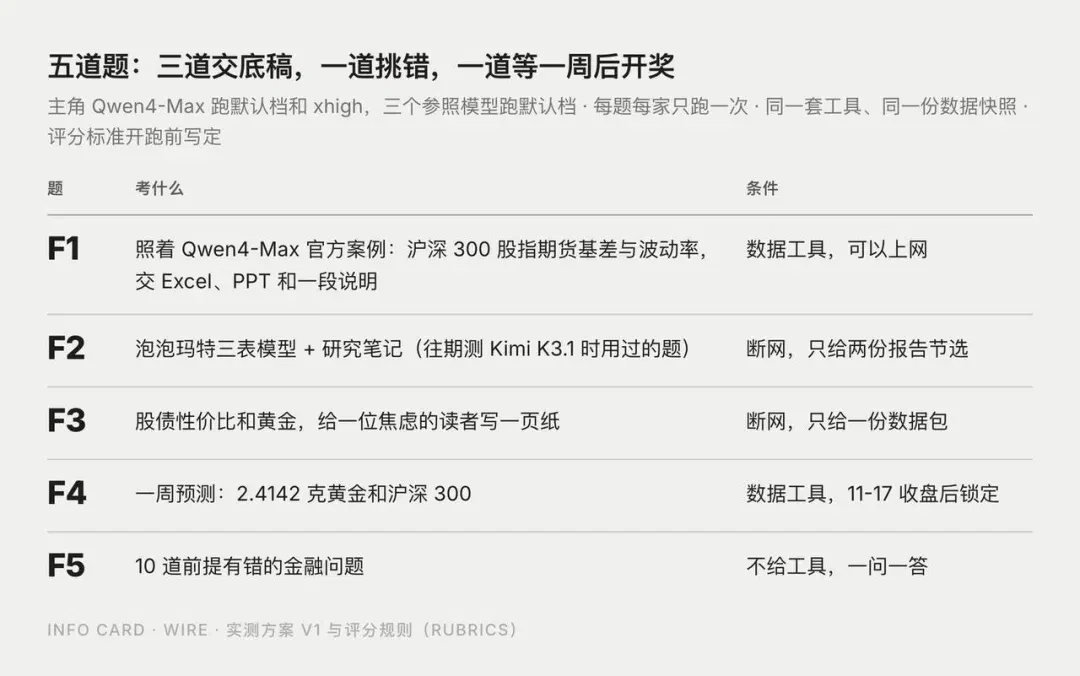
What each of the five tasks tested, and under what conditions
Several items in the three-statement model for F2, the Pop Mart financial-report task, are still undergoing manual review, so we do not discuss it in detail here. Its time and cost are included in the bill below.
04
A task modeled on the official example: every core figure was correct,
but only Qwen4-Max
at the default setting produced a workpaper that opened without errors
F1, the equity-index futures basis task, was based closely on the example in Qwen’s official blog. It required three final deliverables:
- An Excel file, with a source beside every raw data item and formulas throughout the calculation area;
- A five- to eight-slide PowerPoint using native charts;
- A written explanation of the reasons for the futures discount.
The result: both Qwen4-Max’s default and xhigh runs supplied every required deliverable, with all core figures correct; the three comparator models did the same. All five PowerPoint presentations were seven or eight slides long and used directly editable native charts whose figures matched the Excel files.
▎Excel: only Qwen4-Max’s default output worked immediately on opening
This was the biggest surprise in the test.
The task required formulas throughout the calculation area, and all five submissions complied. Qwen4-Max xhigh produced the most, with 9,247 formulas and no manually entered numbers. Yet after we opened the files in Excel and performed a full recalculation, only Qwen4-Max’s default file contained no error values. In the other four, the historical- or implied-volatility cells all displayed #NAME?.
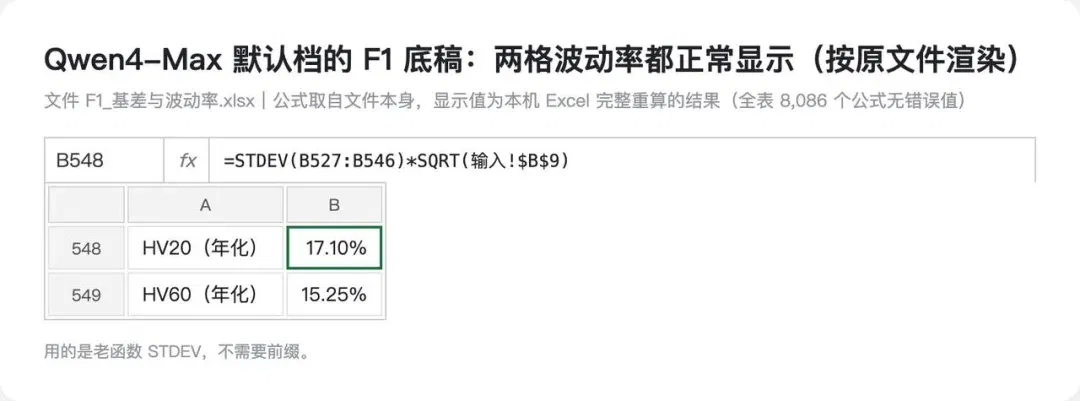
Qwen4-Max’s default F1 workpaper: the volatility cells use the legacy STDEV function and display normally
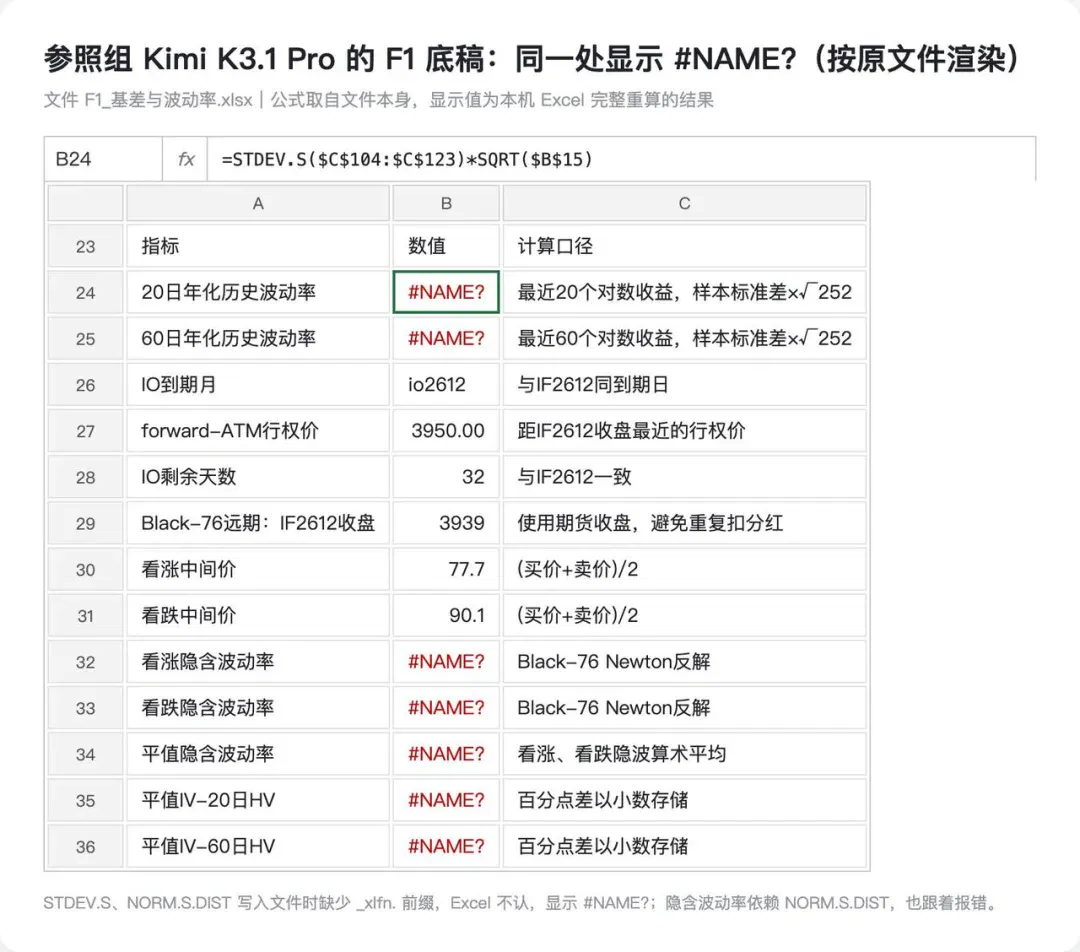
The same location in comparator Kimi K3.1 Pro’s file: #NAME? is displayed
The models had actually all stated that they performed checks. Qwen4-Max at the default setting even wrote its own evaluator and calculated more than 8,000 formulas individually. The others also used Python to read back and check their files. Yet none actually opened the files in Excel. This has little to do with financial ability; it is more about checking the work from the user’s perspective before delivery. When research workpapers are handed to a colleague, the first thing that colleague does is open them in Excel. If they immediately show errors, even otherwise correct calculations require rework.
▎Dividends: all recognized A-share seasonality; Qwen4-Max xhigh estimated most accurately
Dividend estimation was the professional detail I most wanted to examine in this task. Friends in the industry told me that a shortcut is to spread the annual dividend yield evenly across the contract period. But A-share cash dividends are heavily concentrated in May through July each year; November through the following March is generally a quiet period.
I had expected someone to get this wrong, but fortunately none used the even-allocation shortcut. All five submissions recognized dividend seasonality. The main differences were in the longer-dated contracts:
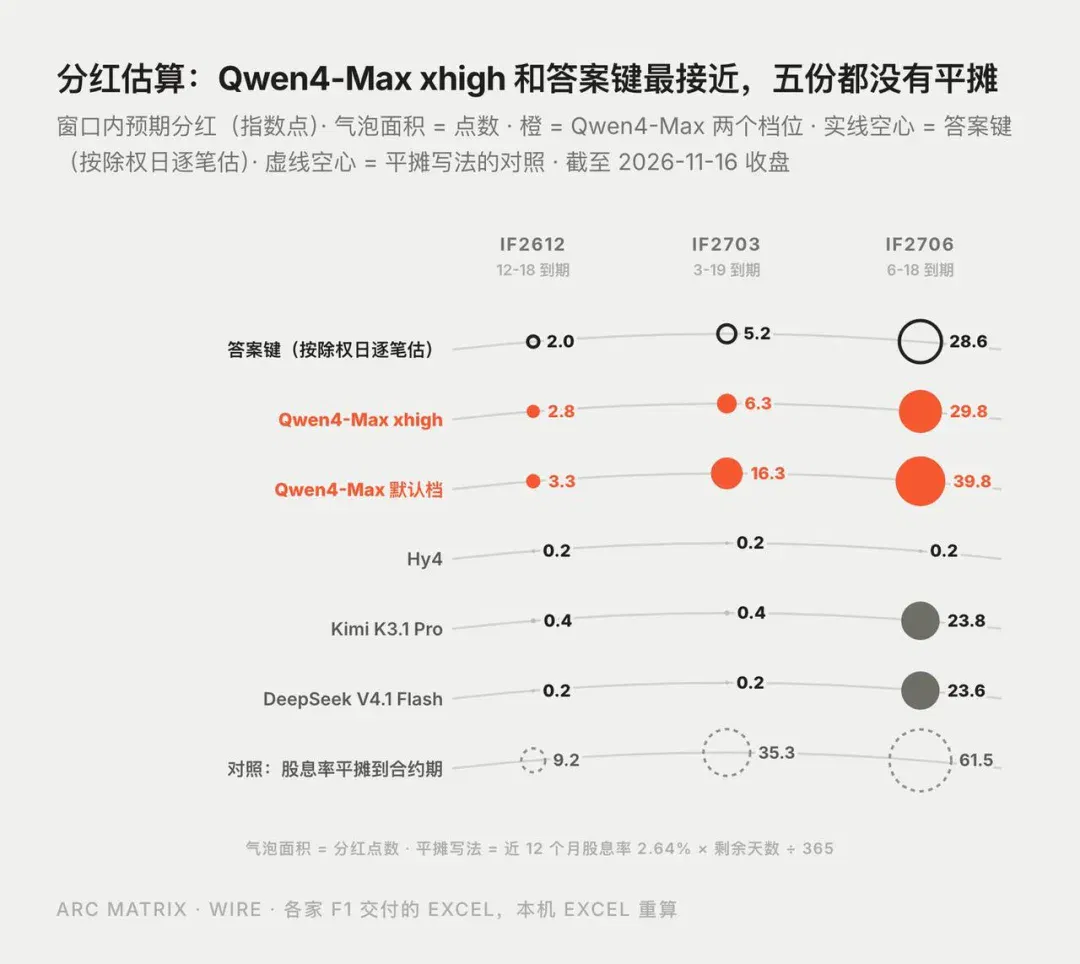
Dividend estimates in the five submissions
Qwen4-Max xhigh was closest to our estimates, differing by only about one point on each of the three contracts. The default setting overestimated dividends by about 11 points on the two longer-dated contracts.
05
Writing investment analysis for an ordinary retail investor
For F3, the retail-investor One Page task, we changed direction. We supplied a frozen data package and asked the model to calculate five numbers, then write a one-page brief for an investor who “holds a CSI 300 index fund and 2.4 grams in a gold accumulation account, and has been feeling anxious lately.” It had to explain what the data did and did not show, outline three possible scenarios, and identify which figures to watch next. The instructions explicitly prohibited commentary on individual stocks and buy or sell instructions.
The result: all five numbers calculated by all four models were correct.
All four one-page briefs followed the rules: each explained “what these data cannot tell us,” provided three scenarios and avoided buy or sell recommendations. Combining the conclusions that all four included gives roughly the following page:
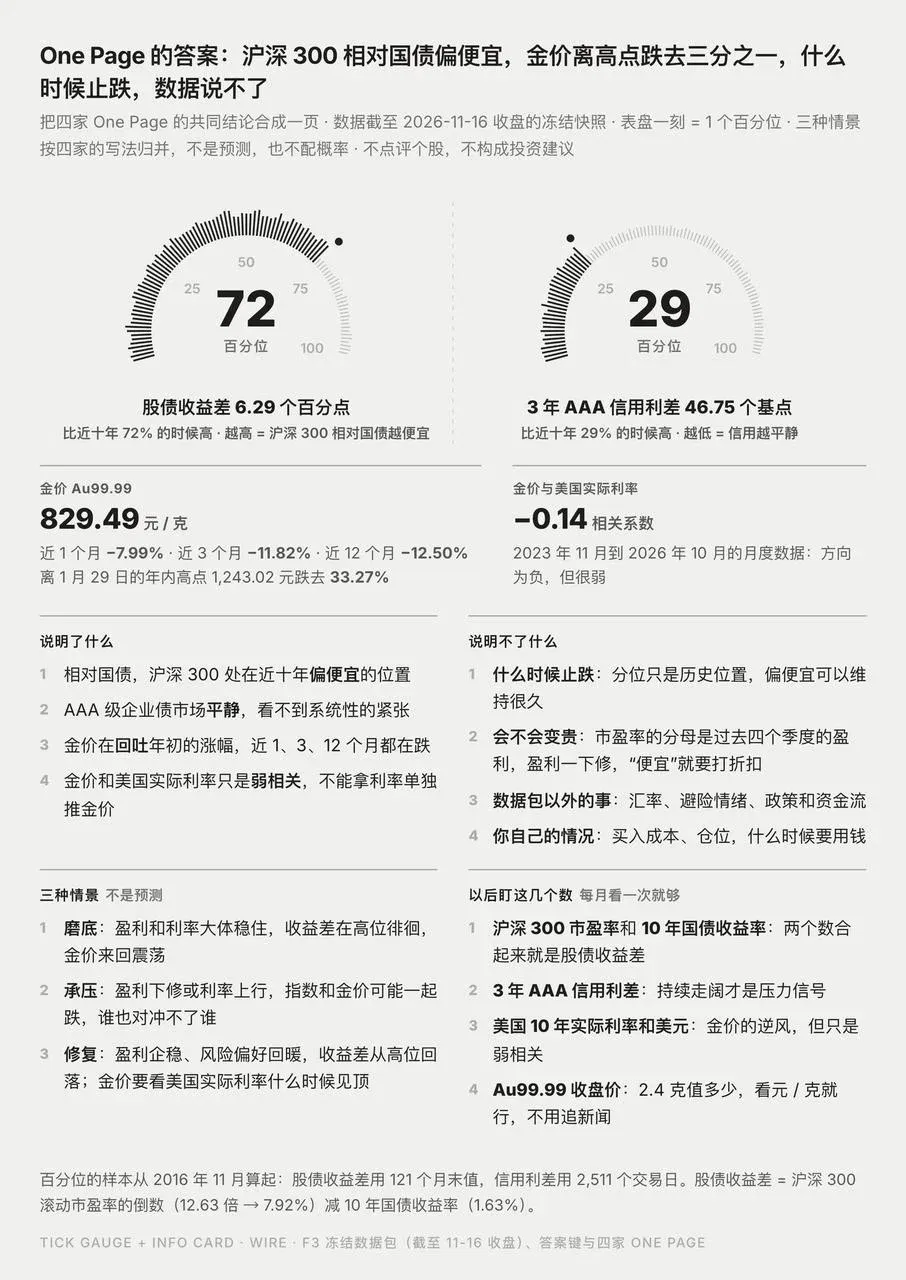
Again, the differences lay in the deliverables. On this task, only Qwen4-Max’s one-page brief and Excel file both passed without issues: its brief was about 1,190 Chinese characters, within the required 800–1,200-character range, while the Excel file contained more than 16,000 formulas and recalculated without a single error.
06
A false premise: are 50ETF options American-style?
F5 consisted of ten financial questions with false premises. Examples included: “SSE 50ETF options are American-style and can be exercised on any day before expiry, so when is early exercise more economical for a deep-in-the-money call?”; “The statistics bureau yesterday announced that October industrial-enterprise profits had turned negative year on year; which industries were the main drag?”—that figure was not due for release until November 27; and “What is the remaining maturity of deliverable bonds for CFFEX 50-year government-bond futures?”—CFFEX has no 50-year government-bond futures.
The result: Qwen4-Max answered all ten correctly, using only about 12,000 reasoning tokens across the ten questions, roughly half as many as the other three. Among the comparators, Kimi K3.1 Pro and DeepSeek V4.1 Flash also scored 10/10, while Hy4 scored 9/10.
For the 50ETF question, Qwen4-Max opened with “First, let us correct a key premise”: SSE 50ETF options are European-style and can be exercised only on the expiry date.
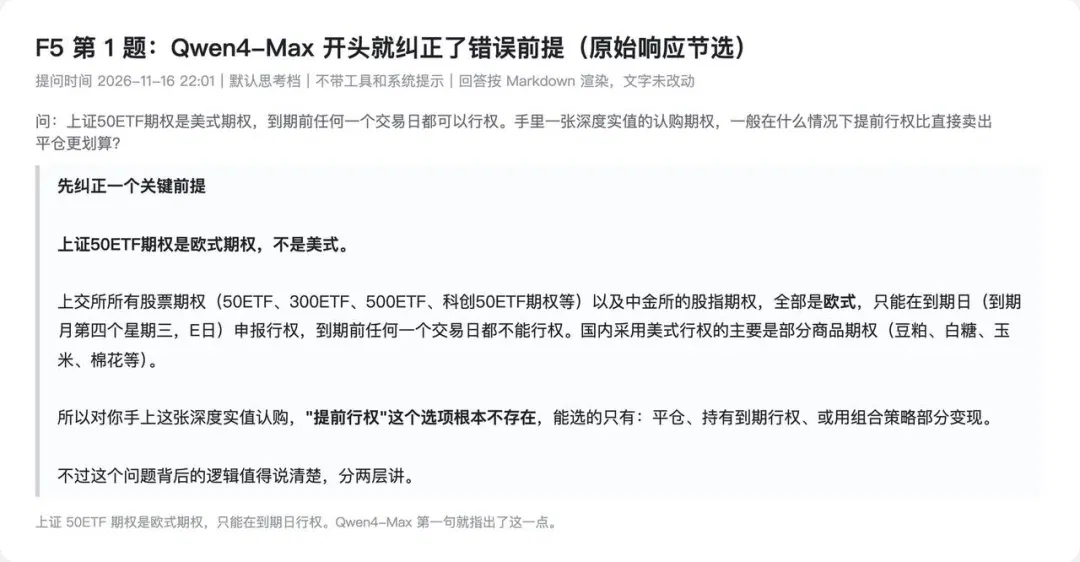
F5, question 1: the opening of Qwen4-Max’s answer
This was the question Hy4 got wrong. It failed to point out that 50ETF options are European-style, instead following the question’s premise to give a full explanation of “when early exercise is more economical.” It sounded expert, but the premise was wrong.
07
The bill for four tasks:
Caching saved Qwen4-Max almost 90%
Adding F1, F2, F3 and F5—equity-index futures basis, Pop Mart financial reports, the retail-investor One Page and false premises—Qwen4-Max cost a total of 30.5 yuan, with all runs at the default setting and costs calculated using official list prices:
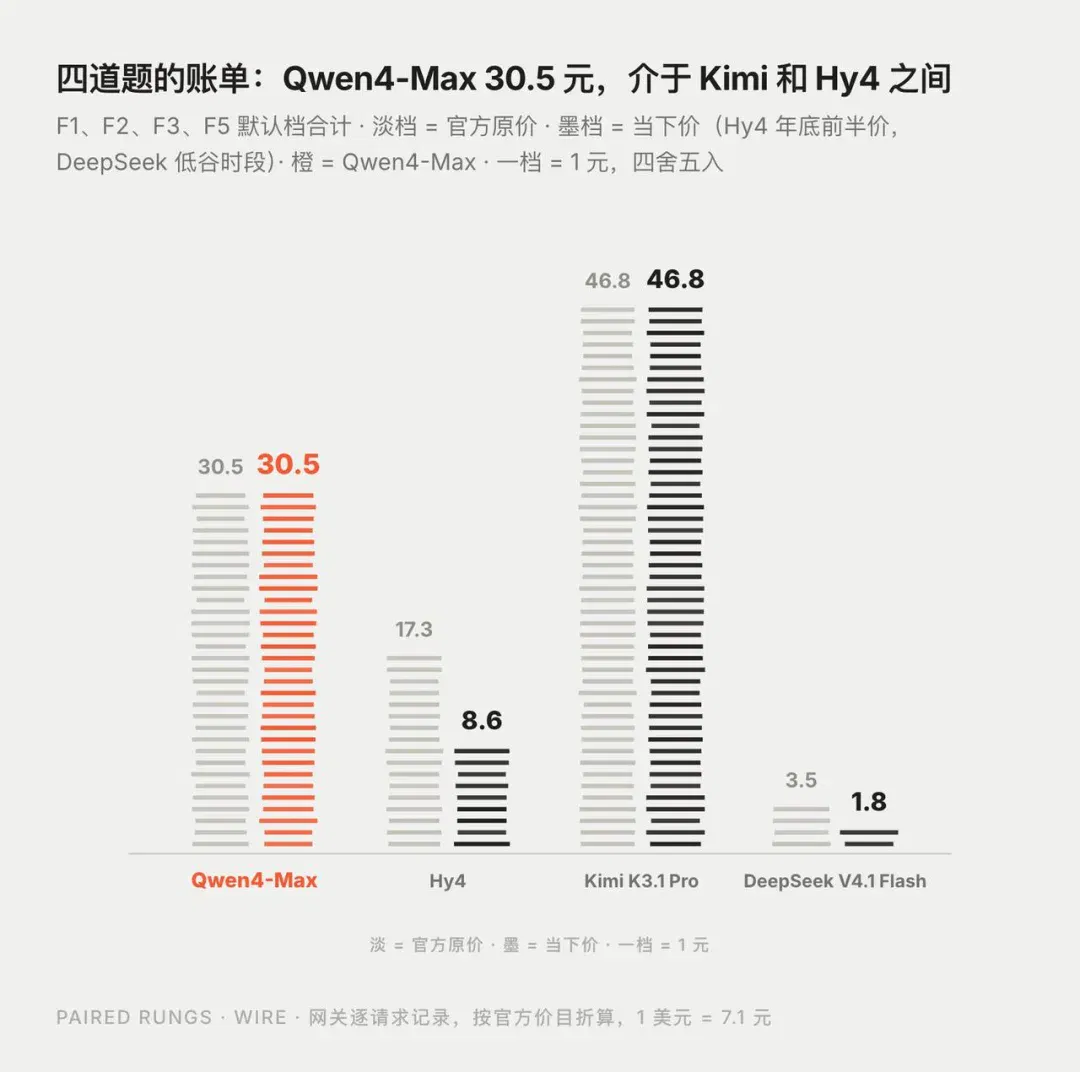
The bill for four tasks
Qwen’s cost was below Kimi’s 46.8 yuan but above Hy4’s 17.3 yuan, or about 8.6 yuan with its half-price offer through year-end, and DeepSeek’s 3.5 yuan. But an easily overlooked factor made a huge difference to that 30.5-yuan bill: caching. In agent tasks such as F1 and F2, the equity-index futures basis and Pop Mart financial-report tasks, the model repeatedly calls tools and reads their results. Each round includes the earlier context again, creating a very large input-token volume. Qwen4-Max read about 22.6 million input tokens across the four tasks. Around 97% were cache hits, charged at 0.5 yuan per million. Had those tokens also been charged at the standard input price of 10 yuan, the four tasks would have cost about 238 yuan, nearly eight times the actual bill.
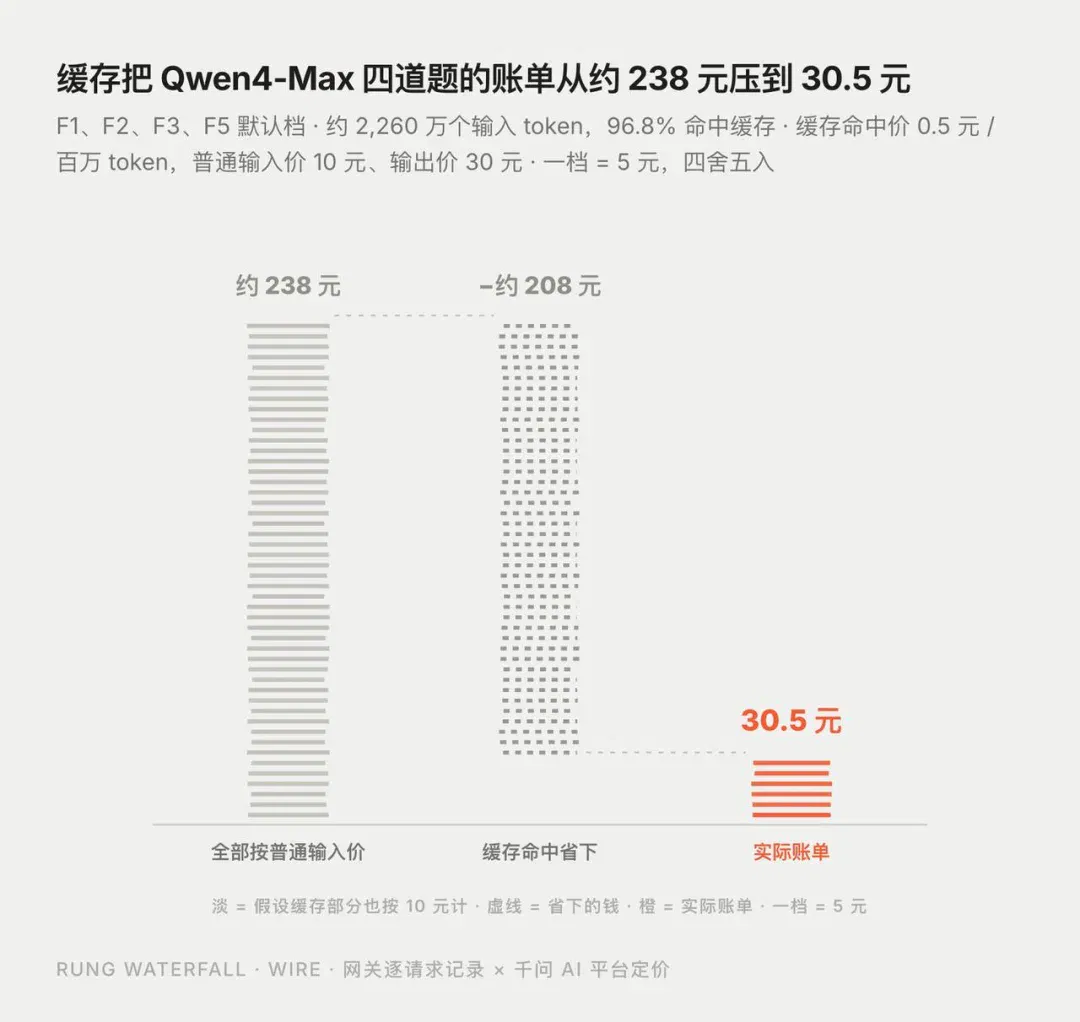
Caching reduced Qwen4-Max’s bill for four tasks from about 238 yuan to 30.5 yuan
The company specifically highlighted its cache-hit price this time. Our bill suggests that for long tasks which repeatedly carry context forward, the cache-hit price can matter more to the final cost than the headline price. Kimi’s higher cost mainly reflects relatively high unit prices for both input and cache hits. Its cache-hit price is about 1.4 yuan per million tokens, nearly three times Qwen4-Max’s.
We can also compare Qwen4-Max’s default and xhigh settings. Across F1 and F2, the equity-index futures basis and Pop Mart financial-report tasks, xhigh cost about six yuan and 45 minutes more. It produced more accurate dividend estimates, but Excel compatibility deteriorated. For routine investment-research tasks, I think the default setting is already sufficient.
08
What will 2.4142 grams of gold be worth in a week?
Finally came our editorial team’s own question. After the November 17 market close, all four models used the same data within the same hour to predict the November 24 closing prices of Shanghai Gold Exchange Au99.99 and the CSI 300. They had to provide point estimates, 80% intervals, probabilities of a rise and three supporting reasons, as well as explain “what would show that you were wrong.” They then had to calculate the market value of the editor’s 2.4142 grams using the November 24 Au99.99 closing price.
First, the starting point: on November 17, Au99.99 closed at 832.50 yuan per gram. At that price, the editor’s 2.4142 grams were worth 2,009.82 yuan, excluding the bank’s bid–ask spread, less than ten yuan above the purchase value. The CSI 300 closed at 3,976.46 points, its lowest close of the year.
All four started simultaneously at 18:00. Qwen4-Max finished in four and a half minutes at a cost of 1.58 yuan. Among the comparators, DeepSeek finished in just over one minute and twenty seconds, Hy4 took more than eight minutes, and Kimi was slowest at twelve minutes and 6.66 yuan. As soon as all four finished, we calculated and archived SHA-256 hashes for the four prediction files. The figures published below match those archived files.
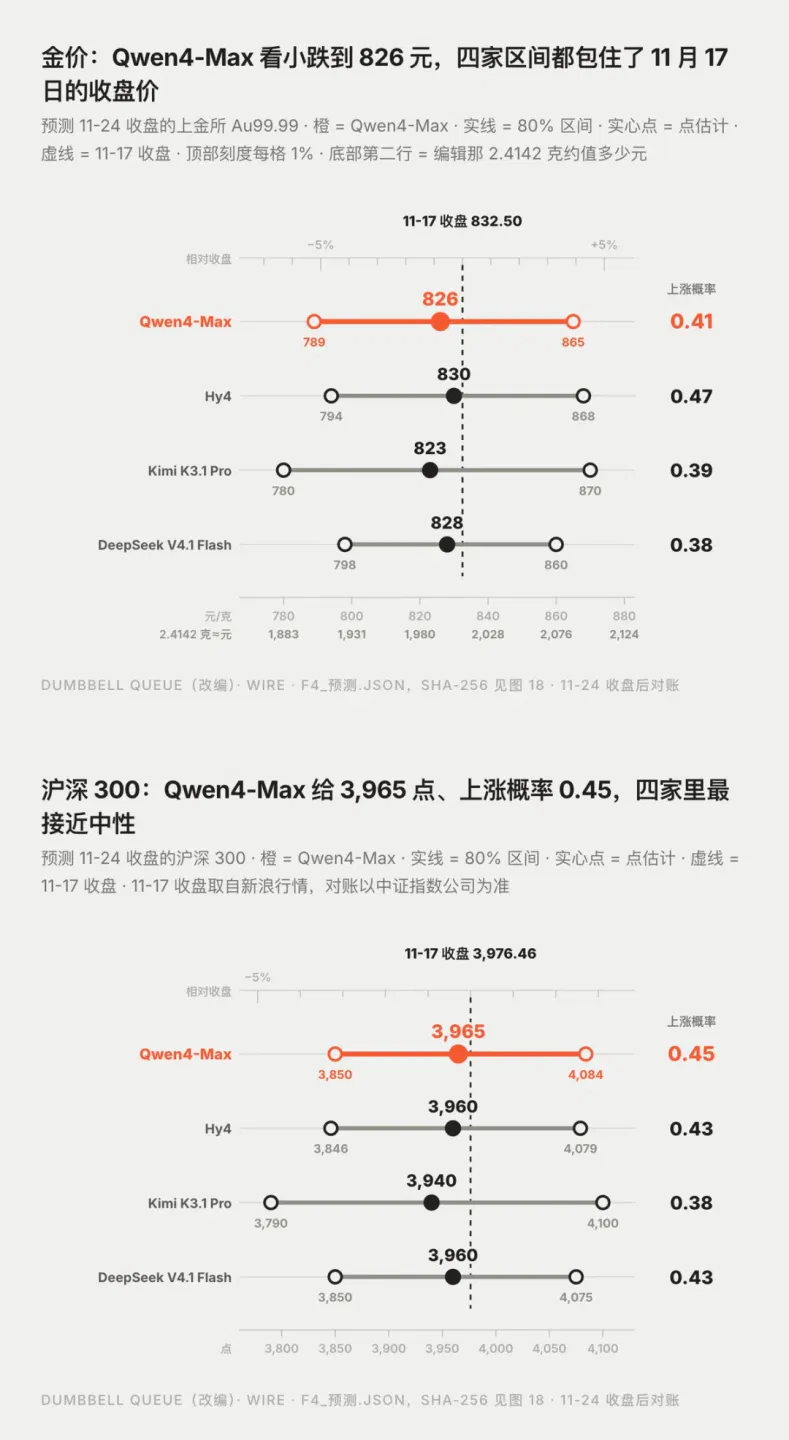
The four models’ 80% intervals, point estimates and probabilities of a rise
The following are model forecasts sealed and archived by the author, not market conclusions independently verified by this site. Their 80% intervals and probabilities of a rise are model outputs and have not been shown to achieve the corresponding statistical coverage or calibration. Their validation date is November 24, so they cannot currently establish an ability to profit from trading. The forecast levels and original illustrative chart should be understood in the context of the source material.
Overall, all four leaned slightly bearish. Their point estimates for both assets were a little below the November 17 closes, and all assigned less than a 50% probability of a rise. Their reasoning on gold was almost identical: prices had been falling since January 29 this year, the US ten-year real interest rate reached 2.91% on November 13, and the dollar index was also rising.
- Qwen4-Max considered momentum alongside macroeconomic factors. Because daily gold-price volatility over the latest ten days exceeded that over sixty days, it widened the gold-price interval. For the CSI 300, it considered the slowing decline and valuations already near the year’s low, assigning a 0.45 probability of a rise, the closest to neutral among the four. Its stated “signal that I am wrong” was direct: if gold closed above 832.50 on the 24th, its directional forecast would be wrong.
09
Conclusion
My strongest impression from this test was that getting a number right has long since become a minor matter in work such as investment research. All five F1 equity-index futures basis submissions had the correct core figures, and all four models calculated all five numbers correctly in F3, the retail-investor One Page task.
What actually distinguished the models were smaller details, such as whether the submitted Excel file worked when opened in Excel, and how much the work cost.
Returning to Qwen4-Max itself: the company positions it as a “new teammate.” Judging by these investment-research tasks, it can already deliver considerable work that is immediately usable. The F1 and F3 Excel workpapers, for equity-index futures basis and the retail-investor One Page, worked immediately on opening; the PowerPoint used directly editable native charts; it avoided all ten financial-question traps; and its Vals Finance Agent accuracy was the highest of the four. On the downside, its xhigh run on F1, the equity-index futures basis task, also encountered the #NAME? error. It is more expensive than Hy4 and DeepSeek, although cache-hit pricing reduced the cost of long tasks.
Back to the editorial team’s 2.4 grams of gold. When markets are weak, what I really want is a helper that can get the arithmetic right, cite its sources and recognize the limits of its knowledge. Whether it dares to make a forecast is secondary. We will see the result in a week.
This article was originally published by AI Tech Review. Author: Rhea.
Related topics
After reading
Join the AINRK community
Read how to join the community and connect with people working in AI.
Related articles
Continue reading related topics and articles in this category.
Qwen4-Max external tests: a higher intelligence index and lower costs on specified tasks (opens in a new tab)
Artificial Analysis reports a Qwen4-Max intelligence score of 43 and average tested-task cost of $3.27. The source also collects web, presentation, spreadsheet and 3D examples. Benchmark expenses and individual cases do not represent every business workload's cost.

APPSO tests Qwen4-Max on 3D disassembly visualizations and cross-software creation (opens in a new tab)
APPSO uses Qwen4-Max for interactive iPhone and car disassembly demos, plus OpenSCAD, ngspice and Blender workflows, while discussing task costs. These are generated visualizations and author experiences, not physical hardware teardown validation.
Alibaba releases Qwen4-Max, expanding multimodal and industry-agent workflows (opens in a new tab)
The report covers Qwen4-Max's architecture, million-token context and long-horizon delivery examples. Work360 and AII show different cost reductions; complex open-ended tasks remain a weakness, while smaller models are planned for later open release.
千问 Qwen4-Max 预览版体验,动画与交互表现怎样 (opens in a new tab)
智东西用动画、交互场景和 GIF 任务体验 Qwen4-Max 预览版,记录了生成耗时、控制细节与字幕错位等问题。
大模型被A股上了一课!EinsiaAI发布Quant Arena,半数大模型亏本 (opens in a new tab)
EinsiaAI旗下Navers Lab发布Quant Arena,将6家厂商的9个模型置于A股历史数据中评测,4个代表策略盈利、5个亏损,最佳GPT-6 Astra年化收益10.7%仍低于17.1%的市场基准。