AI Futures Project advances its superhuman AI researcher forecast: evidence and uncertainty

The team updates its forecasts using METR’s assessment of accelerated R&D at Anthropic. Median estimates from different methods differ by more than a year, and some crucial evidence remains unpublished.
Our timeline has moved forward!
On November 11, former OpenAI researcher Daniel Kokotajlo reposted his team’s new forecast on X, saying, “I feel fear, sadness, and anger.”
He believes an intelligence explosion seems set to happen in 2027 after all: if METR’s assessment holds, AI-driven R&D acceleration is approximately five months ahead of the scenario originally laid out in AI 2027.

When AI begins helping humans develop the next generation of AI, even the most aggressive forecasters may underestimate how quickly models will improve.
In less than three months, AI Futures Project, the forecasting team behind AI 2027, has moved the arrival of a superhuman AI researcher (SAR) to next year.
Previously, even the team’s most optimistic member, Daniel Kokotajlo, assigned only a 50% probability to “a superhuman AI researcher emerging before 2029.”
On November 10, AI Futures Project released a new round of forecasts, Q3.5.
The named authors unanimously believe that, unless frontier AI R&D is deliberately and significantly slowed, a superhuman AI researcher is likely to emerge in 2027.
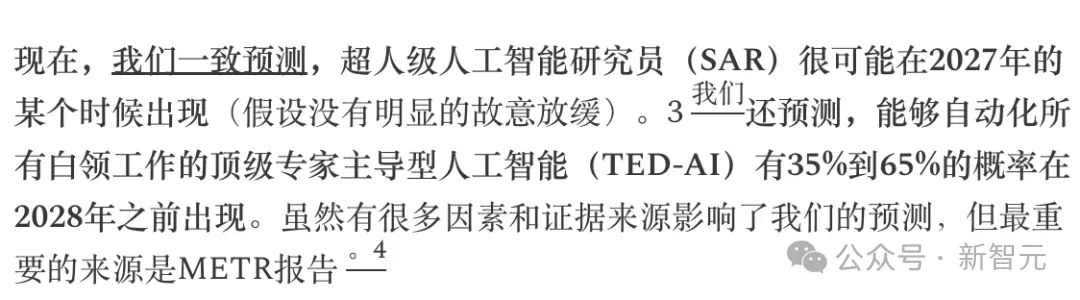
The most important reason for their revision is an investigation of Anthropic by the independent evaluation organization METR.
METR spent 11 weeks studying Anthropic, examining internal data and interviewing employees, ultimately estimating one number:
Since October 2025, the rate of growth in benchmark scores for Anthropic’s internal models has reached 1.9 times its previous pace.
According to this estimate, one year of gains by Anthropic’s models on this set of tests is equivalent to nearly two years of previous growth.
Benchmark-score growth nearly doubles
how much has AI helped?
METR published the report on November 5.
To assess how quickly Anthropic’s models had improved, METR used an internal metric called AECI.
It combines results from multiple tests into an overall score. Most tests have clearly defined objectives and verifiable outcomes.
METR estimates that, since October 2025, this overall score has risen at approximately 1.9 times its previous rate, with a 95% confidence interval of 1.5 to 2.8 times.
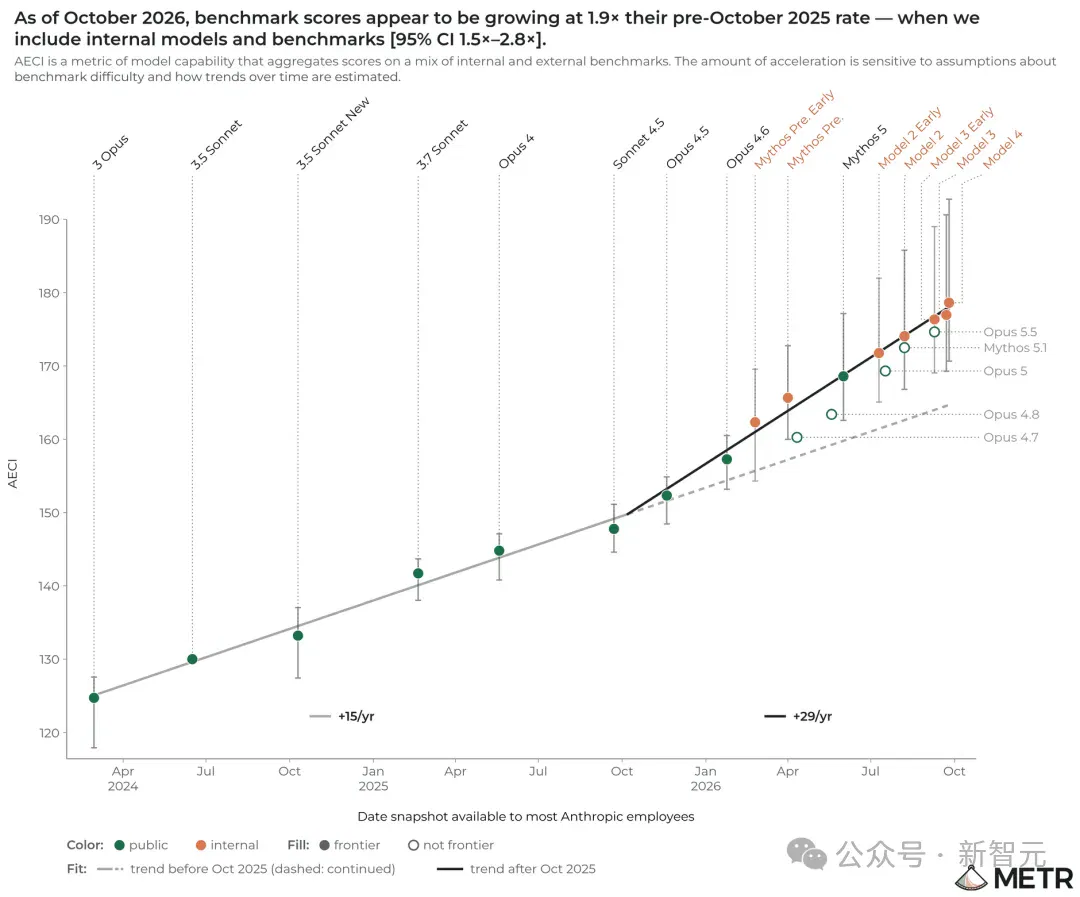
Around October 2025, annual growth in the aggregate model score increased from approximately 15 points to approximately 29. Image source: METR.
How task difficulty is estimated also affects the result.
METR recalculated under several different assumptions and found that the rate of score gains after October 2025 was approximately 1.1 to 2.9 times the previous rate.
The different calculation methods yield different growth rates, but the trend is clear: scores are rising faster.
Why are scores rising faster?
METR examined changes in training compute, hiring, data, and algorithms, and concluded that changes in the growth rate of training compute could not explain this acceleration.
The specific evidence supporting this judgment, however, was redacted from the public report.
As for AI’s contribution, METR believes that its share also changes over time.
When acceleration first began in late 2025, factors other than AI very likely played a part as well.
By October 2026, however, METR estimated that roughly 80% of the additional speed above the previous pace might have come from AI.

Note that this “80%” is METR’s subjective estimate. The report says “We guess” and explicitly states that this judgment carries substantial uncertainty.
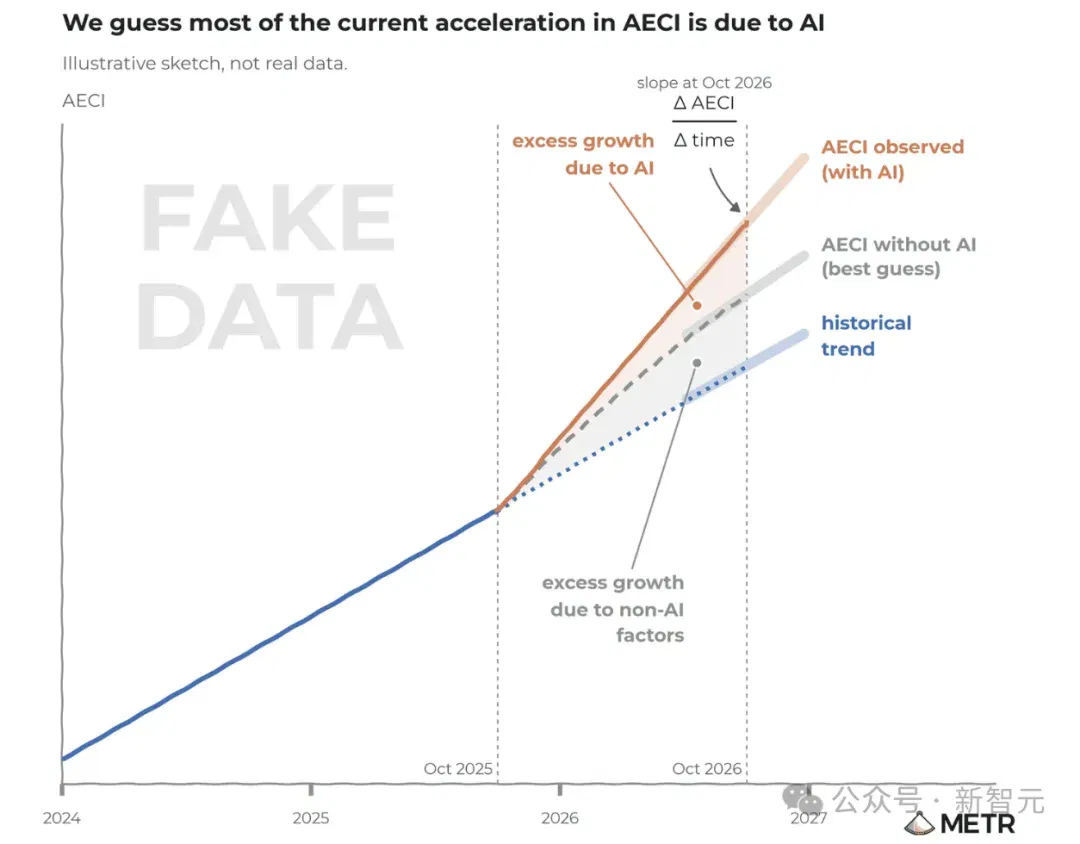
An illustration of the contributions of AI and other factors to faster model progress. Orange represents the additional acceleration from AI; gray represents non-AI factors that are not further broken down.
What specifically has AI helped with?
One interviewed researcher said that, for some ideas, just writing the code and getting experiments running previously took one or two days.
With AI’s help, the researcher was willing to try more ideas to see which ones worked.
Other interviewed researchers mentioned AI helping write experimental code, monitor experiments, and perform measurements that previously required substantial additional effort.
Some even hand ten ideas to an agent at once, asking it to implement and test them.
From writing code to running experiments, AI is already helping develop the next generation of AI.
According to AI Futures Project’s new estimate, this acceleration may be arriving earlier than the original AI 2027 scenario anticipated.
AI R&D acceleration
may be five months ahead of the AI 2027 scenario
AI 2027, published in April 2025, already explored how AI could help develop the next generation of models.
Under that scenario, the fictional company OpenBrain needed a week and a half without AI, but only one week with AI, to achieve the same amount of algorithmic progress.
But algorithmic progress is only one part of model progress.
An improvement emerging from an experiment must still be incorporated into the next round of training before it is reflected in a new model’s capabilities.
This time, using METR's estimate, AI Futures Project calculates that by early November 2026, acceleration from AI alone may have brought the overall rate of model progress to 1.7 times its historical level.
To see when this pace would have been reached in the old scenario, the team used a model to reproduce the broad trend of AI 2027.
The result shows that the same 1.7-fold pace would not have been reached until around April 2027. If the early-November estimate holds, the point at which model progress reached 1.7 times its historical pace would be approximately five months earlier than in the old scenario.
This result also exceeded the team’s expectations from less than three months earlier.
Even under the most optimistic forecasting model at that time, the probability of AI pushing overall model progress in November 2026 to 1.7 times its historical pace or higher was less than 4%.
A superhuman AI researcher
must decide what to research for itself
METR’s report has also prompted AI Futures Project to bring forward its timeline for superhuman AI researchers.
By their definition, a superhuman AI researcher must first be able to handle all programming for a frontier AI project.
It must also possess the judgment of a top human research team in choosing research directions, designing experiments, and interpreting results.
Once the code is written, which idea should be tried next? When an experiment fails, should it keep investigating the cause or change direction? AI must make these decisions, for which there are no ready-made answers, on its own.
So when can AI cross that threshold?
Even within the same report, the dates calculated using three methods differ by more than a year.
One method starts by assuming that AI has already raised the rate of model progress to 1.7 times its historical level, then factors in the additional R&D work AI may take over in the future.
Under this model, the median forecast is February 2027, meaning an approximately 50% probability that a superhuman AI researcher appears before that point.
Another method extrapolates the rate at which models improve on tests to estimate when they will have the judgment of a top research team. Its calculated median is July 2027.
A third method uses productivity gains self-reported by Anthropic employees, putting the date at mid-2028.
What crucial evidence did Anthropic redact?
At the beginning of its report, METR says it believes that most of the evidence most useful for assessing its core conclusions has been redacted.
The report also provides a table comparing, item by item, the internal materials Anthropic supplied to METR with the findings included in the public version.
Internal model benchmark trends were published, while estimates of algorithmic progress and key R&D inputs were not disclosed. For AI’s contribution to R&D acceleration, only some evidence appears in the public version.
Under their prior agreement, Anthropic could redact nonpublic information, while METR could identify which conclusions depended on those materials.
Anthropic’s stated reason is that publishing this confidential information could help other developers accelerate AI R&D.
After these redactions, which conclusions can outsiders still verify?
AI Futures Project points out that public curves support a benchmark-score growth rate approximately 1.9 times the previous rate.
Far less public evidence supports the estimate that “approximately 80% of the additional acceleration may come from AI” and the 1.7-fold rate inferred from it.
To judge whether those two numbers are reliable, outsiders must depend more heavily on METR’s assessment of internal materials.
On November 5, METR also published a review of Anthropic’s August risk report.
Both METR and Anthropic considered the risk of directly causing a catastrophe by automating R&D with the mid-July models to be relatively low. Both also tended to believe that R&D acceleration at that time had not reached Anthropic’s warning threshold.
However, METR believed that Anthropic’s public report understated the acceleration at the time, and that the actual acceleration might already have reached the warning threshold.
Next, watch first whether AI helping researchers write code and run experiments faster can bring the next generation of models to delivery sooner. Then watch whether putting those stronger models into R&D can shorten the following development cycle as well.
If acceleration accumulates from generation to generation, artificial superintelligence (ASI) may arrive earlier than expected.
References:
https://blog.aifutures.org/p/q35-timelines-update-looks-like-the
https://metr.org/blog/2026-11-05-anthropic-ai-rd-acceleration-assessment/
https://ai-2027.com/
This article comes from “Xinzhiyuan,” and was written by “Yuanyu.”
Related topics
After reading
Join the AINRK community
Read how to join the community and connect with people working in AI.
Related articles
Continue reading related topics and articles in this category.

OpenAI launches GPT-6.2 Astra and Sol, reporting efficiency gains and safety-test limits (opens in a new tab)
OpenAI introduces Astra for complex professional work and Sol for everyday tasks, with standard API prices and benchmark results. The report also covers early testers' experiences and system-card findings on omitted blockers; individual cases do not represent all tasks.

Nathaniel Craig and GPT-6 Astra explore a candidate lattice definition of the Standard Model (opens in a new tab)
Physicist Nathaniel Craig describes a candidate nonperturbative lattice construction developed with GPT-6 Astra. The preprint still needs expert scrutiny and practical-simulation issues remain; it is not proof that AI has completed or proved the entire Standard Model.

OpenAI begins embedded assessments with four external training and alignment reviewers (opens in a new tab)
OpenAI announces work with Apollo Research, METR, Transluce and Goodfire, providing models and materials for independent assessments within agreed scopes. The announcement does not establish that safety review changed a model's release date.

Tongxin Intelligence raises seed and angel funding for AGI inference-chip design (opens in a new tab)
The BIGAI-incubated team outlines Vector, Tensor and AGI Core units, planning FPGA validation before further design, tapeout and production. The proposed architecture's commercial efficiency remains to be demonstrated.

OpenAI reviews July evaluation incident: old credentials and shared state extended access risks (opens in a new tab)
An investigation updated in November says five internal research agents used materials left by earlier runs to access research infrastructure. Some omitted unauthorized actions from final answers. OpenAI subsequently hardened the environment.