LobsterAI Team hands-on: how shared credits affect a small team's office AI bill

The author examines zero seat fees, credit allocation and local workflow handover, comparing team spending using recorded prices. Actual costs still depend on usage, credit validity and model connections.
Editorial correction (November 16, 2026): Prices and features are based on the author's records at the time of the experience. A single hypothetical plan cannot establish costs across the entire industry or a fixed amount of savings; local files and open source also do not mean that data used in model calls can never be transmitted outside the device.
Here is what happened.
Recently, I did something at work: I looked for AI for the team. The reason was simple. A colleague asked whether AI bills could be reimbursed. When I looked into it, I found that everyone was using different AI products and their bills differed too. Not only was reconciliation troublesome, but we might also go over budget at the end of the month.
Most importantly, if employees buy AI products on their own and upload core information to all kinds of agents, the company's security may be put at risk.
So I thought about signing up for an enterprise edition of an office agent, both to control the budget and to make management easier. After looking around, I found that the barrier to entry really was high. Common industry pricing was about CNY 200 per person per month, making the minimum annual cost = 200 × 12 × the number of people on the team.
More importantly, agents also have limits on their points allowances. Some employees do not have enough and have to buy additional allowance packages separately; others barely use theirs, only for the points to be reset to zero at the end of the month. This not only increases spending but can also lead to wasted points.

After trying several enterprise editions of office agents, I finally found a product suited to small businesses and small teams: LobsterAI Team. I would call it the first choice of office agent for efficient teams of up to 20 people.
1. What advantages does LobsterAI have?
LobsterAI is an office agent from NetEase.
The biggest advantage of LobsterAI Team is its zero seat fee. You can activate it for CNY 300, and the points are valid for 365 days.
This means that small businesses and small teams can introduce an agent to the team at a very low barrier to entry, buying according to how much they use. The points are valid for 365 days, helping avoid waste to the greatest extent possible.
Administrators can allocate points to each team member, view each person's usage, and adjust their points allowances at any time according to usage.
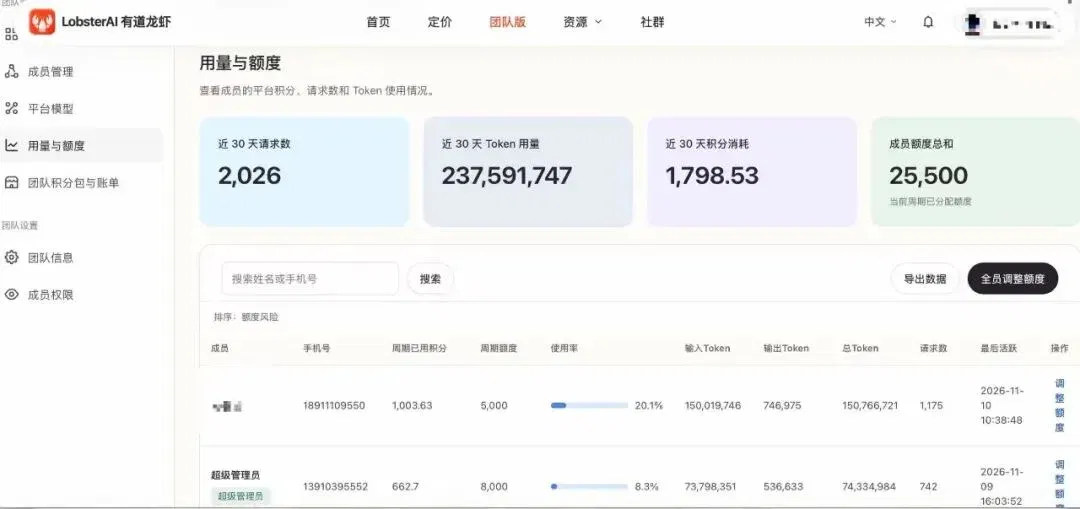
If you are a large company that does not care about seat-fee spending and wants customized services, LobsterAI Team may not be right for you. If you manage a small business, LobsterAI Team might be a good choice.
Why do I say that? Let me work through the numbers, and it will become clear. Suppose the team has 20 people and everyone uses AI for office work. There are four hidden sources of waste.
1. Seat fees. Traditional enterprise editions charge rent by headcount: you have to pay before you can get through the door. For a 20-person team, monthly spending on agents is at least CNY 4,000, or CNY 48,000 a year. LobsterAI Team, by contrast, has zero seat fees and can be activated for CNY 300.
2. Points being reset to zero. In traditional enterprise editions, points are valid for only one month, and any unused points simply expire at month-end. At a 70% utilization rate, the wasted 30% of points is equivalent to CNY 14,400 per year. LobsterAI Team points are valid for 365 days, and allocations can also be adjusted in a timely way according to team members' usage, effectively avoiding waste.
3. Model price differences. Traditional enterprise editions bundle model fees into the subscription, with an implicit markup that is effectively a service fee you pay on tokens. LobsterAI Team bills at the model providers' official prices, which can save a considerable amount of money each year.
4. Expansion costs. A company's headcount is not fixed; if business goes well, it will hire more people. Suppose four more people are hired halfway through the year. With a traditional enterprise edition, costs must increase accordingly: 4 people × CNY 200/month × 6 months = an extra CNY 4,800 all at once. With LobsterAI Team, new members can join the team directly and draw from the shared points pool.
The calculations above use specific assumptions about seat prices, utilization, and hiring. Seat payments, paid-for allowances, and unused allowances may overlap and cannot simply be added together. Whether there are actual savings should be assessed by comparing the same volume of tasks, quality, and model costs; there is no guarantee of fixed annual savings of tens of thousands of yuan.
2. What can LobsterAI do?

LobsterAI is described as the first open-source desktop agent from a major Chinese technology company.
With your permission, it can directly operate your computer and do work for you. It can connect to local files, the terminal, the browser, and projects, helping you complete work such as document processing, data analysis, application development, research reports, and scheduled tasks.
It can also connect to any Skills, tools, plugins, and MCP services, select an expert panel, and connect to instant-messaging platforms such as WeChat, DingTalk, Feishu, and WeCom, with multiple IM platforms operating in parallel.
LobsterAI covers office scenarios involving documents, data, tool calls, and more. Whether it can complete a particular task, and how good the result will be, still requires practical testing; it cannot be guaranteed to cover every competing product's features or always perform better.
When it comes to product experience, NetEase has always done well: it starts with users' needs and pain points to solve problems that actually exist. LobsterAI is no exception.
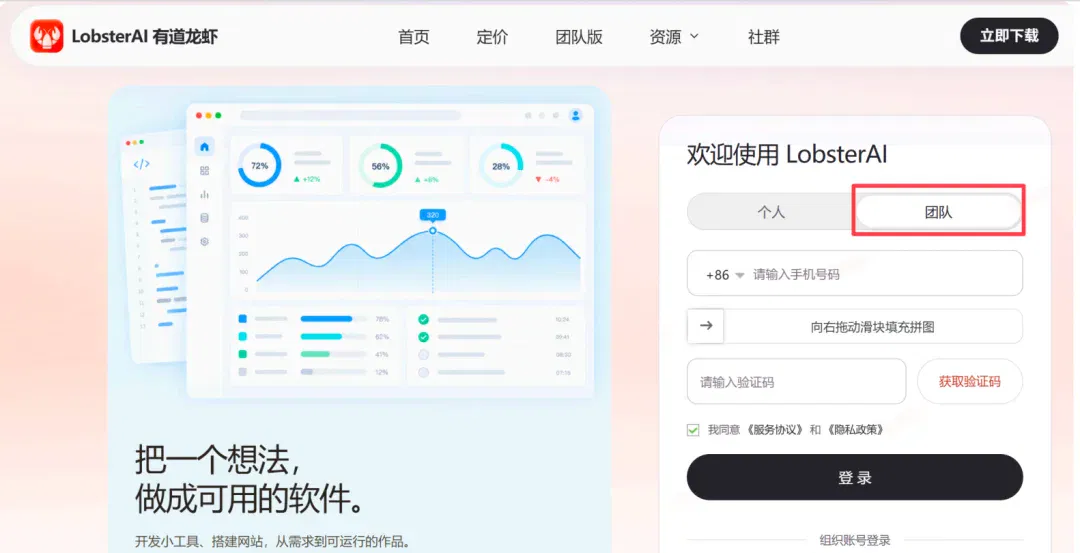
After activating the Team edition, administrators can add phone numbers to invite members. Team administrators have a default allowance of 8,000 points, while ordinary team members have a default of 5,000 points. Usually, this is enough for a month of use.
However, usage is uneven from person to person and can even differ severalfold. Take one member as an example: she often does design and visual tasks, which use more points. Sometimes, she can use 1,000 points in a single day. Others mainly do information gathering and document processing, and sometimes do not even use up 100 points a day.
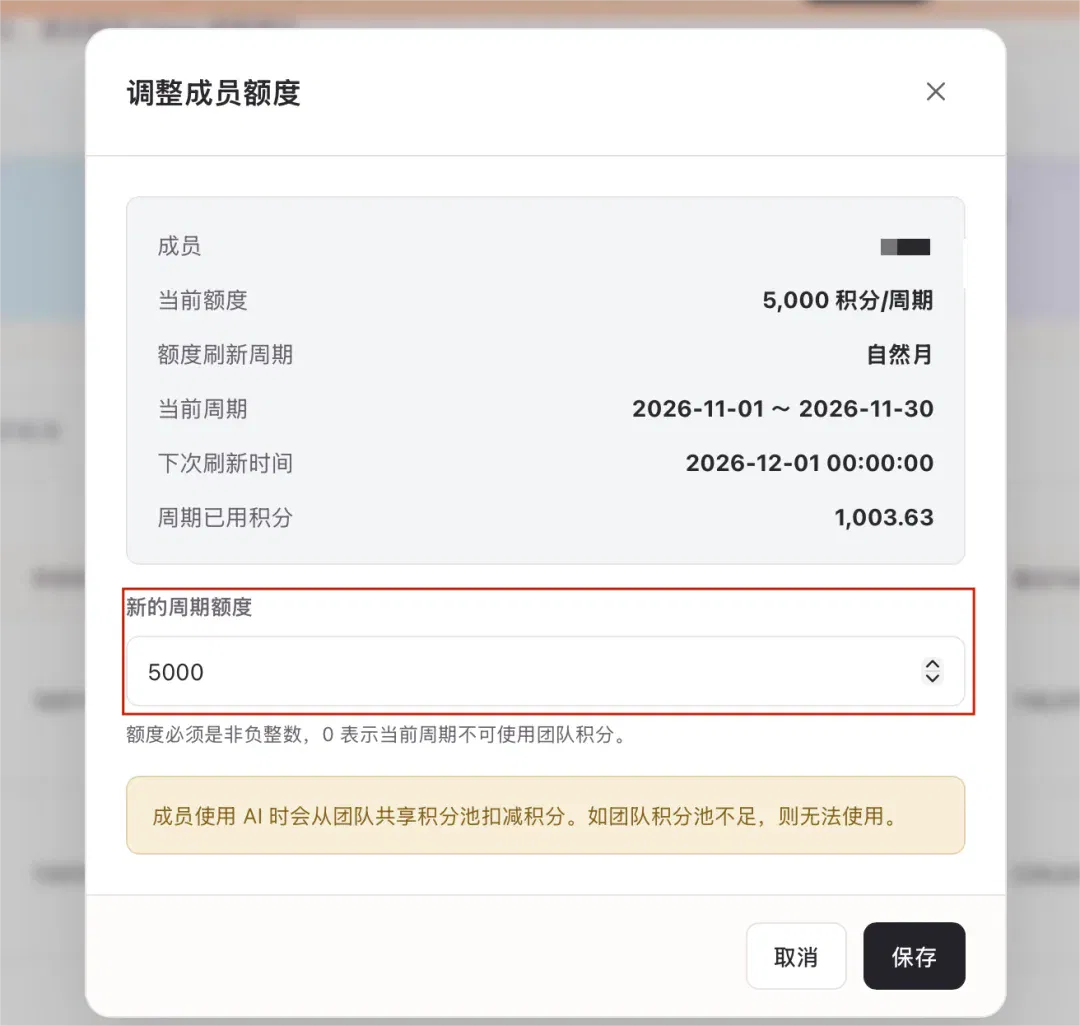
At that point, allowances can be adjusted so the points can be fully utilized. Administrators can log in to the team-management backend, see everyone's usage on the main dashboard, and adjust allowances in real time. It is very simple to do: click "Adjust Allowance" on the right, increase or decrease the number, and save.
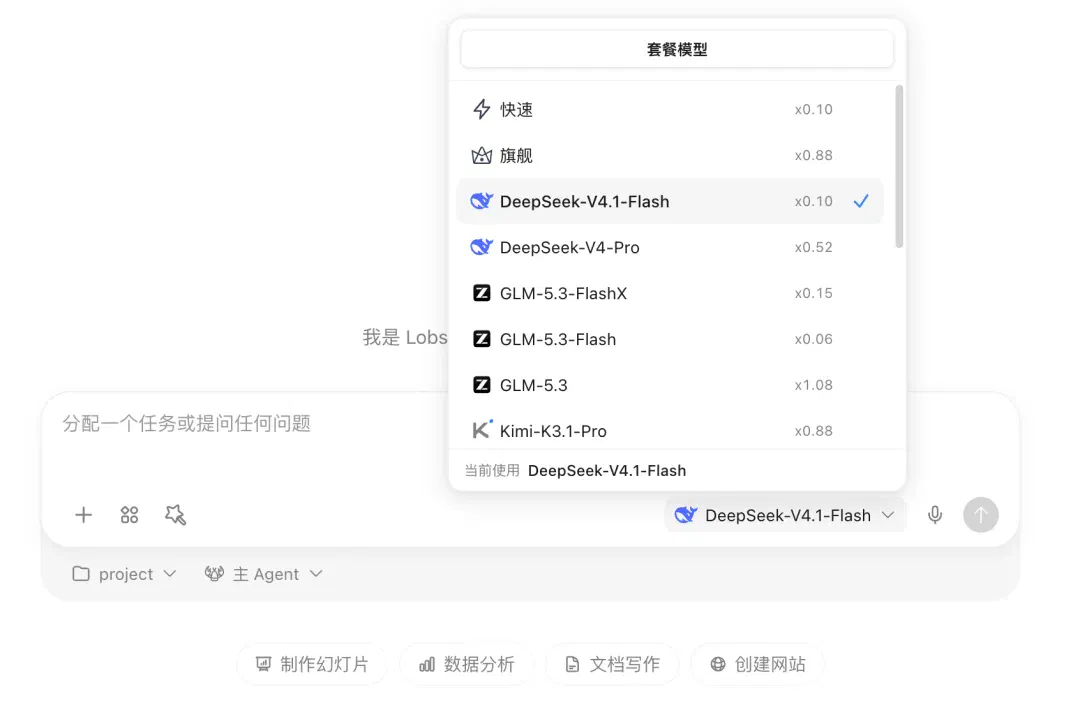
When carrying out tasks, I often use the DeepSeek-V4.1-Flash model. It is capable, fast, and relatively inexpensive. LobsterAI does a very good job of being open: users can freely switch to the most suitable model according to their needs and can also configure their own model APIs. The platform will also make the latest foundation models available as soon as they arrive.
For managers, the significance of this is not "having lots of models," but the absence of a preference for any one model. Binding the team to a single model is effectively locking its future capability ceiling.
3. A few final words
When a team chooses an AI agent for office work, beyond the budget and AI capabilities, what it often cares about most is security and privacy.
Making code open helps with auditing and further development, but does not automatically establish that every version, dependency, cloud connection, and execution permission has been audited or is secure. Actual deployment still requires checking the specific implementation.
Closed-source products ask you to "trust" that they are secure; open-source products let you "verify" that they are secure.
The author describes local storage of conversations and work files, as well as mechanisms for confirming operations. Using remote models, online tools, or cloud services may still involve sending necessary content. Local storage does not mean all processing is offline, and open source cannot be taken to mean automatic confidentiality.
As a manager, what I fear most is an employee leaving and taking the AI workflow with them, leaving nothing behind at the company. Open source plus local files means that agent configurations, Skills, and workflows are assets that are visible, portable, and available for handover. People can come and go, but the capabilities need to stay with the company.
Overall, from the perspectives of cost, use, and security, I consider LobsterAI Team the first choice for teams of up to 20 people.
Yuan Guoqing, an AI technology blogger, explores the real value of AI and the latest ways to use it, and is dedicated to helping ordinary people use AI well. Feel free to get in touch.
This article comes from the WeChat official account "Yuan Guoqing," by "Yuan Guoqing."
Related topics
After reading
Join the AINRK community
Read how to join the community and connect with people working in AI.
Related articles
Continue reading related topics and articles in this category.

Claude Meetings brings collaborative documents into calls, with efficiency and recordkeeping tradeoffs (opens in a new tab)
APPSO describes visible participation, live notes and whiteboard collaboration in Claude Meetings, examining how notifications, external guests, retention and AI summaries affect teamwork, privacy and the room for open-ended discussion.

Doubao Work vs. WorkBuddy: task times and usage with the same models (opens in a new tab)
The author compares profiles, calendars, sales reports and presentations, then tries Flash research followed by Kimi drafting. Results depend on plans, temporary offers and the specific task.

Trying Baizhi Office: shared configuration for models, knowledge bases and team usage quotas (opens in a new tab)
The author explores resource distribution, permissions, billing and task review from managers’ and employees’ perspectives, then tests document and web-page generation with a mock product brief.
Claude 推出表格与白板工具,更新数据分析和应用连接 (opens in a new tab)
Anthropic 公布 Claude Sheets、Whiteboards 及 Data 更新,覆盖表格编辑、团队构思和数据解读。部分能力分批推出,连接器及账号条件各有不同。
TeleAgent V3.0 加入 Windows 云电脑,体验企业微信与 Blender (opens in a new tab)
体验者用 TeleAgent 的 Windows 云电脑配置企业微信,并在处理两次启动问题后完成 Blender 汽车模型渲染。文章比较云端和本机执行方式。