OpenAI reportedly folds independent robotics team into core research and Applied
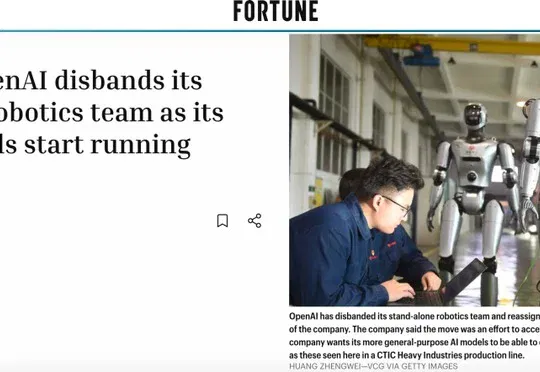
Synced cites Fortune on a reorganization and examines how general-purpose models could work with specialized control policies. Integrating teams does not mean abandoning robotics research.
OpenAI's robotics team has suddenly been disbanded.
According to Fortune, OpenAI has disbanded its independent robotics research team and reassigned the researchers to other departments within the company.
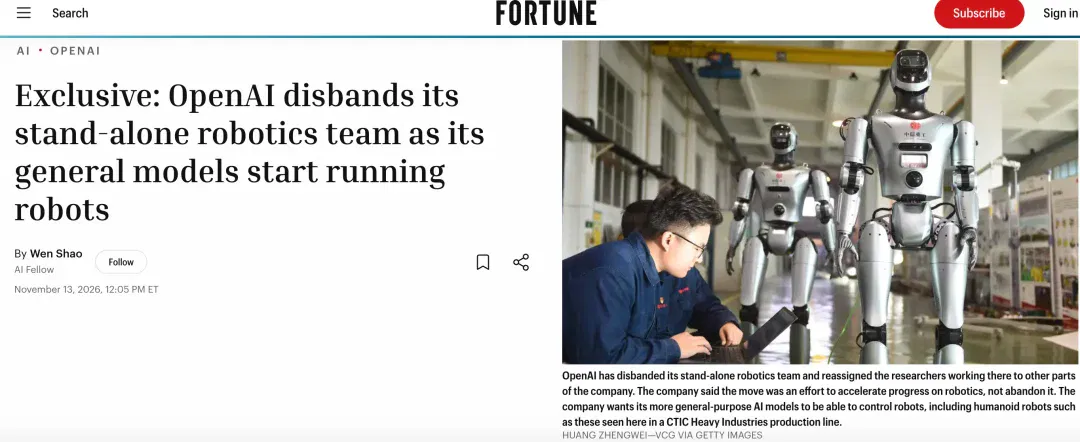
The former robotics research team has been folded into the company's core research team, reporting to Chief Research Officer Mark Chen. The applied robotics and hardware teams have been moved into the larger Applied division, led by OpenAI President Greg Brockman.
OpenAI has confirmed the change.
At this week's Conference on Robot Learning (CoRL) in Austin in the United States, OpenAI had already booked a booth. Its name appeared in both the conference app and the exhibition floor plan, but booth 208 was ultimately empty, with not even the company's logo on display.
OpenAI emphasized that robotics remains a central part of its long-term vision, that the reorganization does not mean it is leaving the robotics field, and that it remains committed to bringing general-purpose robots into the real world.
Why is OpenAI disbanding its independent robotics team at this point?
This may be connected to an important technical judgment. General-purpose large models have begun demonstrating an ability to control robots directly, and OpenAI is trying to have general models take on more robotics intelligence tasks.
Why is OpenAI reorganizing its robotics team again?
OpenAI's exploration of robotics has gone through several stop-start rounds.
The company established a robotics team early on, but disbanded it in 2020. Co-founder Wojciech Zaremba later explained that robotics faced limited training data at the time, and that other technical paths might be more efficient routes to AGI.
OpenAI subsequently shifted its R&D focus to large language models, training them on vast quantities of human text. That path ultimately produced ChatGPT, launched in late 2022.
In 2024, OpenAI formed an independent robotics team again and announced a partnership with humanoid-robot startup Figure to jointly develop AI models for humanoid robots. The partnership did not last long, however. In February 2025, Figure announced that it was ending the collaboration and would develop robotics AI on its own.
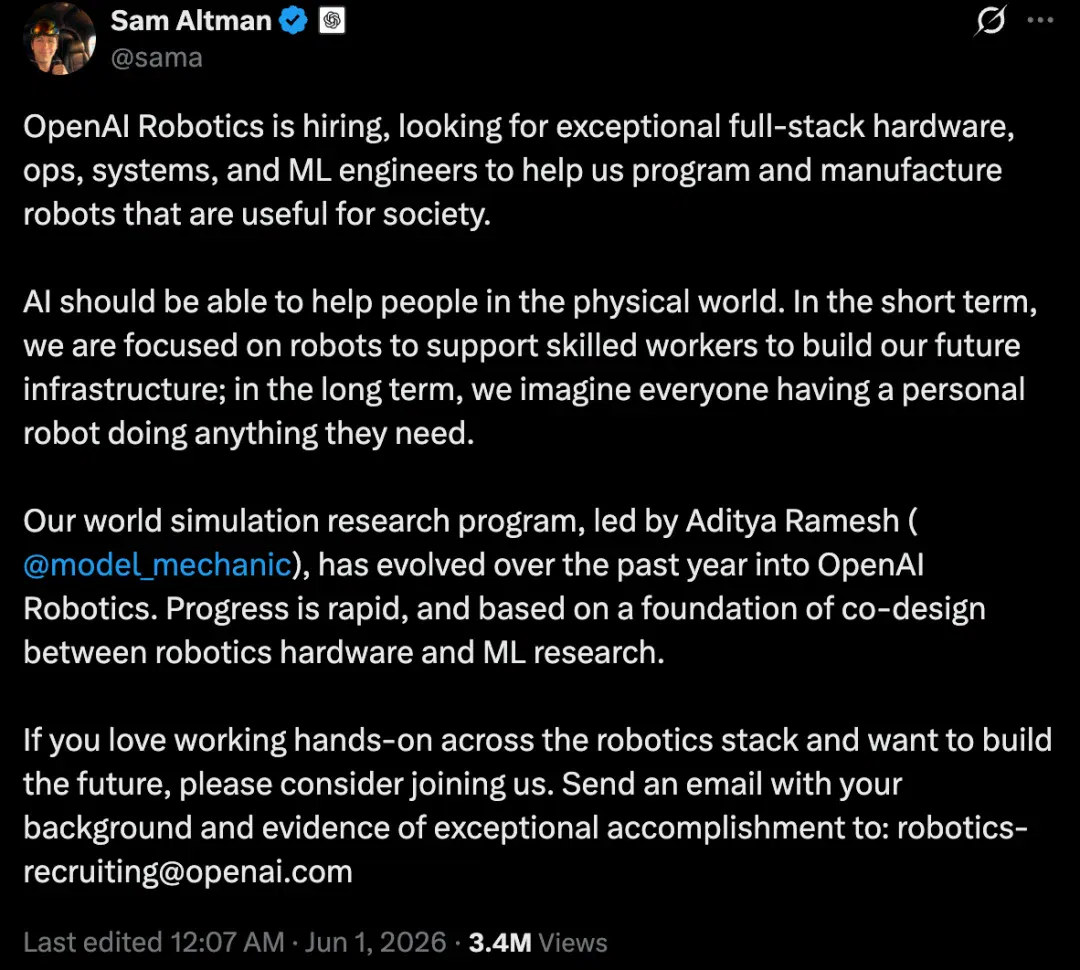
OpenAI then also began developing its own humanoid robot. In late May 2026, Sam Altman publicly posted a large-scale recruitment call, officially named the effort OpenAI Robotics, and set 2027 as the target for its first public demonstration.
Looking at this history, OpenAI's investment in robotics has not stopped; the main changes have been in its technical approach and organizational structure.
According to Fortune, OpenAI's research approach at the start of this year still involved looking for breakthroughs in robotics from existing work such as the video-generation model Sora.
To generate realistic video, Sora needs to learn object motion, spatial relationships and some of the physical world's regularities during training. These capabilities may be transferable to robotics.
Later, however, OpenAI found that general-purpose frontier models, including GPT-6 Astra, could already be applied directly to robotics tasks.
This finding changed the company's R&D approach. OpenAI decided to integrate robotics researchers into its general-model R&D organization, tying robotics research more closely to advances in foundation-model capabilities.
This reflects a technical approach that is gradually gaining recognition across the AI industry. In the past, robots generally needed specially trained models to understand their surroundings, plan actions and control actuators. Adapting to different robot hardware, tasks and application settings often required substantial amounts of data. Now, general-purpose models are beginning to show the potential to cross these task boundaries. Foundation models trained on language, code and vision may also be used directly to control devices in the physical world.
Can general-purpose large models take over the robot's brain?
This approach has already produced some surprising experimental results.
Recently, researchers have tried connecting GPT-6 Astra to robots, providing the model with camera images, information about the robot and interfaces that let it control the robot's actions.
In one Nvidia study, an Astra-powered agent achieved a 74.8% success rate on a simulated robotic manipulation benchmark. By comparison, the best-performing specialized robotics model on that leaderboard had a publicly reported score of 51.0%.
This experiment was conducted in a digital simulation: the model controlled a simulated robot, not a real one. Even so, the results show the potential of general-purpose models for robotics tasks.
Guanya Shi, an assistant professor at Carnegie Mellon University's Robotics Institute, believes OpenAI's reorganization sends an important signal. OpenAI may no longer see robotics as a special problem that needs to be solved independently, but as a downstream application of general intelligence. This resembles today's AI coding, legal and financial tools: the same general-purpose models operate underneath, with different tools and interfaces adapting them to specific tasks.
Advances in general-model capabilities also offer robots an opportunity to reduce their reliance on task-specific training.
For example, when a bottle's position changes or the ambient lighting shifts, a model can still adapt to some extent. Models can also reason about the order in which a task should be performed, judge whether a step has gone wrong and adjust subsequent actions accordingly.
However, many limitations still stand between general-purpose models and a complete takeover of robot control.
The first issue is inference efficiency. Although large language models are powerful, they run relatively slowly and usually still depend on cloud computing. For robots that need real-time responses, network latency and connection stability are practical problems.
Guanya Shi believes small, specialized models that can run on a robot's local computing hardware still have important value. They can complete some tasks without depending on a continuous network connection.
The second issue is data and experience in real environments.
MIT professor Russ Tedrake, co-founder and CEO of Walden Robotics, points out that robotics companies have an advantage AI laboratories find difficult to replicate. Their robots are already deployed in real settings such as factories, continually accumulating practical work experience. These deployment data can help robots adapt to particular workplaces and specific tasks. Stronger foundation models may also make it more efficient for robots to learn from these data.
In other words, general-purpose foundation models and real-world deployment data still need to develop together. The former provide stronger understanding and reasoning capabilities, while the latter help robots adapt to specific environments and tasks.
Pete Florence, co-founder of Generalist, a startup focused on general-purpose robotics AI models, also believes that it is not yet possible to determine which technical approach will ultimately dominate robotics. Intelligence may develop from different starting points, and existing models are not yet enough to establish who will be a long-term winner.
Is the robotics industry's technical approach about to change?
OpenAI's reorganization may also affect the robotics industry as a whole.
Over the past few years, robotics has attracted billions of dollars in investment. Many startups have bet on a similar approach: build a dedicated AI brain for robots, collect robotics data at scale and train specialized models so robots gradually acquire general-purpose manipulation capabilities.
OpenAI is now trying a different possibility. General-purpose models first acquire sufficiently strong understanding, reasoning and spatial capabilities, then connect to physical devices through interfaces and directly handle robots' intelligent control tasks.
If this approach continues to make progress, R&D systems built around specialized models will need to be reassessed. Robotics companies' value will not disappear as a result, however. Real-world deployment, hardware design, control systems and deployment-specific data remain important foundations for bringing robots into large-scale use.
OpenAI's reorganization also comes as the company faces pressure to control costs.
Last year, Altman asked the company to abandon some “side quests” that strayed from its core objectives and concentrate resources on more important products and R&D directions. OpenAI subsequently adjusted a number of projects to reallocate computing resources.
OpenAI reportedly incurred an operating loss of $10.9 billion in its most recent quarter. At the same time, it is seeking a new funding round and preparing for a possible IPO in early 2027.
Against this background, bringing together researchers previously spread across different teams and concentrating their efforts on general-model R&D also fits the company's aim of using resources more efficiently.
OpenAI's thinking about robotics is changing. Will future robots need a separately trained, specialized brain, or will they be able to call directly on continually evolving general intelligence?
Reference:
https://fortune.com/2026/11/13/openai-disbands-robotics-team-as-its-general-models-start-running-robots/
This article comes from the Synced WeChat account. Author: Synced.
Related topics
After reading
Join the AINRK community
Read how to join the community and connect with people working in AI.
Related articles
Continue reading related topics and articles in this category.
智动未来据报完成亿元级Pre-A+融资,资金用于产线与服务机器人部署 (opens in a new tab)
机甲觉醒报道,智动未来宣布完成亿元级Pre-A+轮融资,由中美绿色基金领投、南曦创投联合领投,资金拟用于广州产线、服务场景部署和世界模型研发。“智子世界”仍属技术预览,商业化效果待更多应用数据检验。
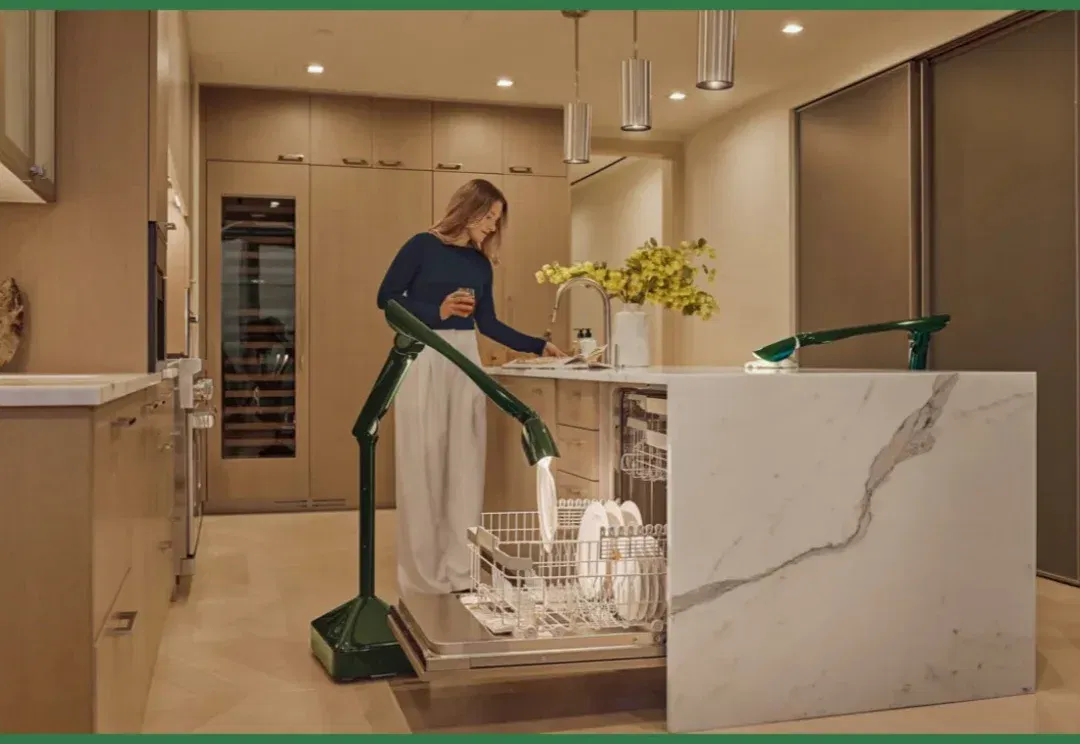
Syncere raises $11M for Lume, a household robot shaped like a floor lamp (opens in a new tab)
Syncere uses a floor-lamp form for Lume: one robot handles some pick-and-place tasks, while two work together in Duet mode on tasks such as folding clothes. Demos are edited; pricing and delivery reflect the source date, and home reliability remains unproven.

Genesis AI raises $500M Series A to advance its full-stack robotics and Eno (opens in a new tab)
Genesis AI announces funding at a $3.5B post-money valuation, outlining a stack of data gloves, simulation, models and the Eno robot. Production and customer deployments are planned; demonstrations and correlation experiments do not establish delivery at scale.
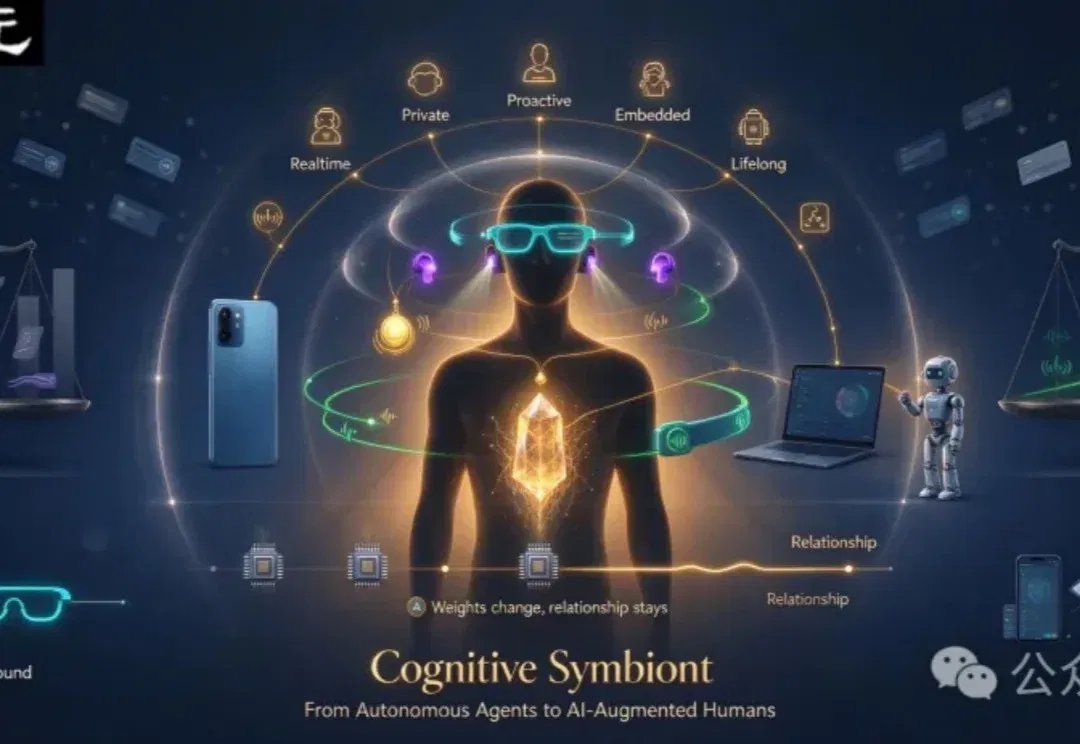
Oxford researcher proposes cognitive symbionts for wearable AI augmentation and governance (opens in a new tab)
Hao Fei's perspective paper proposes cognitive symbionts and AI-Augmented Human Intelligence, covering long-term memory, wearables, proactive help and governance. Privacy, low latency and lifelong companionship are design goals, not verified product guarantees.

OpenAI launches GPT-6.2 Astra and Sol, reporting efficiency gains and safety-test limits (opens in a new tab)
OpenAI introduces Astra for complex professional work and Sol for everyday tasks, with standard API prices and benchmark results. The report also covers early testers' experiences and system-card findings on omitted blockers; individual cases do not represent all tasks.