How long is the window for AI recording hardware? From audio capture and transcription to personal-agent context
GeekPark examines watches, recording cards and wearables, discussing system access, memory filtering and interface integration. Its six-month window is the author's forecast of competition.
Editorial correction (November 13, 2026): Transcription can still be wrong, and continuous audio capture also involves system permissions and participants being informed. The product window and predictions for next year in this article are the author's judgments.
Building a business around "knowing the user throughout the day."
On November 4, Beijing time, Apple released the first developer betas of iOS 27.3 and watchOS 27.3. Besides bringing Apple Intelligence to mainland Chinese models, they added two new AI features to Apple Watch: Live Rewind, which lets you review conversations from the preceding 15 seconds at any time, and Siri Recap, which takes notes on your conversations with others throughout the day and organizes them into summaries. However, both features are currently English-only, and Apple explicitly states that they are not available in China for now.
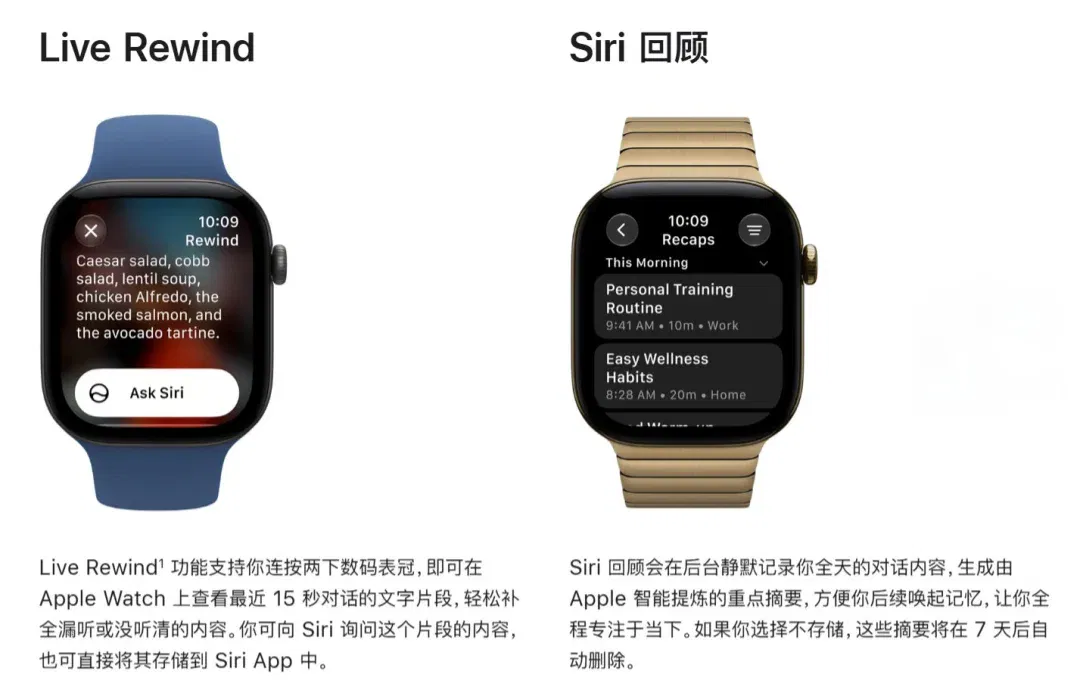
Live Rewind on the left; Siri Recap on the right | Image source: Apple
Apple Watch users do not need to buy dedicated recording hardware for these features, but still need a compatible device, beta software, the required region and language conditions, and an understanding of the feature settings.
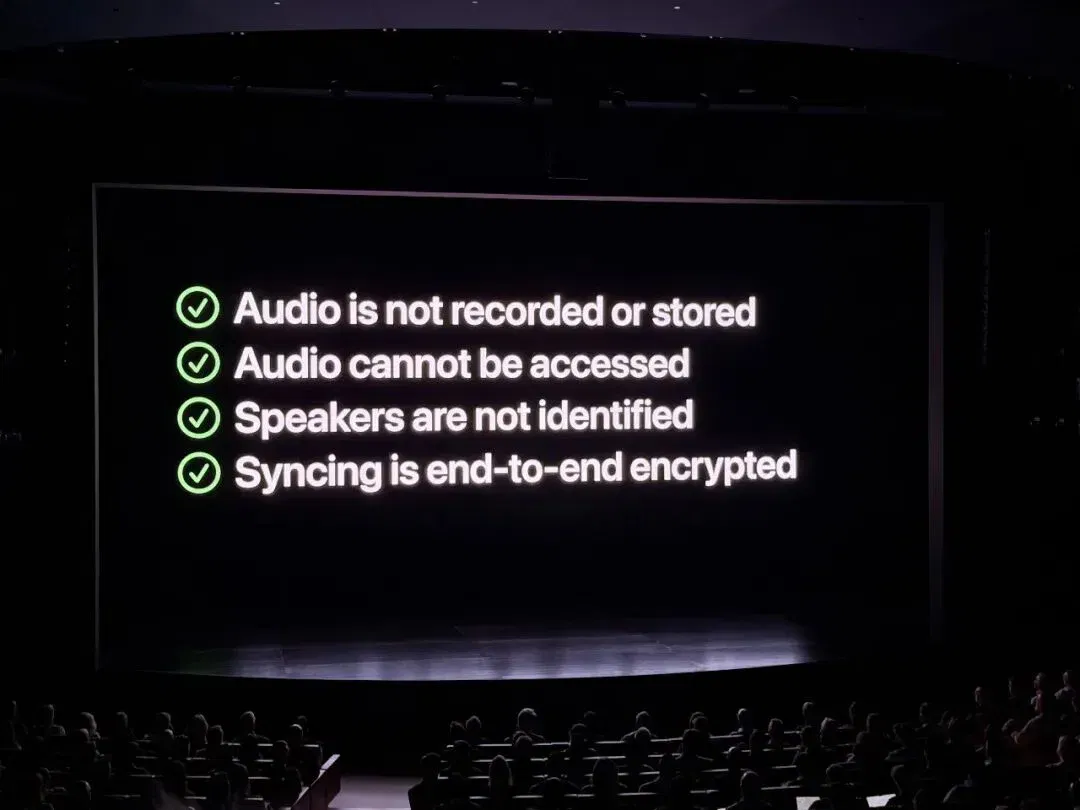
Apple says audio is neither recorded nor stored, and speakers are not identified | Image source: GeekPark
Recap has not launched in China for now, but there is no need to wait for an Apple Watch update to get a similar experience. Several devices in China are already doing the same thing: the OPPO AI Xinli Ball, NOOKLAB portable screen and iFlytek recording ring all emphasize all-day audio capture.
These products are still classified under the broad category of AI recording hardware, but a clear trend is that more and more products are choosing not to retain audio recordings.
The OPPO AI Xinli Ball (opens in a new tab)is a typical example of a product that "keeps only text records." The QwenNote A2 recording card, released by Alibaba's Qwen at the Apsara Conference in September, similarly sends audio to the cloud for transcription and deletes the original audio afterward, retaining only text and notes.
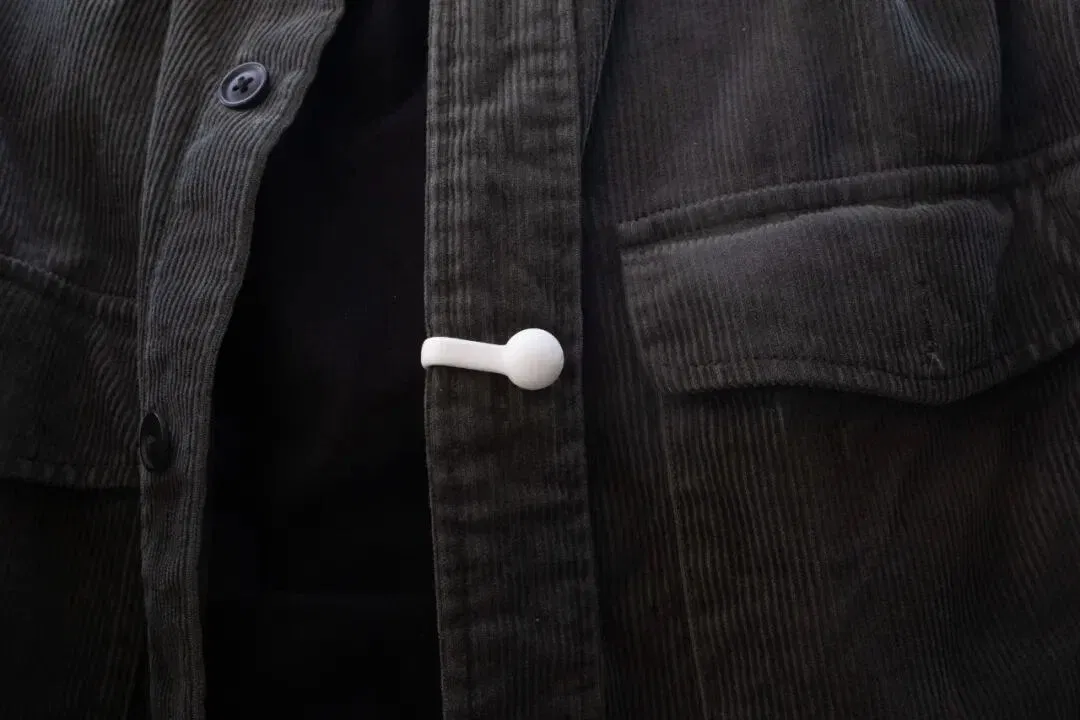
The OPPO AI Xinli Ball clips onto a collar for all-day audio capture | Image source: GeekPark
Yusen Chen believes his product's speech transcription can already meet many recording needs. Transcription can still make mistakes because of noise, accents and technical vocabulary; whether to retain original audio depends on accuracy-checking and usage needs.
He also said AI recording products are only a small category, while AI notes and meeting-intelligence products have "unlimited room for imagination." His previous-generation recording card has already sold "well into the hundreds of thousands of units." Here, recording is merely an intermediate step toward text, so the hardware's remaining job is mainly to capture sound.
As the concept of Personal AI has risen in 2026, the readers of these records are shifting from people to agents. But AI recording hardware may not be the best vessel for "carrying the soul."
The business of filling an information gap
In June 2023, Plaud began selling recording cards that attach to the backs of iPhones. For a time it was unrivaled in prominence, even becoming synonymous with AI-native hardware. Its cumulative sales now exceed 3 million units.
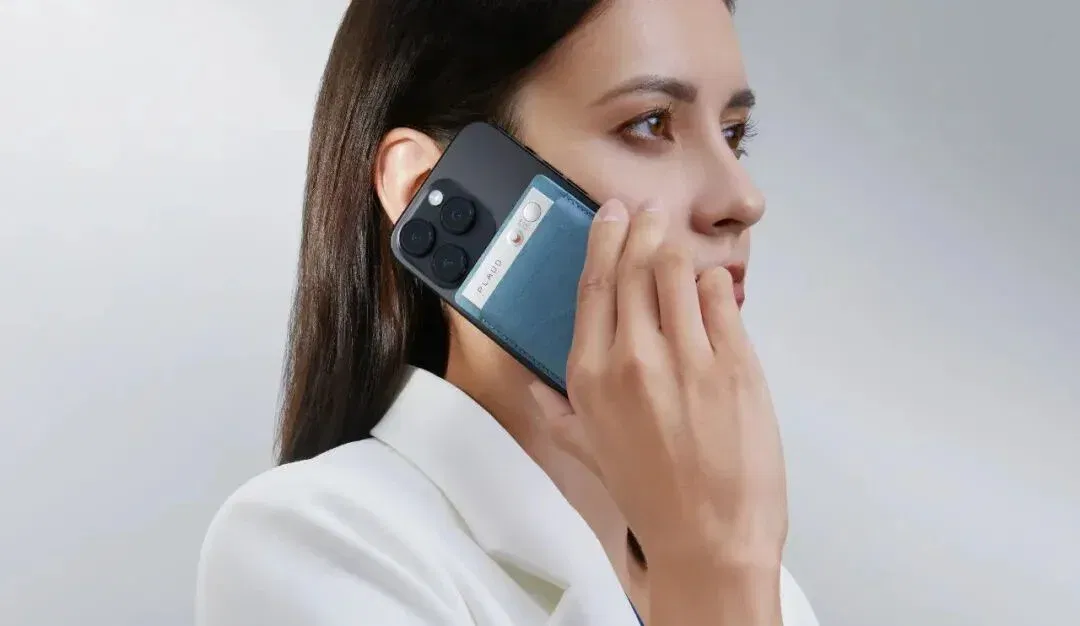
A Plaud recording card in a magnetic case, attached to the back of an iPhone | Image source: Plaud
But even Plaud struggled to adapt when returning to China, where it faces many cheaper competitors. DingTalk says its recording card ranked first in AI recording-device sales on Tmall, Douyin and JD.com during this year's June 18 shopping festival.
Prices can be pushed down because recording and transcription are not moats in themselves: a phone paired with a transcription app can already cover the vast majority of recording scenarios.
Hardware originally created to record on the phone's behalf thus finds itself, in the Personal AI era, back at the old question of competing with the phone itself.
By 2026, the new generation of AI recording hardware has simply shifted its selling point from meetings to people: follow users throughout the day and accumulate their personal context.
This shift has become concentrated this year because personal AI agents can already write reports and run processes for people, yet do not know what their users have said offline.
Internet giants have recognized this problem and started targeted efforts to catch up. In September, Tencent brought nine co-branded hardware products to WorkBuddy; at least six primarily capture audio, according to the published list.
In theory, the phone holds the most context, but third-party agents cannot access it. Competition between apps and AI assistants has even intensified: on October 14, the disclosure period for Doubao's phone assistant ended, with 155 apps explicitly refusing AI operation on users' behalf. Tencent and affiliated companies accounted for 66 of them; WeChat, Taobao and Alipay were all on the list.
Recording hardware does not need to obtain information through every business app, but it still involves conditions such as system microphone permissions, product settings and participants being informed. This cannot be interpreted as allowing unrestricted recording of other people's conversations.
There are times when the phone itself cannot hear, either. It spends most of its time in a pocket, and Android's current architecture does not allow apps to turn on the microphone on their own from the background. Explaining why his company wanted to make separate AI hardware, Nothing founder Carl Pei once gave an example: someone says something worth noting over coffee, but by the time you take out your phone, the moment has passed.
For now, these restrictions primarily block companies other than phone manufacturers. Major internet-service companies now tend to seek controlled cooperation with phone manufacturers through agreements, so when access really opens up, phone manufacturers will probably be the ones at the negotiating table.
For the moment, however, even phone manufacturers need other devices to make up for the shortcoming in audio capture. Apple has put audio capture on the watch, while OPPO has the Xinli Ball share a memory engine with its phone operating system.
These devices themselves are also moving closer to phones. Of the 14 new recording and wearable products released this year, five attach directly to the back of a phone. Meanwhile, the number of devices that can connect to the internet independently, without relying on a phone, has risen sharply in a short time. There are now three: Qwen's QwenNote A2, Mobvoi's TicNote and Meta's Muse Charm.
Agents do the reading
Once records accumulate, people are no longer their only readers. Having agents extract useful information is a step that directly determines the eventual experience.
In my daily use of all-day recording hardware such as the OPPO AI Xinli Ball, I not only use its app directly to obtain organized information, but also connect these records to Feishu as a "transfer station," then import them into tools such as Codex and DeepSeek Harness for engineering-context analysis.
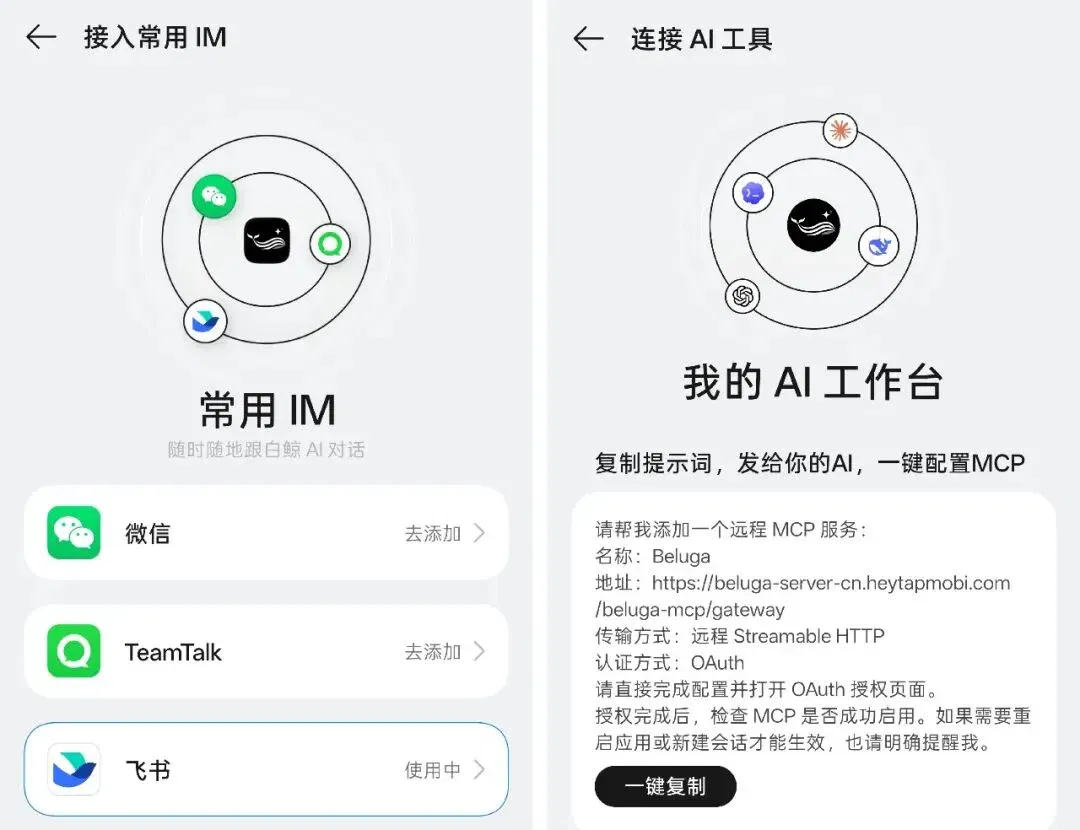
Xinli Ball records can connect to Feishu or be passed to AI tools through MCP | Image source: GeekPark
These harness tools perform an "initial screening" of transcribed content, selecting about 200 segments from my several thousand conversation segments. According to Codex's calculation, about 30% is background noise, 40% is small talk such as "Let me share my screen," and 20% is context useful only at that moment; less than 10% is useful information.
Although less than a tenth is actually usable, I can already clearly feel that, when planning related tasks, the harness more easily works out what I really want from my vague, fragmented language.
Interfaces that let agents read recordings have also largely opened up this year. At the same time, agents' tendency to "choose their raw material" is increasingly apparent. Recap on Apple Watch can create records from a full day's audio, but for privacy, not retaining recordings is becoming the default. The more aggressively raw material is reduced, the less context agents can use, so selection may be scarcer than remembering more.
Whose agent does the reading depends on who controls the true entry point to intelligence.
Phone manufacturers' system agents do not have to wait for others to open interfaces. OPPO's memory engine serves both the system and Xinli Ball. Apple is the most conservative: even Siri AI currently cannot read Recap-generated summaries. Companies without phones can only read from outside. In China, Plaud prioritized WorkBuddy for its interface, while Amazon lets users connect Bee to their Amazon accounts in exchange for more personalized shopping recommendations.
This is also why the phone remains the best place to house personal AI. "Best" does not refer to where the computing happens—Recap summaries are also generated in the cloud—but to the fact that a phone follows a person all day. Accounts, messages, schedules and payments are all on it, and agents' completed work ultimately has to return to this screen for human review.
In September this year, Qualcomm executive Ziad Asghar said, "The smartphone will remain the hub of the agent experience, but personal AI needs devices worn on the body." This is consistent with Apple's and OPPO's approach. Portable hardware with limited computing power will mainly serve as an entry point.
Companies without phone operating systems are therefore building their own entry points. Amazon bought Bee last year; Meta plans to launch the keychain-sized Muse Charm in December; according to Bloomberg, OpenAI also wants to make a device that can replace the phone; and ByteDance has embedded Doubao in ZTE's phone operating system.

Muse Charm, which Meta plans to launch in December, is keychain-sized | Image source: Meta
Hardware companies also understand their position. "Making hardware add-ons for major companies' personal agents" is increasingly becoming a pragmatic choice. Hardware is ready at the level of recording, transmission and transcription, but software integration still has some way to go. For example, among Tencent's co-branded devices, only one from Insta360 has publicly claimed deep interoperability, and Xinli Ball still uses the separate Baijing AI. Phone manufacturers have not yet integrated these things, and this gap is hardware companies' current window of opportunity.
For people considering hardware to record their lives at any time, dedicated recording cards remain useful for meetings. That use case is precisely why Plaud and DingTalk sell well. But if the only purpose of wearing another device is all-day recording, it may be worth waiting, because phone manufacturers' watches and headphones may fill this gap sooner.
The gap in China may be somewhat longer than in the US, however. Recap is not yet available in China, and Bee and Muse have not entered either. The variable is which of Huawei, OPPO, vivo and Xiaomi first builds all-day memory into the system. OPPO and vivo have already added memory features to their systems.
By mid-2027, at least one Chinese phone manufacturer should have made all-day recording a built-in system capability, so users will no longer need to buy separate recording hardware for it.
It took smartphones more than a decade to bring cameras, maps, wallets and address books into a single device. All-day recording is very likely to follow the same path: first appearing as separate hardware, then being built into the system by phone manufacturers.
At that point, users will no longer be choosing which recording device to buy, but whose agent to let read their round-the-clock records.
*Header image source: Apple
This article comes from "GeekPark." Author: "Yongyi Zhang."
Related topics
After reading
Join the AINRK community
Read how to join the community and connect with people working in AI.
Related articles
Continue reading related topics and articles in this category.
General AI models enter hardware development, from files to prototypes (opens in a new tab)
Youxin reviews hardware-design examples involving OpenAI, Anthropic and engineering tools, spanning circuits, enclosures, firmware and CAD. Some prototypes were built and tested, but digital checks, engineering review and physical reliability remain distinct hurdles.
Suisheng raises tens of millions of yuan for Memoket wearable AI memory (opens in a new tab)
Zhidx interviews Suisheng founder Wang Shiyuan about the Memoket Gem wristband, KITE long-memory engine and software subscriptions. Funding, battery life, early user results and benchmark figures are company statements; long-term use remains to be tested.
Turning an unused Android handheld into an AI terminal with buttons, NAS memory and home control (opens in a new tab)
The author rebuilds a handheld around a Big Fat Fish character, voice input, meeting archives and Mijia controls. The project also exposes audio conflicts, button noise, clipped speech and excessive token use from camera polling.

iQIBLA opens Aura Premium preorders, bringing recitation counting and records to a ring (opens in a new tab)
The ring combines touch counting, display prompts and prayer reminders with app-based recitation records. The four million sales mentioned in the report refer to cumulative sales of the brand’s products.
OpenAI 工程案例用 GPT-6 Astra 设计 Codex 掌机原型 (opens in a new tab)
OpenAI 两名员工用 GPT-6 Astra 设计掌机外壳、电路与固件,再经人工审查和制造修改,完成小批量原型。报告还分享了赛车零件与汽车仿真案例。