Hygon and Qingcheng AI report over 3× performance at equal cost in specific long-context hybrid-inference tests

The white paper reports over 3× end-to-end performance versus an equal-cost high-end homogeneous setup: Hygon Shensuan 3 for prefill, B-series nodes for decode, GLM-5.3, long inputs/short outputs, 90%–97% prefix-cache hits and matching SLOs. The result is specific to those workloads.
On November 17, Nvidia released its latest quarterly results: revenue of $115.8 billion for a single quarter, doubling year over year.
Today, the whole world is scrambling for computing power.
Chips ought to become cheaper the longer they are used. In this market, however, even three-year-old GPUs are rising in price.

The biggest force behind this is the explosion in inference demand.
Google disclosed in late October that its model APIs were processing nearly 32 billion tokens per minute, more than four times the figure a year earlier.

While demand is booming, supply within China is growing increasingly tight.
The high-end cards in Chinese data centers are a fixed stock: existing capacity remains, but additional supply is hard to obtain. Chinese-made chips are therefore attracting renewed attention.
With only the existing stock of high-end cards available and inference workloads multiplying, how can this problem be solved?
The main battleground in AI competition has shifted from the 'ceiling of intelligence' to 'cost per task.'
Over the past few years, Chinese-made chips have moved beyond 'going from nothing to something' and are now on the road from 'having something to making it better.'
The cards have now been built. The next competition is about who can use them well and deliver value for money. The day Chinese cards match or even surpass overseas alternatives on price-performance, the landscape will be completely rewritten.
On November 20, Hygon Information and Qingcheng AI jointly released the White Paper on Heterogeneous Hybrid Inference with Prefill-Decode Separation, offering an engineering solution that can be put into practice:
Split inference into prefill and decode. China's Hygon Shensuan 3 takes on compute-intensive prefill, while the limited stock of high-end cards concentrates on bandwidth-intensive decode.
Under the white paper's specific model, workload, cache-hit-rate and service-level constraints, and at equal investment, performance can exceed three times that of a high-end homogeneous setup, without purchasing a single additional high-end card.

A single AI inference call
Two very different jobs
To explain this approach clearly, we first have to look at large-model inference itself.
You send a model a passage, and it replies with another. On the surface, this is a question and answer. Underneath, at the chip level, it actually separates 'reading' from 'writing' completely.
The first step is prefill.
The model reads all the input in one go and computes an internal 'memory,' commonly called the KV cache.
This step can be highly parallelized, with hundreds of thousands of tokens fed in at once. What matters is a vast amount of matrix multiplication.
It consumes the chip's raw computing power, and longer inputs require more work. How long you wait after pressing Enter before the first word appears depends largely on this step.
The second step, decode, follows immediately. Having digested the input, the model starts writing its answer one piece at a time.
The computation required for each piece of output is actually small. Yet each time it produces one, it has to bring the model's entire set of weights and the 'memory' accumulated so far back out of GPU memory and read them again.
At this stage, computing power therefore sits largely idle, with everything bottlenecked by GPU-memory bandwidth and capacity. Whether output flows smoothly or stutters like a slideshow depends on them.
One stage needs computing power and the other bandwidth: their demands point in opposite directions. Squeezing both jobs onto the same cards makes them hold each other back.
When a long request containing hundreds of thousands of tokens starts prefill, responses for dozens of users on the same card can all stall for several seconds.
The industry's solution is prefill-decode separation, dividing the two jobs into two independent resource pools.
But if both pools still use the same type of high-end card, the prefill pool pays for bandwidth it does not use, and the decode pool pays for idle computing power. Money continues to go to waste.
Breaking the impasse!
Chinese computing handles the compute-heavy work, while high-end cards focus on the final sprint
If the two stages need different capabilities, why must they use the same cards?
This is where the idea of 'heterogeneous hybrid inference' comes from.
Chips with different architectures are managed together as one logical resource pool and assigned according to the nature of the work. Externally, there is still one service with one set of service-level standards. Internally, each handles the stage it is best suited to.
Hygon Shensuan 3 offers high FP8 compute density and substantial aggregate GPU memory when multiple machines are pooled. That fits prefill's appetite for 'computing power and room for long contexts.'
The most valuable features of high-end B-series cards are per-card GPU-memory bandwidth and native FP4 capabilities. Putting them on the most latency-sensitive decode work uses the best resources where they matter most.
This division of labor is especially significant in today's supply environment.
With only existing high-end capacity available, free those cards from prefill and concentrate them on the decode work they are uniquely good at. Hand prefill to Chinese-made computing resources with ample supply and domestic control.
Without buying one more high-end card, the entire cluster's serving capacity rises in tangible terms.
Here, Chinese computing is the lever that unlocks existing capacity: first establish a foothold where it fits best, then move forward step by step.
A request's 'complete journey'
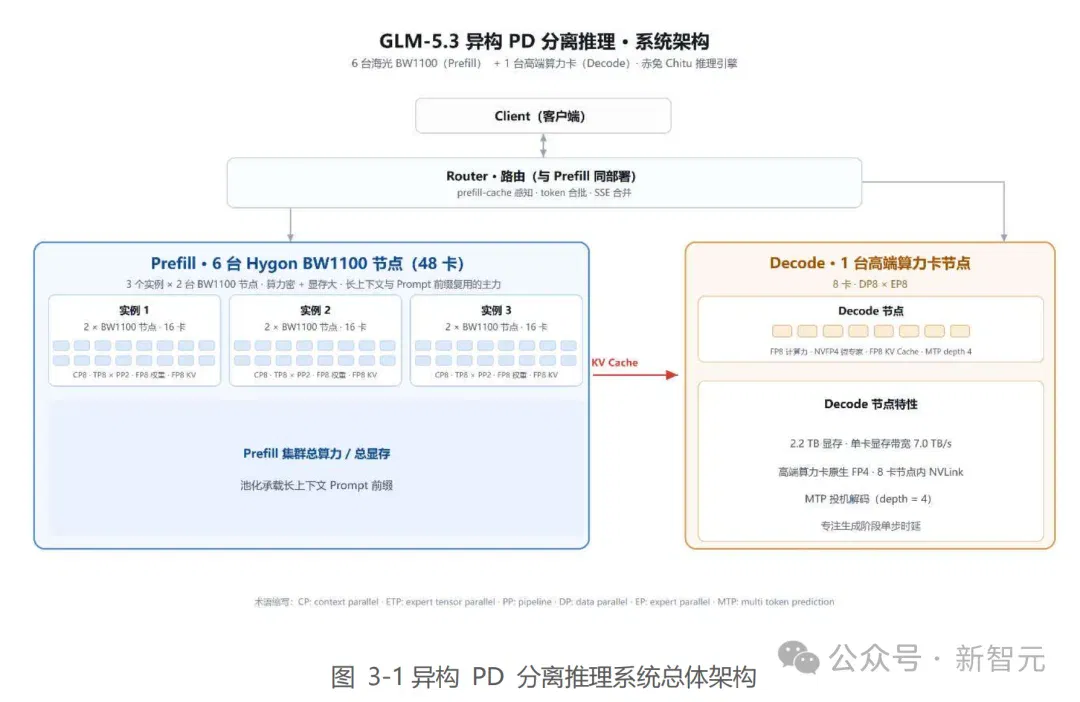
The whole system has four parts. Following a request through it makes them clear.
An incoming request first reaches the routing layer, the front door to the entire service, responsible for prefix-cache-aware routing, token-level batching, merging streaming responses and forwarding requests.
Many agent requests begin with the same system prompt or the same code repository. The routing layer recognizes this and sends them directly to an instance that has already processed the prefix, avoiding repeated computation.
The request then enters the Shensuan 3-based prefill compute pool.
Pooling several Chinese-made nodes produces a large total memory capacity, allowing more prefixes from agent sessions to be retained simultaneously and improving cache hit rates.
The resulting KV cache is sent to the other side over a KV-transfer link, the most technically demanding part of the whole approach.
The two vendors' chips use different numerical formats. The solution standardizes on FP8 and precisely aligns quantization scaling factors, so cross-vendor transfers introduce no additional loss of precision.
During transfer, the decode node actively 'pulls' data through RDMA, so the two pools do not have to wait for each other.
Finally, a B-series node in the decode generation pool receives the ready-made KV cache and starts generating output immediately, without recomputing the prefix. The routing layer collects the results and returns them to the user.
The same money, more than three times the performance
Explaining the logic is not enough. We need to look at measurements.
The foundation model used in this validation is Zhipu's GLM-5.3. The tests specifically target today's popular, hardware-intensive long-context scenarios, covering three workloads:
- 40K input and 200 output, corresponding to interactive conversations and lightweight agent calls;
- 85K input and 654 output, corresponding to context accumulated over multiple agent turns;
- 200K input and 1K output, corresponding to long-document analysis and complex coding agents.
The prefix-cache hit rate is set to 90%–97% in the tests. The author says this setting matches the production workloads being examined; it does not mean all real workloads have the same hit rate. The following three metrics are all reported results under those test conditions:
First: more than three times.
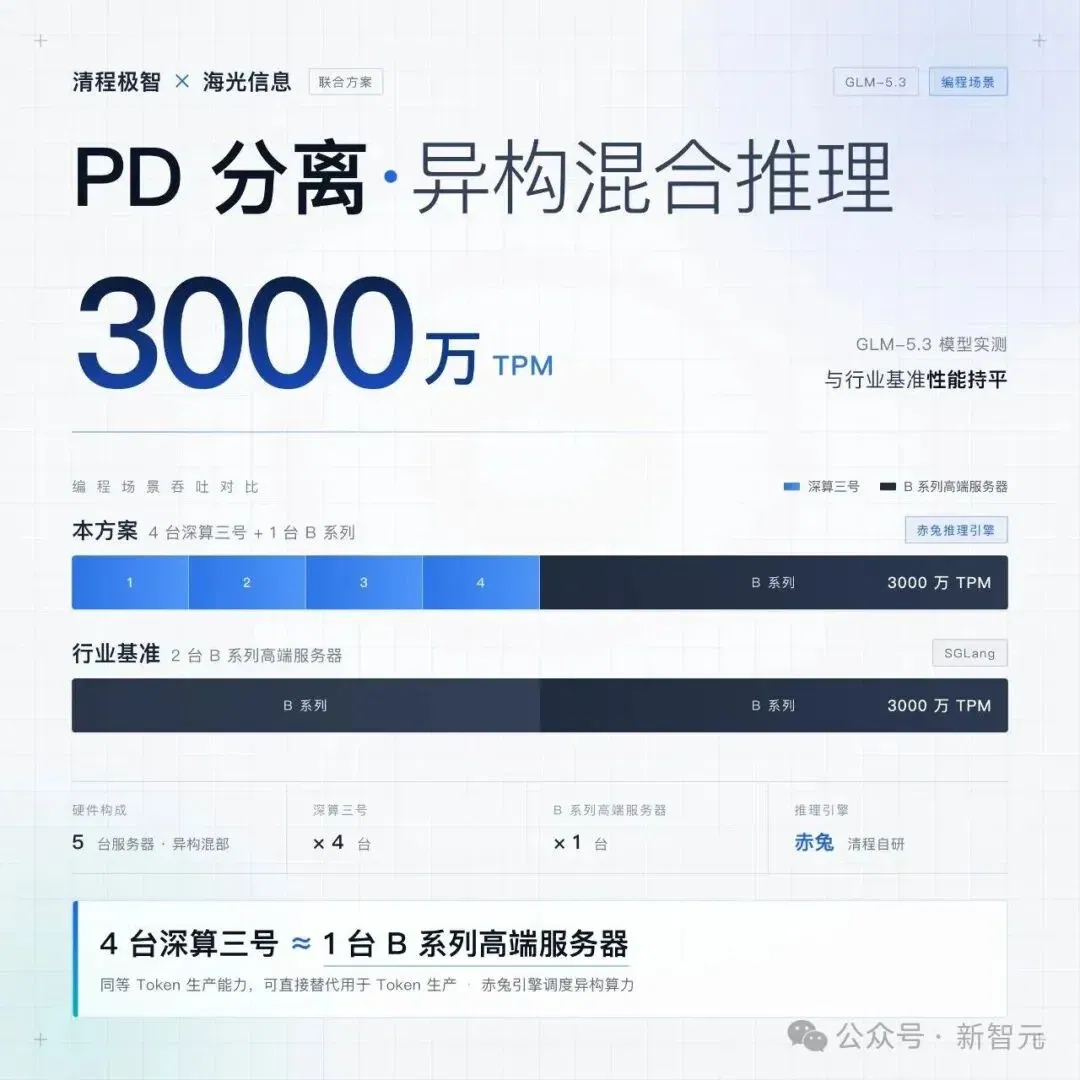
With input/output lengths and service-level constraints held constant, the Hygon Shensuan 3-based heterogeneous hybrid-inference setup delivers more than three times the end-to-end inference performance of a high-end homogeneous setup costing the same amount.
Second: within one to four.
Fewer than four Hygon Shensuan 3 nodes can provide equivalent prefill processing capacity to one high-end B-series node.
Put these two numbers together and the economics become clear: prefill, previously weighing on the high-end cards, is handled by fewer than four Chinese-made nodes. The high-end computing capacity freed up is devoted entirely to decode.
With the same budget, output rises to more than three times the previous level.
Third: 30 million.
Running GLM-5.3, a setup of four eight-card Hygon Shensuan 3 servers plus one eight-card B-series server achieves up to 30 million TPM (tokens processed per minute), equivalent to approximately 500,000 tokens per second. This follows the white paper's TPM definition. The article does not provide separate counts for input, output and prefix-cache-hit tokens, so this figure cannot be directly interpreted as 500,000 newly generated output tokens per second.
Throughput has risen, and stability stands up to scrutiny as well.
Across all three workloads, P50, P90 and P99 time to first token and time per output token all meet the service-level requirements.
According to the white paper, pipelining amortizes cross-pool KV-cache transfer overhead, keeping latency curves steady. Within the tested concurrency range, throughput grows approximately linearly with concurrency, and model accuracy matches the official reference on the benchmarks tested. These results do not guarantee accuracy or latency across all workloads, concurrency scales or quantization settings.
Anyone who has run online inference knows that these last few achievements are harder to obtain than peak figures.
You can boost a peak figure by choosing favorable scenarios. Whether P99 stays stable and accuracy holds up determines whether a system can genuinely go into production.
These are the numbers that take a system from 'technically feasible' to 'deployable in production.'
A good engine is indispensable
At this point, one question cannot be avoided: if the principle is not complicated, why has nobody made it work before?
Because the hardest part is software. Chips with two entirely different architectures must be scheduled together within a single service. KV caches must flow between vendors without loss, routing must be cache-aware, kernels must be tuned separately for each type of hardware, and precision strategies must let both vendors' chips run along their optimal paths.
If any link is poorly handled, theoretical computing power will not turn into actual throughput.
The industry often talks about 「Chinese chips, Chinese engines and Chinese models」.
China has its chips and its large models. The 'engine' between them is the inference engine, responsible for actually translating a chip's hardware capabilities into efficient model execution.
However powerful a chip may be, if the engine does not keep up, the resulting performance could be cut in half.
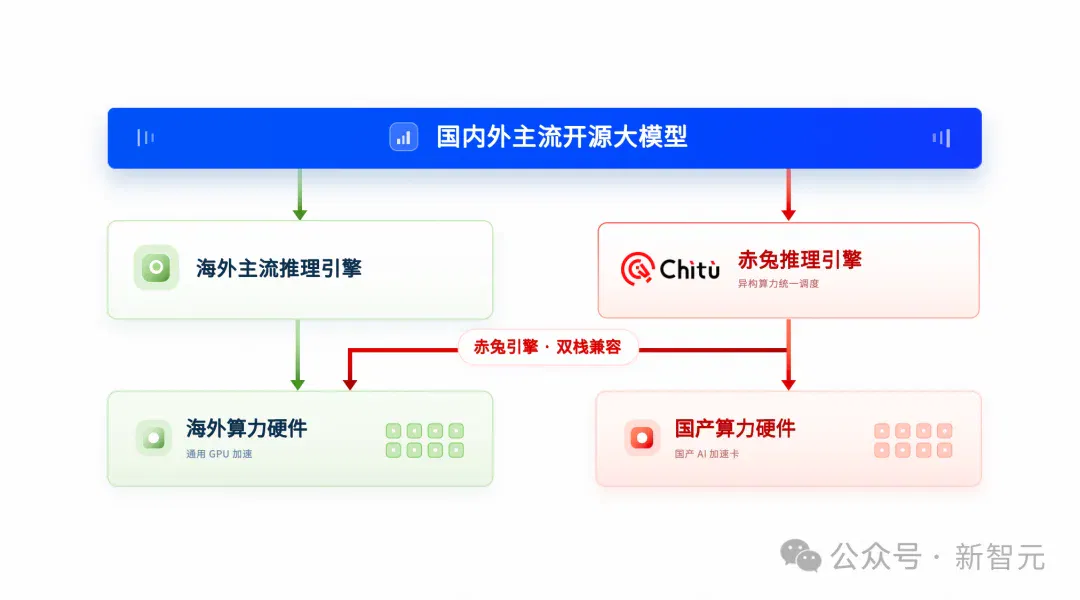
The 'Chinese engine' in this solution is the Qingcheng Chitu inference engine, developed in-house by Qingcheng AI.
Chitu covers the general capabilities of mainstream open-source frameworks such as vLLM and SGLang, with deeper adaptations and optimizations specifically for Chinese-made chips layered on top.
In this heterogeneous hybrid-inference solution, Chitu handles prefill-decode separation scheduling, the full KV-cache lifecycle and adaptation to multiple models.
The two chip families use different numerical formats. Chitu combines FP8 with precisely aligned quantization scaling to move KV caches between vendors without losing precision. Its decode-initiated pull-transfer design prevents the two pools from waiting on each other, while cache-aware routing avoids recomputing repeated prefixes in agent requests.
The more-than-threefold performance figures above come from Chitu making the two types of chips work together as one.
Making this possible takes years of accumulated experience.
Qingcheng AI's core team comes from the Institute of High Performance Computing in Tsinghua University's Department of Computer Science. Chinese Academy of Engineering academician Weimin Zheng serves as chief adviser, and Tsinghua University professor Jidong Zhai as chief scientist.
Parallel systems, computing frameworks, AI compilers and scheduling systems are this team's established areas of expertise. Its engineering experience is just as substantial:
- In adapting, tuning and evaluating Chinese-made chips, the team has accumulated more than ten years of experience;
- it has participated in infrastructure optimization for national flagship computing projects such as the Zhengzhou Dengfeng system, and can optimize exceptionally large systems at the scale of 100,000 cards;
- it led AI adaptation and tuning for two systems involved in results associated with the 2026 Gordon Bell Prize, the 'Nobel Prize of supercomputing'.
The engine is the crucial link in taking Chinese-made chips from 'usable' to 'good to use.'
The next step is an entirely Chinese-made system
Let us return to the question at the beginning.
Additional high-end capacity is hard to obtain, and inference demand continues to climb. This situation probably will not change in the short term.
Expecting a complete switch to Chinese-made hardware overnight is unrealistic. Sitting anxiously over the limited stock already available is even less realistic.
Heterogeneous hybrid inference offers a practical path: Chinese computing first takes over the prefill work it is best suited to, while scarce high-end capacity concentrates on decode.
Serving capacity still rises without buying a single additional high-end card. Chinese-made chips also gain a real role and real data in the most demanding long-context production workloads.
This is a feasible first step toward replacing imported hardware.
The next milestone is to switch decode to Chinese-made hardware too, matching overseas high-end cards on price-performance and achieving an entirely domestic combination of 'Chinese computing + Chinese engines + Chinese models.'
The white paper already notes that advances in memory capacity and bandwidth allow a new generation of Chinese computing hardware to handle decode tasks.
Hierarchical KV-cache pooling, CXL memory expansion, cross-data-center KV sharing and adaptive prefill/decode resource ratios: each step forward along these directions brings an entirely Chinese-made setup closer.
At this stage of the contest for computing power, the strength of the cards you hold is, of course, important.
But the people who can truly extract every card's value and make different chips work together as one will gain the initiative in the token era's competition over cost.
Hygon and Qingcheng have already taken the first step.
This article comes from New Zhiyuan, and was written by New Zhiyuan.
Related topics
After reading
Join the AINRK community
Read how to join the community and connect with people working in AI.
Related articles
Continue reading related topics and articles in this category.

Amazon plans to buy Decart technology and team; $7.5 billion price is media-reported (opens in a new tab)
Amazon has signed an agreement to buy the proprietary technology behind Decart Optimization Stack and bring over its founders and technical team, subject to regulatory clearance and other closing conditions. The roughly $7.5 billion price is a media report; Amazon has not disclosed a price.
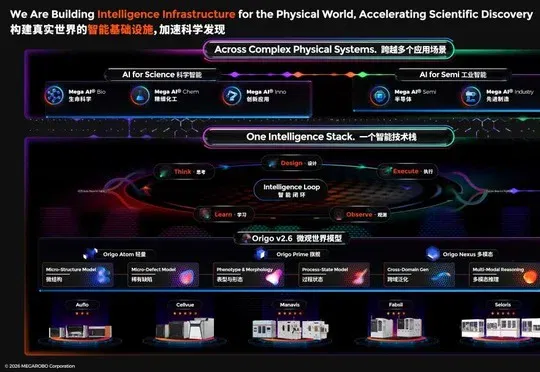
MEGAROBO raises nearly $200 million for AI infrastructure in the physical world (opens in a new tab)
MEGAROBO completed a financing round of nearly $200 million, with participation from Oman Investment Authority and follow-on investment from existing shareholders. Funds will support core R&D, global operations and AI infrastructure for the physical world.

Palo Alto Networks agrees to $4.5 billion all-stock Applied Compute acquisition, pending closing (opens in a new tab)
Palo Alto Networks agreed to acquire Applied Compute in a $4.5 billion all-stock deal, expected to close in fiscal Q3 2027 subject to regulatory approval. Applied Compute previously announced a completed $350 million round at a $3.25 billion post-money valuation.

Inside Ulanqab's data-center boom: deadlines, operations and local returns (opens in a new tab)
LatePost interviews construction workers, suppliers, operators and residents in Ulanqab, documenting the gap between computing investment and limited permanent jobs, alongside changes in electricity, rents and tax revenue.

Lenovo Plans a Hybrid Token Factory in Zhangjiakou, Combining Green Power and Heterogeneous Compute (opens in a new tab)
The first phase targets a 15,000P cluster and roughly 100 MW AI computing center, with construction planned for 2027. The report details hybrid routing, resource scheduling and vendor-disclosed cost targets.