Lenovo Plans a Hybrid Token Factory in Zhangjiakou, Combining Green Power and Heterogeneous Compute
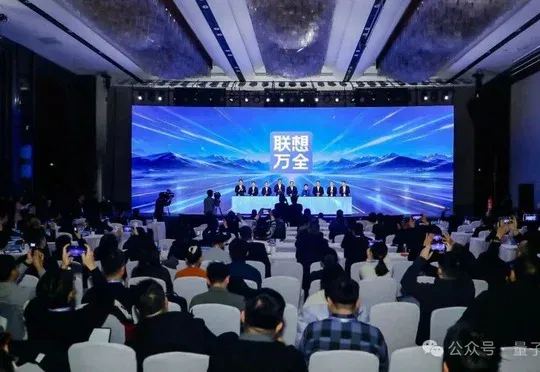
The first phase targets a 15,000P cluster and roughly 100 MW AI computing center, with construction planned for 2027. The report details hybrid routing, resource scheduling and vendor-disclosed cost targets.
Editorial correction (November 16, 2026): The capacity and savings figures below include planning targets and vendor disclosures. Protections provided by TEEs and privacy-preserving computation depend on the specific implementation, trust boundaries and configuration; they are not an unconditional guarantee that content is invisible to every participant.
They can afford the cards, but cannot afford to use AI.
It may sound a little absurd, but as AI enters enterprises on a large scale, many companies have indeed found themselves in this awkward position.
The AI industry's growth over the past two years could almost be described as a headlong surge.
According to China's National Data Administration, the country's average daily token usage increased from 100 billion at the start of 2024 to 100 trillion at the end of 2025, and exceeded 140 trillion in March 2026—a thousandfold increase in two years; the China Academy of Information and Communications Technology disclosed that the related metric had exceeded 500 trillion by June 2026.
The surge in demand quickly reached the compute-supply side. Models keep evolving, agents are gradually taking on complex tasks, token demand is soaring, and computing infrastructure is expanding faster in response.
IDC expects global server-market revenue to reach about $685.1 billion in 2026, with investment in AI infrastructure as the main driver of growth.
Yet while the supply of compute keeps increasing, businesses are becoming ever more cautious about 'burning through tokens'.
According to the Economic Observer, a midsize bank spent nearly RMB 9 million on tokens in the first half of the year, equivalent to 8% of its previous annual IT budget. At the start of this year, growing token consumption was a positive sign that AI applications were becoming more deeply embedded in the business. By the end of June, however, management was demanding a fresh examination of the costs and benefits of that investment.
A McKinsey survey also found that about one-fifth of respondents said their organizations had restricted AI use because of its operating costs.
Businesses have begun weighing AI's costs against its actual output.
The reasons are not hard to understand. An agent executing a complex task may keep running for hours, with repeated reasoning, model calls and task retries all adding to the cost. Building your own computing infrastructure means reserving equipment for business peaks; even when it is usually idle, depreciation, electricity and operations expenses still have to be paid.
Even more troubling, the money may not be spent where it matters most. A simple task may use an expensive model, while sensitive operations must stay in a private environment. It is difficult to put computing resources in the right place for each need.
So helping businesses use AI effectively and affordably remains an urgent problem to solve.
Who would have thought that at a wind corridor beyond the Great Wall, in Zhangjiakou, Hebei, an enormous facility with a planned 15,000P supernode cluster and annual output of two quadrillion tokens—a hybrid token factory—is set to rise. On November 10, Lenovo Group officially announced its 'Lenovo Wanquan Hybrid Token Factory' brand there.
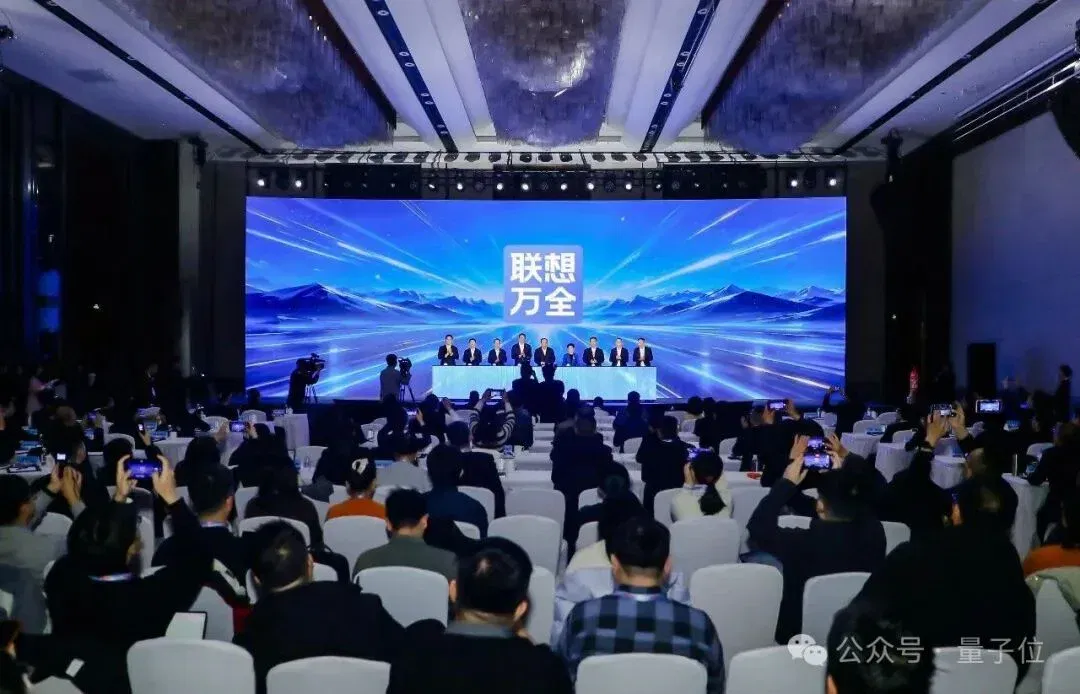
Rather than simply delivering servers or selling computing resources, the factory plans to organize compute and models from different sources to continuously produce more economical, more efficient token services.
The production logic could hardly be more direct: green power in, tokens out.
This marks the beginning of a transition from indiscriminately piling up chips to industrial-scale mass production of cost-effective tokens. The underlying rules of computing infrastructure may be about to change overnight.
Green power in, tokens out
That day, Lenovo Group and the municipal government of Zhangjiakou, Hebei, signed a cooperation agreement to advance the establishment of the first hybrid token reference factory in Zhangjiakou.
According to the latest disclosed plan, the project's first phase calls for a 15,000P heterogeneous compute cluster and an approximately 100 MW AI computing center. Once completed, annual token production capacity is expected to reach two quadrillion, with peak output of 200 million tokens per second.
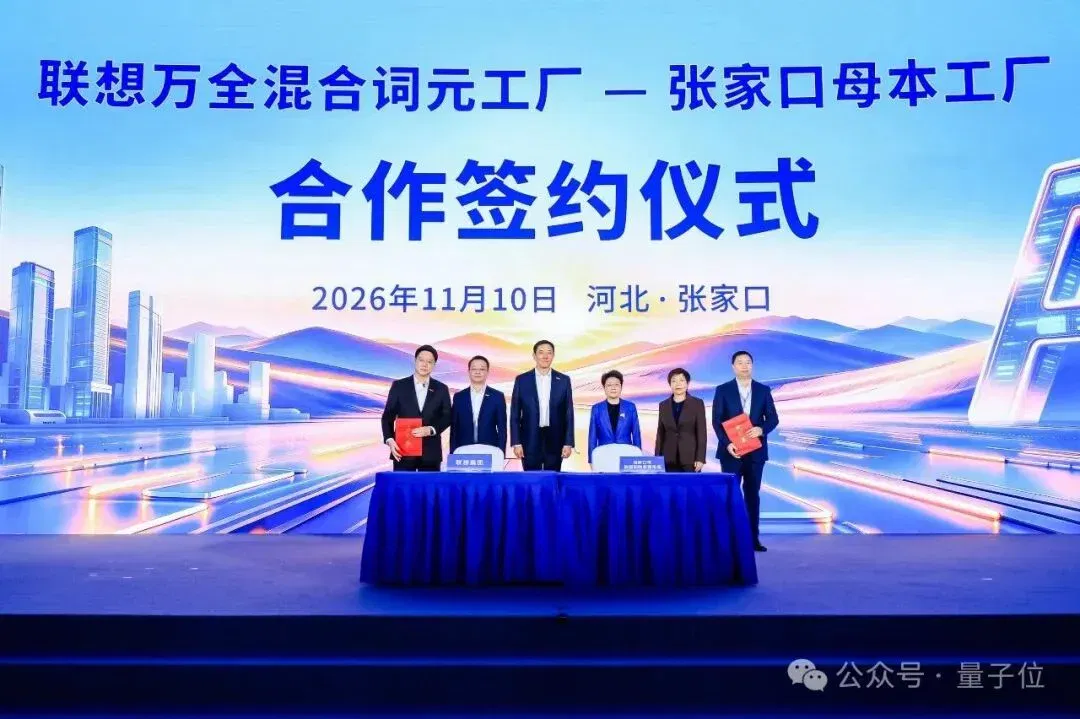
Dai Wei, Lenovo Group senior vice president and general manager of its China Solutions and Services Business Group, said at the event that first-phase construction is scheduled for 2027. By 2030, the corresponding scale is planned to expand by 10× or more.
What does an annual capacity of two quadrillion tokens mean?
On average, it amounts to producing about 5.5 trillion tokens per day. Even this simple conversion makes the sheer scale clear.
Yet what arouses even more curiosity than the scale is the factory's name.
Token factories are not a new concept. There have already been many industry initiatives: some start with the energy efficiency of chips and servers, some operate model platforms, and others excel at running AI computing centers. Each technical approach has its own focus, but when businesses actually use AI, they often face an overlap of different computing requirements.
What makes Lenovo's token factory distinctive is the word 'hybrid'. At its core, this means letting compute supply follow business demand.
Businesses need stable, controllable private compute, while also facing sudden demand for calls to public services. Different tasks also vary enormously in their requirements for model capabilities, response speed and cost.
Simply expanding the scale of compute, or optimizing just one stage of token production, cannot independently solve all these problems.
Lenovo's proposed hybrid supply takes on the role of a hub, reorganizing resources that were previously scattered: combining private-token services with public-token services, primarily relying on private services; coordinating on-device, edge and cloud operation; and flexibly choosing different models according to task requirements.
In this way, compute supply can follow business demand instead of being determined entirely by hardware configurations.
The ideal token supply should work like electricity supply. Businesses connect as needed and receive stable, economical services. Which equipment runs behind the scenes, which models are called, and how resources are scheduled are all handled by a unified supply system.
Of course, having models and servers is not enough to make different resources work together within the same system. Computing equipment, server-room operations, energy supply and even model scheduling all need to be considered together.
How can this be ensured?
Lenovo set its sights on the 'windy hotspot' nearest to Beijing—Zhangjiakou, Hebei.
Calling it a 'windy hotspot' is justified, first, by its exceptional energy conditions.
Zhangjiakou is China's top city for wind and solar green power, and a benchmark dual node in the national six-networks initiative, covering the computing network and the new power grid. By the end of 2025, its installed renewable-energy capacity had exceeded 45 million kilowatts, accounting for nearly 90% of its total installed power-generation capacity.
Second, the city also has a substantial existing base of computing infrastructure.
Zhangjiakou is a key host location for the Beijing-Tianjin-Hebei hub of the national East Data, West Computing project, and the local government is actively providing policy support and industrial guidance. To date, more than 50 data centers have been built locally, with more than 1.07 million standard racks in operation.
Abundant wind and solar resources beyond the Great Wall, a cool climate and more competitive electricity prices, together with proximity to Beijing—over a hundred kilometers away—and shorter latency, are well suited to reducing computing operating costs and meeting demand for AI inference in Beijing, Tianjin and Hebei.
In fact, policy is also pushing the computing industry to shift toward efficient supply.
The Outline of the 15th Five-Year Plan released this year calls for the development of compute at scale, through intensive use, in a green and broadly accessible way. It also calls for coordination between green power and compute, and for reducing the cost of computing for small and midsize enterprises.
Lenovo and Zhangjiakou have therefore joined forces to explore a more end-to-end industrial model: green power in, tokens out.
It sounds like an industrial assembly line. Unlike a traditional factory, however, a token production line needs not only stable energy and equipment, but also the ability to adjust its production methods at any time to widely differing task requirements.
How, then, can compute in different locations and models with different capabilities genuinely work together to serve businesses?
Put every bit of compute where it matters most
Imagine that a manufacturing company using AI on a large scale encounters the following situation:
Its production system needs to run reliably, so sensitive data cannot leave the private environment. Yet office assistants and customer-service agents may suddenly receive large numbers of requests at business peaks.
If it builds all its own computing infrastructure, it must maintain equipment over the long term for brief peaks, at enormous cost; if it buys all its compute as public services, it still has to deal with data boundaries, ongoing spending and model adaptation.
What is more, simple document organization and complex professional reasoning should not use the same expensive configuration. Clearly, different tasks require different forms of compute supply.
Following this line of thinking, Lenovo proposes a hybrid supply model with three dimensions:
- Hybrid supply sources, allowing privately produced tokens and authorized public services to complement one another;
- On-device, edge and cloud coordination, keeping lightweight tasks on the device, running latency-sensitive tasks nearby, and matching elastic demand with the cloud;
- A hybrid model ecosystem, choosing open-weight or proprietary closed-source models according to quality and cost requirements.
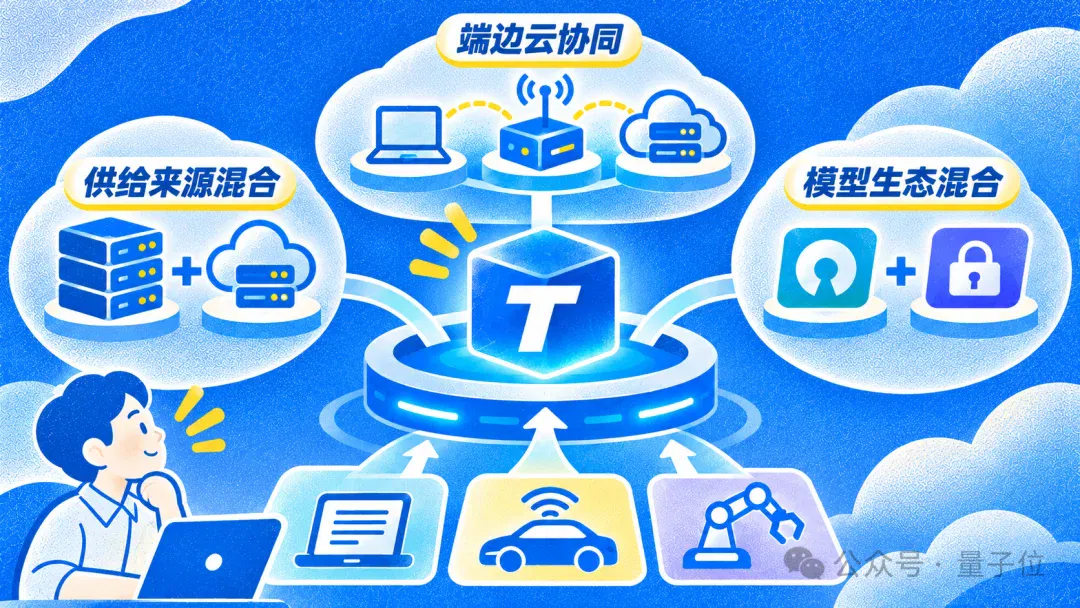
△ Image generated by AI
However, once there are more choices, actual scheduling becomes more complicated too.
Whether a task involves sensitive data, how powerful a model it needs, how long it can wait, and how public and private resources should be proportioned all need to be weighed together. This is especially true of the allocation between public and private resources, because the two types of workload have opposite characteristics. Those permanently inside a business need stability and must keep data within its boundaries; those that rise and fall with external calls need to be economical and scale with peaks.
To address this, Lenovo designed Token Engine, using dynamic mixed deployment of models and compute, task-level resource-pool allocation and intelligent model routing to improve resource-matching efficiency.
A unified management system is also needed if scheduling is to cover both private and public resources.
Lenovo's previously established xCloud intelligent cloud can fulfill this role. It provides unified management, scheduling and intelligent operations for private- and public-cloud resources, enabling computing resources scattered across different environments to work together.
On this foundation, xCloud also includes Token Hub. This is more specifically geared toward AI inference: through model routing and dynamic allocation of inference resource pools, it considers task requirements, model quality, data boundaries, response latency and cost together to match different requests with suitable models and compute.
Resources that were previously scattered can thus be combined flexibly according to business demand. Scheduling can be granular enough to reach the level of chips and computing nodes.
Yao Zhenyu, Lenovo Group vice president and general manager of Global Infrastructure and Intelligent Cloud, gave an example: lightweight models can run on smaller computing nodes or edge resources, without occupying large clusters.
In other words, scheduling does more than find idle machines: it also lets tasks use suitable models and chips, fully utilizing computing resources and truly putting every bit of compute where it matters most.
In addition, taking data security and compliance into account, Lenovo has established barriers in three dimensions:
The first is model security: all models must pass security testing and certification and enter a whitelist before they can be offered to businesses through Token Hub.
The second is content security. Lenovo has introduced Token Trust token-security capabilities, proactively intercepting sensitive information in transit and making data security and access permissions boundaries that resource scheduling must respect.
Lenovo says it uses privacy-preserving computation and TEEs to isolate sensitive processing. Actual visibility needs to be checked against conditions such as the running code, remote attestation, key management, logs and permissions. A TEE alone is no guarantee that content will remain inaccessible to the platform in every situation.
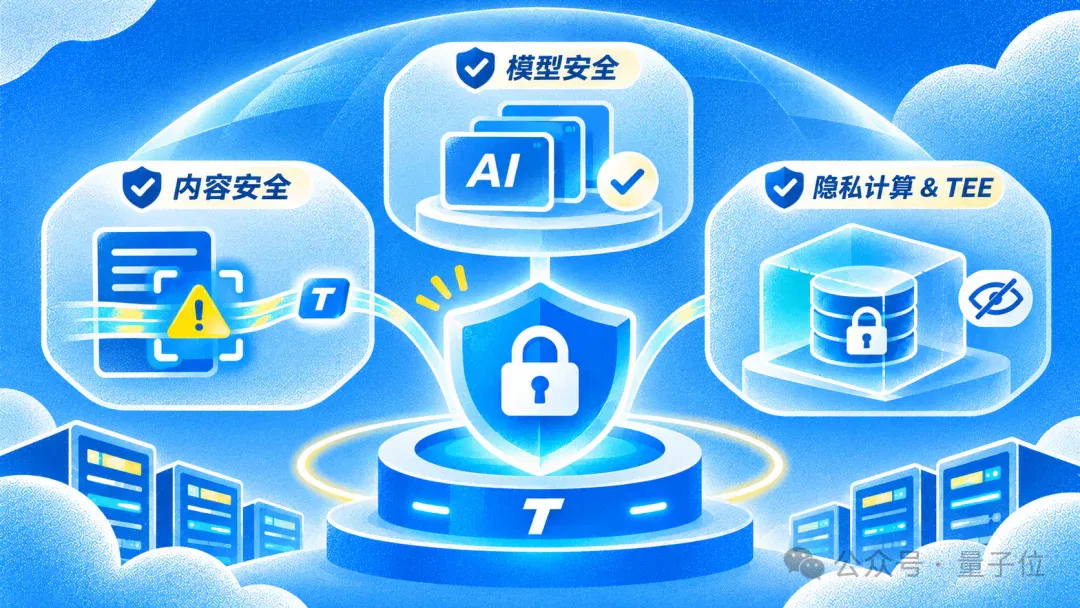
△ Image generated by AI
Yet even the most precise scheduling cannot eliminate the costs of the equipment and server rooms themselves. Lenovo therefore goes further by proposing three levels of optimization:
The first level is improving the efficiency of computing equipment.
In the Wentian heterogeneous AI computing solution, Lenovo combines supernodes, a multi-chip, multi-model training-and-inference engine, cluster communications and operator optimization to improve coordination among heterogeneous computing resources.
According to Lenovo, the solution can achieve more than a 30% improvement in compute efficiency. For large clusters, reducing some of the waiting and idle time can release considerable computing capacity.
The second level is controlling the full lifecycle cost of AI computing centers.
Beyond servers, power supply, cooling, construction and operations are also expensive. Through technologies such as modular prefabrication, integrated liquid cooling throughout, and intelligent control of green-power direct-current systems, Lenovo optimizes server-room construction and day-to-day operations together.
In addition, Lenovo plans to build a computing-equipment recycling and reuse production line in Zhangjiakou, extending the useful value of existing equipment. The supporting AI computing center has set a target of PUE below 1.1.
The third level is optimizing token efficiency for business scenarios. Through model routing and dynamic resource-pool allocation, simple tasks do not need to occupy costly models, while sudden demand can also be matched with appropriate computing resources.
In this way, hardware, server rooms and Token Hub each optimize a stage. The resources and costs saved at each stage ultimately combine into efficiency gains when businesses use AI. As Lenovo's clearly stated core proposition puts it, "Unlock every bit of computing performance."
Moreover, to take responsibility for its enterprise customers, Lenovo first validated the approach in its own business. Yao Zhenyu disclosed that through internal AI practices, the company has achieved overall cost optimization of about 70%.
Lenovo has now also proposed overall targets for the hybrid token factory, including 70% optimization in overall cost per million tokens, a 5× improvement in token output per second, and a token quality pass rate above 99.9%.
Of course, measuring a token factory's efficiency cannot be limited to cost and throughput.
However large the capacity or low the cost, response speed and model quality still have to be ensured. Especially for sensitive data inside a business, security cannot be discarded in the process of cutting costs. Energy consumption at large AI computing centers is also an important factor determining long-term operating costs.
Therefore, in addition to overall cost and token throughput, Lenovo also takes accuracy in task completion, environmental sustainability and end-to-end security into account, forming the token factory's five core competitive strengths.
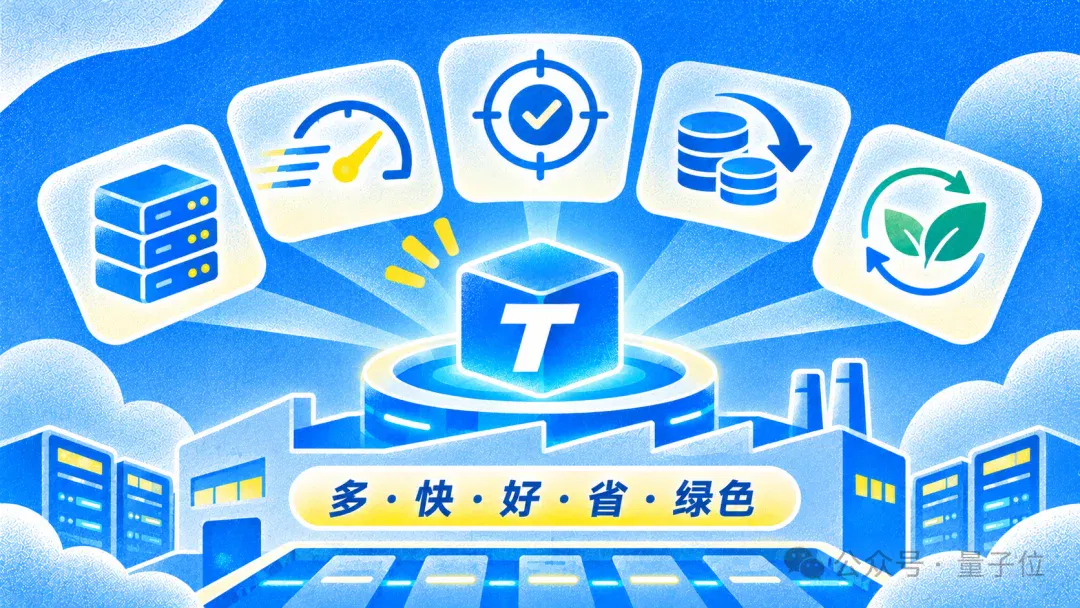
△ Image generated by AI
Lenovo summarizes this as 'more, faster, better, cheaper and greener'.
The word "better" is particularly worth examining. When agents carry out the same task, one system may deliver an acceptable result on the first attempt, while another needs repeated revisions and fresh reasoning. Even if the latter consumes more tokens, it does not mean it has created more value.
Lenovo proposes a vivid concept for this: effective tokens.
For businesses, token output and the price per million tokens are certainly important. But disconnected from the quality of actual task completion, even the most impressive performance metrics can hardly explain how much real value AI has created.
Turn a factory into a methodology
'Each part is fine, but there is a problem with the whole.' Yao Zhenyu said he has seen many situations like this:
When an enterprise IT system fails, the hardware, database and platform vendors can all prove that their own part has no problem, yet the root cause of the failure still cannot be found.
The more stages an AI system involves, the more pronounced this kind of difficulty will become.
The threshold a token factory must cross is therefore precisely reorganizing capabilities that have been dispersed.
This is also the opportunity Lenovo targeted from the outset of building a token factory.
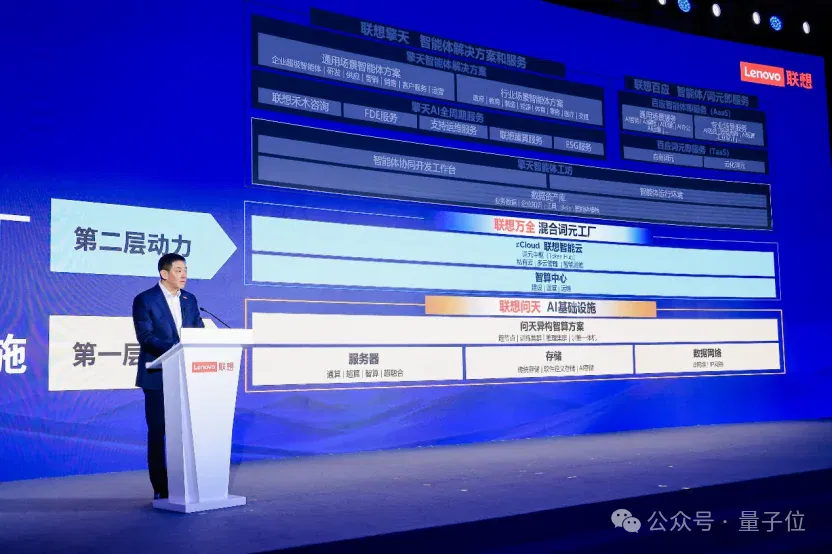
As a veteran hardware company with accumulated business capabilities across multiple technical stages, Lenovo describes its enterprise AI business as 'three layers of hybrid power':
- At the bottom is Wentian AI infrastructure, covering servers, storage, networking and heterogeneous AI computing platforms;
- In the middle is the newly announced Wanquan Hybrid Token Factory, responsible for turning computing resources into token services that can be supplied continuously;
- At the top are agent solutions and services such as Qingtian and Baiying, directly connecting to businesses' real applications.
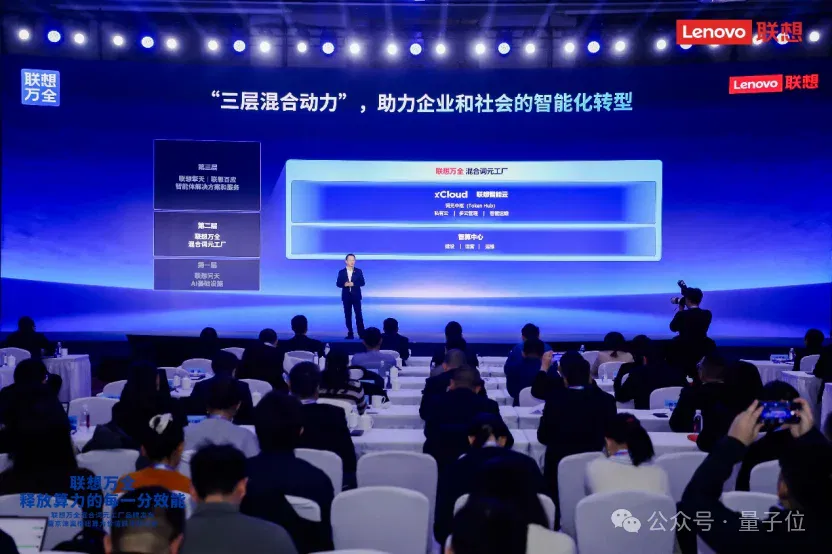
The three layers span compute production, token supply and business use, ultimately positioning Lenovo as a hub to help more businesses move from '+AI' to 'AI+'.
'+AI' means introducing AI tools into existing business processes to solve problems in individual stages. 'AI+' means involving AI in core business areas such as research and development, production and supply chains, driving the restructuring of production processes and organizational methods.
The more complex the tasks AI takes on and the more deeply it participates in business, the more enterprises depend on the stability, economy and flexibility of the underlying compute.
Lenovo's advantage lies precisely in business capabilities that span both infrastructure and applications. It can participate in optimizing equipment, energy and compute efficiency, while also receiving feedback from real business through model services and agent applications.
Connecting compute production to real business places Lenovo closer to final output in the AI infrastructure value chain.
Having all the capabilities is one thing; making collaboration happen naturally is another. Turning optimization across stages into a replicable method still requires a mature test bed.
So in addition to being the first site for the Lenovo Wanquan Hybrid Token Factory, Zhangjiakou also has a validation role. Lenovo calls it 'the first hybrid token reference factory'.
Lenovo plans to use its own real AI business workloads to test how efficiently different computing resources and models work together, continually optimize resource scheduling, cost control and secure operations mechanisms, and then extend mature technologies and operating experience to different industries.
Liu Jun, Lenovo Group executive vice president and president of China, said the company already has more than a hundred internal agent applications, which can provide continually changing usage scenarios.
The reference factory here is not intended to be a server room that can be copied 1:1, but to derive a way to make different resources work together.
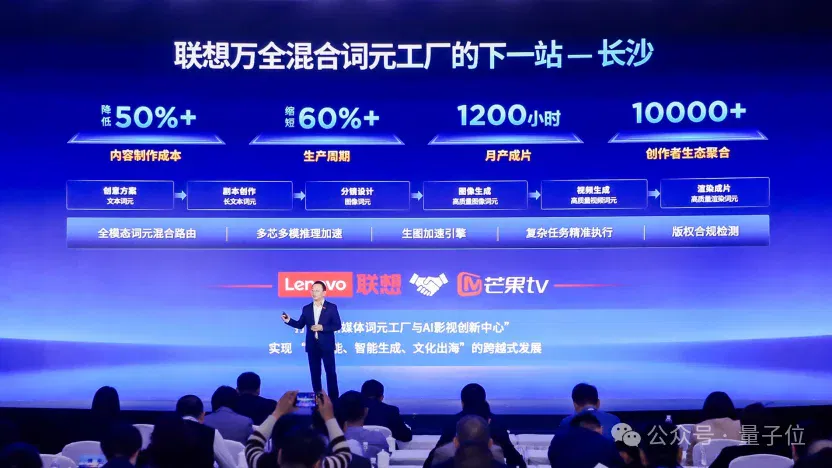
Take Hunan Broadcasting's AI short-drama project as an example.
Dai Wei revealed that Hunan Broadcasting's initial need was actually a content-generation agent. As AI creation became part of regular production, token costs gradually became a new source of pressure. The two sides therefore extended their cooperation to infrastructure, planning to build a hybrid token factory in Changsha specifically for the film, television and short-drama industries.
The explanation begins with how short dramas are produced.
AI film and television production involves multiple stages, including scripts, storyboards, images, video and rendering. Different models have very different costs, and project schedules also create pronounced peaks and troughs in computing demand. Owned IP and copyrighted materials involve data-security concerns too, and cannot be handed to external services at will.
Xiao Wenqiang, investment director in Mango Media's Strategic Investment Department, also offered his assessment at the event: the way compute is supplied must follow the way content is produced.
The Hunan project therefore plans to use technologies such as hybrid routing of omnimodal tokens and multi-chip, multi-model inference acceleration to match computing resources to different production stages.
According to the plan, the project aims to achieve a 50% reduction in production costs, a 60% shorter production cycle and more than 1,200 hours of finished content each month, while bringing together more than 10,000 OPC content creators.
An output of 1,200 hours is equivalent to an average of about 40 hours of finished content per day, requiring large numbers of parallel tasks behind the scenes. Parallel creation on this scale places far greater demands on a continuous token supply than scattered, occasional calls do.
Similar tensions also appear outside film and television.
Take education. Lenovo's disclosed Shanghai Jiansheng general-education project covers more than 600 primary and secondary schools. Everyday teaching, concentrated lesson preparation and exam grading produce very different computing demands, while loads fall noticeably during summer and winter holidays.
Unlike film and television production, however, education systems also involve large amounts of information about minors and have stricter requirements for data security and service continuity. Computing resources cannot be permanently provisioned for peak loads, nor can sensitive operations be moved freely to public environments simply to cut costs.
The difficulty of hybrid supply is therefore not only adjusting resource quantities, but also finding an appropriate balance between business patterns and data boundaries.
Whether supply has been matched appropriately to demand ultimately has to be seen in long-term operations. The Suihong Huachuang AI Computing Center in Qingyang, Gansu, announced by Lenovo, provides an operational reference.
According to Lenovo, this project, listed as its first hybrid-token operating case, delivers about 30% savings in overall usage costs. A single model handles an average of more than two million calls and two billion tokens per day, bringing the measures of success squarely down to everyday calls and actual costs.
The business workloads in these cases each have their own rhythms, and their resource constraints also differ. For token factories to truly serve every industry, a single fixed hardware configuration cannot be expected to solve every problem.
What should be standardized is the underlying technology and the methods of scheduling and operations. What should differ is the form of supply designed for each specific industry.
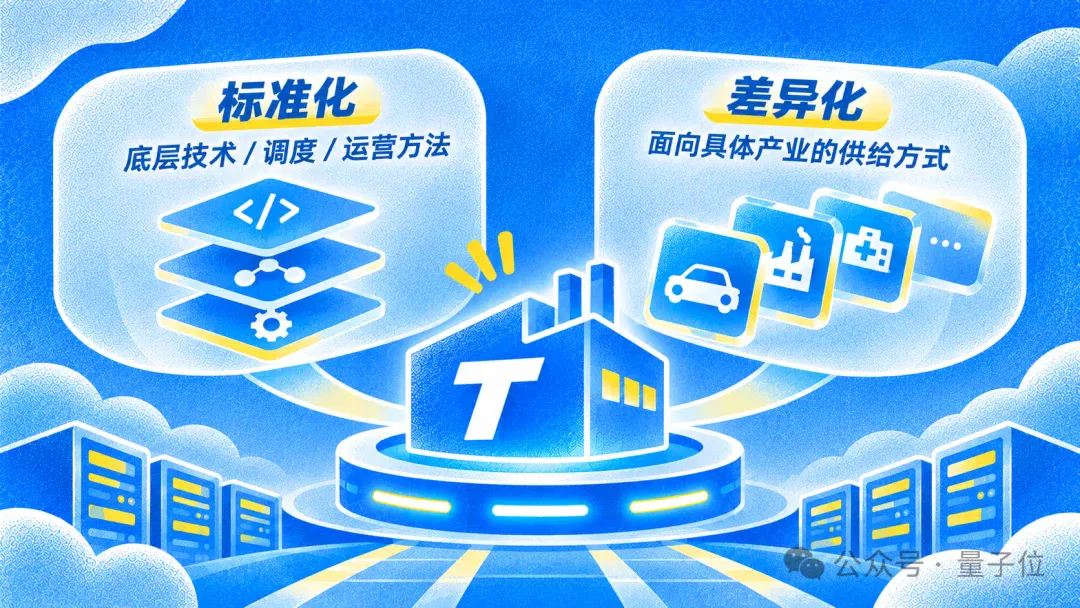
△ Image generated by AI
This is the original purpose of Lenovo's reference factory. Zhangjiakou validates the methods, while other regions combine resources according to their energy conditions and industrial needs.
Once the methods are validated, Lenovo has an opportunity to turn its business capabilities into a token-supply system that can be replicated at scale, and become an organizer of token supply across regions and industries.
And being an organizer means responsibility extends beyond delivery.
When selling servers, performance and price have clear benchmarks. But when token services enter production processes, they must also withstand the long-term tests of business fluctuations, model adaptation, data security and cost control.
The value of AI infrastructure is extending from delivering computing capacity to delivering actual productivity.
For businesses, reliable delivery of production tasks and controllable long-term costs are the ultimate measure of AI infrastructure's value.
Similar changes can be traced back to the Industrial Revolution.
More than two hundred years ago, steam engines brought sustained, powerful mechanical energy. Factories gradually escaped the constraints of water flows and geography, allowing more machines and workers to be brought together for production.
Beyond stronger power, the lesson for industrial production was that energy, machines and production processes were organized into a system that ran efficiently.
AI is now crossing a similar threshold.
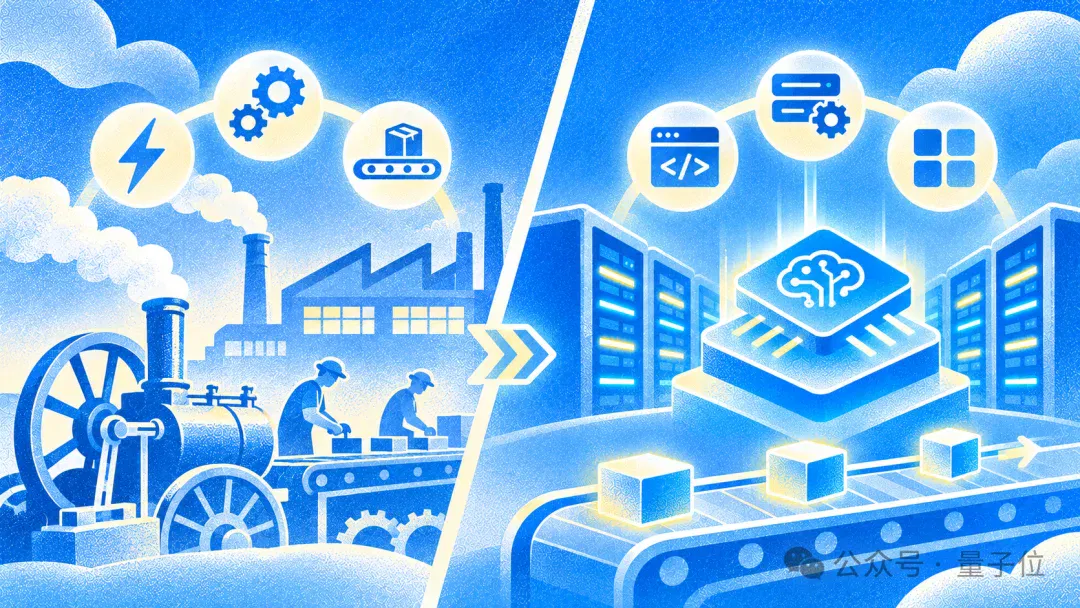
△ Image generated by AI
Chip performance keeps climbing, and model capabilities advance at tremendous speed. Yet between the compute in a server room and improved efficiency on a production site still lie many stages, including model deployment, resource scheduling and business adaptation.
The key to the next round of AI infrastructure competition is turning vast computing capacity into continuous productivity.
The more complex technology becomes, the less the people using it should be trapped by that complexity.
The burdens of model deployment, resource scheduling and long-term operations should be borne by mature infrastructure, leaving businesses more energy for products, production and services.
Only then will AI's value truly return to solving problems themselves.
Only then will AI productivity for every industry have the chance to be fully unleashed in everyday operations.
This article comes from the WeChat public account QbitAI and was written by QbitAI.
Related topics
After reading
Join the AINRK community
Read how to join the community and connect with people working in AI.
Related articles
Continue reading related topics and articles in this category.
Inside Ulanqab's data-center boom: deadlines, operations and local returns (opens in a new tab)
LatePost interviews construction workers, suppliers, operators and residents in Ulanqab, documenting the gap between computing investment and limited permanent jobs, alongside changes in electricity, rents and tax revenue.

Mercor announces $750 million Series D, reaching a $20 billion valuation (opens in a new tab)
According to the company and investors, the round includes employee share sales. The funding will support model evaluation, post-training infrastructure and work environments for agents.
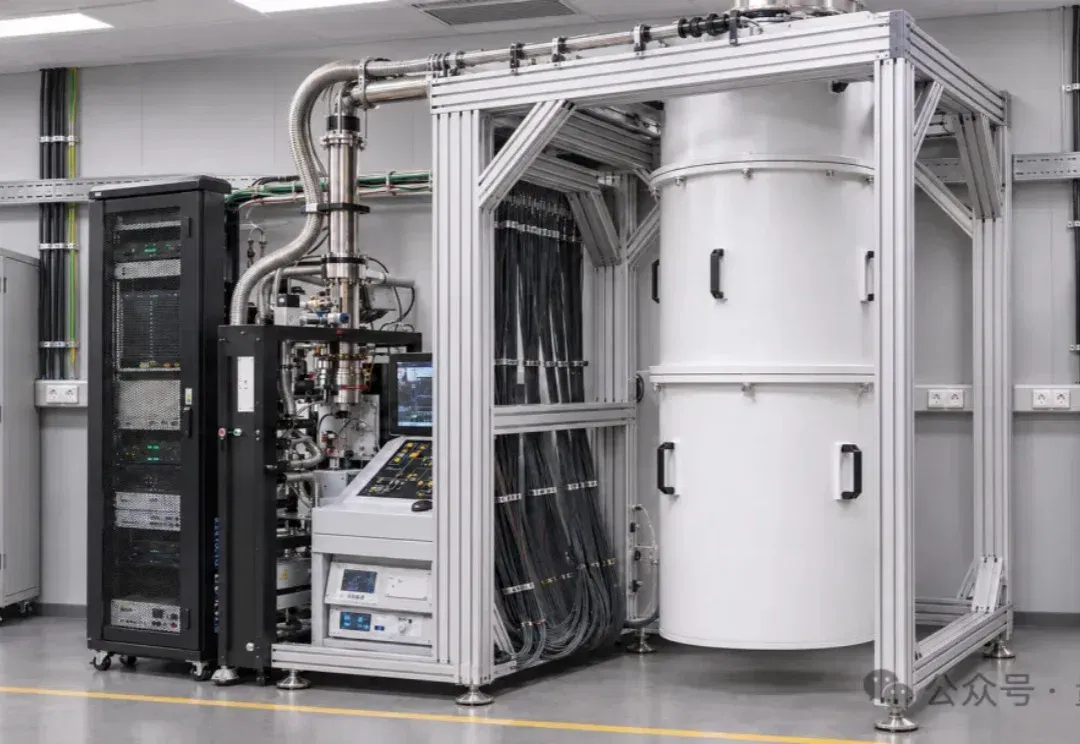
从芯片互连到测控,正元量子推进千比特超导整机研发 (opens in a new tab)
正元量子宣布近亿元天使轮融资,计划推进三维封装、低温互连及集成测控。文章解释物理比特规模扩大时,连接和纠错所面临的工程问题。
DayOne 提交赴美上市申请,招股书披露大客户收入集中度 (opens in a new tab)
数据中心运营商 DayOne 拟以 DODC 为代码登陆纳斯达克。10 月提交的招股书披露,最大客户约占 2025 年收入的 69.4%,文件未点名客户。

据报 Anthropic 斥资 34 亿美元锁定数据中心发电设备 (opens in a new tab)
《金融时报》称,Anthropic 与 OnePWR Solutions 达成约 1.7 吉瓦重型发电设备供应交易。报道还提到安装能力与数据中心用电需求。