AI hardware demand lifts electronic-grade glass fabric prices; equipment and approvals constrain expansion
Xingchuan Zhizao maps the glass-yarn, fabric, copper-clad laminate and PCB supply chain, examining AI demand for low-dielectric and low-expansion materials. Price increases do not establish profit rankings, and different specifications and measurement windows are not directly comparable.
The electronic-grade glass fabric prices, GPU rental rates, rack costs, segment gross margins and demand forecasts discussed here use different samples, units and time windows. Price increases alone do not establish that glass fabric is the AI industry's most profitable link. Grace Fabric Technology's announcement (opens in a new tab) reports RMB 53.83/kg and 206.55% as the company's average electronic-grade yarn purchase-price figures for the first quarter of 2026. Future demand, capacity targets and the company's claims of the world's finest or thinnest products must likewise be understood within their respective disclosure definitions. The official RTX 5090 starting price (opens in a new tab) is $1,999. The original article's figure of more than $50,000 lacks a verifiable sample of widespread actual transactions and cannot establish an overall price increase for consumer GPUs. Toyota's official materials (opens in a new tab) confirm that the JAT910 can weave glass-fiber materials for PCBs. They do not substantiate the full basis for claims of being the only suitable machine, a share above 90% in a particular high-end market, delivery times or comparative tension-control precision.
Where there is compute, there is a world of competition.
However whimsically Silicon Valley's iron throne changes hands, and however grand the cloud narrative becomes, the world's fastest compute remains bound to an ancient supply chain, woven day and night through some of humanity's most traditional processes.
Warping, weaving and desizing.
In today's AI boom, electronic-grade glass fabric has become a closely watched material whose prices are rising rapidly.
Four years ago, the price of 7628-grade electronic-grade glass fabric once fell to RMB 3.3 per meter. By November 2026, the same fabric was quoted at RMB 14.6 per meter, an increase of about 342%.
In other words, getting the same material today costs more than four times as much.
Meanwhile, the supposedly most profitable GPU has seen far more moderate price increases than fabric within their respective observable windows: in November 2026, NVIDIA's earnings call disclosed that some Hopper GPU renewal prices reached as much as twice the original contracted price, while B300 rental rates had risen more than 60% since launch.
Chips may be the most expensive, but electronic-grade glass fabric stands out for its price increases in certain measurement windows. The reason is that, among manufacturing's essential tools, fabric guards a critical hardware chokepoint for chips:
How far high-frequency signals travel depends on the fabric's dielectric properties. How reliably advanced packaging holds up depends critically on its coefficient of thermal expansion. Electronic-grade glass fabric can also determine whether a $7.8 million AI rack meets the requirements to leave the factory.
Materials determine performance.
Two supply chains
The diameter of glass filaments directly affects the performance of electronic-grade glass fabric.
China's first glass filament originated around Xingfu Road, not far from Shanghai's popular Wukang Mansion landmark.
Xingfu Road runs just 609 meters, from Fahuazhen Road in the south to Pingwu Road in the north. Before 1949, Shanghai technician Cheng Weimin drew China's first glass-fiber filament here, planting the first technological seed for the country's later vast electronic-grade glass fabric industry.
Electronic-grade glass fabric is cloth woven from electronic-grade glass-fiber yarn. Its origin lies in extremely fine filaments drawn from melted glass raw materials.
Its importance to AI is this: chips set the upper limit of compute, while glass fabric determines whether that limit can be realized.
There are two supply chains here. One shows how electronic-grade glass fabric becomes AI's essential foundation👇
Electronic-grade glass fabric accounts for about 20% of copper-clad laminate costs and is a core reinforcing base material.
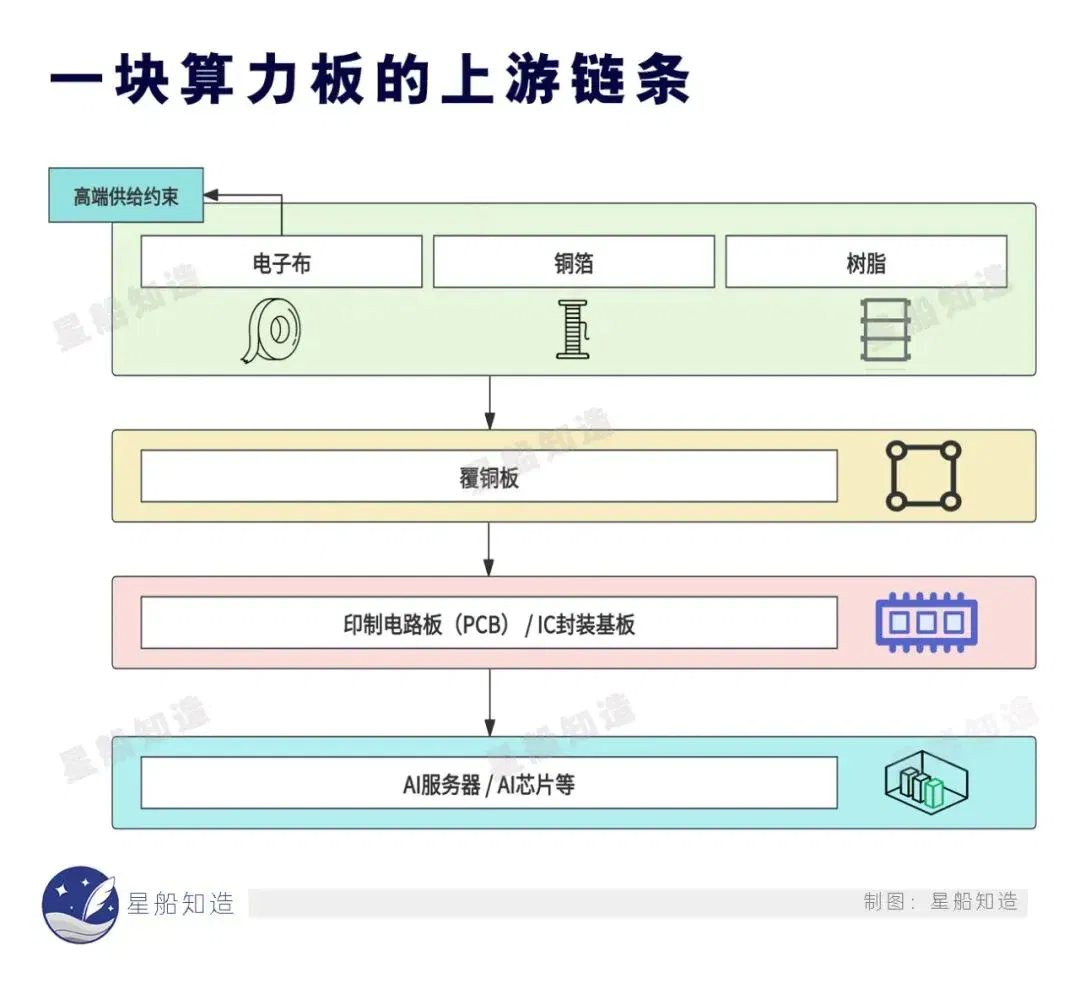
The other is the supply chain for the fabric itself:
Mineral raw materials → electronic-grade yarn → weaving and processing → electronic-grade glass fabric.
Upstream are mineral raw materials and electronic-grade yarn: electronic-grade glass-fiber yarn made by combining ultrafine glass filaments into strands.
In the middle, the yarn undergoes warping, weaving, desizing, surface treatment and other processes to become electronic-grade glass-fiber fabric.
It then goes into downstream copper-clad laminates and PCBs. Those PCBs enter AI servers, high-speed switches, optical modules, packaging substrates, consumer electronics and automotive electronics.
Imagine the fabric as a precast reinforced-concrete slab, with the glass filaments forming its reinforcing skeleton. Coarser filaments make the slab thicker, heavier and rougher, seriously affecting heat conduction away from downstream chips. Finer filaments make it lighter, thinner and flatter, able to support extremely fine circuit fabrication.
China's glass filaments and electronic-grade fabric have followed this progression:
Before 1949, Cheng Weimin drew China's first glass-fiber filament, with a diameter of 25 micrometers;
In 1956, Cheng, his wife and workers used a clay crucible to draw glass filaments 6 micrometers in diameter;
In 1998, an ambitious Mao Jiaming came to Shanghai. Years later, his company, Grace Fabric Technology, successfully mass-produced 9-micrometer ultra-thin electronic-grade glass fabric in 2021.
In 2023, Huangshi Honghe achieved large-scale production of 4-micrometer ultrafine yarn, supplying a core raw material for extremely thin electronic-grade glass fabric.
Today, Grace Fabric Technology is a key mainland Chinese manufacturer with leading mass-production capabilities in high-end electronic-grade fabrics, including extremely thin, ultra-thin and Low-CTE T-glass fabrics. With Nittobo's expansion constrained and high-end supply tight, Grace Fabric has become an important source of incremental Chinese supply meeting global demand for AI-server materials and T-glass fabric for advanced packaging.
Extremely thin fabric and Low CTE fabric form essential structural materials determining whether AI compute can be stacked densely and transmitted at high speed.
However lofty AI's narrative becomes, it cannot escape manufacturing's fundamental laws.
Grace Fabric Technology's headquarters and research and development are in Pudong. Its core raw material, ultrafine electronic-grade glass-fiber yarn, is produced by wholly owned subsidiary Huangshi Honghe in Huangshi, Hubei.
Its electronic-grade yarn can be as fine as 3 micrometers, weighing only 0.77 grams per kilometer. The company calls it the world's finest electronic-grade yarn;
its electronic-grade fabric reaches a minimum thickness of 8 micrometers and weighs 7 grams per square meter. The company calls it the world's thinnest electronic-grade glass fabric.
Its high-end products have entered leading GPU and CPU supply chains.
The place of electronic-grade glass fabric in the AI supply chain is beginning to show up in financial data.
Why does fabric earn more than board makers?
In Xingchuan Zhizao's view, the foundation of today's global AI compute is spun and woven.
GPUs' high prices are structural.
NVIDIA's revenue for Q1 FY2027, ended April 26, 2026, was $81.6 billion, including $75.2 billion from Data Center, representing more than 90% of total revenue. Separately, on the November 17, 2026 third-quarter earnings call, management said NVIDIA compute remained fully utilized at the hyperscalers and neoclouds it serves. Cloud-industry backlog was about $2.5 trillion, versus about $2 trillion three months earlier. This is neither first-quarter revenue nor NVIDIA's own unfulfilled GPU orders. GPUs remain the highest-value core component of AI servers.
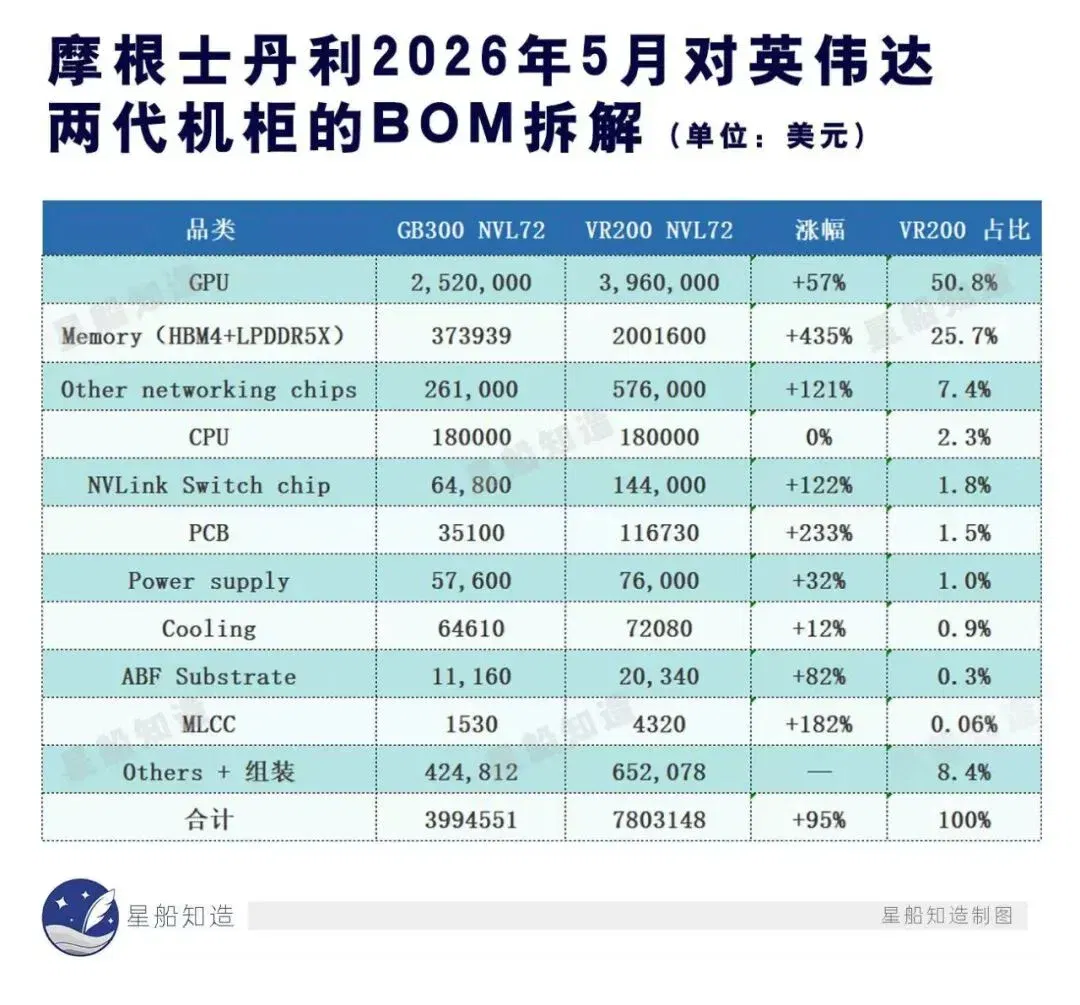
GPUs account for $3.96 million per rack, nearly twice the second-largest item, storage at $2 million, and 34 times the PCB cost of $116,700.
But consider price increases: in 2026, multiyear renewal rental rates for NVIDIA Hopper-architecture GPUs reached as much as twice their original prices, while Blackwell B300 rental rates rose more than 60% since launch. For the consumer RTX 5090, the official recommended retail price of $1,999 is the reference point; the original article's claim of actual retail prices above $50,000 still lacks verifiable transaction samples—
GPU price increases are substantial, but pale beside the increases in electronic-grade glass fabric discussed here.
GPU price rises show up more in system-level prices, supply shortages and compute rentals. Fabric's rise looks more like a sharp upward pull on the supply curve: repeated surges in spot prices quoted per meter. Click the image below to enlarge it. 👇
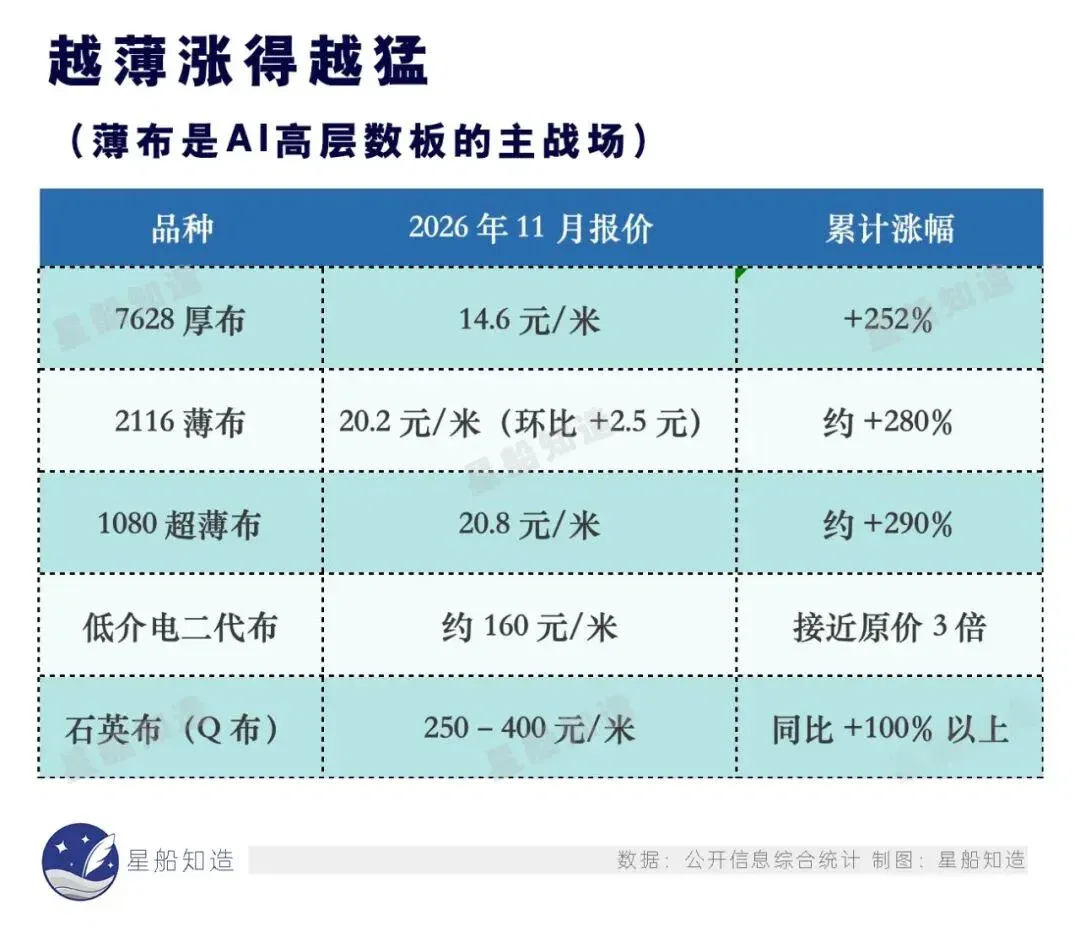
In the table above, the thick-fabric window runs from around September 2025 to November 2026; the thin-fabric window runs from Q4 2025 to November 2026; the baseline for "second-generation low-dielectric fabric" is early 2026; and quartz fabric uses rolling increases within 2026. These price-increase windows are not uniform.
Overall, however, the thinner the fabric, the steeper the increase. This is because the AI revolution does not simply mean using more electronic-grade fabric; it changes the specifications required.
Before the AI boom, electronic-grade glass fabric was an inconspicuous upstream material.
Its end markets were relatively dispersed: it went into copper-clad laminates, which became PCBs, which ultimately entered consumer electronics, automotive electronics and other applications.
Its business cycle was therefore tied to replacement cycles for phones, PCs and home appliances: the classic logic of a cyclical product.
For example, smartphone shipments essentially peaked after 2017, and the electronic-grade glass fabric industry endured a long period of depressed prices from 2021 to 2024. The 7628 thick fabric mentioned earlier once fell to RMB 3.3–4 per meter, and Grace Fabric Technology was still loss-making in 2023.
Counterpoint data show global smartphone shipments peaking at 1.566 billion units in 2017, then declining for three consecutive years to 1.331 billion in 2020, almost back to the 2014 level.
In this period, ordinary E-glass fabric, such as grade 7628 (thick fabric), dominated electronic-grade fabric. Technological iteration was slow, and competition centered on cost and scale.
The market for high-end Low-Dk and Low CTE fabric (thin fabric) was much smaller. Japan's Nittobo long dominated global high-end supply, but demand was not urgent enough to make these products indispensable.
Broadly, Japan's Nittobo and Asahi Kasei led, followed by Taiwan Glass, Taishan Fiberglass, China Jushi, Grace Fabric Technology and Sinoma Science & Technology (Taishan Fiberglass). The pattern remained stable for years.
During this long cycle before the compute boom, data-center servers consumed large quantities of PCBs, but ordinary electronic-grade fabric sufficed. Within the overall machine, the fabric seemed insignificant.
Image credit: Unsplash
After AI compute exploded, electronic-grade glass fabric's status rocketed upward.
Materials determine performance.
In AI hardware, electronic-grade glass fabric determines whether a chip can reach its computing ceiling.
Traditional servers have PCBs with 8 to 14 layers. In AI servers, that jumps to 20 to 40 layers, while orthogonal backplanes in some NVIDIA flagship systems reach up to 78 layers. Each layer needs glass fabric as its skeleton, so a single AI server uses three to five times as much electronic-grade glass fabric as a traditional server. Doubling layers and surging usage mean every performance flaw in the fabric is magnified to the scale of the entire system.

Image credit: Pexels
On one hand, internal transmission rates in AI servers have reached 112 Gbps and even 224 Gbps, requiring signal losses in PCBs to be minimized as far as possible.
Low-Dk fabric has therefore become an important material option. Low dielectric properties depend on factors including glass composition. Low Dk cannot simply be equated with thin fabric, nor can signal propagation speed and loss be judged from thickness alone.
On the other hand, the central role of Low CTE fabric, or low-thermal-expansion fabric including T-glass fabric, is to bring the substrate's thermal expansion into line with that of the silicon chip, preventing packaging warpage and solder-joint fractures. As advanced packaging grows, Low CTE fabric shifts from a niche material to a critical advanced-packaging bottleneck.
In other words, after the AI boom, demand has suddenly narrowed to requiring those few high-specification types of fabric.
GPUs used for compute are driving growing demand for low-dielectric electronic-grade fabric:
Low-dielectric fabric demand rises from about 68.57 million meters in 2025 to 140 million in 2026, and is projected to approach 240 million in 2027. Low CTE demand grows even more steeply: 6.7 million meters in 2025, 18 million in 2026, and a projected more than 33.6 million in 2027.
Click the image below to enlarge it. 👇
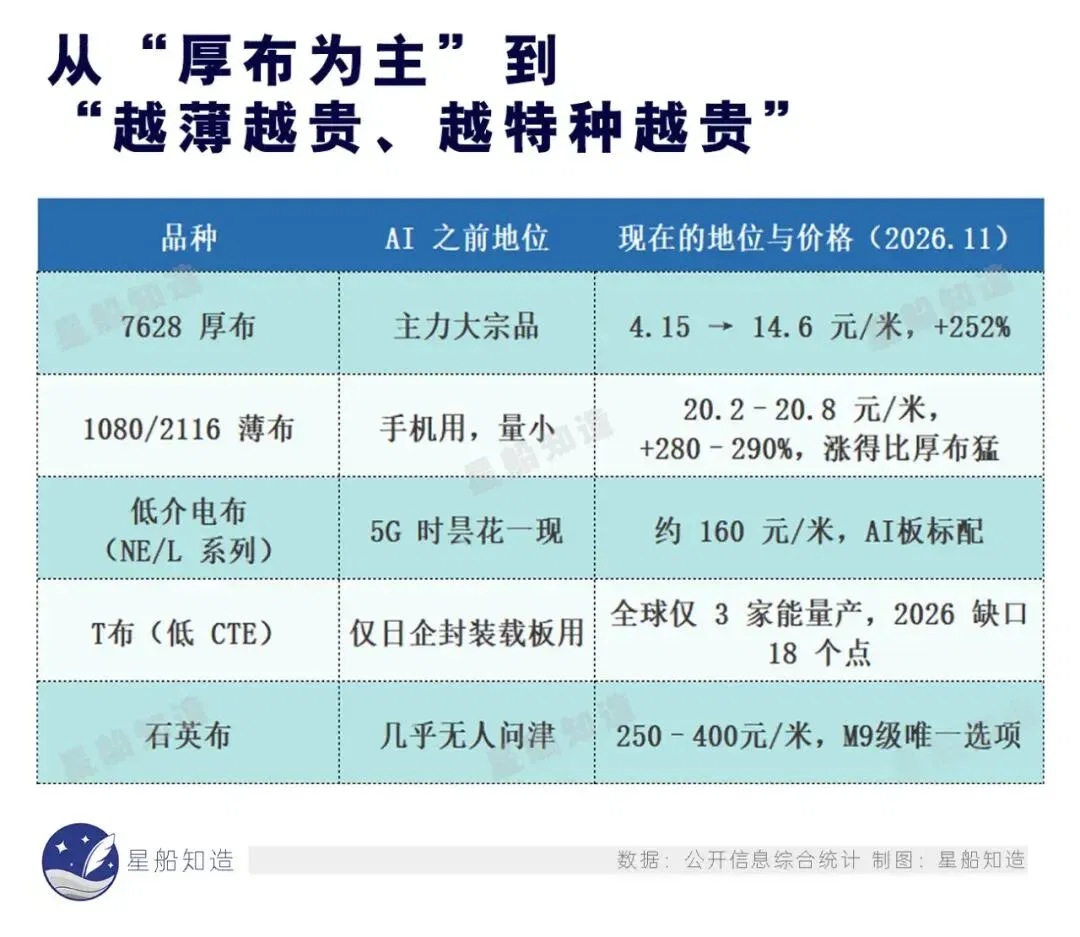
China's electronic-grade glass fabric industry in the AI era has thus split into two worlds with entirely different profit dynamics: a scale layer and a specialty layer.
China Jushi represents the scale layer; Grace Fabric Technology represents the specialty layer.
The scale layer provides the industry's foundation; the specialty layer controls its performance chokepoints.
Meanwhile, upstream electronic-grade yarn prices are rising alongside fabric prices.
On the purchase-price basis disclosed in Grace Fabric Technology's first-quarter report, electronic-grade yarn surged 206.55% to RMB 53.83/kg.
After the AI boom, companies within the same industry that make electronic-grade fabric and those that do not have taken two different paths. Click the image below to enlarge it. 👇
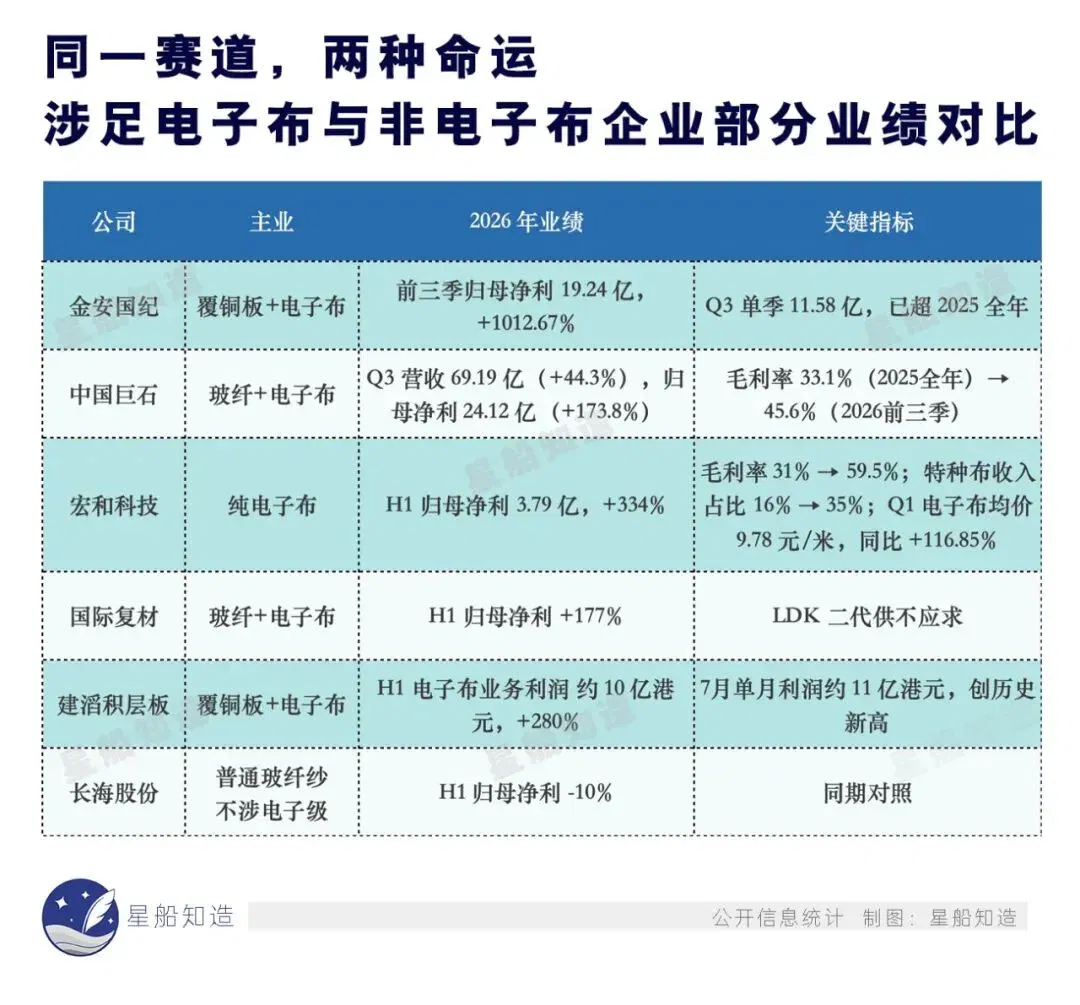
Across China's electronic-grade fabric chain today:
Yarn suppliers include China Jushi, Taishan Fiberglass (Sinoma Science & Technology) and CPIC, operating large-scale, commodity-like businesses.
Fabric suppliers include Grace Fabric Technology, Ping An Electric and Hongchang Electronics. This is the segment with the thickest profits this year, in the article's account.
Downstream copper-clad laminate suppliers include Shengyi Technology, Kingboard and Nanya New Materials.
PCB makers include WUS Printed Circuit, Shennan Circuits and Dongshan Precision. Compared with fabric makers, their order books are full but their earnings are thinner.
The AI boom's financial rewards have not spread evenly across AI hardware. More have stayed in the least conspicuous material: fabric.
It has changed from a cyclical cost item into a key industrial bottleneck. The faster compute advances, the more power the material has to define what is possible.
Rising prices indicate a gap between supply and demand.
That gap arises from few suppliers and difficult capacity expansion.
First, the global players capable of large-scale production of Low CTE electronic-grade fabric can be counted on one hand: Nittobo, Grace Fabric Technology and Taishan Fiberglass.
Second, even these few high-end suppliers cannot readily expand.
To enter high-end supply chains, electronic-grade fabric must pass two stages of qualification, from copper-clad laminate makers and end chipmakers. Qualification for leading CCL supply chains generally takes one to two years. At its November 2026 earnings briefing, Nittobo raised its T-glass capacity target from threefold in FY2028 to 3.6-fold in FY2029. That is already the fastest pace the world's largest T-glass fabric supplier can offer, according to the article.
Taiwan's Industrial Technology Research Institute estimates the T-glass fabric supply-demand gap will widen from 14 percentage points in 2025 to 18 percentage points in 2026.
As the gap grows, Chinese manufacturing faces a historic opportunity in high-end fabric.
With AI compute reshaping hardware architecture, high-end electronic-grade fabric is no longer an optional supporting player, but an essential skeleton determining whether compute can be stacked at high density.
Slow capacity expansion and long qualification cycles—the materials constraints Nittobo cannot bypass—also confront Chinese companies. Yet as the world's largest glass-fiber producer, China has the most complete industrial foundation in chemicals, glass fiber and weaving. Chinese firms' speed of engineering response, production-line iteration and cost control, repeatedly tested in consumer electronics and new-energy vehicles, are becoming accelerating factors.
How far have Chinese companies advanced in this battle over compute's foundations?
China's position in fabric
For years, Japanese companies including Nittobo and Asahi Kasei have held the iron throne of global high-end electronic-grade fabric, protected by dense patent barriers and first-mover advantages. As late as 2025, Nittobo still commanded about 85% of T-glass (Low CTE) fabric.
There is no shortcut for Chinese companies to break through. It is a climb taken one step at a time:
first pushing physical processing to its limits, then moving into the deeper waters of chemical formulations, overcoming generational gaps, and finally reaching something close to the same starting line as Japanese companies at the next technological fork.
This climb has four levels.
Extremely thin fabric occupies the first step: Chinese suppliers are already the ones others are chasing. This is also the ground China captured first.
In the extremely thin and ultra-thin fabric segment, Grace Fabric Technology's revenue ranks first globally. At the extreme specification of 8 micrometers and below, only Grace Fabric and Nittobo can maintain stable large-scale production worldwide, according to the account. Grace Fabric says its finest electronic-grade yarn reaches 3 micrometers and weighs just 0.77 grams per kilometer.
T-glass, or low-thermal-expansion fabric, follows close behind, gaining ground in the gaps in Japanese capacity.
Moving from making fabric thin to controlling it stably is sharply harder. T-glass has never been a field of many strong competitors, but one of few players and long qualification cycles.
Global T-glass fabric demand currently exceeds supply. Taiwan's Industrial Technology Research Institute estimates the supply-demand gap will grow from 14 percentage points in 2025 to 18 in 2026, with global demand rising from 9.6314 million meters in 2025 to 69.5956 million in 2028.
Nittobo is a heavyweight, but a longstanding problem in Japanese manufacturing appears here: expansion plans cannot keep up with exploding demand.
On November 5, Nittobo announced about JPY 20 billion of additional investment to expand capacity, aiming to reach 3.6 times its FY2025 capacity in FY2029. That is already the fastest this giant can run, in the article's view.
Chinese companies are opening a path through this narrow gap. Grace Fabric Technology, which describes itself as China's only manufacturer to mass-produce a full range of low-thermal-expansion fabrics, recorded RMB 178 million in specialty electronic-grade fabric revenue in 2025, with a gross margin of 61.31%. Taishan Fiberglass, under Sinoma Science & Technology, has also begun supplying low-expansion fiber fabric in volume.
Japanese suppliers' capacity gaps offer a foothold for Chinese companies.
Low-dielectric fabric is moving into deeper waters and narrowing the generational gap. This level depends on the underlying chemistry of glass formulations. Grace Fabric and Sinoma Science & Technology have now achieved volume supply of second-generation low-dielectric fabric.
Quartz fabric follows a different logic: addressing the extreme bottlenecks of NVIDIA's next-generation Rubin architecture, it could become a future fork in the evolution of electronic-grade fabric materials.
Feilihua is currently China's only manufacturer spanning the full quartz-sand-to-quartz-yarn-to-quartz-fabric chain, according to the account. But its 2026 half-year report and October investor-relations record both explicitly say it remains at the customer-testing and end-customer-qualification stage. Industry expectations once pointed to a mass-production window in Q2 2026, but that window did not open on schedule.
Even so, of the four levels, this is the only category in which Chinese companies and Japanese leaders stand close to the same starting line.
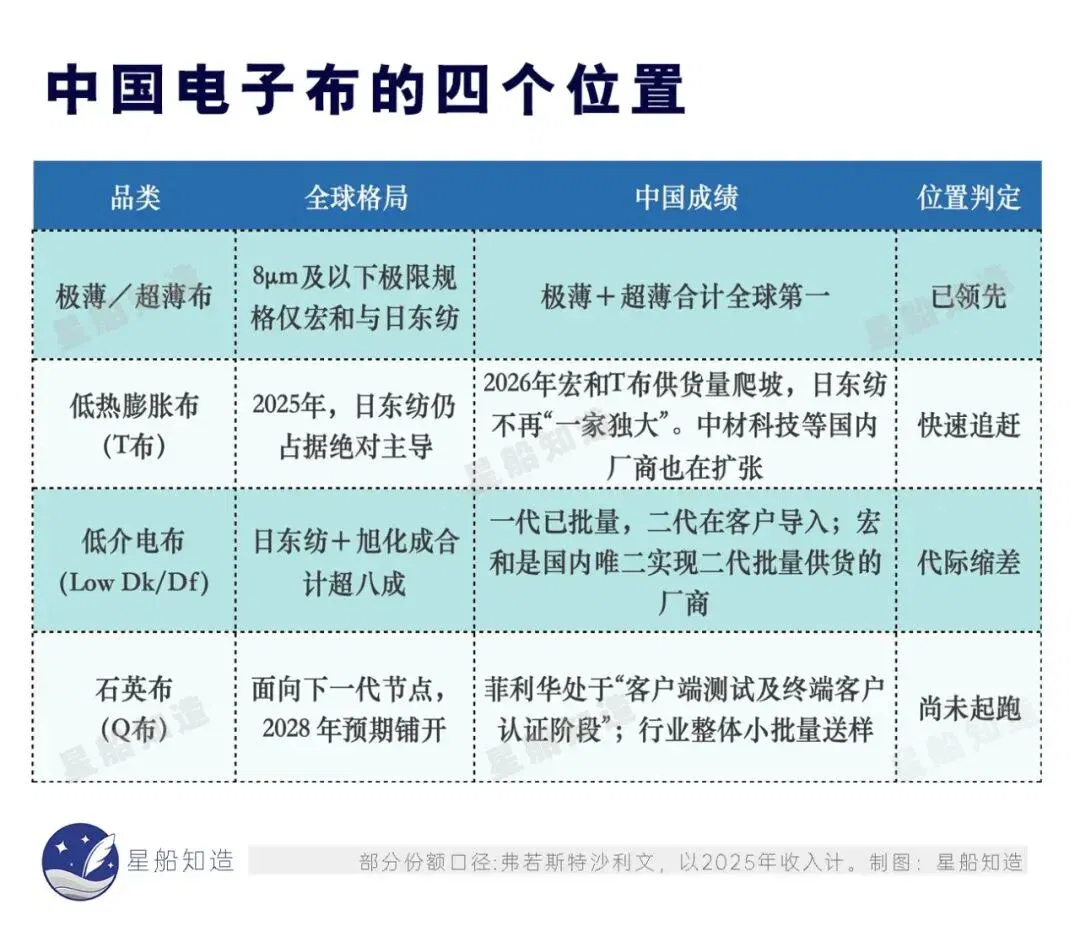
Basis for some market shares: Frost & Sullivan, measured by 2025 revenue.
After understanding the steps, we must also distinguish the camps.
China's electronic-grade fabric businesses now form three camps: traditional glass-fiber majors such as China Jushi, Taishan Fiberglass and CPIC; platform or diversified giants such as Kingboard Group and Shengyi Technology; and fabric specialists such as Grace Fabric Technology and Feilihua.
China Jushi and similar companies use roving as their core business and electronic-grade fabric as a second growth curve, building a foundation through scale; high-end specialists such as Grace Fabric Technology focus on specialty fabrics, breaking through with technology.
And hanging over every player in this upward climb is another physical constraint: Toyota's Japanese JAT910 loom.
Toyota's JAT910 is one of the machines used to weave high-end electronic-grade fabric. The report's comparison—a global high-end share above 90%, delivery times of 18–24 months, and tension-control precision of ±0.1 grams versus about ±0.3 grams for Chinese equipment—does not provide a complete basis identifying the market segment, models and test conditions. It cannot establish that the JAT910 is the only machine capable of mass-producing the relevant specifications.
Chinese loom substitution can be summarized as thick fabric achieved, thin fabric under validation, ultra-thin fabric catching up. For thick fabrics such as 7628, Chinese equipment from Shandong Rifa, Wanli Textile Machinery and others can already produce reliably. The hardest stage has passed.
For medium-to-thin grades such as 2116 and 1080, some Chinese equipment has entered customer validation. But in applications such as ultra-thin, extremely thin and low-dielectric fabric, domestic equipment remains at prototype sampling or small-batch trial production and has not achieved large-scale production capability. Titan's TT-8001 targets the JAT910, but the company warns in its announcement of development-failure risk, and it had not been delivered as of mid-2026. Liu Changlei, secretary-general of the China Fiberglass Industry Association, previously estimated that substituting Chinese equipment for high-end looms would require at least two more years.
Money can be poured into capacity, but equipment lead times and customer qualification can only be endured over time.
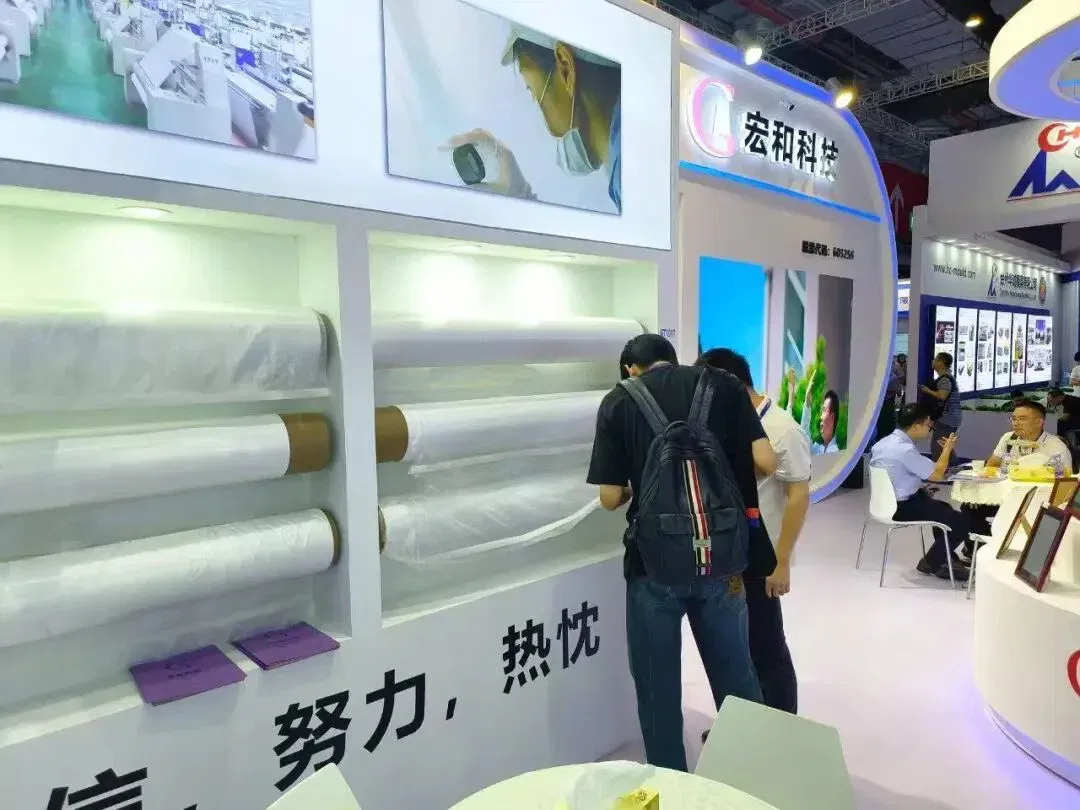
Source: Grace Fabric Technology
Electronic-grade glass fabric is soft. Soft enough to roll tightly and evenly around a hollow paper tube, pack into a cardboard box and ship anywhere in the world.
Yet it is also hard: hard enough to determine whether an expensive AI chip reaches its stated compute performance, and firm enough to follow manufacturing's harshest rules:
A chip may turn its fortunes around with a new architecture. Software may reshape the landscape through iteration. But materials have no miracles.
Whether the road ahead leads through the hidden currents of yield or the hard wall of a loom breakthrough, the rule that materials define performance will not change at the end of compute's headlong rush. Nor will Chinese manufacturing's determination to break through at the foundational level.
Main references:
[1] A Road Named Happiness, a Piece of Shanghai's Past. Shangguan News.
[2] Electronic-Grade Glass Fabric Prices Rise Again as Supply Remains Tight. Securities Times.
[3] China Jushi Plans RMB 2.4 Billion Expansion of Electronic-Grade Glass Fabric Capacity. Shanghai Securities News.
[4] Sinoma Science & Technology: Second-Generation Low-Dielectric Electronic-Grade Fabric Now Supplied Stably in Volume. Yicai.
[5] Electronic-Grade Glass Fabric Prices Keep Rising as High-End Upstream Looms Remain Scarce. Shanghai Securities News.
This article is from Xingchuan Zhizao, by Xingchuan Zhizao.
Related topics
After reading
Join the AINRK community
Read how to join the community and connect with people working in AI.
Related articles
Continue reading related topics and articles in this category.

Why AI Data Centers Are Turning to Optical Interconnects: Supply Chains and CPO's Manufacturing Test (opens in a new tab)
Silicon Valley 101 traces optical interconnects from lasers to silicon photonics and packaging, comparing CPO, LPO, XPO, and NPO. Interviews and proposed deals highlight power, maintenance, capacity, and policy risks; roadmaps and forecasts must be distinguished from deliveries.

An AI researcher's view of synthetic data, expert networks and outsourcing (opens in a new tab)
Jinyan Su draws on post-training research and job-search experience to discuss data vendors' tasks, sales and quality checks. This is personal observation and commentary; anonymous examples are not independently verified or representative of every provider.

LingBot robotics challenge ends: 48 hours on real robots test data and engineering (opens in a new tab)
Fifteen teams reached the LingBot challenge finals, tackling produce sorting, transparent-object storage and dual-arm work. TARS won with 82.50 points. The report highlights additional data collection, gravity compensation and on-site adaptation.

高端 GPU 服务器报价上探 2000 万元,采访追踪中间商交易 (opens in a new tab)
智能涌现采访采购方、中介及部署服务商,记录某型八卡服务器的高报价、供货不确定与交付压力。文中报价来自受访者所接触的交易。

大模型的数据生意:人类如何蒸馏自己 (opens in a new tab)
晚点走访数据生产者、供应商和模型团队,梳理专家怎样把工作任务、示范、操作轨迹和评分标准做成训练数据。文章也讨论采购独占、数据合规、自动扩写与标注劳动的报酬。