Testing MAGI-2: 30-second video, mixed references and editing, with open weights planned
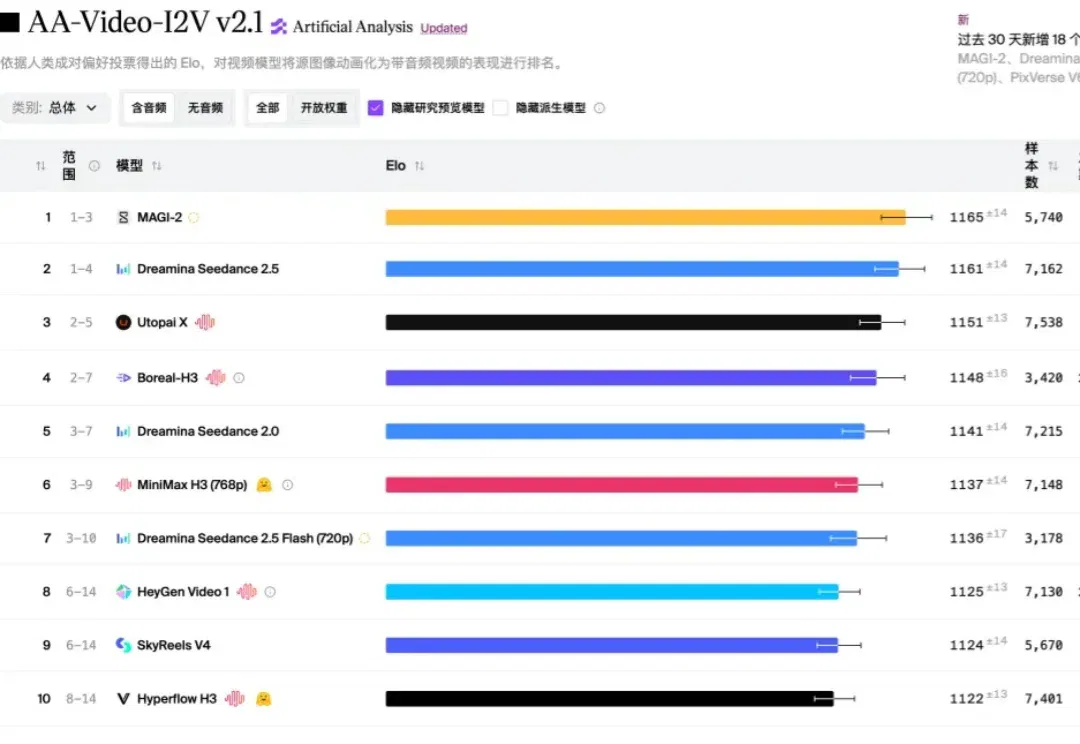
APPSO tests MAGI-2's long takes, mixed references, language edits and stylization in LibTV. The 480B model led AA's image-to-video ranking by Elo point estimate at reporting time. RMB 0.5/second is a 1080p list price; full-version weights remain planned and examples do not verify all tasks.
Editorial fact-check (2026-11-26): At the time of this check, MAGI-2 leads Artificial Analysis's image-to-video leaderboard by Elo point estimate, but its 95% interval overlaps with Seedance 2.5's. This is not proof of superiority across all video capabilities or of a statistically significant difference. RMB 0.5 per second and one-tenth the price refer to the reported comparison of 1080p list prices; costs also depend on factors such as the platform and retries. Sand.ai's full-version weights and comprehensive report remain planned for future release. The example-based impressions in this article cannot replace systematic reliability evaluation. Sand.ai: MAGI-2 release, training setup and limitations; (opens in a new tab)Artificial Analysis: Original AA-Video-I2V v2.1 leaderboard. (opens in a new tab)
If there is still a barrier to AI video generation today, high cost is certainly one that cannot be ignored.
For most AI video creators, obtaining better image quality and more natural physical motion often still means choosing a leading closed-source model such as Seedance 2.5. But high generation costs can make every attempt feel like burning money.
Switching to open-source models can lower the barrier to use, but often brings problems with complex narratives, consistency in long videos and visual realism.
Today, Sand.ai officially released its next-generation video model MAGI-2. The predicament of good models being unaffordable and open-source alternatives falling short may be about to change.
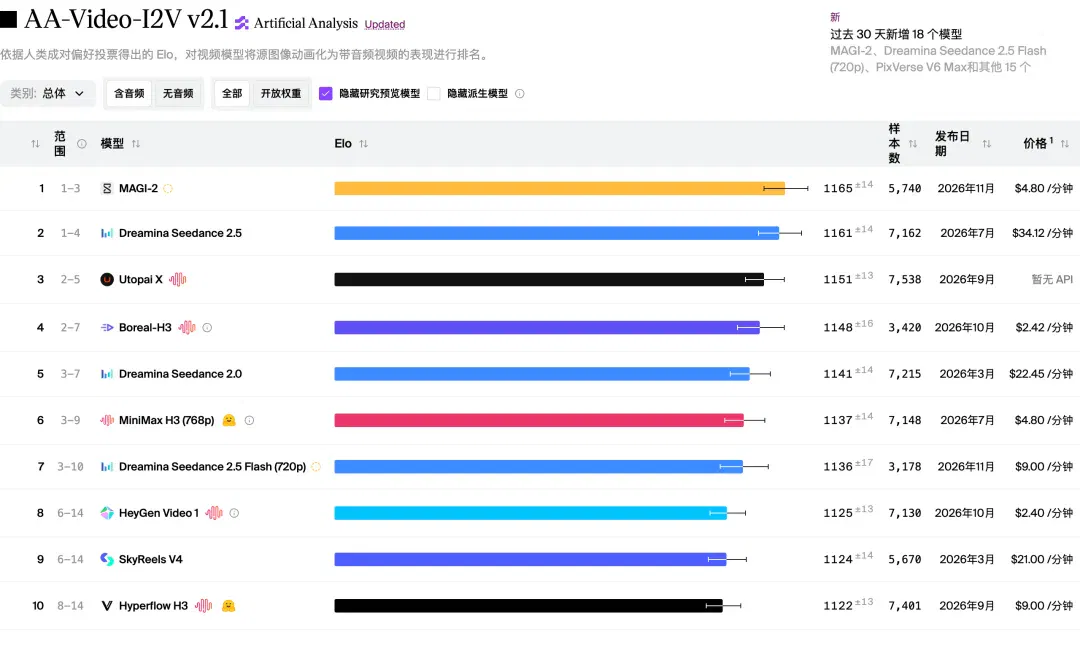
At the reporting date, MAGI-2 ranked first by Elo point estimate on Artificial Analysis's image-to-video, or I2V, leaderboard, ahead of Seedance 2.5. Their 95% intervals overlap, so this does not establish a statistically significant difference.
More notably, Sand.ai also announced plans to open-source MAGI-2's weights as soon as possible, enabling developers to use this model with leading video-generation capabilities.
The price is attractive too. MAGI-2's official list price at 1080p resolution is just RMB 0.5 per second, approximately one-tenth the price of Seedance 2.5 at the same specification.
A price cut to one-tenth, with open weights also planned: how well does MAGI-2 actually generate video?
APPSO received early test access to MAGI-2 and tried tasks in LibTV including native 30-second generation, mixed-media references, precise video editing and stylized creation.
From street racing to a kitchen escape: A complete scene in 30 seconds
Complex actions and continuous long takes have always been settings in which AI video generation readily reveals problems. Our first scene for MAGI-2 was a native 30-second continuous take.
We uploaded a GTA 6 screenshot and asked for: "Move from the game's overhead view into a cinematic tracking perspective. Two people race in a car along the Miami beachfront, speeding and driving aggressively in S-shaped swerves, with loud music playing on the car radio."
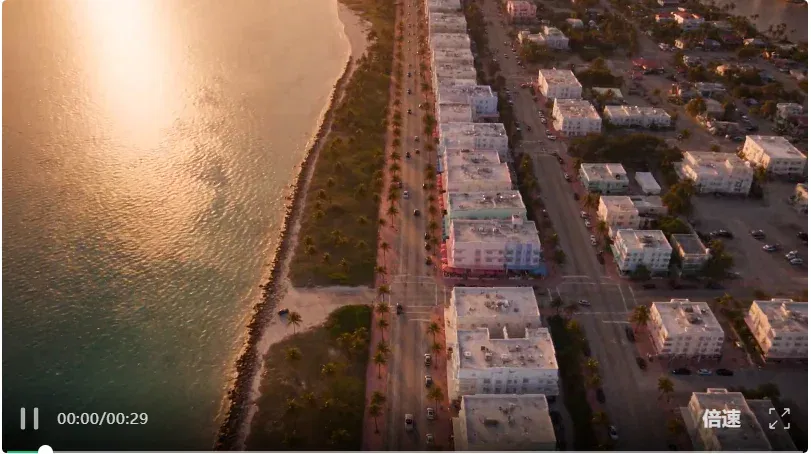
Throughout the full 30-second sequence, MAGI-2 produced almost no major problems. From establishing views of Miami's sunny beaches to tracking the racing car through the streets, the pacing and various camera movements worked very well.
Because MAGI-2 can plan shots autonomously from short prompts, it worked out a sensible pace of camera movement and dynamic composition even though we had not specified the second at which to move closer or initiate a drift.
We next asked it to generate a 30-second short in a realistic cinematic style, with the working title An Orange's Extreme Escape. The entire film was to use one continuous take, without cuts or time jumps. The camera would follow the same orange throughout, using realistic physical motion and continuous cause and effect to tell a tense yet humorous story of escape through a kitchen.
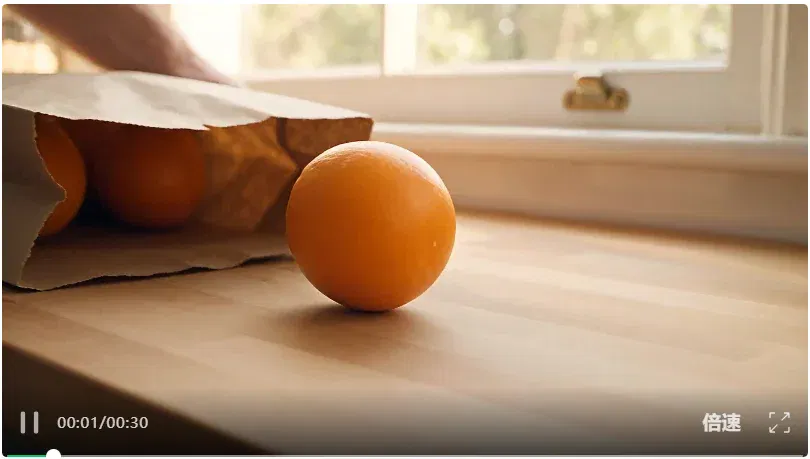
This prompt differed from the GTA example. Because MAGI-2 supports input contexts of up to 20,000 characters, we wrote a script of more than 1,700 Chinese characters. The prompt specified the kitchen's layout, obstacles on the countertop, and every second of the orange's rolling trajectory, collisions, rebounds and shifts in center of gravity.
Where the GTA example left shot planning to the model, this time we wanted it to follow the script as closely as possible.
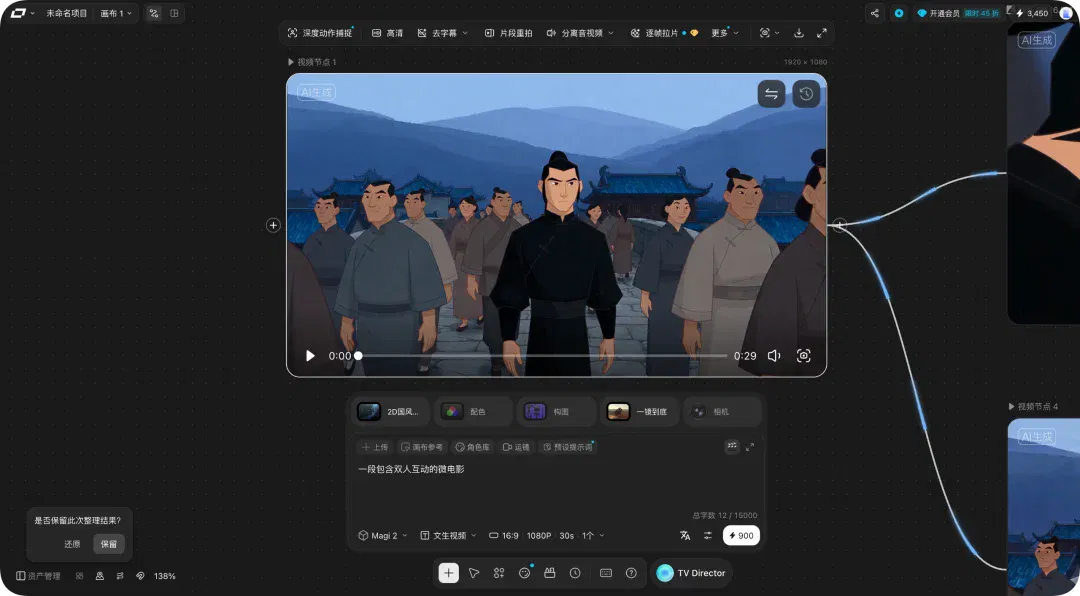
We also tried turning off the large language model's prompt enhancement, or PE, entering only "a short film featuring interaction between two people." We then selected "2D Chinese-style animation" from LibTV's film-style library and "one continuous take" for the camera movement.
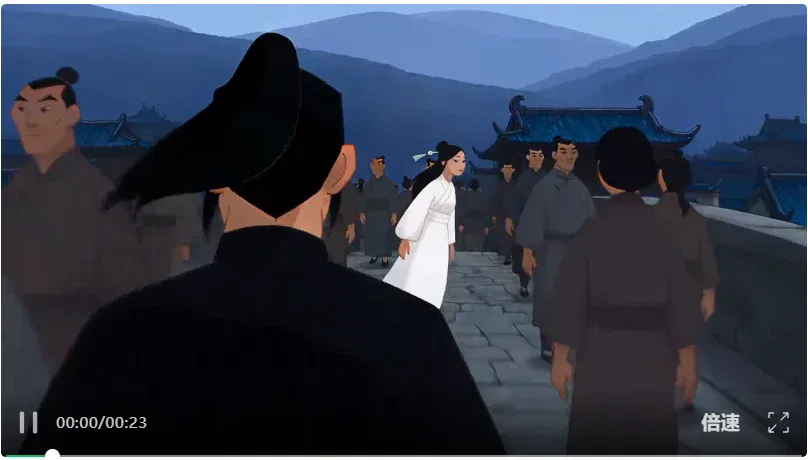
From GTA street racing to an orange setting off across a countertop and an animated short without a specified subject, MAGI-2 must handle not only continuity of settings and actions, but also the rhythm of an entire story.
Native 30-second generation gives it more room to develop a complete sequence. We can arrange a setup, a change and a conclusion within a single generation. Short prompts let the model supply camera direction, while detailed scripts let us specify actions and timing more closely.
This also means creators can decide how much work to delegate to the model and how much control to retain, depending on how developed their idea is.
Reference material for the lead character, camera work and rhythm
In actual advertising and short-drama production, text descriptions alone are often insufficient. A client may want a specific model holding a specific product, camera movement borrowed from a particular video, and cuts following a particular musical rhythm.
MAGI-2 offers mixed omnimodal references for these needs. A single generation can take up to 10 images, five video clips and five audio clips simultaneously, for a total of 20 assets. Creators can assign an explicit role to each one.
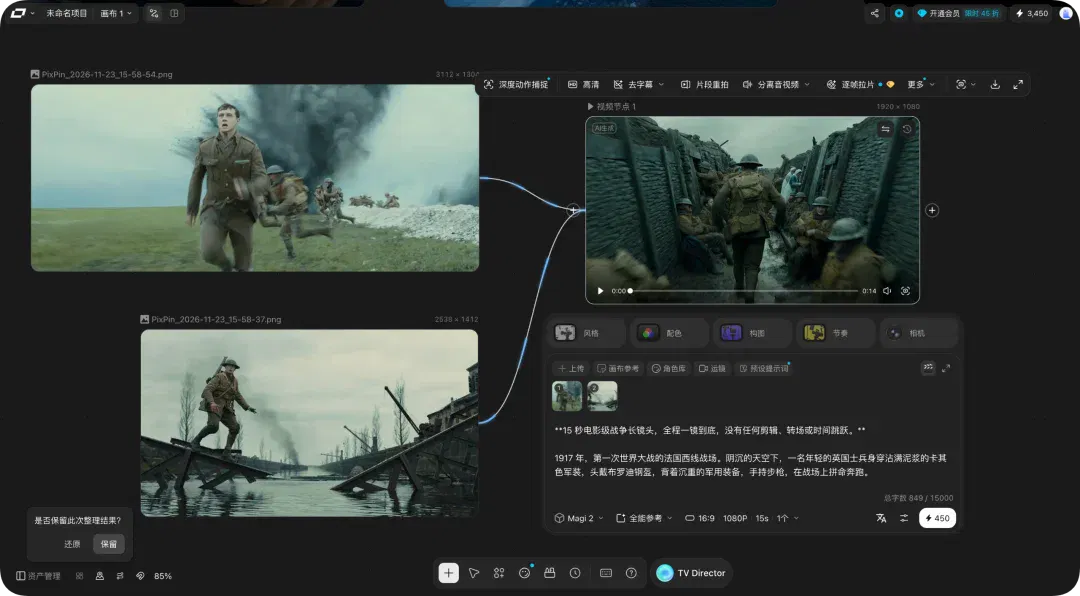
We first found several stills from the film 1917, uploaded them to MAGI-2 as omnimodal references, and added a broad scene description: "A 15-second cinematic war sequence, filmed in one continuous long take, without any cuts, transitions or time jumps."
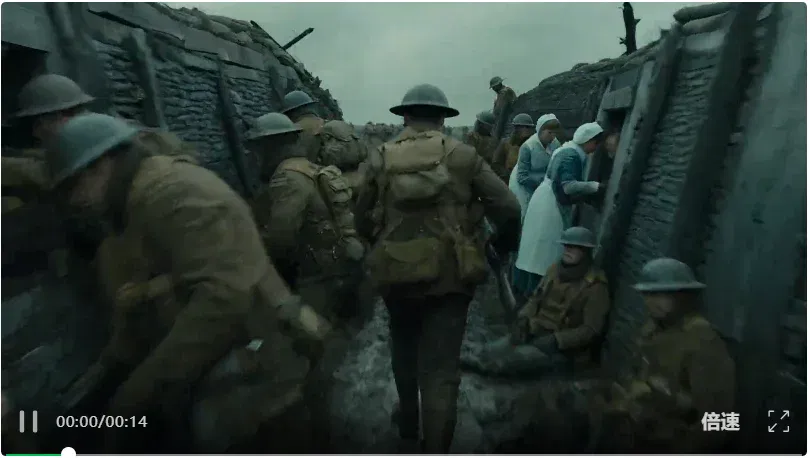
The generated video retained the atmosphere of a war film, with fairly well-coordinated images and sound effects.
This omnimodal referencing requires the model to remember the relationships among the reference images at the same time. On one hand, it needs to draw on their imagery and generate scenes matching the uploaded pictures. On the other, the camera must learn from the movement in reference videos.
In this 30-second continuous, cinematic space sequence, for example, the model can learn to make the camera behave like an observer free from gravity, floating, orbiting, rolling, approaching and retreating among astronauts and spacecraft.
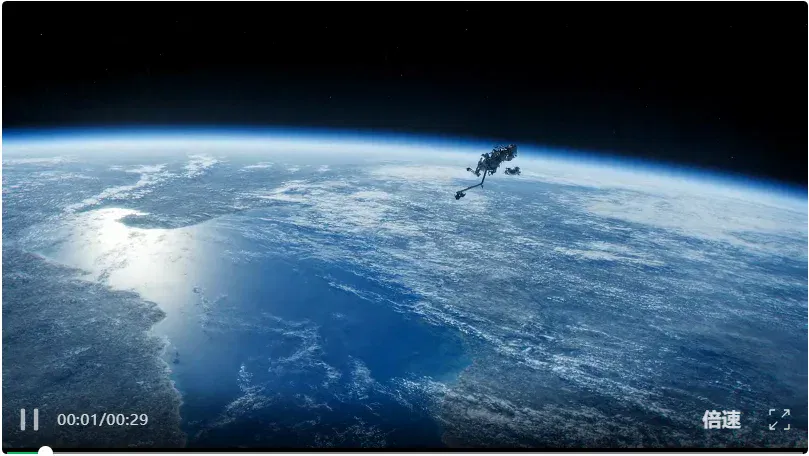
Compared with merely asking for cinematic camera movement, supplying a reference video communicates the desired movement more concretely to the model.
Finally, we increased the complexity of the inputs, using multiple images, videos and audio clips together as mixed references.
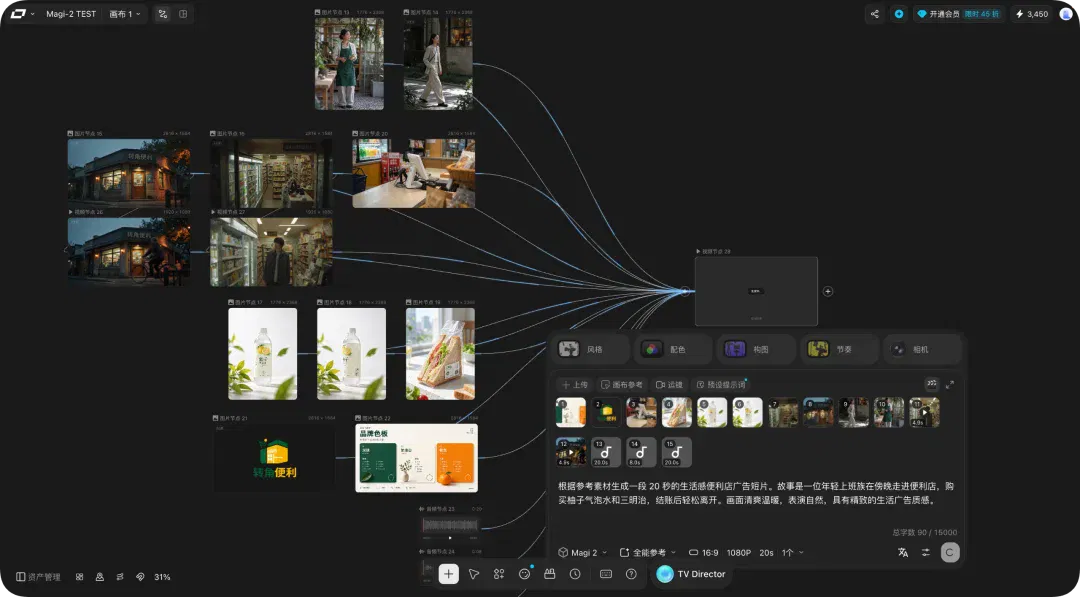
MAGI-2 largely preserved the features of the reference content, whether the uploaded logo image, convenience-store setting or character appearance. Simply providing the corresponding references let the model generate a complete video following those requirements.
This is also the most notable aspect of MAGI-2's omnimodal reference feature.
For advertising, e-commerce and short dramas with clear visual requirements, creators can directly supply product images, character designs, action videos and background music, reducing the repeated prompt revisions needed to describe a scene.
Keep the good shots, then give the idea a different style
Beyond video generation, we also tested MAGI-2's ability to modify existing videos.
The first task was to change an approximately 15-second product presentation from its original language into French and Italian separately, while preserving the person's actions, camera work and composition as much as possible.
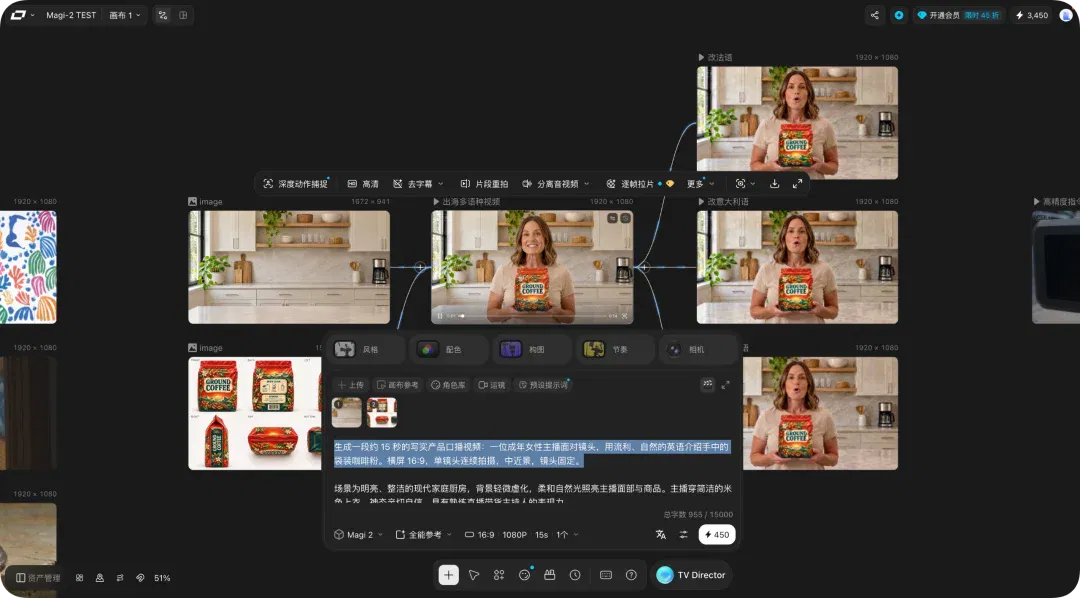
In the generated results, the presenter's lip movements changed with the language, while the original camera position, composition and body movements were largely retained.
This kind of local editing is valuable in commercial video production. In particular, product advertisements aimed at different countries and regions can reuse approved shots and performances, changing only the speech and lip movements.

Alongside editing existing videos, we tested how well the model follows timing instructions.
This time, we asked MAGI-2 to generate a timer whose display flashed yellow, green and blue at seconds 3, 5 and 7 respectively.

The output changed colors in the specified order, and the key timings also matched the prompt. For content requiring actions, effects or visual changes at specific moments, this kind of control can reduce repeated adjustments in post-production.
More surprisingly, this precise control can also extend smoothly to the overall visual style.
In commercial projects, once local revisions are complete and actions and camera positions are confirmed to be exactly right, visual treatments are often still needed for different channels. We can now upload an image and have MAGI-2 generate a video in the corresponding style from it.
First, we used Matisse's The Parakeet and the Mermaid as a reference and asked for a 20-second handmade stop-motion animation.
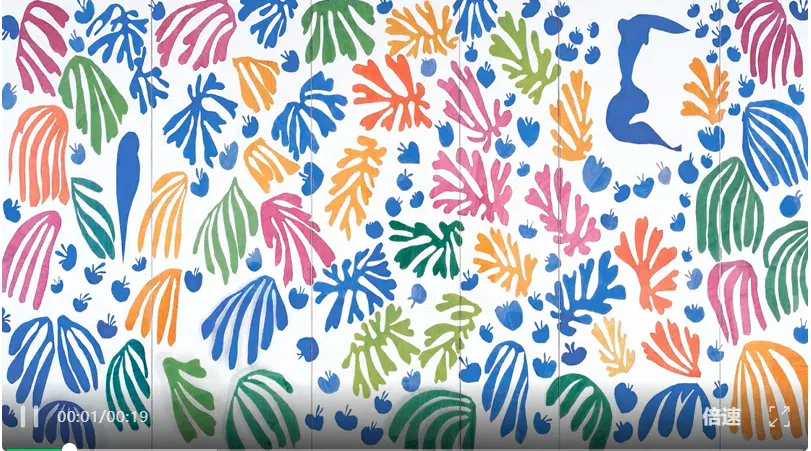
Prompt: Drawing on the painted-paper cutouts of Matisse's The Parakeet and the Mermaid, make a 20-second handmade stop-motion animation. Blue leaves on white paper lift one after another, yellow fruit rolls gently, and a paper-cut parakeet moves among them. The camera descends slowly from an overhead view to paper level. The initially flat plants rise layer by layer into a paper-sculpture garden that can be traveled through. Keep each leaf's outline, color and cut notches consistent. At the end, the camera rises again, and the entire garden reassembles into the flat composition seen at the beginning.
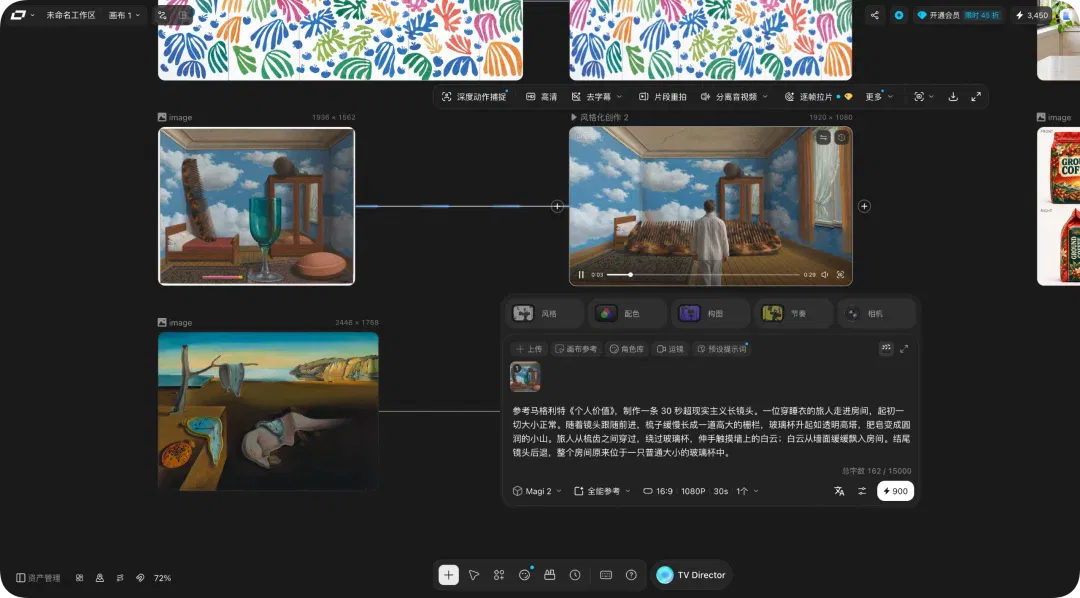
We then used Magritte's Personal Values as a reference, attempting to generate a surreal scene in which objects continually change scale.
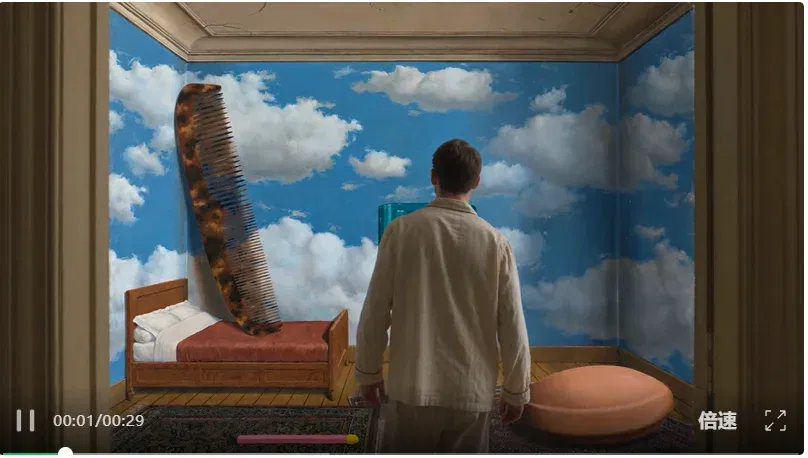
Prompt: Drawing on Magritte's Personal Values, create a 30-second surreal continuous long take. A traveler in pajamas enters a room where everything is initially of normal size. As the camera follows them forward, a comb slowly grows into a tall fence, a drinking glass rises like a transparent tower, and a bar of soap becomes a rounded hill. The traveler passes between the comb's teeth, walks around the glass and reaches out to touch white clouds on the wall; the clouds slowly drift off the wall into the room. At the end, the camera pulls back to reveal that the entire room is inside an ordinary-sized drinking glass.
Compared with the film references above, these examples make a different demand on the model. It must make objects actually move while retaining a specific artistic style. Scenes such as paper-cut leaves rising layer by layer and everyday objects changing size also require it to handle spatial relationships before and after those transformations.
From local edits to multilingual product presentations, through timer control, to generating videos in different artistic styles, MAGI-2 already covers many stages of real creative work that require repeated adjustment.
For video production requiring repeated approvals and ongoing delivery, preserving what has already been done correctly directly affects the number of generations needed and the post-production workload.
How does a video model achieve one-tenth the price?
Another notable aspect of MAGI-2 is its technical path from Preview to the full 480B model.
In its data strategy, Sand.ai expanded pre-training data threefold to 4T tokens, approximately 1 billion samples, while preserving real-world distributions such as multi-person interactions, complex motion, frequent cuts, on-screen text and complex soundscapes as much as possible. A high-throughput data pipeline enabled annotation at this scale within three weeks.
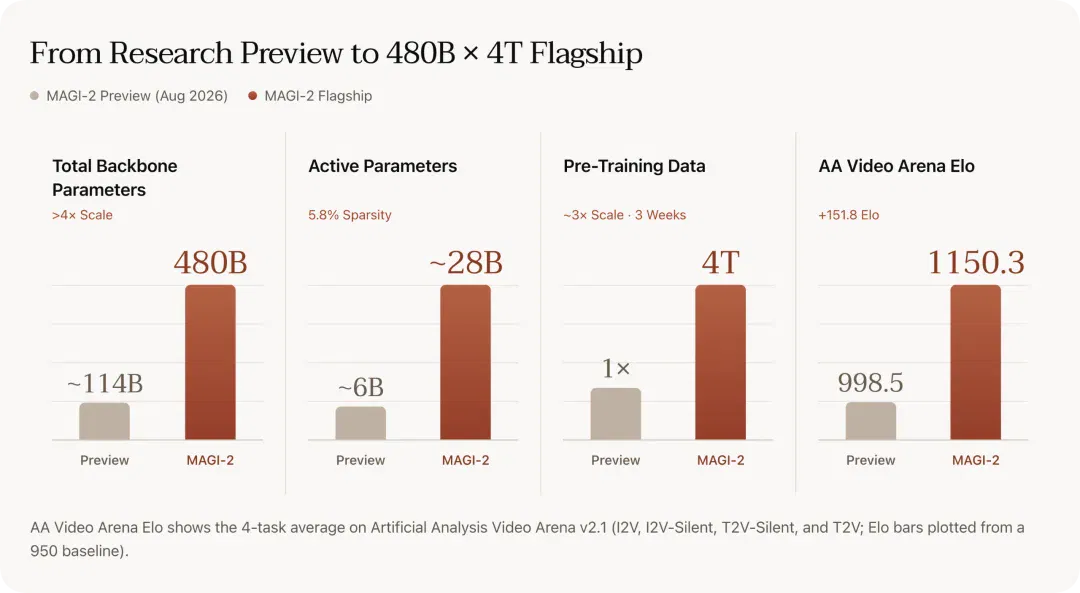
Architecturally, MAGI-2 retains a single-stream design that processes text, video and audio together. It expands its core Multi-Head Latent MoE backbone to 480B total parameters, while activating only about 28B parameters per inference.
Compared with traditional MoE, the main value of this architecture is that it scales well without congestion. During video training with tens to hundreds of billions of parameters, mixed video, audio and reference inputs can easily cause uneven cross-device communication loads and idle compute in conventional MoE.
Multi-Head Latent MoE splits the latent space into multiple independent subspaces, performs cross-device exchange in a fixed structure first, then routes experts locally. The cross-device exchange thus uses statically known shapes, reducing communication uncertainty caused by dynamic routing. Combined with in-house system optimizations including Head Parallel, MagiFSDP, MagiMoE and MagiMuon, it delivers approximately 22% faster training than LatentMoE, according to the official 480B pre-training comparison under matched total FLOPs and each architecture's own optimal configuration.
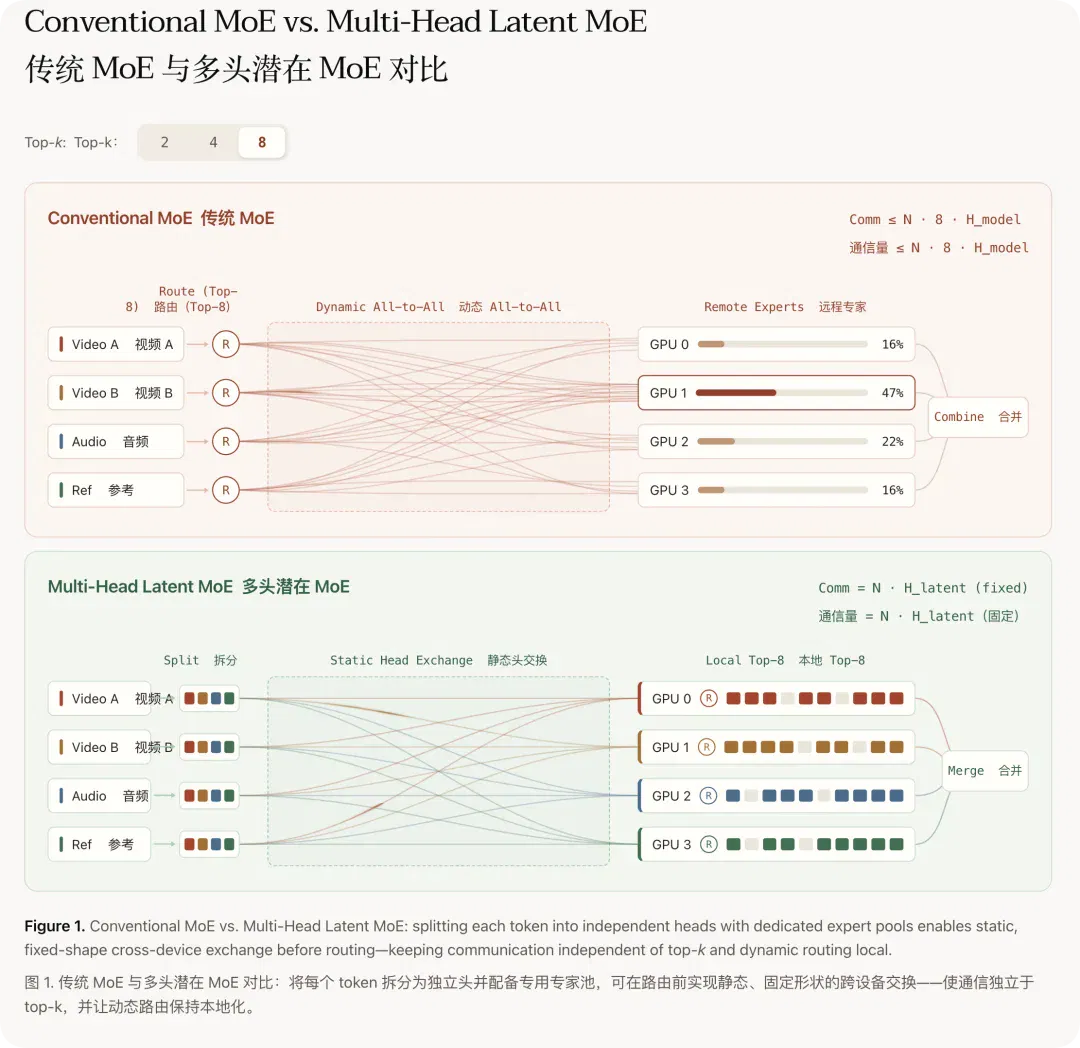
Notably, this technical approach has also been adapted to Chinese computing platforms including Hygon and Moore Threads. Co-design across data, architecture and systems not only supports MAGI-2's performance in complex video generation, but also creates conditions for lowering inference costs.
For ordinary creators, however, the most immediately noticeable change is still the generation price.
Beyond RMB 0.5 per second, what else could open-source release bring?
At the officially announced 1080p list price of RMB 0.5 per second, the base cost of generating a 15-second video once is approximately RMB 7.5, or RMB 15 for 30 seconds. Actual spending must, of course, also account for retries after failed generations and the particular billing methods of the platform and editing features.
For a long time, there has been a clear gap between open-source video models and the world's leading closed-source models. Open-source models suited enthusiasts' experimentation but struggled to compete directly with closed-source benchmarks on complex narratives and commercial delivery.
Obtaining video quality close to leading closed-source models has often meant accepting high generation costs.
Now, with its top I2V position on AA's leaderboard and its actual generation quality, MAGI-2 has the capability to compete with leading closed-source models worldwide. If its weights are released to the community as planned, developers will have an opportunity to examine further how its performance differs from Seedance 2.5 across video tasks.

We can see leading video-generation capabilities becoming cheaper and more accessible.
For creators who frequently generate AI videos, the RMB 0.5-per-second price gives us more room to experiment. Native 30-second generation, multiple references and precise editing offer a chance to keep shots we already like and change only the parts we do not.
The planned release of model weights could bring more possibilities. Technically capable teams could deploy it themselves and fine-tune for particular scenarios, while developers could build more tools around it for specific creative needs.
When generating a video is no longer so expensive, creators can worry less about cost and spend more time trying different shots, stories and ideas.
For film and video creators, a new era of boundless possibilities is approaching.
This article comes from APPSO and was written by APPSO.
Related topics
After reading
Join the AINRK community
Read how to join the community and connect with people working in AI.
Related articles
Continue reading related topics and articles in this category.
Testing MAGI-2: Strong camera work and stylization, with room to improve speech (opens in a new tab)
Kazike's team tests MAGI-2 on long takes, physics, stylized animation and mixed references. The author praises camera control and prompt following while noting spatial, detail and speech flaws. It supports up to 30 seconds of 1080p audio-video; open weights remain planned.

Yoroll Launches Interactive Short-Drama Adaptation Tool; Guaranteed Deals Depend on Project Terms (opens in a new tab)
Yoroll adapts finished short dramas with branches, generated shots and compositing, illustrated by the 30-episode Clutch Time. Platform guarantees depend on tiers, exclusivity and other terms; one-click adaptation does not ensure a guarantee, reliable output or distribution income.

Siltok on local AI video workstations: Tiered inference, generation time and cost trade-offs (opens in a new tab)
Siltok says Token Station runs H3 by coordinating VRAM, RAM and SSD storage. Its internal test generates 5 seconds at 1344×768 with 20 sampling steps in under 8 minutes. The interview examines workstations starting above RMB20,000, cloud costs and payback conditions.
Dawa Technology discusses AI video's control layer: FilmOS production and Scenes AI interaction (opens in a new tab)
GeekPark interviews Dawa Technology CTO Zhu Ziwei and CPO Li Zongxing about Latent Stage, production-process data, FilmOS and Scenes AI. Local editing is said to reduce retries; revenue, cost and performance figures are company-reported, while future use cases remain plans.
Seedance 2.5 flash launches; Zhidx tests a 15-second cat parkour video (opens in a new tab)
ByteDance reports faster generation and lower prices. Zhidx tests shot transitions and text stability in a 480P clip, finding that some background signs still lose parts of their characters.