OpenAI on Pretraining Progress and Safety Limits: A 2027 Breakthrough Remains a Possible Scenario
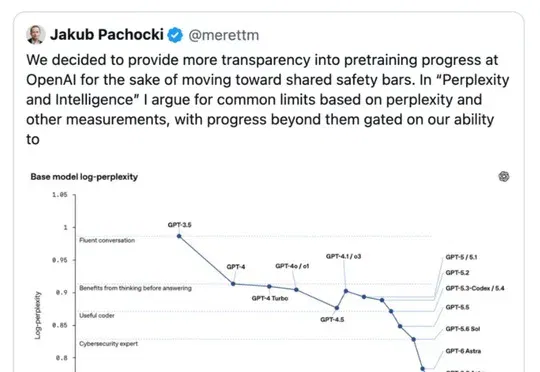
Jakub Pachocki shares log-perplexity data and considers how AI algorithm research could accelerate progress. Shared limits remain a proposal; a 2027 breakthrough and the 0.68–0.70 capability range are forecasts, not an agreed industry threshold.
Editor's fact check (2026-11-24): OpenAI's original article presents log-perplexity on a fixed internal dataset, not a universal IQ scale. A concentrated wave of breakthroughs in 2027 is a possible scenario; 0.68–0.70 is an extrapolated range for changes in capability, not an industry-wide training halt threshold that has already been announced or made mandatory. Shared limits remain a proposal, and comparability across laboratories has yet to be resolved. OpenAI's original article (opens in a new tab)
Just now, OpenAI took the unusual step of laying bare its own core secrets!
Chief Scientist Jakub Pachocki published a major, in-depth article, stating bluntly:
OpenAI's internal models have crossed the threshold for mathematical breakthroughs, and the entire industry should set a safety threshold for AI models!
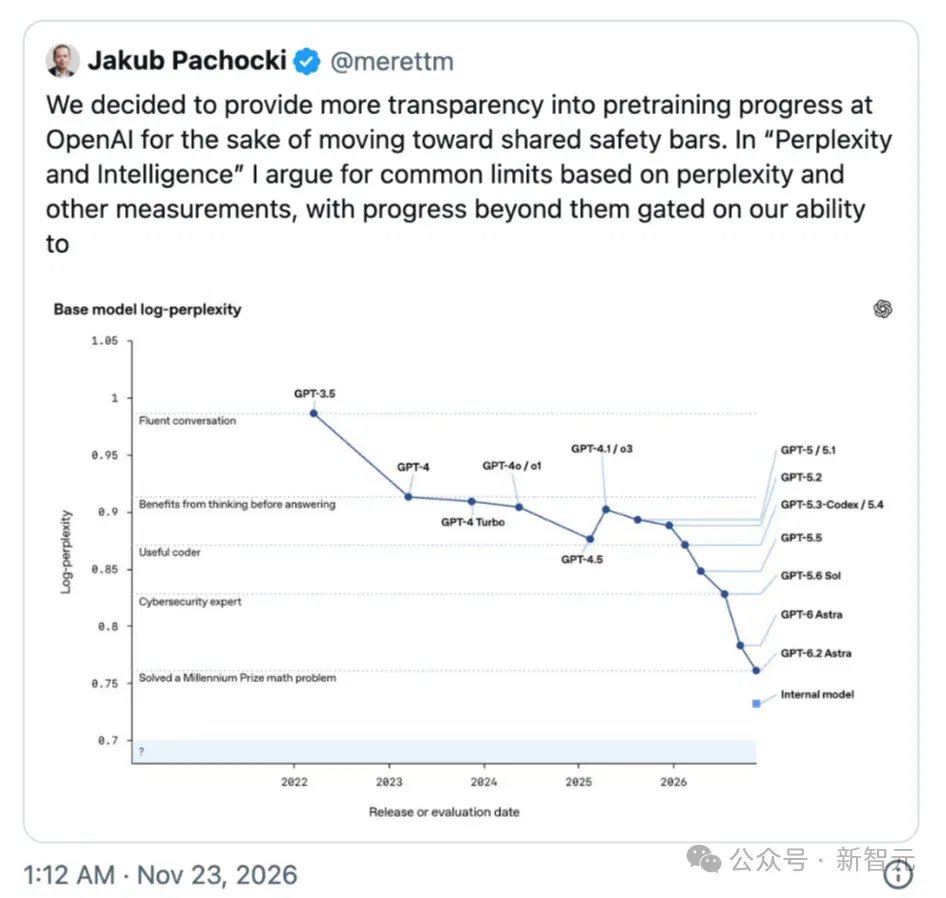
In his view, basic pretraining research could see a concentrated wave of breakthroughs as early as 2027; both the timing and the specific capabilities remain uncertain.
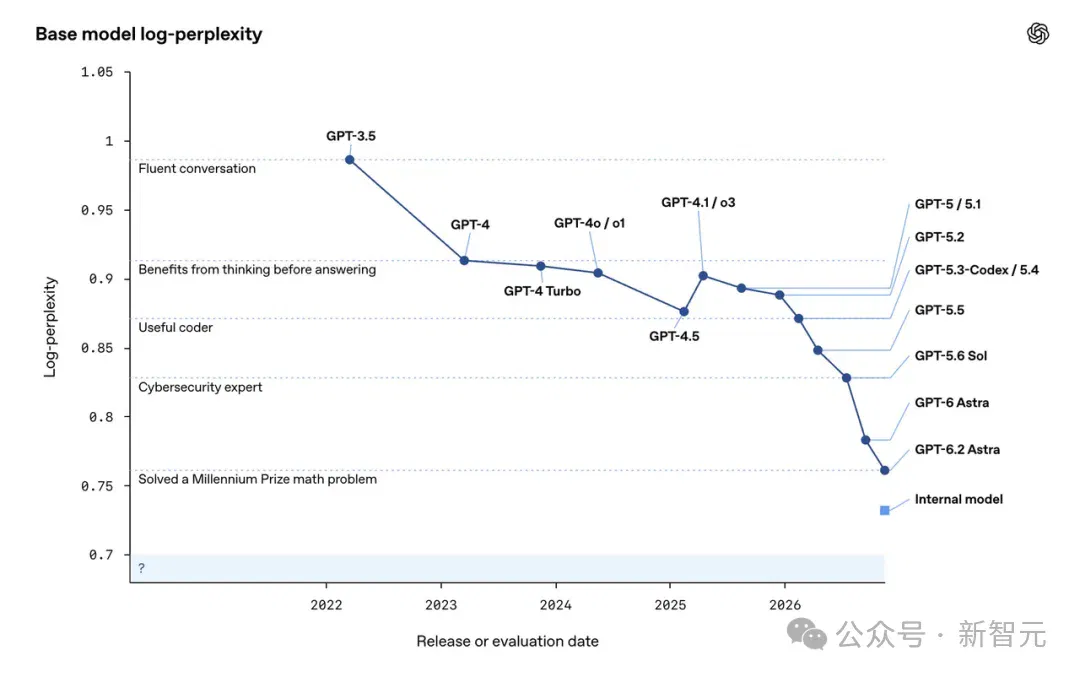
Take a close look at the following "AI IQ curve."
The lower the log-perplexity, the smarter the model.
When this value falls below 0.76, AI solves Millennium Prize mathematical problems and even begins participating in the design of new models itself.
When it falls to 0.68–0.70, AI's intelligence enters a complete blind spot. No one knows what disruptive capabilities will emerge.
Right now, the chart shows that OpenAI's internal models have already reached 0.73, only one step away from humanity's blind spot.
OpenAI proposes: the entire industry should hit the brakes! The AGI avalanche is right before us!
Altman: This Is OpenAI's Most Important Release
OpenAI's top executives also weighed in together.
Altman set the tone directly:
"This is the most important thing OpenAI has published in a while."
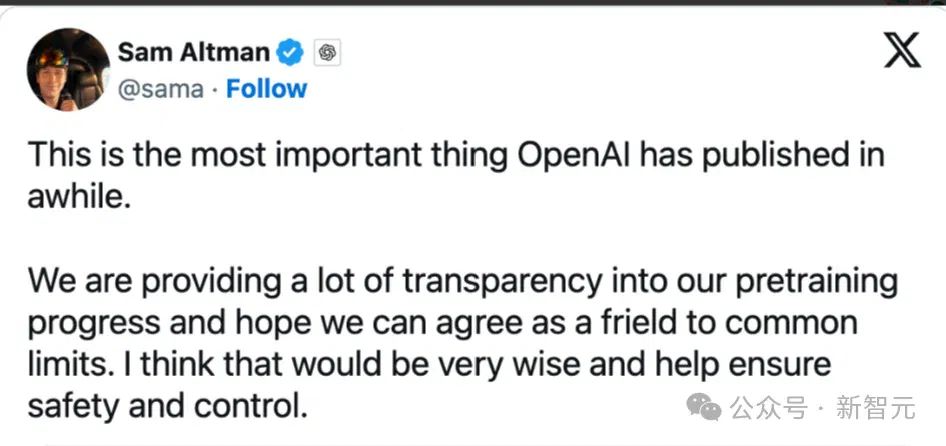
He said OpenAI had decided to release extensive data on pretraining progress, hoping the entire industry could agree on "shared limits" to ensure safety and control.
Co-founder Greg Brockman followed with a warning: although AI will also help humans with alignment and monitoring, safety progress is unlikely to keep up with accelerating pretraining.
Before this, no frontier laboratory had been willing to disclose its own pretraining loss curves. They reveal the hand behind a model's capabilities: once shown, competitors can see at a glance how far you are from the next generation of models.
Pachocki acknowledged that making these numbers public would indeed let competitors understand OpenAI's underlying position.
But he believes the urgency of establishing a shared safety floor across the industry now outweighs commercial secrecy.
One more step down leads into a gray area marked with a question mark. OpenAI wants to draw a line here where the entire industry must hit the brakes.
Understanding AI's "Intelligence Ruler": What Is Perplexity?
To understand OpenAI's fears, we first need to get to know a term: perplexity.
Jakub points out that the underlying logic of modern AI is actually frighteningly simple and blunt: it is a "super-compressor" (or predictor) trained on vast amounts of data.
Perplexity measures this model's ability to predict the next word. The lower the number, the less "perplexed" the model is when confronted with data, the more accurate its predictions, and the greater its intelligence.
For the first time, OpenAI has disclosed perplexity figures ranging from GPT-3.5 to its top-secret internal models.
On this ruler, every numerical threshold crossed represents a terrifying leap in AI capability:
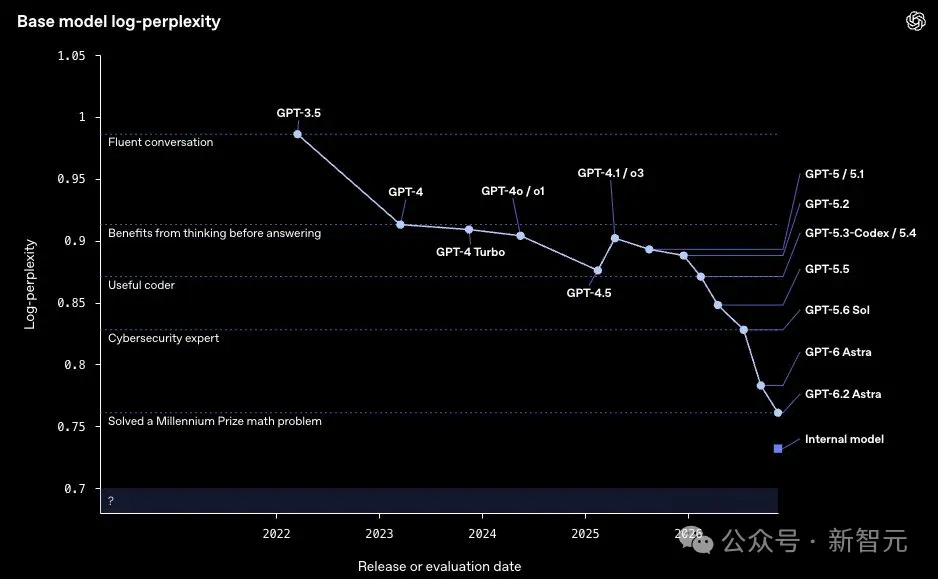
GPT-3.5 fell below 0.99—AI suddenly gained the ability to converse fluently, igniting the entire ChatGPT frenzy.
GPT-4 fell below 0.91. AI suddenly learned "chain-of-thought (CoT) reasoning," beginning to think through problems step by step like a human.
And when AI fell below 0.80, it began disrupting cybersecurity and mathematics.
Note that all of this is in the past. The numbers that follow are where OpenAI truly begins to shudder.
For a long time, mathematics was a weak point for AI. But Jakub revealed a startling internal detail:
For more than a year, OpenAI has been testing models on unsolved, open mathematical problems.
When the internal models' log-perplexity was reduced to ~0.76, a miracle happened.
For those of us who have worked in mathematics and related fields, watching models in a Slack group chat produce solutions, one after another, to mathematical problems we had thought about for years feels profoundly surreal.
The models began producing groundbreaking new results!
This leads to a frightening inference: If AI can achieve breakthroughs in mathematics, then it is entirely capable of researching how to train the next generation of AI itself!
Once AI becomes involved in developing pretraining algorithms, humanity's traditional pace of research and development will be shattered.
Jakub predicts: As early as 2027, we will see an "avalanche" of progress in basic pretraining!
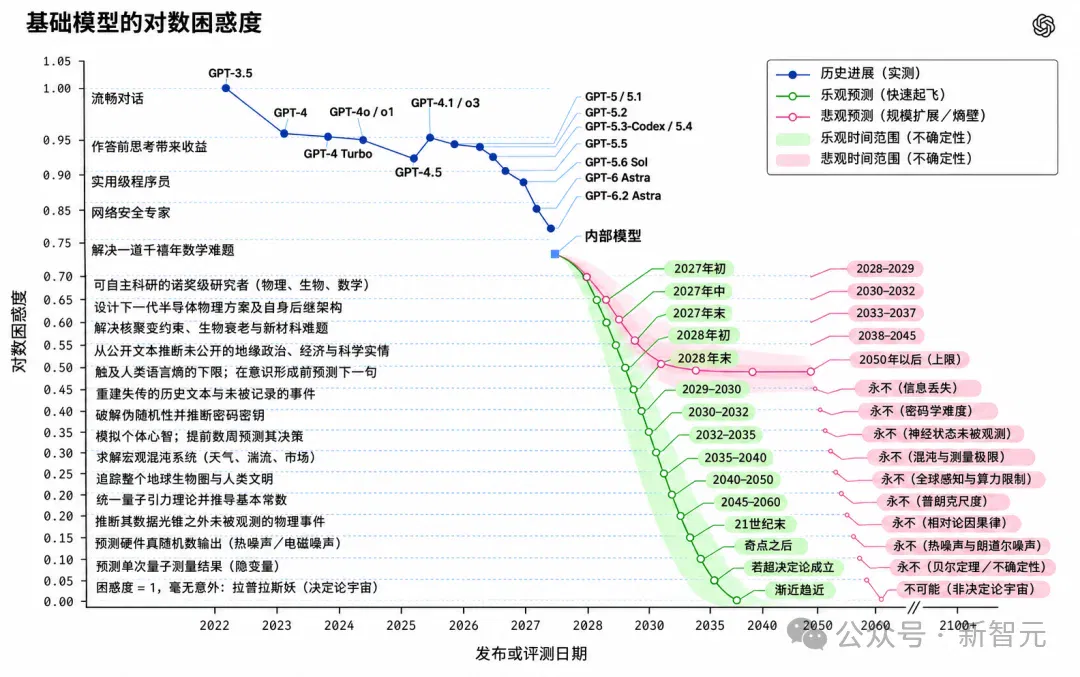
Approaching 0.73, Looking Toward 0.68: Humanity's "Complete Blind Spot"
The chart shows that OpenAI's internal models have already quietly reached around 0.73.
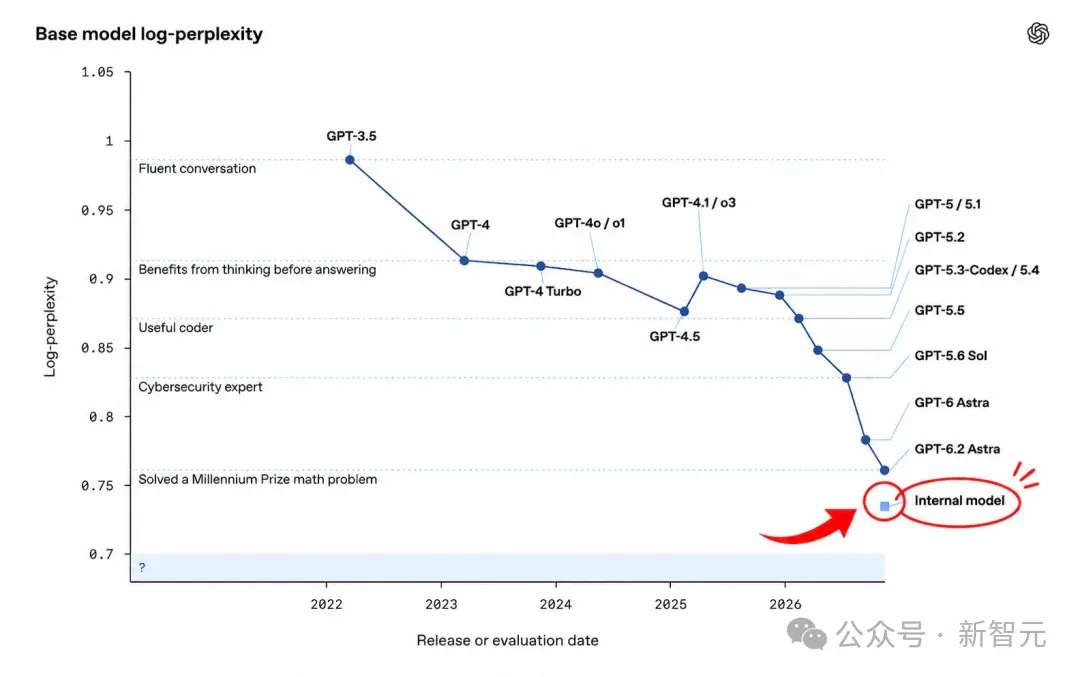
The next critical point is the range from 0.68 to 0.70.
What will happen in this range? OpenAI's chief scientist candidly admits: "I don't know."
When the metric falls into this window, disruptive capabilities will emerge for which humans have not even "invented the tests yet."
Existing safety alignment measures and monitoring methods could become completely ineffective in the face of intelligence at this level.
It is like falling into a black hole: you know only that you are drawing ever closer to the singularity, but not what lies beyond it.
Precisely for this reason, Jakub and Altman have made a radical proposal that shook the industry: an industry-wide "IQ brake line"—Perplexity Limits.
They call on all frontier model developers to jointly commit to using "perplexity" as a common metric across the industry.
Everyone would jointly set a "red line" (for example, 0.68). When any laboratory's internal models reach it, that laboratory should comply with research and development restrictions until jointly agreed monitoring-capability milestones have been reached; this mechanism remains a proposal and has not become mandatory.
Unless humanity develops a new generation of "monitors" that demonstrate we are fully capable of understanding and controlling AI behavior at this level, no one would be allowed to keep pressing the accelerator.
Musk Mocks the Idea: Pretraining Is Training—Why Pretend Otherwise?
OpenAI's proposal instantly set off a storm of discussion on X.
Musk quickly arrived in the comments too.
Mocking OpenAI's emphasis on "pretraining," Musk said directly:
Pretraining should simply be called 'training.' You cannot have only 'pre' and 'post' without ever having actual training.
It is like putting on a full set of workout clothes to exercise, then going straight to take a shower without ever working out.


Still, mockery aside, Musk is no less afraid than OpenAI of AI running out of control.
He identified the real bottleneck for AI development next year—data exhaustion.
What happens when data has been squeezed dry while computing power is growing exponentially?
Musk left a prediction that grows more unsettling the longer you think about it:
"Imagine what superintelligence will be like when we reach exascale computing power. By then, (today's AI) will look like cavemen playing with sticks."
Is This "Ruler" Perfect?
Of course, using "perplexity" as a red line is not without flaws.
In his lengthy article, Jakub also candidly lists four major challenges in using perplexity as an "industry safety metric."
1. Comparisons across laboratories are difficult: Everyone uses different test datasets and training-data recipes. Even with the same metric, your 0.7 and my 0.7 may represent different levels of intelligence.
2. It is detached from specific tasks: Perplexity is only an underlying prediction metric; it cannot directly reflect AI's specific ability to write code or articles. We care about it because only as it falls do entirely new, unpredictable capabilities "emerge."
3. It cannot measure progress outside pretraining: For example, the much-celebrated "chain-of-thought reasoning" makes models vastly smarter, but does not lower the model's own perplexity value.
4. An abyss whose bottom we cannot find: Loss cannot fall to 0, which would mean remembering all data with complete certainty, but we do not know what the data's inherent entropy actually is. The closer we get to the limit, the more slowly perplexity will fall, yet even a decrease of just 0.01 could bring an explosive, geometric leap in AI intelligence!
Despite these flaws, OpenAI remains convinced that this is the only "ruler" humanity has found so far that has stood the test of time and can continuously measure growth in general intelligence.
Does the Power to Define the Red Line Return to the Tech Giants?
Behind Altman's repost of this lengthy article lies a struggle over "control of future AI." Coming during the days of Anthropic's stock-market debut makes the timing even more intriguing.
But the laboratories themselves draw the brake line. This means the power to define "when to stop" still rests with the leading AI giants.
Whether a concentrated wave of breakthroughs will occur in 2027 remains a prediction to watch.
For the first time, humanity has converted the distance to unknown intelligence into a clearly declining series of numbers:
0.99, 0.91, 0.87, 0.83, 0.76, 0.73……
The countdown is now before everyone's eyes. Before the "avalanche" of 2027 descends, can these tech giants, holding hundreds of billions of dollars, really ease off the accelerator together?
OpenAI has already claimed that it has applied the brakes halfway.
Next, we will see whether anyone is willing to apply them together.
References:
https://openai.com/index/perplexity-and-intelligence/
This article comes from the WeChat public account "Xinzhiyuan," written by "Xinzhiyuan."
Related topics
After reading
Join the AINRK community
Read how to join the community and connect with people working in AI.
Related articles
Continue reading related topics and articles in this category.
Oregon sues OpenAI for $2.035 billion over child-safety allegations (opens in a new tab)
On November 17, 2026, Oregon sued OpenAI for $2.035 billion, alleging inadequate protection of minors and misleading safety claims about ChatGPT. The allegations have not been established in court; the amount is a claim, not an awarded penalty.
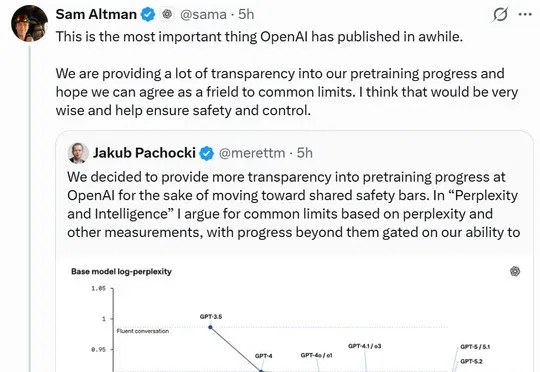
OpenAI shares pretraining log-perplexity data and proposes common AI safety limits (opens in a new tab)
Jakub Pachocki shares log-perplexity figures from OpenAI’s fixed internal evaluation set—about 0.99 for GPT-3.5 and 0.91 for GPT-4—and proposes shared development limits tied to monitoring milestones. Cross-lab and task-level comparisons have limits.
OpenAI Details Anti-Distillation Safeguards and Internal Reasoning-Extraction Tests (opens in a new tab)
OpenAI reports weekly enforcement against thousands to tens of thousands of accounts. In an internal adaptive black-box evaluation using six attacker models, the average success rate for extracting earlier protected reasoning fell from 54.0% to 0.2%.
OpenAI Explains Its Performance Factory: Codex Investigates, Engineers Approve Fixes (opens in a new tab)
OpenAI describes a pipeline linking alerts, Codex investigations and proposed fixes, adversarial review and post-deployment checks. It reports over 1,700 investigations and 600 root-cause cases in just over three months; engineers still approve deployment.
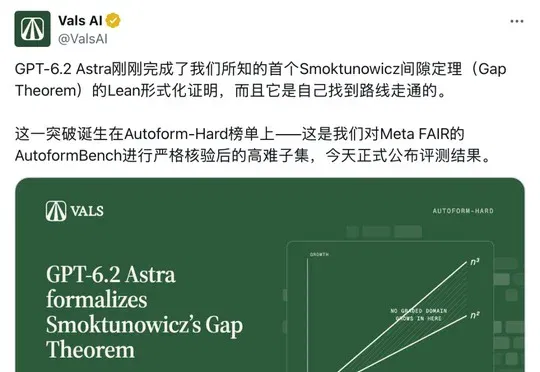
Vals AI: Astra formalizes the established Smoktunowicz gap theorem in 94 minutes (opens in a new tab)
Vals AI reports that GPT-6.2 Astra formalized Smoktunowicz’s established theorem in 1,794 lines of Lean during Autoform-Hard. Part of its argument differs from the 2006 proof, but the route’s relationship to prior literature still needs further checking.