OpenAI shares pretraining log-perplexity data and proposes common AI safety limits
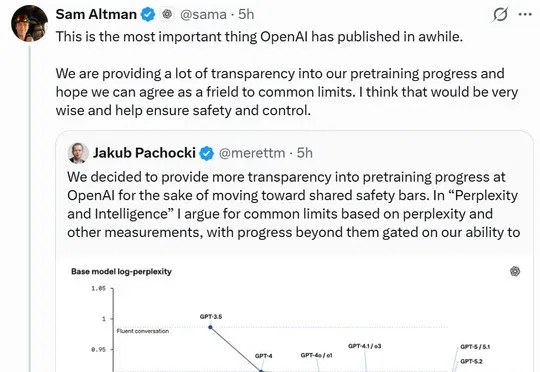
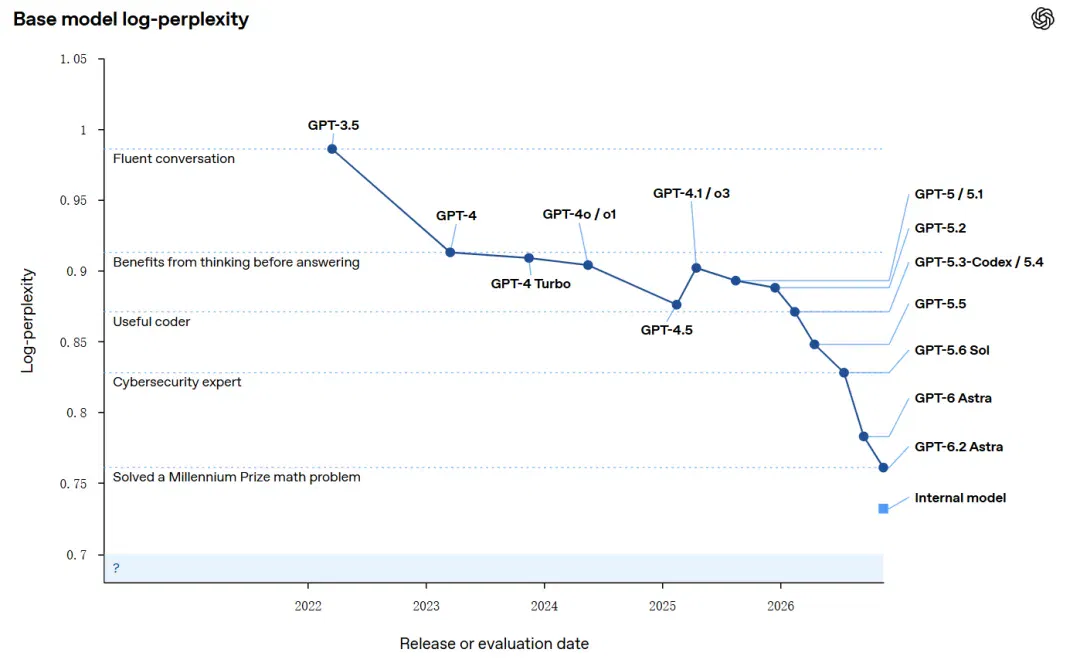
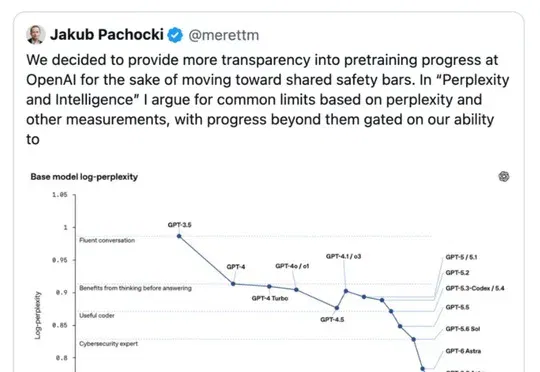
Jakub Pachocki shares log-perplexity figures from OpenAI’s fixed internal evaluation set—about 0.99 for GPT-3.5 and 0.91 for GPT-4—and proposes shared development limits tied to monitoring milestones. Cross-lab and task-level comparisons have limits.
Editorial fact-check (November 24, 2026): The figures such as 0.99 and 0.91 refer to log perplexity, or cross-entropy loss, measured on a fixed held-out evaluation set within OpenAI’s internal code. They are not “IQ scores” directly applicable across laboratories. Common research and development limits are Pachocki’s proposal, not a standard already in force across the industry. OpenAI original article (opens in a new tab)
As AI grows stronger, OpenAI is calling for a “ceiling” for the entire industry.
On November 22 local time, OpenAI chief scientist Jakub Pachocki unexpectedly published a lengthy article, 《Perplexity and Intelligence》, disclosing internal pretraining metrics for the first time and making a controversial proposal: the world’s leading AI companies should agree on shared development limits. None should cross that line until AI safety monitoring reaches specified standards.
This time, OpenAI has voluntarily released data its competitors have long wanted to know.
The metric Pachocki chose is perplexity. It measures a model’s ability to predict the next token: the lower the value, the more accurate the prediction. In OpenAI’s disclosed data, GPT-3.5 has log perplexity of approximately 0.99 and GPT-4 approximately 0.91. Below 0.8, models begin to show breakthrough capabilities in cybersecurity and mathematics. Around 0.76, models can solve a succession of long-standing open mathematical problems.
More concerning, Pachocki believes AI may soon begin accelerating its own development. As early as 2027, pretraining algorithm research could see a wave of fundamental breakthroughs, while safety monitoring technology might not keep pace.
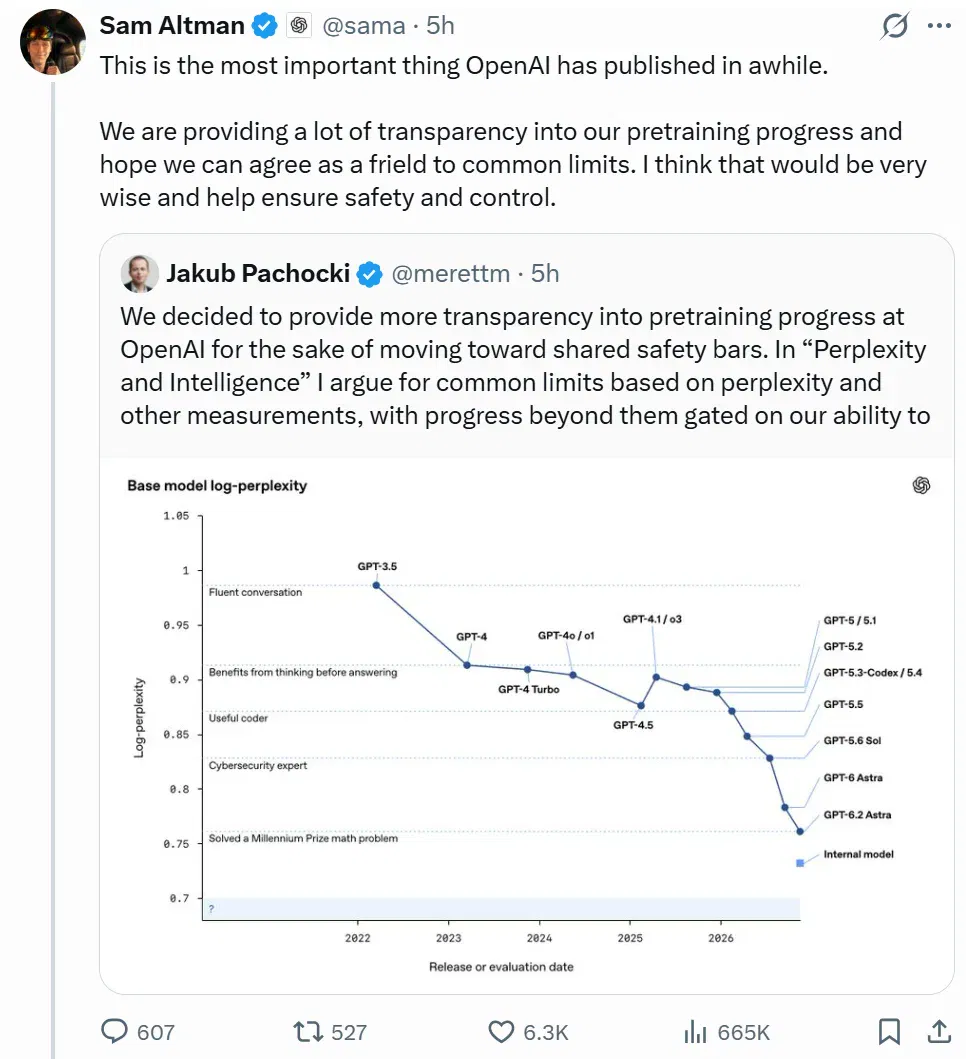
OpenAI CEO Sam Altman also publicly called it one of the most important pieces OpenAI had published recently. OpenAI is substantially increasing transparency around pretraining progress and hopes the industry can agree on common limits. Altman sees this as a very sensible approach to ensuring AI remains safe and controllable.
The following is an edited translation of Jakub Pachocki’s original article:

URL: https://openai.com/index/perplexity-and-intelligence/
From a distance, the way modern AI is built may look similar to software development over past decades: a series of distinct techniques implements specific capabilities.
AI development does involve diverse methods, but most do not design a capability from scratch. Instead, they elicit intelligence produced by a simpler, harder-to-explain process: training a compressor—or, equivalently, a predictor—on enormous amounts of data.
I believe tracking progress in our ability to train compressors is key to understanding AI’s trajectory. In this article, I advocate using perplexity, or the equivalent cross-entropy loss measure, to compare the technical capabilities of different model developers and help establish common safety standards.
As a first step, I will increase transparency around OpenAI’s pretraining progress.
We did consider the implications of publishing our internal perplexity measurements. Doing so gives competitors a clearer view of OpenAI’s position. But the urgency of establishing shared safety measures across the industry outweighs that consideration. We hope this will be a step toward the shared scientific foundation needed for future pacing efforts in AI development.
From a simplified but fundamentally explanatory perspective, AI development has several stages:
First, build a large computer. Then use it to pretrain a model—a compressor—on a large, unstructured dataset. Finally, elicit its latent capabilities in different settings through techniques such as prompting, fine-tuning or reinforcement learning.
Algorithmic advances may blur the boundaries between training stages, but we can still distinguish two processes: creating AI with emergent capabilities that are difficult to predict, the process I previously called “An Alien Mind,” and subsequently eliciting those capabilities in targeted ways.
An underlying metric for tracking progress in AI intelligence
For years, our primary way of measuring progress in this crucial “intelligence substrate” has remained remarkably stable. We have tracked models’ perplexity on a held-out dataset.
Perplexity measures a model’s average ability to predict the next token. Lower perplexity means more accurate predictions.
The chart opening this article shows how that metric has changed across OpenAI models, starting with GPT-3.5.
It is remarkable how broad a range of model capabilities can be described through this single metric.
After setting a new perplexity record on an earlier dataset, GPT-2 was arguably the first model able to produce sustained, coherent paragraphs.
The next major leap came with GPT-3, which could learn to perform tasks in context from a few examples.
With log perplexity of approximately 0.99 on our current main evaluation dataset, GPT-3.5 could already converse fluently and became the foundation for the original ChatGPT.
At approximately 0.91 log perplexity, GPT-4 could effectively reason using chain of thought. This led us to further elicit that capability in targeted ways, ultimately giving rise to modern reasoning models.
Today, as loss falls below 0.8, we have seen transformative capabilities emerge in fields such as cybersecurity and mathematics.
I want to emphasize again that nobody could clearly foresee these capabilities appearing at those specific perplexity thresholds. Fundamentally, they can be understood as latent capabilities emerging as models continue to improve on this metric.
As AI develops rapidly, the range of downstream capabilities and the ways we measure them may soon change.
Testing GPT-2 and GPT-3 on many of today’s leading benchmarks is no longer particularly meaningful, while many benchmarks used at the time were already largely saturated by GPT-4.
By contrast, I believe continued observation of pretraining progress is likely to remain informative.
AI participating in its own development could bring new acceleration
One distinctive change in the pace of AI research and development comes from AI’s increasing involvement in its own creation.
The most widely discussed metrics currently focus on how AI augments or replaces human researchers at different stages of development.
The ultimate turning point is often considered to be “full recursive self-improvement,” where the entire research and development process becomes automated and no longer requires human oversight.
Beyond believing that we should clearly avoid that outcome to preserve human control, I also think this all-encompassing framing overlooks a key issue.
AI’s participation in one critical part of research and development could itself produce a major transition: algorithmic research for pretraining.
Recently, we have already witnessed unprecedented acceleration in another field.
For more than a year, we have given models open mathematical problems to solve as one way of evaluating their capabilities.
When we upgraded to a model with log perplexity of approximately 0.76, it began producing breakthrough research.
For those of us who had worked in mathematics and related fields, seeing a model solve, one after another in a single Slack thread, problems we had thought about for a long time was a deeply surreal experience.
Having experienced this, we can extrapolate that a similarly sudden change could occur in deep-learning research.
Although deep learning depends more heavily on experiments, it has always been a field in which simple insights can remain undiscovered for years.
As a result, we could see a cluster of similar fundamental breakthroughs in pretraining techniques as early as 2027.
I expect AI to substantially advance alignment and monitoring technology as well, but I believe progress in those fields may be insufficient to keep up with a potential across-the-board acceleration in pretraining.
Perplexity could become a shared yardstick for general intelligence
If new and surprising capabilities arise primarily from progress in compression, perplexity-based metrics could serve as a common benchmark for general intelligence, regardless of how automated AI development becomes.
Extrapolating from recent progress, we should expect further transformative capabilities as models reach log perplexity of approximately 0.68 to 0.70.
I do not know exactly what those capabilities will be. We may not even have designed evaluations for them today.
At the same time, we should expect the currently dominant approaches to alignment auditing to become less effective, related degradation to continue, and models to become more aware of evaluation and training processes.
I believe frontier-model developers should work together on shared protocols specifying how models will be evaluated and safety red-teamed before their first deployment.
These protocols should include common transparency standards.
I further propose common limits on development across the industry. Based on perplexity and other metrics, these would be limits that companies commit not to exceed until developers reach concrete milestones in understanding and monitoring AI behavior.
For example, we first need an alternative more advanced than today’s chain-of-thought monitors.
In other words, I hope to establish industry standards clarifying two questions:
- First, where to place the initial development limit using a key metric that can be tracked across laboratories.
- Second, which specific technical goals must be achieved before that limit can be crossed.
I hope this can help create a common framework for setting subsequent staged limits and managing the pace of future AI development.
Challenges remain in using perplexity as a common metric
There are also problems with using perplexity as an industry-wide shared metric.
First, direct comparison across laboratories is difficult.
Different developers use different evaluation datasets and different mixtures of training data.
This article publishes measurements on the main dataset OpenAI has tracked over time. I believe that if the industry establishes transparency objectives, we can find transferable ways to compare the quality of different foundation models.
Second, there is a disconnect from practical task evaluation.
Perplexity does not directly correspond to any particular task we actually care about.
We care about it because we can expect continued improvements in perplexity eventually to produce entirely new emergent capabilities.
Third, it does not capture technical advances beyond pretraining.
The clearest example is chain-of-thought reasoning: it can greatly improve model capabilities without reducing the perplexity the model has already achieved.
Fourth, the theoretical lower bound of perplexity remains unclear.
We do not believe loss can reach zero, because that would mean the model could predict everything in the dataset with complete certainty.
But we still do not know the data’s intrinsic entropy.
As models approach that value, the apparent pace of improvement in perplexity may slow. At the same time, smaller improvements in perplexity could correspond to larger leaps in model intelligence.
Despite these challenges, perplexity has stood the test of time as a metric. Many research teams have devoted substantial effort to optimizing it for years, and it has continued to deliver advances in general intelligence.
I believe perplexity can play an important role in standardizing how the industry discusses AI progress, and I hope to see greater industry-wide transparency around this metric.
This article comes from the WeChat public account Synced, written by Synced.
Related topics
After reading
Join the AINRK community
Read how to join the community and connect with people working in AI.
Related articles
Continue reading related topics and articles in this category.
Oregon sues OpenAI for $2.035 billion over child-safety allegations (opens in a new tab)
On November 17, 2026, Oregon sued OpenAI for $2.035 billion, alleging inadequate protection of minors and misleading safety claims about ChatGPT. The allegations have not been established in court; the amount is a claim, not an awarded penalty.
OpenAI on Pretraining Progress and Safety Limits: A 2027 Breakthrough Remains a Possible Scenario (opens in a new tab)
Jakub Pachocki shares log-perplexity data and considers how AI algorithm research could accelerate progress. Shared limits remain a proposal; a 2027 breakthrough and the 0.68–0.70 capability range are forecasts, not an agreed industry threshold.

OpenAI Details Anti-Distillation Safeguards and Internal Reasoning-Extraction Tests (opens in a new tab)
OpenAI reports weekly enforcement against thousands to tens of thousands of accounts. In an internal adaptive black-box evaluation using six attacker models, the average success rate for extracting earlier protected reasoning fell from 54.0% to 0.2%.
OpenAI Explains Its Performance Factory: Codex Investigates, Engineers Approve Fixes (opens in a new tab)
OpenAI describes a pipeline linking alerts, Codex investigations and proposed fixes, adversarial review and post-deployment checks. It reports over 1,700 investigations and 600 root-cause cases in just over three months; engineers still approve deployment.

Vals AI: Astra formalizes the established Smoktunowicz gap theorem in 94 minutes (opens in a new tab)
Vals AI reports that GPT-6.2 Astra formalized Smoktunowicz’s established theorem in 1,794 lines of Lean during Autoform-Hard. Part of its argument differs from the 2006 proof, but the route’s relationship to prior literature still needs further checking.