Agent Evals in Practice: From Product Metrics and Trace Observability to Real-World Regression Testing

Kaiyi draws on general-agent projects to discuss scoring dimensions, trace observability, subjective judgment, real-world tests and harness iteration. These practical views do not make sampled scores, repost coverage or one-off results substitutes for capability or factual judgments.
Editor's fact check (2026-11-24): This article presents methodology and product judgments based on the author's project experience, not universal theorems about all model training, agent development or divisions of evaluation work. A news item appearing on multiple sites can help reveal coverage and consistency, but the number of reposts cannot by itself establish truth or authority, and absence does not automatically imply exclusive value. MarginLab's current page says it is collecting a new baseline for Opus 5.5/high and degradation detection is paused; daily pass rates and changes on individual tasks do not amount to confirmed model degradation. Anthropic's official agent-evaluation methods and terminology; (opens in a new tab)MarginLab's Claude Code performance tracker (opens in a new tab)

"Evals Are Tests Too"
Zang AI brings you the most valuable—and labor-intensive—article since this account was founded, written by our friend Kaiyi.
After working through several agent projects, Kaiyi had a profound moment of insight into Agent System evaluations and produced a systematic interpretation. We recommend that anyone interested in evaluating Agent Systems read it seriously.
For anyone who cannot be bothered to read the whole thing, let me explain its main content on Kaiyi's behalf:
Taking Manus as an example, building agents requires someone like Peak who understands models, deploying models and products, and has a strong sense of responsibility; running the company requires a strategist like Xiaohong.
The following is written by Kaiyi:
I began working with evaluations earlier in 2026. Over the past six months, I have done evaluation-related work or exchanged ideas with Tabbit Browser, Offloop, Persom and some friends' startup projects. Most of these projects take something like the form of a general-purpose agent.
I started writing this article in October 2026, mainly to share some experiences from evaluating General Agent Systems (abbreviated below to agents).
The experiences in this article also apply to iterating on harnesses, prompts and skills, which are all submodules of an agent.
01
Defining Agent Evaluations
Evals are tests too. Evaluation is a testing job.
Testing in traditional software engineering serves to verify that system behavior meets expectations after an iteration. There is no difference on this point.
So why single it out with a separate word, evaluation, rather than simply calling it model testing or agent testing?
Compared with software testing, changes made when iterating on models and agents carry a great deal of uncertainty. For agents, the main subject of this article, there are specifically two kinds:
1. Agents depend on model outputs, which are unpredictable. Language, the tool humans use to control agents, itself contains considerable ambiguity.
Our ability to control model outputs is therefore limited—arguably far below our control over a traditional software code system.
2. An agent is a tightly coupled system internally, and its internal complexity multiplies with the model's randomness.
Changing the first sentence of a prompt may also affect behavior required by another sentence.
For example, suppose my agent already has a planning mechanism, with a prompt saying "Plan before starting a task." A later iteration needs to add a mechanism for directly answering simple questions.
If I iterate by changing the prompt, I must consider whether it conflicts with the sentence "Plan before starting a task."
People who have written a lot of prompts have probably felt something similar:
When generating images in ComfyUI, achieving a particular effect often requires a fine-grained understanding of every keyword and the relationships between them. Adding an unsuitable style descriptor can throw off the character's previously fixed hair color and all the lighting effects.
In agent iteration, the desired effect and its implementation are connected to some extent. There is also some controllability compared with model training, but overall it remains fairly opaque.
Completely untangling its logic is extremely difficult and demands a great deal from the person doing it.
Evaluation therefore branched off from testing in ordinary software development. Its importance has also increased compared with traditional software testing.
But what exactly is the difference between agent evaluation and model evaluation?
02
The Difference Between Agent and Model Evaluation
Within agent or model work, evaluation is often deeply tied to iteration. When the two sit together, improvement methods and evaluation targets often share the same origin, creating a situation where someone acts as both referee and player.
For model companies, using training sets inspired by the same source as evaluation-set design when improving many capabilities is not a fatal problem.
That is because current training paradigms can ensure that, in certain capability directions, useful results are achieved even with this issue taken into account, and that they still work in users' hands.
By contrast, most agent-harness iteration is engineering work, and no engineering paradigm provides such a guarantee.
As the saying goes, compression is intelligence. Training to climb leaderboards or satisfy defined evaluation dimensions may compress data, but it still contains some intelligence.
Harness work, however, is decompression or steering. Decompression can still be described as releasing intelligence, but many evaluations can be satisfied entirely through steering, which to some extent amounts to cheating.
For example, suppose I define an evaluation metric requiring the agent's searches to be as comprehensive as possible. An engineer adds a sentence to the prompt: "If you have not found twenty results, retry until you have enough." The score immediately rises substantially, but the actual user experience may not improve.
Looking at actual team collaboration, agent evaluation and iteration cannot be divided up in the same way as in model teams.
Many model-training tasks can begin with evaluation: evaluation is the source of inspiration for the entire process. Agents cannot reproduce this path at all.
To summarize the points above: model evaluation only defines the problem; agent evaluation must also define the solution. It is harder and difficult to divide up in the same way as current model iteration.
03
Getting Started with Agent Evaluation
In practice, there are many engineering patterns for this work. Among existing resources, I think this is a particularly good one to read:
https://www.anthropic.com/engineering/demystifying-evals-for-ai-agents
Evaluation design has two parts:
1. The first is more product-oriented and of great concern to nontechnical people and users: how to design tasks and scoring mechanisms.
2. The second is an engineering matter: how to design the infrastructure around evaluations.
Anthropic's article and many other online articles provide ample practical experience on the engineering side.
Next, I will share the difficulties encountered while doing the first part and the approaches to solving them that I have accumulated.
3.1 Designing Evals Around Agent System Iteration
Anthropic's definition of evaluation infrastructure includes the following two elements:
Task: A task is a single test with defined inputs and success criteria. (A single test with clearly defined inputs and success criteria.)
Grader: A grader is logic that scores some aspect of the agent’s performance. A task can have multiple graders, each containing multiple assertions .
Tasks and evaluations are the most central parts of designing a benchmark. Their usual organization is a number of tasks, with several evaluation dimensions within each task.
Some graders are shared: for example, both slide-deck design and web-page design might use a visual grader to offer feedback.
Others are specialized. For example, a task might ask for the difference in the number of tails of six Pokémon before and after evolution. A dedicated script would then check whether the final number the agent answers is correct. (This task comes from the Gaia Benchmark.)
Designing tasks and scoring is a product question. The tasks and scoring should be designed to reflect how you want your product to behave.
On designing scoring dimensions and tasks, I want to share four main lessons:
1) Define Product Scoring Metrics Before Defining Tasks
I have noticed that, when building evaluation sets, many people habitually begin by thinking of tasks straight away. They then get stuck wondering whether a task is unsuitable or whether it can demonstrate the product capability they want to show.
The reason is that when designing agent products, we already know that the user tasks they must handle cannot be enumerated.
Some tasks are infrequent and others frequent; different tasks can be combined, with an order to those combinations, and users enter everything entirely in natural language.
We therefore cannot enumerate every task users will handle and use those tasks to represent our product.
If we skip scoring-metric design and go straight to task design, there will always be some gap between those tasks and our product-design goals.
We should instead start from what we want the product to demonstrate—our perspective on judging good and bad—design the scoring mechanism first, and then design the tasks.
We can gather a collection of user feedback and look for commonalities. For design tasks, for example, users often say they want outputs to meet certain standards; we can then write an evaluation dimension based on those standards.
We can also draw from theories encountered in everyday life, such as the "metaphor rate" Manus derived from linguistics (opens in a new tab).
Or we can directly define the product characteristics we need. For example, if I am designing an agent for design work, my product definition must address:
Designing attractive motion effects;
Having an appropriate process;
Whether motion effects should be particularly prominent or avoid stealing the show.
Once these are settled, build the agent according to those premises.
2) Observability Is the Most Important Part of Evaluation Work
Work around large language models often resembles an empirical discipline, and observability is one of the most important principles of experimental design in such disciplines.
Especially in disciplines that accumulate knowledge through repeated experiments, feedback and iteration, observability is almost a prerequisite for experiments to produce useful knowledge.
Imagine an extreme evaluation design: do not settle on any metrics first; simply lay out the results, such as the final output, screenshots of it and screen recordings.
All my design objectives serve to show outputs to the audience as conveniently as possible. These might include:
1. If it made a frontend, provide screenshot previews and a full interactive preview.
2. If it made a video, provide a screen-recording preview.
3. Its trajectory, with a summary of every action.
4. How much time and how many tokens it used, what effort level (reasoning intensity) it used, and which skills it loaded.
5. Which harness it is based on.
An observer can then look directly according to their own subjective preferences, without guidance from me, and still judge whether the result is good or bad.
By clarifying their own subjective preferences, the observer can therefore design a more reliable scoring dimension.
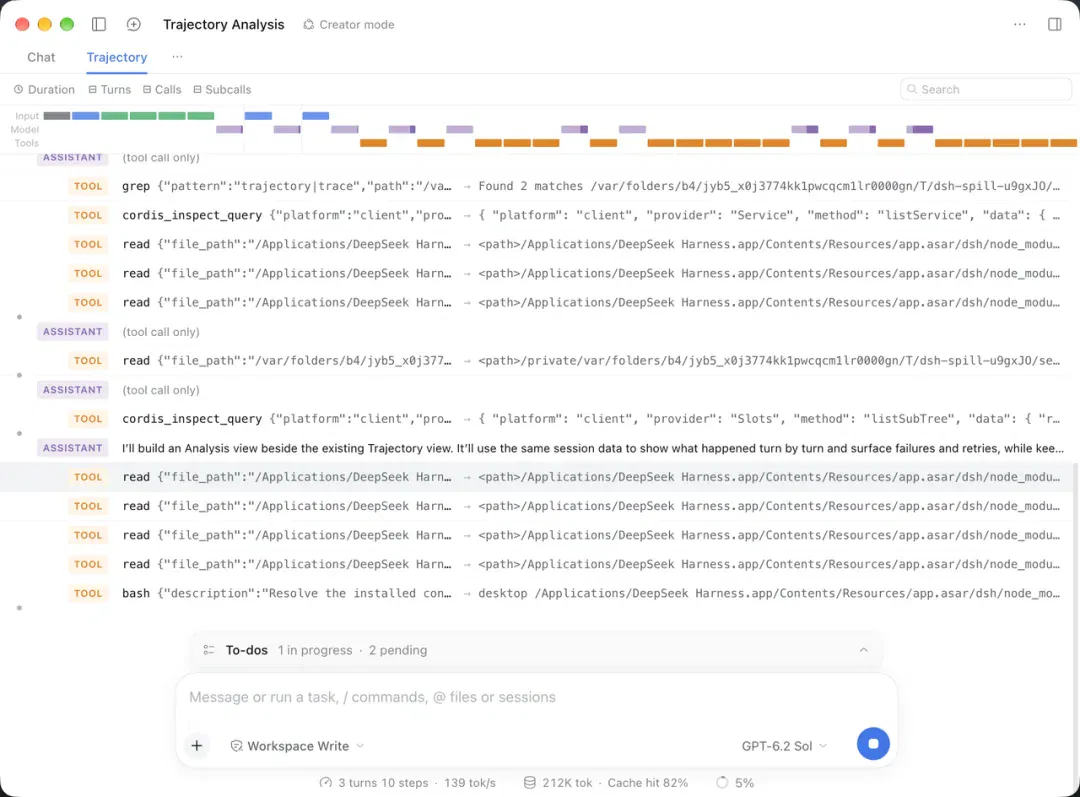
DeepSeek Harness's trajectory-analysis page
3) Make Subjective Judgments in Experiments and Take Responsibility for Them
There are two kinds of problems for which establishing evaluation dimensions is very difficult:
1. In many users' applications, judgments of the results an agent produces are highly subjective.
For example, whether an article is enjoyable to read or a game is fun to play—evaluating such questions is difficult for both model and agent iteration.
2. As agents are newly born technical products, no one is yet sure what services they should provide. Everyone is still asking users how they use agents and what they use them for.
Agent evaluation also needs to assess trajectories, how an agent operates at particular intermediate steps in a task, and many other things not directly related to user needs, making precise standards even harder to find.
In the previous section, we said our work resembles an empirical discipline. One important working mindset in such disciplines is to dare to make subjective judgments: do not get too caught up in deduction and reasoning; make a judgment directly, then conduct experiments and observations.
Every principle and regularity begins as a "subjective definition." An "objective standard" is a "subjective definition" formed over a long period.
Agents are young both as a technology and as a product form. Many definitions have not been tested through extensive use, making consensus difficult, and it is hard to find entirely trustworthy evidence when reasoning about whether a design is reasonable.
We therefore need to accept making some subjective judgments ourselves and take responsibility for them.
Suppose a developer believes their agent should exhibit a particular product characteristic but cannot use existing evidence to establish whether it will actually be good in users' hands.
There is no need to keep searching for evidence; they can simply release it and run an A/B test directly.
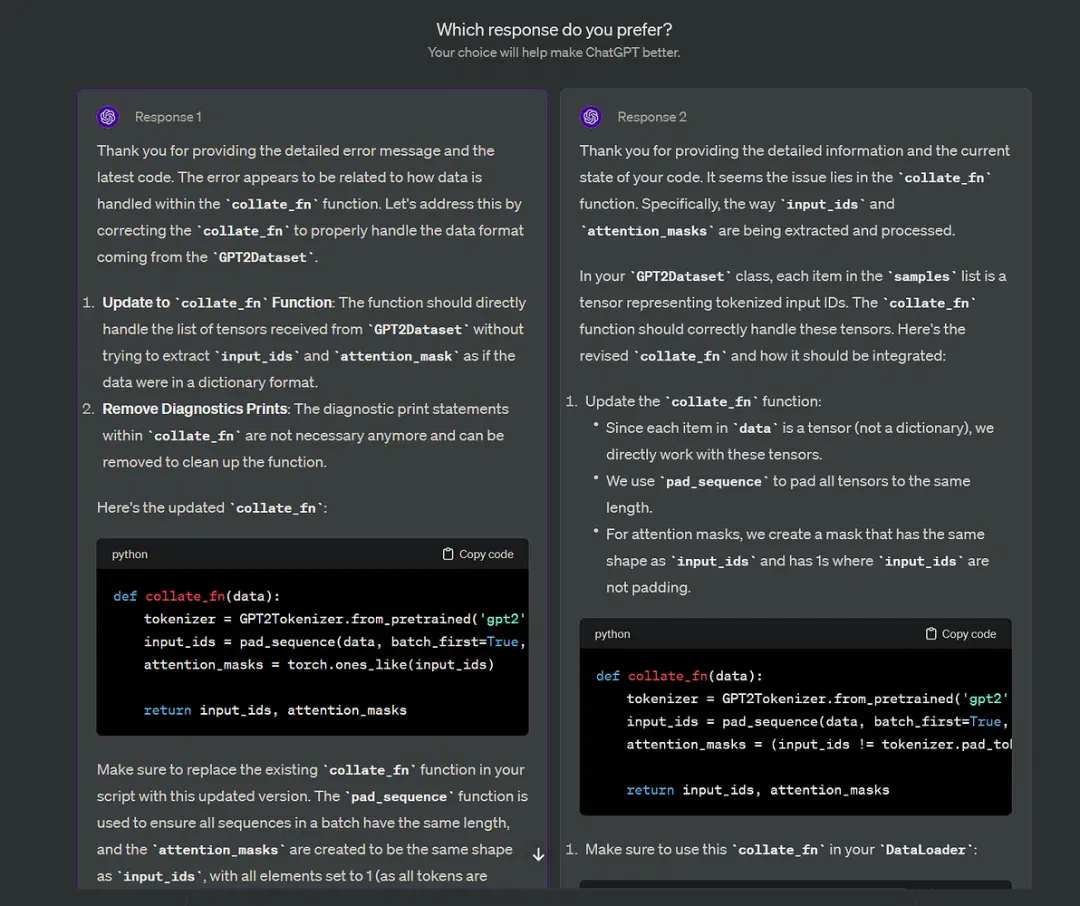
OpenAI Developer Community: https://community.openai.com/t/incorrect-use-of-ui-ux-when-choosing-which-response-do-you-prefer/596139
At the same time, during exploration, evaluation can serve as a central means of describing one's understanding of the product and overall architecture.
As the core maintainer of a harness, you should understand as fully as possible how your system runs and what behavior it will show under particular conditions—evaluations make these behaviors concrete.
4) Tasks Strongly Connected to the Real World
Tasks closely tied to the real world need two evaluation mechanisms:
1. Create snapshots of time-sensitive information to run regression tests for a clearly defined capability we want to achieve.
2. Run tasks directly against the real world, drawing inspiration for iteration and establishing evaluation dimensions from them.
For example, if I ask an agent to retrieve daily international political news, it finds different things every day, so I cannot fix the search environment in place.
Evaluating these tasks presents two problems: completion cannot be checked in the conventional sense, and the process is unstable, as search results may differ every day.
There are two approaches to evaluating such problems. The first is to build Internet Archive + Search infrastructure to evaluate basic search capabilities.
The second is to account for the environment's dynamism when designing tasks, then run them daily with the aim of exposing problems, making it easier to find evaluation dimensions.
For example, ask an agent to collect 50 major international news events, then use scripts or APIs to fetch that day's news lists from 100 news websites.
Combine these two datasets to define evaluation dimensions:
1. Check how many of the 50 major international events appeared on how many news sites, which can demonstrate the accuracy or authority of what it collected.
2. Check how many did not appear on the news sites, representing its ability to dig up unofficial information;
Such evaluations can be considered for routine daily runs to facilitate observation, expose problems and find inspiration for iteration. In fact, a large number of tasks actually initiated by users depend on time-sensitive real-world information.
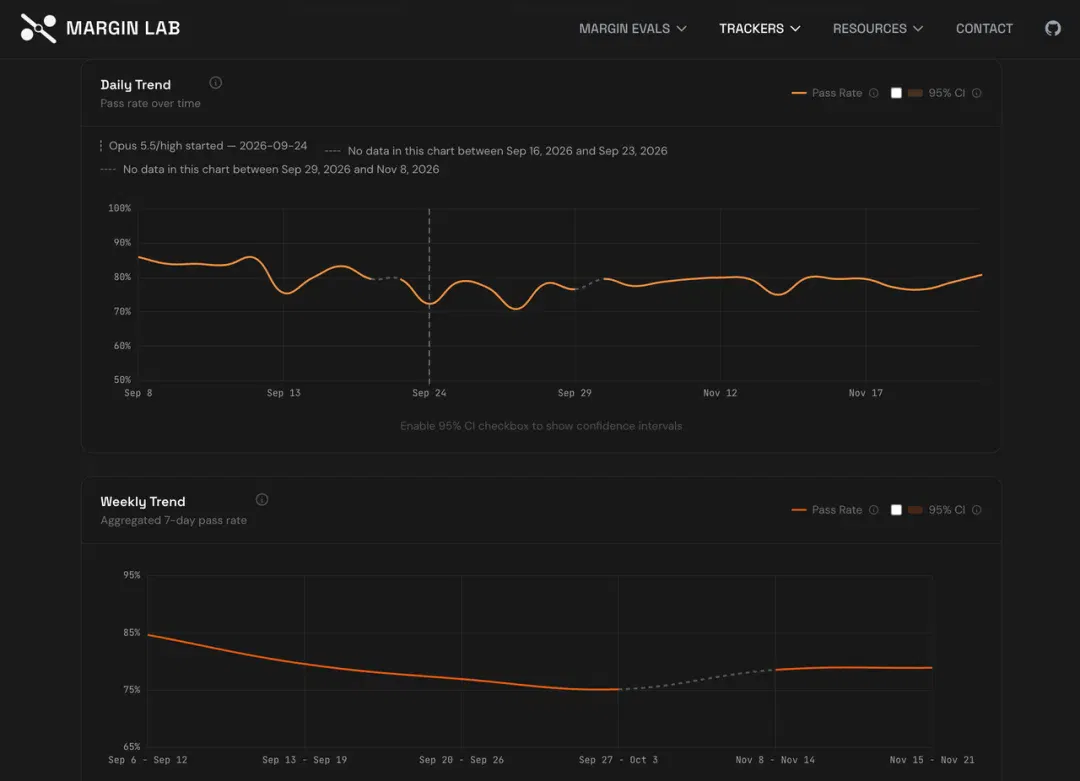
MarginLab's degradation evals for Opus 5.5 in Claude Code: this evaluation system selects several tasks from an open-source benchmark and checks the daily pass rate when using Opus 5.5 in Claude Code to complete them, observing degradation in Claude Code's Opus 5.5. https://marginlab.ai/trackers/claude-code/
04
On Agent System Evaluation and Harness Iteration
4.1 Will Model Capabilities Absorb the Harness?
When a model is not capable enough, should engineering first cover part of the gap?
Many agent developers have debated this question for a long time.
My personal view is:
1. People's technical understanding will not differ too much, but on one hand, products always have to solve the last-mile problem and deliver definite value.
On the other hand, many business decisions cannot wait. If we rely on model iteration to improve an agent—whether waiting for frontier-model updates or doing our own post-training based on requirements—the iteration cycle is too long.
An engineering (harness) change can complete the entire cycle from defining the problem, through making the change, to release and validation in just a few hours at the fastest. If models really do improve enough, deleting it will not hurt; we could even sell that work to a model provider.
2. Much of harness work consists of understanding model capabilities and drawing them out.
Abstract words such as "intelligence" and "aesthetics" have actually misled many people's understanding of models. Many model behaviors emerge after targeted training and are not entirely unpredictable.
For example, Claude models have been trained on large amounts of design-style data. Developers' harness-engineering work should examine how to prompt the model so that it exhibits those behaviors too.
Even if models improve, a harness will certainly never become a matter of shouting "Do not stop until you finish" or "Make this page look good" at a model and having it reliably meet a vague expectation.
3. Much harness work progresses and evolves together with model training. Many features of current harness engineering, such as inspecting trajectories, correcting errors, verifying and delivering, align with or extend the training-data distribution of the Agentic RL stage.
Harness work also encourages models to continue training on data accumulated through harness use.
4.2 Can We Simply Copy a Harness?
In the narrowest sense, a harness makes the agent loop run and terminate correctly, adding capabilities such as loading skills and extending tools.
This is not much work, and building one is not particularly difficult.
Directly wrapping Pi, Claude or OpenAI's Agent SDK, or even copying an agent that already runs reasonably well and heavily modifying it, is not difficult.
But when real business use starts, users send all kinds of feedback, and everyone has different requirements for the agent's behavior. After copying it, you need to understand what is inside, know how to change it, and have evaluations. You cannot copy it and never change anything.
So copying an agent framework does not solve the problem.
This work is like product development: get it running first. Many improvements cannot be dreamed up on a whim.
The only solution I currently see is an exceptionally capable person who understands models, deploying models and products, has a very strong sense of responsibility, and takes overall ownership with a mindset of enjoying the exploration of unknown territory.
Building an agent does not require much code or prompt text, but almost every character in this engineering project can be said to be coupled with every other. The demands on engineers' responsibility and thinking about global optima overwhelm team divisions of labor that are not pursuing the utmost. (Muqiu recommends reading this sentence twice.)
Unsurprisingly, few teams currently do this well. The difficulty is not about headcount or money; it is a great task of exploring the unknown for human progress!
05
A Few Final Musings
5.1 The Great Proliferation of Model Terminology
We have spent a lot of time discussing evaluation as an independent concept. Social media now constantly produces other standalone concepts: Prompt Engineer, Context Engineer, Harness Engineering, and all kinds of novel terms...
I think these terms do represent distinct ideas, but they also overlap enormously.
Creating concepts means creating levels of abstraction. Good abstractions can reduce collaboration costs, so coining terms is not a bad thing; it is a necessary process for raising productivity. Otherwise, programmers would probably still be writing assembly language.
The downside is that when the market overheats, practitioners rush to coin terms and compete for the power to shape the discourse. Most concepts they create completely lack the basic elements a good abstraction layer should have.
Even what a skill, agent or harness actually is cannot be clearly explained, leaving conscientious users and practitioners equally confused when they encounter them.
What was supposed to benefit everyone ends up doing nothing but giving bosses FOMO, after which the bosses put their subordinates through the wringer.
Whether we call it evaluation, harness engineering or something else, all work around models must remember its core purpose: making AI produce results that meet our own design objectives.
5.2 Evaluation from the User's Perspective
Beyond professional evaluation design, another topic I consider especially important is evaluation from the user's perspective.
There are two questions here: how users understand a model or a harness's capabilities and the reasons for particular tendencies, and how users interpret different evaluation scores.
The evaluations widely circulated today have obvious problems.
Most people—not only users, but even professionals—do not have time to test a model's performance specifically, so the demonstrations of model capabilities they encounter vary enormously in quality.
The benchmarks people commonly encounter today fall mainly into two categories.
The first is professional benchmarks. Models run them on release, and accompanying papers are available.
Many metrics were defined when they were established, with arguments offered to justify them and continuous community feedback providing evidence from some perspectives that they are relatively fair.
But they are also difficult for the audience to understand. Terminal-Bench and SWE, for example, are popular and widely used for evaluation, so audiences think they are fair because so many people use them.
Yet people have little understanding of the tasks and content inside them.
In the end, many people look only at a professional benchmark's score or a few parameters, such as pass rate and time taken, overlooking token efficiency in the process.
More importantly, they overlook the evaluation dimensions.
Something whose fairness can be supported by understanding it from multiple angles becomes distorted when taken out of context.
If evaluation dimensions are ignored and understanding of a model remains at an abstract level of good or bad, the benchmark does not have much meaning.
If an audience cannot fully understand a relatively fair benchmark, much of its value is reduced, and it may even mislead.
The second category is all the capability demonstrations on social media, where you cannot even tell whether they were one-shot results.
Many more discerning viewers question them. For example, with many Opus 5.5 videos shown on social media, trying to make one yourself reveals that the results are nothing particularly special.
Social media also repackages professional benchmarks for secondary circulation—for example, screenshots of a "kill line" that can very easily distort people's understanding of model capabilities:
If a model has been trained and optimized only for some task areas in an evaluation set that are easy to complete and require few steps, it will naturally end up above that line.
But this only means it performs well on a small subset of tasks, not that it offers good value for money, as many proponents of the kill-line theory claim.
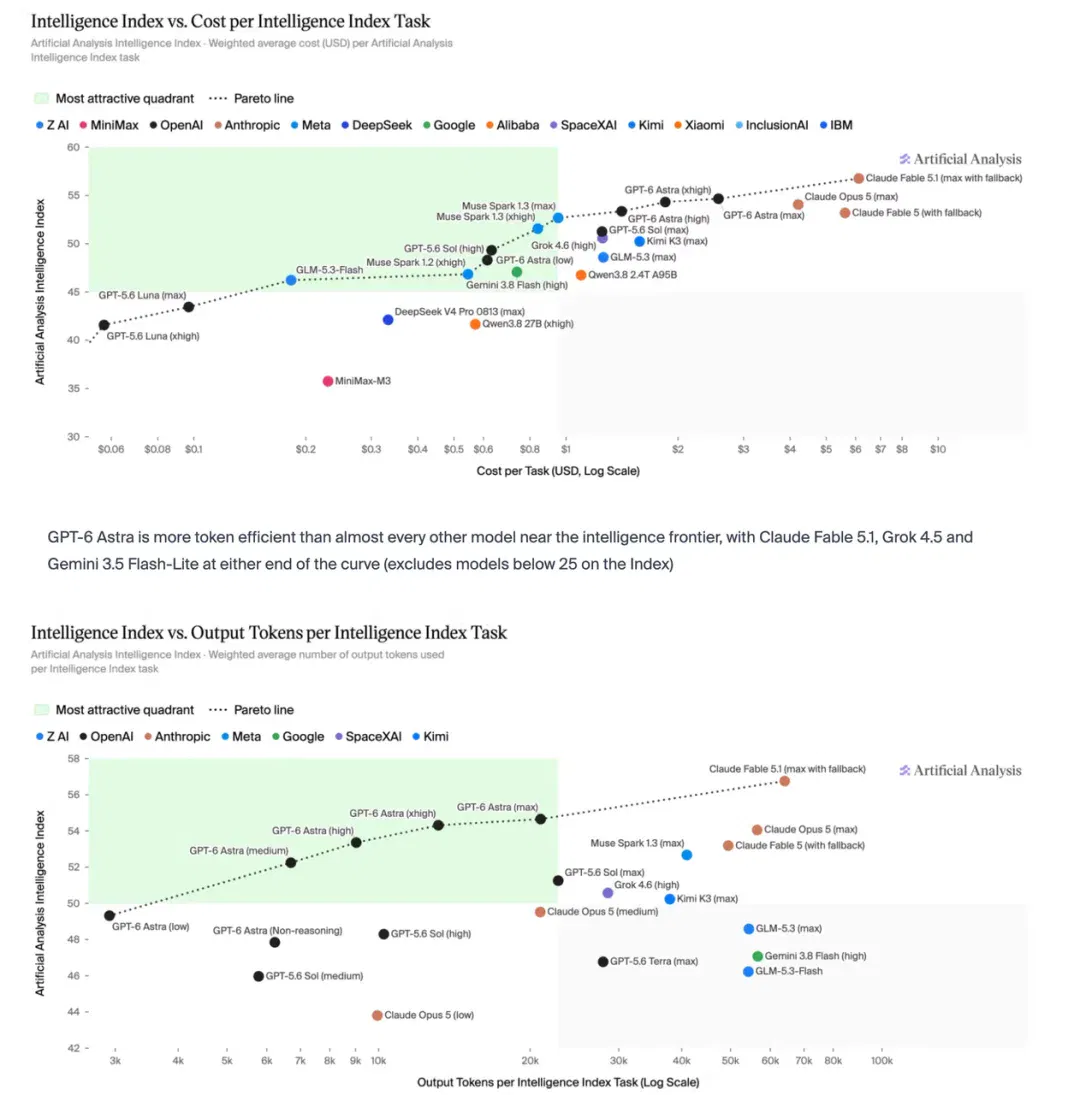
In a blog post, Artificial Analysis plotted completion-rate/token-consumption-per-task scatter charts for multiple benchmarks. Different charts show which models offer the best value at a given price in different domains. Some people circulating them crop out just one chart and directly call it a model kill line. Image source: https://artificialanalysis.ai/articles/artificial-analysis-intelligence-index-v4-2
This kind of circulation overemphasizes completion rates and per-task costs while ignoring every other factor. It further distorts how ordinary people understand the capabilities assessed by professional benchmarks.
Recently, I have also been thinking about how to let users perceive differences in model capabilities and tendencies more directly, rather than putting a score in front of the public and leaving everyone to guess.
This work is still in progress. I may share its design in the next article.
(This article's cover was generated by ChatGPT; the writing is entirely human.)
This article comes from "Zang AI," written by "Qingqing Shuangshuang Di Wan Yaogun."
Related topics
After reading
Join the AINRK community
Read how to join the community and connect with people working in AI.
Related articles
Continue reading related topics and articles in this category.

Doubao Work Adds 21 Professional Workbenches: Four Task Trials and Human Review Limits (opens in a new tab)
QbitAI tries Doubao Work's new workbenches for finance, design, medicine and teaching. They produce useful drafts but sometimes miss instructions. The author's 80/100 is subjective; facts, medical information and final deliverables still need professional review.

Linq Raises $90 Million Led by a16z to Expand Agent Communications and Execution (opens in a new tab)
Linq announced a $90 million Series B at a $1 billion valuation, expanding from messaging into WhatsApp, HD Calling and computer use. The report explores agents in existing channels while retaining limits around authorization, capabilities and the business model.

Tabbit's 18-month Browser Use review: Coding-first and the tradeoffs of prioritizing Playwright (opens in a new tab)
The Tabbit team reviews its shift from screenshots, DOM and stepwise clicks to Coding-first tasks with Playwright, retaining visual and CDP fallbacks. It discusses a 25-task internal benchmark, local Jev decisions and WebMCP; results are specific to the tested models, hosts and samples.

Agents Are Shifting the Gateway to Corporate Spending. Meituan Wants the Next Order (opens in a new tab)
Meituan Enterprise and AsiaInfo have connected two agents from travel request to booking. The platform is exploring how enterprise workflows can call spending services directly, while its general manager Kai Kang sees agent interconnection as a major variable over the next three years.

Poppy and ChatGPT Wallet Advance Agent Access and Payments (opens in a new tab)
Sierra and Meta's personal agent protocol addresses access, while OpenAI's checkout flow requires user payment confirmation. Public information has not established whether the two systems interoperate.