Poppy and ChatGPT Wallet Advance Agent Access and Payments
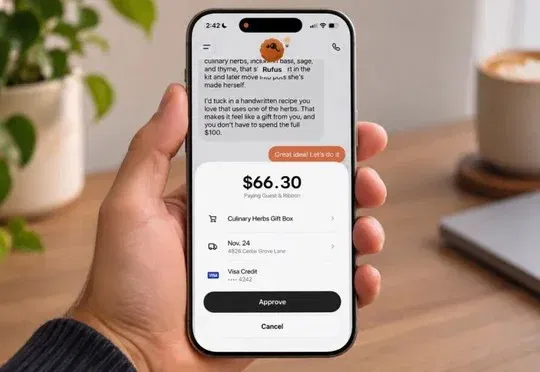
Sierra and Meta's personal agent protocol addresses access, while OpenAI's checkout flow requires user payment confirmation. Public information has not established whether the two systems interoperate.
Editorial correction (November 16, 2026): The two announcements do not mean that the two systems already interoperate; Poppy's scope of authorization and Wallet's confirmation of each individual payment must not be conflated as the same mechanism.
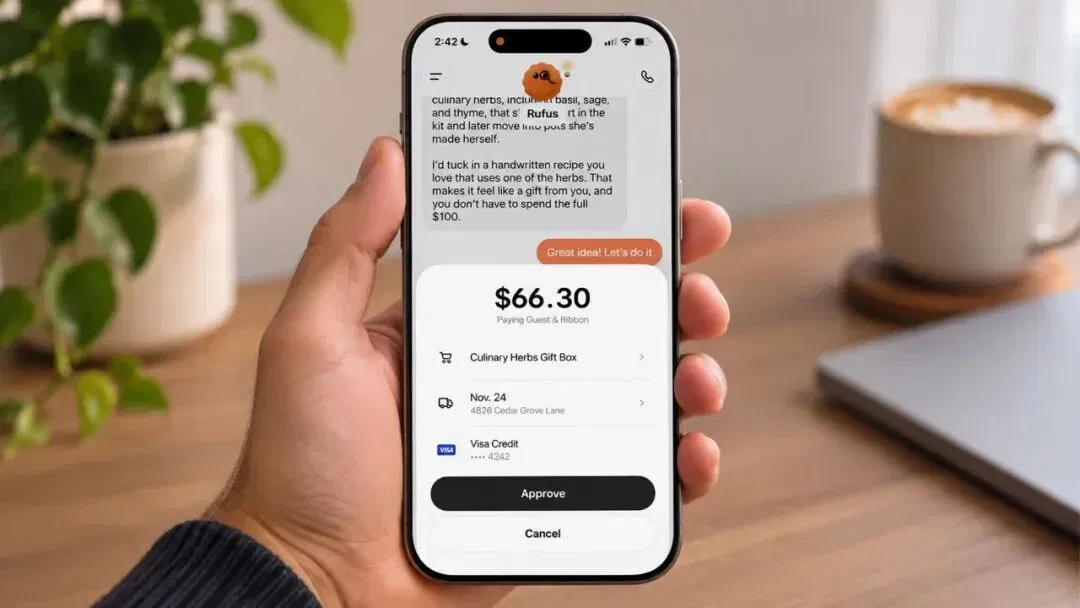
Agents can now get in, and they can pay, too.
The era of agents spending on users' behalf has finally arrived.
On November 13, 2026, US time, two companies held two launches on the same day. On one side, enterprise conversational-agent company Sierra joined Meta to officially release the Personal Agent Protocol, Poppy v1.0, addressing how assistants can "get in"; on the other, OpenAI launched ChatGPT Wallet for its personal assistants, dots, addressing how assistants can "pay".
Opening up access and checkout on the same day is intriguing in itself. What is even more worth noting is the same set of names behind the two approaches. Visa and Mastercard appear on both lists, while companies that oversee e-commerce and payment infrastructure, such as Shopify and Stripe, are among Poppy's core partners.
On the surface, the next round of competition in agents is a contest among giants for entry points. Beneath it, however, is a less visible race to secure early positions in commercial channels.
A personal agent protocol: PPP

Sierra and Meta jointly release the Personal Agent Protocol, Poppy v1.0 | Image source: Sierra's official blog
Previously, personal assistants visiting business websites could only act like invisible visitors. Merchants could not clearly tell who had arrived, and were even less willing to entrust them with sensitive operations such as checking orders, changing addresses, booking flights or financial pre-screening.
The core problem the Poppy protocol from Meta and Sierra aims to solve is trust, allowing businesses, when they receive a request, to cryptographically verify three things: which assistant is knocking, which user it represents, and exactly how much authority it has been granted.
The core of the Poppy protocol consists of a 'door sign,' a 'foundation' and 'two-way authorization.'
'Door sign'. Businesses integrating Poppy put a configuration file at the standard website path /.well-known/poppy. You can think of it as a visitor guide posted at the entrance of a shop, setting out which communication endpoints are open, how to log in, and which operations are allowed. When an assistant comes calling, it no longer has to guess how to click webpage buttons: it can first read the sign and follow the rules.
'Foundation'. Poppy does not overturn the internet's existing communication methods; it is built directly on OAuth authorization, HTTPS encrypted transport, OpenAPI and the Model Context Protocol. If a user only wants to check a product's price, the assistant can interact as an anonymous visitor. Once account operations are involved, however, it must go through authorization and login so the business can verify its identity.
'Two-way authorization'. On the user side, people can decide whether to grant the assistant read-only access or allow it to modify information and conduct transactions. On the business side, companies set how far an external assistant can go on their own territory. An interaction is valid only when both sides agree.
According to the launch information, Sierra and Meta are highly complementary in jointly advancing this protocol. Sierra, founded by former Salesforce co-CEO Bret Taylor and former Google executive Clay Bavor, primarily helps businesses build their own customer-service agents, naturally placing it on the "host" side. Meta's personal assistant Muse is a typical "visitor" that needs to knock on the doors of countless websites. The host and visitor each contributed their half to bring this standard into use. When Muse visits participating sites, it already defaults to looking for and invoking the Poppy protocol first.
The most feared obstacle for an open protocol is the chicken-and-egg problem of a cold start. This time, the company that really helped Poppy cross that threshold was the e-commerce infrastructure giant Shopify.
When the protocol was released, Shopify automatically enabled and generated Poppy discovery files for every one of its merchants across more than 175 countries worldwide, without requiring any manual configuration by merchants. In addition, its more than 100 design partners include representatives of different industries such as Delta Air Lines, 1Password, Okta and Cloudflare. This access-control system therefore achieved considerable coverage on its first day.
Agents that never touch cash
With access addressed, the next hurdle is payment.
Most people's instinctive reaction to letting an agent open their wallet for them is resistance. OpenAI's ChatGPT Wallet has a very clear starting point for its design: let the agent bring a transaction all the way to completion without ever touching actual financial information at any point.
In an actual shopping flow, users can ask their dot to search for products, compare prices, add items to a cart and prepare the checkout page. But when the process reaches payment, the dot must stop and return the decision to a human. After personally checking the item list, total amount and selected bank card, users must authorize the transaction through biometrics such as facial recognition or a fingerprint scan before it can proceed.
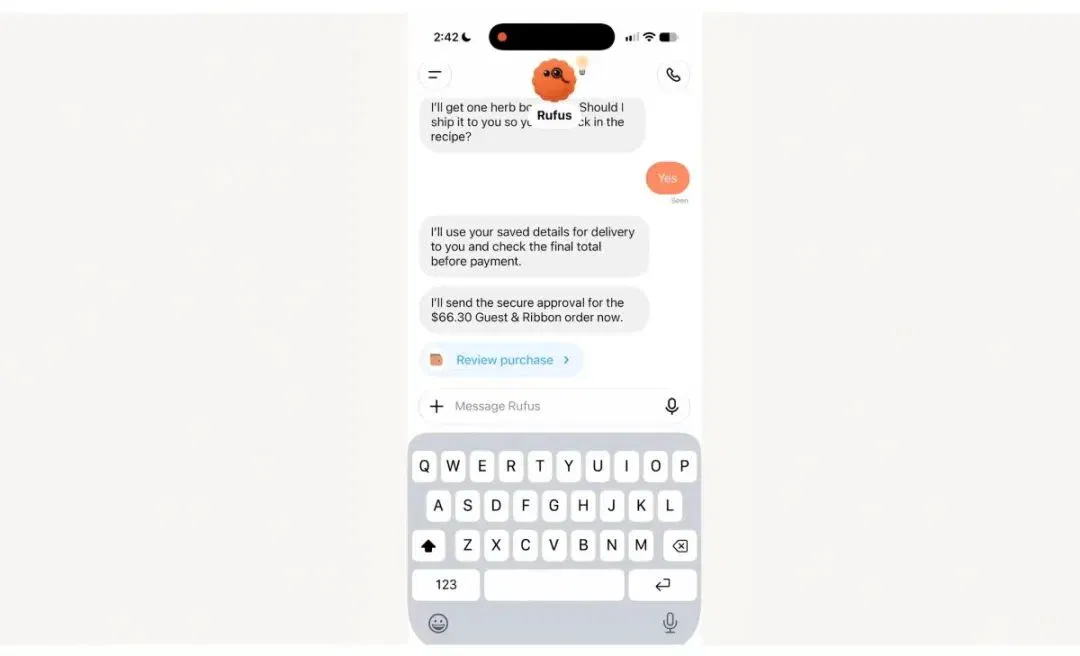
OpenAI personal assistant dot (Rufus) initiates a "Review purchase" checkout confirmation in the conversation | Image source: OpenAI
An even more important security design is hidden in the backend. Neither the dot running the errand nor the merchant collecting the money ever sees your actual credit-card number at any point in the transaction. After the user authorizes it, the partner card network generates a one-time payment credential containing a temporary card number, security code and expiration date. The merchant receives only this temporary information; your actual card number is never exposed.
To implement this mechanism, OpenAI brought in American Express, Mastercard and Visa to develop it jointly, fully retaining existing credit-card points, benefits and chargeback protections. At launch, OpenAI also explicitly drew a boundary, emphasizing that ChatGPT Wallet is not a crypto wallet, does not use blockchain or stablecoin payments, and runs entirely on traditional fiat-currency banking and card-network infrastructure.
Based on public information, each party's commercial motives are clear. For OpenAI, if personal assistants only give advice and hand out links, they will remain at the shopping-advice stage forever. Keeping the entire checkout process within the conversational ecosystem lets dots move from advisers to agents that close purchases. For traditional card networks, once agents become a new entry point for spending, none wants new payment networks to siphon off transaction traffic. Through this partnership, the three major card networks naturally connect the new channel back to their own clearing networks.
Even so, OpenAI's first step remains quite restrained.
Initially, ChatGPT Wallet is available on a limited basis only to ChatGPT Pro subscribers in the United States aged 18 or older. It supports eligible US-issued bank cards, including Amex, Visa, Mastercard and cards issued by Chase. Based on public information, starting with paid subscribers is most likely intended to take a more cautious approach to risk control.
When giants join forces
Putting these two news items side by side reveals a very interesting picture of overlap.
Shopify, Stripe, PayPal, Visa and Mastercard all appear on Poppy's initial list of core partners. Turn to ChatGPT Wallet, and the companies supporting its development are again Amex, Visa and Mastercard. Only Visa and Mastercard truly straddle both sides: they appear on Poppy's list and are also Wallet development partners.
An even more intriguing detail is that OpenAI's own name also appears prominently among Poppy's more than 100 design partners.
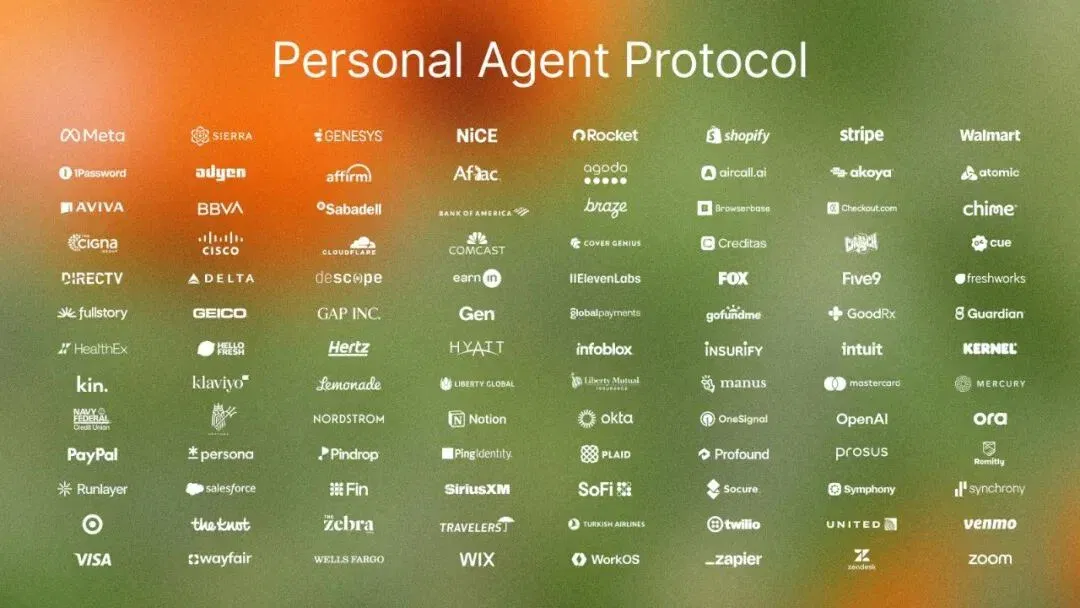
The Personal Agent Protocol's initial group of more than 100 design partners includes OpenAI, Visa and Mastercard | Image source: Sierra
In the consumer market, Meta's Muse and OpenAI's dots are direct competitors, each fighting to become the first entry point users open every day. But at the enterprise-access layer, the two giants have sat down at the same conference table, ready to share the same access card. The reason is not hard to understand: airlines or retailers are unlikely to want to maintain a separate, incompatible interface for every model provider. On the consumer side, each can use its own strengths to compete for the entry point; on the business side, they must build a common pass together.
There is also a signal in the technical approach. Automated transactions between agents were once seen by many as a potential use case for stablecoins. But in this round of deployments, existing financial and e-commerce infrastructure has chosen an incremental route of "standard authorization protocols plus one-time virtual-card credentials", temporarily setting crypto approaches aside. First connecting to mature risk-control and clearing rails to get transactions running is the most convenient route for the traditional commercial system.
Of course, one question remains open in the public information.
Poppy and ChatGPT Wallet have not yet explained whether they already connect to each other. In the future, when a user's dot enters a Shopify store with Poppy enabled, whether it can complete the handshake smoothly and then pay with Wallet still needs to be verified.
Agent autonomy stops at the shopping cart
Looking at Poppy's two-way authorization together with ChatGPT Wallet's mandatory biometrics makes the industry's common boundary clear: Human in the loop.
Poppy limits executable operations through user and business authorization, while Wallet requires users to confirm payment within its checkout flow. This does not mean every data read or order modification uniformly stops at the same 'shopping cart' confirmation step; the specific permissions depend on the protocol and the merchant's implementation.
Authorization and payment confirmation can reduce risk, but cannot guarantee that agent judgments, transaction intent and subsequent disputes are all safe and error-free. There are still questions awaiting verification.
For example, liability for transactions remains a gray area. If the assistant misunderstands your intent when selecting products, or is induced by hidden malicious prompts on a webpage to place an order, then even if you scan your face at the end, public information has not defined whether the bank's existing chargeback protection covers disputes arising from the assistant's mistakes.
Limits on coverage and barriers to participating in transactions under the protocol remain. Shopify has brought in huge numbers of merchants, but when will the internet's countless long-tail websites put up their own Poppy door signs? Meanwhile, ChatGPT Wallet is currently available only to Pro subscribers in the United States. How long other markets and ordinary users will have to wait remains unknown.
Mandatory biometrics for every transaction certainly maximizes the feeling of security. But imagine a future in which you are used to asking your assistant to order coffee and buy everyday necessities each day. If every little thing requires taking out your phone and scanning your face, the convenience promised by fully automated agents instead becomes a new source of friction in high-frequency scenarios.
At the present stage, when assistants are still imperfect and social trust has yet to be established, keeping the final power to click "Confirm" firmly in human hands may be the price the industry must pay to gain admission, and also determines the pace of personal-assistant commercialization.
The next time you ask an AI assistant to change a delivery address and settle a bill while it is at it, it will finally no longer be turned away as a web crawler. It will show a compliant identity to enter the shop, read the door sign, fill the shopping cart, and then stop at the checkout page, presenting the phone to you and waiting for you to face the camera.
Today's face scan is the final threshold before people place their trust in assistants. But when a day comes when everyone is used to handing everyday spending over to programs running errands for them, will this confirmation become a formality that people dismiss with a casual tap? Just like the authorization agreements that all websites and apps ask you to sign, which almost nobody truly understands or is willing to read carefully.
*Header image source: Shopifreak
This article comes from the WeChat public account GeekPark and was written by GeekPark.
Related topics
After reading
Join the AINRK community
Read how to join the community and connect with people working in AI.
Related articles
Continue reading related topics and articles in this category.

AFK AI 的 Comma 用常驻路由器协调多个智能体 (opens in a new tab)
文章介绍 Comma 将主对话与任务执行分离,并记录通过 Linear 交接任务、并行制作原型的案例。长期记忆和跨端权限取决于具体配置。
冯若航谈 Super-agent:路由之外,怎样管理工作上下文 (opens in a new tab)
作者以 DeepSeek 的 Router 与 Worker 原型为起点,讨论如何按项目显式划分权限、在群聊中协作,并以数据库和文档保存任务、决策和长期记忆。文中同时说明完整方案仍属设想。
LobeHub 用 Agent 组织研发:自动开发与人工验收如何衔接 (opens in a new tab)
开源Agent协作平台LobeHub已让主管Agent协调Claude Code、Codex等自主开发与审查,并由Acceptance生成验收报告,人类仍负责审批和最终判断,系统尚无法完全无人值守。
ForgeKernel 开源,以自动迭代优化 GPU 与昇腾算子 (opens in a new tab)
ForgeKernel 通过架构里程碑、硬件经验积累和实测反馈生成优化算子。团队展示了在 B200 上从数学定义出发优化 FlashMLA Prefill 的过程,并介绍昇腾评测与训练框架接入;单个算子的加速幅度不能直接折算为整机性能或全球算力开支节省。
绝杀OpenAI!首个Claude Duet上岗,Opus 5.5 24 小时替你打工 (opens in a new tab)
Anthropic正式宣布上线由Opus 5.5驱动的主动式智能体Claude Duet,面向美国Pro和Max用户开放候补,可在云端持续监控并推进工作流,发消息、付款、签文件和删除内容仍需用户批准。