Levent Alpöge and Claude's Riemann Hypothesis collaboration: Mathematics and formal verification
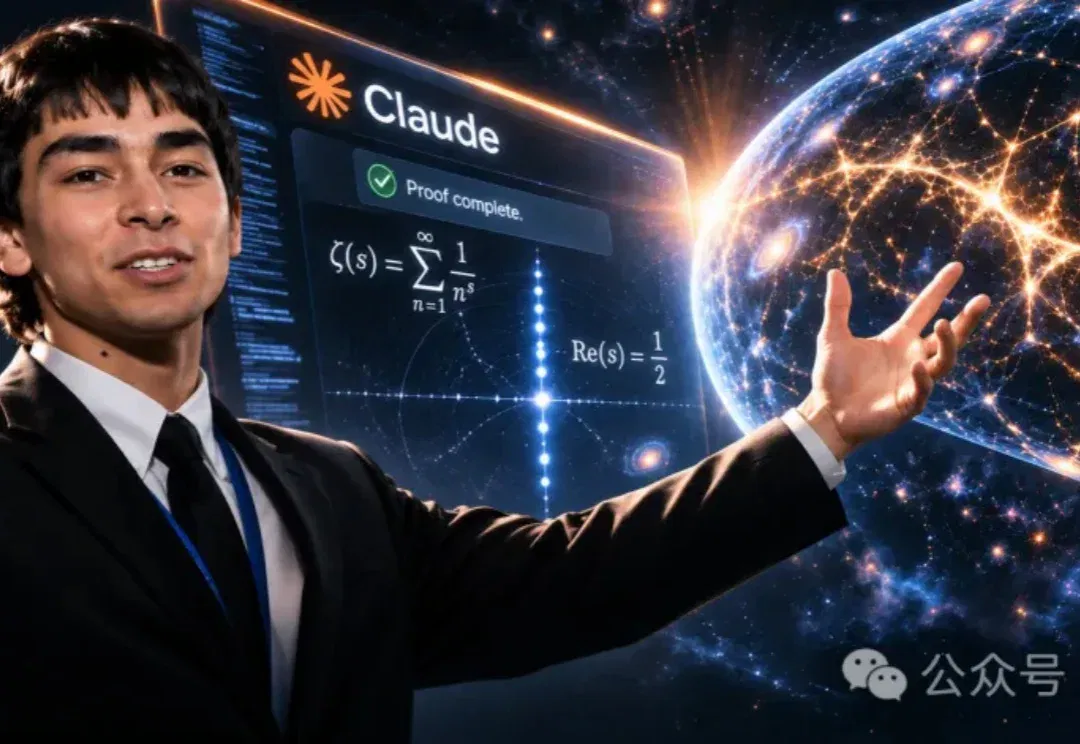
An account of Alpöge's number-theory training and six-week collaboration with Claude. Lean and Mathlib have confirmed the formal proof of the Riemann Hypothesis; understanding, simplification and recognition by the Clay Mathematics Institute are separate matters.
Editor's verification (2026-11-24): The Lean community's verification concerns the correctness of the formal statement and proof; it does not mean the Clay Mathematics Institute has completed its recognition process. The scope of the generalized Riemann Hypothesis discussed here is limited to the verified case of Dirichlet L-functions. Alpöge subsequently clarified that "250,000 pages" was a joke and should not be treated as the actual length of a generated manuscript. Lean community statement (opens in a new tab) | MIT verification records (opens in a new tab) | The author's subsequent response (opens in a new tab)
On November 21, the Lean and Mathlib communities announced that, after independent checks by multiple experts using different tools, they were confident that a mathematical proof comprising 17 million lines of code was entirely correct. Its subject was the Riemann Hypothesis, which had troubled mathematics for 167 years.

The proof had just two authors: Levent Alpöge, an American mathematician born in the 1990s, and Claude, Anthropic's AI model.
Alpöge had released the proof the previous day. He claimed that he and Claude had not only solved the Riemann Hypothesis but extended the result to the generalized Riemann Hypothesis. The mathematics community immediately began checking it and subsequently issued this unusual formal-verification statement.
Of course, even after machine checking, mathematicians still need to understand the ideas involved. The Clay Mathematics Institute has not formally recognized this Millennium Problem as solved either. But at least at the level of formal proof, this time there is a very solid result.
Intriguingly, Alpöge admitted in his statement that, during the final stretch, Claude had moved far ahead of him.
I led us toward the right analogous setting, and then Claude began to amaze me.
Yet just three months earlier, Anthropic had given Claude an almost identical task, letting it explore the Riemann Hypothesis freely.
The model proposed 650 ideas and then organized approximately 60 subagents, but still failed to prove the Riemann Hypothesis.
Later, Alpöge became directly involved, working with Claude for approximately six weeks before finally producing this proof.
Why?
With the same kind of leading AI, some people have it exhaust hundreds of paths, while others know where to direct it.
Alpöge's own explanation may lie in his life story.
He had wanted to solve the Riemann Hypothesis since childhood and had spent more than 20 years preparing.
In 2026, he finally encountered Claude.
1. A teenage coder
Levent Alpöge was born on April 1, 1992, in Dix Hills on Long Island, New York, and holds dual US and Turkish citizenship.
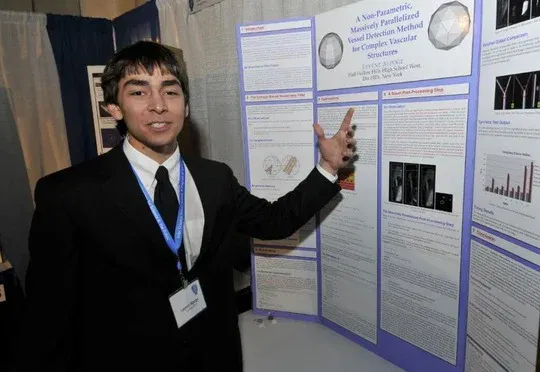
People discussing him today tend to emphasize his mathematical talent. But the earliest research achievement Alpöge could point to as a teenager was in computer science.
In 2010, at just 17, he became a finalist in the Intel Science Talent Search. His project studied blood-vessel detection in medical images.
Doctors want to identify vascular abnormalities early through medical imaging, but accurately detecting vessels in complex images requires substantial computation.
Alpöge thought of graphics cards.
NVIDIA's CUDA technology had only recently appeared, allowing programmers to use graphics processors' parallel computing capabilities for other problems. Its applications were still far less developed than they are today.
Working with researchers at institutions including Yale University, Alpöge incorporated CUDA into vessel-detection algorithms, exploring how ordinary graphics cards could accelerate medical image analysis. By January 2010, the research had become a published technical paper.
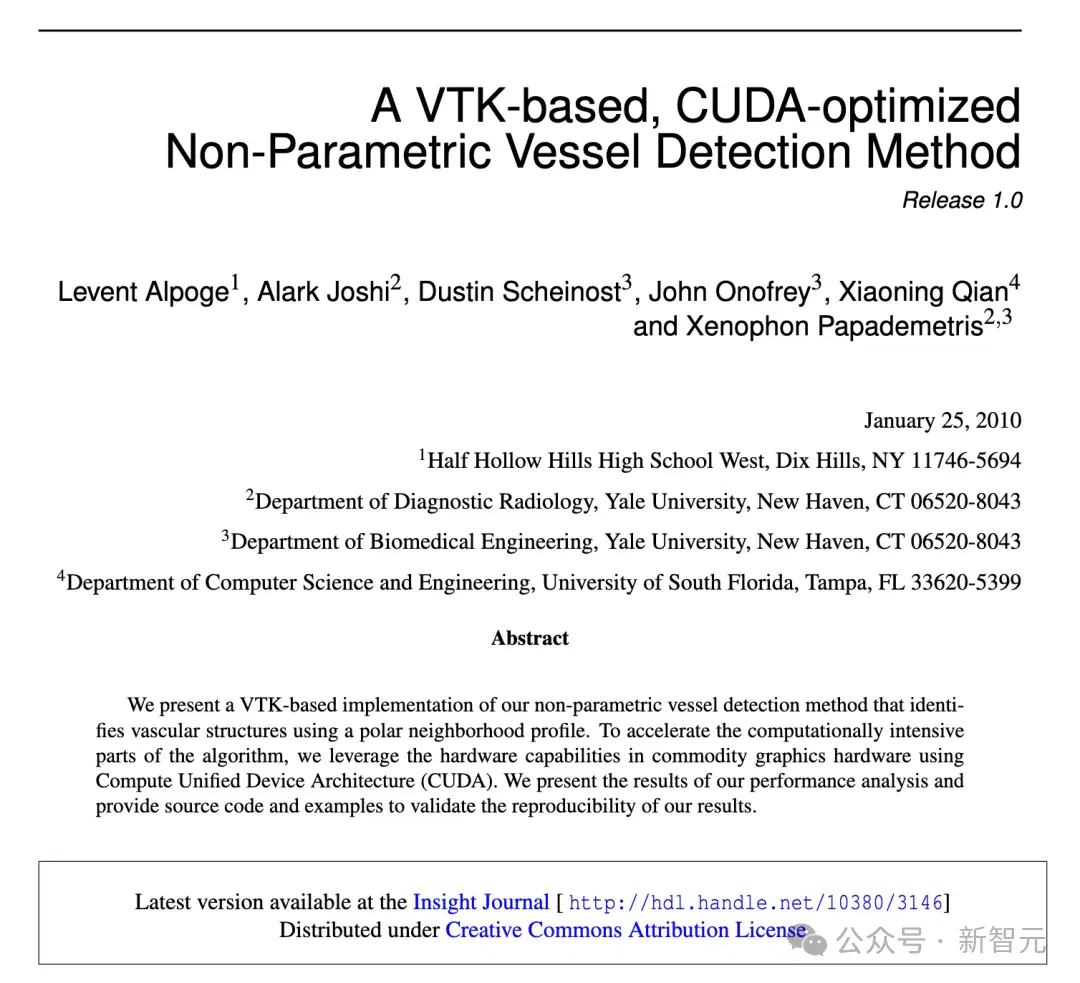
https://www.cs.usfca.edu/~apjoshi/papers/2010-J_Midas_vessel_detection.pdf
A high school student was figuring out how to turn gaming graphics cards into scientific research tools.
His personal website records another early episode.
As a teenager, Alpöge scraped New York Times articles, trying to train a program to imitate economist Paul Krugman's columns.
It failed.
He still keeps this account of failure on his website today, writing lightly and even with a degree of pride.
Later, however, Alpöge realized he seemed better at mathematics, and turned toward it.
That change shaped more than a decade of his subsequent life and temporarily interrupted his connection with computer science.
2. An ambition formed young
Alpöge truly fell in love with number theory at the Ross Mathematics Program at Ohio State University.
Number theory studies integers and the patterns hidden among them. Some of its questions are understandable even to primary school students, yet solving them can consume a mathematician's lifetime.
He later entered Harvard, studying algebraic number theory, analytic number theory, and combinatorics with mathematicians including Benedict Gross, Steven Miller, and Joe Gallian.
Within just a few years, he had encountered several important branches of number theory.
In 2014, Alpöge graduated from Harvard with a bachelor's degree in mathematics and a master's degree in physics. He had a 4.0 undergraduate GPA and graduated with the highest honors.
His thesis on integral points on elliptic curves also received Harvard's award for the best undergraduate thesis. By graduation, he had completed seven papers independently or with collaborators.
In 2015, he received the Morgan Prize, an important US award for undergraduate mathematical research.
At the award ceremony, however, he said something interesting.
Alpöge gave special thanks to Joe Gallian, who had encouraged him to approach professors and ask about a thesis topic.
Without that encouragement, Alpöge admitted, he would have felt he was not qualified to make such a request.
Talent in a young person is, of course, a good thing. But his acceptance speech reveals something else.
He knows what he learned from whom, and is willing to admit what he once did not know.
That same year, Alpöge entered Princeton University for a PhD in mathematics, studying with Manjul Bhargava, who had recently won a Fields Medal.
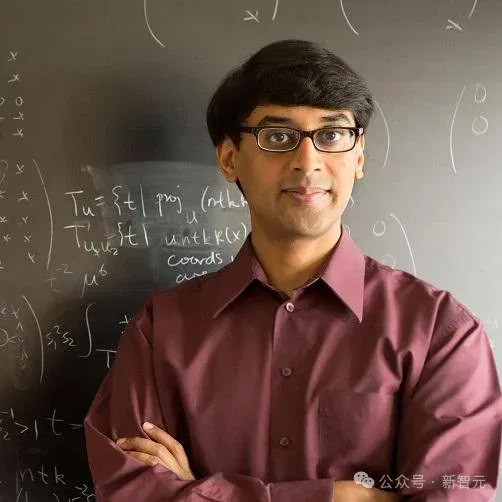
Manjul Bhargava
He continued working on arithmetic geometry, elliptic curves, and Diophantine equations. An important result published in 2025 with Bhargava, Wei Ho, and Ari Shnidman resolved the extension of Hilbert's tenth problem to rings of integers of number fields.
By then, Alpöge was already a number theorist with major achievements.
But it was only in November 2026 that people learned from his own writing that, since his student days, he had been harboring a grand plan.
The Riemann Hypothesis.
He wanted to spend decades solving it.
In 1859, German mathematician Bernhard Riemann proposed the hypothesis: all nontrivial zeros of the Riemann ζ function have real part 1/2.
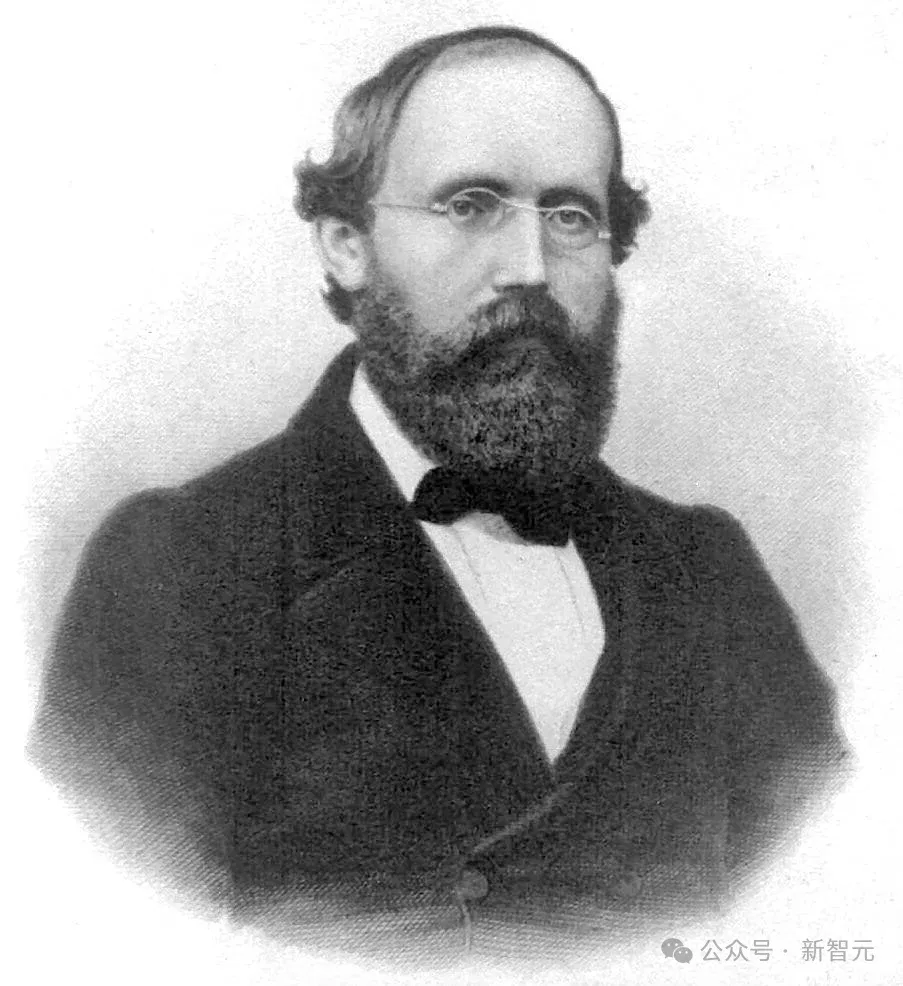
Riemann
This concerns the fine structure of the distribution of prime numbers. Using the Riemann ζ function, mathematicians can study that distribution with great precision. If the Riemann Hypothesis is true, many estimates that depend on it gain a firm foundation.
Over the following century and more, countless mathematicians studied it.
Alpöge decided early that he wanted to try too.
In his latest statement, he admitted that, as a student, he had secretly planned to study the Riemann Hypothesis for decades. He therefore worked to familiarize himself with a wide range of mathematical tools, hoping that when he eventually confronted the problem, he would recognize what might be useful.
The problem was so difficult that nobody could know in advance which approach would ultimately help. He studied algebraic number theory, analytic number theory, and arithmetic geometry, as well as elliptic curves and Diophantine equations.
All this knowledge might be useful one day.
By 2026, he had spent more than 20 years preparing for the Riemann Hypothesis.
3. Becoming a student again
GPT-4 appeared in 2023.
On his personal website, Alpöge recalls immediately thinking it was the most interesting thing humanity had ever created.
He decided to return to computer science.
He later joined Anthropic to conduct AI research.
A mathematician who had already made important contributions to number theory began learning new research tools again.
In July 2026, he announced a counterexample to the Jacobian conjecture developed with Claude Fable, crediting Claude with important construction work.
Clearly, he had begun adapting to a new way of working.
AI can try many directions continuously, write programs to check counterexamples, consult relevant knowledge, and submit derivations to a formal proof system for verification.
Yet these powerful capabilities do not currently produce major results automatically.
In August 2026, Anthropic conducted an interesting experiment.
Employee Jarred Sumner tasked Claude with making a serious attempt to prove the Riemann Hypothesis.
Sumner was not a mathematician. He mainly encouraged the model to keep exploring, leaving the specific mathematical choices to Claude.
Claude first proposed 650 ideas, without success.
It then coordinated approximately 60 subagents, executed 2,400 shell commands, wrote hundreds of Python programs, and searched through dozens of mathematics papers.
The experiment produced approximately 31 million tokens of output.
In the end, Claude still did not solve the Riemann Hypothesis, but made an important advance: it raised the known provable lower bound on the proportion of zeros on the critical line from 41.6% to 67.2%.
Alpöge and another Anthropic mathematician, Ralph Furman, helped review the result.
The experiment illustrates the issue well.
Claude already had considerable mathematical research ability. It could propose ideas autonomously and explore dozens of paths in depth. But the route it chose at the time ultimately only advanced a related problem part of the way.
A few months later, Alpöge personally guided Claude in studying the Riemann Hypothesis. The outcome was very different.
Of course, this change cannot simply be credited to Alpöge alone. Models keep improving, research tools are being updated, and the time and resources devoted to different experiments vary.
But Alpöge brought something the earlier experiment had lacked.
He had his own understanding of number theory and knew which techniques from mathematical history might be borrowed across fields. He had also spent years acquiring mathematical knowledge in preparation for the Riemann Hypothesis.
That knowledge finally had an opportunity to be used.
4. The final six weeks
On October 6, 2026, Alpöge and Claude made a key advance in their research.
They began exploring Stepanov's method.
This is a set of mathematical techniques related to algebraic curves over finite fields. The Riemann Hypothesis has a corresponding version in the world of function fields, where mathematicians had long since achieved important results.
Given the deep connection between the problems in these two worlds, could ideas from function-field proofs be borrowed to study the Riemann Hypothesis in the world of ordinary integers?
Alpöge was interested in this possibility. But the difficulties were evident too.
Stepanov's method needs to exploit a certain "multiplicity" structure. The relevant techniques arise fairly naturally in function fields, but it is difficult to find equally effective operations in the integer setting.
In his statement, Alpöge explained that it was somewhat like trying to differentiate integers.
The research then moved into more complex mathematical territory.
On October 8, they obtained new estimates. On October 14, the work progressed toward determinants, period integrals, and related directions. Around October 19, it also involved automorphic forms, θ functions, and associated tools from representation theory.
These branches of mathematics have long histories and enormous theoretical frameworks of their own. Their terminology and techniques are unfamiliar enough to challenge most professional mathematicians.
On November 15, the truly crucial idea emerged.
Claude suggested repeatedly iterating θ lifts and choosing the number of iterations to be on the order of √X.
Why was this step important?
Stepanov's original method uses multiplicity to strengthen mathematical constraints. Replicating this directly in the integer setting is difficult, whereas successive θ lifts can accumulate a multiplicity-like effect within a particular mathematical construction.
Claude further suggested setting the number of lifts on the order of √X, bringing this effect to the scale required for the proof.
Alpöge thought this idea alone was enough to astonish his peers.
It connected techniques from what had been different mathematical fields, helping overcome an obstacle that had previously been difficult to handle.
Of course, the 17 million lines of code involve far more than this one technique. The entire argument also uses determinants, representation theory, automorphic forms, arithmetic geometry, and a vast number of delicate estimates.
Alpöge admitted in his statement that the proof contained far more mathematics than he had imagined as a student.
As the research progressed, he even gradually entered areas unfamiliar to him.
His knowledge of automorphic forms on higher-rank groups was limited. In some technical areas, Claude's knowledge had already surpassed his.
He did not conceal this. He even admitted that his current understanding of some parts of the argument still depended on Claude's explanations.
On November 15, the research log recorded a succession of key advances.
By November 16, the last entry in the log contained just three letters.
GRH.
Generalized Riemann Hypothesis.
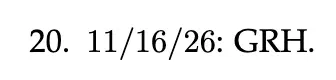
In Alpöge's view, they had obtained a complete argument resolving the problem.
Looking back over these six weeks, it is difficult to draw a simple line between the contributions of the human and the AI.
Alpöge selected the problem, proposed key analogies, and judged which mathematical techniques were worth trying. His long study of number theory enabled him to see connections between different theories.
Claude undertook extensive technical exploration and derivation, pushing forward in some areas Alpöge had not yet mastered and ultimately proposing ideas that astonished him.
Alpöge assessed their collaboration with remarkable candor and honesty:
Claude far surpassed me as we approached the finish line.
Claude was simply flying, dancing, and shining near the finish.

These words come from a mathematician who normally writes academic papers. Such an excited tone is rare.
People often reduce AI's mathematical ability to leaderboard scores, as though a stronger mathematical model will naturally have a better chance of solving a problem.
Alpöge's experience makes that judgment seem too crude.
A considerable amount of mathematical research happens before the proof begins.
Researchers need to know which questions are worth pursuing, which existing results offer inspiration, and how to connect concepts that originally belonged to different fields.
Alpöge's accumulated knowledge of number theory let him recognize value among Claude's many ideas and gave him the confidence to pursue a bold route.
Merely having access to a leading model is not enough to reproduce his achievement.
More than 20 years of high-level mathematical training carry weight here.
5. After the proof
On November 20, 2026, Alpöge finally released the research results.
He wrote just four pages of explanatory text and attached the enormous Lean formal proof files.
Lean is a formal system capable of checking mathematical proofs. Mathematicians must express definitions, propositions, and every inferential step rigorously, for a computer to check.
It will not overlook logical gaps merely because a proof is by a famous mathematician, beautifully written, or seemingly plausible.
But checking such a vast proof also requires ensuring that it really proves the intended mathematical statement and excluding potential problems in the system itself.
The Lean and Mathlib communities therefore organized independent checks.
On November 21, they issued a joint statement confirming that Alpöge's code precisely proved Mathlib's statement of the Riemann Hypothesis. Different checkers agreed, including independent checks of the raw proof data.
This is a statement of enormous significance.
Mathematicians around the world immediately began studying the proof. They want to understand which ideas it uses, why these techniques can be combined, and whether the long argument can be shortened.
Alpöge himself admitted that 17 million lines of code really is too long.
Alpöge subsequently clarified that the claim of "more than 250,000 pages" for a conventional written proof was a joke, not the actual length of a generated manuscript.
Opening this enormous work, Alpöge discovered that its first theorem began with an extremely basic fact.
The real numbers are totally ordered, so a real number not equal to 1/2 must be either greater than 1/2 or less than 1/2.
Well, that tells us... exactly what we already knew.

In the end, he did not release this difficult-to-read tome, publishing only the Lean proof.
Alpöge himself knows that this is not yet a mature, conventional mathematics paper.
In his statement, he said that although the formal proof was complete, he had taken only one step.
He still needed to work to understand the entire argument, explain it clearly, and turn it into a proof mathematicians could actually read.
At the beginning of his statement, Alpöge wrote something moving.
He had thought that, if he truly solved the Riemann Hypothesis one day, he would lose the most important guiding purpose of his life.
But the entire proof process surprised him. He began to believe that scientific research had many possibilities that had previously been hard to imagine.
The next thing he most wanted to do was still to learn.
To learn how to truly understand the mathematics he and Claude had completed together, and how to organize those complex and beautiful ideas and explain them to other mathematicians.
It had taken him more than 20 years to reach this point.
Now he was starting again.
References:
https://alpo.ge/
This article is from "Xinzhiyuan," by "Ma Ke."
Related topics
After reading
Join the AINRK community
Read how to join the community and connect with people working in AI.
Related articles
Continue reading related topics and articles in this category.

Sun Zhiwei reduces a Diophantine definition of integers over the rationals to 26 auxiliary variables (opens in a new tab)
Human- and AI-assisted manuscripts simplify a Diophantine representation of integers over the rationals. Sun Zhiwei’s November 13 preprint revision uses 26 existentially quantified auxiliary variables. Peer review and formal verification remain distinct.
GPT-6 Astra drafts short proof of Deligne's bound from Alpöge's outline; human review pending (opens in a new tab)
A November 21 preprint develops a new proof of Deligne's Frobenius eigenvalue bound from Alpöge's footnote. Its core argument is under six pages but assumes étale cohomology and weak Lefschetz. The manuscript says models wrote and checked it; no human has checked it.
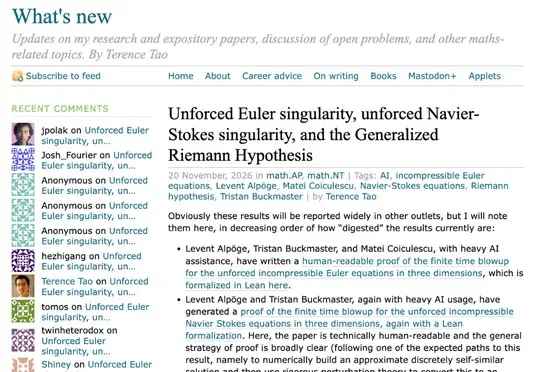
Masullo releases a GRH proof draft; Vakil’s update says issues remain unresolved (opens in a new tab)
Ravi Vakil introduces Masullo’s The Music of the Primes draft, which the author says took nearly 12 years without AI. Issues remain unresolved. Its status differs from the formally verified Alpöge–Claude RH proof; they cannot be described as two established proofs.

Alpöge and Claude’s Riemann Hypothesis Proof Verified; Masullo’s Draft Still Needs Revision (opens in a new tab)
Lean and Mathlib have verified Alpöge's classical Riemann Hypothesis statement and proof. MIT's generalized results cover Dirichlet L-functions; Masullo's separate draft still needs revision. Alpöge describes the work as a collaboration with Claude.
Alpöge and Claude release a Lean proof of RH; the Lean community confirms verification (opens in a new tab)
Alpöge and Claude released a Lean proof of the Riemann Hypothesis, subsequently verified by the Lean and Mathlib communities. The report traces their collaboration and theta-lift approach; the verified GRH results are limited to Dirichlet L-functions.