Google unveils Gemini 4 Neon and expands Genie 4 access for eligible Ultra users
Google introduces Neon for efficient, complex tasks, with a million-token context window and API pricing, and expands Project Genie interactions. Rollout is gradual; cybersecurity models and Genie access remain subject to eligibility and availability restrictions.
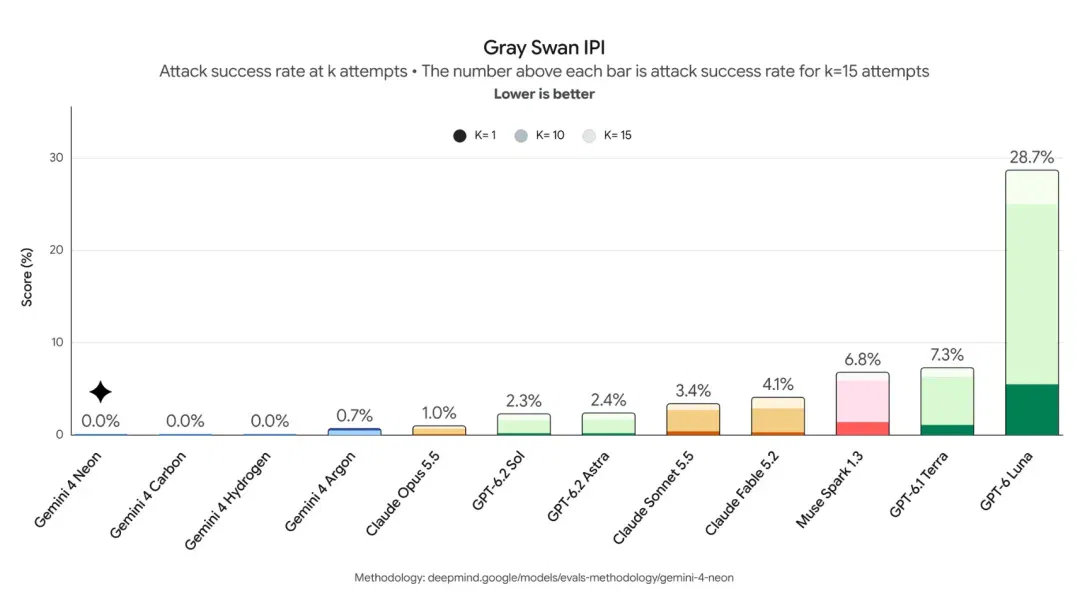
Editorial correction (November 19, 2026): Scientific rankings and safety results are limited to the stated comparisons and test settings. A result of 0.0% does not mean zero risk in real-world settings; access remains subject to eligibility restrictions.
Wake up, and Google has released yet another Gemini 4 model.
Google has been pushing hard on foundation models lately, releasing models across the spectrum from maximum intelligence to maximum efficiency. It is pulling out all the stops to regain the crown.
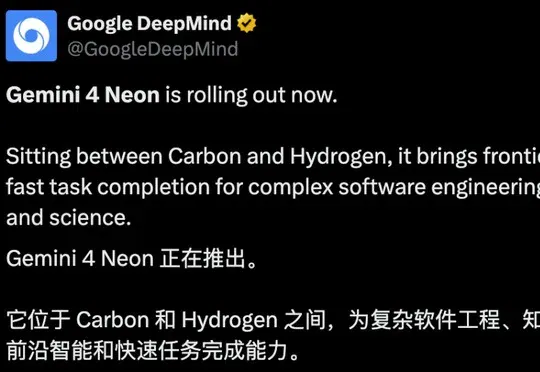
After Carbon, Argon and Hydrogen comes a model to fill the gap between maximum intelligence and maximum efficiency: the mid-sized Gemini 4 Neon!
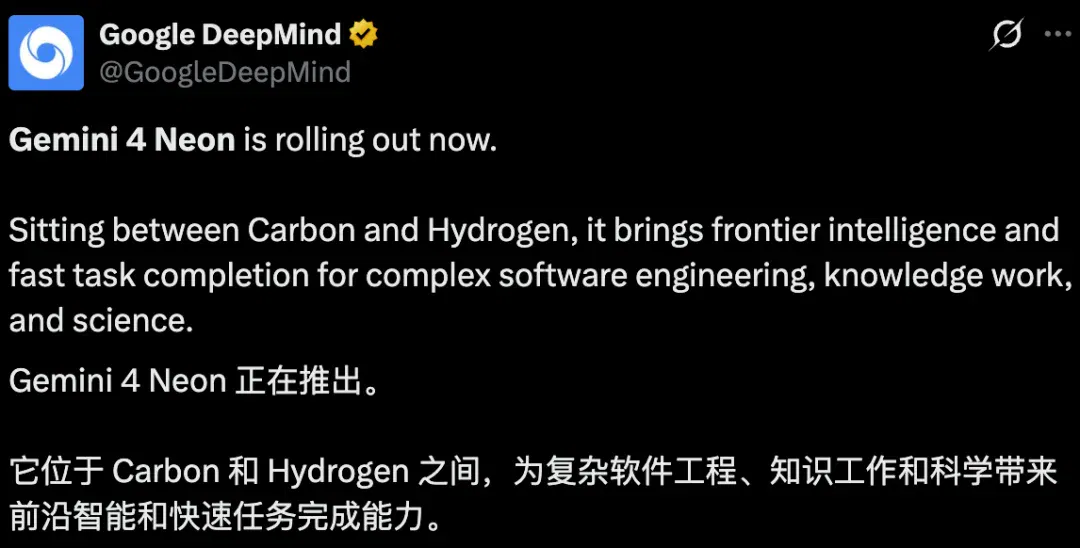
Demis Hassabis described the mid-sized Gemini 4 Neon as "Alchemy at its finest".
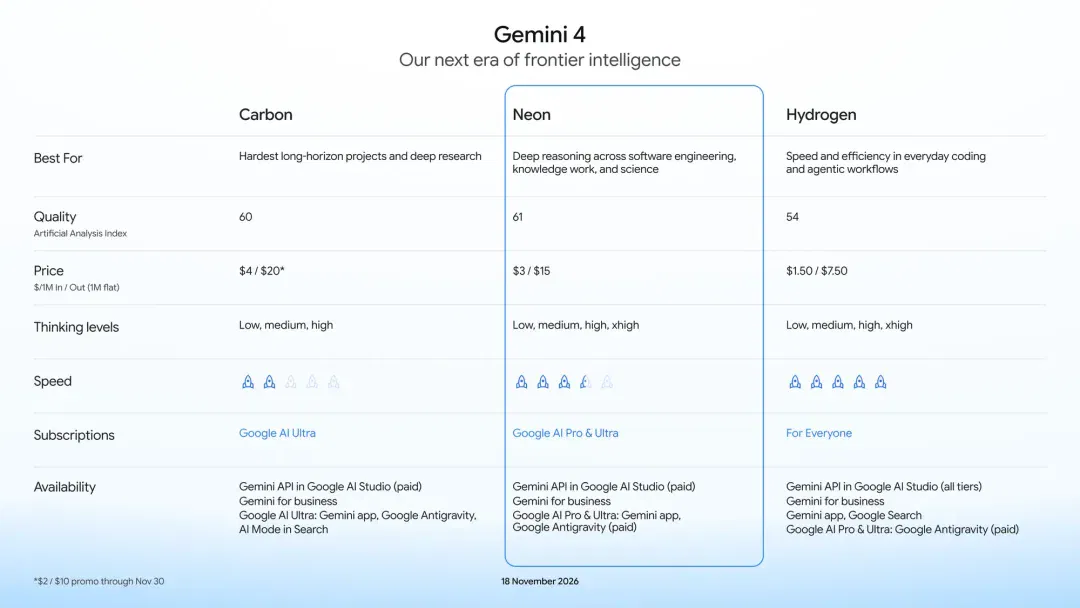
In the Gemini 4 family, Carbon is the flagship for the hardest long-running projects, while Hydrogen targets frequent everyday use with a focus on response speed. Neon sits between the two, "delivering frontier reasoning for complex coding, analytical reasoning and production-grade enterprise workflows, while being faster and more economical".
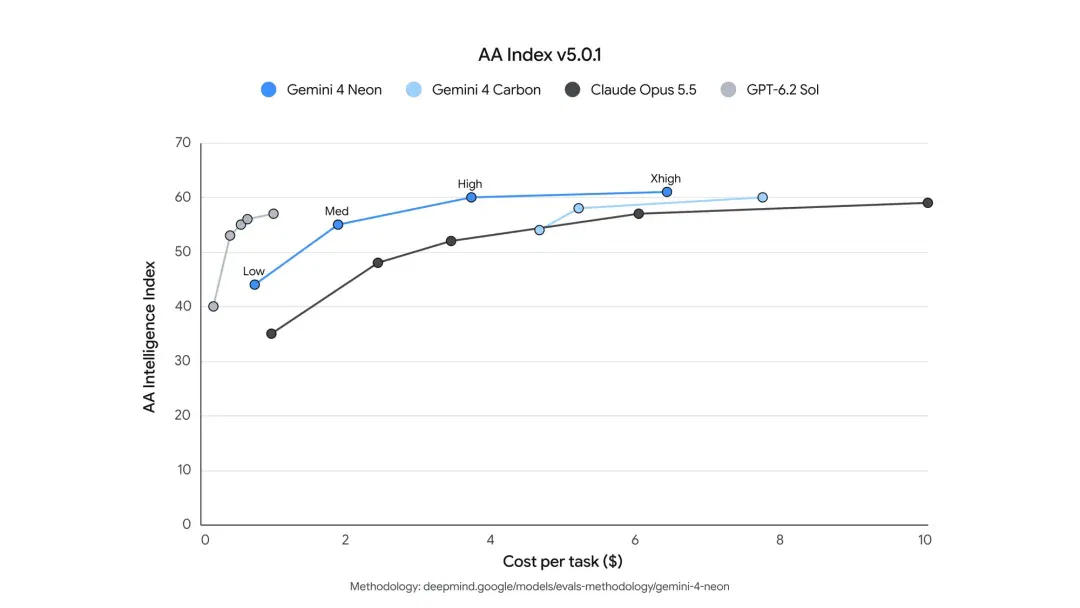
Neon is three times as fast as Carbon and costs only 60% as much. Pricing is $3 per million input tokens and $15 per million output tokens, with cached input tokens as low as $0.15 per million. Its context window is one million tokens. It also supports four adjustable thinking levels, allowing developers to vary speed and reasoning depth according to task complexity.

Gemini 4 Neon ran /swarm for 12 hours to reconstruct Alan Turing's 1936 research from archival photographs, including a working universal Turing machine, the blueprint for modern computing.
- Blog post: https://blog.google/innovation-and-ai/models-and-research/gemini-models/introducing-gemini-4-neon/
A broad set of benchmark results
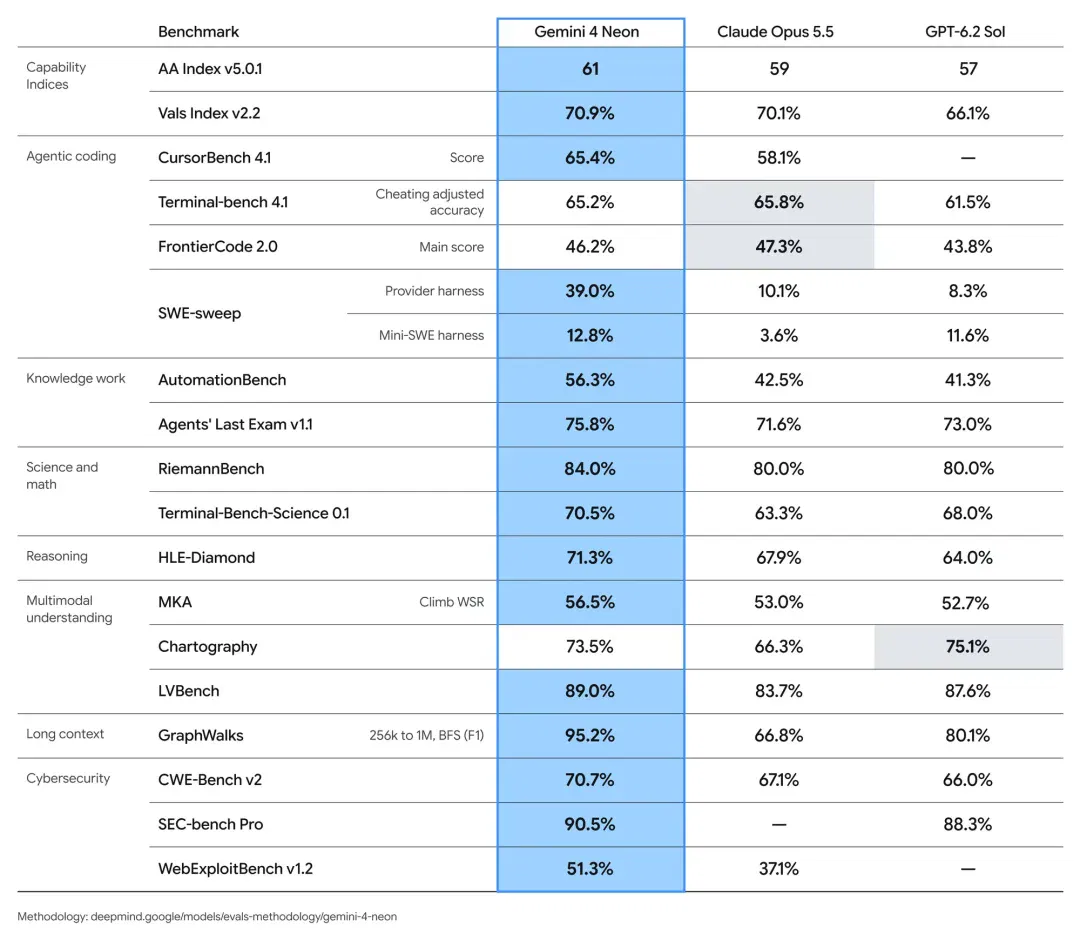
Neon's performance on third-party evaluations covers considerable ground. On overall intelligence, it ranks third on the Artificial Analysis Intelligence Index with a score of 61, behind only larger, slower models. It ranks second on the Vals Index at 70.9%, placing it on the Pareto frontier.
On the new Agent Arena Index, Neon took second place with 1,336 points across more than 4,200 real-world agent sessions. It also ranked second for steerability, indicating that it can change direction more cleanly when a user revises instructions partway through.
It also topped a wide range of enterprise and knowledge-work evaluations. It ranked first on both Legal Research Bench and Tax Agent Bench, and first in most of the finance, accounting, spreadsheet-modeling and other categories covered by Surge AI. It took first place on Zapier AutomationBench at 56.3% and on Andon Labs' Vending-Bench 2 at $16,843. The latter simulates long-term business operations and places high demands on long-horizon planning. Neon scored 73.5% on Chartography, a benchmark for reading dense charts, and 75.8% on Agents' Last Exam v1.1, on a par with leading models.
For scientific and mathematical reasoning, Google describes Neon's performance on Terminal-Bench Science, RiemannBench and HLE-Diamond as leading in its class. This should be understood within the scope of those comparisons, rather than as exceeding models of every size and configuration.
Breaking down Neon's capabilities
According to the official blog, Neon's new capabilities fall into several main areas.
More accurate, more consistent coding. Neon targets real production environments and can handle multi-file debugging, refactoring and precise edits. Google particularly highlighted its "surgical edits" capability for targeted changes across multi-file projects. The model has improved significantly at following multi-step instructions, while internal Google Antigravity testing recorded its lowest fabrication rate to date (fabrication rate).
A million-token window for multimodal work. Spreadsheets, PDFs, charts, audio and video can all be processed together in Neon's single context window, producing structured deliverables. "Neon matches or exceeds Carbon in overall quality, at three times the speed and 40% lower cost. It strikes a compelling balance between accuracy, detail and speed."
Cybersecurity. This is a distinctive part of the Neon launch. Google introduced Neon for Cyber, spanning the full chain from secure coding through vulnerability discovery and validation to patching.
The reported figures show state-of-the-art secure-code generation on AutoBaxBench's hard tier at 76%, outperforming Carbon across the board. It also achieved state-of-the-art penetration-testing performance on WebExploitBench v1.2 at 51.26%, at half the cost of competing large models; state-of-the-art vulnerability discovery on SEC-bench Pro at 90.5%, with a per-challenge cost roughly half that of comparable models; and 70.7% on CWE-bench v2 vulnerability patching, an improvement of 3.4% over Carbon. Neon for Cyber will become available to trusted security defenders through the Fairwind Program over the coming days.
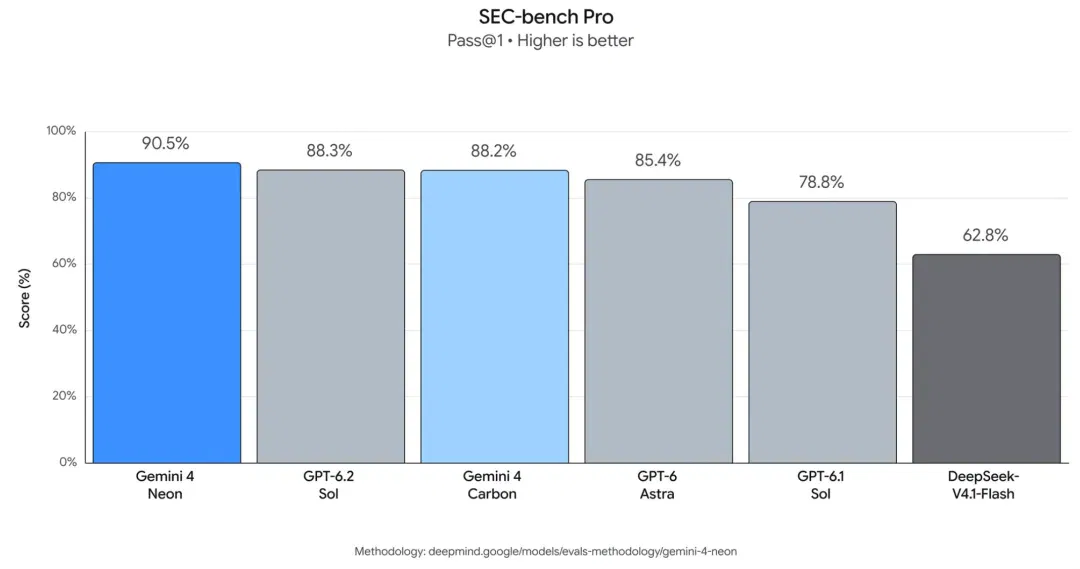
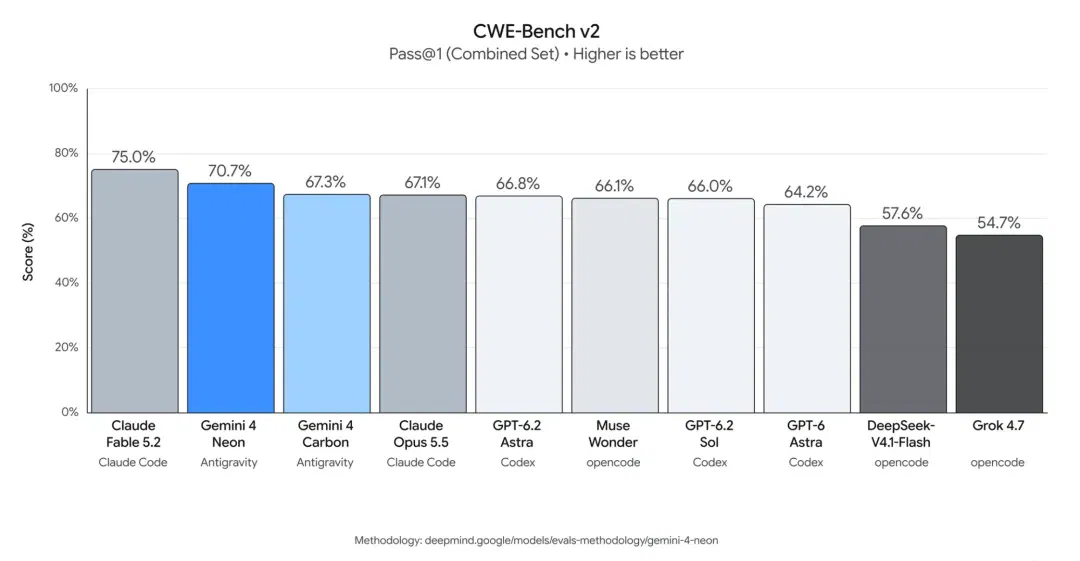
The source lists evaluation results for Terminal-Bench, coding cheating, agent safety and indirect prompt injection, among others. Results including 0.0% apply only to the corresponding samples, attack methods and reasoning configurations. They do not mean the model never cheats or cannot be compromised in real-world settings; a low refusal rate does not automatically imply greater safety either.
Consumer features are also getting an upgrade. In the Gemini app, Neon offers higher-quality writing, reads uploaded spreadsheets, PDFs and photos more accurately, and can connect to Gmail and Docs to obtain relevant information. The Tasks feature is now powered by Neon, making complex multi-step tasks faster and less demanding on usage allowances.
Gemini 4 Neon has begun rolling out. Developers can build applications through the Gemini API's paid tier in Google AI Studio and Android Studio, while Google AI Pro and Ultra subscribers can try it in Google Antigravity. Enterprise users can access it through the Gemini for Business API or model dropdown. For consumers, Pro and Ultra subscribers can switch directly to Neon in the Gemini app's model picker. The cybersecurity-focused Neon for Cyber will be made available to trusted defenders through the Fairwind Program over the coming days.
The Genie 4 world model finally becomes available
On October 28, Google DeepMind announced its latest-generation world model, Genie 4, calling it its "most realistic and interactive world model yet."
After more than half a month of waiting, Google has finally announced that Genie 4 is officially available.
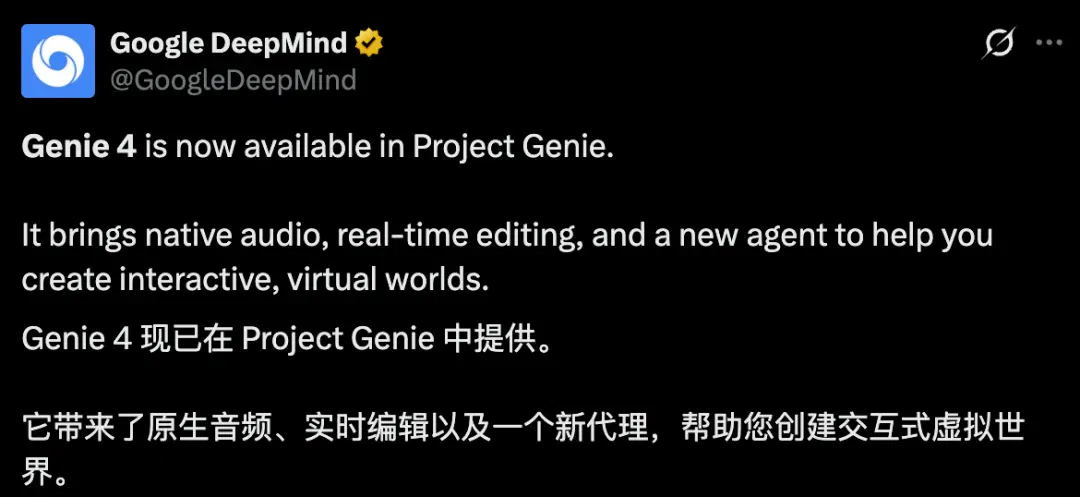
- Blog post: https://blog.google/innovation-and-ai/models-and-research/google-deepmind/genie-4-now-available-project-genie/
Genie 4 is Google's most realistic and interactive world model so far. Its core new capability is "mid-session prompting": the ability to change the environment through natural language at any point as you explore a world. You can change the weather, introduce a character or alter the direction of the story, with every change happening in real time in the current scene.
Another first-time capability is native audio. Worlds generated by Genie 4 come with sound that automatically adapts as the scene changes, from ambient sound effects to character dialogue, filling in the auditory piece of the puzzle.
Genie 4 focuses on maximum fidelity, while Genie 3 remains in Project Genie's model picker for longer explorations and panoramic scenes.
Alongside Genie 4, Google has also launched Project Genie Agent. Creating a world used to require a carefully crafted prompt; now it becomes a conversation. You describe the world you want in natural language, and the agent orchestrates Google's combination of multimodal models to generate initial visuals that establish the world's visual style, accompanied by tailored background music.
More interestingly, the Gemini model can watch the screen as you explore, proactively suggest where to go next, or automatically trigger events within the world based on your journey.
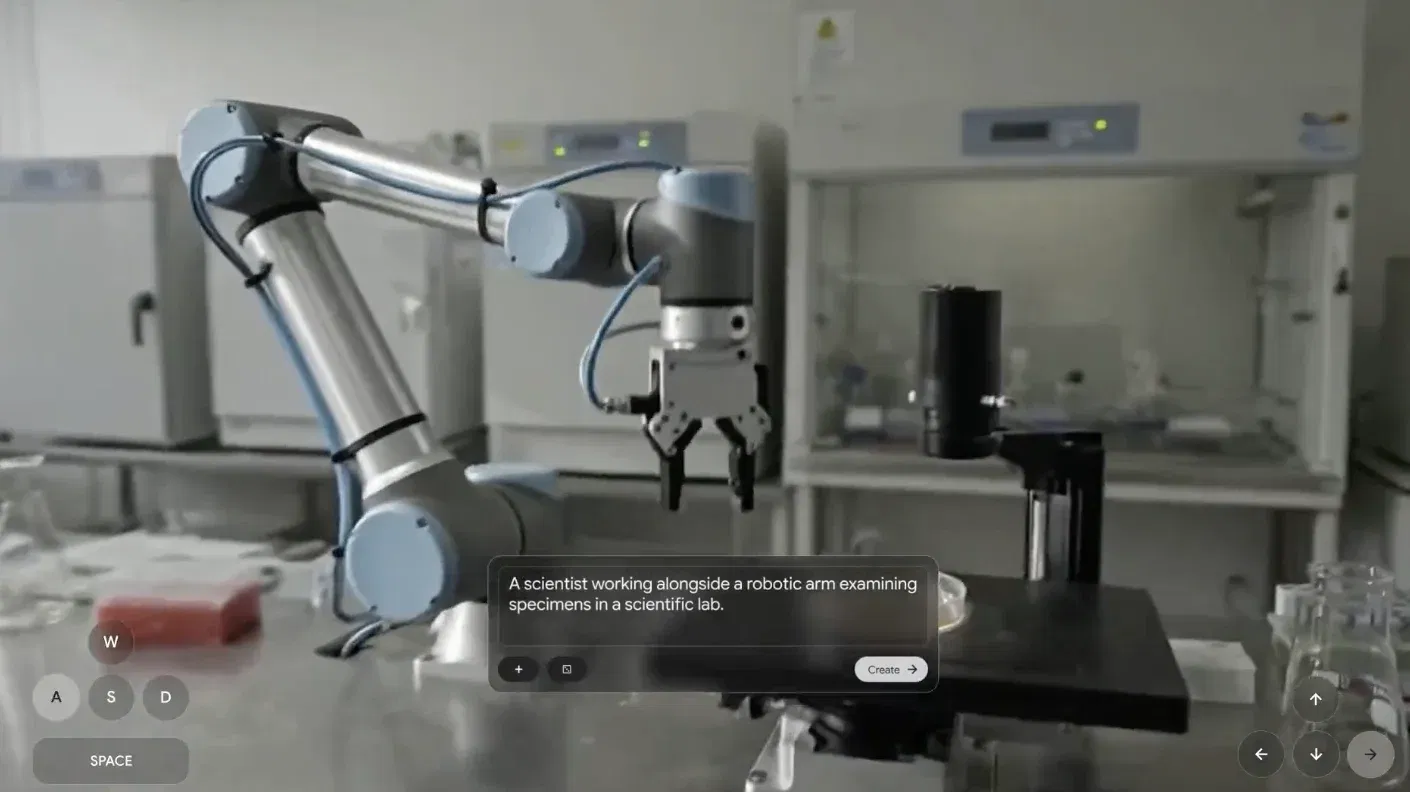
You can also remix worlds already in the gallery, adjusting their underlying structure, soundtrack or rules to make your own version, then publish it in the community gallery for others to explore and remix.
The new Project Genie experience is currently available to eligible Google AI Ultra subscribers. Google AI Pro members can join a waitlist on the same page.
This article was originally published by the WeChat account Synced. Author: Synced.
Related topics
After reading
Join the AINRK community
Read how to join the community and connect with people working in AI.
Related articles
Continue reading related topics and articles in this category.
刚刚,谷歌发布Gemini 4 Argon:单次输出上限达100万Token (opens in a new tab)
机器之心编辑部 刚刚,Google 宣布推出新一代前沿模型 Gemini 4 Argon。 Google 将 Argon 定位为面向复杂、长周期工作流的模型,重点覆盖软件工程、法律与金融等企业知识工作
谷歌物理真觉醒!全新Gemini 4 Argon一大波实测来了 (opens in a new tab)
谷歌Gemini 4 Argon真的来了。
Neon identifiers surface in Gemini web code; model and subscription positioning remain unconfirmed (opens in a new tab)
A source report recounts developers finding Neon model and subscription identifiers in Gemini web code, alongside discussion of element naming. Code strings and online guesses do not establish a release, plan features or access date.
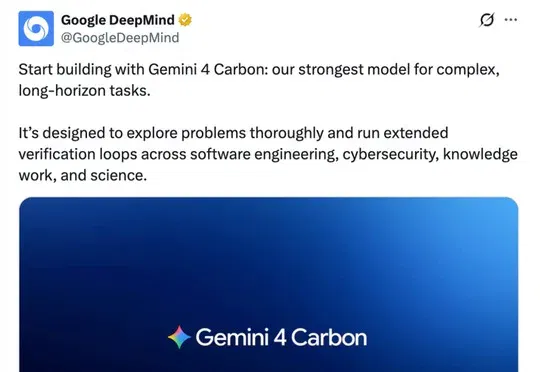
Google 用 AlphaProof Code 验证 Signal 部分代码的安全性质 (opens in a new tab)
Google DeepMind 展示了由 Gemini 4 Carbon 驱动的形式化验证案例。团队报告四周内生成约 650 万行 Lean 证明,所验证的是明确规格下的部分安全性质。
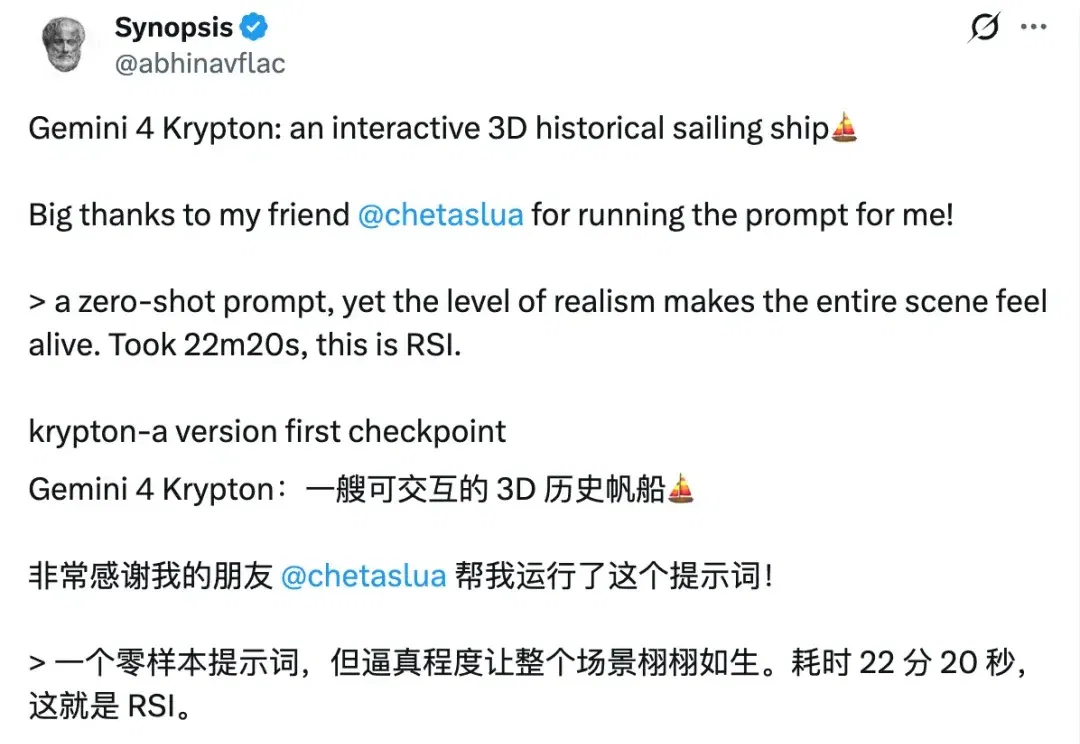
测试者分享 Gemini Krypton 动画与 3D 案例,模型信息待确认 (opens in a new tab)
早期测试者分享了标为 Gemini 4 Krypton 的代码动画、SVG 和 3D 场景,并与 Carbon、Argon 作对比。模型身份及稳定表现仍待官方信息验证。