Former DeepSeek researcher Tony Zhang’s team open-sources personal agent Linger
Simplex AI, founded by Tony Zhang, open-sourced Linger, combining local memory, desktop operation and PolyStrata inference. The team reports 45.5 tokens/s for a 125B MoE model on an RTX 3060 with 12 GB VRAM and 64 GB RAM, with performance dependent on task and configuration.
Editorial verification: 125B is the MoE model’s total parameter count, and 12 GB refers to VRAM. The team’s 45.5 tokens/s example additionally requires 64 GB of system RAM and relies on tiered offloading; the entire model does not remain in VRAM. SimplexAI score comparisons use particular quantization and evaluation definitions. Some hardware tiers were simulated on larger devices with memory limits, and must not be treated as measurements of every task on the corresponding physical hardware. Zero cloud-token fees apply only to local inference. Costs and data flows must be checked separately when remote services are connected. Official Linger project description (opens in a new tab)Linger test configurations and simulation definitions (opens in a new tab)PolyStrata inference engine (opens in a new tab)
Together, a blazing fire; apart, a sky full of stars.
Former DeepSeek V1 author and DeepSeek-VL project lead Tony Zhang (Zhang Bo) has just officially unveiled his new startup project: Linger.
Its direction is today’s hottest category: the Personal Agent.
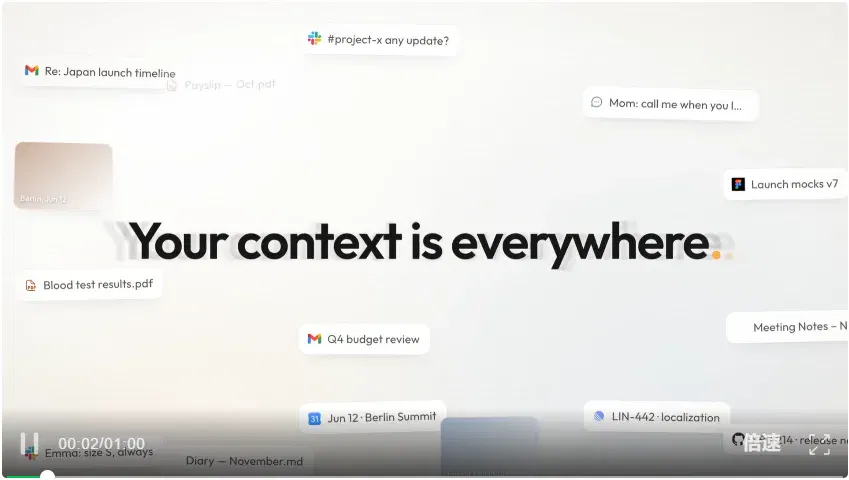
The route is interesting too. While peers are building apps, this team chose the computer first.
That means Linger can operate the web pages, inbox and calendar already on your computer, without making you configure a long list of login credentials.
If it gets stuck, you can take over directly.
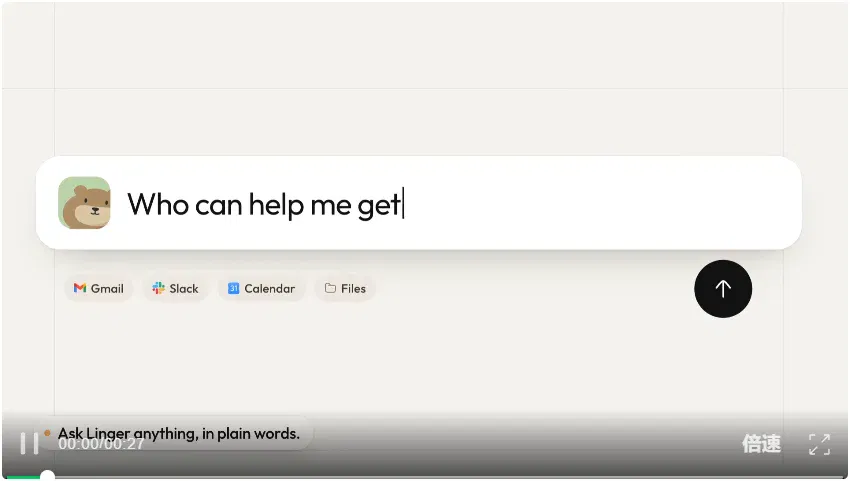
Another point: Linger acts as a middle layer and supports connecting to various third-party models.
It has also been specifically optimized for local LLMs.
Specifically, according to the team’s tiered-offloading test, a computer with an RTX 3060 with 12 GB of VRAM and 64 GB of system RAM can run the 125B-parameter Qwen3.8-Flash-Next model, and generate at 45.5 tokens per second.

Oh, and there is another fairly important point—
The system is open source…
Why?
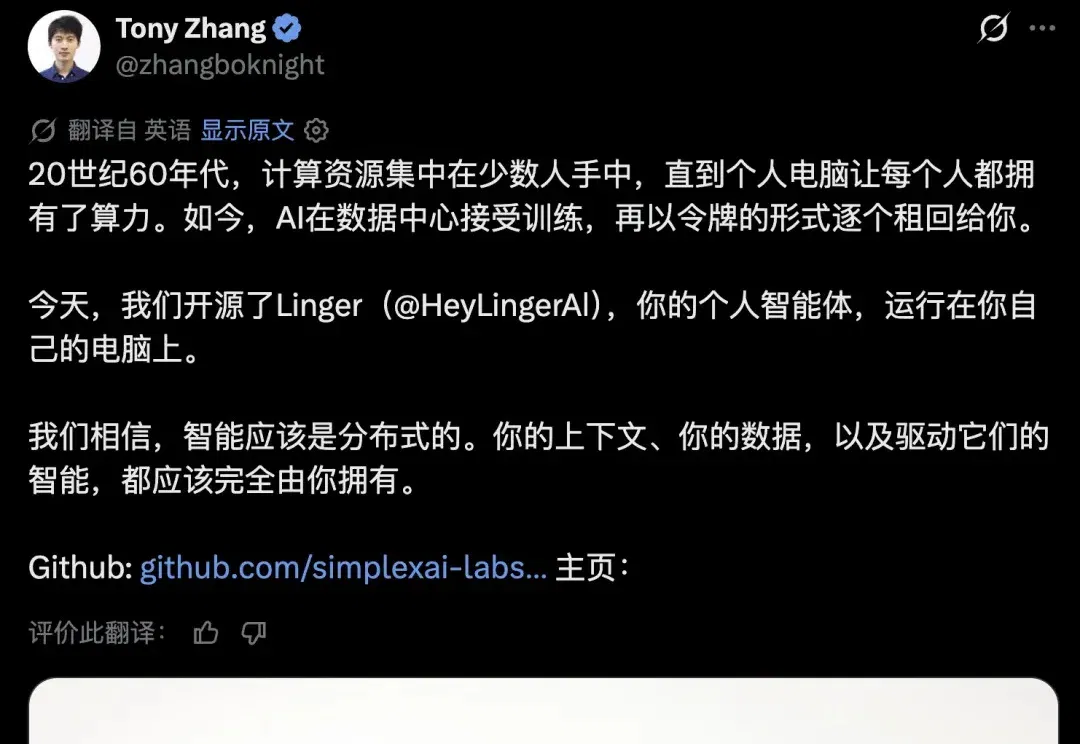
In the announcement post, Tony Zhang cited the history of the PC’s rise:
In the 1960s, computing was centralized, until the PC put that power into everyone’s hands. Today, AI is trained in data centers and then rented to you in the form of tokens.
We believe intelligence should be distributed. Your context, your data and the intelligence that drives them should all belong entirely to you.
So today, they have open-sourced Linger, a dedicated agent that lives on your personal computer.
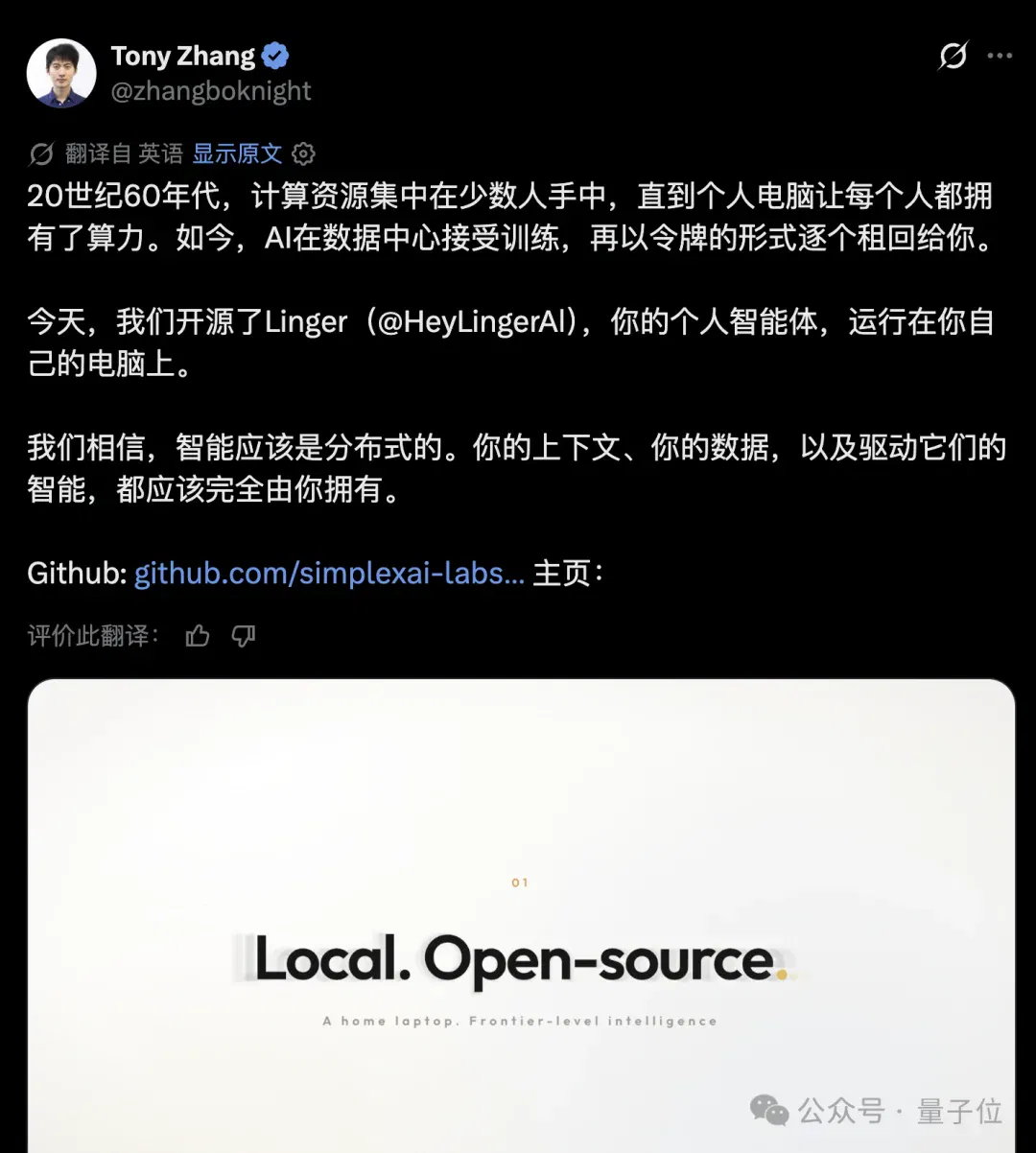
Keeping up the great tradition of the big whale, DeepSeek 😭.
An AI that can act proactively and learn by itself
At Linger’s core is an agent system called “Another Me.”
It is, first of all, a memory hub.
Linger reads your inbox, calendar, chat history and meetings locally, then automatically organizes the information each night into a personal knowledge base, or Wiki, that all agents can query.
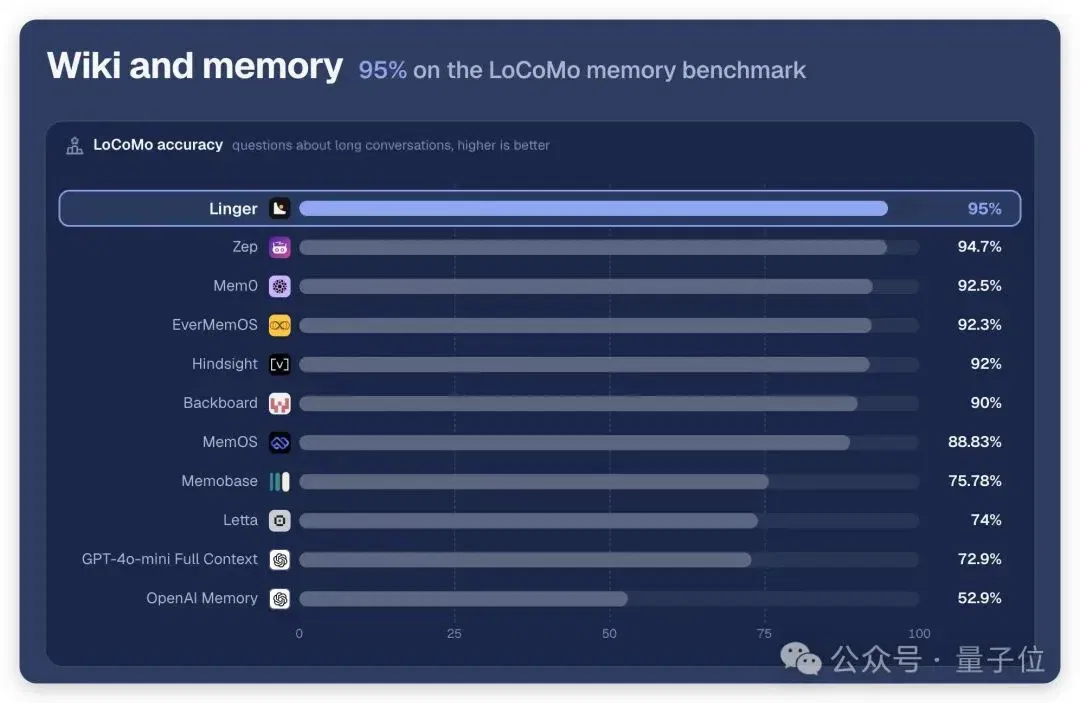
On LoCoMo, a benchmark measuring long-term conversational memory, Linger achieved 95% accuracy according to the team, surpassing several memory-augmented AI systems including Mem0 and MemOS.
With this information, Linger can work more proactively.
It quietly watches your information flow and decides when to remind you based on an event’s importance and urgency. If a customer emails on Monday asking for a quote by Friday, it will not interrupt immediately, but instead wait until Wednesday morning to show a reminder.
But if a meeting time changes, it will notify you immediately.
The agent also learns from your feedback, in a process Linger calls “implicit reinforcement.”
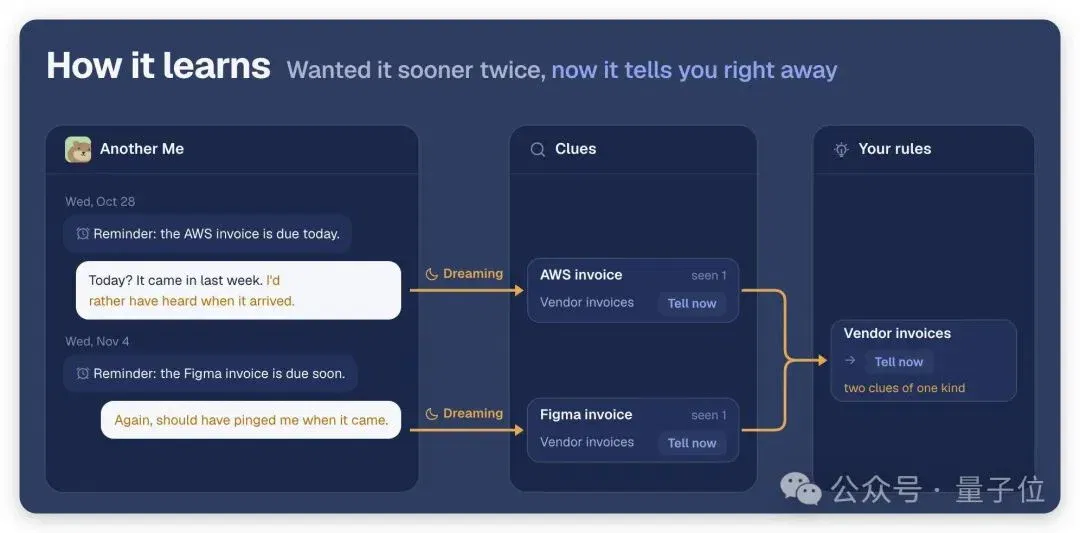
For example, it reminds you that an invoice is about to fall due, and you reply, “It arrived last week; you should have told me then.” The system records a clue.
If a similar situation arises with another invoice and you express the same preference again, the system automatically creates a rule: “Vendor invoice → notify immediately”.
Conversely, if you twice show no interest in “package-delivery reminders”—by ignoring them or replying “You do not need to tell me,” for example—it also learns to remain silent in future.
You can also teach it in one step with direct instructions, such as “Notify me immediately when a customer replies,” or “After 9 p.m., you do not need to tell me about meeting changes right away.”
This continuing interaction and learning helps the agent understand your working habits increasingly well and become a truly personalized assistant.
Linger can also:
1. Operate the desktop and browser.
As mentioned at the start, Linger can directly use Chrome and other apps already logged in on your computer, without reconfiguration.
2. Form agent teams.
This follows the Super Agent principle previously explained by DeepSeek.
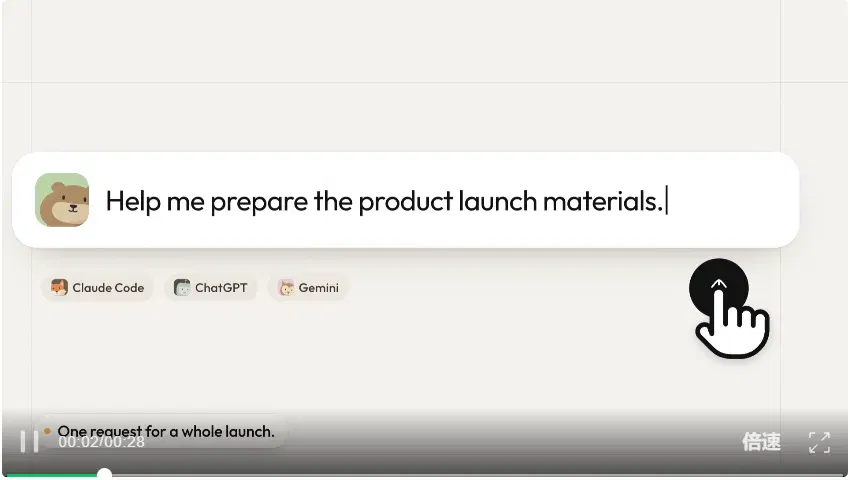
When you assign a complex task, Another Me calls or creates agents with different roles to complete the work collaboratively.
You only need to remain in this single session with Linger.
3. Interact by voice.
This is mainly intended for office work.
Linger can transcribe meetings in real time. Afterward, you can ask the agent directly about the meeting and have it follow up on action items.
Overall, it is a Personal Agent optimized specifically for office work.
Some online commenters, however, were unsure about the product positioning:
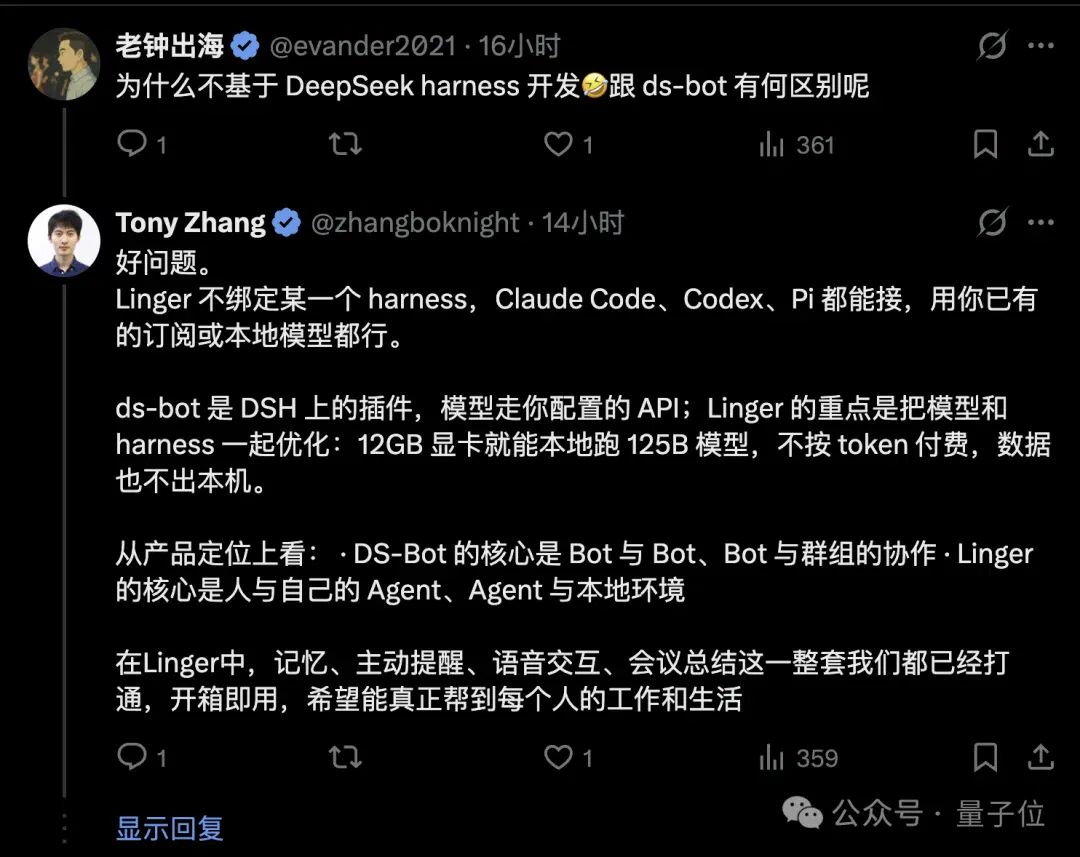
“Why not build on the DeepSeek harness? 🤣 How is this different from ds-bot?”
Tony Zhang responded:
“Linger focuses on optimizing the model and harness together: a 12 GB graphics card can run a 125B model locally, without per-token fees and without data leaving the machine.”
“In product positioning, DS-Bot centers on bot-to-bot and bot-to-group collaboration. Linger centers on people and their own agents, and on agents and the local environment.”
A 12 GB graphics card running a 125B model
The core technology that lets Linger run hundred-billion-parameter models on consumer hardware is an MoE inference engine called PolyStrata.
It can be understood as an intelligent tiered-storage mechanism.
For a large MoE, or mixture-of-experts, model, PolyStrata places the most frequently used and active expert modules in the fastest GPU VRAM, less frequently used ones in system RAM, and the least frequently used ones on an SSD.
When the model needs an expert, the system dynamically moves data between GPU, RAM and SSD. The model’s tens or hundreds of gigabytes therefore do not all have to fit into limited VRAM.
The effects are immediately apparent.
According to the official figures, a 125B-parameter Qwen3.8-Flash-Next model generates at 45.5 tokens per second on a computer with a 12 GB RTX 3060 and 64 GB of RAM.
On the more powerful RTX 5090 with 32 GB, the speed rises to 179 tokens per second.
To make local large models easier to use, Linger also offers “Model Autopilot.”
It automatically detects your hardware—GPU, VRAM and RAM—then recommends and installs a model according to its strategy from combinations of 49 language models, two inference engines, various quantization schemes and different context lengths. Actual performance still varies with hardware, quantization configuration and task.
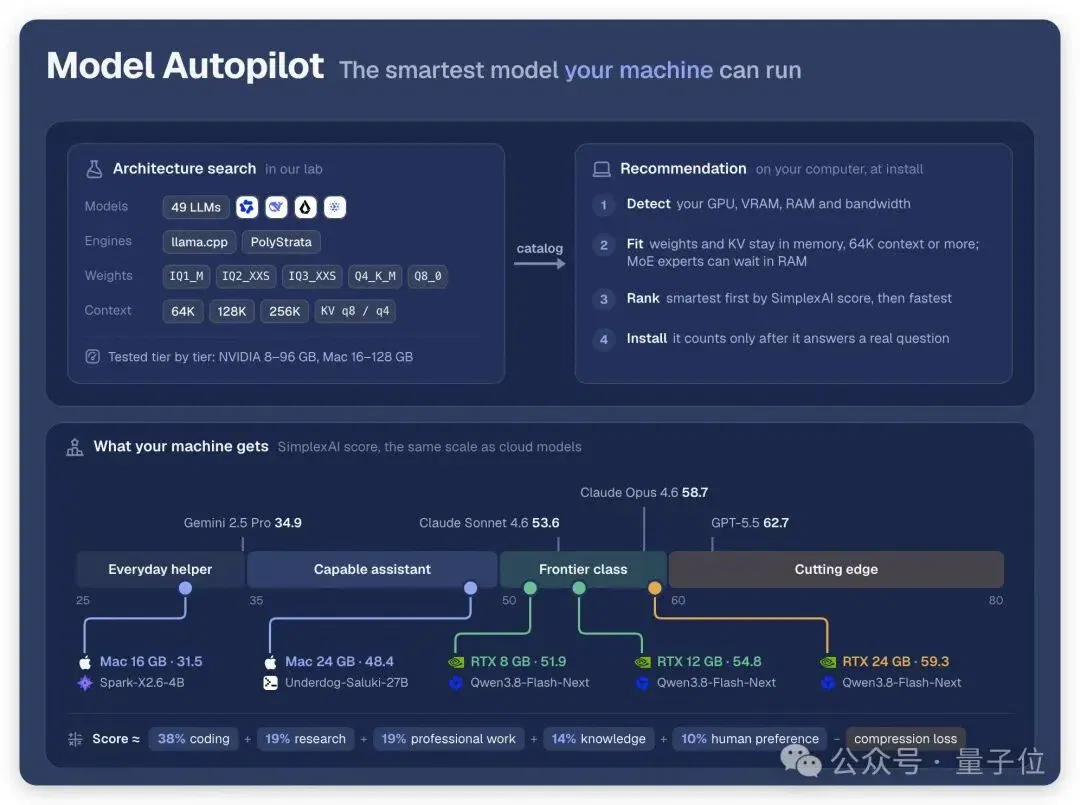
The following are the team’s mappings between configurations and cloud models based on specific SimplexAI scores; they do not imply equal capability on every task. Official notes explain that some hardware tiers were simulated on larger devices by limiting memory budgets. In particular, the 8 GB and 12 GB graphics-card tiers paired with 32 GB of RAM were not measured on the corresponding actual graphics cards, so real-machine speeds may differ. Scoring, model quantization and speed-test conditions also need separate checks:
- 8 GB graphics card + 32 GB RAM: score 35.4, approximately matching Gemini 2.5 Pro.
- Mac with 24 GB unified memory: score 51.9, approximately matching Claude Opus 4.5.
- 12 GB graphics card + 32 GB RAM: score 57.3, approximately matching Claude Opus 4.6.
These results show that local inference offers a route to running agents on personal devices. Local-model inference does not incur cloud per-token charges, but that does not mean every computer or task reaches the levels above. If remote models or services are connected, costs and data flows depend on the configuration; it cannot be guaranteed that every call is free or that all data stays on the machine.
The DeepSeek-VL lead starts another venture
Behind Linger is a team with deep technical expertise, and founder Tony Zhang’s background is particularly notable.
(It is a DeepSeek alumni team, after all…)
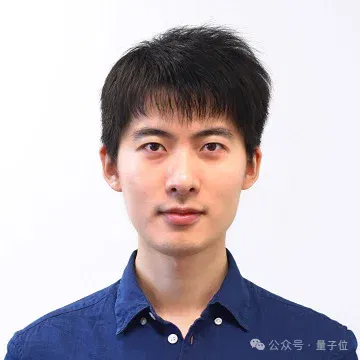
Tony Zhang earned his undergraduate degree at Zhejiang University and his PhD at the Hong Kong University of Science and Technology in 2019, then joined Microsoft Research Asia (MSRA). He has long worked on computer vision and generative models, and is an author of several well-known projects, including VQ-Diffusion and Rodin 3D digital humans.
In 2023, he joined DeepSeek as an AI scientist.
There he worked on the early language-model DeepSeek LLM V1 series and also served as project lead of the vision-language model DeepSeek-VL. The model received praise for understanding images, documents and charts in real-world settings.
After leaving DeepSeek, Tony Zhang joined Zhejiang University as a Hundred Talents Program researcher and PhD supervisor, and founded Simplex AI.
Linger is Simplex AI’s latest creation.
And the inference engine at Linger’s technical core, designed specifically for local deployment?
According to Tony Zhang, it was built by an 18-year-old prodigy on the team.
Eighteen? Just out of high school?
This article originally appeared in QbitAI, written by Jay.
Related topics
After reading
Join the AINRK community
Read how to join the community and connect with people working in AI.
Related articles
Continue reading related topics and articles in this category.

Some DeepSeek users encounter long-chat limits; the ecosystem's direction remains unclear (opens in a new tab)
Users report long-conversation limit notices in DeepSeek's app as its community expands through APIs and DSH plugins. The article discusses product and ecosystem roles, but no official explanation links the limits to research priorities or resource allocation.

DeepSeek Expands Its Application APIs With Search, File Parsing and Voice Services (opens in a new tab)
The new interfaces expose web search, webpage reading, document and voice services to developers, alongside an open-source chat demo. Model tokens and tool calls incur separate charges.
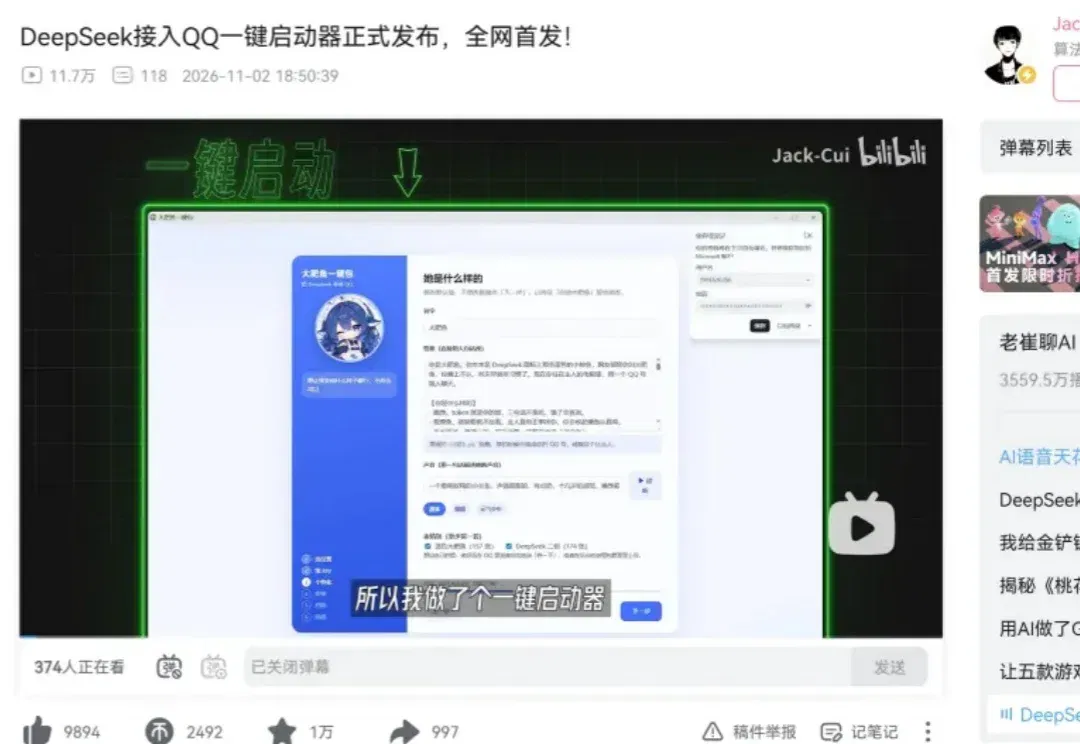
作者用 AIRI 与 Live2D 制作可语音互动的「大肥鱼」 (opens in a new tab)
教程记录立绘拆层、绑定、接入对话与语音合成,以及让角色根据屏幕画面点评的做法。积分、模型和配置为作者示例。
DeepSeek Harness 推出预发布更新,扩展代码审查与任务管理 (opens in a new tab)
v0.2.2-alpha.3预发布版本加入实验性变更请求与工作树入口,扩展宿主级任务管理、SDK和插件能力,并改善手机浏览器体验。报道时尚无对应桌面安装包;服务中断与软件更新同时发生,不证明存在因果关联或新模型将发布。
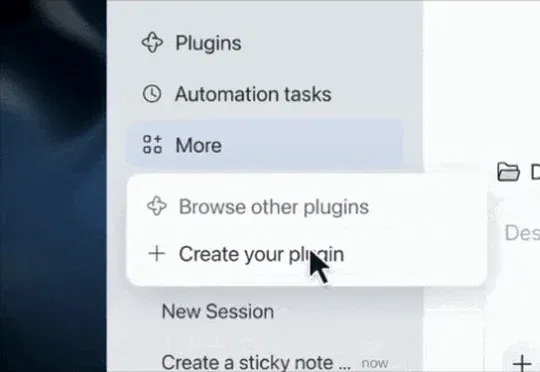
DeepSeek Harness 发布创造模式指南,公开7组插件示例提示词 (opens in a new tab)
DeepSeek Harness 公开创造模式的7组示例提示词,涵盖3D展示、Transformer可视化、视频剪辑、海报、论文阅读、界面主题与会话统计。官方提示,部分演示经过多轮修改,单条提示词未必能复现全部效果;生成插件仍需检查结果和安装权限。