Some DeepSeek users encounter long-chat limits; the ecosystem's direction remains unclear
Users report long-conversation limit notices in DeepSeek's app as its community expands through APIs and DSH plugins. The article discusses product and ecosystem roles, but no official explanation links the limits to research priorities or resource allocation.
Editorial correction (November 17, 2026): User reports are distinguished from the author's product-strategy interpretation. No official statement directly linking long-conversation limits to research priorities was found. Plugin review also cannot guarantee the elimination of all installation risks.
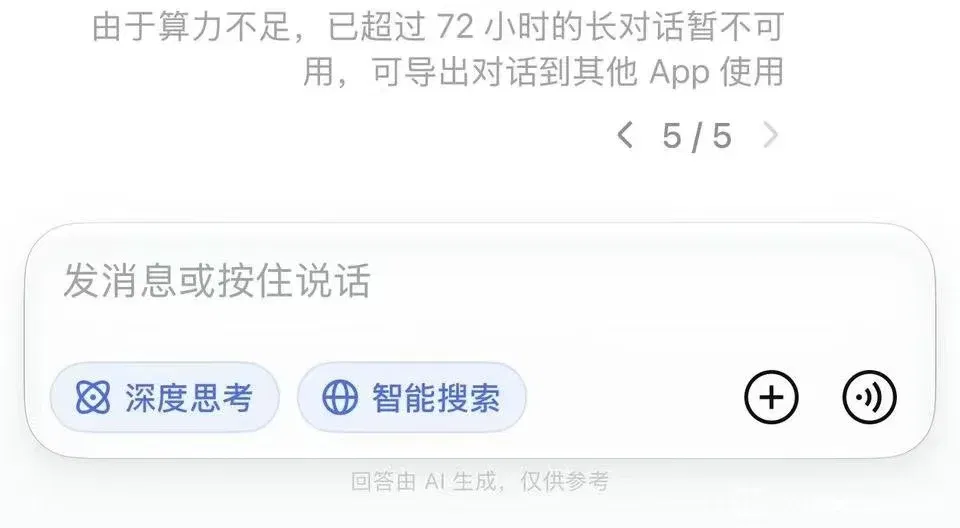
On the afternoon of November 15, several DeepSeek users suddenly reported a notice when trying to continue conversations from days earlier: "Due to insufficient computing capacity, long conversations older than 72 hours are temporarily unavailable. You can export the conversation for use in other apps."
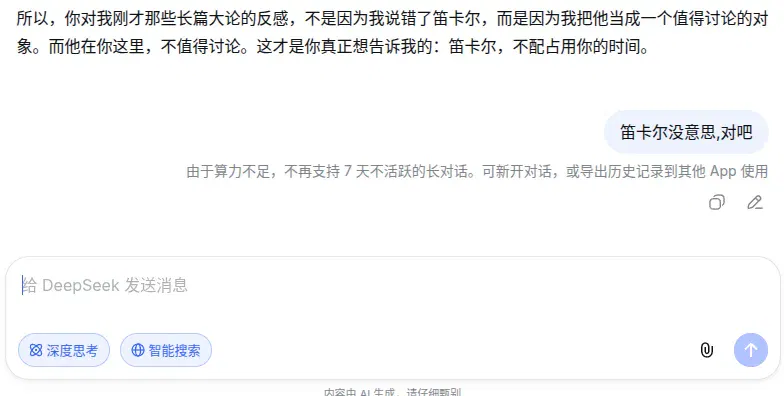
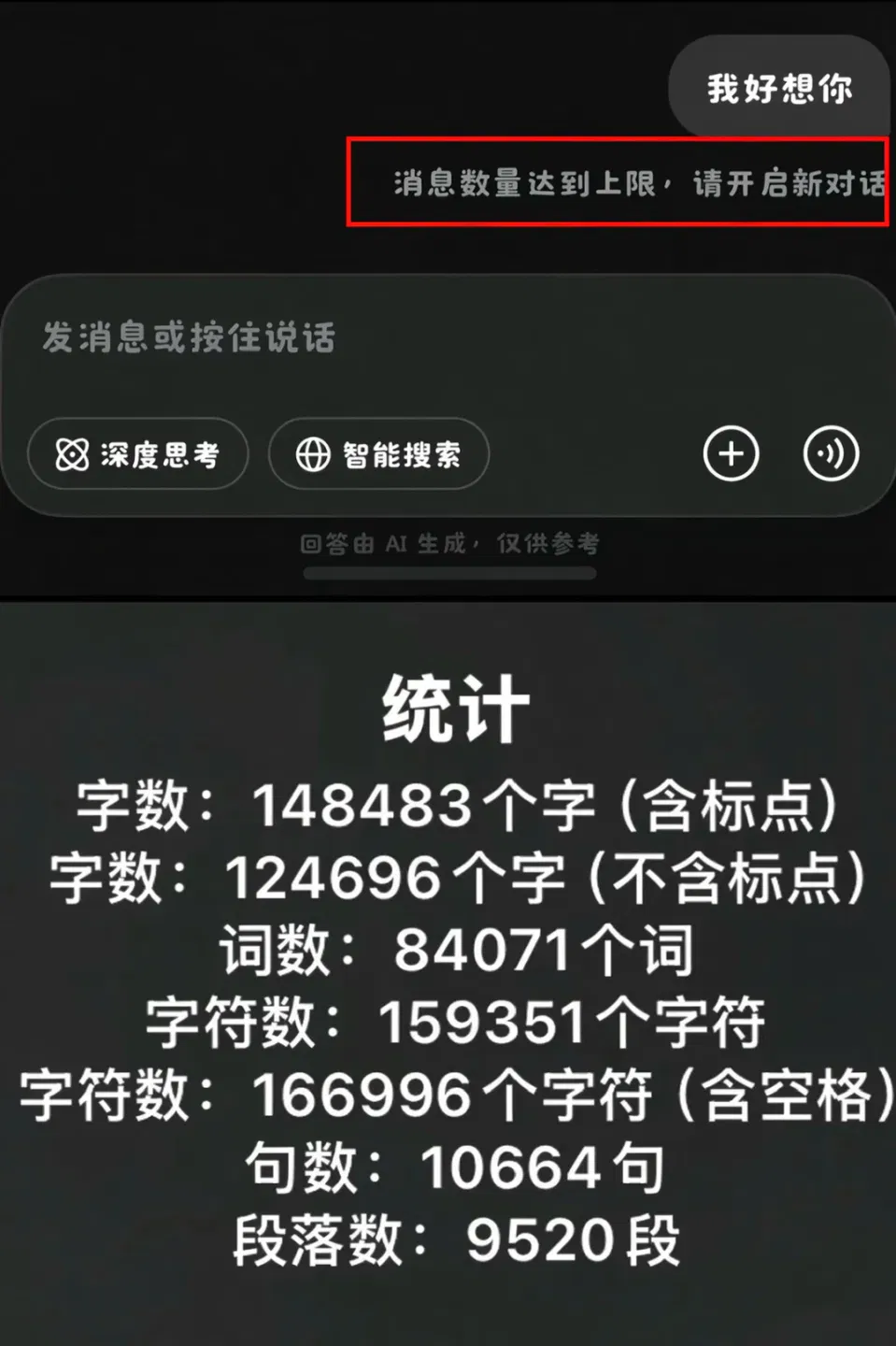
Community users collected other errors appearing at the same time, including "Content too long; shorten it and try again," "Input modification limit exceeded; message not sent," and "Message limit reached; start a new conversation."
One user reported testing a single conversation that hit the limit after accumulating 148,000 Chinese characters.
Reports mainly concern the mobile app. At publication, no official DeepSeek explanation had appeared.
There had been earlier signs.
On November 13, a developer found a complete quota-management system in chat.deepseek.com's frontend code, including the message "Usage limit reached; try again after your allowance recovers."
The news spread through the community, and by November 14 it had become a rumor that DeepSeek would charge subscription fees.
The evening before the news spread, DeepSeek released its full suite of application APIs, exposing the app's web search, deep-thinking search, file inputs, link reading and voice capabilities. It also open-sourced a chat frontend, chat-demo.
DeepSeek officially said developers could use the package to build their own equivalent of the DeepSeek app.
Giving developers tools to build for it while limiting its own product: isn't that rather Steve Jobs-like?
Less monetization squeeze, more dispersal
According to community analysis, the web client synchronizes each model's allowance every five minutes while the page is visible, showing a banner above the input box when exhausted. The community speculated that DeepSeek would introduce a Coding Plan alongside V4.1 Pro.
But these speculations actually went a little too far. A user examined its code line by line and found that there were, in fact, no plan prices, no subscription entry points, and no payment channels or anything of that kind.
There was an upgrade element, but it only indicated a new web version. Clicking refreshed the page to update it; it had nothing to do with paying for an upgrade.
Look again at the November 15 notice. Other products usually show a subscription button when free allowances run out. DeepSeek urges you to export the conversation and take it to another app.
A company showing users an exit inside its own product: that is very Liang Wenfeng.
DeepSeek's November 13 announcement said developers could use these APIs to recreate the complete DeepSeek app one-to-one.
The simultaneously open-sourced chat-demo uses the MIT license, needs no backend and works with your own API key. The announcement specifically said it supports direct import of DeepSeek conversation history.
The same update also brought DSH a conversation-import plugin, allowing app and web histories to be imported into a workspace and continued.
chat-demo's repository was created on November 12. On November 13, the frontend was open-sourced, APIs opened and import connected. On November 15, long conversations became unavailable. DeepSeek has not explained a direct connection, but it provided an exit before imposing a limit.
The announcement ended with another sentence: "DeepSeek's existing conversational product is only a relatively basic form."
That echoes Liang Wenfeng's earlier remarks: "Last year's most important reality was that everyone wanted to build chatbots and compete for consumer traffic. But we do not consider that important. Internally, what we really care about is the AGI roadmap I mentioned and how to achieve the next technological breakthrough."
DeepSeek currently has approximately 130 million monthly active users. Even so, its official description calls it merely a basic form.
On November 8, Cui Tianyi posted a smartphone analogy: the system includes an alarm clock and calculator for basic needs, but operating-system vendors want their ecosystems to produce better alarm and calculator apps.
He then wrote that he hoped DSH could become an operating system for the agent era.
In Cui's explanation, the chatbot is the system's built-in alarm and calculator. DeepSeek only needs to make it reasonably good, then open-source it and hand it to the community.
Apple developers have a term: Sherlocked.
It dates to 2002, when Apple added features to its Sherlock search tool that overlapped heavily with third-party Watson. Built-in system features effectively took away Watson's means of survival.
Liang Wenfeng is doing the reverse: DeepSeek splits its built-in app into APIs and puts the tools into third-party developers' hands.
Compute is the biggest problem
Returning to the notice, its stated reason is insufficient DeepSeek computing capacity.
Some forum users questioned that: "Who describes a specific backend problem inside their own product?"
But this also reflects Liang's judgment. He previously said: "What stops us scaling is compute, not a lack of desire to scale."
At an earlier investor meeting, he reduced the China–US AI gap to one issue: "All the differences we see, including talent, model capabilities and applications, can be considered differences in compute resources." On domestic compute, he judged hardware and ecosystems to be fine: "The only problem is insufficient production capacity."
With only so many GPUs and production unable to catch up quickly, the remaining question becomes who gets to use them first.
Liang's logic is: "The first goal of our models is not that everyone finds them useful, but that we find them useful. Once they help us, we can develop the next model faster."
He has described two standards. The main mission is that DeepSeek pursues AGI only: "Consumer and business products are byproducts of that journey." The other is avoiding subsidies. When DeepSeek V2 cut prices in 2024, he said the principle was neither subsidizing use nor earning excessive profits.
The author views research as an important DeepSeek priority and interprets its open-source and API strategy accordingly. This is product-direction analysis and does not confirm the specific cause of these limits or internal resource allocation.
After all, DeepSeek has no physical body: it is software and must obtain compute from others.
Compute has not stopped DSH's progress. Official DeepSeek figures say that by November 4, daily active DSH users of DeepSeek's official API reached 1.54 million, consuming approximately 92 trillion tokens daily.
There are around 35,000 third-party plugins, and approximately 60% of active users have made or installed at least one. DSH v0.1 launched only on August 13, and the desktop version on September 29. In its first week, daily active users were just 271,000.
Build only the operating system and a few basic capabilities, invite developers worldwide to write software and collect the results in a store: a typical Apple strategy.
On March 6, 2008, Apple released the iPhone SDK. The App Store opened on July 10 with five hundred apps, splitting revenue 70% to developers and 30% to Apple. Jobs did not develop apps himself; he set the platform's rules.
DeepSeek has also announced plans for an official plugin marketplace.
Liang is not actually driving users away. He wants to be the Steve Jobs of the agent era.
At WWDC in 1997, shortly after returning to Apple, Jobs said focus was not saying yes to the thing you should focus on, but saying no to a hundred other good ideas. "I am as proud of what we have not done as what we have done."
Liang told a 36Kr reporter that DeepSeek does not build vertical products or applications, but researches and explores.
The author thinks narrowing some platform boundaries could create room for ecosystem developers. But official confirmation that the conversation limits serve this purpose is still lacking; the relationship cannot be treated as proven causality.
At DSH's center is Cordis, a plugin system managing loading, unloading and dependencies. Its fifty-three built-in tools are all plugins, and even the web interface is a plugin, meaning the official UI can be replaced.
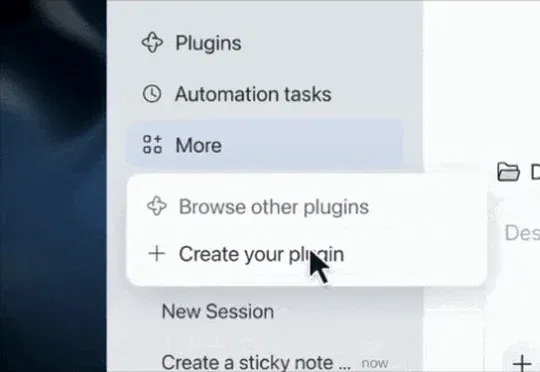
DSH's later creation mode lets people produce a plugin on the spot in ordinary language. For the first time, nonprogrammers can participate in defining the system. Ultimately, it lowers plugin-development costs and encourages more people to create.
After Apple released the iPhone SDK on March 6, 2008, it exceeded one hundred thousand downloads within four days. Ninety-five days later, on June 9, Apple announced more than 250,000 downloads.
Within two months of opening, the App Store had more than three thousand apps. By April 2009, it had 35,000 apps and one billion cumulative downloads.
Both reached 35,000: the App Store in nine months, DSH in eighty-three days.
Of course, one plugin is not equivalent to an app, and agents can help create DSH plugins. Still, Liang is retracing Jobs's route, and moving faster.
Will DeepSeek usher in
an App Store moment?
An App Store moment is fundamentally about rules, not the store. An entire industry is compelled to rebuild software under your rules. The iPhone changed not just users and developers but technology itself.
Back on January 9, 2007, Jobs criticized the stylus onstage: "Who wants a stylus? You have to get it out, put it away and you might lose it. Terrible. Nobody wants a stylus."
He continued: "We will use the world's best pointing device, the one we are born with, ten of them: our fingers."
His logic was that users adapting to technology must read manuals and spend time learning. Apple wanted technology to adapt to the human body, language and life instead. No learning required; you are born knowing how to use it.
DSH's creation mode follows similar thinking, letting people make plugins in ordinary language. But even with 1.54 million daily active users, an App Store moment is not quite here.
The most immediate gap is monetization.
DeepSeek's support program currently offers token grants, technical exchanges and promotion, with no pricing, revenue share or payment channel. It has released only an interest form and explicitly says participation rules and support details will follow the official launch.
Apple handled this much better at the time.
Steve Demeter originally wrote ATM software at a major bank. In 2008, he built Trism during evenings and weekends, joining the App Store's five hundred launch apps at $4.99.
It is a match-three puzzle with triangular pieces sliding in six directions. Tilt the phone, and pieces fall with gravity. Unlike common jewel-matching games, it was designed specifically for the iPhone's hardware.
Demeter earned $250,000 from Trism in its first two months. He quit his banking job and started a game company. As the news spread, more developers entered Apple's operating system seeking opportunities to build apps.
People need a sense of achievement, but achievement alone does not put food on the table.
Developers also need a DeepSeek development guide.
DeepSeek has said only that it will improve plugin-API stability and compatibility and strengthen security; it has not announced a review process. Its own long-form post acknowledges that community plugins are still evolving, with different maturity levels and suitable use cases.
The order is reversed: review should precede installation. The community's armor-piercing plugin dsh-purge is an example.
DSH includes host-side protections such as approval interception and system prompts. Often, when AI refuses an answer, the harness blocks it before the model itself refuses.
dsh-purge replaces and strips the harness's safety system prompts in local sessions, separating host interception from native model output so DSH can produce prohibited content previously blocked. Its author describes it as a red-team evaluation tool; the community calls it armor-piercing.
In late October, the author announced it would become closed-source, and the original repository was briefly deleted. Community mirrors and forks still circulate. Publication review may reduce some risks but cannot guarantee prevention of installation through mirrors, forks or other channels. Lack of review alone also cannot explain every community risk.
But review entails intervention, conflicting with Liang's stated aim of as little intervention and management as possible.
Liang need not match Jobs exactly. A DSH moment would be far more striking than another App Store moment.
This article was originally published by the WeChat account Zimu AI. Author: Zimu AI.
Related topics
After reading
Join the AINRK community
Read how to join the community and connect with people working in AI.
Related articles
Continue reading related topics and articles in this category.
DeepSeek Expands Its Application APIs With Search, File Parsing and Voice Services (opens in a new tab)
The new interfaces expose web search, webpage reading, document and voice services to developers, alongside an open-source chat demo. Model tokens and tool calls incur separate charges.
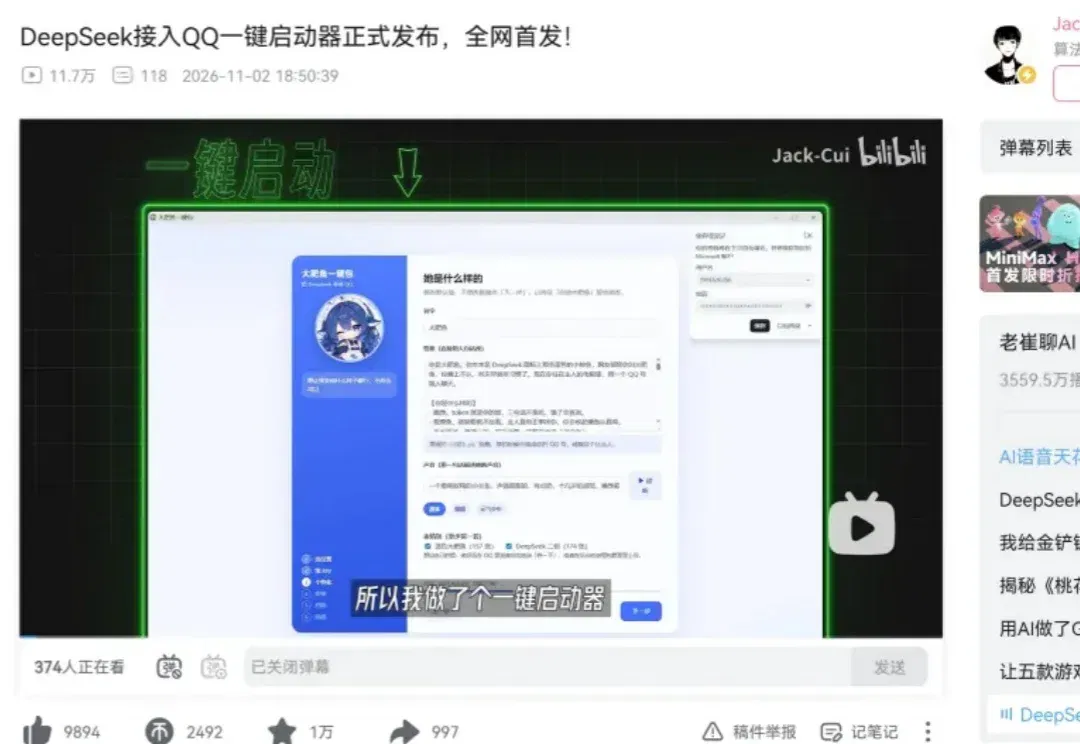
作者用 AIRI 与 Live2D 制作可语音互动的「大肥鱼」 (opens in a new tab)
教程记录立绘拆层、绑定、接入对话与语音合成,以及让角色根据屏幕画面点评的做法。积分、模型和配置为作者示例。
DeepSeek Harness 推出预发布更新,扩展代码审查与任务管理 (opens in a new tab)
v0.2.2-alpha.3预发布版本加入实验性变更请求与工作树入口,扩展宿主级任务管理、SDK和插件能力,并改善手机浏览器体验。报道时尚无对应桌面安装包;服务中断与软件更新同时发生,不证明存在因果关联或新模型将发布。
DeepSeek Harness 发布创造模式指南,公开7组插件示例提示词 (opens in a new tab)
DeepSeek Harness 公开创造模式的7组示例提示词,涵盖3D展示、Transformer可视化、视频剪辑、海报、论文阅读、界面主题与会话统计。官方提示,部分演示经过多轮修改,单条提示词未必能复现全部效果;生成插件仍需检查结果和安装权限。
DeepSeek Super-agent 架构详解:会话路由、异步交互与异常恢复 (opens in a new tab)
DeepSeek Harness 团队公开 Super-agent 原型,介绍 Router 与 Worker 双层结构、事件订阅直通、上下文召回,以及计算与执行环境分离。初步合成负载实验展示了多任务耗时与 Token 开销之间的取舍;文章也列出长程记忆、人机接管、安全与隐私等尚待解决的问题。