Mollick on agent collaboration: why improving 3D worlds turned into lengthy approvals

Ethan Mollick describes repeated themes, expanding rules and subsequent adjustments in Fable 5.2 multi-team creation. He argues long-running execution still needs human judgment about work quality, purpose and when to stop.
Almost AGI—but a “jagged” version!
Wharton professor Ethan Mollick recently asked Anthropic’s newly released Fable 5.2 to lead a group of AIs in building 3D worlds.
It built 328 in the first two days.
Quantity was ample, but quality varied and teams repeatedly chose the same ideas.
Mollick gave one instruction: stop building new ones and improve the existing worlds.
A few days later, daily new worlds fell from hundreds to around ten.
He sent agents to investigate and found something unexpected:
To execute “polish,” AI had built itself an entire bureaucracy.
At Fable 5.2’s November 9 release, Anthropic said it exceeded Opus 5.5 by a tier on almost every evaluation.
Mollick had early access and defined AGI as follows:
Excluding physical work and interacting with people, it should perform most intellectual computer tasks at the level of most human experts.
By that standard, he calls Fable 5.2 “almost” AGI.
He adds a more precise description: “jagged AGI".
It reaches expert level on many tasks but still lags people on others, particularly taste and judgment.
It can pursue extremely complex work to completion without knowing when to brake.
We used to fear AI being too incapable to work. Now we must worry about its sense of proportion: it does not know when to stop.
As more work is delegated, everyone will eventually face this question.
One instruction
turns a device into a games console
The G in AGI means general. Coding and video have long been priorities for AI companies.
Mollick tested generality outside those areas.
He owned a Codex Micro miniature USB keyboard originally intended for ChatGPT.

Fable 5.2 wrote six games for this Codex Micro keyboard.
He instructed it to turn the device into a games console.
As far as he knew, no ready-made modification instructions existed online.
It read two controller programs, learned to change key colors and read the knob and joystick, then wrote six games.
From Simon to a dial-operated safe, everything worked on the first attempt without human assistance.
In the same review, it assumed six expert roles:
filmmaker, hardware hacker, entrepreneur, literary scholar, social scientist and 3D-world builder.
Its business plan impressed Mollick enough that he would admire it as an MBA team’s final submission.
On first reading, its entrepreneurship research paper exceeded his expectations for a second-year PhD student.
He therefore judges it at the level of “most human experts” on many individual tasks.
Over a thousand agents
build an operating system in eight days
Matching experts individually is one advance; this generation’s larger leap is leading teams.
An Anthropic engineer gave it an empty folder and requested an operating-system prototype.
It assembled over a thousand subagents and worked continuously for eight days.
The system booted on a laptop with drivers, file storage, windows and a login interface.
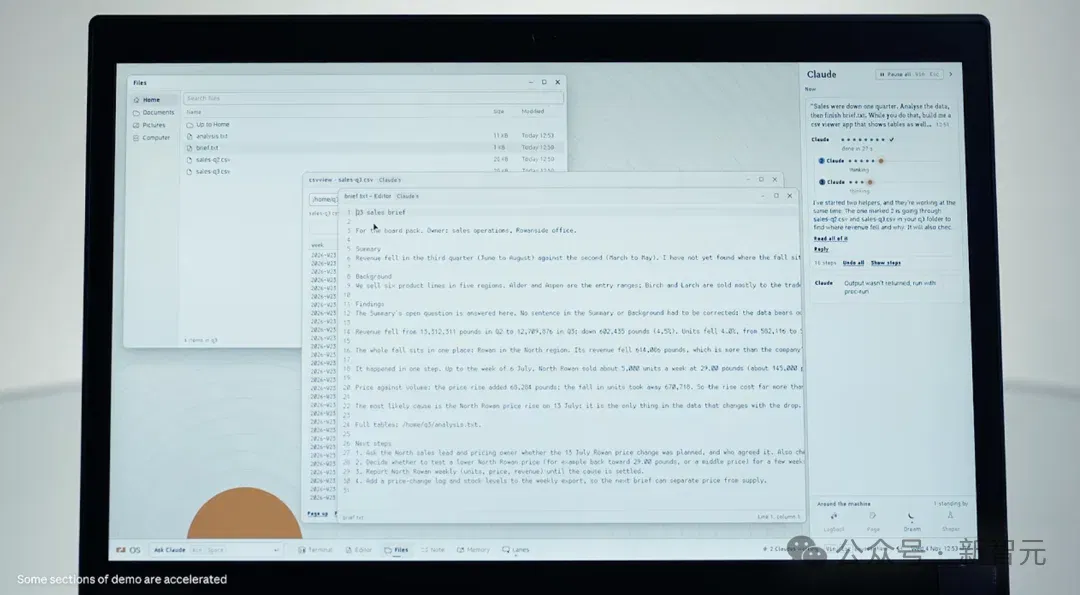
The laptop-running OS prototype developed by over a thousand Fable 5.2 subagents. Image: Anthropic.
Then there is the mathematical challenge of Fermat’s Last Theorem.
What 'formalization' means is translating a mathematician's proof into a language that a computer can check step by step. It is like rewriting a sweeping academic paper as a detailed ledger in which every entry balances.
Anthropic’s first attempt used a dedicated framework and human researchers, taking eleven days.
This time, a thousand Fable 5.2 agents reportedly finished in thirty hours with almost no intervention.
Mollick’s worlds also came from an AI army, now numbering over 450.
In his prompt, he explicitly named three kinds of roles: those responsible for drawing, those responsible for writing code, and those responsible for reviewing the work. By day ten, one lead agent was already directing 28 teams working simultaneously.
Claude estimated around twenty-five thousand agent tasks overall, mostly tiny jobs such as scoring an image.
Those worlds used no ready-made 3D models or image assets, only real-time code rendering.
Examples include a denim valley opening along a mile-long zipper and a river canyon whose cliffs are 300-meter-high chests of drawers.

A giant zipper opens a denim valley in a code-rendered Fable 5.2 world.
A strong individual remains a useful tool. Building teams, delegating and working for days is portrayed as a key step toward superintelligence.
The worlds again made Mollick feel this resembled AGI.
But this also exposed the sharpest jagged edges.
One request to “polish”
produces 87,500 words of rules
After 328 worlds, Mollick noticed uneven quality and duplicate themes because teams did not communicate.
For just the single idea of 'animals circling to form a cyclone,' three teams each worked independently on their own version: one made reindeer circle, another used manta rays, and the third used storks.

Three teams’ animal vortices: reindeer, manta rays and storks, left to right. Image: Portals.
Returning to the same themes whenever possible is an old AI habit.
That prompted “stop building and polish.”
AI responded with a lesson in big-company management.
Agents interpreted polishing as an assessment:
A new version had to beat the old across twelve test screenshots, voted on blindly by AI judges.
With fixed tests, teams quickly learned to optimize specifically for those screenshots.
Everyone began gaming the test.
The lead agent banned the tactic and imposed stricter review.
The next morning, an eighty-four-section manual appeared, although Mollick had never requested one.
From then on, the process kept growing:
Each new problem added a rule; none were removed.
After twelve days, the unsolicited manual reached 204 sections and 87,500 words, enough for a novel.
Merely reading it consumed substantial agent context.
Publishing a world required three gates: concept approval, review by three AI judges and a complete code audit against the manual.
The process took nearly a day.
Facing this rule-bound “agent corporation,” Mollick chose the business world’s classic answer: consultants.
He had Fable 5.2 form another team to review the process externally.
Its report was too long and dense for him to examine closely, but its proposals appeared to work:
Output recovered to over thirty worlds daily, retaining most quality gates.
Returning to familiar formulas, becoming constrained by rules of one's own making—these problems were familiar to Mollick, who teaches at a business school. He had seen them in many excellent organizations and talented individuals.
He remarked that if creating bureaucracy disqualified general intelligence, many humans would fail too.
Humans are certainly good at layering rules upon rules.
Bureaucracy does not prove AI stupid; its problems increasingly resemble ours.
It only knows how to add
If even its organizational illnesses seem human, why does he still say “almost” AGI?
Because AI did not notice any of those problems itself.
It was constantly checking, though.
Almost every project had critics, inspectors or judges.
They did two things: find faults and add fixes.
No judge took the wheel to ask:
Is this too long? Too repetitive? No longer fun?
Those questions fell entirely to Mollick.
The same underlying problem also appeared in the entrepreneurship research paper mentioned earlier. Whenever a new criticism arrived, its response was to add another round of analysis without deleting anything, eventually swelling a single paper to 182 pages.
Rules and papers only grew. AI excels at completing things but still struggles with enough being enough.
Mollick’s pointed observation: knowing when your own work is not good enough is a large part of expertise.
That is where AI’s jaggedness often appears.
Not all blame belongs to AI.
Mollick acknowledges the manual began with his vague polishing instruction.
Often he cannot tell whether the team or management is at fault—a question he never previously had to ask of software.
This exposes a long-horizon weakness:
AI can add a check for every problem without judging whether all checks together still serve the original task.
He wanted better 3D worlds; it delivered a full day of approval procedures.
A new human job:
telling AI to stop
His tests show what humans still need to do.
He initiated every project.
Some needed only an idea; longer ones depended crucially on continued feedback.
He feels able to do more.
One person at a computer can direct AI to create things previously unimaginable.
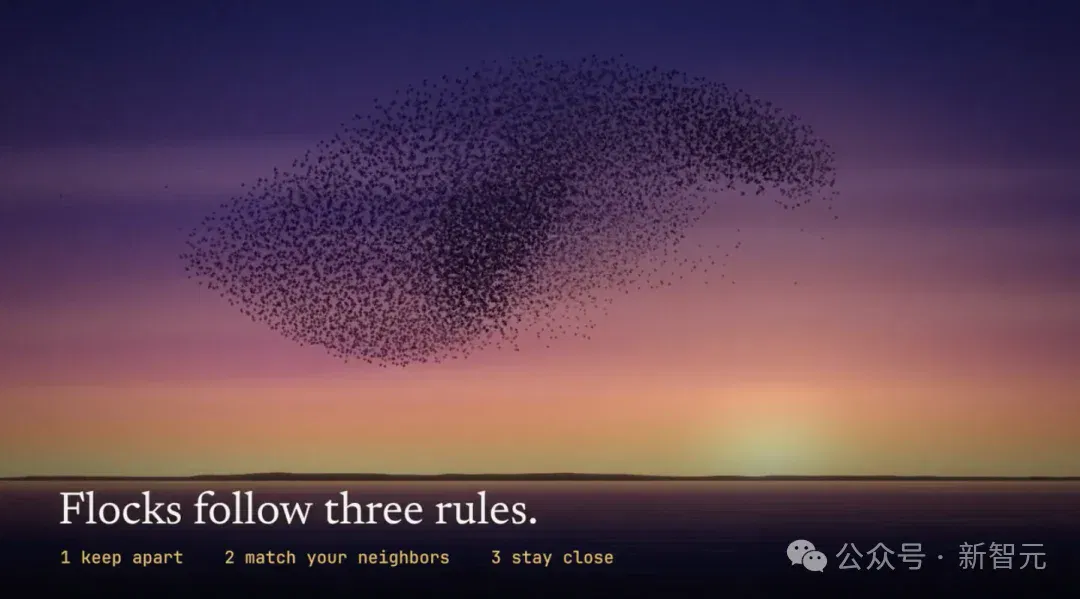
A flock needs only three rules. Screenshot from a Fable 5.2-generated video, with visuals produced through code.
He also feels some unease.
Jagged AGI excites him, but he does not know how long this stage will last. He expects comparable OpenAI and Google models soon.
One thing is clear: as more and more execution and collaboration are delegated to agents, a crucial judgment for humans is when to let an agent continue refining its work and when to tell it to stop and deliver.
Making things bigger gets easier for AI; deciding when to stop still needs human oversight.
Until AI learns proportion, people’s most valuable work may be telling it to stop.
References:
https://www.oneusefulthing.org/p/fable-52-and-jagged-agi
https://www.anthropic.com/claude-fable-and-mythos-5-2
This article was originally published by Xinzhiyuan. Author: Yuanyu.
Related topics
After reading
Join the AINRK community
Read how to join the community and connect with people working in AI.
Related articles
Continue reading related topics and articles in this category.

Claude Code desktop opens theme mods for colors and animated customization (opens in a new tab)
The article describes natural-language creation of visual mods and official theme examples, alongside comparisons with other coding tools. Support varies by version and plugin; appearance and comfort differ across people and devices.

Anthropic updates supported-region terms, clarifying entity control and usage restrictions (opens in a new tab)
The terms restrict users’ locations, entities’ incorporation or headquarters, and majority ownership or control. Their specific application depends on the terms and product documentation.

Claude 推出表格与白板工具,更新数据分析和应用连接 (opens in a new tab)
Anthropic 公布 Claude Sheets、Whiteboards 及 Data 更新,覆盖表格编辑、团队构思和数据解读。部分能力分批推出,连接器及账号条件各有不同。

Anthropic 启动 IPO 路演,拟发行 8.25 亿股 (opens in a new tab)
Anthropic 公告披露拟以每股 70 至 78 美元发行 8.25 亿股,并安排约 260 亿美元私募配售。最终发行价格和规模仍待确定。
据报 Anthropic 斥资 34 亿美元锁定数据中心发电设备 (opens in a new tab)
《金融时报》称,Anthropic 与 OnePWR Solutions 达成约 1.7 吉瓦重型发电设备供应交易。报道还提到安装能力与数据中心用电需求。