Anthropic updates supported-region terms, clarifying entity control and usage restrictions

The terms restrict users’ locations, entities’ incorporation or headquarters, and majority ownership or control. Their specific application depends on the terms and product documentation.
Editorial correction (November 13, 2026): The scope of restrictions was checked against Anthropic’s official supported-region and usage policies. Unverified claims about account-ban detection mechanisms, inevitable bans and revenue equating to technology leakage have been corrected.
Anthropic updated its supported-region and usage policies, effective November 12, 2026. The change in terms alone does not establish that a coordinated wave of account bans—the “strictest ever”—occurred.
The company also introduced a new risk-control policy explicitly prohibiting use from unsupported regions.
The new rules take effect on November 12.
Anthropic recently released a model and advanced its listing plans. The official Fable 5.2 release page is dated November 9; it should not be described as having launched the day before November 12.
For developers, however, the real bombshell was this third move.
November 12: three red lines
Why call this the toughest policy ever?
Because, in the author’s telling, Anthropic has abandoned restraint and taken direct aim at all the usual routes used by many users.
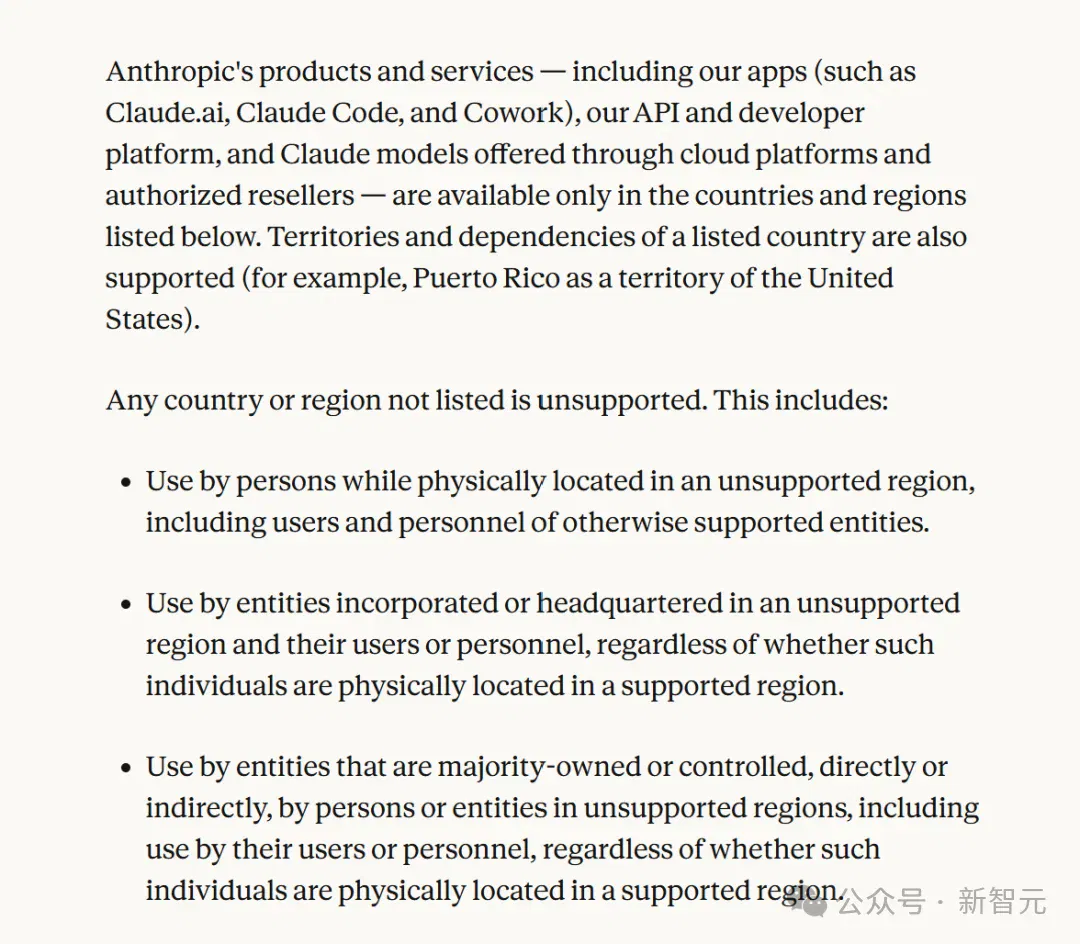
The new rules explicitly state that any country or region not listed is unsupported, including these three situations:
First, use while the user is physically located in an unsupported region, including users and personnel of otherwise supported entities.
Second, use by entities incorporated or headquartered in an unsupported region, or by their users or personnel, regardless of whether those individuals are physically located in a supported region.
Third, use by entities directly or indirectly majority-owned or controlled by individuals or entities in an unsupported region, including use by their users or personnel, regardless of whether those individuals are physically located in a supported region.
In plain language:
First, it looks at “where you are” (physical location).
If you are physically in an unsupported region, use is prohibited even if you work for an otherwise compliant multinational company.
Second, it looks at “where your company is” (incorporation or headquarters).
If the company is headquartered in an unsupported region, use is prohibited even if the employee is physically in the United States.
Third, it looks at “who is behind the business” (ownership or actual control).
The author considers this the most sweeping provision: if your entity is “directly or indirectly majority-owned or controlled” by individuals or companies in an unsupported region, the prohibition applies across the entity.
Actual application depends on the official list of regions, an entity’s majority ownership or control, and the specific terms of service. This does not guarantee that any particular account will be banned.
The new rules also explicitly prohibit forwarding requests through consumer subscriptions, barring resale and proxy services.
Security monitoring and data retention should be understood in the context of the specific product, contract and privacy notice. A particular retention period cannot simply be treated as a new account-ban mechanism.
The official provisions specify regional and usage restrictions. This article does not provide enough public evidence to determine whether past risk controls checked only IP addresses or which behavioral signals are now used.
Data retention conditions can differ between products and require consulting the relevant official documentation. There is no basis here for treating “30 days” as a uniform new monitoring rule across all products.
There is no public basis for asserting the conditions under which call time zones, languages or concurrent use of multiple accounts will inevitably trigger a ban. Speculation should not be presented as a confirmed mechanism.
Why take such a drastic step at this moment?
Why would Anthropic, on the verge of going public, take such a drastic step now?
The author says the answer lies in Anthropic’s IPO filing (S-1).
The document disclosed that over the past nine months, 5% to 7% of Anthropic’s revenue came from customers subsequently determined to be “noncompliant”.
Revenue from customers violating supported-region or usage policies does not mean core technology has leaked. That inference cannot be drawn from the revenue share alone.
Attributing the policy update entirely to an IPO or efforts to prevent technology leakage is the author’s speculation, not a conclusion established by the terms cited here.
And November 12 was simply the final moment.
Developers now face outcomes ranging from rate limits and warnings to disconnection and permanent account bans.
The author urges readers to back up and export all prompts and conversations immediately.
Then put a plan B in place and look for compliant alternatives.
As Anthropic prepares to ring the listing bell, the author concludes, it has turned account bans into a business of their own.
References:
https://www.anthropic.com/legal/supported-regions
https://www.anthropic.com/legal/aup
This article comes from “Xinzhiyuan” and was written by “Aeneas”.
Related topics
After reading
Join the AINRK community
Read how to join the community and connect with people working in AI.
Related articles
Continue reading related topics and articles in this category.

Mollick on agent collaboration: why improving 3D worlds turned into lengthy approvals (opens in a new tab)
Ethan Mollick describes repeated themes, expanding rules and subsequent adjustments in Fable 5.2 multi-team creation. He argues long-running execution still needs human judgment about work quality, purpose and when to stop.

Claude Code desktop opens theme mods for colors and animated customization (opens in a new tab)
The article describes natural-language creation of visual mods and official theme examples, alongside comparisons with other coding tools. Support varies by version and plugin; appearance and comfort differ across people and devices.
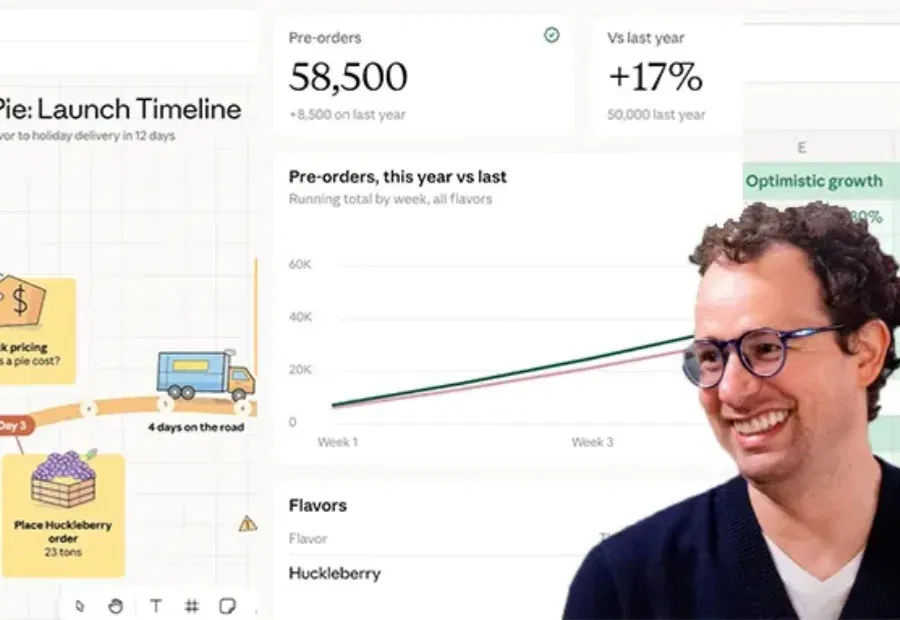
Claude 推出表格与白板工具,更新数据分析和应用连接 (opens in a new tab)
Anthropic 公布 Claude Sheets、Whiteboards 及 Data 更新,覆盖表格编辑、团队构思和数据解读。部分能力分批推出,连接器及账号条件各有不同。

Anthropic 启动 IPO 路演,拟发行 8.25 亿股 (opens in a new tab)
Anthropic 公告披露拟以每股 70 至 78 美元发行 8.25 亿股,并安排约 260 亿美元私募配售。最终发行价格和规模仍待确定。
据报 Anthropic 斥资 34 亿美元锁定数据中心发电设备 (opens in a new tab)
《金融时报》称,Anthropic 与 OnePWR Solutions 达成约 1.7 吉瓦重型发电设备供应交易。报道还提到安装能力与数据中心用电需求。