Bessemer and Bain survey healthcare AI returns: administration outpaces clinical uses
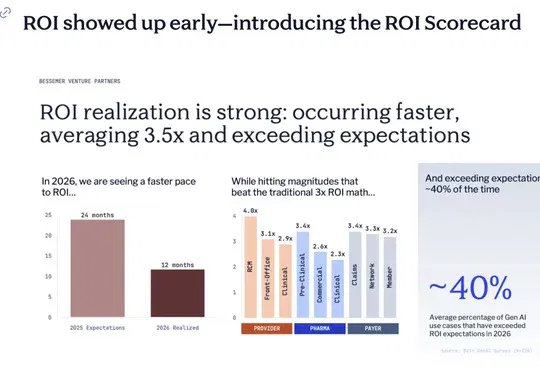
A survey of 226 executives reports average returns of about 3.5x, with higher returns in revenue-cycle management and lower returns in clinical development. Sample definitions, evaluation windows and long-term clinical outcomes must be distinguished.
Editorial correction (November 16, 2026): ROI figures reflect the survey sample and report definitions, not returns or clinical efficacy for every deployment. Annual healthcare spending is not the same as revenue available to AI.
How much has AI investment returned for providers, insurers and pharmaceutical companies?
Leading US venture firm Bessemer (Bessemer Venture Partners) and consultancy Bain (Bain & Company) recently released The 2026 Healthcare AI ROI Scorecard to address that question.
The report surveys 226 healthcare executives, comparing providers, payers and pharmaceutical companies to track 2026 returns on AI investment.
It finds returns arriving sooner and higher than expected: realized after 12 months rather than the anticipated roughly 24, averaging 3.5x, with about 40% of use cases exceeding expectations.
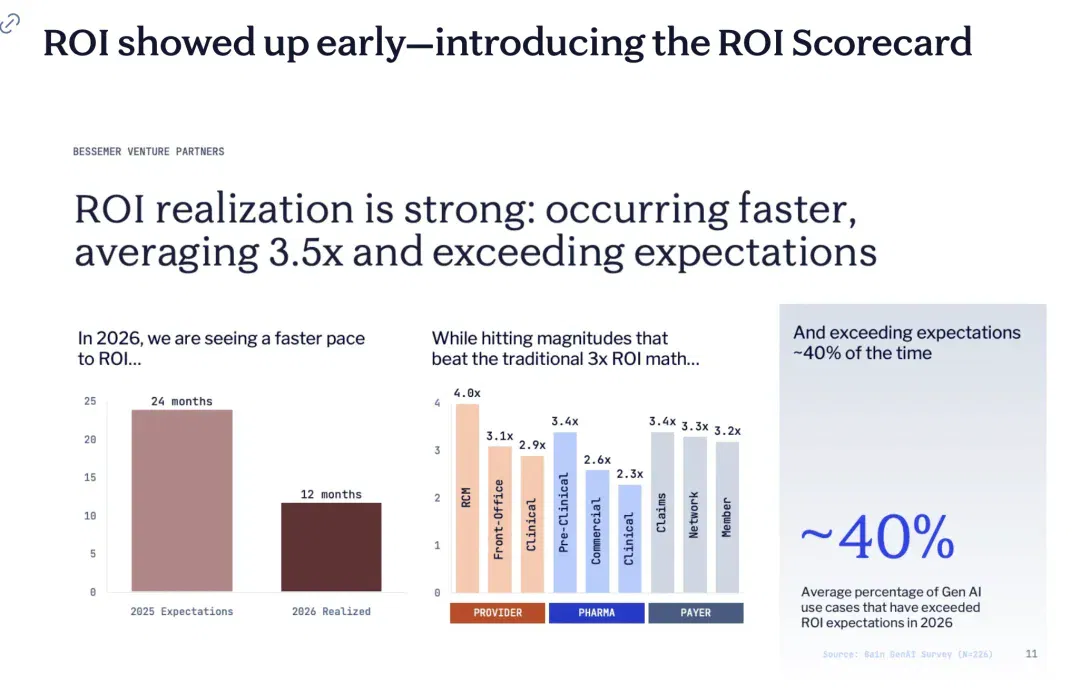
Differences are substantial, however: mature administrative processes show the highest returns, clinical settings the lowest.
Three scorecards: back-office work leads, clinical work trails
Bessemer says all surveyed business areas meet or approach companies' required 3x threshold. The decision is shifting from whether to invest to which areas deserve priority.
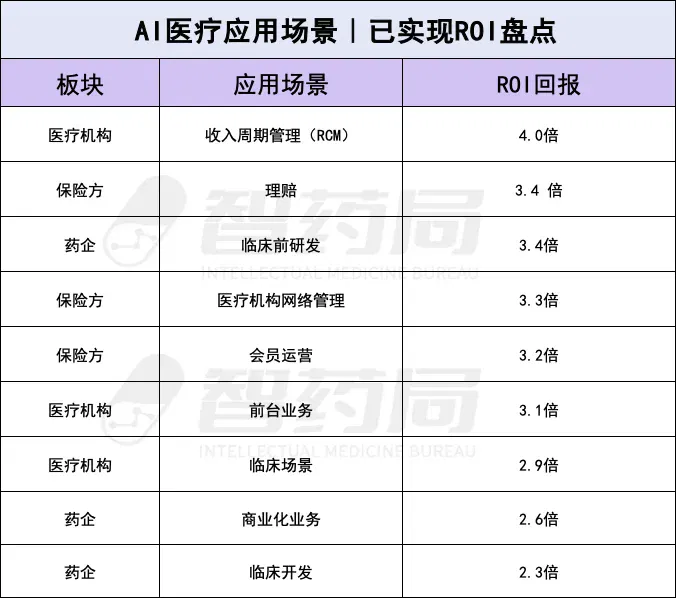
Providers' revenue-cycle management (RCM) leads with 4x ROI, while clinical applications return 2.9x, below the 3x threshold.
Clinical value is harder to calculate. The report says benefits mainly come from improved decisions and care, with little contribution to labor savings or revenue growth.
However, when it comes to decision-making, although AI has already been embedded in workflows, it has not earned trust. Only 46% of healthcare workers would trust AI-assisted clinical decision-making. And 77% of medical staff say that more than half of the recommendations AI provides are rejected outright.
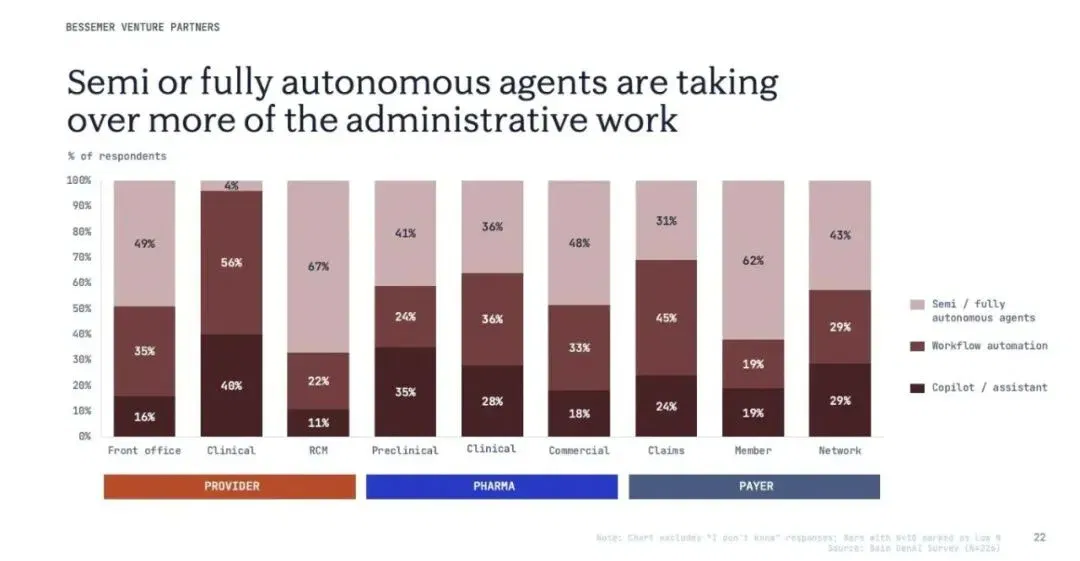
The RCM/clinical return gap also appears in adoption.
About two-thirds of RCM staff use semiautonomous or autonomous agents, versus only 4% in clinical care.
Responsibility partly explains this. Fifty-eight percent of providers believe attending physicians should bear primary responsibility for AI-assisted diagnosis and treatment, and liability concerns hinder wider adoption.
Reimbursement is another obstacle. About 48% of payers oppose covering fully autonomous AI care, versus only 5% opposing physician-reviewed AI-assisted care.
Therefore, expanding the use of clinical AI requires answering several questions at the same time: Are AI recommendations reliable? Who takes responsibility when something goes wrong? Who bears the cost of the service?
Where the next AI expansion may occur
Pharmaceutical returns are developing most slowly among the three sectors, with clearer benefits concentrated upstream in the pipeline.
Preclinical R&D returns 3.4x, tied for second with insurance claims and also pharma's most widely adopted AI area.
More specifically, preclinical molecule identification and structural design have generated returns near 5x.
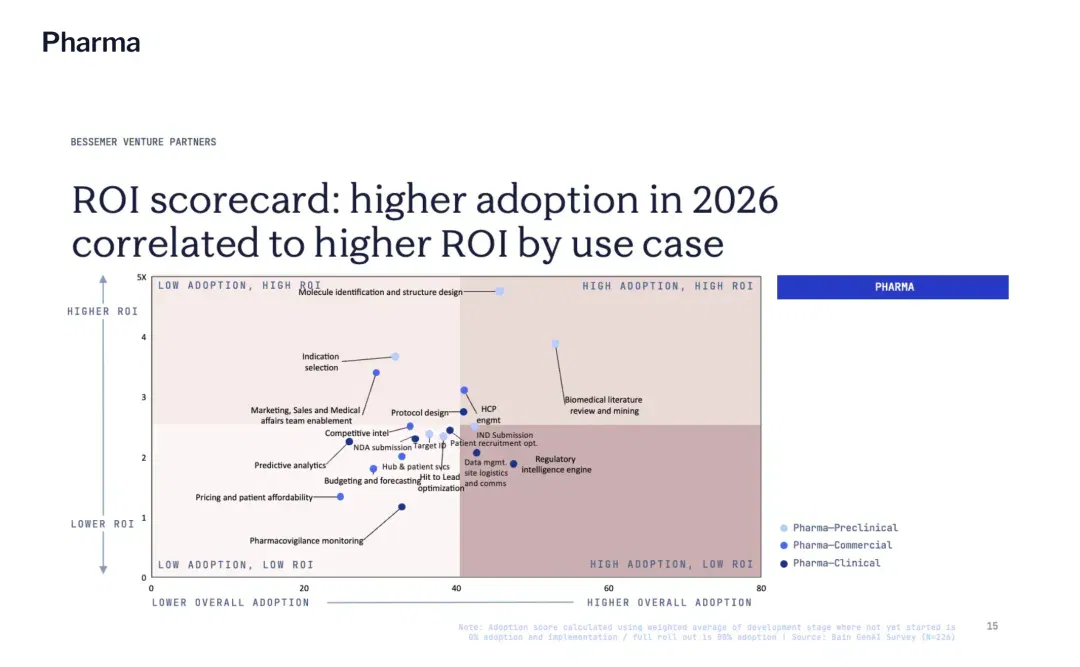
Y-axis: return on investment
X-axis: industry adoption
Clinical development averages only 2.3x, last in the ranking and below the expected 3x threshold.
A major reason is drug development's duration, far beyond a one-year evaluation window, making attribution difficult.
AI can show efficiency gains relatively early in upstream stages such as molecular design. But once drug candidates enter clinical trials, their safety and efficacy still need to be validated, and the ultimate returns often cannot be confirmed until years later.
Lower current clinical-development returns do not mean lower long-term value. Preclinical work accounts for only about one-quarter of pharma R&D spending, with more investment downstream.
That spending share does not guarantee AI value will shift to clinical development. Candidates must still demonstrate safety, efficacy and economic viability; whether and when returns materialize remains uncertain.
As returns become clearer, another question emerges: who supplies these capabilities?
Over the past year, enthusiasm for in-house AI has declined. Sixty-one percent of organizations say half or fewer of their internally built tools remain maintained and used. The in-house-development share fell 16 percentage points, while healthcare-specific AI vendors gained 12 points.
The report expects buyers to seek solutions from AI startups, scaled companies and AI labs over the next decade.
Among them, AI labs merit particular attention. Though adoption rose only two percentage points, pharma views them as its future preferred partner type, with the highest favorability among buyer groups.
Annual healthcare spending and potential AI opportunities
The report discusses transformation across administration, clinical services and medicines. The approximately $4.5 trillion cited totals spending in those areas; it is not directly the revenue AI services could obtain.
$1 trillion: administrative disputes
US healthcare administration costs about $1 trillion annually, roughly $260 billion of it waste. Much comes from repeated provider–payer negotiations over authorization, denials and appeals. AI on both sides may improve each organization's efficiency while still performing essentially the same work twice.
The true trillion-dollar-scale value would be eliminating such processes.
This requires intermediary AI vendors capable of serving both the supply and demand sides simultaneously. It also requires redesigning the accompanying incentive mechanisms, and the latter is not something AI can solve on its own.
$3 trillion: clinical services
This is the largest opportunity and one most likely to emerge first.
US medical-service spending is about $3 trillion annually, growing roughly 5%, while staffing shortages widen. The Association of American Medical Colleges projects a shortage of up to 86,000 physicians by 2036.
Greater shortages increase AI's appeal, but doctors' and patients' trust requires clearer responsibility first.
$500 billion: drug development and distribution
US drug spending is about $500 billion annually, with pharma R&D around $150 billion. AI currently adds value upstream, but candidates still face safety, efficacy and accessibility tests in clinical development.
Longer downstream realization times are the largest bottleneck in this opportunity.
Each area faces a different next-stage barrier: administration must reduce repetitive disputes, clinical care needs trust and accountability, and drug development needs shorter validation cycles.
Model upgrades alone cannot solve every deployment problem.
Closing thoughts
At its conclusion, the report notes that outside healthcare, AI agent teams have already established a standard infrastructure stack, including evaluation, performance monitoring, safety guardrails and agent orchestration.
Average 3.5x returns give buyers reason to keep investing. The next question is whether AI can move beyond validated billing and claims use cases to deliver greater value in care and drug development.
This article comes from the Zhiyaoju WeChat account. Author: Zhiyaoju.
After reading
Join the AINRK community
Read how to join the community and connect with people working in AI.
Related articles
Continue reading related topics and articles in this category.
AI医疗拐点!麦肯锡重磅报告:调研150位高管,Agent全面爆发,行业竞争逻辑已定! (opens in a new tab)
近日,麦肯锡发布了关于“生成式人工智能在医疗领域的应用”的报告。报告调研覆盖150家医疗保健机构的领导者,具体包括50家医疗支付方、50家临床医疗机构和50家医疗健康服务与科技企业,覆盖医疗各细分领域,样本具有代表性。

医疗AI智能体全面综述:行业爆发,年增长130%! (opens in a new tab)
AI智能体正把医疗AI从「看片子」升级成会思考、能行动的「医生搭档」。研究人员发表的最新综述,用通俗语言拆解智能体如何读懂多模态数据、像专家一样规划决策,又能扮演医生、护士、健康管家等多重角色;同时提醒:越智能越危险,必须配套严格评估、隐私保护与伦理护栏,才敢让它走进真实诊疗。
700位医疗高管告诉你,为什么AI最先跑通的是医疗? (opens in a new tab)
医疗机构选择AI,只看这三点。很长时间里,医疗始终被认为是新兴技术应用里最难啃的阵地。 就拿医疗数字化来说,就走得极为不容易。在当下7400亿美元的美国医疗管理支出中,IT 预算仅占630亿美元。
超40亿美元!AI医疗交出最强一季度成绩单,这6家领跑全球! (opens in a new tab)
近日,知名风投机构Rock Health发布了“2026年第一季度融资概况”,报告显示:数字医疗领域在2026年第一季度获得了40亿美元的风投资金,比去年同期高出10亿美元,创下疫情高峰以来最强劲的第一季度。

Menlo Ventures发布报告: 4.9万亿美元医疗市场AI渗透率7倍飙升 (opens in a new tab)
在过去数十年里,医疗行业一直被认为是数字化的“落后者”,技术创新迟缓,采购周期漫长。但今天,情况彻底反转。