Baidu Famou 3.0 debuts, bringing continuous optimization into enterprise R&D and production
Baidu World presents materials, chip and apparel cases that connect data, algorithm search, independent validation and human review in feedback loops. Results are those disclosed by the teams.
AI self-evolution (RSI) has hit the accelerator since the beginning of the year.
From writing code to designing experiments and running tests, AI is gradually entering the core processes of AI research and development. When AI uses the resulting research to improve the next generation of AI in turn, a self-accelerating path of technological evolution begins to emerge. This is precisely why the concept of RSI is attracting attention and continues to grow in popularity.
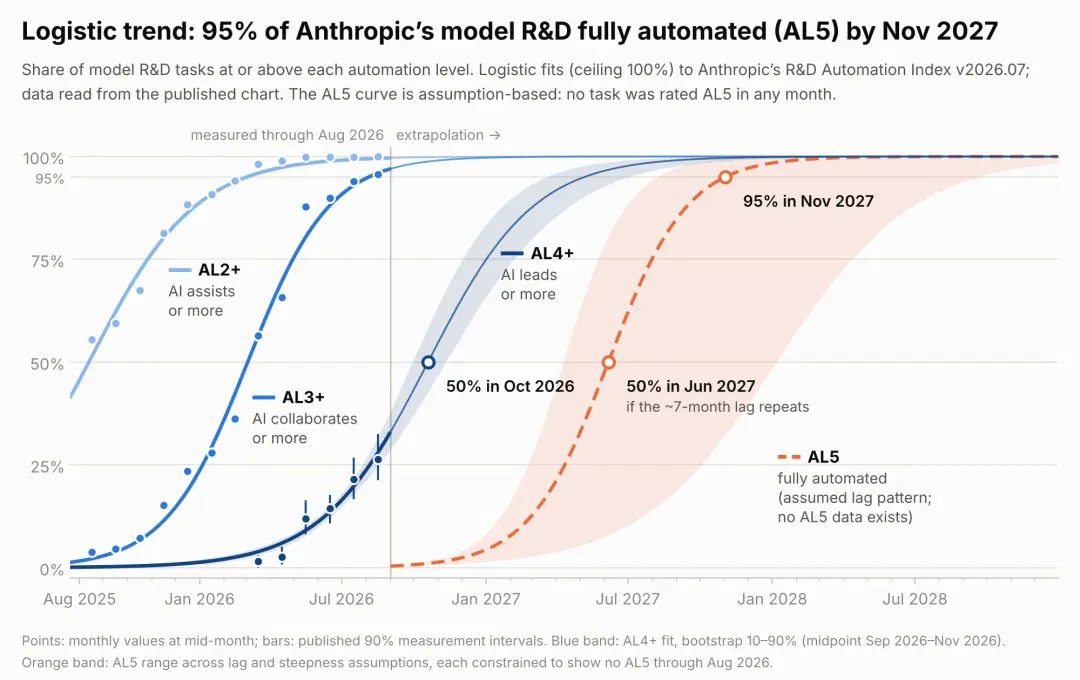
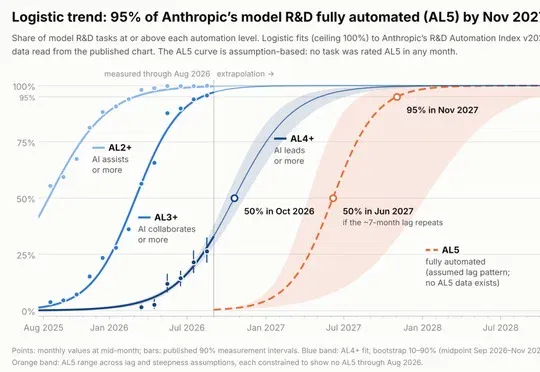
On November 10, the AI Futures Project team extrapolated trends from the changes in R&D automation levels published by Anthropic and offered a fairly aggressive judgment: a Superhuman AI Researcher (SAR) could emerge at the end of 2027. [1]
However, progress in automating AI R&D does not mean this mechanism can be copied directly into the real world. In an interview, Google DeepMind co-founder and chair Hassabis cautioned that the real world is much more complex than environments with relatively clear rules, such as games and laboratories. Every action AI takes may have unexpected results, making verification and control more difficult as well. [2]
The complexity of the real world ultimately shows up in how enterprises organize themselves. Once AI enters a company's core business, its impact goes beyond whether a particular task can be completed faster; it may also change how the entire business chain operates.
On November 12, at Baidu World 2026, Baidu founder Robin Li placed this change in a broader industrial perspective. He argued that AI's next act is "intelligent organizations," and that AI is not only a technological revolution but also an organizational revolution. The changes AI brings extend from efficiency improvements in individual jobs to the division of tasks, accumulation of knowledge, and collaboration within enterprises.
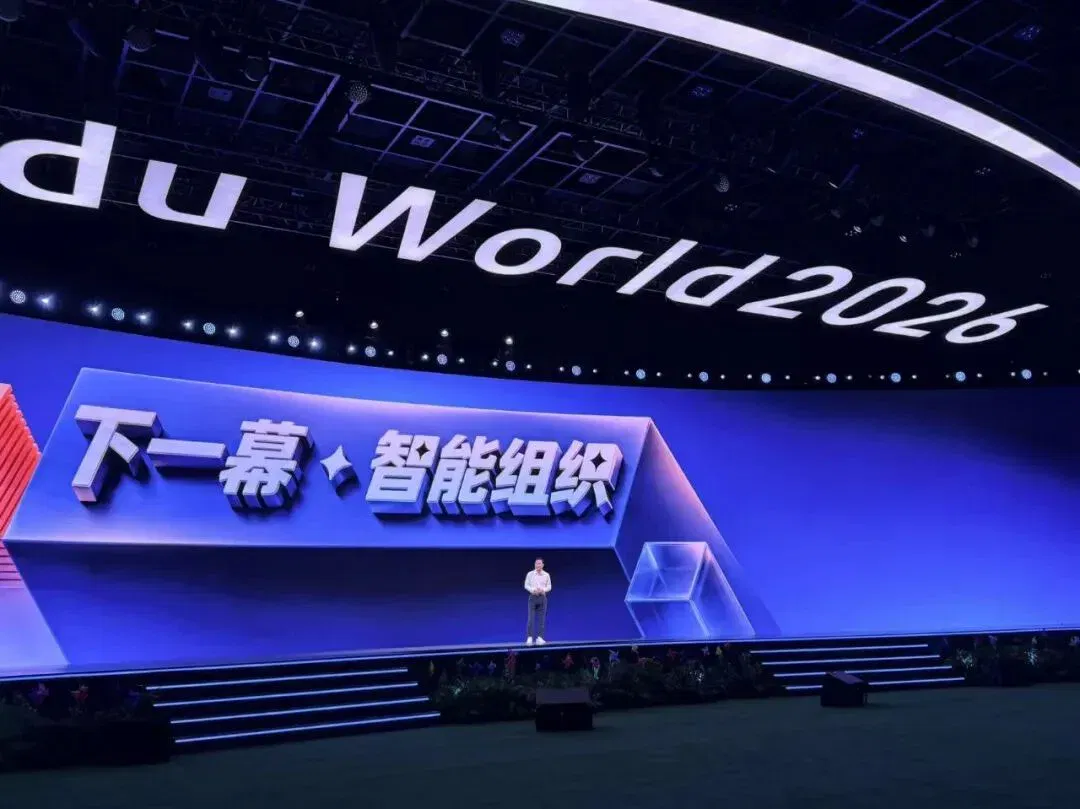
Robin Li
Baidu has made a new move toward deploying AI self-evolution at scale. Famou 3.0, the self-evolving super agent from Baidu AI Cloud, has officially made its debut, further connecting business data within enterprises so AI can enter production, R&D, and business-operation systems and be tested on the front lines of industry.
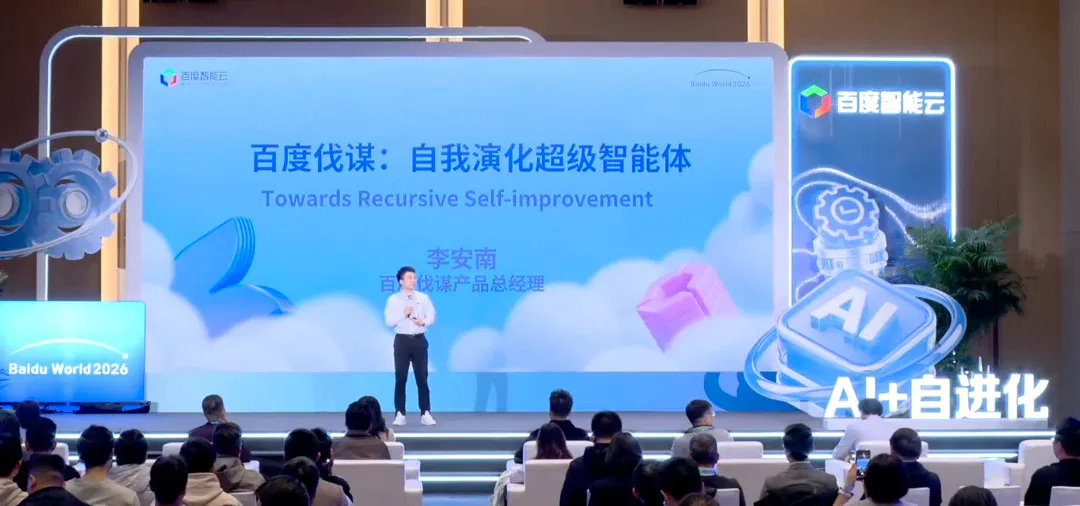
This RSI exploration did not stop at enterprise production. At the "AI + Self-Evolution" session organized by Baidu AI Cloud together with research institutions and industry partners, guests from materials, chips, nuclear fusion, quantum computing, apparel manufacturing, and other fields gathered to share practical work involving AI in research, engineering design, and industrial optimization.
From enterprise production to scientific discovery, AI self-evolution is entering more and more activities that previously depended on specialist talent and years of experience. The next key is to make experiments and engineering validation keep pace with the generation of approaches, shortening the distance from research ideas to practical results.
From automatic optimization to continual learning
AI self-evolution leaves the laboratory
Benchmarks have almost become the yardstick for measuring AI capabilities in recent years. When a new model is released, people often look first at its leaderboard position. Standardized questions, clear rules, and relatively stable scoring criteria let researchers quickly judge whether a model has improved.
But in the view of Annan Li, general manager of Baidu's Famou product, AI self-evolution faces a bigger question: can AI keep solving real-world problems? He divides his understanding of RSI into three stages:
The first stage is Auto Research: automated research and continuous optimization. Given a relatively clear objective, AI finds better solutions through repeated attempts, evaluation, and adjustment. Most self-evolution practices in the industry are still at this stage, and many of Baidu Famou's previously deployed cases also fall into this category.
The second stage is continual learning. Once a system enters the real world, the situation becomes much more complex. The objectives and constraints of many problems are themselves changing, and good results in an experimental environment may not be reproducible in reality. AI needs to keep revising its judgments based on real experiments and production data, adapting to a changing environment.
Only the third stage comes closest to the fully autonomous self-evolution people imagine. AI improves itself and turns those improvements into more general capabilities, driving continued progress in subsequent R&D. This is a longer-term direction, and most results in the industry have not yet reached this stage.
The three stages come with changes in the division of labor between people and machines. Annan Li draws an analogy with the technological evolution of the textile industry. The spinning jenny increased one person's output, but people still had to operate the machine. Only with the arrival of Arkwright's water frame did machines take on more continuous production work, while people gradually shifted toward process design, quality inspection, and handling exceptions.
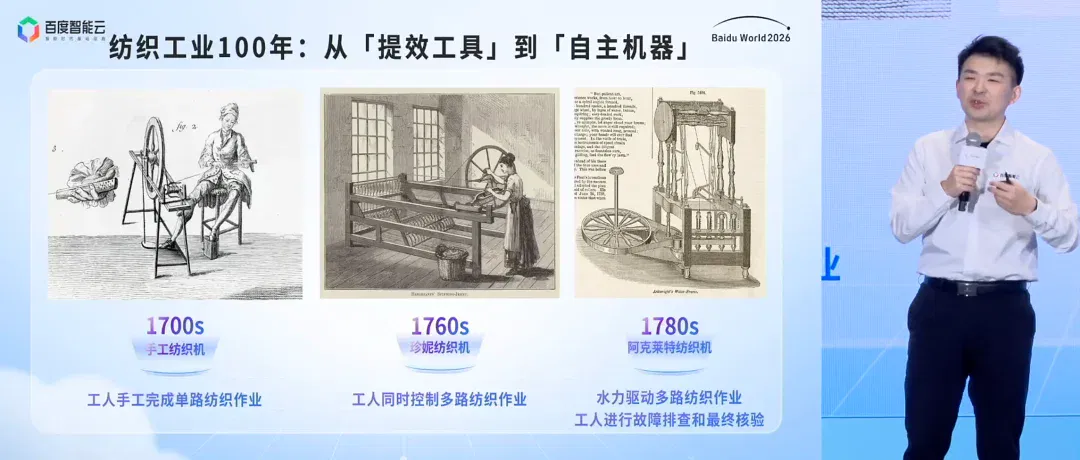
Today's AI is going through a similar change. People step back from each specific operation and take more responsibility for setting objectives, establishing standards, and supervising results. At the "AI + Self-Evolution" session, we saw different attempts to make this change in real environments.
Take new-materials R&D as an example. To produce a material with better performance, researchers need to repeatedly adjust raw-material proportions and preparation processes, then test the results through experiments. Even after an initial approach is available, further improvements in performance and reductions in cost still depend heavily on experienced specialists' know-how.
Xinyan Zhicai co-founder and CTO Kai Nan explained that the team is trying to bring AI into multiple stages of materials R&D. In screening formulations for thermally conductive gels, for example, thermal conductivity, viscosity, CTE, modulus, and other metrics constrain one another. SynMat Research 3.0, a specialist agent for the wider semiconductor-materials field, first breaks down the R&D objectives, predicts different material-ratio approaches, and then progressively screens candidate formulations. Once the work enters the experimental stage, the system also analyzes the results and recommends the next round of optimization.
For new materials whose R&D paths are not yet clear, the team has also built the MARS platform, allowing AI to autonomously find material directions worth studying. A "design–execute–validate" loop eliminates wrong directions, proposes candidates, designs experiments, and continues exploration based on experimental feedback. Xinyan Zhicai has also partnered with Baidu Famou, assigning Famou the optimization tasks for specific models and parameters within the MARS platform. Breakthroughs related to MARS are being developed into two high-level academic papers that are in the submission process.
In addition, Xinyan Zhicai showed a preview of SCALE 1.0 for the first time at the conference. This next-generation materials foundation model is based on a world-model architecture, jointly modeling material structures and real environmental variables such as temperature, density, and even human operations to achieve a one-to-one correspondence with wet-lab results. A full technical blog post is reportedly due to be released soon.
Nuclear fusion brings AI self-evolution into an even more complex physical environment.
Xingneng Xuanguang CAIO Ge Wang explained that an experiment in a fusion device may take only a few minutes, while a complete device-level physical simulation may take more than ten days. Researchers need both to calculate the state of the plasma and to infer internal parameters such as temperature and density from data collected by diagnostic equipment. A gap between simulation and real experiments remains.
To address this, the team introduces AI surrogate models that reduce some equilibrium calculations to milliseconds, at least 100 times as fast as traditional physical simulation. At the same time, it is building a digital-twin system that brings device data, physical simulations, and real-time diagnostic data into the same environment. Measurements from actual experiments can in turn calibrate the physical model, providing a basis for the next round of calculations and experiments.
One change worth watching is that AI is generating approaches faster, while R&D bottlenecks are extending into experimental validation, engineering implementation, and feedback from real data. Those who can truly connect these stages have an opportunity to move AI from one-off automatic optimization toward continual learning over longer periods.
Famou 3.0
Connecting the self-evolution loop to business systems
To move from the laboratory into industry, AI first has to get through the enterprise itself.
Enterprise data are often scattered across production, R&D, and business-operation systems, while different departments have their own business rules and experience. Even when a company knows where a problem lies, bringing this information together so AI can calculate a feasible approach is not easy. What Baidu Famou 3.0 aims to do is organize and connect this scattered information and these business rules.
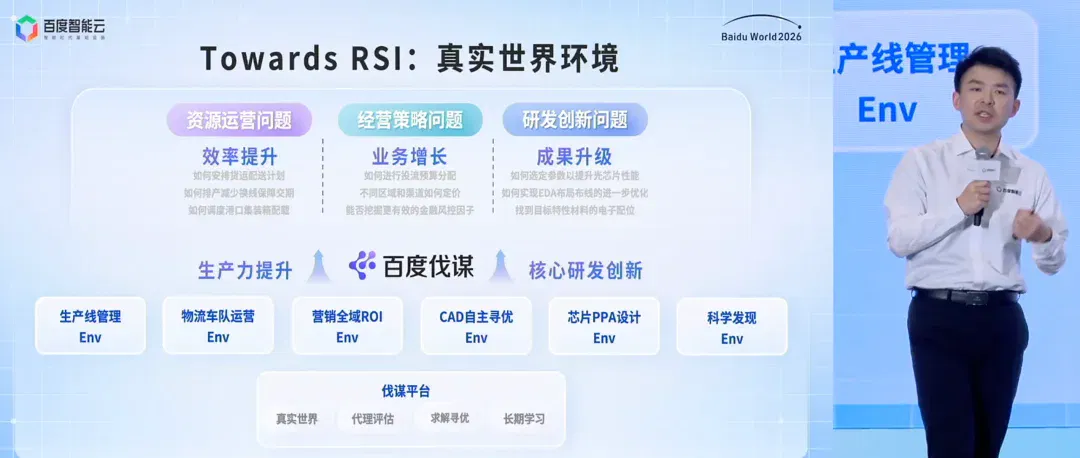
From clarifying business problems to putting approaches into practice, Famou 3.0's operation can be broken into the following key stages:
Before asking AI to find a solution, first understand the business problem. FDEs (forward-deployed engineers) go deep into customer sites and work with business experts to map production processes, data, and constraints, turning scattered business experience into problems that algorithms can handle.
Once the problem is clear, the system tries different algorithms and strategies around the established objective, generates candidate approaches, and gradually searches for better results through multiple rounds of search and comparison.
Next, the candidate approaches enter an independent validation environment and are tested according to preset rules. Finally, an approach enters production, and new business data bring about the next round of optimization.
Famou 3.0's multiple rounds of AI optimization are entering more specialized engineering fields, with chip design among them. Lixin Technology Chairman and Chief Scientist Jianli Chen shared a related practice.
Placement and routing in chip design require finding suitable positions and connections for large numbers of transistors. A chip may involve a hundred or more optimization objectives; area, performance, timing, and other metrics constrain one another, while the number of parameter combinations is enormous. Engineers need to repeatedly run EDA tools to find a relatively suitable approach.
Lixin Technology and Baidu Famou chose clock-tree synthesis in chip design as their entry point for optimization. Using EDA tools, real design scenarios, and evaluation criteria, they continually search for better parameter combinations and optimization strategies.
In two test cases, the optimization iterations originally requiring 29 and 36 runs were reduced to 11 and 20, respectively. Ineffective exploration also decreased, substantially reducing engineers' repeated parameter-tuning workload.
Chip design tests specialist expertise and complex computation, while apparel manufacturing faces a different problem: how to bring AI into traditional enterprises' production processes.
Shenfu Technology CEO Sisi Wu shared the experience of its AI pattern-making product, Huayiyi. Garment pattern-making is highly dependent on experience. An experienced pattern-maker's designs may be stored in CAD files or USB drives, or may exist only in their own experience. At the same time, industrial pattern-making requires millimeter-level precision; generating an attractive clothing image does not mean it can be used directly in production.
Shenfu Technology's AI pattern-making product, Huayiyi, attempts to turn experienced pattern-makers' accumulated know-how into digital capabilities. In the past, a skilled pattern-maker could make only two patterns a day; now, the time to make one can be shortened to about 10 minutes, while the output remains in a standard CAD format.
Improved technical capability is only the first step. Working with Baidu Famou, Shenfu Technology uses FDEs to go deep into different apparel companies and deploy AI pattern-making for different business scenarios, including foreign trade, e-commerce, and brands.
Sisi Wu also points to a longer-term goal for the partnership: C2M. As AI pattern-making gradually enters actual production, consumer needs, design approaches, and production feedback could become more closely connected, allowing AI to continually improve through accumulating industry data and practical experience.
Looking across these cases, a common trend becomes clear: AI is entering business processes previously led by specialists and taking over work within them that can be computed, validated, and repeatedly optimized. This is an important difference between Famou 3.0 and earlier automatic-optimization tools.
However, once AI enters a real production environment, it must pursue optimization while also ensuring that the entire process is secure, stable, and controllable.
Famou 3.0 retains human review, algorithm-version backups, and rollback mechanisms. AI can explore autonomously and generate approaches, but humans have the final say on whether they go live. For validated optimization results, the system also distinguishes customer-specific business strategies from methods that can be accumulated as general capabilities.
A further practical challenge is how to reduce long-term service costs. If every customer needs FDE engineers stationed on site for long periods, deployment at scale will be constrained. In the future, the Famou team hopes to gradually increase the share of autonomous agent operation, leaving people more responsible for management and supervision.
Intelligent organizations
need an intelligent cloud
In the past, when a company wanted to do something better, it depended on people familiar with the business to explore repeatedly. Valuable experience was hidden in different people's heads, and a method one person discovered could hardly be turned immediately into a capability the whole team could use. If personnel changed or the business shifted, accumulated experience could again become ill-suited to the situation.
Baidu founder Robin Li's proposal for "intelligent organizations" seeks to change precisely this situation. He further summarizes three main principles of organizational evolution: break down job boundaries so organizations reorganize collaboration around tasks; accumulate tacit knowledge, turning expert experience into capabilities the organization can call upon; and design closed-loop processes so business results drive continuous improvement.
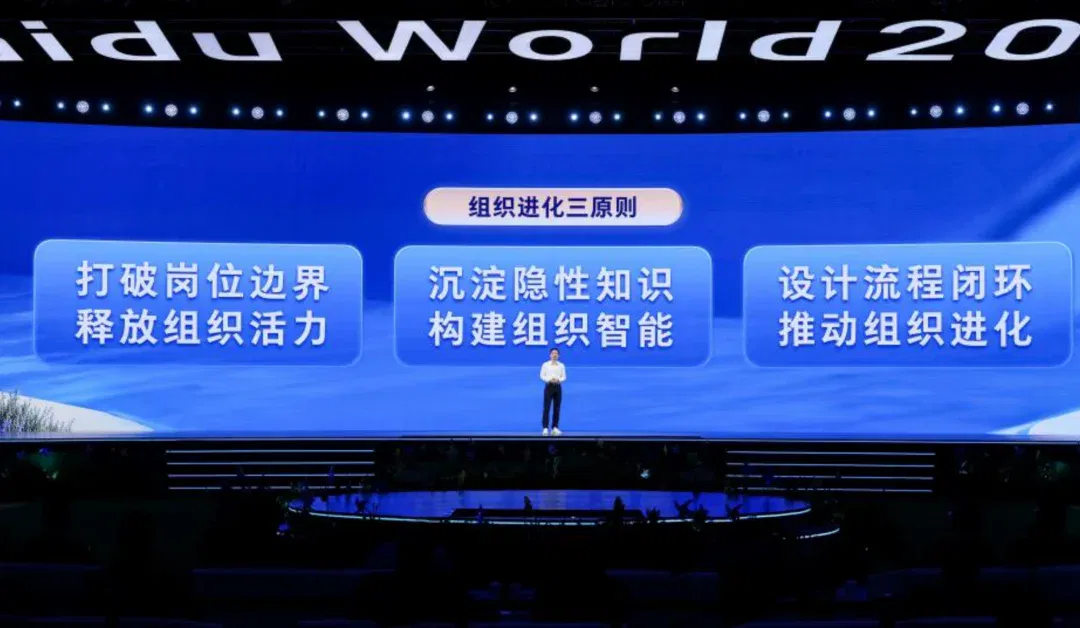
In intelligent organizations, agents take on different parts of a task. Enterprises consolidate experience accumulated by employees and experts into organizational knowledge for subsequent tasks to draw on. Working methods once held by individuals thereby become reusable organizational capabilities.
Over a longer horizon, the large-scale arrival of agents in enterprises is also pushing cloud computing to redefine its role. For cloud providers, compute scale remains important, but whether they can bring agents into enterprises' core businesses securely and reliably will become an important dividing line in the next stage of competition.
Traditional cloud services mainly organize computing, storage, and networking resources around enterprise IT systems. Once agents enter the business, the cloud faces more specific work: a procurement task, a round of production optimization, or a business decision may all require models, data, tools, and multiple agents to work together.
Baidu Group Executive Vice President and President of Baidu AI Cloud Business Group Dou Shen sums up this change as follows: the objects served by intelligent cloud are moving from "IT systems" to "specific tasks".
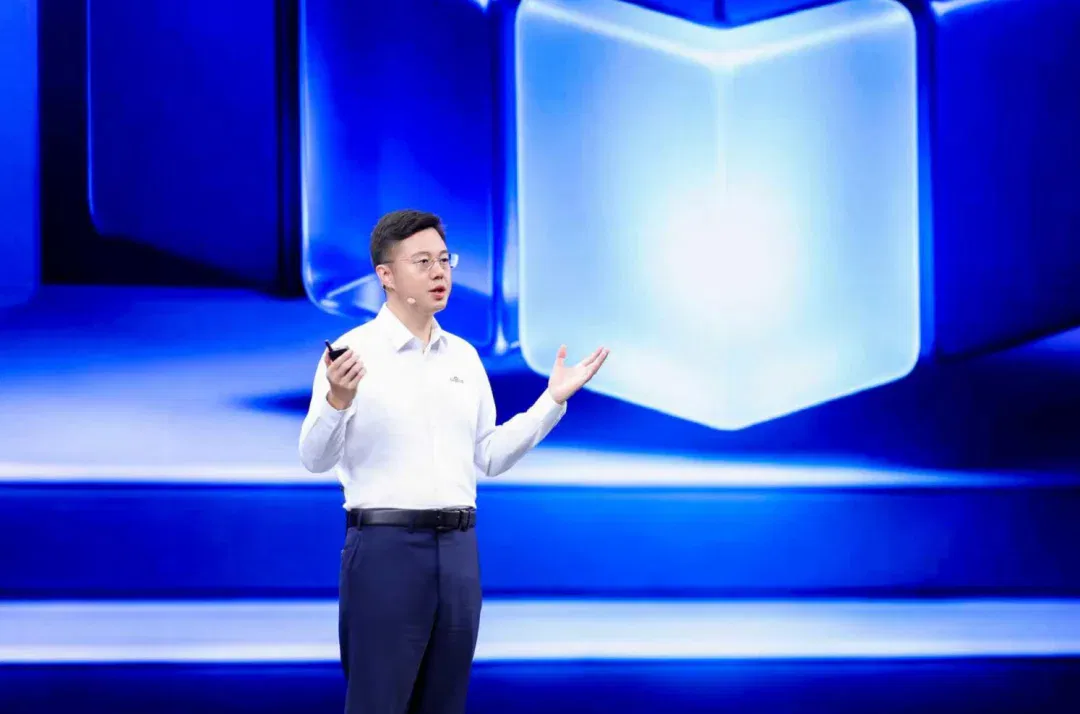
Dou Shen
Around these new intelligent organizations, Baidu AI Cloud is comprehensively upgrading its new full-stack AI cloud, divided into two main parts: Agent Infra and AI Infra.
Baidu Qianfan Agent Infra supports million-scale concurrent sandboxes. Baidu Dazi acts as a unified entry point connecting general-purpose, specialist, and customized agents. Enterprises can call specialist agents such as Famou, Yijian, and Yijing, or develop their own agents on the Dazi platform. Baidu Baige AI Infra can launch 2 million sandboxes within minutes, achieve end-to-end reinforcement-learning throughput of 52,000 Tokens per second, and keep the training–inference difference to one part in 10,000. The two have distinct roles: the former lets agents take on work and collaborate, while the latter supports model training and inference.
In Dou Shen's view, Robin Li's three principles of organizational evolution also correspond to three new standards for intelligent-cloud services: integrate compute, models, data, and security around specific tasks; help enterprises preserve and manage organizational context, turning individual experience into organizational capabilities; and support enterprises in continually closing their business-process loops through long-term service.
Looking back at earlier technological changes, electricity freed factories from dependence on steam power, while computers and the internet changed how enterprises handled information and organized collaboration. Behind every change in production methods is a set of infrastructure that evolves alongside it. Now, "intelligent organizations need an intelligent cloud."
Reference links:
[1] https://blog.aifutures.org/p/q35-timelines-update-looks-like-the
[2] https://www.axios.com/2026/01/27/models-improve-ai
This article comes from the WeChat official account "Synced," by "Synced."
Related topics
After reading
Join the AINRK community
Read how to join the community and connect with people working in AI.
Related articles
Continue reading related topics and articles in this category.
百度APP升级,办公Agent免费用! (opens in a new tab)
百度和谷歌撞车了。 智东西8月20日报道,刚刚,在百度AI Day开放日上,百度APP发布了多项产品升级,其中百度搜索在搜索结果和AI教育方向进行了优化与功能上新,同时,文心助手任务引擎2.0上线,从理解到交付全过程免费。 发布会上,百度APP研发中心负责人何径舟喊出了本次发布的初心——让每个人都能免费使用AI,让AI成为每个用户唾手可得的基础能力。 在搜索功能上,百度搜索完成了GUI的产品升级,用户搜索复杂问题时可以获得一个可直接操作的界面,更好地帮助理解。 同时,百度还升级了深度讲题教育产品文心老师的功能,其可以像真人老师一样,为用户提供动态板书、分层讲解等方式的题目教学。 文心助手任务引
Baidu unveils integrated AI4S solution linking compute, data, and research agents (opens in a new tab)
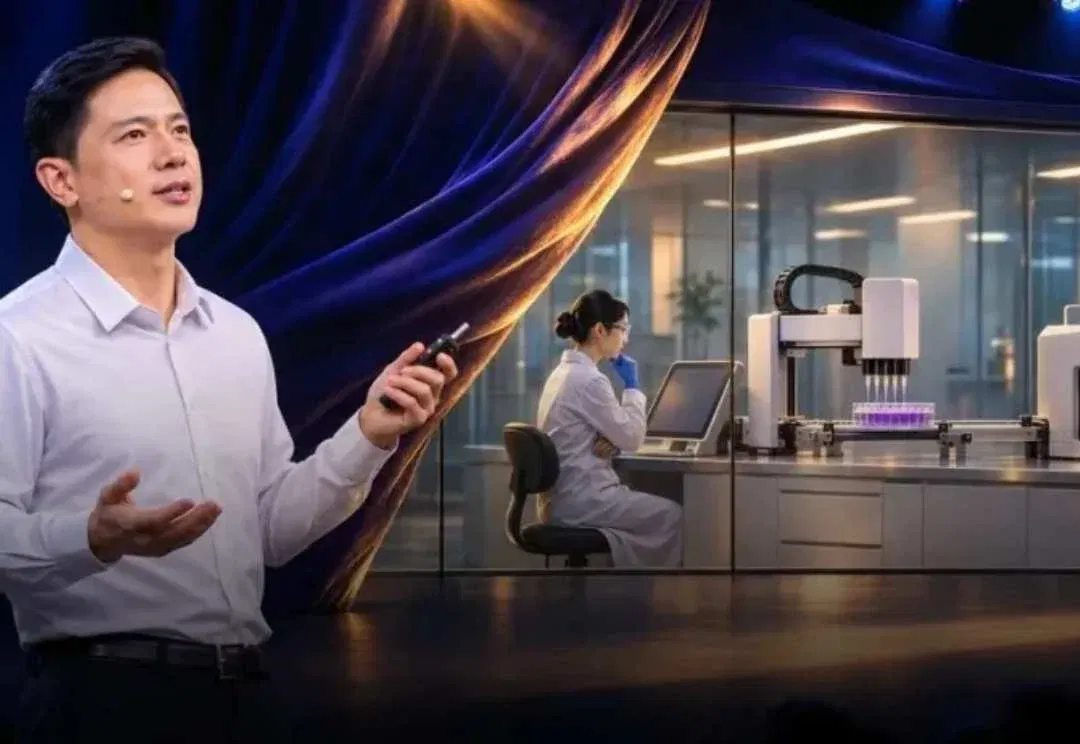
Baidu World introduces intelligent organizations, algorithm optimization, and laboratory equipment integration for research, alongside sandbox and infrastructure tests. Each application still requires validation.

ERNIE 5.5 Flash Preview launches, showcasing long-horizon coding and creative work (opens in a new tab)
Baidu reports model architecture, API pricing, and game and animation demos, with weights planned for November 25. Media trials cover 3D scenes and science videos.
百度开放文心 5.5 Flash Base 权重,主打长上下文推理效率 (opens in a new tab)
百度开源文心 5.5 Flash Base(ERNIE 5.5 Flash Base)权重,该模型总参数280B、每token激活14B,采用稀疏MoE与混合稀疏注意力,微调和推理上下文外扩至1M tokens。
百度发布 ApolloWorld,探索多智能体交互的自动驾驶闭环仿真 (opens in a new tab)
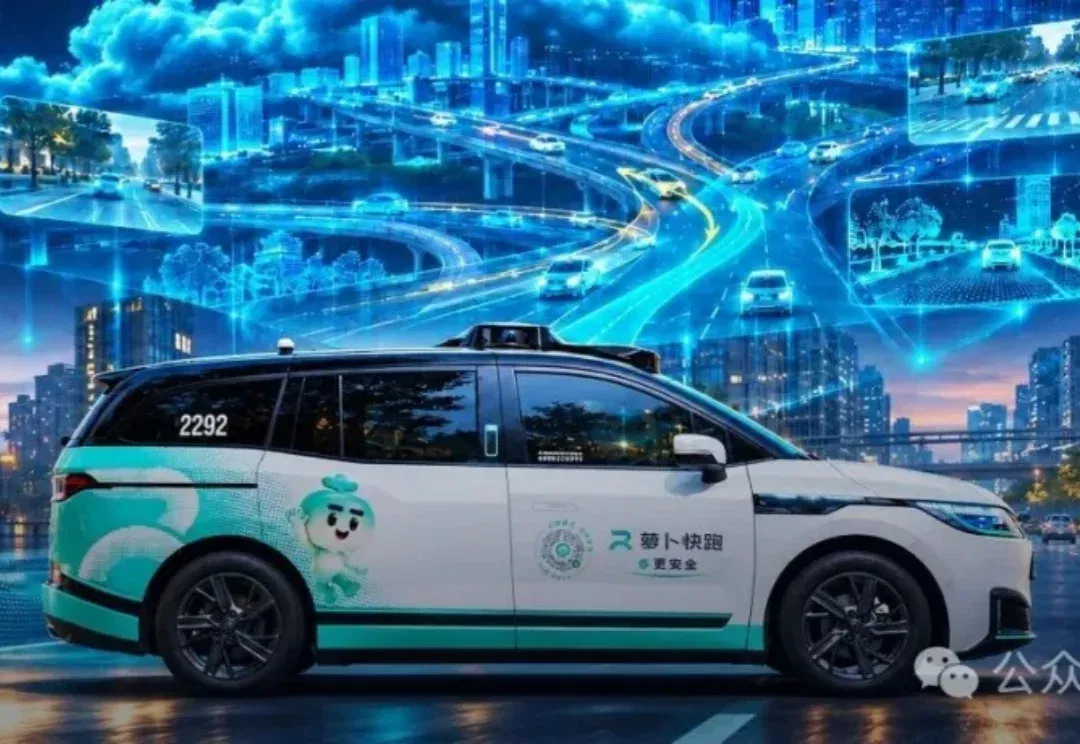
百度介绍ApolloWorld世界模型,面向L4驾驶训练同步生成相机画面与点云,并模拟交通参与者对车辆动作的反应。文中日行十万公里及33毫秒响应属于公司披露的仿真指标,不能直接替代真实路测或证明通用智能已经实现。