ERNIE 5.5 Flash Preview launches, showcasing long-horizon coding and creative work

Baidu reports model architecture, API pricing, and game and animation demos, with weights planned for November 25. Media trials cover 3D scenes and science videos.
Editorial correction (November 13, 2026) The release status and planned availability of model weights should be distinguished. A long context window does not guarantee complete retention of all historical information.
On November 11, Baidu released ERNIE 5.5 Flash Preview and made it available through the Qianfan API.
The model emphasizes speed and cost. Preview weights are scheduled for release on November 25; the API being live now does not mean the weights are already open.
Fast—it really is fast. It generates more than 200 tokens per second, with 280 billion parameters but only 14 billion used each time.
Cheap—it really is cheap. Per million tokens, API input costs RMB 2 at peak times and RMB 1 off-peak; output costs RMB 8 at peak times and RMB 4 off-peak. A limited-time 50% discount is currently available too.
It launches first on Baidu AI Cloud Qianfan today, with direct API access. The model weights will be released to the global open-source community on November 25.
ERNIE 5.5 Flash Preview upgrades programming, 3D modeling, knowledge work, and content creation across the board.
It delivers competitive scores across several benchmarks, including Terminal-Bench and AutomationBench:
46.5 on Terminal-Bench 4.0, which tests real work in a terminal; 61.9 on AutomationBench, which tests tasks across applications; and 36.4 on SpreadsheetBench V2, which tests real Excel work.
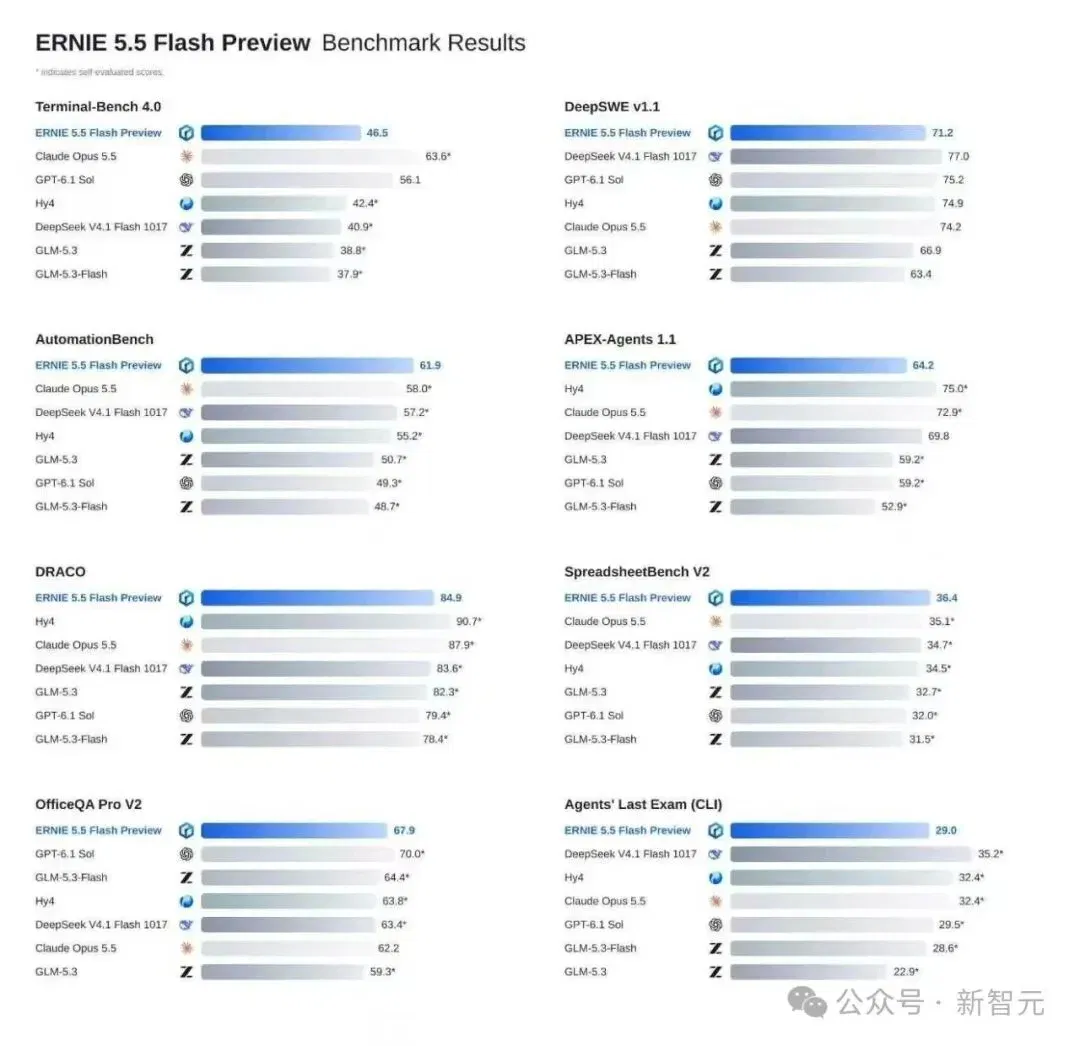
Scores marked with an asterisk in the figure are Baidu’s own measurements.
There are also areas where it is still catching up, but remember its positioning: a Flash model built for speed and economy.
280 billion parameters, only 14 billion active each time; a one-million-token context window; more than 200 tokens generated per second.
With that positioning, it competes alongside big names such as Claude Opus 5.5 and GPT-6.1 Sol and still takes two first-place finishes.
I have always put only half my trust in benchmark scores. The other half depends on seeing it work.
Start with the example that really made me pause: Journey Among Cloud Peaks.
It is a third-person Eastern martial-arts game, with the mist-shrouded stone peaks of Zhangjiajie and an ancient temple on a clifftop. The game engine is Unreal Engine 5.8 and the underlying code is C++. ERNIE 5.5 Flash Preview built the entire game in one task lasting 11 hours.
The following video comes from the ERNIE model team
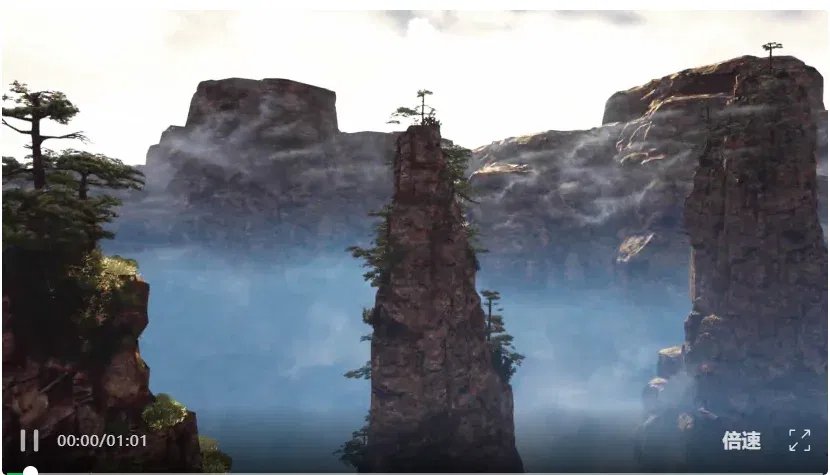
Eleven hours is not unusual. What is unusual is that ERNIE 5.5 Flash Preview is a text-only model. It cannot see the images.
The most common problems when making 3D games—characters floating in midair, movement going in the wrong direction, or camera positions failing to line up—are all problems a person can spot as wrong at a glance.
Its solution is stubbornly practical, and clever: if you cannot see it, measure it.
For example, you do not need to see the image to know whether a character is floating. Write a program to measure the distance between the soles of its feet and the ground. It translated the visual problems that arose during playtesting, one by one, into executable code tests that produced numerical results, then tested, revised, and tested again, working through round after round until the entire game was finished.
Along the way, it also handled some messy work: combining assets spanning several generations of Unreal Engine into a single UE 5.8 project. Formats and interfaces across engine generations are often incompatible. Anyone who has made games will understand: this kind of work can make even a human want to quit.
Honestly, what impressed me about this case was the method of working, rather than the visuals.
Anyone who has coded knows the difference: a beginner reports a bug as “something seems a bit off,” while an experienced developer says, “the return value on line 37 is off by 0.3.” Turning a vague feeling into a verifiable number is a veteran’s craft.
From a pelican to a W16:
code is its master key
Where does the stamina to work continuously for 11 hours without breaking down come from?
According to official disclosures, training used more than 14 million code tasks that “actually run,” along with execution traces from multiple agent frameworks.
What it practiced was the entire sequence of “write it, run it, read the errors, and keep revising.” Memorizing code alone is no use.
Long context provides greater information capacity for long-horizon tasks, but does not guarantee that the entire history of a long-running task will be fully retained or correctly used.
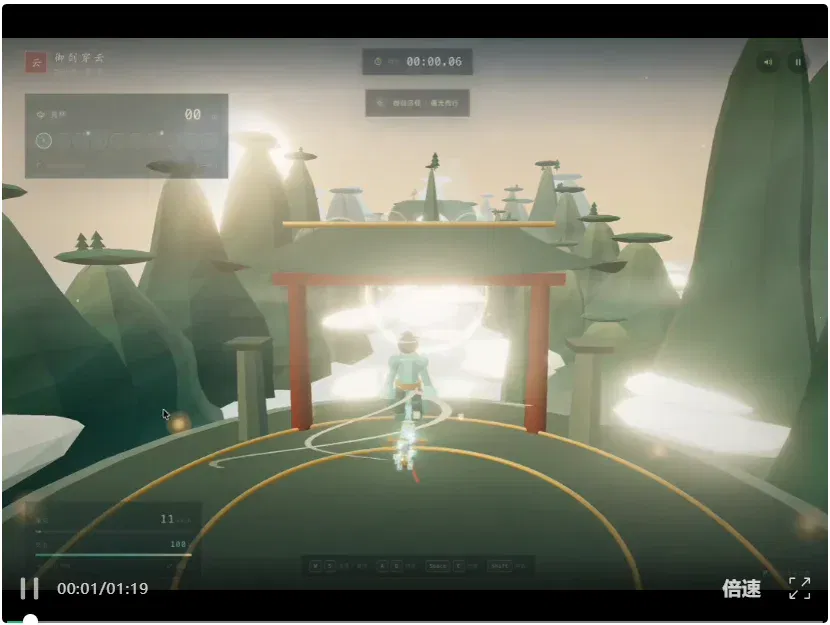
How well has it learned? We set a challenge of our own: make a third-person 3D sword-flight game, Swordflight Through the Clouds.
The game opens on a stone platform. The protagonist wears a blue-green robe, with pale ribbons trailing down his back and hair tied in a topknot, standing firmly on a flying sword. This is more than a few blocks thrown together.
Ahead, blue-green stone peaks rise from a sea of warm golden clouds. A stone arch spans the route, and ten golden rings lead all the way to the temple on the clifftop.
Crucially, the game can actually be played through. Flying through rings three and seven automatically records checkpoints. The ring counter, timer, and energy bar at the upper left keep updating, and there is a minimap at the lower right. Finally, the player lands before a temple with red columns and double eaves, and the results panel appears: all ten rings completed.
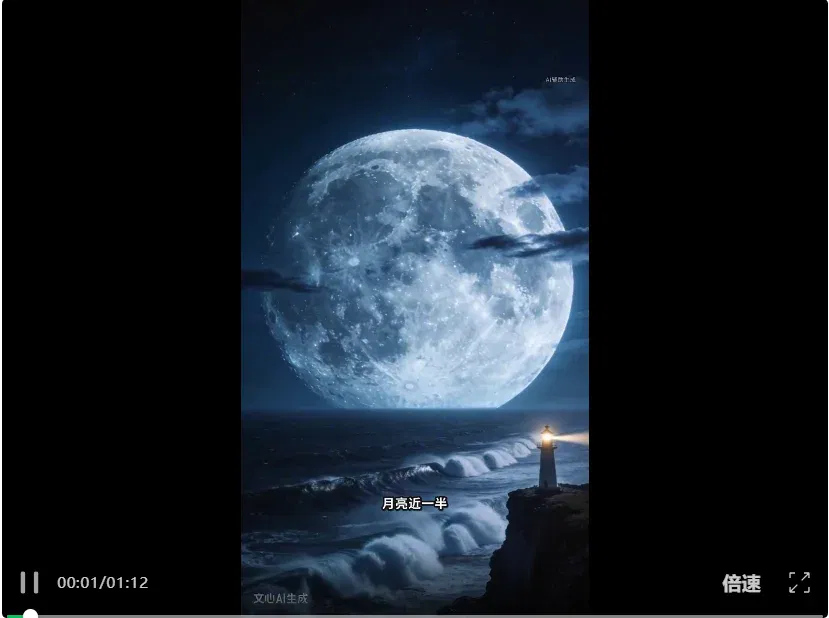
We also asked it to make a science explainer video. The entire prompt was one sentence: what would the world be like if the Moon were only half its current distance from Earth?
The finished video runs a little over a minute, in portrait format. It opens with a huge Moon looming over the sea, drawing viewers in with the line, “The first thing to lose control would not be the night sky, but the ocean.”
What surprised me was its restraint. When explaining tides, it added that the tide-generating force would be eight times greater, not that tidal height would necessarily be eight times greater. Without being asked, it calculated the Roche limit itself and explained that the Moon would not be torn apart: it would still be more than ten times the Roche-limit distance away.
I checked several key figures with a calculator, and they all matched. A Flash model was doing the work of an entire science-video team: researching, calculating, making graphics, and editing footage.
The same abilities work in a different testing ground too.
There is a widely circulated, homespun test in developer circles: ask a model to draw a pelican riding a bicycle using code. How convincing the picture is gives a fairly good idea of what the model can do.
Others submit a picture. ERNIE 5.5 Flash Preview submitted a film.
The Pelican Test is a 117-second 2D animation written entirely from scratch in Python. A white pelican pedals a bicycle, starting in Saharan rock art from 4000 BCE, then riding through rubbings of Han-dynasty stone reliefs, Javanese shadow puppetry, and 8-bit pixels. It changes through 20 art styles, rides into a code editor in the large-model era, and finally appears at the “Pelican No. 21 Launch Event.” In the scene based on Van Gogh’s The Starry Night, the swirling sky twists in time with its pedaling cadence.
The soundtrack uses 22 recordings, ranging from djembe and guqin to the Mario theme. Editing was not handed to a person either: the model wrote its own editing script, aligning each scene precisely with its transition point. (Concept design by Bilibili creator @近步抱告_, used with permission.)

The person setting the challenge only wanted a pelican; it delivered a brief history of pelicans. That feels almost unfair.
It has had serious training in video editing.
According to official disclosures, training included more than 150,000 creative environments for science explainers, animated comics, and creative editing, covering everything from concepts, scripts, and storyboards to voiceovers. They produced approximately 5,300 minutes of video in total.
Now move to professional productivity software. This tests spatial understanding: given only a textual description, it must infer shapes, proportions, and positional relationships itself.
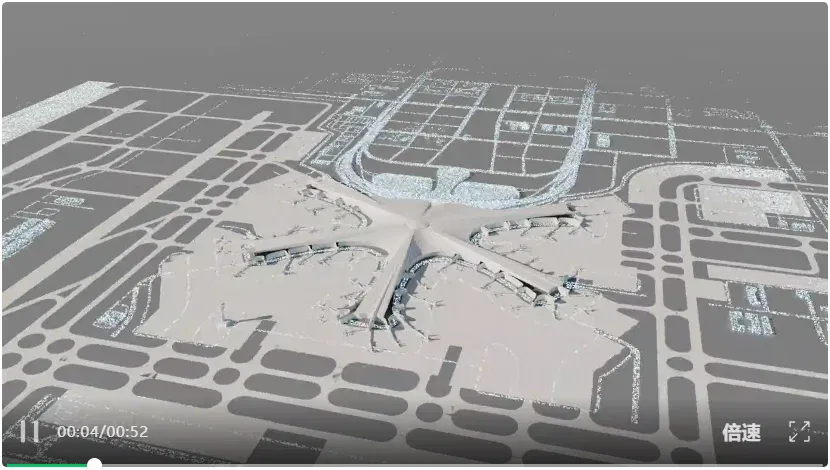
In the 3D modeling application Blender, two ERNIE agents work separately: one builds an airport and the other an airplane.
The airport builder finds layout data on a mapping platform itself and downloads supporting assets such as vegetation, vehicles, and ground-service equipment. The airplane builder assembles the fuselage, wings, cockpit, and double-deck passenger cabin section by section. The two then align scales and camera views and render the result. It is like a small outsourcing team, without the squabbling.
In the engineering design application FreeCAD, it builds a W16 engine using Python scripts. As the crankshaft turns, pistons in four banks of cylinders move up and down.
It also models the east and west towers of Baidu International Building in Shenzhen as editable 3D structures, with some areas detailed down to interior layouts and mechanical and electrical services. Taking inspiration from Yutu-2, it also designs a lunar concept vehicle with articulating suspension and rotating solar panels.
Only at this point did it dawn on me.
Games, animation, airplanes, and engines look completely unrelated, but underneath they are the same thing: writing code.
For modeling, it writes scripts to direct Blender. For video editing, it writes programs to orchestrate audio and video assets. Wherever code can reach, it can get involved.
That is why I am convinced by Baidu’s decision to name coding the highlight of this upgrade. This is more than a single capability; it is a master key.
That key can open office doors too. The two first-place finishes mentioned at the beginning test precisely this kind of work.
It independently wrote a 24-page autonomous-driving research report, working through 4,169 US federal accident reports to compare the safety data of Waymo’s and Tesla’s approaches in detail. It also built a personal wealth-planning tool, simulating 1,000 random market paths to calculate whether retirement savings would be enough.

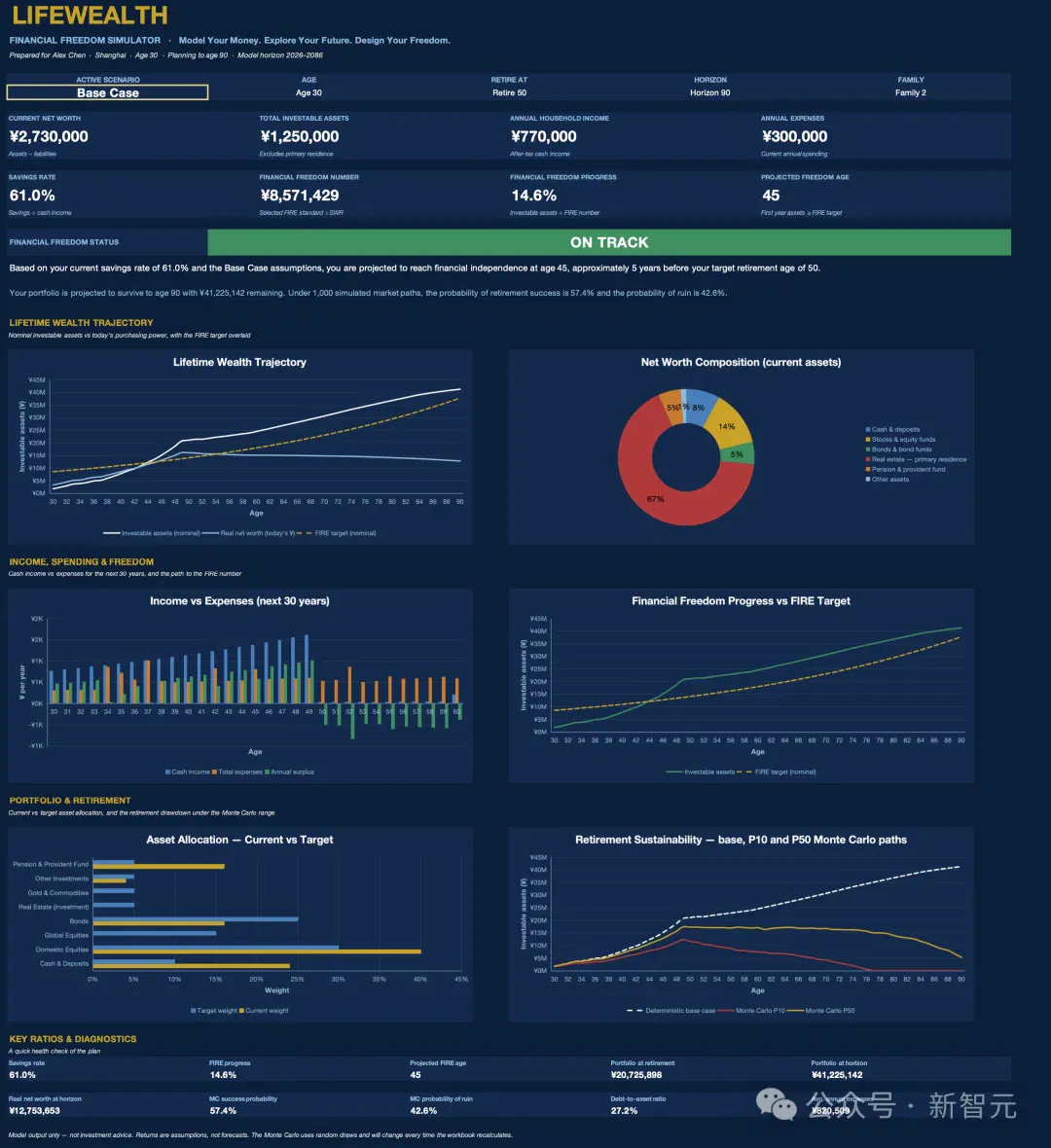
This, too, comes from training. For knowledge work in areas such as finance and law, Baidu provided 300,000 workspaces and ten million reference documents covering more than 40 file types.
It even composed music itself, generating a symphony lasting six minutes and 35 seconds.
Some of this “speed”
was squeezed out by AI itself
Being capable is one thing; working quickly and affordably is another.
Agent work can easily involve hundreds of steps. A little extra time and cost at each step can make the bill at the end of the month heart-stopping.
ERNIE 5.5 Flash Preview’s architecture is designed with an unwavering focus on “efficiency”:
- Save GPU memory when reading long texts: The model has 43 layers. Of these, 37 look only at “summaries” when reading historical content, compressing every 128 tokens into one entry. Only the remaining six revisit the original text token by token, and they calculate only at the most important positions. Think of a project team where most people read meeting minutes and a few check the original files. Even with a million tokens fed in, memory demands remain manageable.
- Avoid mistakes when selecting experts: Each layer has 512 “experts.” Only ten are selected each time, plus one permanently active shared expert; this is how 280 billion parameters become only 14 billion used per activation. Task assignment matters too. Previously, a single “dispatcher,” or router, chose whom to call. If it chose badly, rejected experts never even got a chance to correct the mistake, allowing errors to persist. Now multiple dispatchers score together, so no one has the final say alone.
- Draft ahead to save time: Another clever design is called ECHO. Without attaching an extra module, it uses the model’s own final layer to draft the next few words while writing the next word, accepting the drafts directly once they have been checked.
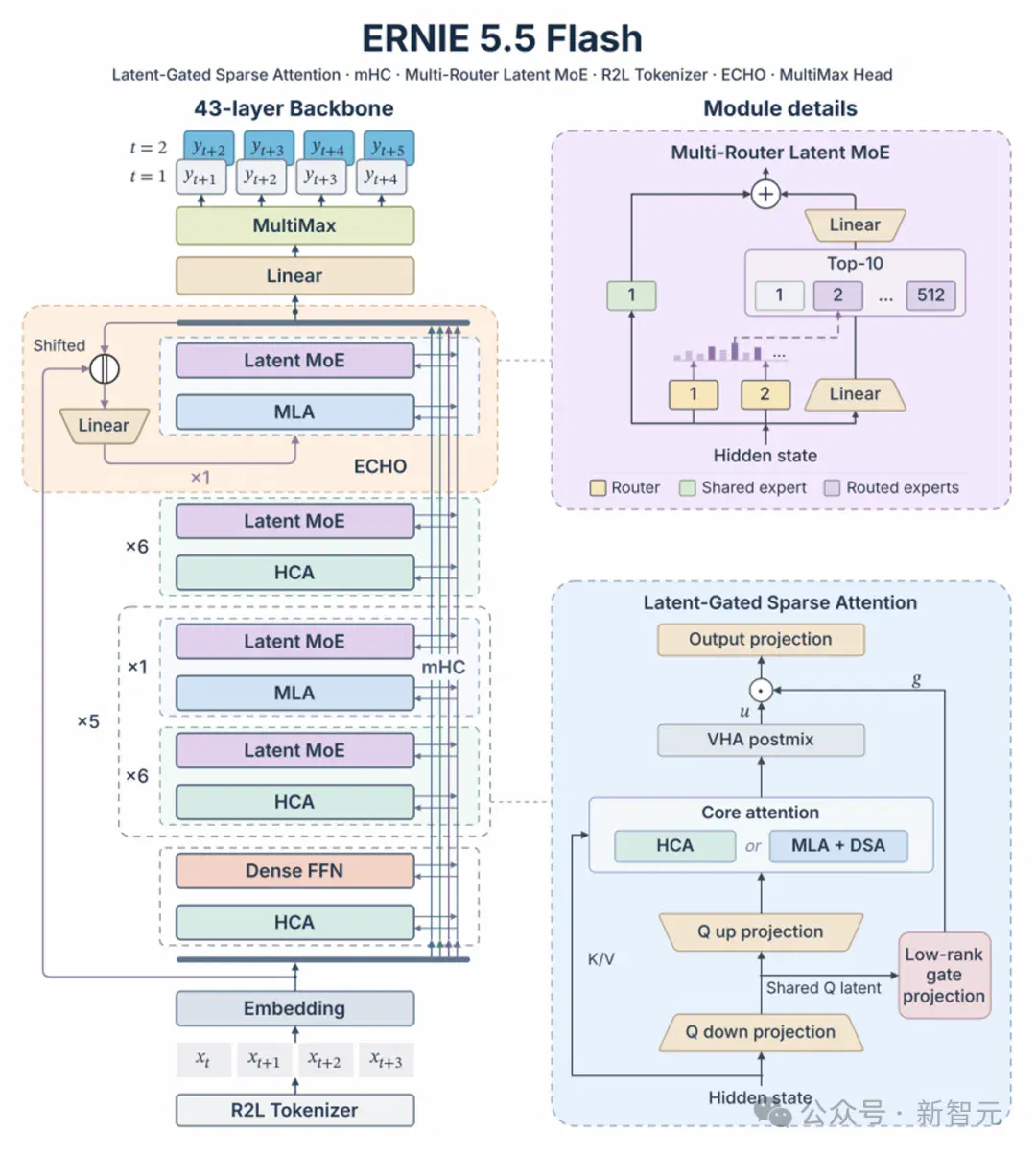
The architecture diagram also includes a few awkwardly named components: mHC widens information channels between layers; MultiMax handles the final word-selection step; and the R2L tokenizer splits numbers into groups of three digits from right to left, making arithmetic easier.
Together, these deliver generation speeds of more than 200 tokens per second. ERNIE’s Flash lives up to its name.
What follows is even more interesting.
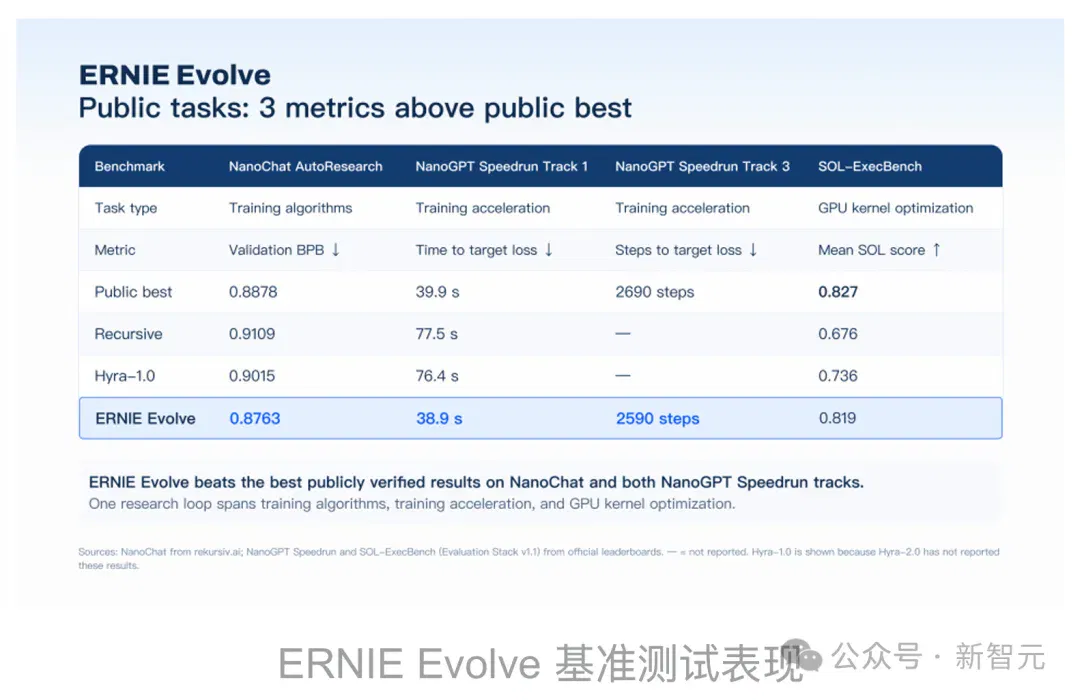
On November 9, Baidu ERNIE disclosed progress in recursive self-improvement (RSI) for the first time: an automated research system called ERNIE Evolve. Put simply, it has AI act as a researcher, proposing ideas, changing code, and running experiments itself. The results must still pass independent evaluation; it cannot bluff its way through.
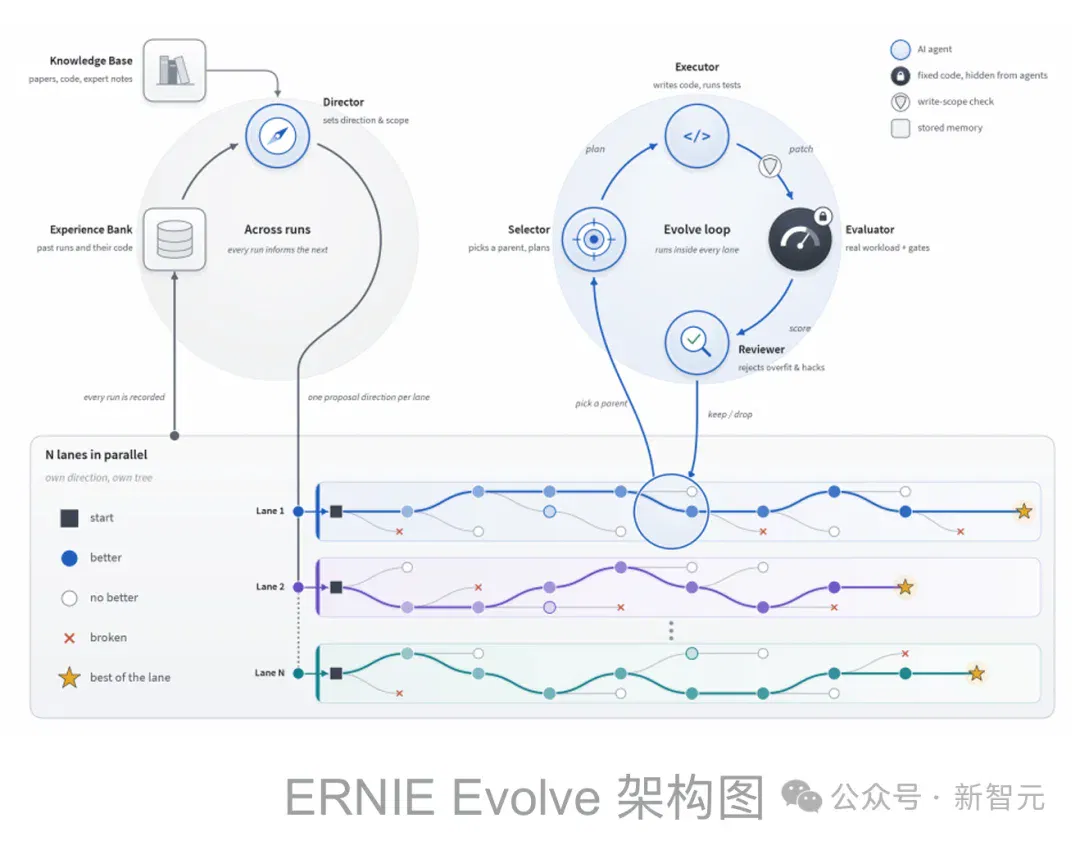
Its practical assignment was to accelerate inference for ERNIE 5.5 Flash. Here is the work it turned in:
In a low-latency setting on the Chinese-developed Kunlunxin P800, generation speed reached 623.6% of the baseline. For the "deterministic inference" needed in reinforcement learning training, where every generated word and every probability must be identical on every run of the same request, at the cost of slower speed, throughput increased by 33.7%.
The most demanding result was in extreme decoding. Human engineers had already optimized this setting specifically, squeezing out the easy gains. Remaining individual improvements were often only 0.3% to 0.5%, smaller than measurement noise.
It nevertheless tried seven directions and squeezed out another 14.9% speedup.
AI working hands-on to refine the next generation of AI: a sentence that once belonged in science fiction is now part of the development record of a Chinese large model.
Three releases in seven days: there is no shame in catching up
Look back at the calendar, and Baidu’s pace over these seven days is almost startlingly dense.
On November 5, ERNIE 5.5 Flash Base was open-sourced, the first time in 16 months that Baidu had released weights for a model on the scale of hundreds of billions of parameters. On November 9, it disclosed progress in RSI automated research. On November 11, ERNIE 5.5 Flash Preview officially launched. Seven days, three releases.
The next release is already scheduled: open weights for ERNIE 5.5 Flash Preview on November 25.
And tomorrow, Baidu World 2026 opens in Beijing under the theme “The Next Act: Intelligent Organizations.” The new model has appeared on the eve of the conference; the main show may still lie ahead.
Let us be practical.
Over the past two years, there has been no shortage of discussion about ERNIE, including both expectations and skepticism.
But after seeing this week’s releases, my feeling is that the team has not been busy explaining itself; it has been working. Refining the architecture, squeezing out efficiency, and putting results on the table one by one. Even speed gains of fractions of a percentage point have people working through them one by one with AI.
There is no shame in catching up. ERNIE’s stance this time is refreshingly open: I am catching up, taking it seriously, and the work is right here. Test it however you like.
There is a line I would like to offer it: when no one supports your lofty ambitions, make your own way through the snow to the summit.
It is too early to say whether the summit has been reached; the leaderboard rivals are formidable. But these footprints in the snow were made one step at a time and cannot be faked. ERNIE has earned this praise.
ERNIE 5.5 Flash Preview is now available on Baidu AI Cloud Qianfan for developers to call through the API. Pricing per million tokens is RMB 2 for peak-time input and RMB 1 off-peak, and RMB 8 for peak-time output and RMB 4 off-peak, with a limited-time 50% discount currently available.
Do not just take my word for it. Have it make you a game.
Try it here: https://ernie.baidu.com/web/new-chat
This article comes from “Xinzhiyuan,” and was written by “Solomon.”
Related topics
After reading
Join the AINRK community
Read how to join the community and connect with people working in AI.
Related articles
Continue reading related topics and articles in this category.
Baidu Famou 3.0 debuts, bringing continuous optimization into enterprise R&D and production (opens in a new tab)
Baidu World presents materials, chip and apparel cases that connect data, algorithm search, independent validation and human review in feedback loops. Results are those disclosed by the teams.

Baidu unveils integrated AI4S solution linking compute, data, and research agents (opens in a new tab)
Baidu World introduces intelligent organizations, algorithm optimization, and laboratory equipment integration for research, alongside sandbox and infrastructure tests. Each application still requires validation.
百度开放文心 5.5 Flash Base 权重,主打长上下文推理效率 (opens in a new tab)
百度开源文心 5.5 Flash Base(ERNIE 5.5 Flash Base)权重,该模型总参数280B、每token激活14B,采用稀疏MoE与混合稀疏注意力,微调和推理上下文外扩至1M tokens。

百度发布 ApolloWorld,探索多智能体交互的自动驾驶闭环仿真 (opens in a new tab)
百度介绍ApolloWorld世界模型,面向L4驾驶训练同步生成相机画面与点云,并模拟交通参与者对车辆动作的反应。文中日行十万公里及33毫秒响应属于公司披露的仿真指标,不能直接替代真实路测或证明通用智能已经实现。
百度上线模型服务平台“词元所”,聚合42款模型与多家供应商 (opens in a new tab)
据《读佳》报道,百度推出词元所,提供多模型选型、统一API调用及供应商资源撮合。平台展示报价、首Token延迟、吞吐和成功率等指标;模型数量、资源数量与榜单热度采用不同统计口径,使用前仍需核对服务质量。