Embedding相似度不是万金油,电商、 新闻场景如何按时效性做rerank

同样是语义相似度结合时效性做rerank,指数衰减、高斯衰减、线性衰减怎么选? 假设你要在一个新闻应用中落地语义检索功能,让用户搜索雷军的投资版图盘点时,能自动关联顺为资本、小米战投等核心关联信息。
同样是语义相似度结合时效性做rerank,指数衰减、高斯衰减、线性衰减怎么选?
假设你要在一个新闻应用中落地语义检索功能,让用户搜索雷军的投资版图盘点时,能自动关联顺为资本、小米战投等核心关联信息。
那么在确定了向量数据库应该用Milvus之后,要怎么对搜索结果排序呢?
是直接根据基于embedding的语义相似度,根据语义进行内容排序,还是引入更多与新闻相关的变量,比如时间?
答案是后者,在类似新闻、电商这样的场景,我们做检索既要考虑相似度,也需要让新鲜内容自动浮出水面,而旧闻悄然后移。
针对这一需求,Milvus 2.6中推出了一个备受关注的亮点功能Time-aware Ranking Functions(时间感知排名函数),也称为 Time-Aware Decay Functions(时间感知衰减函数)。
这个功能让搜索结果不再仅依赖向量相似度,而是巧妙融入时间因素,实现更智能的排名调整。
本文将深入探讨这一功能的细节、意义、应用场景,并通过一个实际案例展示其使用方式。
01
Time-aware Ranking Functions 具体介绍
Time-aware Ranking Functions 通过在搜索结果重排序(re-ranking)阶段应用时间衰减,动态调整文档的相关性分数。 传统向量搜索仅基于相似度(如L2、COSINE等)排名,但现实中信息价值往往随时间衰减(如新闻的时效性)。该功能使用集合中的时间戳字段(支持INT8/16/32/64、FLOAT或DOUBLE类型),计算一个衰减分数(0 到 1 之间),然后与归一化相似度相乘,生成最终排名,从而平衡语义相似度和时间相关性。对于时间相关的衰减,确保参数单位(如秒、毫秒)与集合的时间戳一致。
如何工作
该功能通过三个阶段计算最终分数:
1.归一化相似度分数:将向量相似度分数标准化到 0-1 范围。对于 L2 和 JACCARD 指标(较低值表示更高相似度),使用公式:normalized_score = 1.0 - (2 × arctan(score))/π对于 IP、COSINE 和 BM25 指标,直接使用原始分数。
2.计算衰减分数:基于选择的衰减函数,将数值字段(如时间戳)转换为 0-1 范围的衰减分数,反映与理想点(如当前时间)的“距离”。
3.计算最终分数:final_score = normalized_similarity_score × decay_score在混合搜索中,使用多个向量字段的最大归一化分数:final_score = max(normalized_scores) × decay_score。
支持的衰减函数
Milvus 支持三种衰减模型,每种适合不同曲线形状:
- Exponential Decay(指数衰减):初始快速衰减,后有长尾,适合新闻等急需新鲜度的场景。
- Gaussian Decay(高斯衰减):铃形曲线,渐进式衰减,适用于平衡时效和全面性的通用搜索。如餐厅推荐中允许中等距离的场所。
- Linear Decay(线性衰减):直线衰减,有明确截止点,适合有过期阈值的应用。如事件搜索中超出两周的活动不显示。
配置参数
(通过 Python SDK 的Function对象实现):
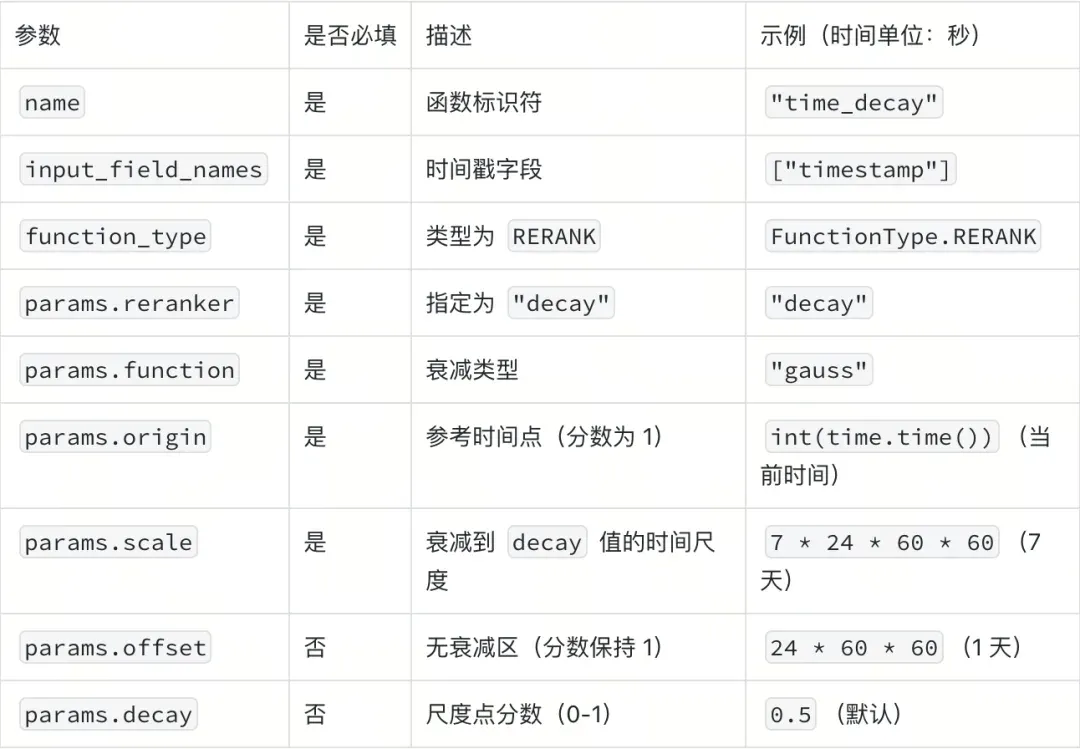
在搜索时,将函数传入ranker参数即可应用,支持标准向量搜索和混合搜索。
示例配置(Gaussian):
from pymilvus import Function, FunctionType from datetime import datetime decay_ranker = Function( name="time_decay", input_field_names=["timestamp"], function_type=FunctionType.RERANK, params={ "reranker": "decay", "function": "gauss", "origin": int(datetime.now().timestamp()), "scale": 7 * 24 * 60 * 60, # 7 天 "offset": 24 * 60 * 60, # 1 天 "decay": 0.5 } )
在search()或hybrid_search()中应用ranker参数。
02
引入该功能的意义和应用场景
引入 Time-aware Ranking Functions 的核心意义在于解决传统向量搜索的“时效盲区”。
在动态数据环境中(如社交媒体或实时推荐),旧信息往往淹没新内容,导致用户体验下降。 该功能通过内置衰减机制,直接在 Milvus 引擎中处理时间因素,避免了后处理(如客户端排序)的额外开销,提高了查询效率和精度。
此外,它与 Milvus 的文本分析管道无缝整合,支持全文本搜索与向量嵌入的结合,进一步桥接传统信息检索和现代 AI。 在 v2.6.3 更新中,还优化了分数合并逻辑,提升了性能。 总体而言,这一功能让 Milvus 更适合亿级规模的实时应用,降低了开发复杂度和运维成本,推动 AI 搜索的民主化。
应用场景:
Time-aware Ranking Functions 适用于任何需要时效优先的向量搜索场景:
- 新闻和内容推荐:在新闻 App 中,优先显示昨日热点,而非数月前的旧文。
- 电商搜索:新上架商品排名更高,结合位置衰减(类似时间)实现“附近新鲜货”。
- 社交媒体 feeds:新鲜帖子主导 feed,Exponential 模型确保高相关旧帖仍有曝光。
- 事件查找:Linear 模型设置过期阈值,如仅显示未来两周活动。
这些场景中,该功能通过 configurable 衰减率,确保结果既相关又及时。
03
实际案例
为了快速了解功能,我们通过一个新闻文章搜索系统案例演示,使用 Milvus 构建时间感知排名。 假设我们有一个包含 7 篇 AI 相关新闻的集合,发布日期从 1 天前到 120 天前,包括相同内容但不同日期的文章对。
实施步骤
(1)连接 Milvus 并创建集合:使用 pymilvus 连接,定义 schema 包括 headline、content、dense(语义向量)、sparse_vector(BM25)和 publish_date。
(2)设置嵌入函数:使用 Openai text embedding 模型生成 dense 向量,BM25 生成 sparse 向量。
(3)插入数据:添加文章,publish_date 为时间戳。
(4)配置衰减排名器:定义 Gaussian、Exponential 和 Linear 排名器,以当前时间为 origin。
(5)执行搜索:查询"artificial intelligence advancements",比较无衰减和有衰减结果。
代码片段
(1)连接Milvus和创建schema:
import datetime import matplotlib.pyplot as plt import numpy as np from pymilvus import ( MilvusClient, DataType, Function, FunctionType, AnnSearchRequest, ) # Create connection to Milvus milvus_client = MilvusClient("http://localhost:19530") # Define collection name collection_name = "articles_tutorial" # Clean up any existing collection with the same name milvus_client.drop_collection(collection_name) # Create schema with fields for content and temporal information schema = milvus_client.create_schema(enable_dynamic_field=False, auto_id=True) schema.add_field("id", DataType.INT64, is_primary=True) schema.add_field("headline", DataType.VARCHAR, max_length=200, enable_analyzer=True) schema.add_field("content", DataType.VARCHAR, max_length=2000, enable_analyzer=True) schema.add_field("dense", DataType.FLOAT_VECTOR, dim=3072) # For dense embeddings schema.add_field("sparse_vector", DataType.SPARSE_FLOAT_VECTOR) # For sparse (BM25) search schema.add_field("publish_date", DataType.INT64) # Timestamp for decay ranking # Create embedding function for semantic search text_embedding_function = Function( name="openai_embedding", function_type=FunctionType.TEXTEMBEDDING, input_field_names=["content"], output_field_names=["dense"], params={ "provider": "openai", "model_name": "text-embedding-3-large" } ) schema.add_function(text_embedding_function) # Create BM25 function for keyword search bm25_function = Function( name="bm25", input_field_names=["content"], output_field_names=["sparse_vector"], function_type=FunctionType.BM25, ) schema.add_function(bm25_function) index_params = milvus_client.prepare_index_params() index_params.add_index(field_name="dense", index_type="AUTOINDEX", metric_type="L2") index_params.add_index( field_name="sparse_vector", index_name="sparse_inverted_index", index_type="AUTOINDEX", metric_type="BM25", ) milvus_client.create_collection( collection_name, schema=schema, index_params=index_params, consistency_level="Bounded" ) print(f"Collection {collection_name} is created successfully")
(2)插入数据:
current_time = int(datetime.datetime.now().timestamp()) current_date = datetime.datetime.fromtimestamp(current_time) print(f"Current time: {current_date.strftime('%Y-%m-%d %H:%M:%S')}") # Sample news articles spanning different dates articles = [ { "headline": "AI Breakthrough Enables Medical Diagnosis Advancement", "content": "Researchers announced a major breakthrough in AI-based medical diagnostics, enabling faster and more accurate detection of rare diseases.", "publish_date": int((current_date - datetime.timedelta(days=120)).timestamp()) # ~4 months ago }, { "headline": "Tech Giants Compete in New AI Race", "content": "Major technology companies are investing billions in a new race to develop the most advanced artificial intelligence systems.", "publish_date": int((current_date - datetime.timedelta(days=60)).timestamp()) # ~2 months ago }, { "headline": "AI Ethics Guidelines Released by International Body", "content": "A consortium of international organizations has released new guidelines addressing ethical concerns in artificial intelligence development and deployment.", "publish_date": int((current_date - datetime.timedelta(days=30)).timestamp()) # 1 month ago }, { "headline": "Latest Deep Learning Models Show Remarkable Progress", "content": "The newest generation of deep learning models demonstrates unprecedented capabilities in language understanding and generation.", "publish_date": int((current_date - datetime.timedelta(days=15)).timestamp()) # 15 days ago }, # Articles with identical content but different dates { "headline": "AI Research Advancements Published in January", "content": "Breakthrough research in artificial intelligence shows remarkable advancements in multiple domains.", "publish_date": int((current_date - datetime.timedelta(days=90)).timestamp()) # ~3 months ago }, { "headline": "New AI Research Results Released This Week", "content": "Breakthrough research in artificial intelligence shows remarkable advancements in multiple domains.", "publish_date": int((current_date - datetime.timedelta(days=5)).timestamp()) # Very recent - 5 days ago }, { "headline": "AI Development Updates Released Yesterday", "content": "Recent developments in artificial intelligence research are showing promising results across various applications.", "publish_date": int((current_date - datetime.timedelta(days=1)).timestamp()) # Just yesterday }, ] # Insert articles into the collection milvus_client.insert(collection_name, articles) print(f"Inserted {len(articles)} articles into the collection")
(3)排名器配置:
# Create a Gaussian decay ranker gaussian_ranker = Function( name="time_decay_gaussian", input_field_names=["publish_date"], function_type=FunctionType.RERANK, params={ "reranker": "decay", "function": "gauss", # Gaussian/bell curve decay "origin": current_time, # Current time as reference point "offset": 7 * 24 * 60 * 60, # One week (full relevance) "decay": 0.5, # Articles from two weeks ago have half relevance "scale": 14 * 24 * 60 * 60 # Two weeks scale parameter } ) # Create an exponential decay ranker with different parameters exponential_ranker = Function( name="time_decay_exponential", input_field_names=["publish_date"], function_type=FunctionType.RERANK, params={ "reranker": "decay", "function": "exp", # Exponential decay "origin": current_time, # Current time as reference point "offset": 3 * 24 * 60 * 60, # Shorter offset "decay": 0.3, # Steeper decay "scale": 10 * 24 * 60 * 60 # Different scale } ) # Create a linear decay ranker linear_ranker = Function( name="time_decay_linear", input_field_names=["publish_date"], function_type=FunctionType.RERANK, params={ "reranker": "decay", "function": "linear", # Linear decay "origin": current_time, # Current time as reference point "offset": 7 * 24 * 60 * 60, # One week (full relevance) "decay": 0.5, # Articles from two weeks ago have half relevance "scale": 14 * 24 * 60 * 60 # Two weeks scale parameter } )
(4)搜索:
# Helper function to format search results with dates and scores def print_search_results(results, title): print(f"\n=== {title} ===") for i, hit in enumerate(results[0]): publish_date = datetime.datetime.fromtimestamp(hit.get('publish_date')) days_from_now = (current_time - hit.get('publish_date')) / (24 * 60 * 60) print(f"{i+1}. {hit.get('headline')}") print(f" Published: {publish_date.strftime('%Y-%m-%d')} ({int(days_from_now)} days ago)") print(f" Score: {hit.score:.4f}") print() # Define our search query query = "artificial intelligence advancements" # 1. Search without decay ranking (purely based on semantic relevance) standard_results = milvus_client.search( collection_name, data=[query], anns_field="dense", limit=7, # Get all our articles output_fields=["headline", "content", "publish_date"], consistency_level="Bounded" ) print_search_results(standard_results, "SEARCH RESULTS WITHOUT DECAY RANKING") # Store original scores for later comparison original_scores = {} for hit in standard_results[0]: original_scores[hit.get('headline')] = hit.score # 2. Search with each decay function # Gaussian decay gaussian_results = milvus_client.search( collection_name, data=[query], anns_field="dense", limit=7, output_fields=["headline", "content", "publish_date"], ranker=gaussian_ranker, consistency_level="Bounded" ) print_search_results(gaussian_results, "SEARCH RESULTS WITH GAUSSIAN DECAY RANKING") # Exponential decay exponential_results = milvus_client.search( collection_name, data=[query], anns_field="dense", limit=7, output_fields=["headline", "content", "publish_date"], ranker=exponential_ranker, consistency_level="Bounded" ) print_search_results(exponential_results, "SEARCH RESULTS WITH EXPONENTIAL DECAY RANKING") # Linear decay linear_results = milvus_client.search( collection_name, data=[query], anns_field="dense", limit=7, output_fields=["headline", "content", "publish_date"], ranker=linear_ranker, consistency_level="Bounded" ) print_search_results(linear_results, "SEARCH RESULTS WITH LINEAR DECAY RANKING")
(5)结果
=== SEARCH RESULTS WITHOUT DECAY RANKING === 1. AI Research Advancements Published in January Published: 2025-07-23 (90 days ago) Score: 0.7090 2. New AI Research Results Released This Week Published: 2025-10-16 (5 days ago) Score: 0.7090 3. AI Development Updates Released Yesterday Published: 2025-10-20 (1 days ago) Score: 0.7317 4. Tech Giants Compete in New AI Race Published: 2025-08-22 (60 days ago) Score: 1.0101 5. AI Breakthrough Enables Medical Diagnosis Advancement Published: 2025-06-23 (120 days ago) Score: 1.1065 6. Latest Deep Learning Models Show Remarkable Progress Published: 2025-10-06 (15 days ago) Score: 1.1649 7. AI Ethics Guidelines Released by International Body Published: 2025-09-21 (30 days ago) Score: 1.3030 === SEARCH RESULTS WITH GAUSSIAN DECAY RANKING === 1. New AI Research Results Released This Week Published: 2025-10-16 (5 days ago) Score: 0.6074 2. AI Development Updates Released Yesterday Published: 2025-10-20 (1 days ago) Score: 0.5979 3. Latest Deep Learning Models Show Remarkable Progress Published: 2025-10-06 (15 days ago) Score: 0.3601 4. AI Ethics Guidelines Released by International Body Published: 2025-09-21 (30 days ago) Score: 0.0642 5. Tech Giants Compete in New AI Race Published: 2025-08-22 (60 days ago) Score: 0.0000 6. AI Research Advancements Published in January Published: 2025-07-23 (90 days ago) Score: 0.0000 7. AI Breakthrough Enables Medical Diagnosis Advancement Published: 2025-06-23 (120 days ago) Score: 0.0000 === SEARCH RESULTS WITH EXPONENTIAL DECAY RANKING === 1. AI Development Updates Released Yesterday Published: 2025-10-20 (1 days ago) Score: 0.5979 2. New AI Research Results Released This Week Published: 2025-10-16 (5 days ago) Score: 0.4774 3. Latest Deep Learning Models Show Remarkable Progress Published: 2025-10-06 (15 days ago) Score: 0.1065 4. AI Ethics Guidelines Released by International Body Published: 2025-09-21 (30 days ago) Score: 0.0161 5. Tech Giants Compete in New AI Race Published: 2025-08-22 (60 days ago) Score: 0.0005 6. AI Research Advancements Published in January Published: 2025-07-23 (90 days ago) Score: 0.0000 7. AI Breakthrough Enables Medical Diagnosis Advancement Published: 2025-06-23 (120 days ago) Score: 0.0000 === SEARCH RESULTS WITH LINEAR DECAY RANKING === 1. New AI Research Results Released This Week Published: 2025-10-16 (5 days ago) Score: 0.6074 2. AI Development Updates Released Yesterday Published: 2025-10-20 (1 days ago) Score: 0.5979 3. Latest Deep Learning Models Show Remarkable Progress Published: 2025-10-06 (15 days ago) Score: 0.3226 4. AI Research Advancements Published in January Published: 2025-07-23 (90 days ago) Score: 0.3037 5. Tech Giants Compete in New AI Race Published: 2025-08-22 (60 days ago) Score: 0.2484 6. AI Breakthrough Enables Medical Diagnosis Advancement Published: 2025-06-23 (120 days ago) Score: 0.2339 7. AI Ethics Guidelines Released by International Body Published: 2025-09-21 (30 days ago) Score: 0.2084
(1)无衰减排名(纯语义相关性搜索)
这是基准(Baseline),其结果完全由查询artificial intelligence advancements与每篇文章内容之间的语义相似度决定,时间因素被完全忽略。
- 相同内容,相同得分: 两篇内容完全相同的文章(“AI Research Advancements Published in January” 和 “New AI Research Results Released This Week”)尽管发布日期相差近三个月,但它们的得分完全一样(0.7090)。这完美地证明了在不使用时间衰减器时,publish_date 字段对排名没有任何影响。
- 相关性决定排名: 排名顺序纯粹基于语义相关性(在这里用L2距离表示,值越小越相关)。得分最低(最相关)的两篇文章内容都包含 "artificial intelligence" 和 "advancements" 的直接同义词或强相关概念。而得分最高的(最不相关)文章 “AI Ethics Guidelines...” 虽然也关于AI,但主题更偏向“伦理”,与“技术进步”的语义距离较远。
- 时效性被忽略: 最新的文章(1天前、5天前发布)并没有排在最前面。甚至一篇90天前的文章排在了第一位,这在很多需要获取最新资讯的场景下是不可接受的。
(2)高斯衰减排名 (Gaussian Decay)
高斯衰减器引入了时间维度,其衰减曲线像一个“钟形”,对近期内容友好,对中期内容惩罚逐渐加重,对远期内容则给予极大的惩罚。
配置: offset 为7天(一周内不惩罚),scale 为14天,decay 为0.5(两周前的文章,时间权重衰减为50%)。
- 近期内容优先: 最新的两篇文章(1天前和5天前)现在跃居前两位。因为它们都在7天的 offset 范围之内,时间上没有受到惩罚,排名主要由它们原始的语义相关性决定。
- 平滑的惩罚曲线: 15天前的文章(略超出 scale 范围)排名第三,得分被显著降低(0.3601),但依然在榜。30天前的文章得分更低(0.0642)。
- 远期内容被“过滤”: 所有超过60天的文章,其最终得分都变成了 0.0000。这表明高斯衰减函数对超过一定时间阈值(在此配置下约为1-2个月)的内容施加了极大的惩罚,使其几乎不可能出现在靠前的位置。
(3)指数衰减排名 (Exponential Decay)
指数衰减是最“严厉”的时间衰减方式,时间越久,权重下降得越快。
配置: offset 仅3天,scale 为10天,decay 为0.3。这些参数比高斯衰减的配置更为“激进”。
- 极致的时效性: 1天前的文章排名第一,5天前的文章虽然也很新,但因为它已经超出了3天的 offset,其分数(0.4774)相比1天前的文章(0.5979)有了明显的下降。这体现了指数衰减对“最新”的极致追求。
- 剧烈的分数下降: 15天前的文章得分骤降至 0.1065,远低于高斯衰减下的得分。30天前的文章得分几乎为零。这显示了指数衰减的惩罚力度非常大。
- 快速“遗忘”: 和高斯衰减类似,超过一定时间的内容得分都趋近于零,但这个“遗忘”速度更快
(4)线性衰减排名 (Linear Decay)
线性衰减的惩罚是恒定的,随着时间的推移,分数呈直线下降,是最“温和”的衰减方式。
- 旧内容仍有价值: 最显著的区别在于,旧文章依然保留了可观的分数。90天前和120天前的文章得分分别为 0.3037 和 0.2339,并且仍然排在榜单上。而在高斯和指数衰减中,它们的得分都是0。
- 平衡相关性与时间: 虽然最新的文章依然排名靠前,但线性衰减给了语义相关性更高的权重。例如,90天前的文章(原始语义分很高)排在了30天前的文章(原始语义分较低)之前,这说明线性衰减虽然惩罚了它的“旧”,但不足以完全抵消其内容上的“高相关性”。
- 温和的惩罚: 分数的下降不像其他两种衰减那样剧烈,提供了一个更加平滑的过渡。
对比总结
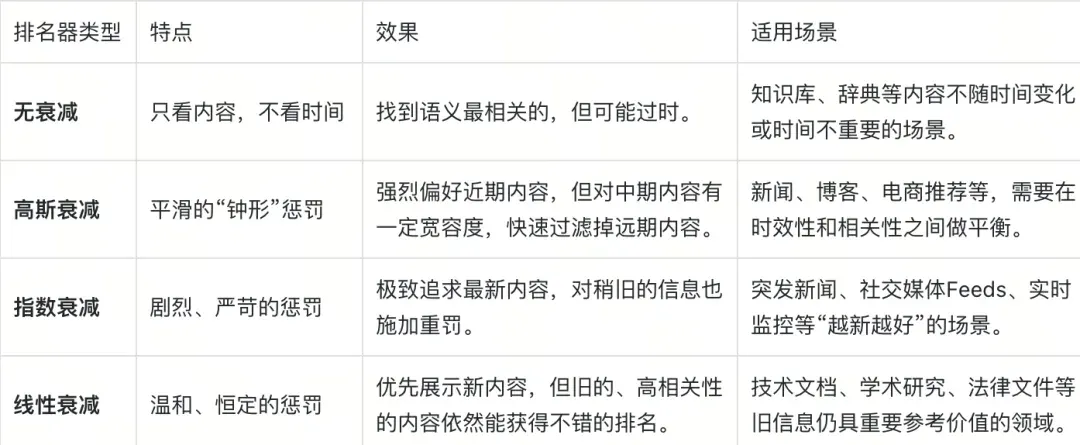
在实践中,我们可以根据以上排名器各自的特点,进行选择性的配置。
如有更多相关问题,欢迎评论区分享交流。
作者介绍

Zilliz 黄金写手:臧伟
文章来自于微信公众号 “Zilliz”,作者 “Zilliz”
相关主题
读完之后
加入 AINRK 交流群
了解加入交流群的方式,与更多 AI 从业者交流。
相关文章
继续阅读AI技术文章栏目中的内容。

代码造世界,扩散绘现实:AgentGarten让智能体在实时试炼场中边玩边进化(在新窗口打开)
推开一块挡板,通道就此封闭;搬来一段坡道,高墙便有了越过的可能。

多会话语音记忆基准VoxMem,专治音频大模型记不住「谁说的、怎么说」(在新窗口打开)
在语音助手、多用户共享的家庭助理等长期对话场景中,模型需要跨越多次会话记住用户的信息,但现有评测常遭遇两大难题:

李飞飞团队造了个世界动作模型:换个底座,机器人成功率直接飙升(在新窗口打开)
9 月 22 日,以 FLUX 图像模型闻名的 Black Forest Labs 跨界发布了开源 7B 世界动作模型 FLUX 3 Action。据其官方博客,该模型在英伟达 RoboLab-120 榜单上超过了此前最强的开源模型 Cosmos 3 Nano,参数量却不到后者一半。一家做图像生成的公司跑来卷机器人控制,说明视频模型里积累的「物理直觉」正被越来越多的团队当作机器人大脑的底座。
何恺明团队发布多模态Harness框架(在新窗口打开)
多模态模型的视觉原生Harness,来了!
ChatGPT踢到铁板了!能破解千禧数学难题,但论文复现率低至13.98%?(在新窗口打开)
OpenAI最近真是频频往数学界扔重磅炸弹。