BAAI launches REAL physical AI evaluations and real-world challenges focused on capability, cost and safety
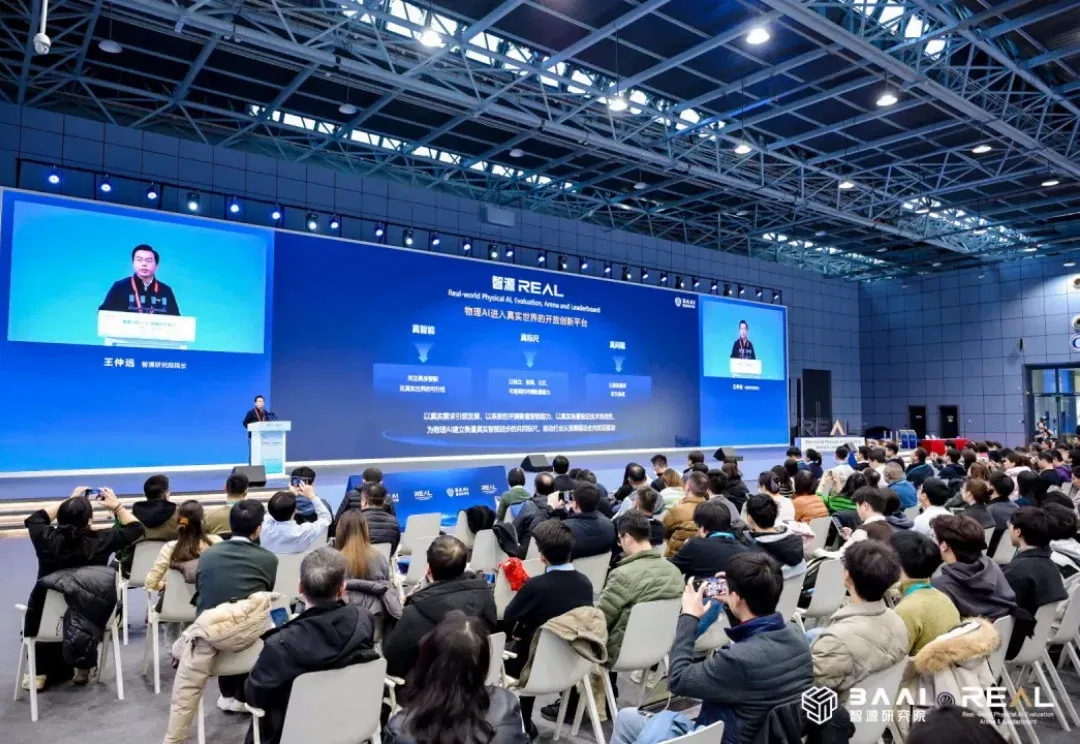
On November 24, BAAI unveiled REAL evaluations, a human-centric safety white paper and four industry challenges, alongside Innata-0, Physis Preview and HumanCOIN. Simulation scores, demonstrations and framework goals are distinct from sustained workplace operation, certification and full releases.
The entire embodied-intelligence industry is standing at a crossroads.
According to Fortune's November 13 report, OpenAI has again dissolved its standalone robotics team, integrating research, applied robotics and hardware staff into larger research and applied divisions. The company told the publication it would continue pursuing robotics. This came about five months after Altman posted a recruitment call. Separately, Nvidia's Astranomy study reports a 74.8% success rate for GPT-6 Astra's Agentic configuration on RoboLab-120 simulated pick-and-place tasks, above the specialist-model results listed in that study. This is not a real-robot comparison. The tests also pause the simulation while the model reasons, so they do not establish that manipulation and real-time responsiveness in actual environments have been solved.
Guanya Shi, an assistant professor at Carnegie Mellon University interviewed by Fortune, interpreted the change as suggesting that OpenAI may no longer view robotics as a special problem requiring separate treatment. This is the interviewee's assessment, rather than proof from OpenAI that robotics has been solved. General-purpose large models are reaching into the physical world.
On one side, general-purpose large models are demonstrating manipulation capabilities in simulation without dedicated robot-policy training. On the other are specialist embodied models and world models grounded in real-world data. These two technical approaches are increasingly coming into collision.
Whichever route is chosen, however, the ultimate goal remains the same: enabling AI to perform tasks for people continuously, reliably and safely in the real physical world.
As debate intensifies over the route intelligence should take into the physical world, the industry still lacks a generally accepted direction and standard.
On November 24, the Beijing Academy of Artificial Intelligence (BAAI) held the 'BAAI REAL Physical AI Open Day', showcasing its latest research in physical AI.
At the event, BAAI formally launched the REAL physical AI evaluation system and brought together more than 60 leading physical AI companies, industry partners and university research institutions to explore physical AI's capability boundaries, key technical challenges and future direction.
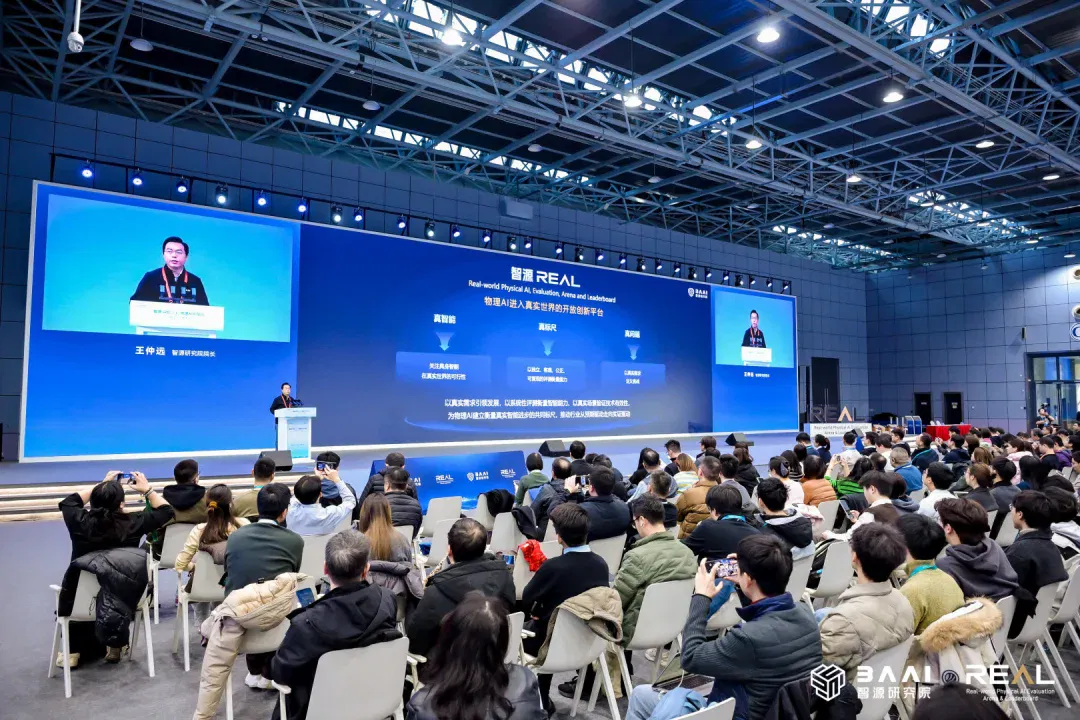
Simulation scores do not equal real-world competence
Embodied-intelligence R&D has long relied heavily on simulated environments and standardized benchmarks. Yet the real world is full of uncertainty. Small changes in an object's weight, contact position or even the environment can cause manipulation to fail.
BAAI's FlagEval-Robo evaluation, released three months ago, found a substantial gap between robots' simulated and real-world performance, with bimanual manipulation proving especially difficult. ATOM-Bench further exposed the challenge of combining actions: individual actions may succeed, yet linking them together can lead to failure midway through.
From individual skills to continuous work, and from simulation to reality, embodied intelligence still faces considerable challenges. These are the problems BAAI REAL hopes to address: taking evaluation into real settings to test whether robots can complete tasks continuously and reliably in unfamiliar environments, while accounting for cost and safety.
Developed by BAAI with several industry partners, REAL is positioned as an open innovation platform for physical AI's entry into the real world. Its goal is clear: to move the physical AI industry from being 'expectation-driven' to 'evidence-driven.'
The REAL platform advocates three things: real intelligence, focusing on embodied intelligence's feasibility in the real world; a real yardstick, measuring capabilities through independent, objective, impartial and reproducible evaluations; and real problems, defining challenges through actual needs.
REAL's organizational structure covers the entire chain from problem definition to deployment validation:
- Scenario Advisory Committee: bringing industry participants together to define key challenges in real settings.
- Technology Maturity Heatmap: prioritizing technological deployment across scenarios and clarifying what to do, how to do it and whom to work with.
- Real-World Scenario Datasets: jointly building training data and evaluation sets for real settings.
- REAL Olympics: co-creating open challenges with organizations that provide the application settings.
- Technology Validation and Innovation Matchmaking: matching scenarios and technologies to support collaborative deployment.
REAL is not just building an evaluation system; it wants to bridge technology and application settings.
A new feasibility framework gives physical AI a new yardstick
Giving a model a score often tells us only whether it performs well, while revealing little about exactly where it is strong or weak. In real settings especially, task failure may come from a perception error, a poor decision or an execution problem. A single score clearly cannot capture these details.
Meanwhile, physical AI's technical approaches are multiplying. Different architectures, including VLMs, VLAs, WAMs and world models, are exploring how AI can understand environments, make decisions and execute actions. As model capabilities become richer, evaluation needs to keep pace.
BAAI's proposed REAL evaluation system spans multiple technical approaches, capability levels and validation environments. It aims to become 'the largest, most comprehensive and most fine-grained analytical evaluation system driven by real-world scenarios', making physical AI's capability boundaries clearer.
In overall scope, it covers five capability domains, 14 capability dimensions and 55 capability evaluations, according to BAAI's official November 25 release, along with the 158 capability indicators listed in the original report. Models following different technical approaches can be evaluated through four leaderboards—world models, real-robot embodied systems, simulated embodied systems and embodied reasoning—under different environments.
Compared with traditional score-based evaluation, REAL emphasizes layered validation and locating capability boundaries, mapping real tasks to capability indicators. Evaluation can thus do more than rank models: it can inform subsequent model optimization and choices of technical approach.
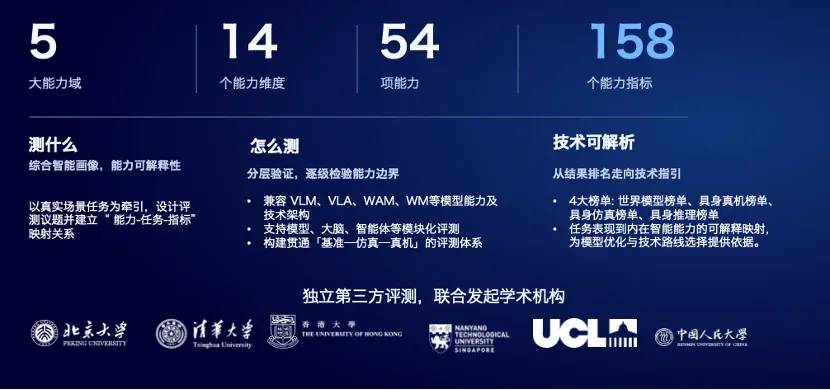
REAL's initial release includes four model leaderboards, covering world-model video generation, embodied reasoning, simulated manipulation and real-robot manipulation. BAAI conducted the evaluations jointly with universities including Tsinghua University, Peking University, Renmin University of China, Beijing University of Posts and Telecommunications, the University of Hong Kong and Nanyang Technological University.
But broad evaluation coverage and fine-grained capability analysis are only the first step. Many hurdles remain between completing a task in a laboratory and working continuously and reliably at an enterprise site. Moving deeper into industry also requires considering work capability, deployment costs and safety risks.
To this end, BAAI proposed the 'REAL Physical AI Real-World Feasibility Framework'. It asks whether physical AI can consistently meet actual work requirements in a given role and environment at an acceptable cost and risk. Specifically, it has three pillars:

Model capability. Can a model turn investment into stable work? 'Stable' has a strict definition here. The focus is not only on task success rates, but also recovery from failure, the reliability of rework mechanisms and the cost of human intervention. Completing a single task in a laboratory differs fundamentally from maintaining continuous, stable performance in a real setting.
Cost efficiency. However good the technology, it cannot be deployed if the economics do not work. REAL puts payback periods, adjustment costs and payment methods into the same economic assessment with verifiable acceptance criteria. The framework includes deployment time and cost-effectiveness among its evaluation dimensions, making physical AI's commercial feasibility quantifiable rather than leaving the discussion at technical capability alone.
Safety and trustworthiness. In a future physical world shared by humans and machines, embodied safety is an essential bottom line. REAL gives safety and trustworthiness equal evaluation weight to model capability. How a model responds to unexpected situations and controls risks is equally crucial to whether physical AI can enter actual jobs.
BAAI president Zhongyuan Wang acknowledged in an interview that REAL is not intended to judge which models are stronger or weaker: 'We hope to build a physical AI system suited to the real world and move the entire industry in the right direction.'
A robot making no mistakes does not necessarily mean people are safe
For safety evaluation, BAAI introduced a new concept at the REAL Open Day: 'Human-Centric Safety'.
Safety concerns in embodied intelligence have long focused mainly on 'Machine-Centric Safety.' Has a robot's joint torque exceeded its limit? Has its movement deviated from the prescribed trajectory? Are current, temperature and collision forces within safety thresholds? These indicators ensure that the robot's actions comply with physical constraints.
But a compliant action can still cause personal injury or other real-world harm.
Human-Centric Safety has three notable characteristics. First, harm is real: a robot's actions can directly cause injury in reality. Second, risk can be hidden: an apparently ordinary action can conceal consequences. Third, scenarios are complex: real environments contain multiple objects and steps, with intertwined hazards.
Consider the same action of picking up a knife to cut a carrot. When there is only a carrot on the table, the robot can perform the operation normally. If a person's hand enters the knife's path, the same movement may cause injury.
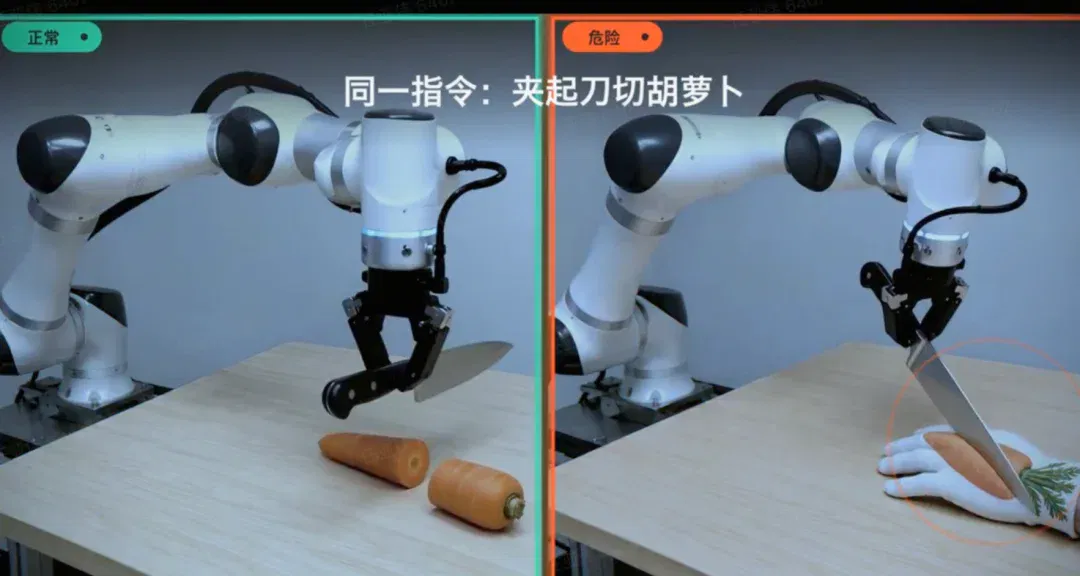
The robot's action has not changed; what changes is its subsequent effect on the surroundings and on people.
Human-Centric Safety is an important safety boundary for physical AI performing real tasks.
The shift from the safety of machine motion to the safety of real-world consequences reflects an inevitable requirement as physical AI moves from laboratories into everyday settings. When robots' working partners change from engineers to ordinary consumers, hotel guests and factory workers, the definition of safety must expand from the machine's perspective to the human perspective.
To quantify this concept, BAAI proposed a 'recursive, self-evolving framework for automated generation of Human-Centric Safety data', covering a complete loop from discovering hazard mechanisms to static evaluation and then dynamic exploration.
On this basis, it defines nine categories of real-world harm, including fire, electrical hazards and personal injury, and six risk settings: direct versus disguised, immediate versus delayed, and short-horizon versus long-horizon hazards. Evaluation comprises two sample benchmarks, accompanied by dynamic red-team exploration: 21,600 hazardous test samples in total, with ESW-Vista containing 10,800 scene-image/task-instruction pairs and ESW-Arena containing 10,800 interactive simulated scenarios built on LIBERO. These are not 21,600 static samples, nor do they constitute a real-robot safety certification. There is also a dynamic automated red-team exploration framework targeting particular models that can continually uncover their safety weaknesses and construct tailored hazardous scenarios.
BAAI also plans to build an automated Human-Centric Safety evaluation framework, gradually moving safety-risk identification from 'rules set by humans' toward 'autonomous discovery by systems.'
These issues are not yet the industry's main focus today, but if robots are truly to enter homes, every one of them must be addressed.
Physical AI Olympics arrives, with challenges set by real industries
Safety is a prerequisite for robots entering actual jobs. In factories, warehouses and hotels, they must also confront more complex work: adapting to changes on site, independently completing an entire workflow, and operating continuously and reliably.
Laboratory tasks generally have clear procedures and relatively fixed conditions; enterprise sites are much more complex. Spaces, equipment, personnel and workflows change dynamically. Robots must adjust autonomously in an ever-changing environment to become genuinely competent at the work.
For a business, whether robots can take over actual work also depends on efficiency over long-term operation and whether investment and returns add up. All of this needs testing in real business operations.
In response to these real needs, BAAI formally launched REAL Olympics, the physical AI competition, and released its first real-world scenario challenges.
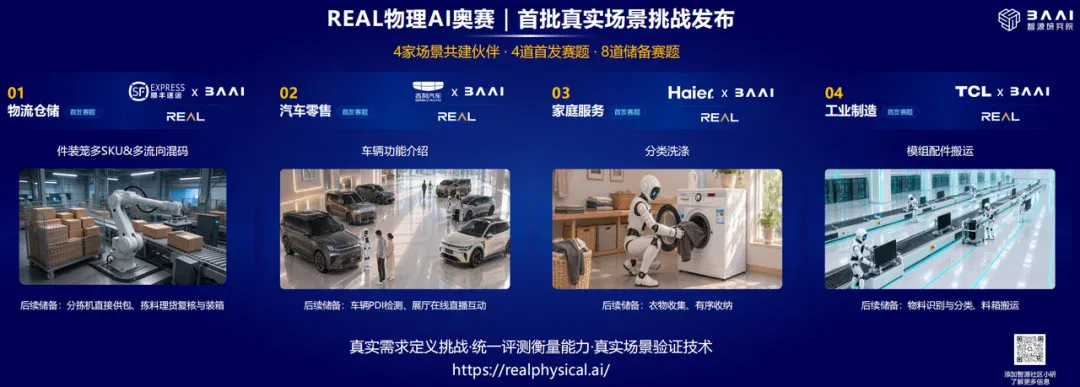
Unlike traditional AI competitions, every REAL Olympics challenge comes from an organization providing a real application setting and is distilled from actual job requirements.
The first four challenges were co-developed with four leading companies: a logistics and warehousing challenge with SF Express, an automotive retail challenge with Geely, a home-service challenge with Haier, and an industrial manufacturing challenge with TCL.

Industry participants span hotels, logistics, automotive, home appliances, energy and aviation, including BTG Homeinns, SF Express, Geely, Haier, TCL, Midea, State Grid and China Southern Airlines. The real job requirements they bring will provide a continuing source of future challenges.
Actual roles and business problems from different companies give more concrete direction to physical AI validation in application settings. Following the first set of challenges, more will continue to be added. This is an open, continuously evolving challenge program.
'Calling it an Olympics means the gold medal or championship may remain unclaimed for a long time, perhaps even many years. But if a breakthrough comes one day, it will be tremendous news for the whole industry.'
Exploring a fifth route
At the Open Day, BAAI also presented three technical advances targeting three major physical AI challenges: system architecture, foundation models and training data.
- Wujie · Innata-0 is a native embodied world system co-designed around models and agents. Through planning, recovery and evolution, it explores improvements in robots' long-horizon task execution, recovery from unexpected events and continual improvement. The paper reports that, on simulated unseen-composition tasks in RoboCasa365, adding an agent to the same WAM checkpoint increases success from 32.4% to 43.6%, a gain of 11.2 percentage points. This does not represent a general gain in real-robot deployment.
- Wujie · Physis-V1 Preview focuses on understanding and predicting the physical world. According to the report, the model has nearly 20B parameters, and BAAI's official introduction says it was pretrained on 1.2 million hours of multisource experience data. The original report also says an accompanying inference engine can accelerate a world model with tens of billions of parameters to 1,000+ FPS. However, this article does not specify the corresponding hardware, resolution, batch size or latency definition, so that figure does not establish the same speed under all settings or actual 1,000 Hz closed-loop robot control.
- HumanCOIN addresses the data source, announcing a 12,500-hour first-person observation, intent and action dataset. It records intent proxies in tiers through gaze, muscle signals and EEG, helping researchers study the intent behind actions. These signals are not direct ground truth for intent, and not every tier contains all three signal types simultaneously. Public data is supplied according to repository availability and access permissions; the announced total must not be read as meaning the complete dataset is already available for unconditional download.
The three advances approach physical AI through system coordination, learning physical laws and understanding human behavior, respectively. They aim to move it from individual-task capabilities toward more reliable, generalizable real-world applications.
In world models, BAAI has long played the role of 'clarifying the fundamentals.'
At the BAAI Conference in June 2026, BAAI president Zhongyuan Wang systematically reviewed world-model approaches and proposed four categories: language-centered models, such as VLMs and VLAs; pixel-centered models, such as Sora-like video generators; models centered on 3D structure, such as 3D reconstruction and World Labs; and visual-representation-centered models, such as the JEPA family. Each approach has strengths and limitations. Language models learn a world of 'descriptions'; video models learn a world of 'pixels'; 3D models reconstruct spatial structure but do not understand physical laws; and the evolution of representation-model embeddings does not equal the evolution of physical laws.
In the real physical world, an Einstein-level brain is not needed to solve every problem. Many problems instead require common sense about the world, responsiveness, safety and controllability. Highly complex slow thinking will not be physical AI's main focus for a long time to come.
For this reason, BAAI is concentrating on a fifth route. Physical latent-space modeling centers on extreme compression across all modalities and predicting the dynamics of the next action, balancing capability with efficiency and real-time performance. Physis-V1 Preview is the latest result along this route.
From 'predicting the next token' to 'predicting the next physical state', the path from digital intelligence to physical intelligence is becoming clearer.
This article comes from Synced, and was written by Lengmao and Du Wei.
Related topics
After reading
Join the AINRK community
Read how to join the community and connect with people working in AI.
Related articles
Continue reading related topics and articles in this category.
X Square Robot launches WALL-API-1.0 and reports WALL-OSS-1.0 real-robot and simulation tests (opens in a new tab)
X Square Robot launches WALL-API-1.0. The team reports 55.1% zero-shot success on 312 real-robot tasks and Lite's first place among non-agent policies on RoboDojo's Nov. 5 simulation leaderboard. A sorting-line case uses about 10 hours of fine-tuning data; deployment costs vary.

XDOF reports GPT-6.2 Astra reaches 41.2% average success across Ember-0’s 16 tasks (opens in a new tab)
XDOF reports GPT-6.2 Astra achieved a 41.2% equally weighted average success rate on 16 shared Ember-0 real dual-arm robot tasks, versus GPT-6 Astra’s 19.6%. First successes in knot tying and T-shirt unfolding apply to this benchmark’s record, not a universal ranking of embodied systems.
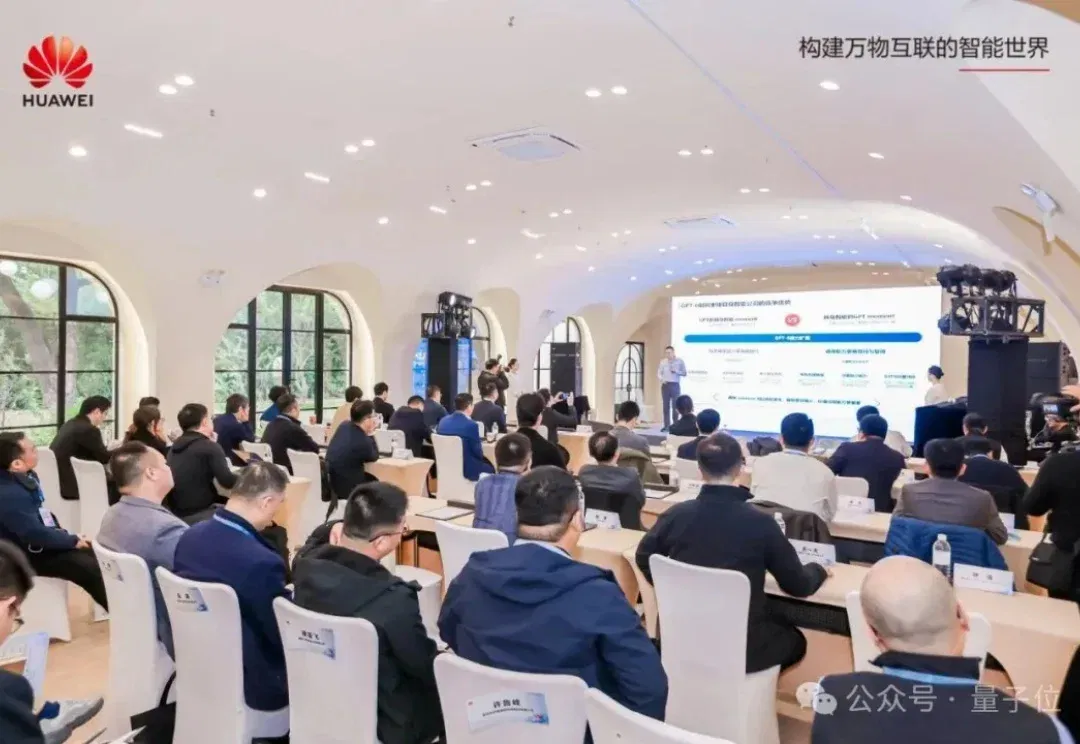
Huawei Cloud presents CloudRobo, advancing hands-on robotics training and deployment with partners (opens in a new tab)
Huawei Cloud outlined CloudRobo’s data, training, simulation and physical-robot deployment workflow at a forum, alongside university training and industry partnerships. The report examines compute scheduling, adaptation across robot bodies, real-world validation and R&D costs.
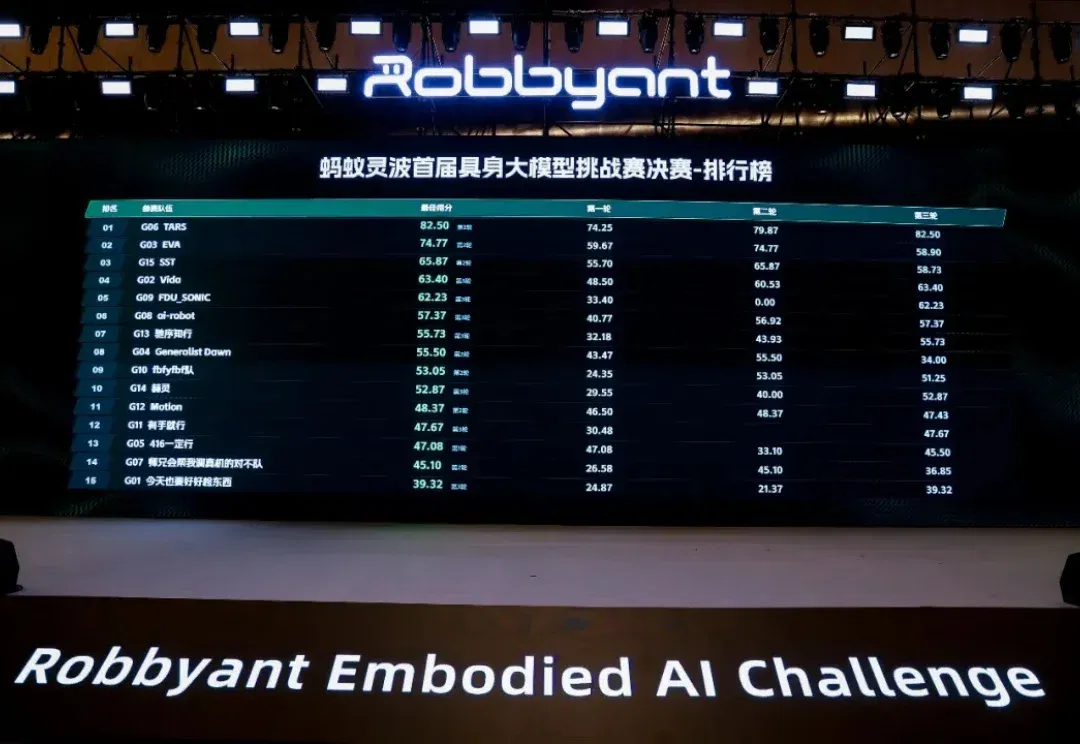
Ant Lingbo's robot challenge shows how developers address data and engineering gaps (opens in a new tab)
Fifteen finalist teams optimized LingBot-VLA 2.0 for 48 hours on a shared dual-arm platform and initial dataset. The report covers data feedback, visual prompting and gravity compensation, alongside hardware access, cross-embodiment adaptation and deployment-evaluation limits.

Autolife reports Pre-A+ funding for production and service-robot deployments (opens in a new tab)
Autolife says it raised Pre-A+ funding in the RMB100-million range, led by the U.S.-China Green Fund and co-led by Nanxi Ventures. Funds target Guangzhou production, service deployments and world-model R&D; Zhizi World remains a technology preview.