X Square Robot launches WALL-API-1.0 and reports WALL-OSS-1.0 real-robot and simulation tests
X Square Robot launches WALL-API-1.0. The team reports 55.1% zero-shot success on 312 real-robot tasks and Lite's first place among non-agent policies on RoboDojo's Nov. 5 simulation leaderboard. A sorting-line case uses about 10 hours of fine-tuning data; deployment costs vary.
Editor's verification (2026-11-24): The evaluations and production-line results here are disclosures from the X Square Robot team and have not been independently reproduced. The 55.1% figure concerns its open-ended real-robot task set; ManipArena scores and the RoboDojo simulation leaderboard use different tasks and statistical measures. Lite's first place is limited to policies without agent systems in the November 5 leaderboard snapshot, and does not establish comprehensive superiority over Astra or all embodied systems. Fine-tuning on approximately 10 hours of data and cross-site retention figures concern a specific logistics case; its usability thresholds, hardware, and task scope should not be generalized to all production lines. API access does not mean every model component or weight has been released. X Square Robot's WALL-OSS-1.0 technical explanation (opens in a new tab) | Official RoboDojo simulation leaderboard (opens in a new tab) | Official WALL API access instructions (opens in a new tab)
People tell only half the story of Leonardo da Vinci drawing eggs.
The textbook version is about diligence: his teacher Verrocchio had him draw eggs for three years. The other half is rarely mentioned. Those three years honed intuition, not patience. Later, when drawing muscles, flowing water, or flying machines, he relied on that same foundation of understanding at a glance.
Robots should be trained in this order too: first build intuition, then tackle unseen tasks. The industry has long done the reverse, teaching each specific task only when it arises.
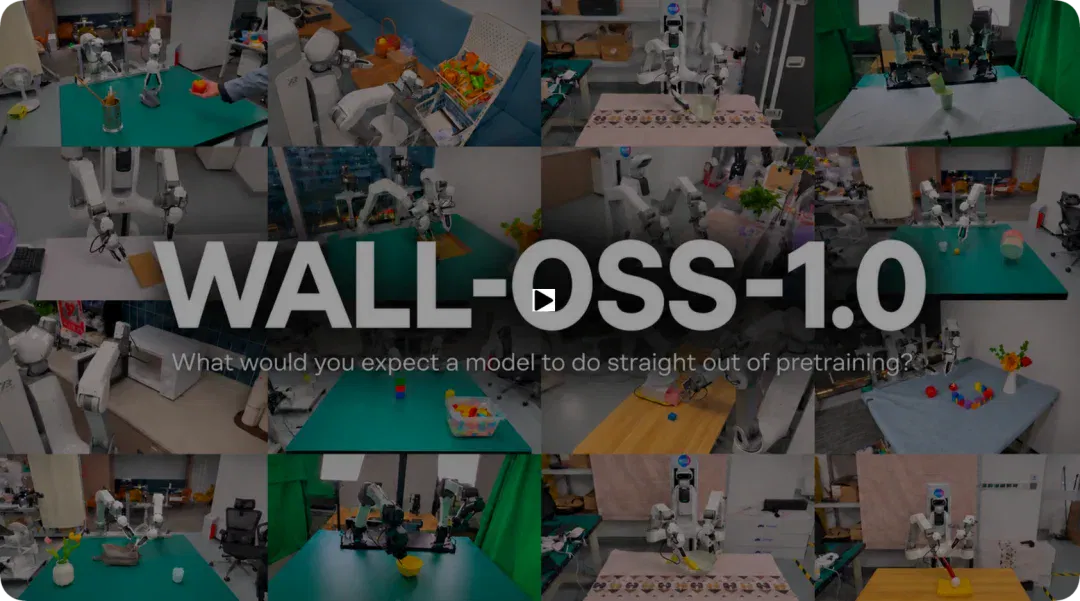
X Square Robot has launched WALL-API-1.0, a model-access service powered by WALL-OSS-1.0, an iteration of WALL-OSS-0.5 that seeks to address this problem.
WALL-OSS-1.0 is a major generational upgrade to X Square Robot's previous embodied foundation model, WALL-OSS-0.5.
According to officially released figures, WALL-OSS-1.0 achieves a 55.1% zero-shot success rate in open-ended real-robot evaluation. In another real-robot evaluation, without task-specific fine-tuning, its aggregate score is 70.8% higher than that of π0.5 after multitask fine-tuning.
It also ranks first in the single-model track of the RoboDojo simulation evaluation.
WALL-API-1.0 currently provides the WALL-OSS-1.0 model family for researchers and businesses worldwide to call. Making highly capable models available "out of the box" through APIs marks a move toward standardization and industrialization of embodied intelligence, turning it into a utility like water, electricity, and gas for many industries.
API application link:
https://x2robot.com/docs/quantax1pro/v1/model-development/wallx-api/api-usage-instruction
Technical blog:
https://x2robot.com/blog/wall-oss-1
Returning to WALL-API-1.0's core model, WALL-OSS-1.0: in essence, X Square Robot wants large-scale pretraining to give robots a "general education," first acquiring reusable foundational capabilities and then adapting to a multitude of specific tasks.
The ability to infer the unfamiliar from familiar examples, something humans take for granted, is exactly the "big outcome" embodied intelligence seeks.
Why should a robot's general education begin with pretraining?
Many previous vision-language-action models, or VLAs, first trained a vision-language model and added robot-action data afterward.
This approach lets robots recognize objects, understand scenes, and follow instructions. The problem is that, by the time action data arrives, the model's foundational representations for understanding the world have largely taken shape.
A vision-language model might recognize a cup on a table and understand an instruction to pick it up, for example, without knowing how to contact the cup's surface, control gripper force, or adjust after a failed grasp.
Physical interaction has many details that are difficult to learn from observation and description alone. Even when picking up a cup, an empty cup and one filled with water require different forces. Position, material, and surrounding obstacles also change the action strategy.
What X Square Robot changes is precisely when actions enter training.
WALL-OSS-1.0 includes action data from pretraining onward, letting language, vision, and action jointly shape how the model understands the world.
The first training stage uses a unified autoregressive framework. VL Pretraining covers language understanding, visual recognition, and spatial reasoning; Action data trains robot-action prediction; and Action VL bridges actions and semantics, teaching the model to describe actions, judge whether an operation is correct, and recognize and correct errors.
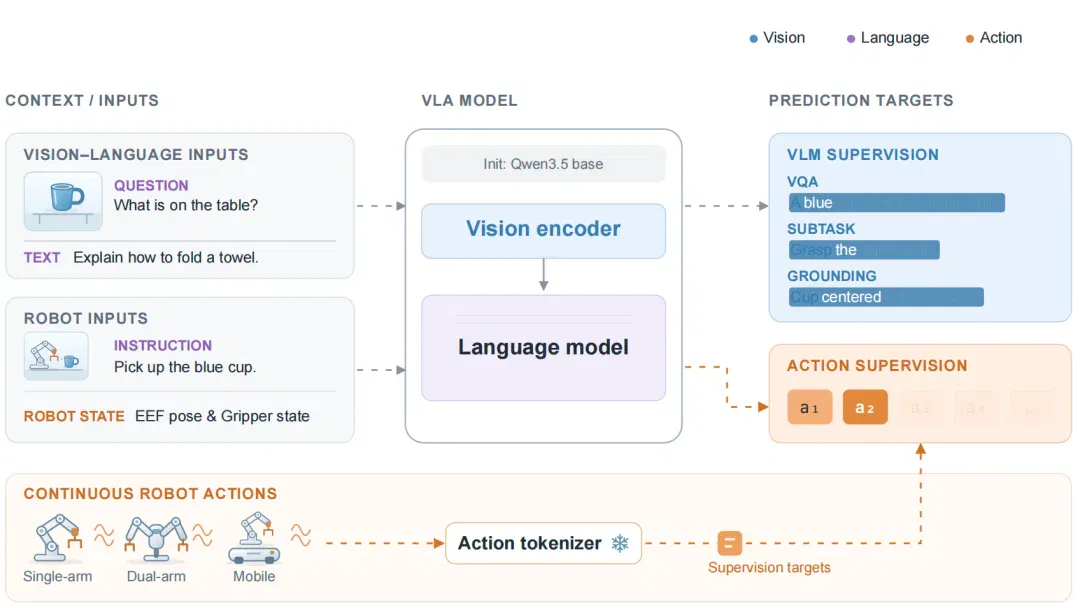
In effect, while learning what objects are and what a task requires, the robot also begins understanding the connection between actions and task goals.
But for actions to join unified training like text, differences in data formats across robots must also be addressed.
X Square Robot therefore improved its in-house X-Tokenizer to compress continuous action trajectories into discrete action tokens that retain motion information. Think of it as establishing a common action language for different robots, allowing data from single-arm, dual-arm, and mobile robots to enter a unified learning framework.
More interestingly, WALL-OSS-1.0 also changes the one-purpose use of action trajectories.
Previously, an operation sequence was usually used only for imitation learning: a human demonstrated how to pick up a cup, and the robot copied it. Now one trajectory serves multiple purposes. It can predict actions from instructions, help the model understand action semantics and evaluate correctness, and use failed trajectories and human corrections to learn how to adjust.
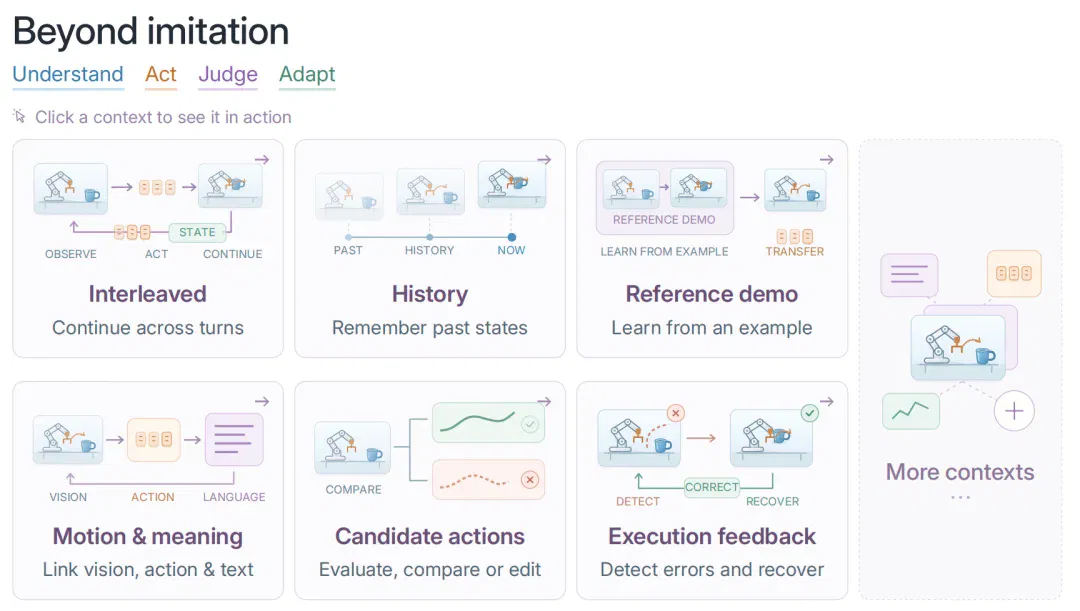
Data previously used only to imitate actions becomes comprehensive teaching material combining action, semantics, judgment, and error correction. The significance is that robots' learning begins shifting from isolated operations toward physical-interaction experience reusable across tasks.
Picking up a cup, moving cutlery, and tidying a tabletop may look like three different tasks, but can involve similar grasping, spatial judgment, and object-manipulation capabilities.
When pretraining establishes shared representations of actions and semantics, the model has a chance to recombine prior experience for unfamiliar tasks, reducing dependence on dedicated demonstrations and fine-tuning.
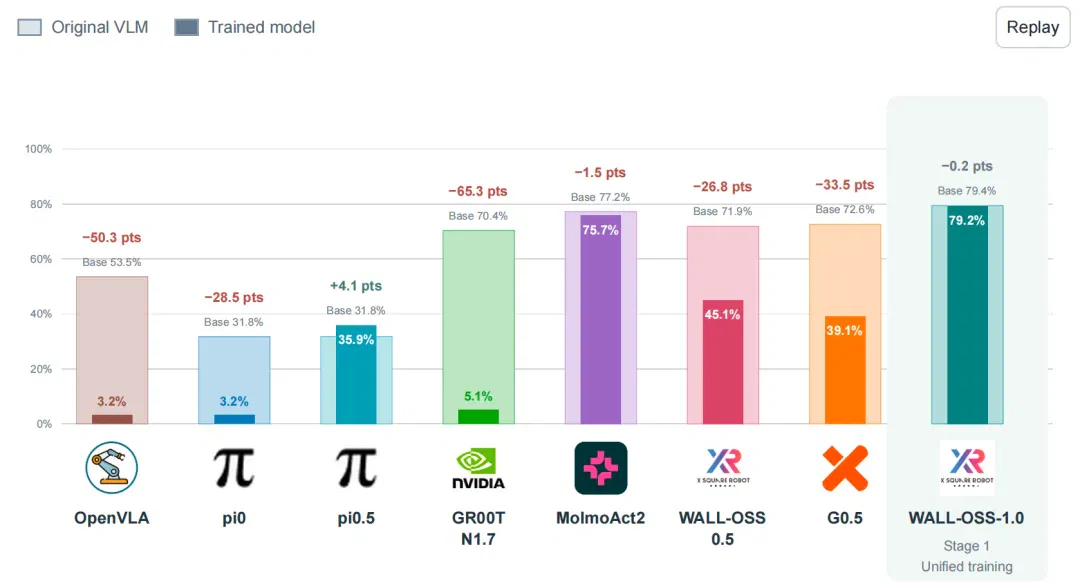
After connecting vision, language, and action, getting a robot to work still requires action precision and continuous control.
In the second stage, WALL-OSS-1.0 therefore introduces an Action Expert through a MoT architecture, using Flow Matching to generate continuous robot-control trajectories. Real-time chunking, RTC, predicts the next trajectory segment while the current action executes. The associated optimizations reduce latency per inference to under 60 milliseconds.
The two training stages thus have distinct roles: the first learns general visual, linguistic, and physical-interaction capabilities, and the second uses an action expert to convert them into precise, continuous robot operations.
If this training approach is a general education, it must answer two questions together: how a robot understands what to do, and how it turns that understanding into action. Covering enough tasks also requires rich physical-world experience.
The more varied the data sources, the more experience robots accumulate
The cost of collecting physical-interaction data has long troubled embodied intelligence.
Language models can consume vast amounts of internet text and images, while robots require actual equipment, operators, and varied physical environments. Collection is much harder and more expensive.
X Square Robot uses training that combines multiple data sources, exposing WALL-OSS-1.0 to richer operational experience across tasks, scenes, objects, and interaction styles.
A large share comes from embodiment-free data collected by operators with UMI devices, alongside robot teleoperation, open-source action data, and human-takeover data.
Embodiment-free data is particularly worth noting.
Operators perform tasks directly in real environments such as kitchens and offices using handheld UMI devices, recording trajectories and physical interactions without needing an actual robot for every demonstration.
This lowers the collection barrier while retaining human movement rhythms, contact changes, and bimanual coordination details—like inviting countless real masters to teach in person.
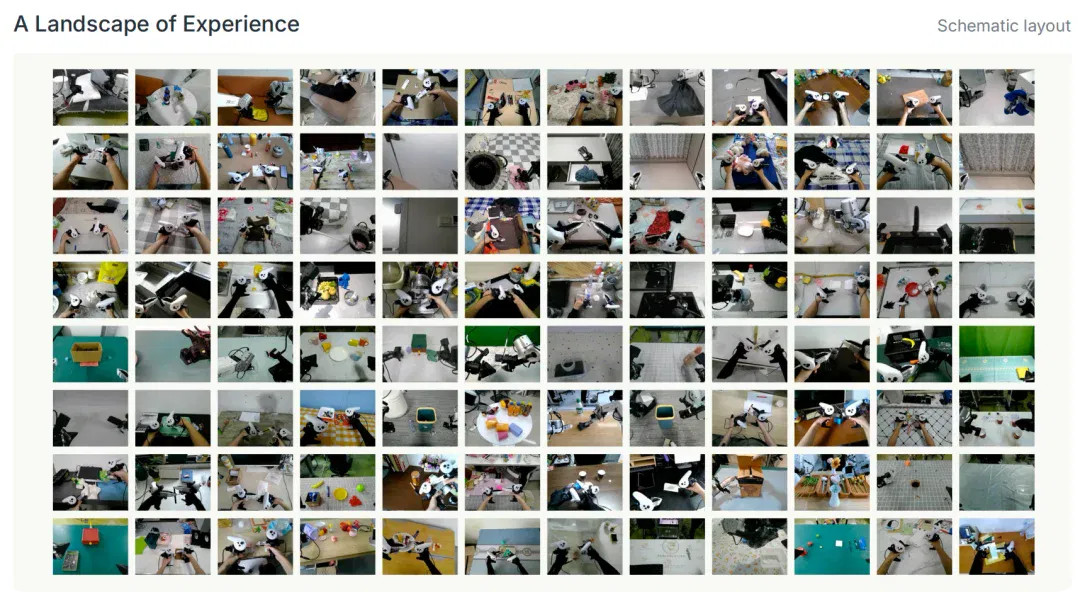
After collecting data, the team still needs to ensure its quality and help the model understand relationships between different actions and tasks.
X Square Robot established more than 20 automated quality checks covering motion feasibility, smoothness, pose continuity, and visual quality, followed by action processing and semantic annotation.
One key design annotates the same operation trajectory in language at four levels. Tidying the table is the overall task, picking up a cup is a level below, followed by specific actions and motion segments, moving from an outline down to a detailed transcript.
Automated segmentation, action descriptions, and video checks connect instructions at different levels to real movements. The model's experience then includes not only isolated action clips but links between high-level goals and specific execution.
The real world does not always organize tasks into standard answers. A user might simply tell a robot to clear the table. Whether to pick up a cup or deal with wastepaper first is something the robot must judge from the environment.
Beyond broadening data coverage, X Square Robot also focuses on tasks the robot has not mastered.
The team built an agent-driven human-takeover data-collection mechanism. An agent evaluates model capabilities, finds challenging tasks, and assigns them to the robot for autonomous execution.
When an operation fails, a human operator takes over, completes the current subtask, and returns control to the model. The system records the erroneous operation and human correction so the robot can learn from failure.
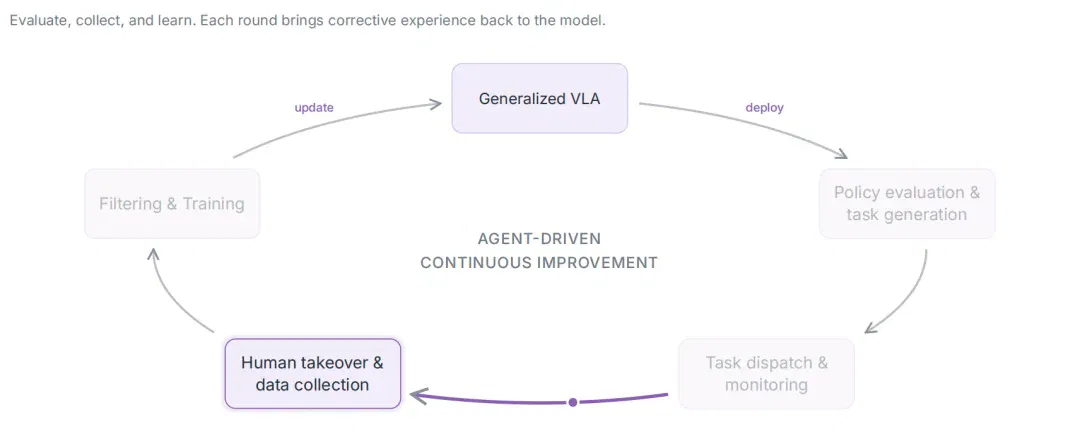
Teach the areas the robot does not know; demonstrate the correct operation again wherever it tends to make mistakes.
As the model improves, the agent keeps finding new difficult tasks, centering collection on the model's current capability boundary. In training terms, this gives the robot a continuously updated notebook of mistakes and focuses limited data-collection resources on skills not yet mastered.
Multiple sources increase scale; quality filtering and hierarchical annotation improve utilization; human takeover continuously supplies more targeted experience.
WALL-OSS-1.0 is trying to establish a foundational education system that continually accumulates, transfers, and reuses experience. The richer the physical world a robot has encountered, the more opportunity it has to draw answers from past experience when facing unfamiliar tasks.
From zero-shot tasks to production lines: Measuring embodied intelligence's "big outcome"
Ultimately, the training approach and data system must answer the same question: how far can the capabilities a robot has acquired extend to new tasks?
In ManipArena's real-robot evaluation of 15 tabletop tasks, WALL-OSS-1.0 without task-specific fine-tuning scores 1,101 out of 1,500—52.5% above WALL-OSS-0.5 and 70.8% above π0.5 after multitask fine-tuning.
In semantic-understanding tests such as headphone sorting, object pairing, and selecting fruit as instructed, WALL-OSS-1.0 achieves an overall success rate of 78%, versus 44% for π0.5.
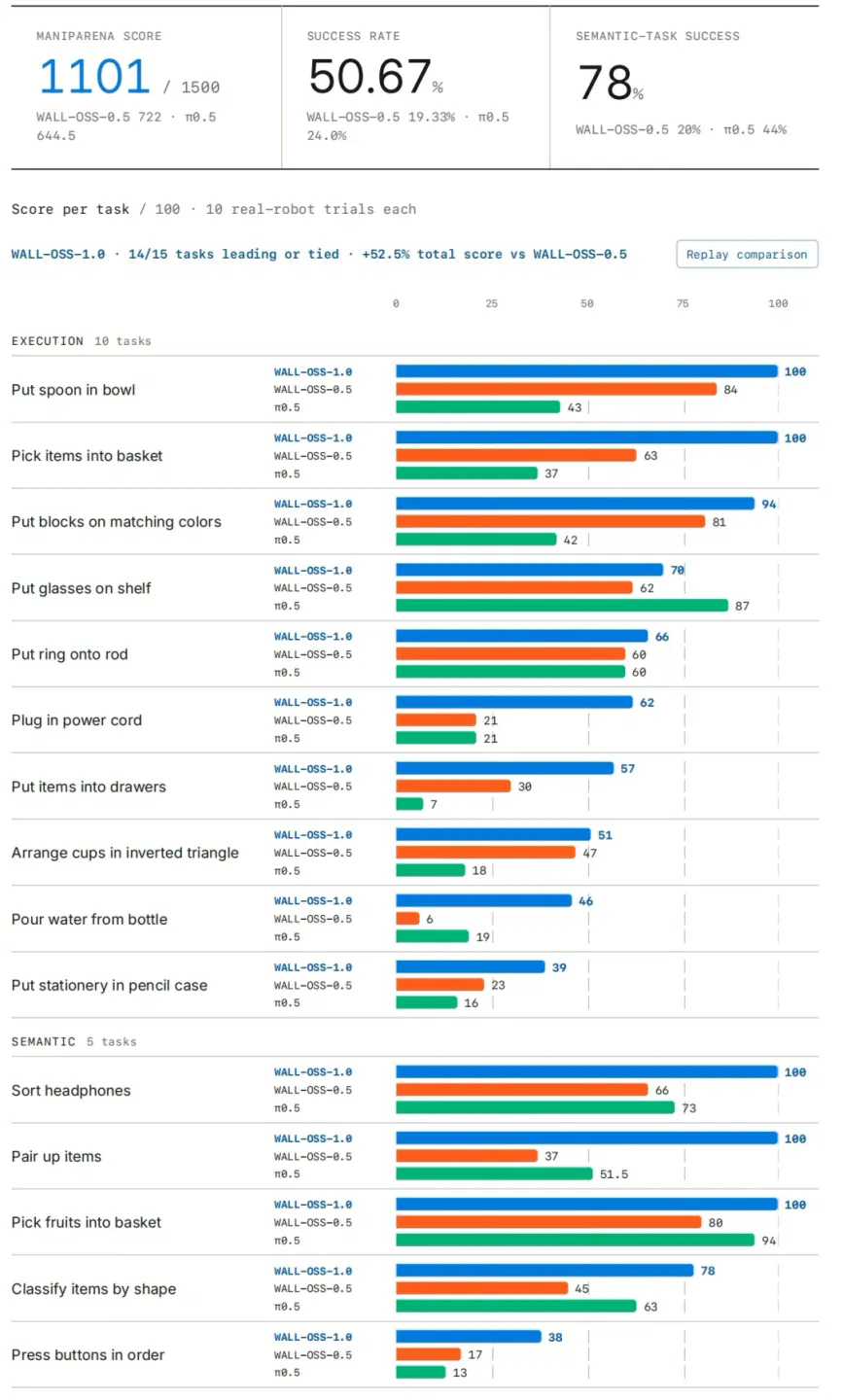
WALL-OSS-1.0's advantage becomes more evident when a task requires understanding intent and object relationships before deciding what action to take.
Beyond fixed-task evaluation, open-ended zero-shot testing deserves particular attention.
Evaluators freely choose tasks, and the model directly uses its pretrained policy without additional task-specific fine-tuning.
After consolidating repeated instructions across 377 tests, the set contains 312 distinct tasks, covering multistep operations, bimanual coordination, spatial relationships, and tool use. WALL-OSS-1.0 achieves a 55.1% zero-shot success rate, including 66.5% for multistep sequential execution, 62.2% for pick-and-place, and 57.7% for bimanual coordination.
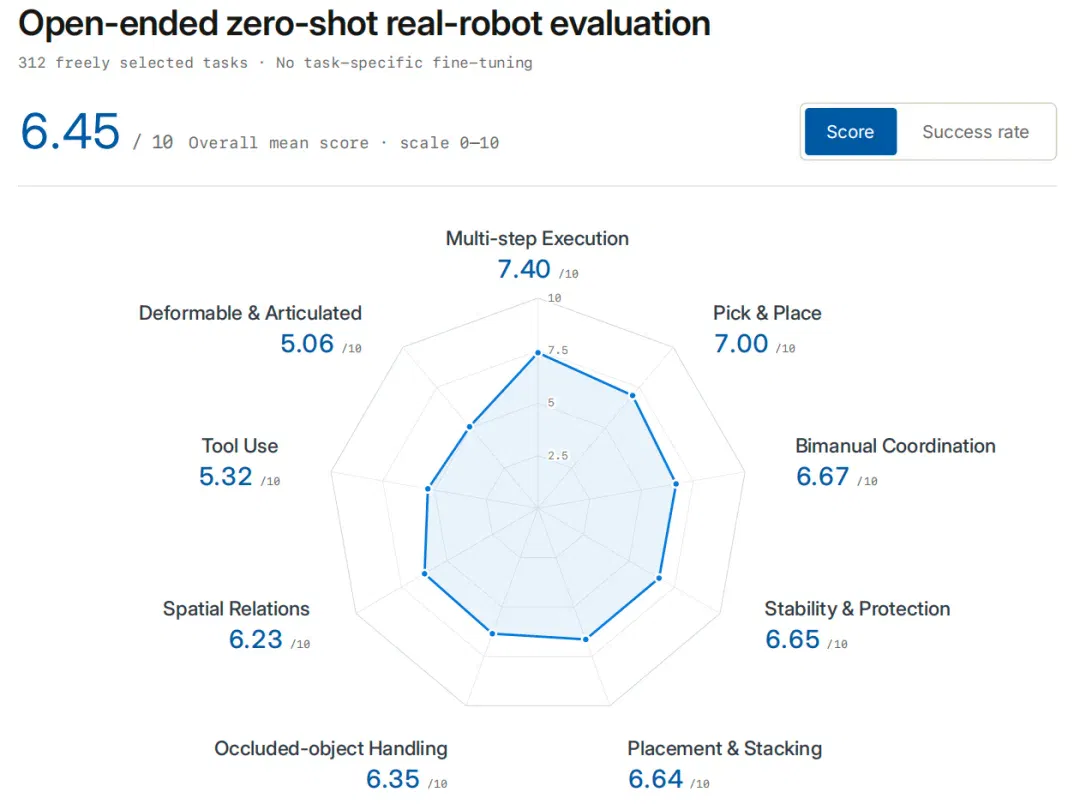
What makes these results notable is that, for some tasks on which it has never been specifically trained, the robot can already call on previously acquired capabilities and attempt the operations directly.
Of course, a 55.1% success rate also means that many entirely new tasks still challenge the model. Even so, zero-shot generalization shows promising potential.
To illustrate zero-shot capability more clearly, X Square Robot also shows operations across tasks, environments, and embodiments without targeted fine-tuning, including long-horizon tasks, spatial judgment, bimanual coordination, tool use, and error recovery.
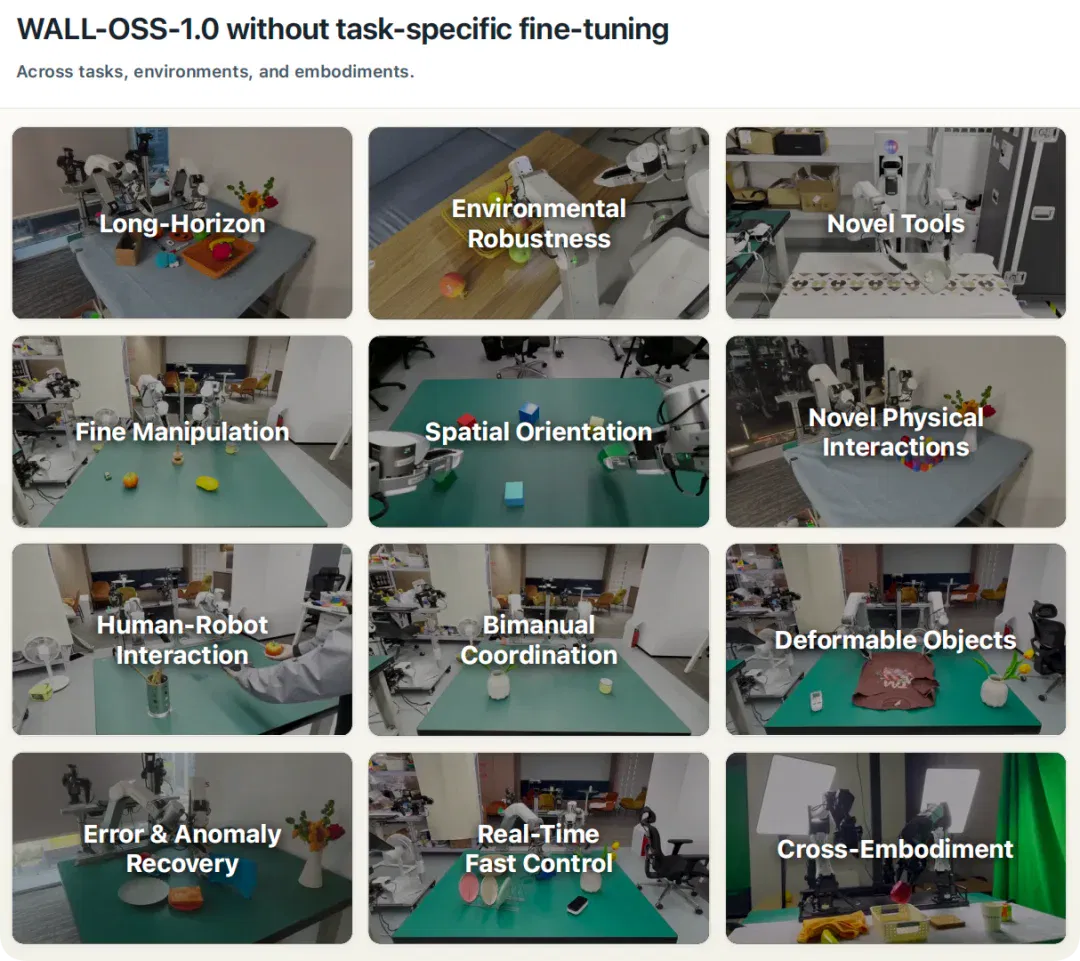
With reusable foundational manipulation skills, robots may also collaborate with higher-level agents to complete more complex, long-horizon tasks.
Asked to set a place for one person, for example, a robot must inspect the table, judge whether there is enough space, move obstacles, and place the plate and cutlery in sequence.
X Square Robot's XR Harness organizes these long-horizon tasks. The higher-level agent plans and adjusts steps from environmental feedback, while WALL-OSS-1.0 generates the specific manipulation actions.
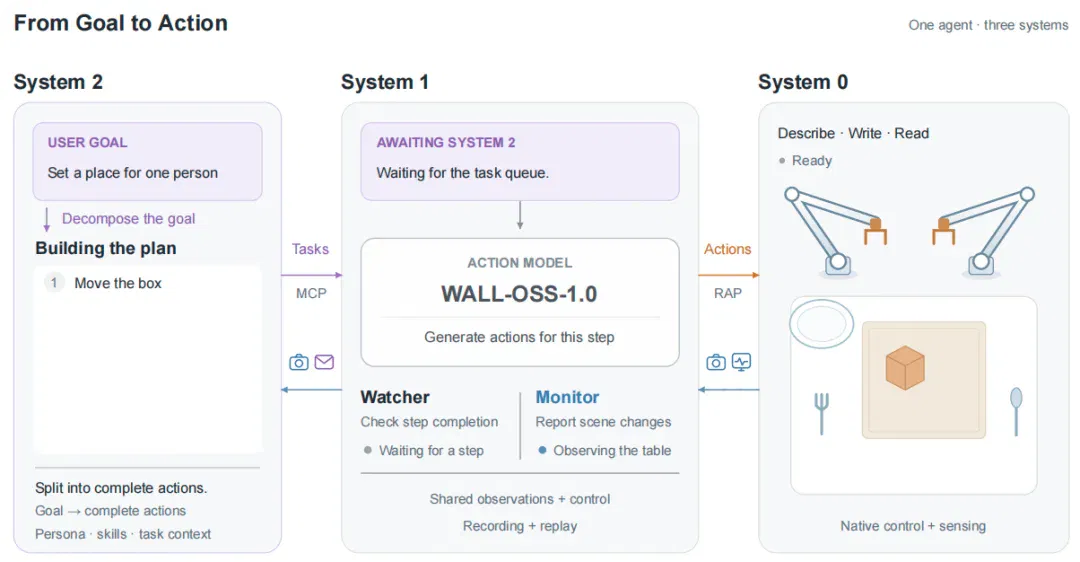
The four-level language annotations described earlier help here, allowing the agent to invoke foundational robot skills through instructions at different granularities.
X Square Robot has also introduced Lite and Nano for lightweight deployment, and Gen and AR to explore different action-learning approaches.
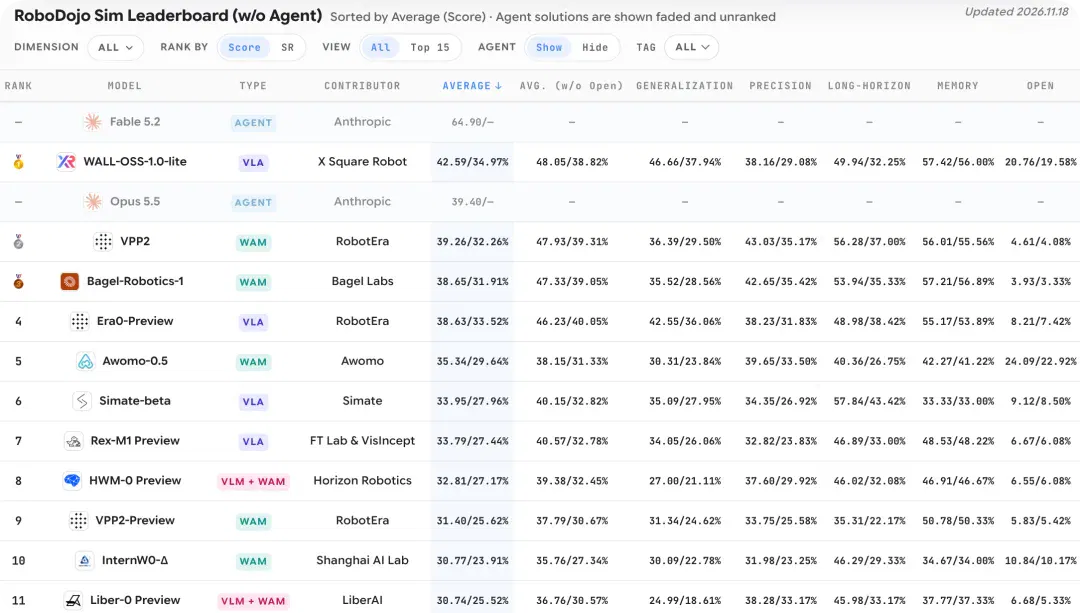
In the November 5, 2026, leaderboard, Lite ranks first among policies without agent systems on the public RoboDojo simulation track, with 42.59 points.
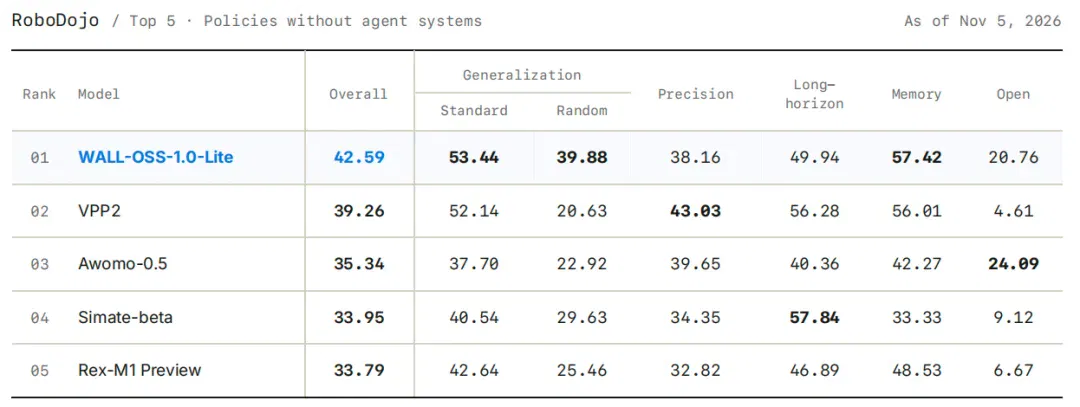
The leaderboard updated as of November 18 shows Lite retaining its strongly leading position, with a score above the listed agent-based approaches using very large models such as Astra and Opus 5.5.
Laboratory results, however, are only a beginning. For robotics, the true commercial value of general capabilities also depends on the extra training cost required to enter a new scenario.
A WALL-OSS-1.0-based solution has entered the sorting line of a leading logistics company in China, performing tasks including flipping parcels and aligning barcodes.
According to X Square Robot, fine-tuning the pretrained model on approximately 10 hours of production-task data reaches a usable level, compared with more than 1,000 hours for a control without pretraining. After transfer to other production sites, the pretrained solution retains more than 90% of its original sorting speed and success rate, while the non-pretrained solution's success rate drops by more than 90%.
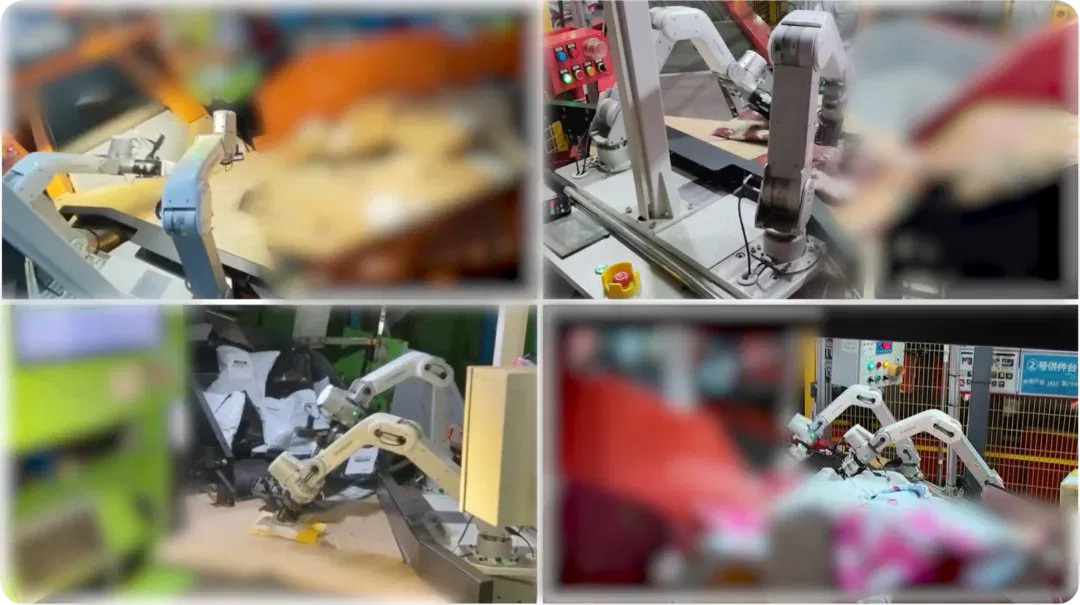
For the same change of job, one approach needs only a little training to adapt, while the other must collect large amounts of data anew. The difference lies in the foundation built through pretraining.
If pretraining is a robot's general education, adapting to a specific production line is vocational training.
The richer the foundational capabilities, the less a robot needs to learn when entering a new role.
For deployment, under a particular test configuration, the Nano version can serve 18 robots simultaneously from one NVIDIA Blackwell GPU. X Square Robot has also opened WALL-OSS-1.0 API access, providing the conditions for external model services.
From 55.1% zero-shot success across 312 tasks to substantially lower data requirements for production-line adaptation,
WALL-OSS-1.0 is examining from several angles how general embodied capabilities may gradually form through large-scale pretraining and be reused in new tasks and environments.
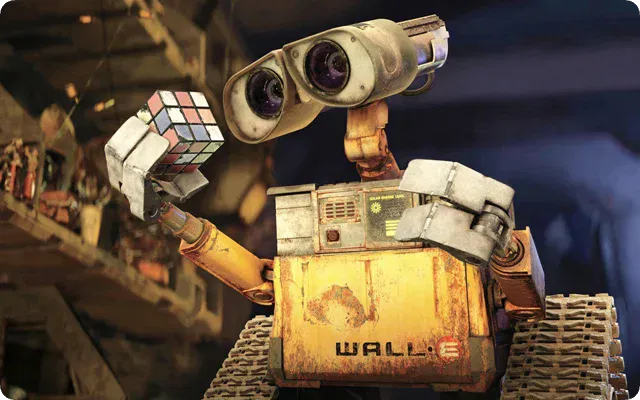
This brings to mind the robot WALL-E in Pixar's WALL-E. After collecting rubbish on Earth for 700 years, it comes across a Rubik's Cube, a lighter, a plant, and an old boot. Without anyone rewriting its code, it uses accumulated physical experience to gradually figure out how to handle and store them.
WALL-OSS-1.0 gives this expectation a more concrete technical basis. The "big outcome" it points toward is this:
The team hopes robots will reuse prior experience across more unfamiliar tasks in the future. Current results do not establish that all robots can learn without instruction across every task and environment.
This article is from the WeChat public account "APPSO," by "APPSO."
Related topics
After reading
Join the AINRK community
Read how to join the community and connect with people working in AI.
Related articles
Continue reading related topics and articles in this category.
XDOF reports GPT-6.2 Astra reaches 41.2% average success across Ember-0’s 16 tasks (opens in a new tab)
XDOF reports GPT-6.2 Astra achieved a 41.2% equally weighted average success rate on 16 shared Ember-0 real dual-arm robot tasks, versus GPT-6 Astra’s 19.6%. First successes in knot tying and T-shirt unfolding apply to this benchmark’s record, not a universal ranking of embodied systems.
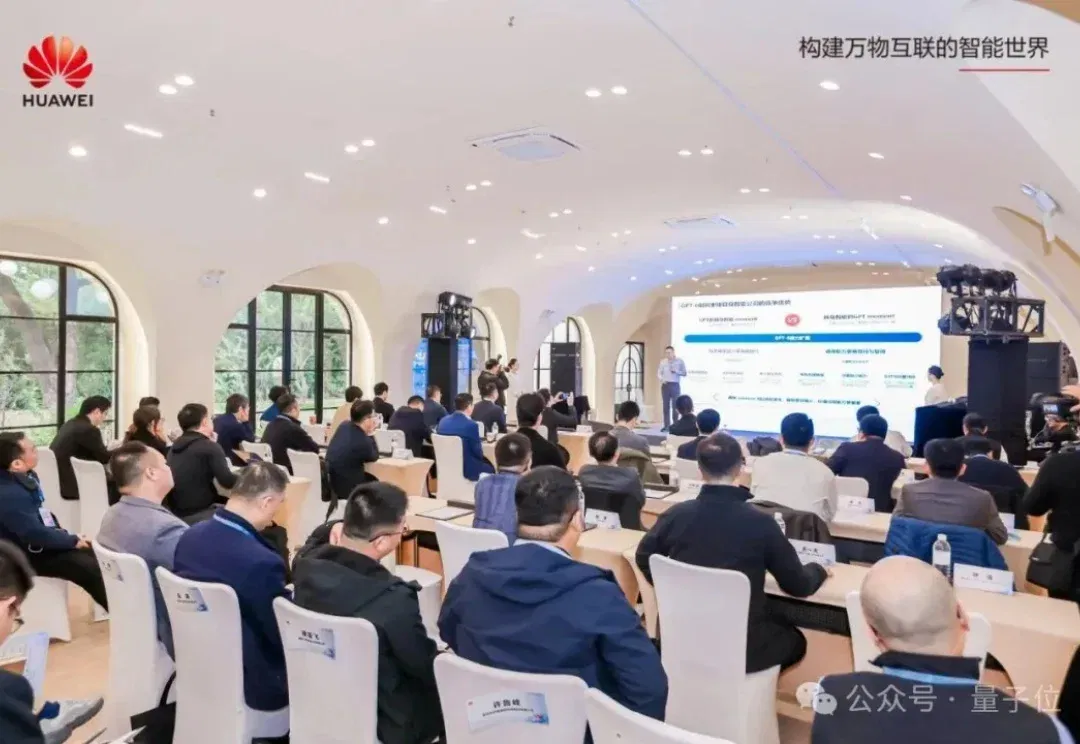
Huawei Cloud presents CloudRobo, advancing hands-on robotics training and deployment with partners (opens in a new tab)
Huawei Cloud outlined CloudRobo’s data, training, simulation and physical-robot deployment workflow at a forum, alongside university training and industry partnerships. The report examines compute scheduling, adaptation across robot bodies, real-world validation and R&D costs.
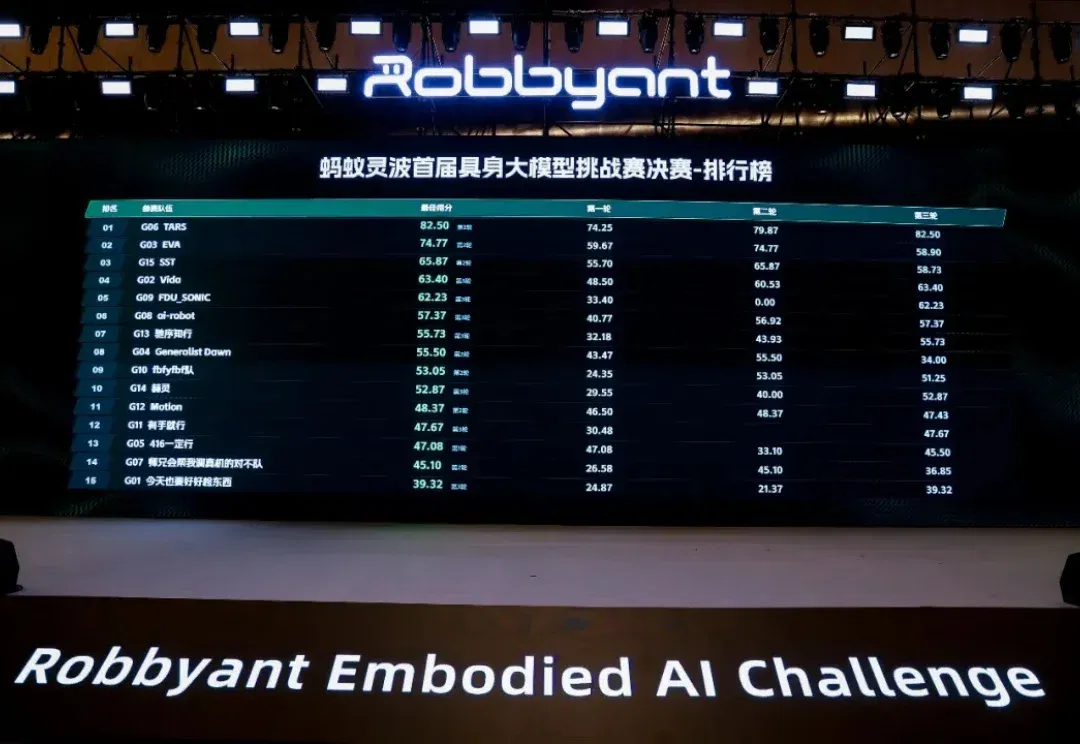
Ant Lingbo's robot challenge shows how developers address data and engineering gaps (opens in a new tab)
Fifteen finalist teams optimized LingBot-VLA 2.0 for 48 hours on a shared dual-arm platform and initial dataset. The report covers data feedback, visual prompting and gravity compensation, alongside hardware access, cross-embodiment adaptation and deployment-evaluation limits.
Autolife reports Pre-A+ funding for production and service-robot deployments (opens in a new tab)
Autolife says it raised Pre-A+ funding in the RMB100-million range, led by the U.S.-China Green Fund and co-led by Nanxi Ventures. Funds target Guangzhou production, service deployments and world-model R&D; Zhizi World remains a technology preview.
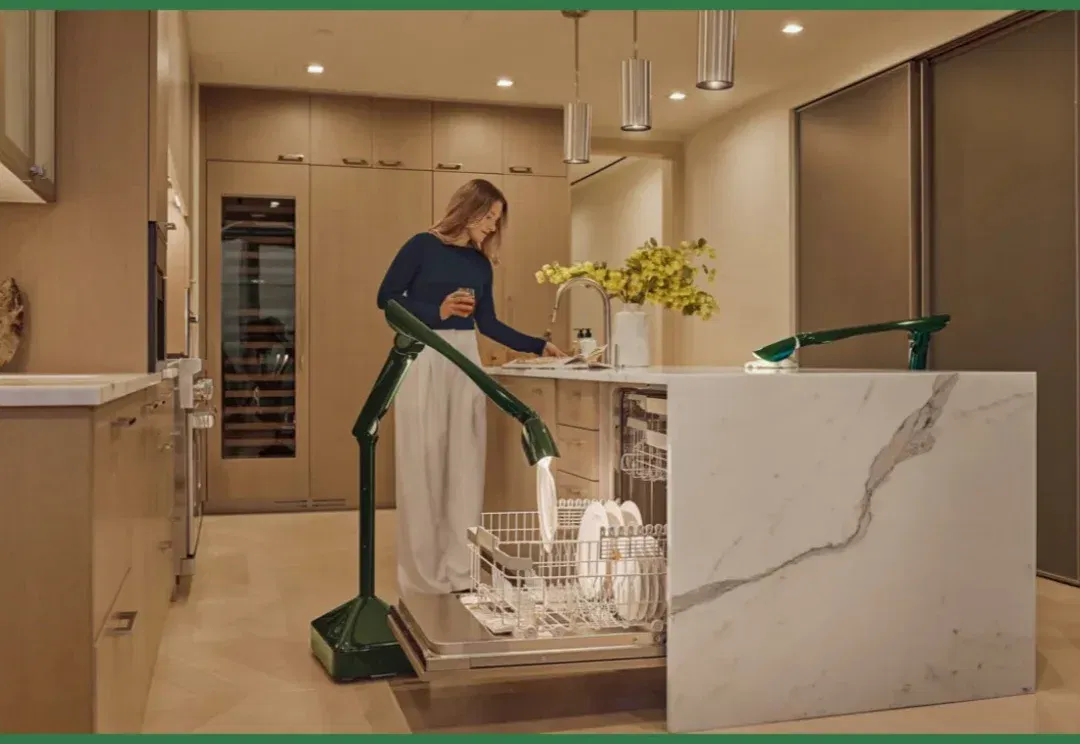
Syncere raises $11M for Lume, a household robot shaped like a floor lamp (opens in a new tab)
Syncere uses a floor-lamp form for Lume: one robot handles some pick-and-place tasks, while two work together in Duet mode on tasks such as folding clothes. Demos are edited; pricing and delivery reflect the source date, and home reliability remains unproven.