Haima Cloud's lumimax reports eight benchmark self-tests and demonstrates cross-document and literary analysis
Haima Cloud's lumimax links entities, relationships and evidence through DEN. The article examines financial-report discrepancies, contract clauses and The Great Gatsby. Its eight benchmark self-tests cover listed comparisons and metrics, with original evidence still requiring review.
This article presents a product introduction and the author's examples from Jiqizhixin. The eight scores and specifications such as capacity come from vendor disclosures or self-tests. Any lead is limited to the reference systems listed; this article did not reproduce models, retrieval configurations, samples and costs under uniform conditions. The claim to be the first has not been confirmed by a comprehensive independent comparison, and Karpathy's LLM Wiki concept does not certify this product. MultiHop-RAG's Hits@10 requires only that the first ten results contain at least one piece of gold-standard evidence; it does not mean the entire evidence chain has been found or the question answered correctly. The InfoVQA score of 84.54% concerns a subset of OpenDocVQA. The financial-report, contract and literary examples still require checking against original materials. The reasons for conflicts and the applicable legal provisions cannot be decided by a tool in place of professional judgment. Vendor product information and scores (opens in a new tab), Official MultiHop-RAG scoring code (opens in a new tab), Karpathy's original concept (opens in a new tab).
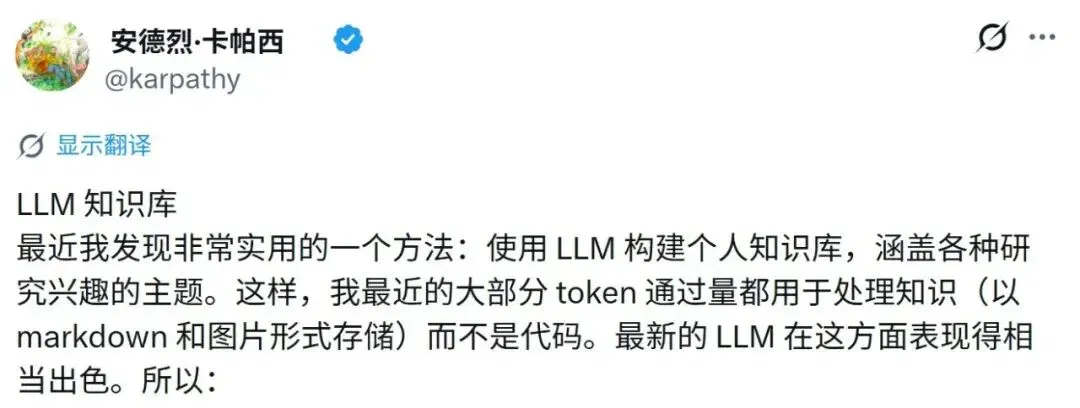
This April, Karpathy proposed an interesting concept: LLM Wiki, a knowledge base in which a large model automatically organizes, connects and continually updates knowledge.
Knowledge bases are nothing new. Give a contract to a traditional RAG knowledge base and ask for the maximum compensation a supplier could owe; that seems straightforward enough.
But what if there are several supplemental agreements and technical appendices as well?
The same business may appear under its full name or an abbreviation in different documents, or be called Party B or the supplier. More troublesome still, different documents may set out different contractual penalties.
At that point, similarity-based retrieval of passages containing keywords is no longer enough. The knowledge base also needs to know whether the information concerns the same entity, how the pieces relate, and which document should provide the basis when information conflicts.
Karpathy's LLM Wiki offers another approach.
Rather than looking things up only when users ask questions, the model actively organizes knowledge and establishes connections as it reads, continually updating existing content as new material arrives.
To let more people try this approach, Karpathy also published a detailed LLM Wiki explanatory document on GitHub.
- github: https://gist.github.com/karpathy/442a6bf555914893e9891c11519de94f
But this is not a product you can download and immediately use.
Many people complain that the tutorial is suitable only for programmers. Others point out that growing collections still present knowledge-consistency problems, and coping with large models' context-window limits is troublesome too.
The idea is good, but turning it into a product that genuinely works, is easy to use and suits varied situations is indeed a difficult problem.
Now a Chinese company has offered its own answer: Haima Cloud has officially launched lumimax.
Founded in 2014, Haima Cloud is an AI-productivity technology company that has long explored how to turn AI technology into practical productivity. From content creation to intelligent task execution, it is now extending that effort into professional knowledge processing.
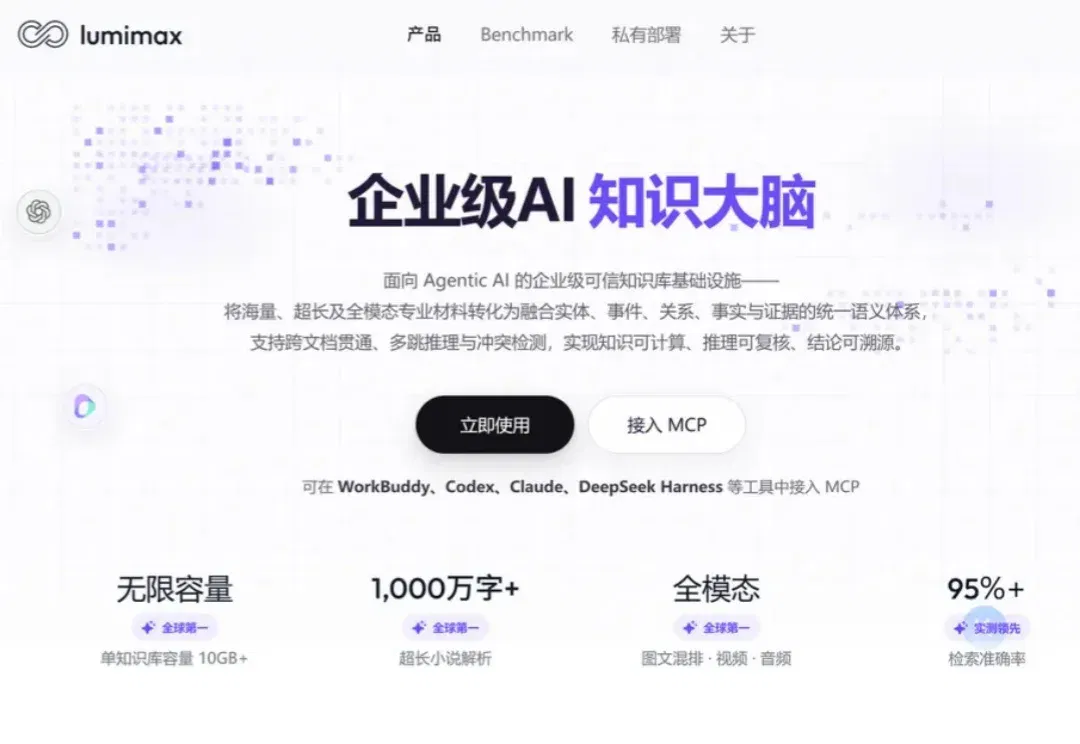
Haima Cloud positions lumimax as trustworthy enterprise knowledge-base infrastructure for agentic AI. The company says it can turn vast, extremely long and multimodal professional materials into a unified semantic system integrating entities, events, relationships, facts and evidence. It supports connections across documents, multi-hop reasoning and conflict detection, with the aim of making knowledge computable, reasoning reviewable and conclusions traceable. Being the first is not a priority claim independently verified by this article.
That is easy to say, but what can it actually achieve with complex materials? Haima Cloud has presented scores on eight public benchmarks.
According to Haima Cloud's self-reported results on eight benchmarks, lumimax exceeds the public reference scores it lists. This is not a comprehensive independent ranking produced by this article under uniform conditions.
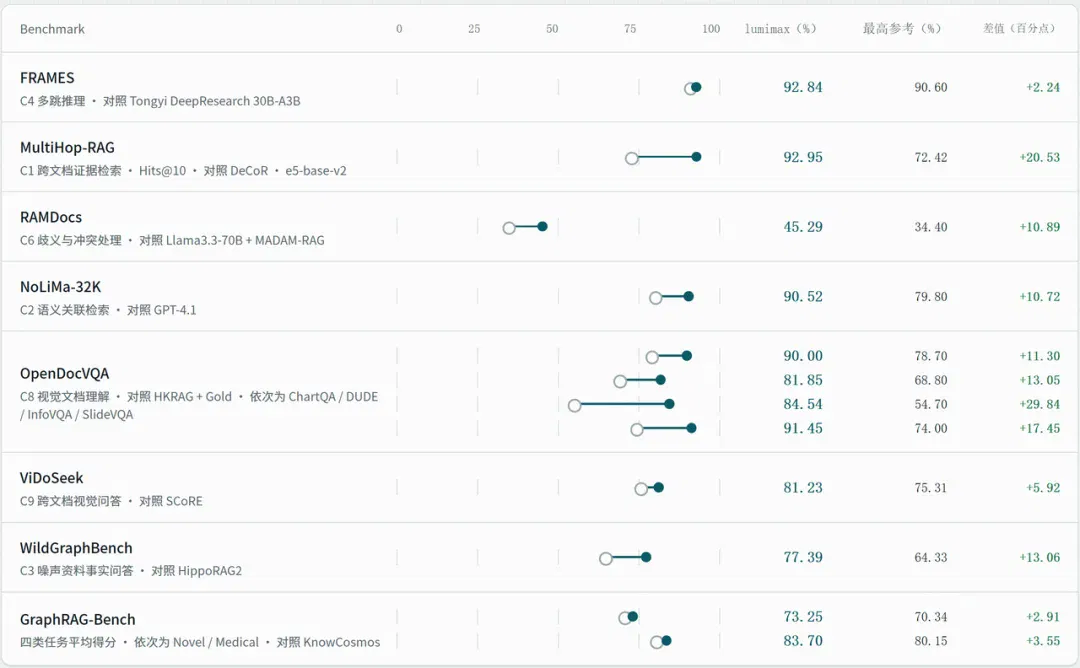
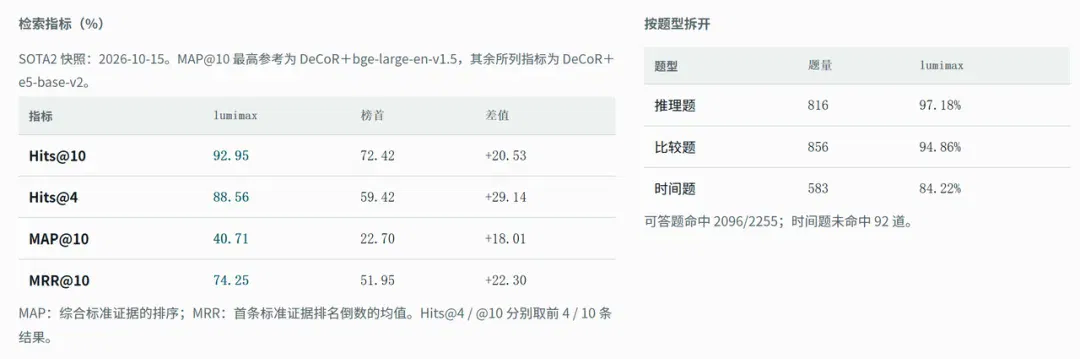
According to its self-tests, lumimax achieves a retrieval hit rate of 92.95%, a lead of 20.53 percentage points, on MultiHop-RAG, which tests the ability to find clues across documents.
On the InfoVQA subset of OpenDocVQA, which examines understanding of complex visual documents, it scores 84.54%, with an even larger lead of 29.84 percentage points. This suggests that, when faced with complex material interweaving text, charts and numbers, the knowledge base can still understand relationships between pieces of information, rather than merely read the text.
From cross-document evidence retrieval to understanding complex visual documents, these two substantial leads address precisely the challenges a professional knowledge base most needs to solve.
From Karpathy's LLM Wiki concept to lumimax's official launch, knowledge-base products are entering a comprehensive transformation in how knowledge is organized.
How does lumimax go beyond traditional RAG?
From complex-document parsing to deep knowledge reasoning
Suppose you need to analyze a company's annual financial report and have a PDF more than a hundred pages long.
You want to know how revenue in a business segment changed over the past three years. But the years, revenue figures and reporting definitions sit in different places within tables, making their relationships difficult for a traditional RAG knowledge base to understand.
Splitting the PDF's text into fixed-length chunks may separate table headers from figures and charts from explanatory notes. Even if retrieval finds the correct keyword, the model may be unable to locate the corresponding statistical figure.
Finding information is therefore only the first step. The key is how to analyze and organize it, and establish connections between the pieces.
That is the first problem lumimax aims to solve.
Parsing multimodal materials on the scale of ten million characters
Unlike simple text chunking, when parsing complex documents lumimax retains the original locations of information such as sections, pages and tables, keeping data linked to its sources. In subsequent analysis, users can not only find relevant numbers but return to specific PDF pages and charts to verify what they actually mean.
lumimax supports formats including PDF, Word, Excel, PPT, text, images, audio and video. A single knowledge base has a capacity of 10GB and can import materials on the scale of ten million characters in one batch.
Even with capacity for so much material, however, the context a large model can process at once remains limited. To address this, lumimax introduces dynamic context compression.
The system identifies key information for the current question and dynamically adjusts the coverage of the effective context, giving the model as much relevant content as possible within its limited context space.
Knowledge compilation and cross-document integration connect scattered information
But when the number of files reaches dozens or hundreds, another problem appears.
For example, a business might use its full official name in an annual report, an abbreviation in a project report, and be called the supplier in another document.
If the knowledge base cannot identify this connection accurately, it may miss important information even after searching every file. The system therefore needs entity disambiguation capabilities.
To solve this, lumimax introduces its in-house DEN (Deep Evidence Network), a knowledge network of deep evidence chains.
It extracts entities such as companies, people and events, together with their relationships, links them to original evidence, and organizes them into a browsable, searchable knowledge network structured as "entities—events—relationships—evidence."
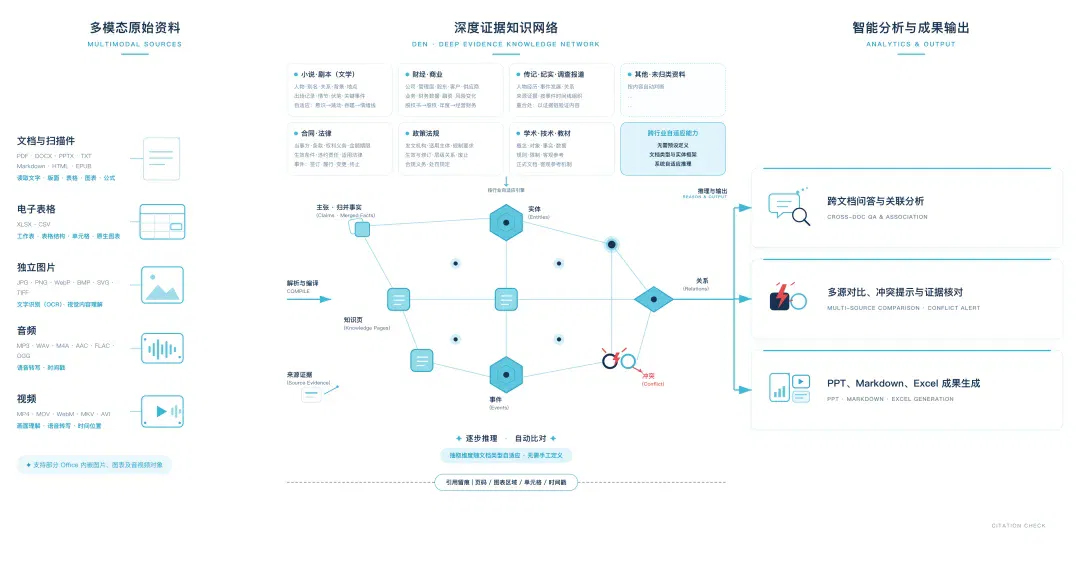
Through entity disambiguation, the system can recognize the same subject even when different documents use different names, linking previously scattered information.
Hybrid retrieval and multi-hop reasoning follow the trail of clues
Once these knowledge connections are established, how can they be used to answer complex questions?
Consider a user investigating a project's supply-chain risks.
Traditional text-chunk retrieval may find a supplier's name in a project report. But learning which other companies that supplier is connected to, or whether it is involved in other risk events, requires further searches through other materials.
lumimax can first identify the supplier in the project report, then use that entity as a lead for cross-document multi-hop reasoning, progressively tracing related companies and relevant risk events.
During this process, the system combines knowledge catalogs, keyword and semantic retrieval, result reranking and relationship queries to follow clues step by step. It ultimately connects information scattered across different documents, reducing omissions in complex questions.
Evidence tracing and conflict detection: two answers to one question?
One situation is harder to handle than missing or unfound information: the information has been found, but there is more than one answer, and some pieces even contradict each other.
Take a company's annual financial reports. Searching for diluted earnings per share for 2024 returns 24 relevant source passages from RAG.
Looking closely at the first two results reveals that the same metric is RMB -0.16 per share in the 2024 annual report, but RMB -0.19 per share in the previous-year comparison in the 2025 annual report.
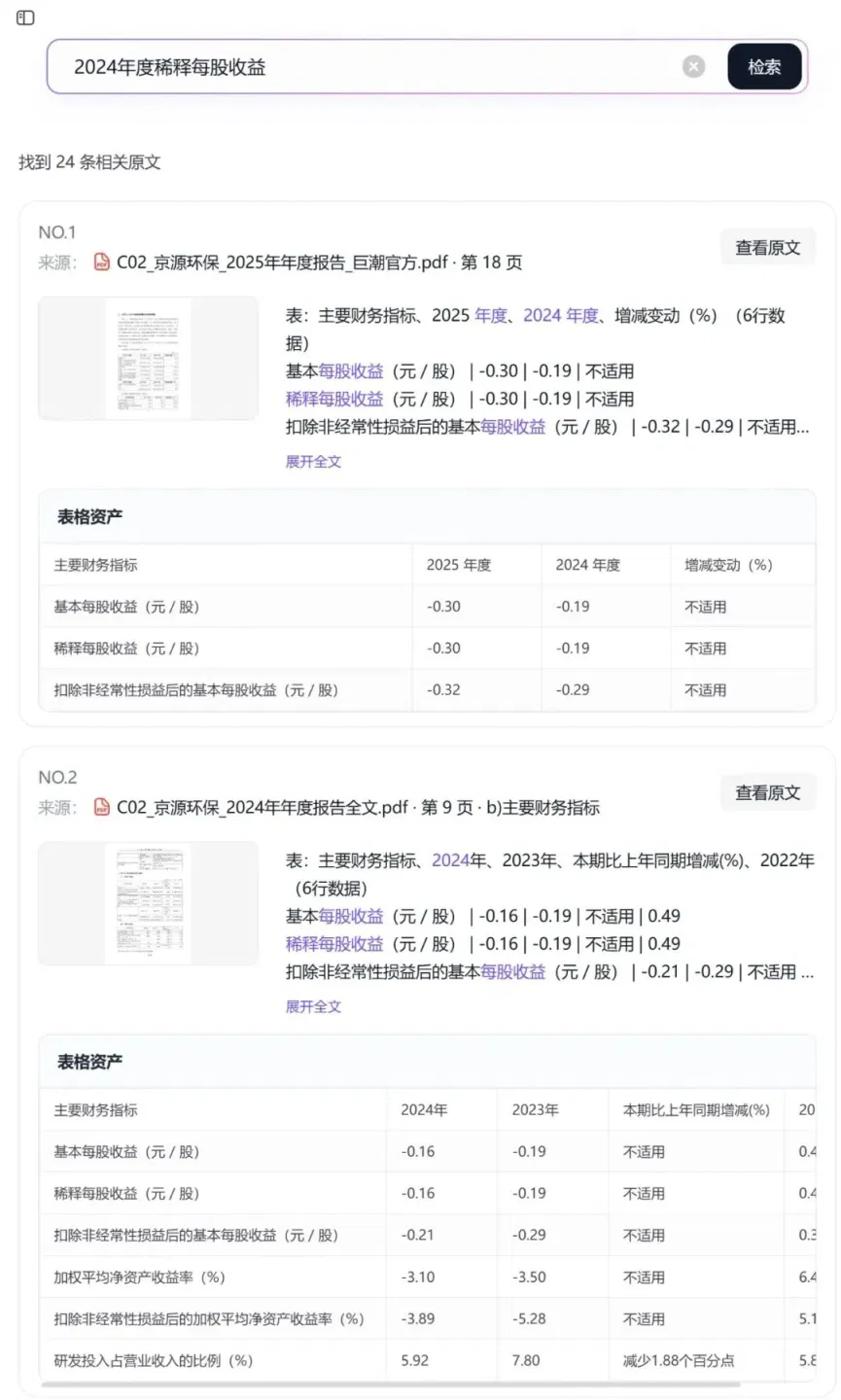
Both figures have clear sources. Which one should be used?
That calls for another core lumimax capability: conflict detection and evidence tracing.
For the same question, lumimax not only provided the original figure from the 2024 annual report, but proactively highlighted the discrepancy between the two reports. It suggested that this might involve a retrospective adjustment or a change in presentation in the later report, and attached the corresponding source passages.
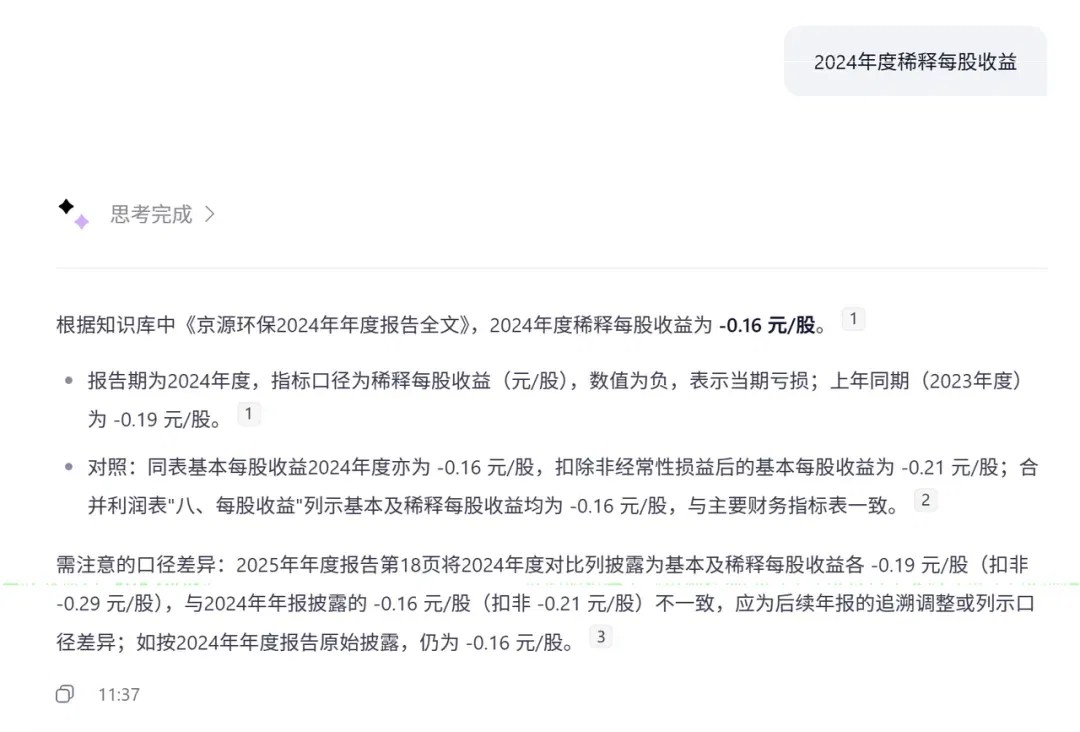
Rather than merely returning relevant search results, lumimax went further with cross-document data comparison, conflict detection and discrepancy analysis, retaining uncertainty when the evidence could not establish the reason for the difference, instead of ignoring one figure and directly giving an answer.
Incremental updates and reuse of results keep knowledge growing
This knowledge does not stop changing once it has been organized.
When users add or delete files, lumimax supports incremental updates to relevant knowledge according to the changes and their effects, reusing completed processing results and checkpoints to reduce repeated analysis.
This fits Karpathy's LLM Wiki idea precisely: a knowledge base is not a file repository that remains unchanged after construction, but a system of knowledge that continually updates as new materials arrive.
MCP integration and deliverable generation put knowledge to work
Of course, however well knowledge is organized, it ultimately has to serve actual work.
In its web interface, lumimax supports generating or editing report text, Excel spreadsheets and PPT presentations using knowledge-base materials. More importantly, it also supports connecting external agents through MCP.
Within the user's authorized scope, compatible agents can query the knowledge base directly, retrieving relevant information and original evidence. When carrying out complex tasks, agents can draw on an enterprise's existing professional knowledge as needed to support further analysis and judgment.
From understanding a complex PDF to connecting hundreds or thousands of documents, identifying contradictions, continually updating and serving agent requests, lumimax puts knowledge from scattered files into practical business use.
Consider a practical legal example.
In a demonstration case involving a quality dispute over new-energy vehicle battery packs, a law firm needs to organize contracts and evidence for a vehicle manufacturer.
One key question is how much compensation the supplier must bear after a quality dispute.
The main contract caps liability at 100% of the total contract amount, about RMB 460 million. But a newer appendix specifies a different standard for quality-defect claims: 30% of amounts already paid, about RMB 63 million.
The two amounts differ by a factor of about seven.
Lawyers cannot look only at the two numbers. They must establish the many conditions underlying them. Missing any one piece of information could affect the assessment of liability.
lumimax can follow the liability clauses to supplemental agreements, newer appendices and other relevant documents, organizing relationships between versions and their source passages for lawyers to review individually.
Of course, deciding which provision applies still requires a lawyer's legal judgment based on the complete evidence. lumimax handles much of the work of finding, connecting and checking those materials.
That is also the value of a professional knowledge base when it enters real business use.
The company reports scores on eight benchmarks:
where exactly does lumimax excel?
The eight public benchmarks used for lumimax focus on two capabilities: finding the right evidence, and using that evidence to answer questions.
First, consider MultiHop-RAG.
Proposed by the Hong Kong University of Science and Technology, this test includes 609 news articles and 2,556 questions. It primarily examines whether a system can find the evidence needed to answer a question across different documents.
For example, a question may involve two news articles at once. Finding only one will often be insufficient for a complete answer.
The test uses Hits@K. Put simply, it checks how many questions have at least one piece of gold-standard evidence among the first K retrieved results.
Of 2,255 answerable questions, lumimax retrieved gold-standard evidence in its first ten results for 2,096, achieving Hits@10 of 92.95%. For comparison, the highest public reference score included in Haima Cloud's capability guide is 72.42%, giving lumimax a lead of 20.53 percentage points.
Finding evidence, however, is still some distance from answering a question.
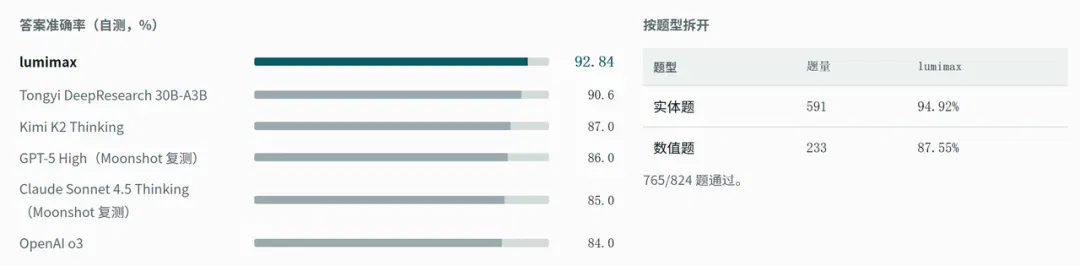
To examine whether a system can connect the information it finds and reach the right conclusion, another test is needed: FRAMES.
This is a multi-hop reasoning benchmark proposed by Google. Unlike simple information retrieval, FRAMES requires a system to combine multiple sources and take several steps to arrive at the final answer.
Each question may involve two to fifteen Wikipedia articles.
Some questions require identifying a person first, then looking up related events, and finally finding an entity that satisfies multiple conditions. A mistake at any intermediate step can affect the final answer.
On this test, lumimax completed all 824 questions, answering 765 correctly for an accuracy of 92.84%. Against the highest public reference score of 90.60%, it leads by 2.24 percentage points.
The other six tests examine knowledge-processing capabilities from different angles.
NoLiMa-32K tests the ability to make semantic connections when a question is worded differently from the source; OpenDocVQA and ViDoSeek focus on understanding charts, infographics and complex visual documents; RAMDocs requires the system to find answers amid ambiguity, distractions and conflicting information.
WildGraphBench and GraphRAG-Bench further examine factual question answering, knowledge connections and complex reasoning in noisy materials.
According to Haima Cloud's self-tests, lumimax exceeds the listed public reference scores on every test.
These results cover several stages of knowledge processing, including cross-document connections, multi-hop reasoning and conflict detection. They demonstrate lumimax's capabilities in knowledge organization, reasoning and evidence tracing, moving knowledge bases beyond simple information retrieval toward computable knowledge, reviewable reasoning and traceable conclusions.
That sounds easy enough. Let us now see how lumimax actually performs.
Hands-on: using lumimax
for a literary study of The Great Gatsby
For this test, we chose F. Scott Fitzgerald's The Great Gatsby and tried having lumimax carry out a small literary study.
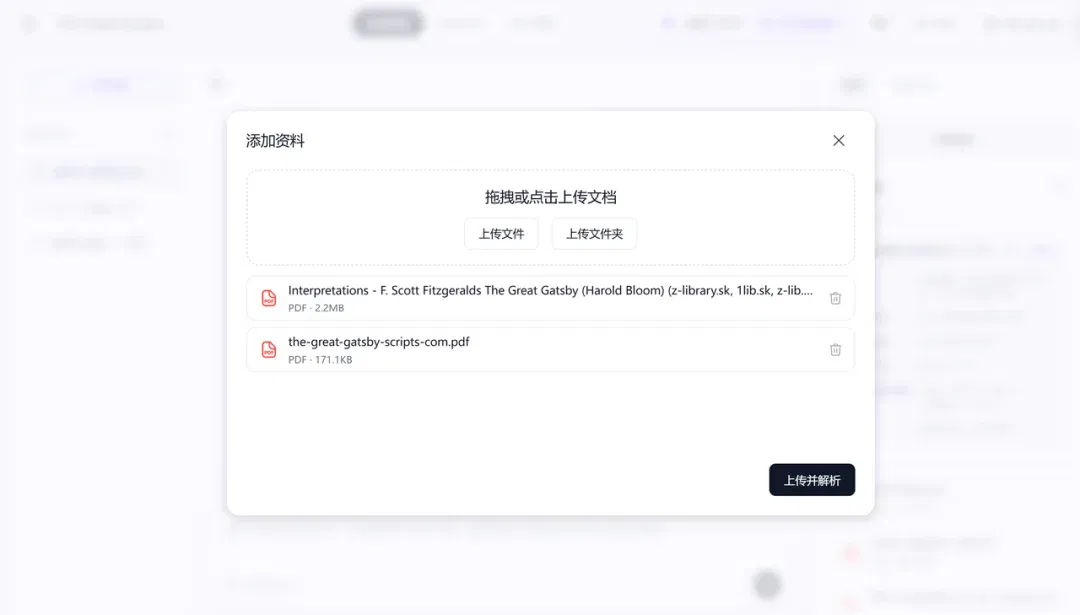
We first uploaded the original English novel and the screenplay of the 2013 film The Great Gatsby. Both tell the same story, but the characters' experiences, narrative order and presentation of information are not entirely identical.
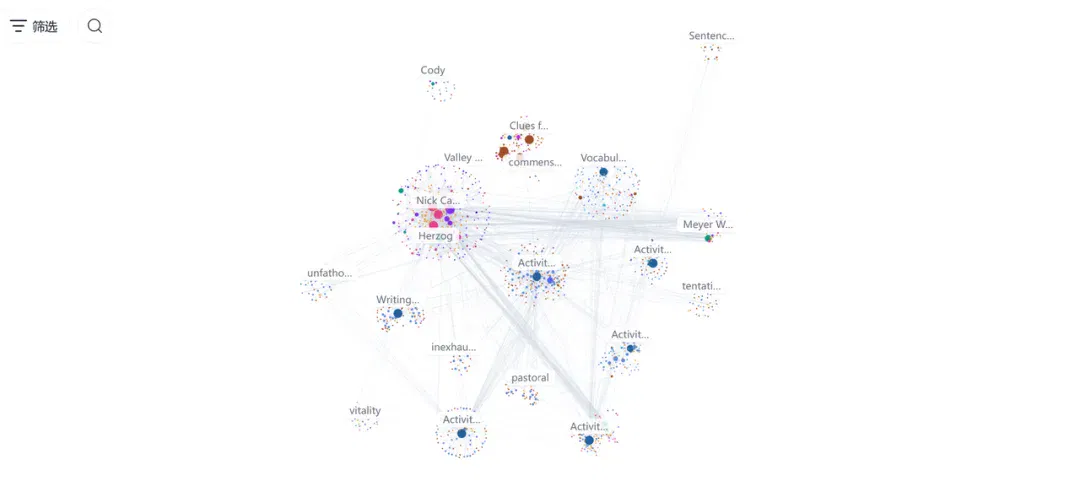
After upload, lumimax automatically organizes the entities and their relationships in the files, presenting them as a knowledge graph.
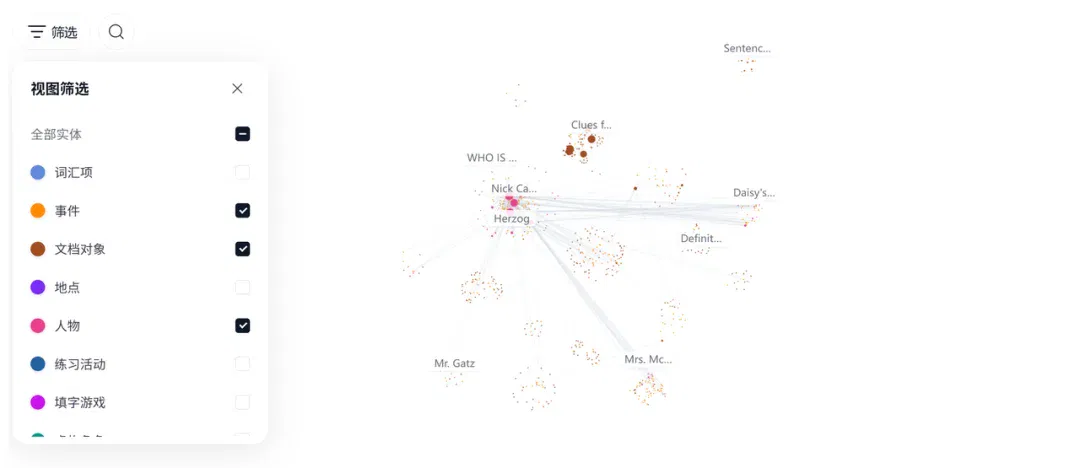
The graph can be filtered by types such as people, events, places and document objects, and users can inspect connections between entities. Besides the overall relationship graph, the system provides an "Entity Description" page and a "Conflict Detection" page. The former organizes characters' aliases, backgrounds, related information and source passages. The latter lists potentially contradictory statements across sources and supplies the corresponding evidence for further checking.
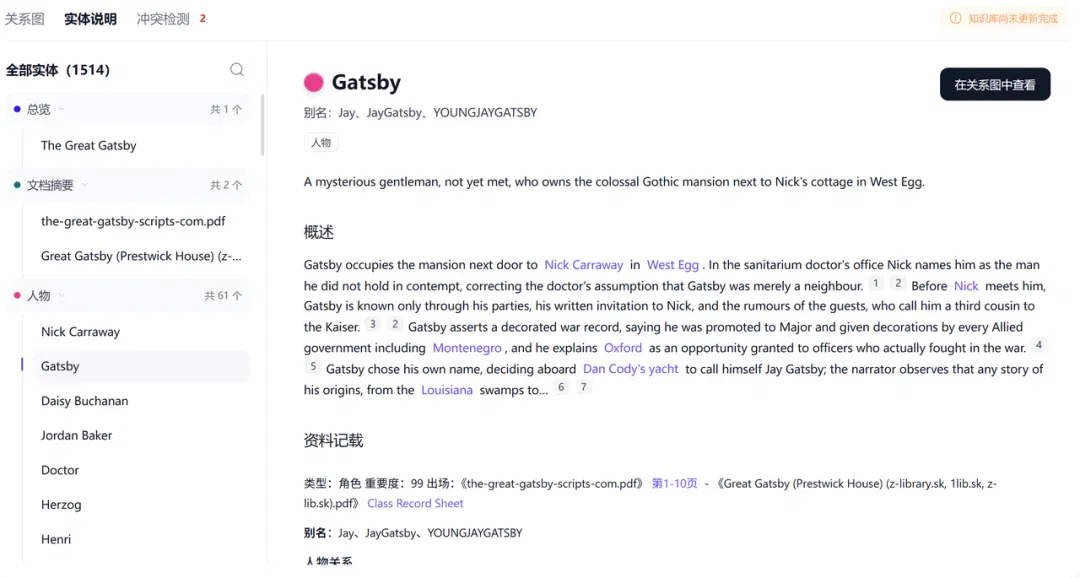
Once the knowledge base was built, we began with a question about a character's identity.

The focus here was whether the knowledge base could recognize names and identities used by a character at different stages, and connect the relevant experiences.
lumimax gave a clear conclusion: Gatsby's account of his family background did not match his actual experiences. It detailed contradictions and differences concerning his family origins, his parents, his time studying at Oxford and the source of his wealth.
The comparison table made this particularly clear. lumimax proactively connected the names James Gatz and Jay Gatsby, identifying them as the same person, then linked experiences from different chapters of the novel to create an item-by-item comparison of his claimed family background and actual origins.
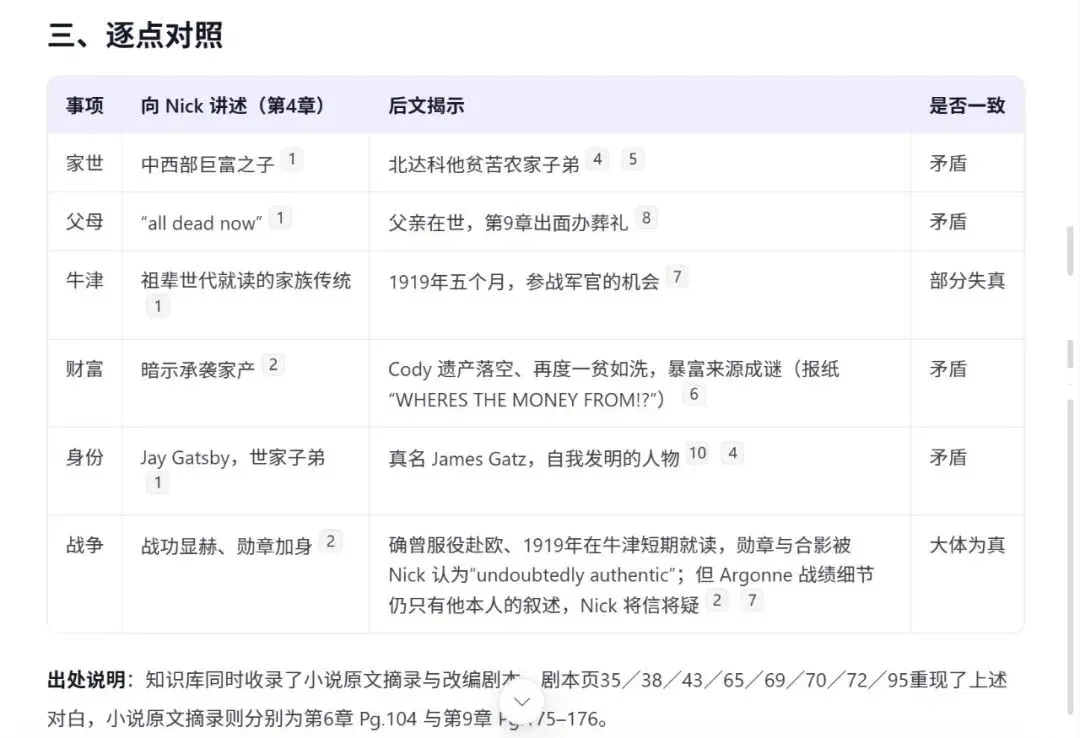
Next, we raised the difficulty from one novel to cross-text research.
On top of the original novel and film screenplay, we uploaded several academic papers on the novel's narration, characterization and film adaptation. The system did not have to build a new knowledge graph from scratch. It added information and established new connections directly within the existing structure.
This time, the question went beyond a specific plot point. It required combining the novel, screenplay and research papers to find connections across texts.

The system found two key changes. First, the film adds a narrative framework involving a sanatorium and a doctor, turning Nick's recollections into a process of therapeutic writing. Second, voice-over and more pronounced subjective assessments strengthen Nick's guidance of the narrative about Gatsby.
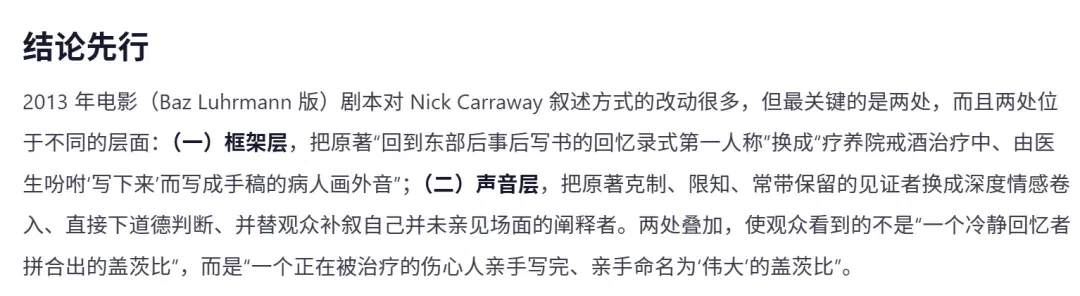
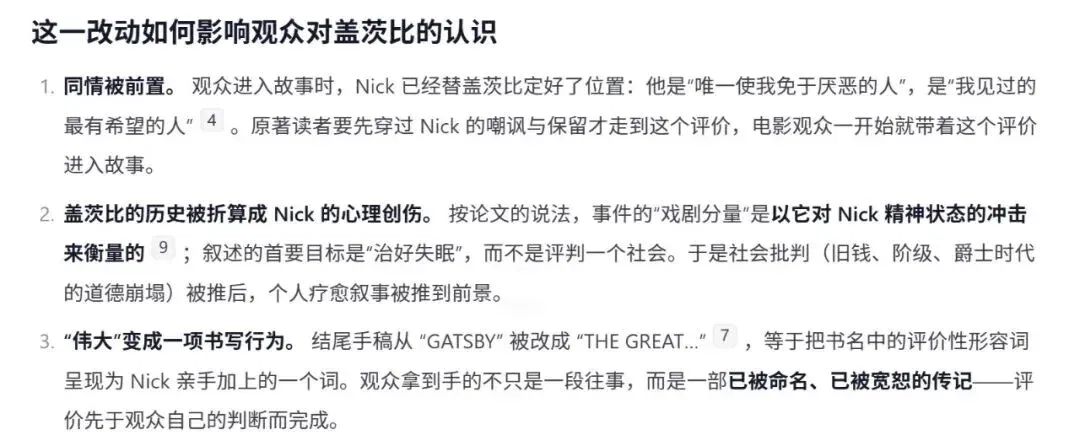
The answer did not merely list differences between the novel and film. It cited chapters of the novel, screenplay page numbers and relevant papers, connecting specific adaptations to scholars' discussions of the narrator's role and audience understanding. It then analyzed how the changes affect the audience's understanding of Gatsby.
This also illustrates the value of cross-text multi-hop reasoning: locating adaptations in the screenplay, checking them against the novel, then interpreting their narrative functions through academic research forms a relatively complete chain of evidence.
Finally, we further tested lumimax's ability to generate deliverables.
The earlier tests focused on specific questions. How would it perform if asked to organize research findings scattered across multiple sources into a complete presentation?
We chose a contested topic in The Great Gatsby: is Nick Carraway actually a reliable narrator?
Different researchers may interpret the same events in the novel differently. Rather than simply summarizing papers' conclusions, it is more important to connect different viewpoints to evidence from the original text, distinguishing textual facts from scholarly interpretations.
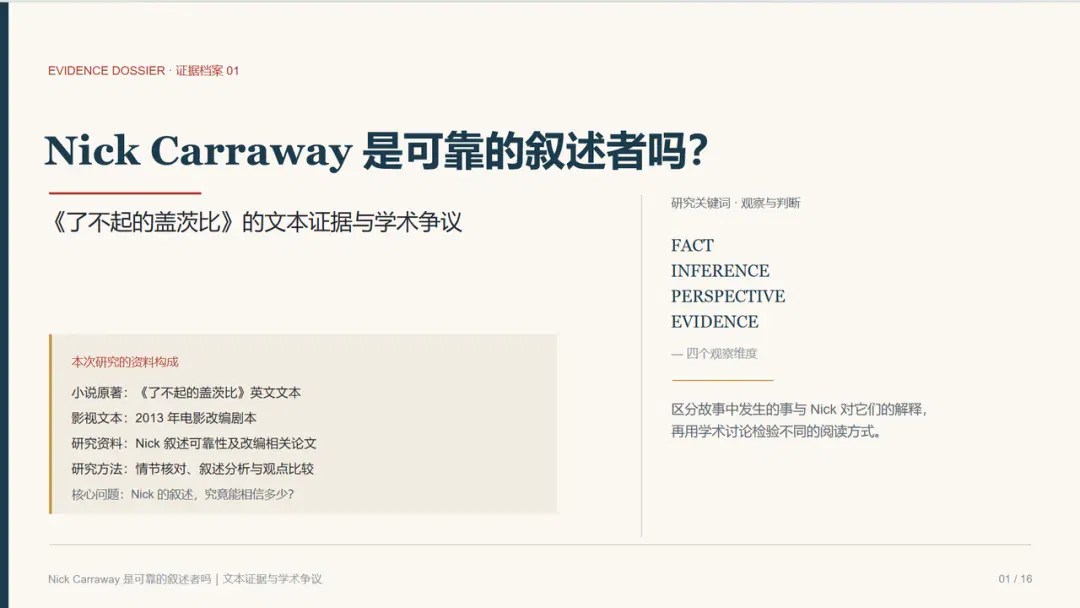
The final task was therefore to use the novel, screenplay and academic papers in the knowledge base to generate a visual research presentation in PPT form on the reliability of Nick's narration.
lumimax ultimately completed a 16-slide literary-research presentation.
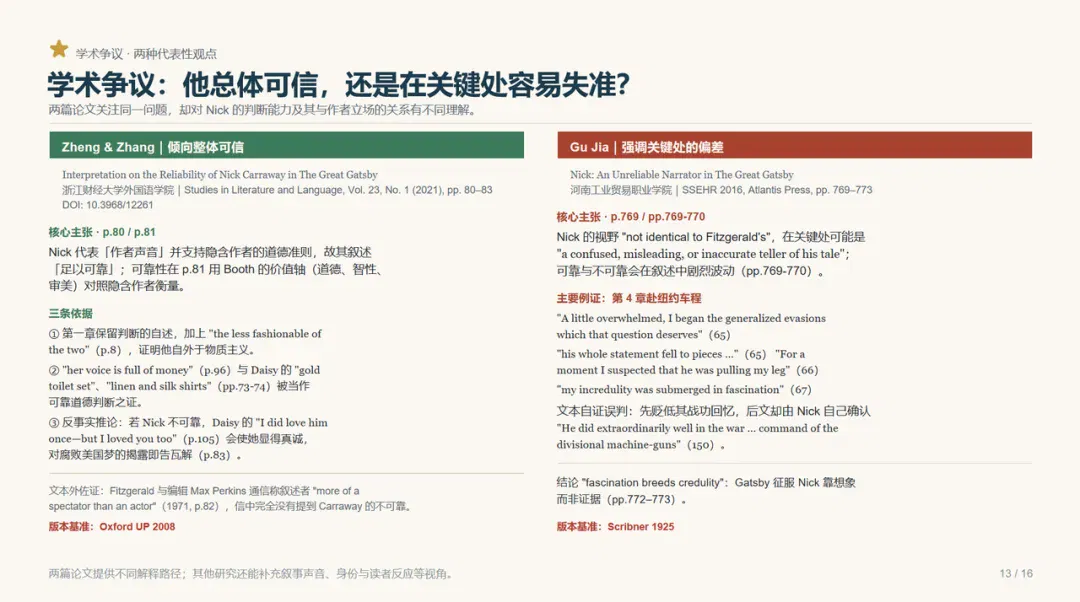
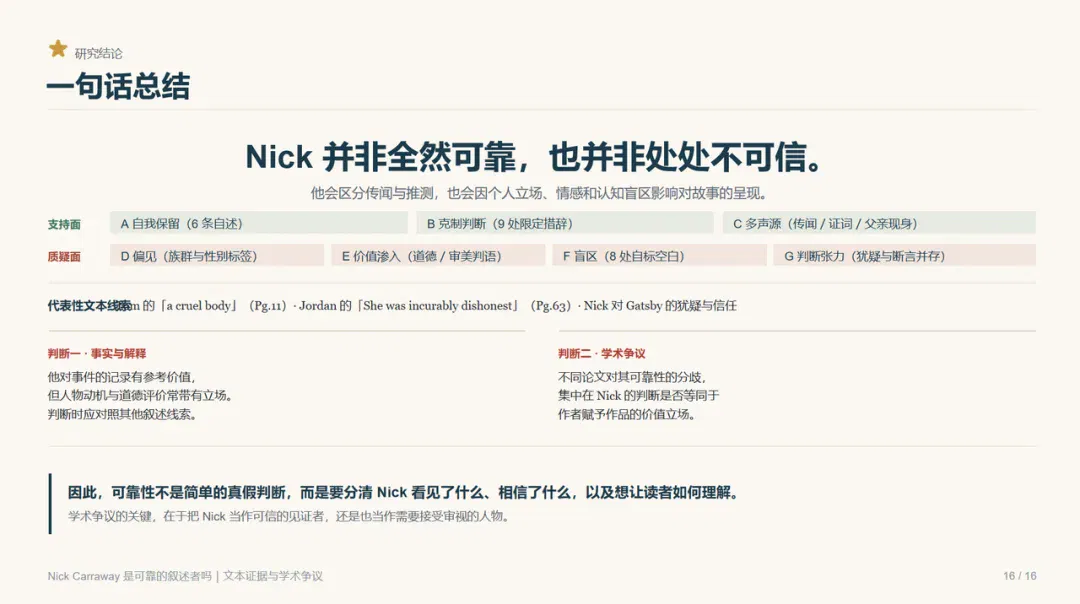
Two slides were particularly noteworthy. One compared two academic papers taking different positions side by side, showing their central arguments, textual evidence and sources. The other integrated evidence across materials to analyze Nick's narrative reliability from seven angles and reach a synthesized conclusion.
From cross-text evidence connections to organizing and visualizing disagreements among scholars, these two slides concentrated the demonstration of lumimax's knowledge integration and conflict-analysis capabilities.
Building professional enterprise context:
Haima Cloud adds a key link in agent productivity
In Haima Cloud's long-term view, a key direction for AI's next stage is "agents driving everything」.
But once agents enter an enterprise, knowing how to call tools and search materials is not enough. For professional tasks, agents need not just execution capabilities, but also accurate, verifiable professional knowledge as context. That is precisely lumimax's place in Haima Cloud's product portfolio.
Through MCP, external agents can directly access lumimax's knowledge base once authorized, query relevant materials and obtain the original evidence.
For enterprises, truly valuable knowledge includes both content accumulated in contracts, reports and technical documents, and the professional judgment and practical experience developed through long-term work: their unique know-how.
lumimax's purpose is to let agents use this professional knowledge embedded in documents while working. Enterprises can thus let agents draw on their own accumulated knowledge for specific business tasks without training all that professional knowledge into a model.
Looking back, the changes taking place in knowledge bases reflect the direction of the AI industry as a whole.
Users once wanted knowledge bases that could store information and find it. Faced with increasingly complex materials and tasks, that is no longer enough. Knowledge bases must also understand and organize information, connecting material from different files, identifying contradictory claims and providing verifiable support for answers.
This article emphasizes how lumimax advances the use of enterprise materials through knowledge organization, reasoning and evidence connections. That does not mean traditional RAG can only accumulate knowledge and cannot participate in actual business.
A knowledge base is no longer just a standalone AI application. It is also becoming a window onto an enterprise's overall technical capabilities.
From GPU infrastructure and model optimization to harness task orchestration and professional knowledge management, Haima Cloud's technical work over more than a decade has gradually formed an AI-productivity system spanning multiple stages. lumimax's launch adds the professional-knowledge context component.
Teaching AI to do things is only the starting point for productivity. The next hurdle is enabling it to do the right things, and do them well, using an enterprise's own knowledge.
This article is from Jiqizhixin, by Shan Hui.
Related topics
After reading
Join the AINRK community
Read how to join the community and connect with people working in AI.
Related articles
Continue reading related topics and articles in this category.

haimacloud launches lumimax knowledge base and reports results on eight benchmarks (opens in a new tab)
haimacloud's lumimax combines document parsing, knowledge relationships and evidence tracing. Eight vendor-reported benchmarks and three research, technical and literary examples require checks of configurations, samples and business data; they are not general accuracy or security guarantees.
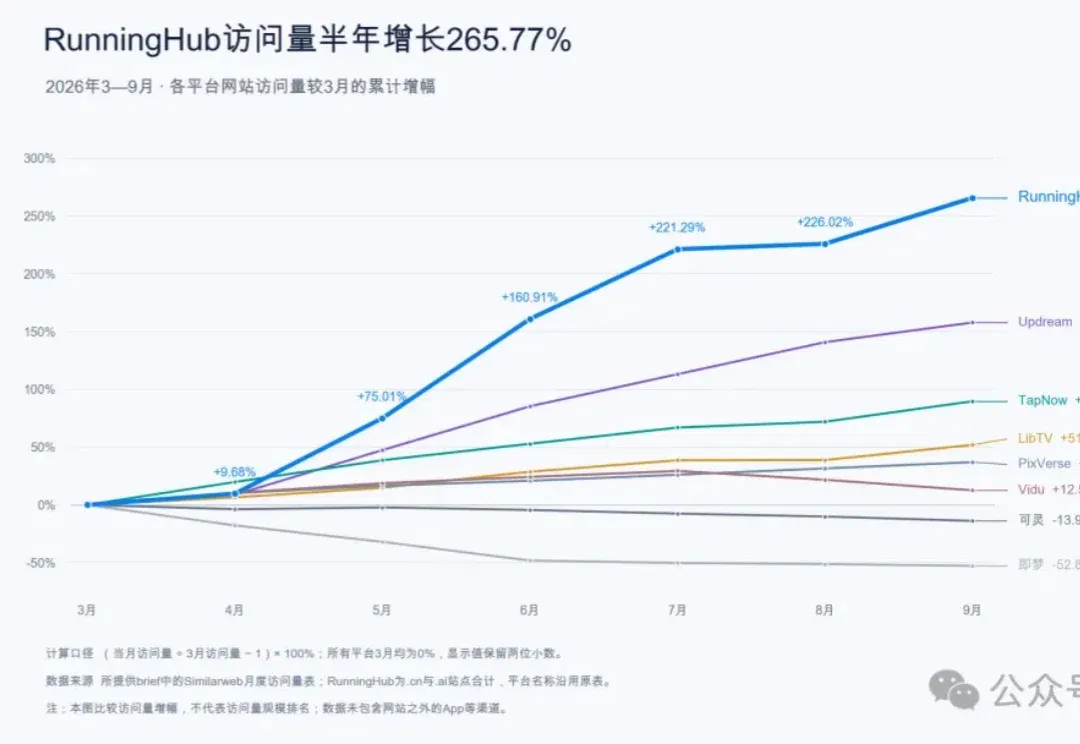
海马云谈 RunningHub:算力调度、创作工具链与数据如何配合 (opens in a new tab)
海马云围绕 RunningHub 介绍GPU池化、场景化模型后训练、专业软件连接及创作者工作流沉淀,主张从模型调用走向完整生产交付。访问增速、成本改善和留存数据为报道引用及公司披露,不能据此保证所有AI应用的商业结果。
13 组横评综合性能第一!RunningHub 发布 RH Upscale,瞄准视频超分「不变样」难题 (opens in a new tab)
海马云旗下RunningHub发布自研生成式视频超分模型RH Upscale,在13组横向评测中以综合得分0.539位列第一,通过内容保真约束下的时空联合重建与五档模式设计,解决视频超分中"放大而不改内容"的难题。

虾马之后又火一个!OpenHuman用20分钟了解你的一切,存成卡帕西式知识库 (opens in a new tab)
虾在前,马当道,居然还有新物种能在Agent赛道突出重围。OpenHuman连续霸榜GitHub Trending第一,狂揽9k+ Star,一天就涨千星。和虾马不一样,Human不用你花心思养,还能反过来主动了解你。
Karpathy知识库「LLM Wiki」火爆了,全网围观讨论 (opens in a new tab)
Karpathy 表示,大多数人使用 LLM 处理文档的方式,基本都类似于 RAG:你上传一组文件,模型在查询时检索相关片段,然后生成答案。这种方式是有效的,但问题在于每一次提问,模型都在从零重新发现知识。没有积累。