a16z Studies 11,307 AI Shopping Runs: Overlapping Picks, Channels and Checkout Barriers
a16z and The Prompting Company test four agents across 1,270 prompts and 11,307 runs, alongside separate YipitData spending samples. Recommendations vary with use cases and merchant policies; 81% guest-checkout progress means reaching the form's end, not payment conversion.
Editorial check (2026-11-26): The 11,307 observations are completed runs during a particular period, not 11,307 real transactions; sample sizes vary by experiment. YipitData's payment sample is analyzed separately, does not distinguish Muse from Instinct and excludes Amazon. Merchant amounts and rankings are not whole-market shares. The 81% for stores offering guest checkout means reaching the end of the checkout form, not payment conversion; the hotel price-comparison walkthrough did not submit a reservation either. Recommendations, interface accessibility and payment samples should be understood separately. Future traffic and business-model changes discussed below are the author's analysis. a16z original research and methodology (opens in a new tab)
For decades, consumer businesses have focused on one question: how to get consumers to buy their products.
With the development of AI agents, however, businesses may also need to study a new question: how to get AI to buy their products.
Silicon Valley venture firm a16z previously proposed an interesting concept: B2A, or Business to Agent. In simple terms, as more people delegate shopping, travel bookings and software procurement to AI, agents could become an entirely new product distribution channel.
But how exactly does AI make purchasing decisions? Will the brand, marketing and channel advantages companies spent decades building still work in the agent era?
Recently, a16z investors Olivia Moore and Justine Moore partnered with The Prompting Company to design 1,270 prompts for four agents—Grok Bot, Muse, Instinct and Dots—and conduct 11,307 tests. They combined this with YipitData's actual consumer expenditure data in their research.
Several findings in the study strike me as particularly worth watching.
First, AI considers far fewer products than one might imagine, and different agents' recommendations overlap heavily. This suggests consumer-market traffic could become more concentrated, making distinctive advantages in specific use cases more important.
Second, AI is better than humans at calculating a product's total purchase cost. Business models that profit from information asymmetry and consumers' reluctance to reconsider decisions could come under pressure.
Third, traditional internet platforms may not be as easily disrupted as expected. Among the top 50 merchants by agent spending, more than half of expenditure still went to aggregators and multibrand retailers. What may change is platforms' bargaining power.
Today, Guiji Jun will use this study to discuss several important ways the business world could change when AI starts spending money on people's behalf.
/ 01 /
AI's allocation of traffic could be more concentrated than in the internet era
The first notable finding is the very high overlap between products recommended by different AI agents.
In the tests, a product selected by one agent had a 73% chance of being selected by at least one other. In nearly a quarter of cases, all four agents picked exactly the same top product.
One important reason is the limited number of products AI actually examines.
Take Meta's Muse. It usually starts by searching Meta's own product catalog, retrieving no more than 50 candidates. Even when it performs an additional web search, it looks at only three product pages on average.
When buying shoes on Taobao, we might spend half an hour browsing dozens of products. We might even set out to buy sneakers and change our minds because a pair of loafers looks appealing.
AI's shopping logic is somewhat different.
Suppose you ask AI to buy noise-canceling headphones under $150. Constrained by task time and search costs, it may shortlist only a few suitably priced, well-reviewed products, compare them and give a final recommendation.
That means many products might never even get the chance to enter consumers' consideration sets.
This does not mean a few big brands will capture every opportunity. On the contrary, distinctive product advantages in specific use cases may become increasingly important.
Researchers ran an interesting test asking agents to choose between two hair-styling products: Shark FlexStyle and Dyson Airwrap.
Without any special user requirements, agents chose the cheaper Shark in 91% of cases. Public reviews suggested similar performance, while Shark cost less.
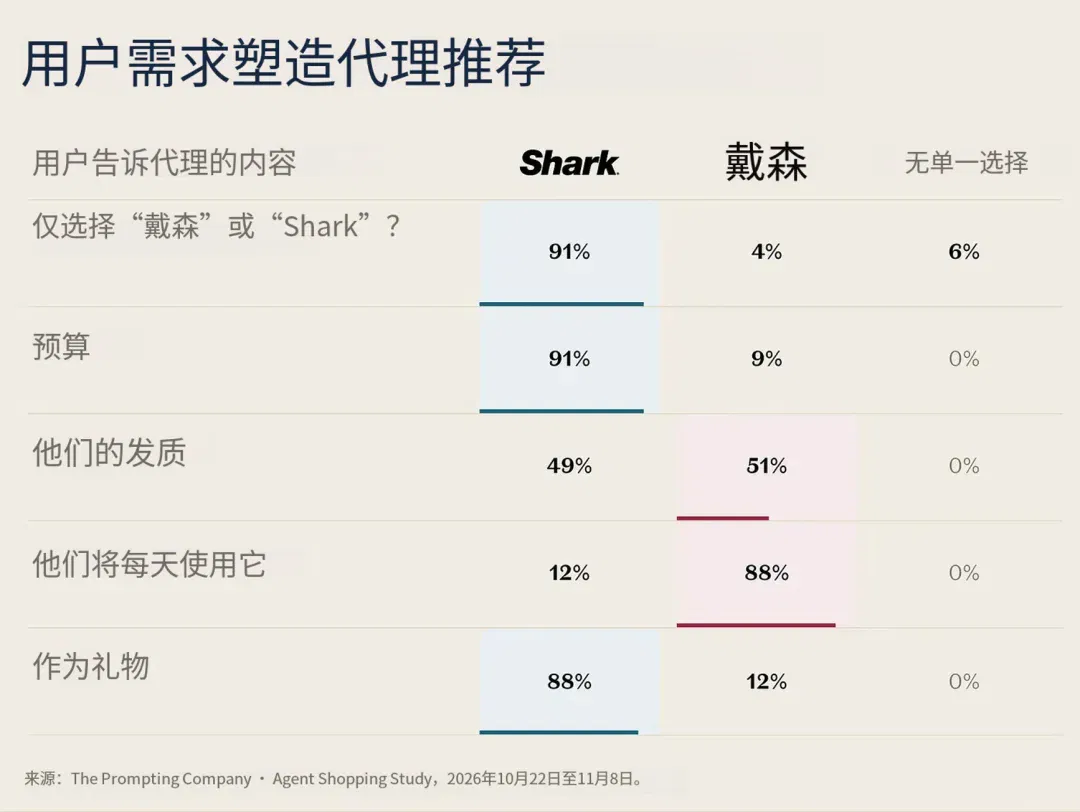
When the user specified fine or color-treated hair, however, Dyson's win rate rose to 51%. If the user said they would use it every day, Dyson's win rate rose further to 88%.
Why such a large shift?
More specific needs prompted AI to reassess features such as weight, maximum temperature and noise. In certain use cases, Dyson's advantages justified its higher price.
Software showed a similar pattern. For general graphic design, agents recommended Canva in 78% of cases and Adobe in none. When the user explicitly required professional-level output, Adobe became every agent's first choice.
This reveals an important possible shift in brand competition: a clearly distinctive product identity may matter more than a more comprehensive feature set.
/ 02 /
Profiting from information gaps is becoming harder
Compared with humans, AI has another conspicuous trait in purchasing decisions: it loves doing the math.
It compares not only sticker prices but shipping, warranty and subscription costs, and even different merchants' return policies.
For example, when two retailers sold the same product at the same price, agents chose the better return policy in 86% of tests. Discounts below 10% rarely changed their decisions.
These changes may sound small, but their impact could be substantial in certain industries.
Domain registration is a classic example. Many registrars attract new users with very low first-year prices, then raise renewal prices sharply from the second year onward.
Consumers often focus on the first year's cost. When renewal comes, the inconvenience of transferring a domain leaves them continuing to pay.
That tactic may work less well on AI.
In the study's ranking by number of agent transactions, domain registrar Porkbun ranked ninth and was the highest-ranked technology product. Cloudflare and GoDaddy ranked 17th and 112th, respectively.
Yet Cloudflare and GoDaddy register 2.6 and 4.8 times as many domains per month as Porkbun, respectively.
Why did a much smaller company attract more agent transactions?
An important reason is Porkbun's more transparent pricing, without a cheap first year followed by a sharp price increase or complicated contractual lock-ins.
AI actively calculates costs over several years when choosing a registrar, making Porkbun's price advantage easier to discover.
There are many similar business models. Some software companies use complicated subscription plans to charge for features customers do not need. Some hotels advertise low headline rates, then add fees at checkout.
These models work largely because consumers lack the time and energy to scrutinize every purchase.
Comparing that information costs AI much less. Of course, price is not its only consideration.
Across 275 merchant-comparison tests pitting a cheaper but less reputable seller against a more expensive, more trustworthy seller, AI chose the latter 72% of the time.
In one Sonos speaker test, Grok Bot passed over a $200 listing and recommended the same product for $250 because the latter came from an authorized dealer offering a warranty.
As AI makes purchasing decisions, profits built on information asymmetry, complicated pricing and consumer inertia may become harder to earn.
/ 03 /
Serving agents becomes more important
As AI intervenes in transactions, companies may face a question they rarely considered before: can AI actually use their products?
Researchers asked Dots to create ten advertising images from a product photograph, letting it choose the image-generation tool.
Dots first considered the better-known Midjourney.
After discovering that Midjourney lacked a general API and restricted automated use, it quickly moved to another image-generation company, Ideogram.
Ideogram offered an API and an official MCP integration, and its developer documentation even supplied code to generate and download images.
Dots ultimately chose Ideogram.
An important shift is involved here: when a software user changes from a person to an agent, the criteria for judging the product change too.
Software companies have spent enormous effort making interfaces attractive and easy to operate. For AI, convenient invocation and clear documentation matter more than an attractive interface.
E-commerce shows a similar pattern. In stores offering guest checkout, agents reached the end of the checkout form in 81% of runs; that is not an actual payment-completion rate.
In every test requiring an account login to complete checkout, agents encountered an obstacle early in the purchasing process. They either asked users for login information or switched stores.
Imagine two stores selling exactly the same item. One has the better-known brand, but AI cannot complete checkout smoothly. The less famous store lets AI obtain product information and finish the purchase process directly.
The final order may well go to the latter.
Companies may therefore need to serve two kinds of customers: people and AI. Their product requirements could be completely different.
Over the past decade or more, a vast SEO industry has grown around helping Google discover websites.
The agent era presents more problems to solve. Beyond helping AI find a product, companies need it to understand the value, obtain live prices and inventory, and even invoke the product or complete transactions directly.
A new business-services market could emerge around these needs.
/ 04 /
Platforms' value in the AI era is underestimated
A popular argument over the past year or two has been:
As AI agents spread, consumers will no longer need to open individual apps. AI will connect consumers directly with merchants, greatly weakening traditional internet platforms.
This study, at least, suggests things may not be so simple.
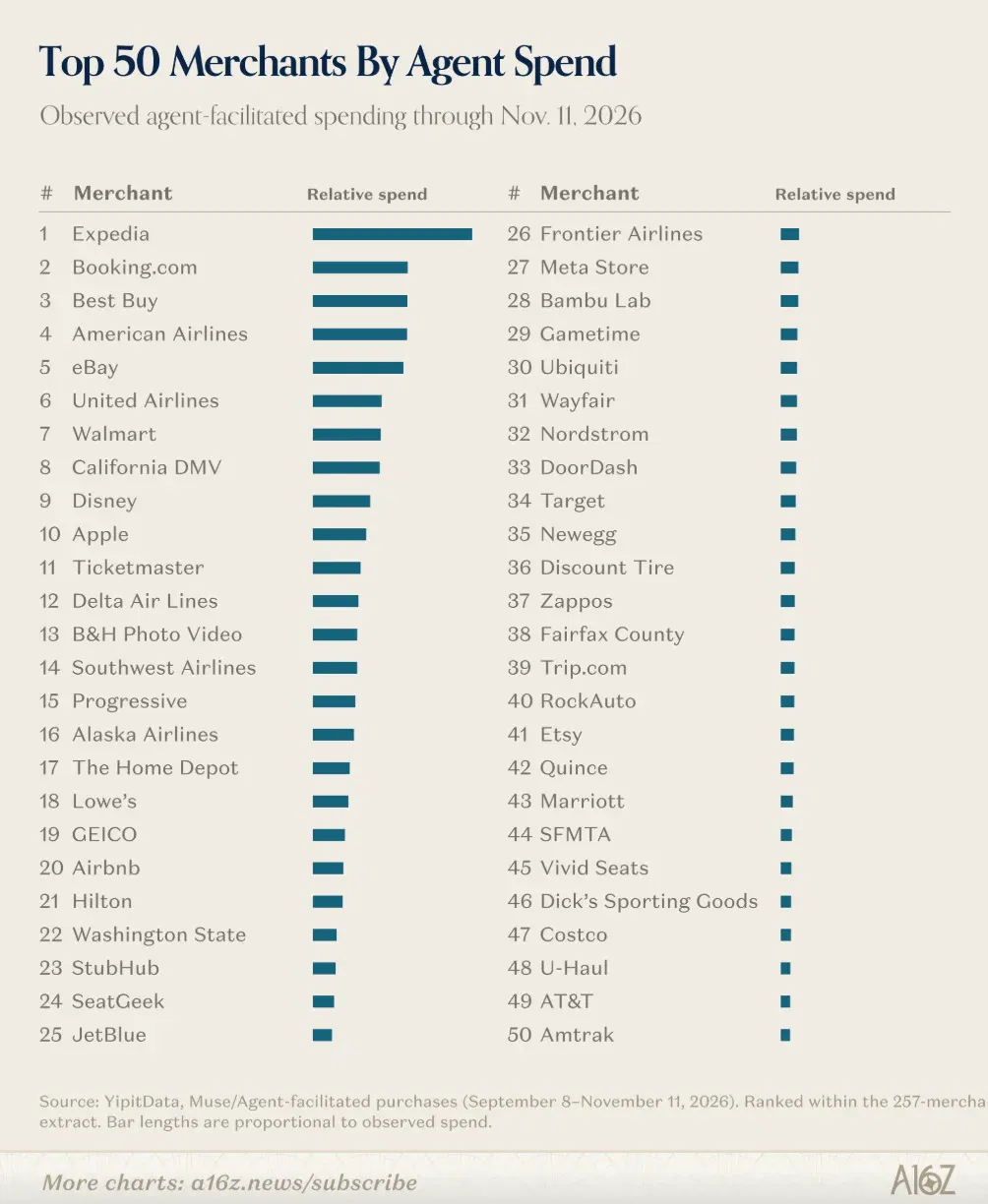
Among the top 50 merchants by agent spending, nearly a third of expenditure went to marketplaces and aggregators.
Including retailers operating third-party marketplaces raises that proportion to 46%; including conventional multibrand retailers brings it to 55%.
Travel is especially notable: Expedia and Booking.com occupied the first two positions by spending.
Why does AI also like these traditional internet platforms?
The reason is straightforward: going directly to Booking.com or Expedia is more efficient.
Researchers compared two ways to book the same hotel. The hotel's website quoted $476.20; Expedia quoted $476.
The prices were nearly identical, but Expedia supported several payment methods and let users pay immediately or at the property.
Unless the user explicitly asks for direct hotel booking, an agent has little reason to bypass Expedia.
People have often assumed platforms' greatest moat was user traffic.
But companies such as Ctrip, Taobao and Meituan spent more than a decade, sometimes decades, integrating fragmented supplies of goods and services and developing information, payment, fulfillment and after-sales systems.
Those capabilities remain difficult to replace even if AI takes over purchasing decisions. By reducing decision costs, AI may even create more transactions for platforms to handle.
/ 05 /
AI companies are becoming new allocators of traffic
The main concern may be platforms' bargaining power. If AI companies control the consumer entry point, platforms may need to renegotiate the division of value with them.
Researchers also found that different agents already exhibit marked channel preferences.
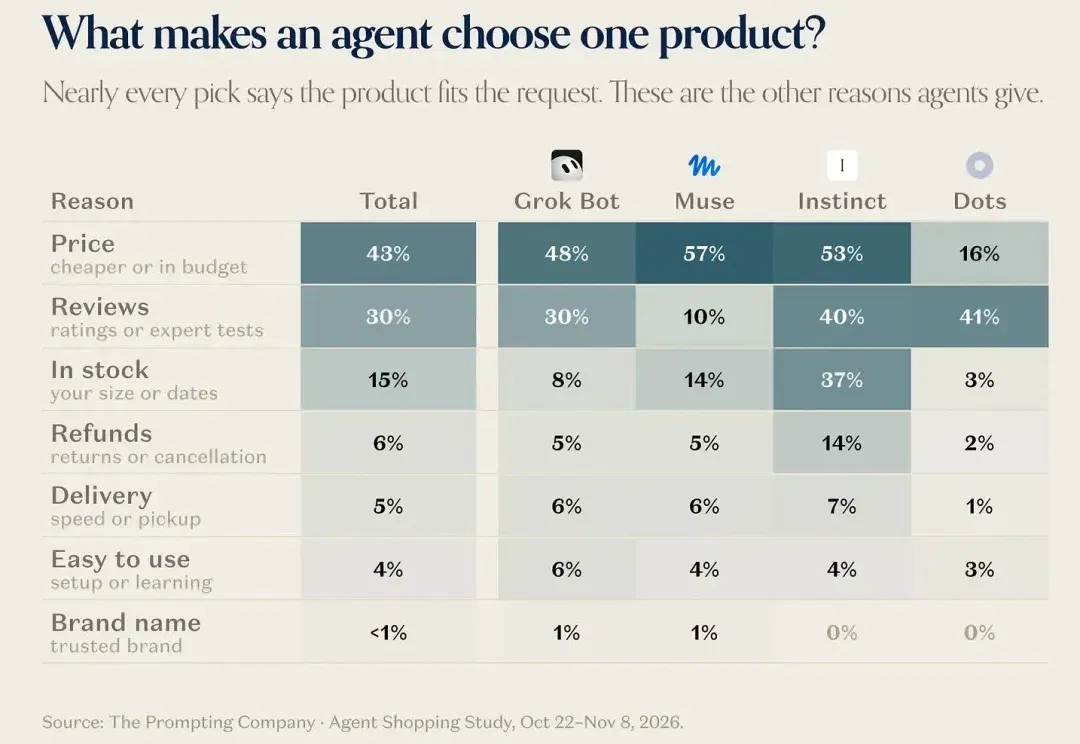
For example, 17.5% of Grok Bot's search results pointed to Amazon, versus no more than 1.6% for any of the other three agents. Meta's Muse pointed to Walmart in 26% of results and Best Buy in 22%.
Agents also emphasize different factors in purchasing decisions.
Muse rarely cited user reviews, mentioning them in only 10% of recommendations, compared with 30%–41% for the others. Dots placed more weight on professional product tests, while Instinct paid more attention to return and cancellation policies.
Currently, these differences largely arise from each agent's search system, product databases and website access. In a series of Amazon checkout tests, Grok Bot successfully added the item to the cart every time, while all three others were blocked.
These channel preferences could strengthen as AI companies develop commercial partnerships with more retailers.
Imagine 100 million consumers accustomed to shopping through AI. A single AI company could influence large flows of orders simply by adjusting its product-search scope, recommendation logic or merchant partnerships.
How much business value could that company capture?
Google built a vast advertising business by controlling the search entry point. Taobao and Douyin built their own ecosystems by controlling recommendations and traffic allocation.
Agents may intervene more deeply in purchasing decisions than those traditional platforms. That is why more technology companies are building agent-facing catalogs, payment systems and checkout infrastructure.
Stripe, Shopify and OpenAI are all trying to make it easier for AI to complete transactions.
Looking back over more than twenty years, almost every shift in internet traffic entry points brought a new wave of business opportunities.
Search, e-commerce platforms, short videos and livestream shopping each created channel advantages that helped produce new consumer brands and internet giants.
This time, AI could change both traffic allocation and purchasing decisions. Businesses may compete not only for consumers' attention, but also for the recommendation of the AI in their hands.
This article comes from Silicon Observation Pro, written by Aqi.
Related topics
After reading
Join the AINRK community
Read how to join the community and connect with people working in AI.
Related articles
Continue reading related topics and articles in this category.

Small-town merchants try AI assistants for menus and hotel analysis (opens in a new tab)
GeekPark interviews merchants in Rizhao, Chifeng and Chaoyang about Meituan's business assistant. Uses include menu cleanup, conversion analysis and room pricing. Platform figures and merchant accounts alone do not establish general AI-driven gains.

千问办公月卡走进直播间,AI 服务如何讲清使用场景 (opens in a new tab)
报道回顾一分钱月卡推广和现场演示,区分战报所列算力权益与实际成交额,并讨论促销拉新之后的续费与使用问题。
ThredUp 如何用 AI 处理二手服装:识别、定价与商品发现 (opens in a new tab)
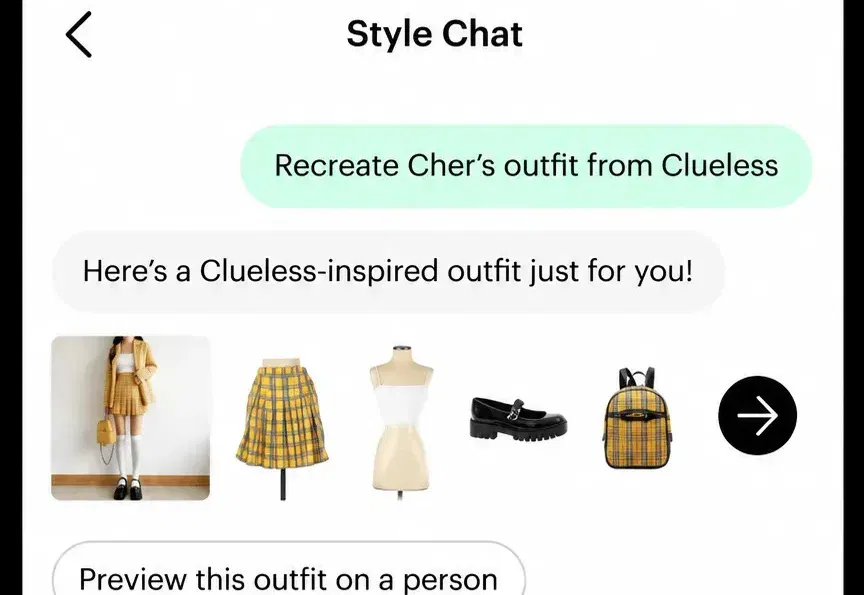
文章以 ThredUp 为例,梳理机器学习定价、图像搜索与对话式搭配如何处理大量非标准服装,并讨论AI购物入口和代理下单的边界。所引79.5%毛利率来自2025年第二季度,不能直接当作当前净利润率,或与不同收入确认口径的零售商简单比较。
帮用户抢 iPhone 折叠屏的 Agent,正在塑造 AI 时代电商的形状 (opens in a new tab)
Shopify AI 交易订单增长了 13 倍。

Muse 让 Agent 购物出圈了,DeepLumen 要帮商家开一家“接待Agent的店” (opens in a new tab)
A2A 商业马拉松,刚开跑。 最近,Meta 的 AI 智能体 Muse 引起行业轰动。它能根据你的预算和偏好筛选商品,替你跟商家砍价,甚至帮你追回忘记取消的订阅费。虽然它因隐私和安全问题一度引发争议,但它让 Agent 购物第一次被大众“看得见”。 在这场新开的 A2A 商业马拉松中,Shopify、Visa 等平台和支付公司都在快速入场。创业公司在寻找“平台不愿做或做不好的事”,比如商品事实整理、跨入口归因、中小商家的运营能力。 DeepLumen 便是其中一家。它在做的是让商家的商品被 Agent 准确理解,让商家的能力被可靠调用、真正参与到用户的购物决策中。 自2025年12月成立以来