Small-town merchants try AI assistants for menus and hotel analysis

GeekPark interviews merchants in Rizhao, Chifeng and Chaoyang about Meituan's business assistant. Uses include menu cleanup, conversion analysis and room pricing. Platform figures and merchant accounts alone do not establish general AI-driven gains.

Understanding local commerce is a new lesson for AI as it leaves the laboratory.
The stories the AI world likes to tell have changed over the past few years.
At first, the focus was on technology: how large a model's parameter count was, how quickly it could compute, and how many rivals it beat on benchmarks. Gradually, attention shifted to practical applications: how AI could produce a business plan in a minute, or offer emotionally reassuring advice to people struggling with everyday problems.
After the laboratory, where does AI go next? Behind that question lies a half-told story about democratizing AI. The first half concerns consumers: ordinary people using AI to find information, write proposals and plan trips. The unfinished half concerns business owners. For a small shopkeeper, democratization has never simply meant being able to chat with AI. It means whether AI can help manage money, inventory and customer traffic.
In November, OpenAI began testing Businesses in ChatGPT, allowing merchants to claim their profiles, maintain their information and see how users interact with their businesses in ChatGPT. The feature is modest, but its message is clear: the major players are starting to make room for merchants.
In China, this business has already begun to take shape. According to Meituan, over the past month the number of merchants in third-tier and smaller cities using its AI assistants grew by more than 200% month on month, while conversations initiated by those merchants increased roughly threefold.
One path for business AI leads up into office towers to support white-collar work. Another leads into streets and neighborhoods, serving small shops whose owners work more than ten hours a day. The second path is harder. It tests more than a model's intelligence: does it understand local business and the complexities of the physical world? It must make sense of a delivery restaurant's menu ordering, as well as subtle price changes at a hotel and its nearby competitors.
From small restaurants in Rizhao, Shandong, and Chaoyang, Liaoning, to hotels in Chifeng, Inner Mongolia, small-city managers are beginning to use AI store managers. Meituan has introduced a range of AI business assistants for restaurants, hotels and travel, pharmaceuticals and other sectors, integrating these capabilities into the management systems small and midsize merchants already use. AI is entering the everyday routines of neighborhood businesses and beginning to serve a vast market made up of countless small shops.
01
Changing a business,
starting with a delivery menu
Ai Ze, who owns a pizza shop in Rizhao, Shandong, used to judge business mainly by how tired he felt: "If I was too busy to rest, I thought business must be good that day." But after he began using the delivery edition of Miaoshou this July, exposure, conversion rates and product performance appeared side by side. He discovered that the data did not always agree with his intuition.
Meal bundles were the first thing to change his thinking.
Ai Ze had assumed that customers could simply order individual items and that there was no need to assemble bundles. The AI's analysis helped him see that, in food delivery, a bundle can address a clearer customer need, make decisions easier and help retain particular groups of customers.
He reorganized the menu, changed images and product descriptions, adjusted item order and created bundles he had previously resisted. Besides saving more than a thousand yuan a month on outsourced operations, he says he went from being "so idle I crouched by the roadside watching ants" to being "too busy even to drink water." According to Ai Ze, delivery orders more than doubled within half a month of using AI: "We get thirty or forty orders just during the daily peak."
"The first thing I do when I arrive early each morning is ask Miaoshou how business went yesterday, which dishes sold well, which did not, and why." AI has become an important part of his shop's operations. Ai Ze has also developed his own rhythm: after changing the menu, he leaves time to observe the results before deciding what to change next. "I used to go through the management dashboard and work out the figures bit by bit. Now AI pulls the data, analyzes it and suggests adjustments. I am also learning more about how to run this business well."
North of the coastal tourist city of Rizhao, in the inland fourth-tier city of Chifeng, Inner Mongolia, a hotel owner known as Pengpeng faces a different concern after nearly twenty years in the business: everyone is cutting prices; should he follow?
His hotel has no dedicated revenue manager, so he personally watches room pricing, promotions and room availability. When Inner Mongolia's peak tourism season arrived in July and August, many nearby hotels began cutting prices to attract guests. Matching them risked losing revenue; holding prices risked losing customers to competitors.
Caught between these options, Pengpeng began spending an hour a day discussing the issue with Miaoshou Jibai, Meituan's AI assistant for hotel merchants.
To his surprise, the AI did not mechanically push him into a price war. Instead, it brought together his hotel's actual bookings, gaps with nearby competitors, page views and conversion rankings, and the property's strengths and weaknesses. He previously had to compile those figures individually. "During the summer peak, simply getting a clearer picture of the business took at least half a day every week. And judgments based purely on our experience of running the hotel were not necessarily accurate."

Pengpeng's hotel in Chifeng, Inner Mongolia | Image supplied by the interviewee
Pengpeng says the AI's recommendation to maintain prices gave him confidence while nearby properties were discounting. Rather than rushing to follow, he made other operational adjustments based on the analysis. His hotel's booking-conversion ranking rose into the top five among hotels of a similar size in the city.
In a county in Chaoyang, Liaoning, AI has taken on more basic work.
Near a high school in Jianping County, Wang Huan and his family run a wrap shop that has been open for four years. They prepare stock from seven in the morning and work until eight at night. When students leave school and business gets busy, they sometimes cannot even spare a hand to mark an order as ready. He also tried outsourced operations, but encountered slow responses and difficult communication.
Wang Huan began using the delivery edition of Miaoshou only a few days ago. During its initial business diagnosis, he noticed that the shop's flagship mixed-filling wrap "did not even have a product description." He used the generated suggestions to add selling points and then adjusted the order of products on the home page. Operational details long postponed because of daily pressures were finally getting attention.
Ai Ze, Pengpeng and Wang Huan all started using AI for small, everyday tasks: adding descriptions, checking conversion and adjusting menus. They did not need to study technical specifications first. They started with familiar business problems, reviewed suggestions and adapted them to their own shops.
02
AI that understands business
is filling a role that small shops have long lacked
Looking beyond these individual shops reveals the fundamentals of a vast lower-tier market with highly fragmented needs.
The latest figures show that county-level areas account for 90% of China's land, half its permanent residents and 40% of its economic output. By the end of July 2026, more than 78 million individually owned businesses were registered in lower-tier markets. Of these, 86% operated in services, including small restaurants and guesthouses.
County-level commerce is changing too. Meituan's 2026 County Consumption Report says that, in the first half of the year, the number of county-level merchants transacting on its platform increased by nearly 10% year on year, while the number belonging to chain brands rose by nearly 20%.
As merchant numbers grow, county-level businesses are adopting more detailed management. A small physical shop must serve local regulars while also helping first-time visitors find it on their phones. It must make good products and understand how to present its online page and configure promotions. Chain brands can rely on specialist headquarters teams; independent shops often leave everything to the owner.
"What small shops really lack is an operations role that has remained vacant for years," an industry observer told GeekPark. "For shops in third-tier and smaller cities in particular, careful operations demand an understanding of the business. Owners who have already worked a long day also struggle to find the time and energy to do this work."
Outsourcing operations was one way to fill that gap. But, as Ai Ze notes, even after paying, the speed of response and quality of service remain uncertain. Wang Huan also says that relatively few merchants in his county use AI. Some prefer to rely on long-established experience. Many others have long been exposed to dubious training courses and outsourced-operations scams. They instinctively resist paying for tools and are deeply afraid of choosing the wrong one and wasting money.
This is a reality AI must face when entering tens of millions of physical shops. Owners often agree to try a tool because they have an immediate problem. Whether they keep using it depends on whether it continues to provide useful help.
Ai Ze and Pengpeng both initially tried general-purpose AI tools. Ai Ze felt that the tools on the market were useful only for simple conversation: "They just agreed with my ideas and said nice things. I would not dare use them to make business decisions."
Pengpeng also asked general-purpose large models about his hotel's difficulties. Their suggestions consisted of stock advice such as making short videos and doing promotional campaigns, with little that could be turned into specific actions. "They did not provide any substantive help."
"The gap between general-purpose and vertical agents in actual business operations is not just about model capability. It also depends on access to context and data relevant to the problem," the industry observer said. Knowing general industry practices is not enough to answer the question a particular shop faces right now. Deciding whether a hotel should cut prices requires knowing its room availability, booking pace and changes in the surrounding market. Assessing restaurant bundles requires considering product performance and customer needs.
Beyond data, there is also a difference in accessibility. "Not every AI assistant is within easy reach," the observer said. For most physical shops, it remains a substantial burden if owners must spend considerable time configuring data and knowledge bases, learning to write prompts, or even programming.
03
When professional operating expertise moves beyond big companies
Making AI readily usable by small shopkeepers takes much more than accumulating algorithms and parameters. It requires a business foundation built in everyday commercial life, even in the dirt: model capabilities must be connected to store data, industry experience and concrete actions.
Few companies can take on such a market. At present, Meituan, which has spent sixteen years in local services, appears the most likely answer.
Meituan's approach is to integrate AI technology and capabilities into the management systems small and midsize merchants already use. Combining store data with local market information, it offers analysis and recommendations for particular problems and connects these to actions involving menus, prices and promotions.
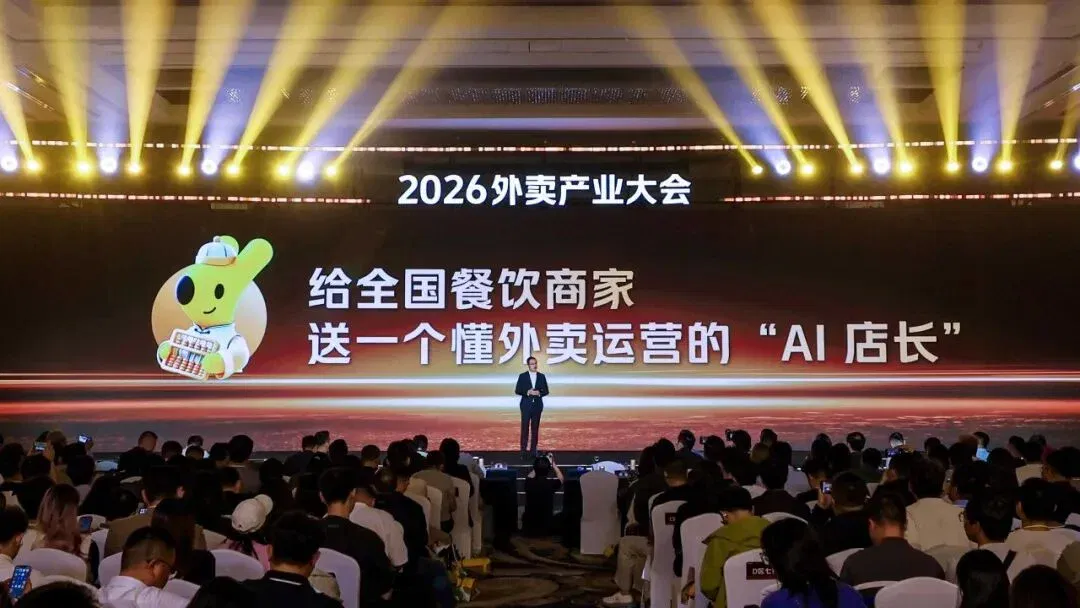
On October 22, Meituan announced it would provide restaurant merchants nationwide with an AI store manager that understands delivery operations | Image: Meituan
During Meituan's second-quarter 2026 earnings call, Wang Xing made clear that the company would not become a token factory. Its models and AI products would support Meituan's core business, improve the experience of users and merchants, and increase operating efficiency.
Recent business figures also reflect this trend. According to Meituan, over the past month the number of merchants in third-tier and smaller cities using its AI assistants increased by more than 200% month on month, and conversations they initiated grew roughly threefold. More physical-shop merchants are trying Meituan's merchant-facing AI assistants for business problems.
Looking more deeply at this development reveals a change in how operating expertise is supplied in the business world.
For a long time, professional business analysis and operations expertise were closely tied to organizations. Large chains were better placed to employ dedicated data and operations teams, while independent shops struggled to afford comparable investment. Some of those capabilities are now beginning to reach individual shops through AI tools with lower barriers to entry. Separating operating expertise from large organizations is the most tangible commercial meaning of democratizing technology.
As these capabilities become less dependent on large organizations, competition in lower-tier markets changes too. Much of the pressure chains put on neighborhood shops came from standardized online operating capabilities. As independent shops gradually close that gap, they have an opportunity to devote more attention to their products and craft.
As Ai Ze puts it, chains and prepared dishes made the restaurant industry more industrialized and standardized over many years. With AI, owners can hand over the most troublesome, time-consuming routine work. More detailed data and stronger operating capabilities can free up time and reduce costs, allowing owners to focus on dishes and product development, make their food more distinctive and substantial, and return to the essentials of a small restaurant.
In his 1991 essay The Computer for the 21st Century, computer scientist Mark Weiser wrote: "The most profound technologies are those that disappear." He imagined technology becoming woven into everyday life until people no longer needed to remain constantly aware of it.
Such a change is now quietly taking place in neighborhood shops.
*Lead image: Visual China Group
This article was originally published by GeekPark. Author: Li Su.
After reading
Join the AINRK community
Read how to join the community and connect with people working in AI.
Related articles
Continue reading related topics and articles in this category.

千问办公月卡走进直播间,AI 服务如何讲清使用场景 (opens in a new tab)
报道回顾一分钱月卡推广和现场演示,区分战报所列算力权益与实际成交额,并讨论促销拉新之后的续费与使用问题。
ThredUp 如何用 AI 处理二手服装:识别、定价与商品发现 (opens in a new tab)
文章以 ThredUp 为例,梳理机器学习定价、图像搜索与对话式搭配如何处理大量非标准服装,并讨论AI购物入口和代理下单的边界。所引79.5%毛利率来自2025年第二季度,不能直接当作当前净利润率,或与不同收入确认口径的零售商简单比较。

帮用户抢 iPhone 折叠屏的 Agent,正在塑造 AI 时代电商的形状 (opens in a new tab)
Shopify AI 交易订单增长了 13 倍。

Muse 让 Agent 购物出圈了,DeepLumen 要帮商家开一家“接待Agent的店” (opens in a new tab)
A2A 商业马拉松,刚开跑。 最近,Meta 的 AI 智能体 Muse 引起行业轰动。它能根据你的预算和偏好筛选商品,替你跟商家砍价,甚至帮你追回忘记取消的订阅费。虽然它因隐私和安全问题一度引发争议,但它让 Agent 购物第一次被大众“看得见”。 在这场新开的 A2A 商业马拉松中,Shopify、Visa 等平台和支付公司都在快速入场。创业公司在寻找“平台不愿做或做不好的事”,比如商品事实整理、跨入口归因、中小商家的运营能力。 DeepLumen 便是其中一家。它在做的是让商家的商品被 Agent 准确理解,让商家的能力被可靠调用、真正参与到用户的购物决策中。 自2025年12月成立以来
多Agent团队都搭好了,怎么生意还是我一个人在做? (opens in a new tab)
苍何评析CarryGo多Agent系统:该系统通过企业初始化、Butler管家协调与跨企业协作机制,让AI参与跨境电商的找客户、谈条件与组织交付,试图将"AI帮我干活"推向"AI帮我把生意做下去",但其在复杂业务中能否稳定履约仍待验证。