Sheng Liu: Why medical AI must look beyond prediction accuracy and patient throughput
Stanford postdoctoral researcher Sheng Liu discusses dementia risk assessment and radiotherapy planning, from data bias and clinician collaboration to patients' needs. In his view, moving from prediction to intervention requires causal modeling and new evidence; efficiency is only one objective.
Editorial fact-check (2026-11-26): Research scope: The Cerebra paper conducts retrospective dementia-related evaluations using existing medical records. The reported clinician-assistance results come from a randomized crossover reader study in which six doctors each assessed 40 cases. They cannot directly be interpreted as patient treatment benefits in actual clinical workflows or as broadly applicable effects on referrals. Disease mechanisms, causal interventions and proactively identifying research questions are future directions discussed by the interviewee; they do not mean the system has been shown to independently devise or carry out treatment. Cerebra paper: Methods, clinician reader study and limitations; (opens in a new tab)Sheng Liu's personal research website. (opens in a new tab)
"If AI could let a doctor see 100 patients a day instead of 10, would that necessarily be a good thing?"
While working on a cancer radiotherapy planning project, Sheng Liu met a patient with head and neck cancer who was a food enthusiast. Beyond controlling the tumor, preserving swallowing function and maintaining future quality of life were very important to this patient. The experience prompted Liu, whose background is in science and engineering and who is familiar with Silicon Valley's efficiency-first engineering culture, to rethink what efficiency and optimization mean. In the AI world, we always want to quantify objectives and maximize efficiency. But in a real hospital ward, the objective we have defined is not the only standard.
Sheng Liu is a postdoctoral researcher at Stanford University and will soon join Johns Hopkins University as a tenure-track assistant professor. His research has appeared in Nature and other journals in the Nature portfolio, and several of his papers have been selected for oral or spotlight presentations at leading AI conferences. He has long worked to build reliable AI systems that can continuously learn and improve, applying them to scientific discovery and biomedicine, with a particular focus on aging, cancer and neurodegenerative diseases.
In moving from science and engineering into medicine, he did not take the shortcut of simply applying ready-made algorithms. Instead, he first sought to understand clinical practice inside hospitals. Those real and difficult clinical problems, in turn, drove his innovations in AI methods themselves. As he explored clinical problems more deeply, he found that the challenges of medical AI extend far beyond technical metrics.
Medical data are intertwined with doctors' subjective judgments and clinical habits. How can AI identify genuinely valuable information within them? When clinicians fear being replaced by AI, how should AI collaborate with doctors and fit into existing medical workflows? As AI moves from disease prediction toward clinical decisions and even therapeutic intervention, what capabilities does it need to understand complex disease mechanisms and respond to patients' and doctors' hard-to-quantify needs? DeepTech spoke with Liu about these questions.
From mathematics to medicine: Defining a problem truly worth solving
DeepTech: What was your initial academic training, and how did you gradually move toward AI?
Sheng Liu: I started with mathematics, then applied mathematics. When I was applying to graduate school, I was not really thinking that far ahead. At the time, I mainly wanted to graduate and find a job as soon as possible. When I was at the University of California, San Diego, some professors hoped I would continue toward a mathematics PhD, but I thought it might also be good to start with a more applied master's degree.
Later, I applied to some data science programs and happened to enter a program in which master's and doctoral students were trained within the same structure. That was how I started my PhD. Early on, much of my work was still in areas such as signal processing, inverse problems and compressed sensing, with a fairly theoretical emphasis. I then gradually moved toward machine learning and deep learning, and eventually what everyone now calls AI.
DeepTech: Was there a particular turning point that led you from applied mathematics into medical research?
Sheng Liu: During my PhD, I attended a lecture about Alzheimer's disease, which made me think of my maternal grandmother when I was a child. Back then, I simply thought her behavior had become strange. I was frightened, afraid to approach her, and would cry whenever I saw her. It was only during that lecture that I understood that the behavior I had found strange or even frightening might have been changes caused by disease.
That experience made me seriously consider, for the first time, whether I could use what I had learned to contribute something to understanding and changing diseases like these. So I contacted NYU Langone School of Medicine, hoping to find opportunities to collaborate. In fact, I began by learning about medical problems, then gradually considered which computational methods might address them. Only later did I realize that machine learning and AI could play a role.
DeepTech: Entering medicine as a mathematics researcher, what differences from traditional computational tasks did you first notice?
Sheng Liu: I noticed that computer scientists are often accustomed to solving clearly defined problems: there is an explicit objective function and a benchmark, and they keep improving the algorithm to perform better on that benchmark.
But when I first encountered medicine, my first thought was not to propose an algorithm. I wanted to see what problems were distinctive to medicine itself. I was studying dementia then and noticed substantial uncertainty in the diagnosis of Alzheimer's disease. In consultations, doctors often have to combine patients' and family members' descriptions of changes in memory with cognitive tests and other information to reach a judgment. That information is subjective and may also be incomplete.
My initial observation was therefore that medical data have extensive missingness and many different kinds of noise. I spent a great deal of time studying AI algorithms for such data. Gradually, however, I became increasingly aware that the problem might go further than that.
Medical data are not purely objective records of disease. They contain doctors' judgment habits and hospitals' care processes. AI is very good at finding patterns, but it cannot distinguish cause from effect. As a result, what it learns is often how doctors treated patients in the past, rather than what is actually happening in the disease itself. I think this is a particularly difficult and also particularly interesting aspect of medical data today.
DeepTech: Does this mean medical AI research should begin by redefining the problem, rather than directly applying an existing algorithm in a hospital?
Sheng Liu: Yes. I tend to work with medical collaborators to identify a problem truly worth solving, find a way to define it clearly, and then look for suitable AI methods.
Often, when you ask doctors which problems they need solved, they cannot necessarily give a clear answer immediately. They may not know exactly what AI can do, and researchers may not understand all the details of hospital work. In both my dementia and radiotherapy planning projects, I spent a lot of time in hospitals observing how doctors worked each day, which steps took time, and which information was not being fully used. I then discussed with them whether there might be better approaches.
Once you define the problem clearly, you often find that an existing model cannot solve it. That is when new algorithms or systems need to be developed. Medical problems and AI methods effectively form a relationship in which each drives the other forward.
DeepTech: I notice that you also do substantial research on general AI methods, including model control, optimization and agents. What common thinking connects these seemingly different directions?
Sheng Liu: My consistent interest is how to enable AI to learn and solve problems reliably in an imperfect and constantly changing real world.
Early on, I focused more on learning itself: when data contain noise, bias or missing values, how can a model learn reliable knowledge? Later, as foundation models became more capable, I began considering another question: once a model already possesses a great deal of knowledge, how can we help it use that knowledge more effectively in a specific task?
For example, my work on inference-time guidance aims to use new contextual information to control a model's behavior without retraining it. TextGrad goes further in exploring how feedback can improve an entire AI system. Traditional gradient optimization depends on numerical gradients, but in complex systems composed of multiple language models, prompts and tools, many components are not well suited to the direct use of traditional gradient optimization. We want to express feedback in natural language and pass it to different parts of the system to optimize them.
Medicine and scientific research offer a rich set of settings for these questions. In these fields, we cannot start with perfect data, complete knowledge and quantifiable objectives. AI needs to keep acquiring new evidence, revising earlier judgments and even reconsidering the problem it is trying to solve. These demands, in turn, push me to develop new AI methods.
Bringing AI into hospitals: The challenges go beyond technology
DeepTech: What specific medical problem does the Cerebra project you worked on aim to address?
Sheng Liu: Cerebra aims to move beyond the question of how to predict the future more accurately. Previously, we could use electronic health records, MRI and other information to predict dementia risk. But information about real patients is distributed across many different data modalities. Simply putting them together can cause numerous problems: the representations of different modalities do not sit at the same level of abstraction, and the records are collected at different time frequencies.
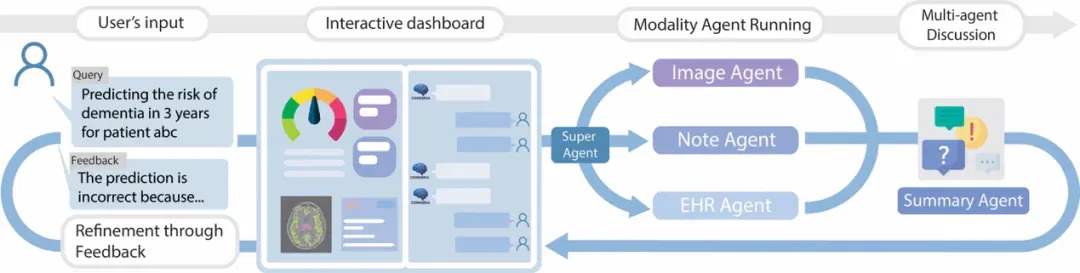
Figure | Cerebra architecture. Source: arXiv.
What we want to try is enabling AI agents to handle information from these different modalities more effectively while truly serving doctors. In the United States, for example, patients sometimes visit primary care doctors because they are sleeping poorly or are worried about aging. To be on the safe side, primary care doctors sometimes refer many of them to neurology specialists, increasing the specialists' workload.
We use evidence such as clinical records and images at different timescales to help doctors understand a patient's disease course and judge whether a referral is really necessary. We invited some doctors to take part in a case study, comparing their judgments with and without AI assistance. The results showed that Cerebra really could help doctors make better decisions.
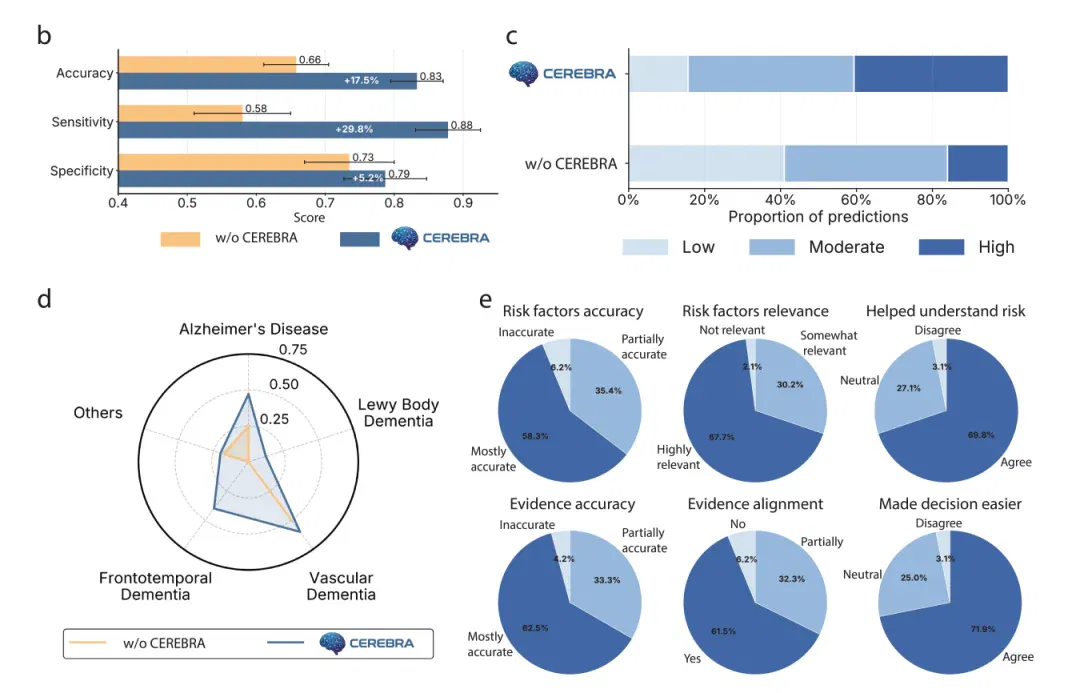
Figure | Cerebra's performance in dementia risk assessment and evaluation of its clinical application. Source: arXiv.
DeepTech: In terms of technical implementation, why choose an agent that can converse with doctors, rather than just a multimodal predictive model?
Sheng Liu: Because doctors are the people using these systems. They are not going to train a model, and they do not need to understand every technical detail. Often, they want convenient access to the evidence and the basis for a judgment. Sometimes they want to offer suggestions directly and have the agent system adjust quickly.
The agent we envision does more than output a risk score. We want doctors to understand which information the system used and why it reached a particular judgment. Doctors can then write feedback, and the agent can learn from that experience to perform the next task better.
DeepTech: You have also worked on AI-assisted radiotherapy planning. What new challenges did that project reveal?
Sheng Liu: Radiotherapy is one of the main cancer treatments. It is like an invisible scalpel, precisely directing high-energy radiation at a tumor from outside the body to kill cancer cells. Radiotherapy planning provides the precision-guidance plan before treatment. Its central objective is to eliminate as much of the tumor as possible while minimizing unintended radiation damage to the surrounding normal tissue.
In the traditional workflow, dosimetrists develop a plan, then radiation oncologists evaluate it. The two teams often have to communicate and make adjustments repeatedly, which takes considerable time. Our purpose in building an AI agent is to improve dosimetrists' efficiency so they can obtain treatment plans for evaluation more quickly.
But the main focus of this project was not simply improving model performance. It was thinking about how to get medical physics staff and dosimetrists at cancer centers to actually use it. What matters most to clinicians is not necessarily whether a metric improves by 10 points or 20. First, they need to know how to use the system and whether it can fit into their existing workflow.
Another very practical issue is job security. As the project progressed, some dosimetrists did worry that the AI system might affect their employment opportunities. We spent considerable time talking with them and explaining that the system was intended to make their work easier, rather than replace them.
Hospitals also already have established workflows and software. We integrated the system into their existing clinical software so dosimetrists would not need to switch to an entirely unfamiliar tool. Working within a familiar interface, they could obtain AI-generated treatment plans for reference.
This is really the process of moving from an AI paper toward an actual clinical application. You find that deployment involves a great many considerations. Model performance is a necessary condition, but not a sufficient one.
DeepTech: In your interactions with doctors and patients, has any experience made you rethink what AI should optimize?
Sheng Liu: I have always felt that what interests me most about medicine is that it ultimately focuses on a person. There is a strong engineering culture here in Silicon Valley that emphasizes defining a problem clearly and then continually improving efficiency. I also come from a science and engineering background, so I understand the value of that way of thinking. But when I first encountered medicine, I found that sometimes what we most need to question is precisely the objective we have already defined.
While working on radiotherapy planning, I met a woman with head and neck cancer who was a food enthusiast. Preserving her swallowing function and long-term quality of life was particularly important to her. Of course, radiotherapy design must balance tumor control against damage to normal tissue. But these specific needs that mattered to the patient might not have been included in our original optimization objective.
That made me wonder: if AI could let a doctor see 100 patients a day instead of 10, would that necessarily be a good thing? If AI can improve efficiency, what should we do with the time saved? Keep increasing the number of patients seen, or better understand patients and what truly matters to each person?
Every trade-off and every decision in medicine affects more than efficiency: it affects a real human life. That means not everything that can improve efficiency should be optimized without limit.
I think this also offers an important insight for AI's future development. We should use AI to remove the friction that obstructs our understanding of the world, but we should not also remove the friction that helps us understand it. AI can reduce a great deal of repetitive work for doctors and scientists. But I hope it ultimately gives people more time to understand patients and explore the unknown, rather than simply complete more tasks.
Beyond prediction: Enabling AI to discover
DeepTech: Medical AI has already made substantial progress in diagnosis and risk prediction. What do you think is the most important capability to develop next?
Sheng Liu: Personally, I am more interested in how to bring intervention into the picture. For the same patient, for example, how would the future disease course change under different treatments? Why do diseases progress differently in different patients? Can we understand the mechanisms behind those differences?
Suppose we can already accurately predict that someone will develop a particular disease ten years from now, but we have no way to change that outcome. In that case, medical AI is still far from realizing its potential.
DeepTech: For models to move from prediction to therapeutic intervention, what is missing from existing data and training approaches?
Sheng Liu: AI is becoming increasingly good at prediction, but being able to predict an outcome well does not mean knowing whether that outcome would actually differ under another treatment.
Many world models today also mainly emphasize predicting the future. That task is certainly important: we want to know whether a patient will develop a disease or experience a particular medical event. But to truly understand a patient's state, I think we also need better causal modeling, new ways of observing, and data that include perturbations and interventions.
We need AI to answer not only what will happen in the future, but also what would happen if we changed a condition. Only then might it further help us understand disease and support intervention decisions.
DeepTech: What would you like to research further in the future?
Sheng Liu: From an AI perspective, what interests me most is whether AI can do more than complete the tasks we give it and can also define good questions worth researching.
We place great emphasis on using AI to accelerate science, but many important discoveries arise precisely from results that do not match expectations. When an experiment fails, should we press ahead as quickly as possible, or pause and question whether the original hypothesis itself is wrong? I hope future AI can do more than improve efficiency: it should identify anomalies worth investigating, actively seek new evidence and revise earlier judgments. Sometimes real progress is not finding an answer faster, but discovering that we were asking the wrong question in the first place.
In terms of applications, I am particularly interested in cancer, aging and neurodegenerative diseases. For me, predicting what disease someone might develop is only a starting point. What matters more is finding a way to change that future. That is also why I want to bring AI, clinical research and experimental biology into closer collaboration.
This article comes from DeepTech and was written by Guo Junyao.
Related topics
After reading
Join the AINRK community
Read how to join the community and connect with people working in AI.
Related articles
Continue reading related topics and articles in this category.
Chongqing seeks feedback on a pathology cloud tender: AI services and patient charges (opens in a new tab)
Chongqing's draft pathology cloud tender concerns voluntary AI service partnerships and incentives. Procurement, hospital payments to suppliers and patient reimbursement are distinct. AI assistance is included in pathology diagnosis pricing; local rules govern implementation.
MedGPT lung cancer case study: higher plan scores for doctors using AI assistance (opens in a new tab)
The study evaluates diagnostic and treatment strategies for 40 unpublished complex cases. Scores improved when 250 doctors used the system, but the results do not establish real treatment outcomes.
Google 推出 Gemini for healthcare 美国预览版,辅助医疗行政流程 (opens in a new tab)
这套方案面向医疗服务方和保险方,通过连接器整理病历、预授权与福利材料,并保留人工审核。部分连接器仍在有限测试阶段。
多智能体协同重构医疗AI!清华AIR孵化:医生AI分身“坐诊”医院 (opens in a new tab)
不会……只有我这样做吧? 现在每次去医院看病前,我都会让AI帮我跑一轮。 哪里不舒服、持续了多久,还包括既往病史,这些零零碎碎的信息,都在预问诊阶段准备妥帖。 等到和医生面对面,结果发现医生也在Vibe Working: Agent协助医生下判断,诊室之外的随访与健康信息管理也由AI跟上。 乍一听有点赛博朋克,但却是实实在在发生在现实的一幕。 张亚勤院士创办的清华AIR,最近又跑出来一家明星AI医疗企业—— 紫荆智康。 其研发的“紫荆AI医院”系统,已经在全国各地的医院陆续上线测试。 走进去更科幻更未来的是,这里的每个医生都能拥有辅助自己工作的专属AI分身,但这还远远不够。 单说咱去看病,一个
哈佛重磅研究:AI凭人脸照片,就能预测癌症患者死亡风险! (opens in a new tab)
就在今天,这个新闻上了各大热搜。 哈佛附属的马萨诸塞州总医院百瀚癌症研究所,在《柳叶刀·数字健康》上发布了一项突破性研究。 他们训练出了一个全球首创的AI模型——FAHR-Face。 只需输入一张普通的脸部照片,这个AI不仅能看穿你的「生物学真实年龄」,甚至能直接预测癌症患者的存活几率! 最高风险组的患者,有超过一半在拍照后90天内离世。 简直是科幻成真了。这个「看脸知生死」的AI,底层到底藏着什么技术? 链接:https://www.thelancet.com/journals/landig/article/PIIS2589-7500(26)00079-8/fulltext 喂给AI 400