Alexandr Wang on superintelligence: Automating AI research without handing society to AI
Meta’s Alexandr Wang uses Alpöge and Claude’s Riemann proof to discuss AI research automation and RSI. Domain knowledge, infrastructure and experiments remain obstacles; he argues humans should retain control. These are his judgments and forecasts.
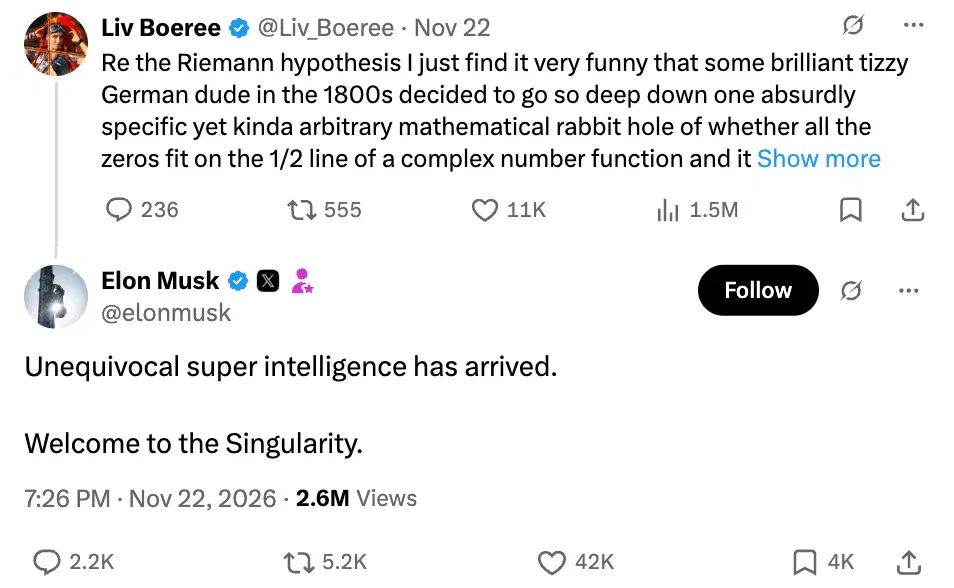
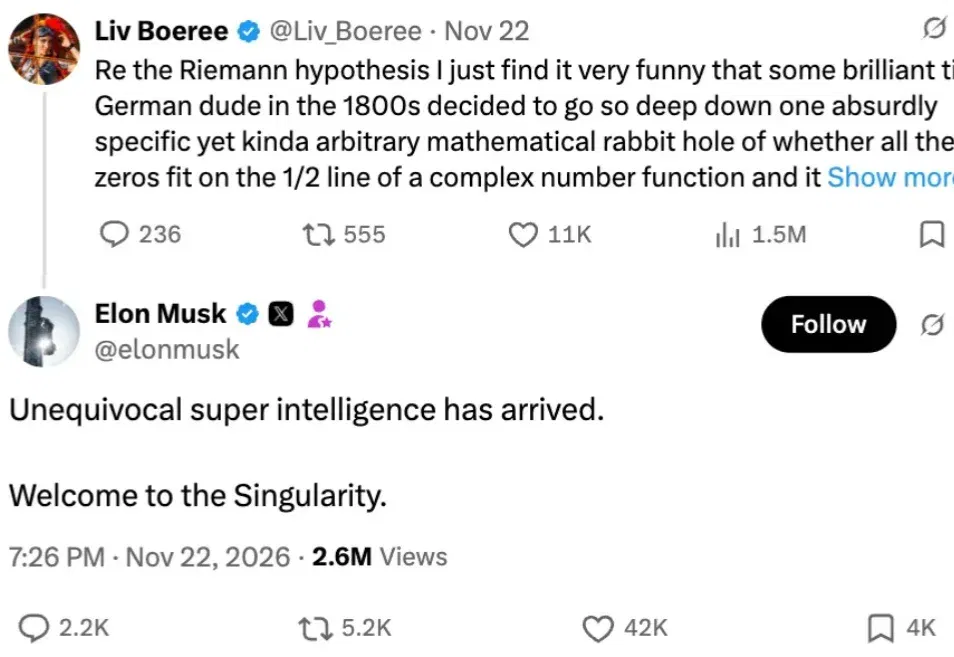
“There is no doubt that superintelligence has arrived. Welcome to the singularity.”
Elon Musk wrote those two sentences on X on November 22.
His excitement followed a mathematical breakthrough formally verified the previous day: a researcher, working with Claude, had produced a formal proof of the Riemann hypothesis.
Early the next morning, Meta’s chief AI officer Alexandr Wang published “Superintelligence is Arriving,” opening with the argument that how humanity acts over the next year will profoundly influence the world we ultimately inhabit.

He believes the Riemann-hypothesis result shows that AI has already demonstrated astonishing intelligence. In his view, the main obstacle to surpassing humans will no longer be whether it is smart enough.
He goes further, predicting that AI will automate the entire AI research process and even improve itself with abilities beyond those of humans.
Yet Wang ends with a warning that sharply contrasts with technological optimism: humanity should not accept handing society over to AI.
The Riemann hypothesis ignites a “singularity moment”
The discussion was sparked by news of Claude’s involvement in proving the Riemann hypothesis.
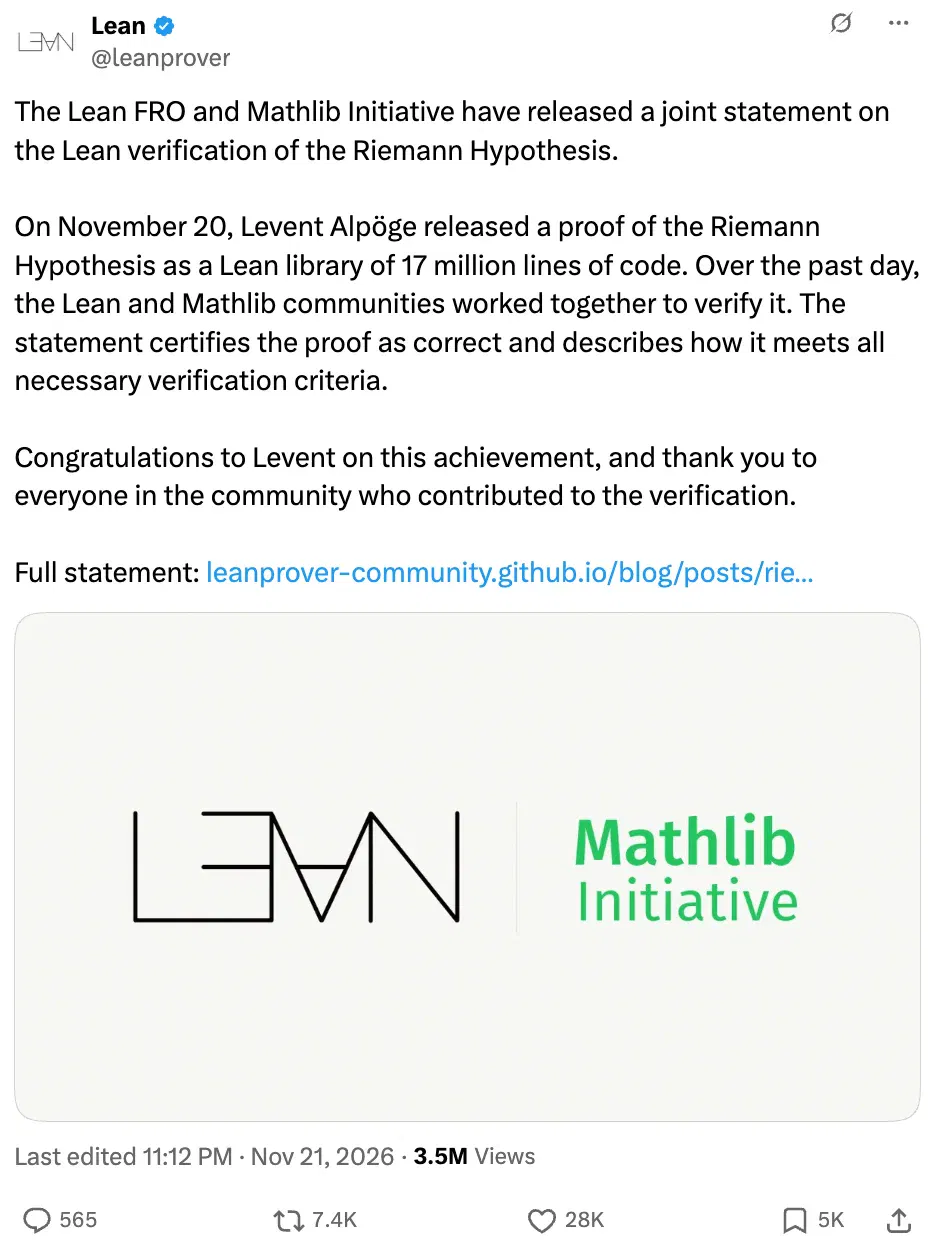
On November 20, Anthropic mathematician Levent Alpöge announced that he and Claude had found a proof of the Riemann hypothesis, releasing approximately 17 million lines of Lean formalization code.
A problem that had challenged mathematicians for more than 160 years had seen an unusual breakthrough. The Lean and Mathlib communities subsequently issued a verification statement about the formal proof. Mathematical explanations and further scrutiny of the enormous proof nevertheless remain in progress.
Beyond the proof’s technical details, its rapid effect on industry discussion of superintelligence deserves attention.
Musk responded first. He argued that proving the Riemann hypothesis would remove conditions from many theorems that had depended on it, calling the result another astonishing achievement of superintelligence.
He then declared: “There is no doubt that superintelligence has arrived. Welcome to the singularity.”
The intelligence bottleneck has been broken
Wang’s essay is more specific than Musk’s brief declaration: why might the Riemann-hypothesis breakthrough change the industry’s assessment of AI?
He grew up in Los Alamos, New Mexico, and spent years studying mathematics and science. He regards proving the Riemann hypothesis as a pinnacle of human intellectual achievement, with greater pure intellectual difficulty than many other major accomplishments in science and engineering.
That is a radical comparison, but it helps explain why he attaches such importance to the event.
Wang recalls a similar shock in December 2024, when OpenAI o3 performed strongly on AIME. People familiar with competition mathematics realized that the model’s reasoning deserved reassessment. AIME, the American Invitational Mathematics Examination, is for secondary-school students. Its participants may be young, but its difficult problems demand powerful abstract reasoning.
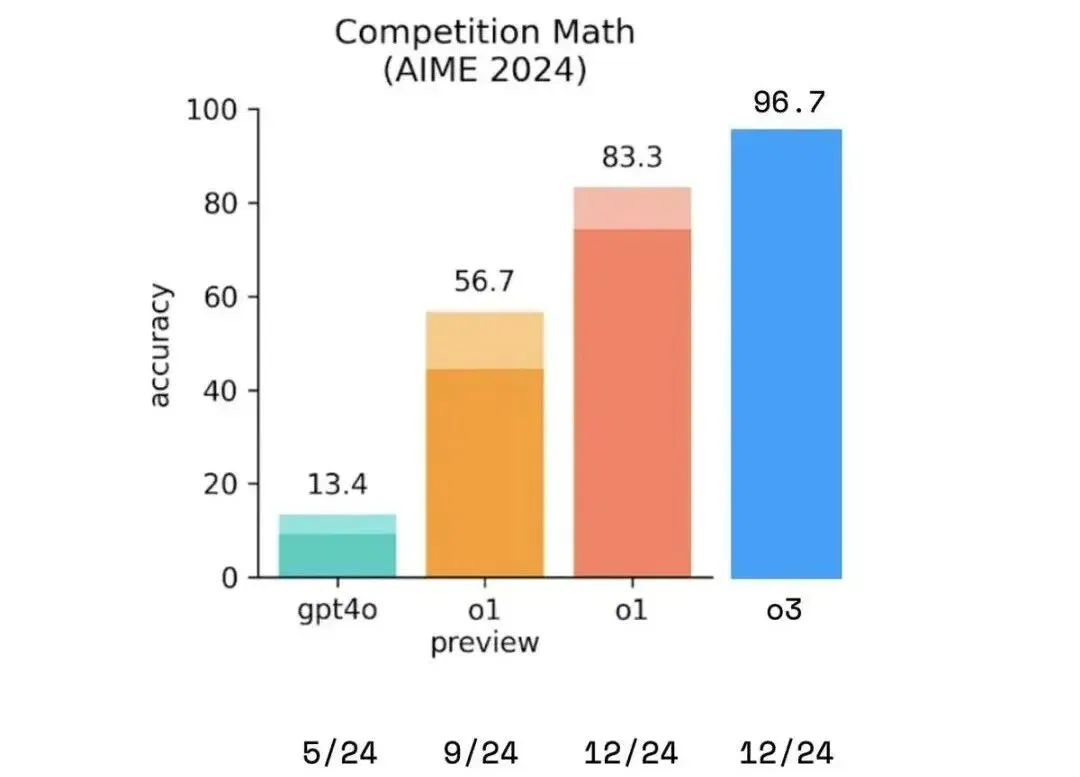
Wang believes these problems can be more intellectually demanding than many of the tasks engineers, programmers and businesspeople face every day.
If models could already solve such difficult mathematics, why were they still unable to perform so much real-world work?
In Wang’s view, the problem was not necessarily insufficient underlying intelligence. Models lacked other prerequisites for real tasks: domain background, specific context, usable tools, and the ability to interact with the world and learn through repeated trials. Over the past two years, agents, coding tools and external systems have gradually filled those gaps. He sees rapid gains in coding, strong cybersecurity capabilities and increasingly useful agents as manifestations of that process.
He therefore offers the essay’s most striking judgment:
“For models to substantially surpass humans across domains, the remaining gaps are no longer intelligence, but domain knowledge, infrastructure and experiments.”
AIME was a signal; the Riemann hypothesis convinces him that the signal can no longer be ignored.
Following Wang’s reasoning, if AI can help solve humanity’s hardest mathematical problems, more capable models might gradually undertake much intellectual work in medicine, biology, engineering and economics.
AI research, taken over by AI
If Wang is right, AI research itself could be among the first fields to undergo enormous change.
He writes bluntly that most researchers would agree that AI research is far less demanding in pure intellectual terms than proving the Riemann hypothesis.
He therefore believes models will eventually become smart enough to automate all AI research and improve themselves at a level substantially beyond humans.
This goes further than AI helping researchers write code.
AI can already assist with reading papers, debugging programs, generating experiment scripts and analyzing results. Developing the next generation of models still depends, however, on researchers deciding which questions to explore, how to configure experiments and whether a change is valuable.
Wang envisions a next stage in which AI gradually takes over those steps.
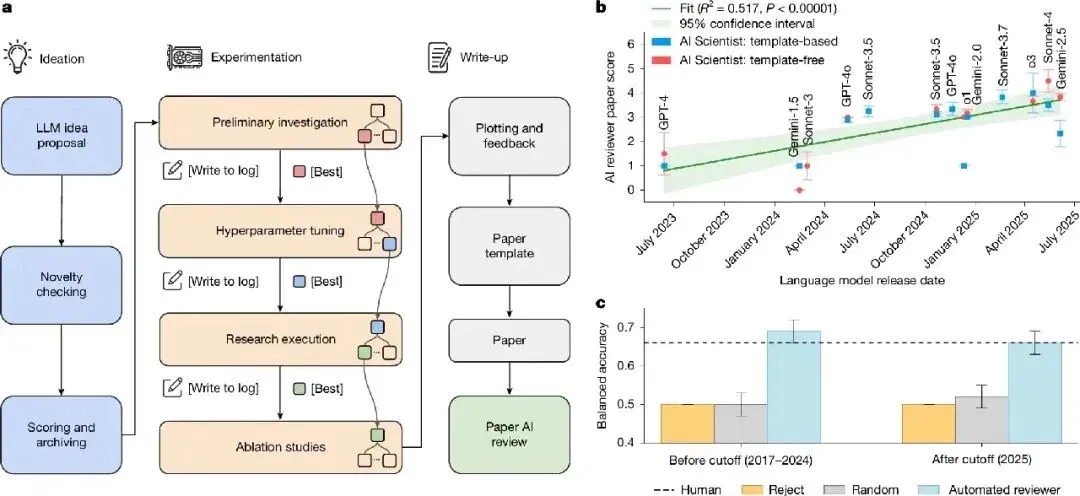
An example of the AI Scientist’s full automated research workflow, from proposing ideas through experiments, paper writing and review.
For example, a model proposes a new training method, writes code and runs tests. After receiving feedback, it revises the approach based on the results. The improved model then designs the next round of experiments, repeating the cycle. AI helps develop AI, and the resulting AI improves the efficiency of the next round of development. This is the kind of loop that recursive self-improvement (RSI) could create.
Once human researchers no longer have to drive each step, the pace of technological progress could change. New bottlenecks would shift toward computing power, experimental environments, evaluation systems and reliable coordination of the entire research process.
Wang further speculates that similar changes could occur in biology, weapons research and economics: machines could advance research faster than humans can fully understand, examine or continuously supervise.
This gives concrete form to his next concern: if AI itself increasingly drives capability improvements, can humans still decide when that cycle accelerates and when it stops?
Who holds control in the age of superintelligence?
At the end, Wang shifts the discussion from “What can AI do?” to “What should humans allow it to do?”.
He writes that it is hard to imagine humans controlling completely unconstrained recursive self-improvement. Likewise, it is hard to imagine maintaining control when a superintelligence is 1,000 times smarter and more powerful than humans in every field.
Wang therefore stresses the urgency of AI safety, alignment and safeguards. But he immediately criticizes an attitude within the industry: if artificial superintelligence is inevitable, the only task is to build it safely.
He believes that is nowhere near enough.
“We should not accept handing society over to AI.”
The person making that statement is Meta’s chief AI officer and head of Meta Superintelligence Labs. The team he leads is itself developing superintelligence.
In fact, Meta’s August essay “The Future Is for Everyone” had already made “greater individual agency” part of its vision for superintelligence, while discussing excessive concentration of power, recursive self-improvement and governance mechanisms.
Wang does not lay out specific technical or institutional solutions in this short essay. Instead, he stresses a tighter timeframe: humanity’s actions over the next year could significantly influence the world toward which superintelligence leads.
He wants more than safer AI construction. He also wants the industry to reconsider its default trajectory: superintelligence should strengthen everyone’s abilities, rather than decide the future on everyone’s behalf.
Musk announces “welcome to the singularity,” while Wang pushes the question beyond it: as AI begins researching and improving AI, the real question for humanity is who decides the direction of its evolution.
Reference links:
https://x.com/alexandr_wang/status/2124636606959345776
https://x.com/elonmusk/status/2124464633490850164
https://x.com/elonmusk/status/2124213680422387741
This article is from “Synced,” by “Neo.”
Related topics
After reading
Join the AINRK community
Read how to join the community and connect with people working in AI.
Related articles
Continue reading related topics and articles in this category.
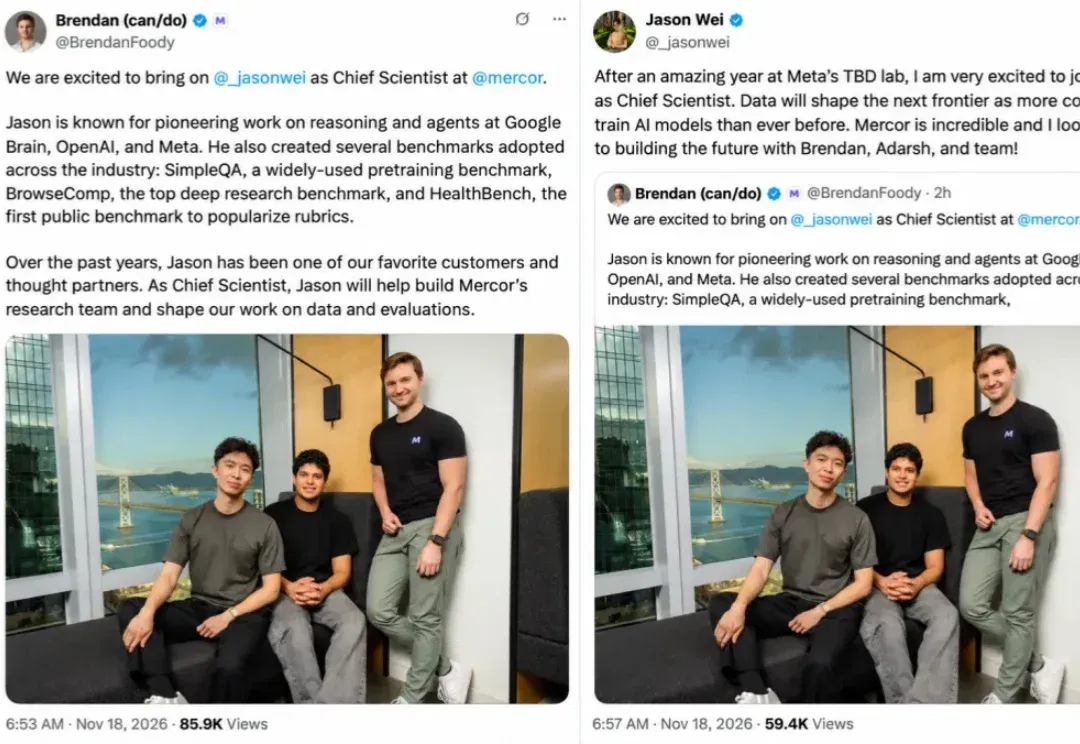
Jason Wei and Mercor announce his move to chief scientist (opens in a new tab)
Jason Wei, first author of the chain-of-thought prompting paper, confirms he is leaving Meta for Mercor to work on data and model evaluation. The report traces his research career and Mercor's expansion from expert data services into evaluation and post-training infrastructure.
Meta 发布 Muse Ember,主打高频智能体任务与低调用成本 (opens in a new tab)
Meta 将 Muse Ember 定位于工具调用、代码修复等高频任务。报道引述评测机构的结果,并列出其每百万输入 0.10 美元、输出 0.50 美元的发布价。

速递|Meta收购AI编程初创公司Conductor,加码多智能体协作 (opens in a new tab)
Conductor宣布加入Meta,并计划于2027年初推出新产品。报道同时提示,现有核心功能暂时保留,但云端服务将于11月20日关闭并开始删除云端数据;新产品具体形态尚未公布。
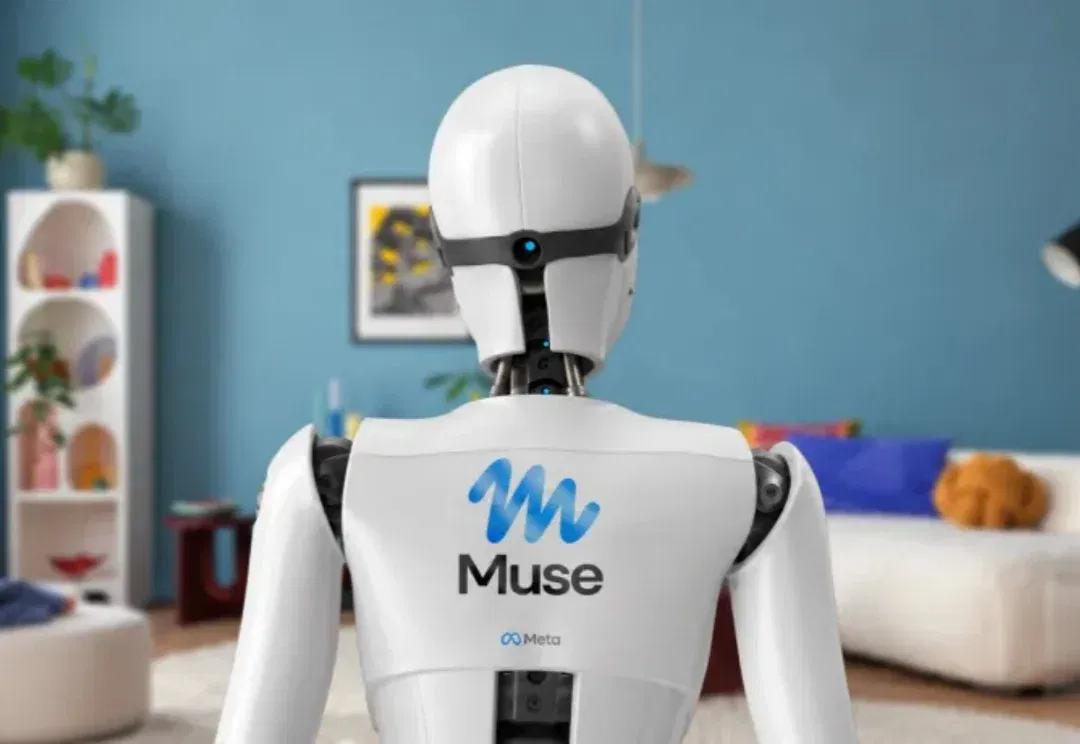
报道称 Meta 与傅利叶合作开发 Max 人形机器人原型 (opens in a new tab)
据 The Information 援引知情人士报道,Meta 与傅利叶合作开发了 Max 人形机器人原型,并已着手第二代产品。报道介绍其家庭交互要求、硬件调整及上海团队合作;项目仍处早期,面向消费者的上市时间尚未确定。

英伟达拟投资 Meta,合作延伸至 Muse 与 AI 基础设施 (opens in a new tab)
据智东西报道,英伟达拟参与 Meta 的股权发行,双方也计划扩大 Muse 模型、个人智能体和基础设施方面的合作。文章梳理这笔计划与 Meta 资本开支、融资安排之间的联系,实施进展仍以相关公告为准。