Jason Wei and Mercor announce his move to chief scientist
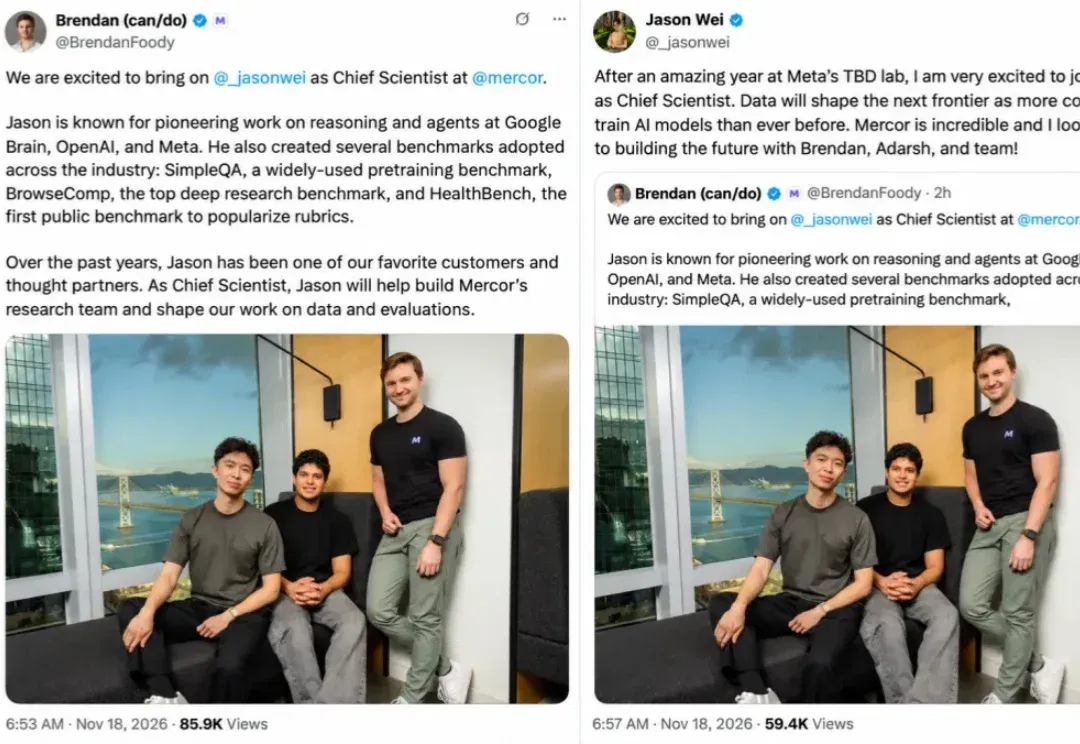
Jason Wei, first author of the chain-of-thought prompting paper, confirms he is leaving Meta for Mercor to work on data and model evaluation. The report traces his research career and Mercor's expansion from expert data services into evaluation and post-training infrastructure.
Another prominent researcher has left Meta's superintelligence lab.
This time it is the researcher known as "the father of chain of thought": Jason Wei.
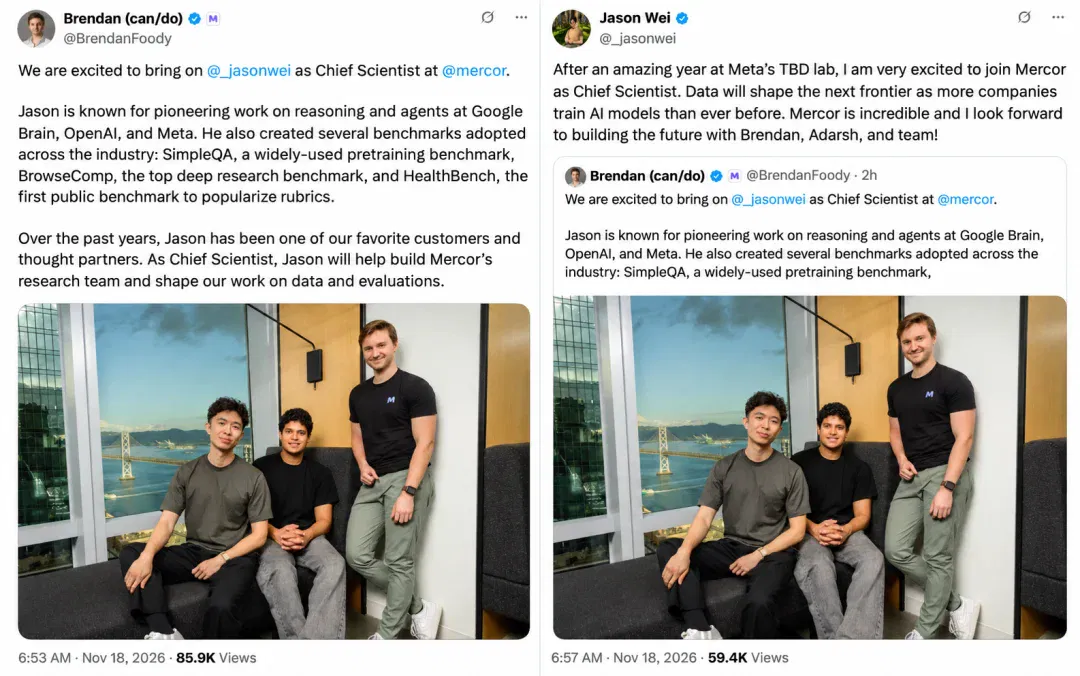
On November 18, AI startup Mercor co-founder and CEO Brendan Foody announced on X that Jason Wei had officially joined Mercor as chief scientist.
Jason Wei subsequently confirmed the news. He said he was excited to join Mercor after a wonderful year-plus at Meta's TBD Lab. He also emphasized that as more companies begin training AI models, data will shape the next frontier of AI development.
Notably, Jason Wei's new employer is neither Google DeepMind nor OpenAI nor another frontier-model lab. It is Mercor, a startup that began with AI talent recruiting and expert data services.
Just a week earlier, Mercor had announced a $750 million Series D round at a valuation of $20 billion.
From Google Brain to OpenAI and then Meta's superintelligence lab, Jason Wei has now chosen Mercor. Why would this influential researcher in large-model reasoning make an AI data company his next stop?
From Google Brain to OpenAI and Meta:
The research journey of the father of chain of thought
Jason Wei is a name that cannot be overlooked in large-model research.
He has worked at Google Brain, OpenAI and Meta, with research spanning large language model reasoning, agents and model evaluation.
What brought him widespread recognition was the 2022 paper Chain-of-Thought Prompting Elicits Reasoning in Large Language Models.
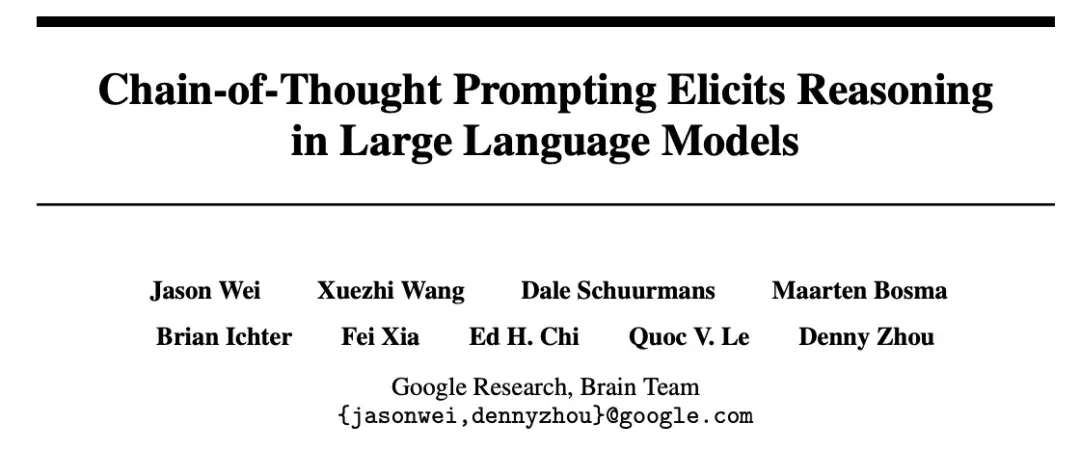
As the paper's first author, Jason Wei joined Google Brain researchers in proposing the chain-of-thought prompting (CoT) method.
At the time, large language models could already perform many natural-language tasks, but often struggled with mathematical problems requiring multiple reasoning steps.
The team found that rather than asking the model to give an answer directly, adding examples containing intermediate reasoning steps to the prompt could guide it through the calculation step by step.
For a mathematical word problem, for example, an ordinary prompt might ask only for the final number. A chain-of-thought prompt would instead demonstrate how to analyze the conditions, set out the calculation steps and arrive at the answer.
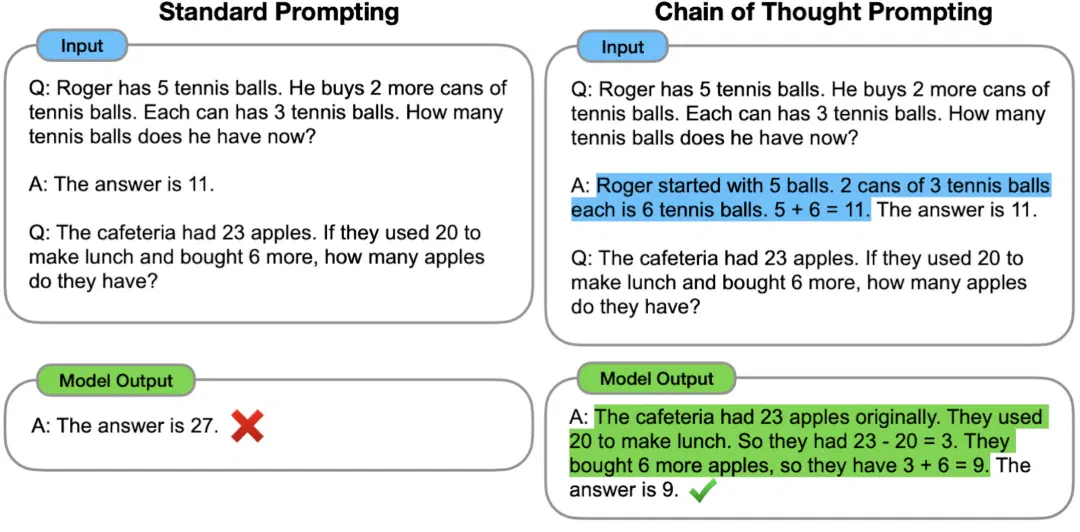
The method requires no changes to model parameters. Simply changing the examples provided in the prompt can significantly improve multi-step reasoning in sufficiently large language models.
Since then, CoT has become one of the widely influential approaches in large-model reasoning research, with subsequent work on topics such as self-consistency and reasoning-path search around chain of thought.
Jason Wei joined OpenAI in 2023, contributing to projects including OpenAI o1 and Deep Research, as well as the development of several model-evaluation benchmarks.
Released in 2024, SimpleQA primarily measures how accurately large language models answer factual questions. It contains 4,326 questions with definite answers, testing whether models can answer correctly and recognize when they cannot answer a question.
Released in 2025, BrowseComp primarily evaluates AI agents' ability to conduct complex web searches. Compared with ordinary factual Q&A, BrowseComp questions often require multiple rounds of searching, filtering and cross-checking information to find an answer.
HealthBench focuses on healthcare, using detailed physician-designed rubrics to evaluate models in realistic medical conversations across accuracy, communication quality, instruction following and other dimensions.

From CoT to SimpleQA, BrowseComp and HealthBench, Jason Wei's research has spanned both improving large-model reasoning and determining how to evaluate those capabilities.
In July 2025, he moved from OpenAI to Meta's newly formed superintelligence lab, becoming one of the prominent AI researchers Meta was recruiting from its competitors at the time.
Now, after more than a year at Meta, he has chosen another new direction.
Fresh from raising $750 million:
What is Mercor's story?
Compared with the AI giants Jason Wei previously worked for, Mercor may be less familiar. But in the market for AI training data and model evaluation, the company has grown into a unicorn valued at $20 billion.

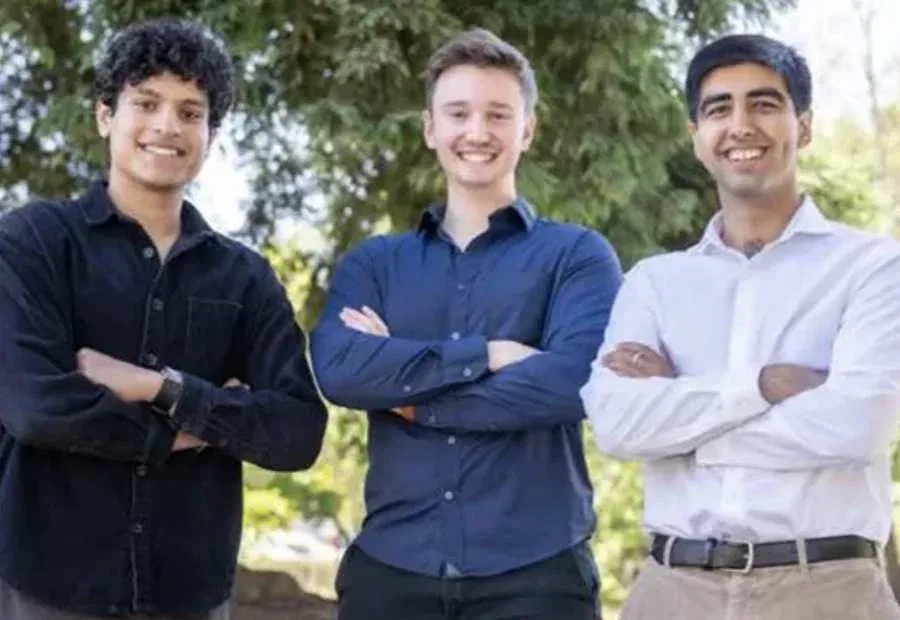
Mercor was founded in 2023 by Brendan Foody, Adarsh Hiremath and Surya Midha.
The company initially entered through AI-powered talent recruiting, helping businesses find and match suitable candidates. As generative AI developed rapidly, Mercor gradually shifted its focus to providing professional talent, training data and evaluation services to frontier-model companies.
For example, an AI lab seeking to improve a model's financial-analysis capabilities may find general internet text insufficient. It also needs professionals who understand financial workflows to help design realistic tasks, assess model outputs and supply high-quality training examples.
Mercor organizes professionals from different fields to provide data and feedback for AI model training and evaluation. Its expert network now covers more than five million people, and it has become an important service provider to frontier-model labs.
On November 10, Mercor announced a $750 million Series D at a $20 billion valuation, with participants including Benchmark, General Catalyst, NVIDIA and Salesforce.
But Mercor's ambitions now go beyond providing expert data to AI labs.
In the funding announcement, the company explicitly said the new capital would support further investment in model evaluation and post-training infrastructure, and the creation of environments where AI agents can learn complex workflows.
At the same time, Mercor is extending capabilities originally built for frontier labs to enterprise customers.
Different enterprises have their own business systems, internal rules and quality standards. Even a general-purpose model with strong public-benchmark scores may not be able to directly perform the work of a particular enterprise.
Enterprises therefore need evaluation systems tailored to their own tasks, followed by expert feedback and specialized data to improve model performance.
For Mercor, this means expanding from organizing experts to participate in model training toward helping customers evaluate, improve and adapt AI models.
Jason Wei's arrival coincides with the company's increased research investment.
The father of chain of thought and the author of LoRA
Come together at Mercor
In fact, Mercor had already begun building its own AI research team before Jason Wei joined.
On October 8, Mercor published an article titled Why Mercor Is Building a Research Team, formally introducing its research plans.
The central idea is to use evaluations to identify real work tasks models cannot complete, then draw on domain experts to understand the failures and build training data. Post-training improves model capabilities, after which evaluations are run again to measure the improvement.
To this end, Mercor is studying evaluation of real work tasks, training-data quality, model post-training and how human expertise can advance AI capabilities.
For real-work evaluation, Mercor has introduced the APEX benchmark series, covering professions such as management consulting, investment banking, corporate law, accounting and software engineering. Unlike traditional knowledge Q&A, these evaluations focus on whether AI can complete tasks with practical workplace requirements.
Mercor has also published concrete experimental results in model training. In its post-training research, it experimented with Qwen3.5-397B, increasing its Pass@1 score on APEX-Agents from 16% to 27%.
More interestingly, Mercor has already brought together researchers behind notable contributions to the large-model field.
They include Edward J. Hu.
Edward J. Hu is the first author of the well-known paper LoRA: Low-Rank Adaptation of Large Language Models and previously worked at OpenAI.
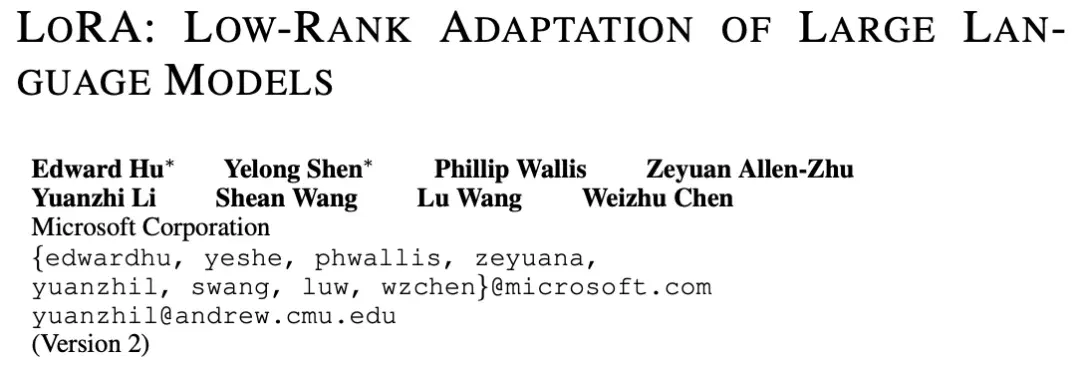
LoRA uses low-rank matrices for parameter-efficient fine-tuning of large models, sharply reducing the number of parameters that must be trained when adapting a model. It has become a widely adopted technique for large-model fine-tuning.
Beyond Edward J. Hu, Mercor's research team includes Minyang Tian, first author of SciCode and CritPt; Victor Barres, first author of tau²-bench; and other researchers from institutions including Anthropic and Ai2.
With Jason Wei's arrival, the company that began with AI talent and data services has gained another researcher with substantial influence in reasoning and model evaluation.
Notably, Mercor founder Brendan Foody revealed in the announcement that over the past few years Jason Wei had been not only a Mercor customer but also an important discussion partner for the company.
Brendan Foody said Jason Wei would help build Mercor's research team, focusing on research into data and evaluation.
That direction overlaps substantially with Jason Wei's earlier work at OpenAI. He helped develop benchmarks including SimpleQA, BrowseComp and HealthBench, while Mercor is extending model evaluation into real work in finance, law, software engineering and other fields, and trying to use evaluation results to improve models.
Jason Wei also discussed the importance of data in his own announcement. In his view, as more companies begin training AI models, data will shape AI's next frontier.
For a company extending from expert data services into AI evaluation and post-training research, this may explain why the two have come together.
From chain of thought to model evaluation, and now to real work tasks and data research, Jason Wei's next chapter will be worth following.
Reference links:
https://x.com/BrendanFoody/status/2122825607763689873
https://x.com/_jasonwei/status/2122826605362127094?a=m63C7Y9P_nHCJU683Og&s=20
This article was originally published by Synced. Author: Neo.
Related topics
After reading
Join the AINRK community
Read how to join the community and connect with people working in AI.
Related articles
Continue reading related topics and articles in this category.
Mercor announces $750 million Series D, reaching a $20 billion valuation (opens in a new tab)
According to the company and investors, the round includes employee share sales. The funding will support model evaluation, post-training infrastructure and work environments for agents.

Meta 发布 Muse Ember,主打高频智能体任务与低调用成本 (opens in a new tab)
Meta 将 Muse Ember 定位于工具调用、代码修复等高频任务。报道引述评测机构的结果,并列出其每百万输入 0.10 美元、输出 0.50 美元的发布价。

速递|Meta收购AI编程初创公司Conductor,加码多智能体协作 (opens in a new tab)
Conductor宣布加入Meta,并计划于2027年初推出新产品。报道同时提示,现有核心功能暂时保留,但云端服务将于11月20日关闭并开始删除云端数据;新产品具体形态尚未公布。

报道称 Meta 与傅利叶合作开发 Max 人形机器人原型 (opens in a new tab)
据 The Information 援引知情人士报道,Meta 与傅利叶合作开发了 Max 人形机器人原型,并已着手第二代产品。报道介绍其家庭交互要求、硬件调整及上海团队合作;项目仍处早期,面向消费者的上市时间尚未确定。

英伟达拟投资 Meta,合作延伸至 Muse 与 AI 基础设施 (opens in a new tab)
据智东西报道,英伟达拟参与 Meta 的股权发行,双方也计划扩大 Muse 模型、个人智能体和基础设施方面的合作。文章梳理这笔计划与 Meta 资本开支、融资安排之间的联系,实施进展仍以相关公告为准。