Zhipu Launches GLM-5.4 with a Loop Transformer; Open Weights Remain Planned
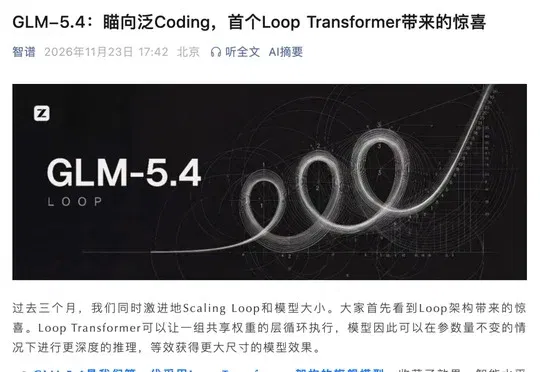
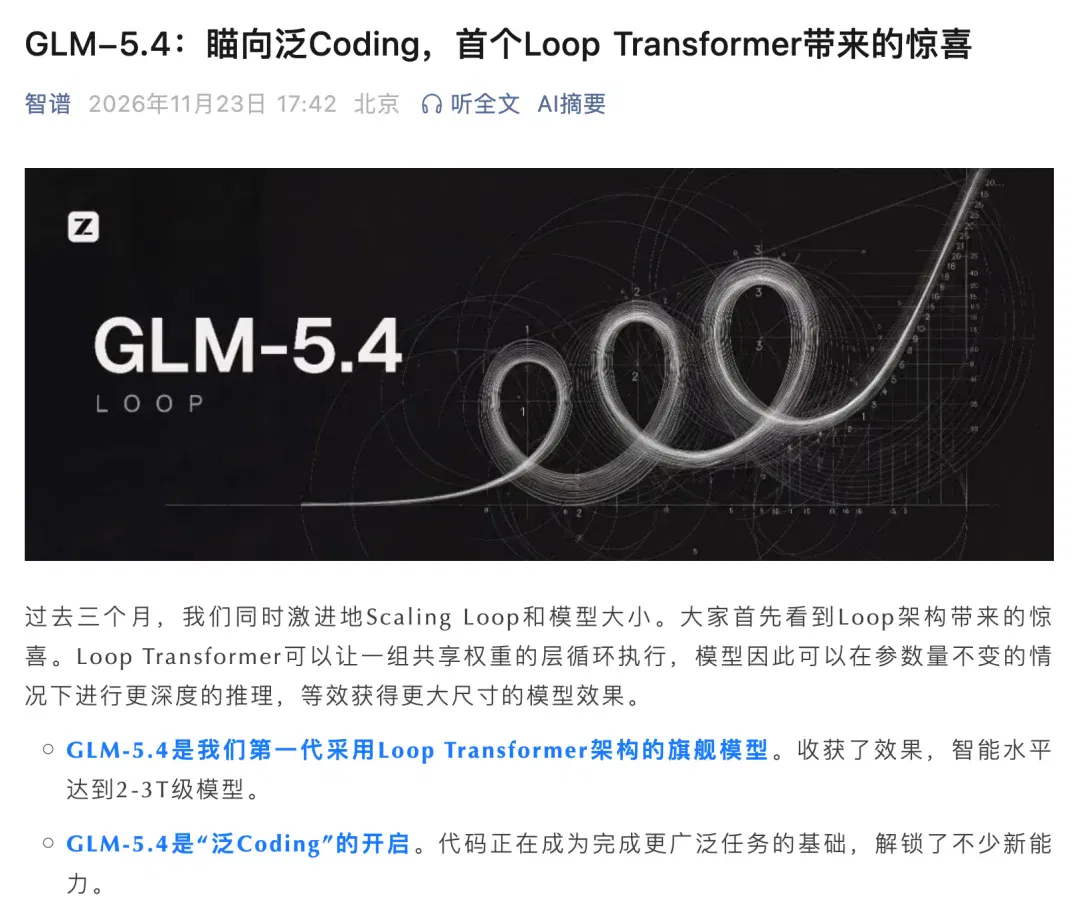
GLM-5.4 brings native vision, a 1M context and Generalized Coding to Coding Plan users. Zhipu says it loops 28 layers of a 750B base twice. API access and open weights remain future plans; product availability does not mean the weights have been released.
Editor's fact-check (November 24, 2026): GLM-5.4 being available in the relevant products does not mean its weights have been released. The official technical blog marks the API as Coming Soon and says the weights will be opened responsibly after necessary safety hardening. The KingBench ranking cited in the body concerns a particular leaderboard at a particular time; it does not establish a general first place among models with released weights. The claim that 750B reaches 2–3T-class intelligence is also the team's characterization. Zero additional overhead refers only to reusing sparse-attention indices in the second pass instead of recalculating them, not to the entire looped inference process having no extra computation. The cache design still retains an additional sliding window, so it must not be understood as using no extra GPU memory. Z.ai: GLM-5.4 technical blog and release plans; (opens in a new tab)ZCode official FAQ: GLM-5.4 plan eligibility (opens in a new tab)
This afternoon, we were pleasantly surprised to discover that the long-awaited new GLM-5.4 model had quietly gone live.
GLM-5.4 is currently available to all GLM Coding Plan users.
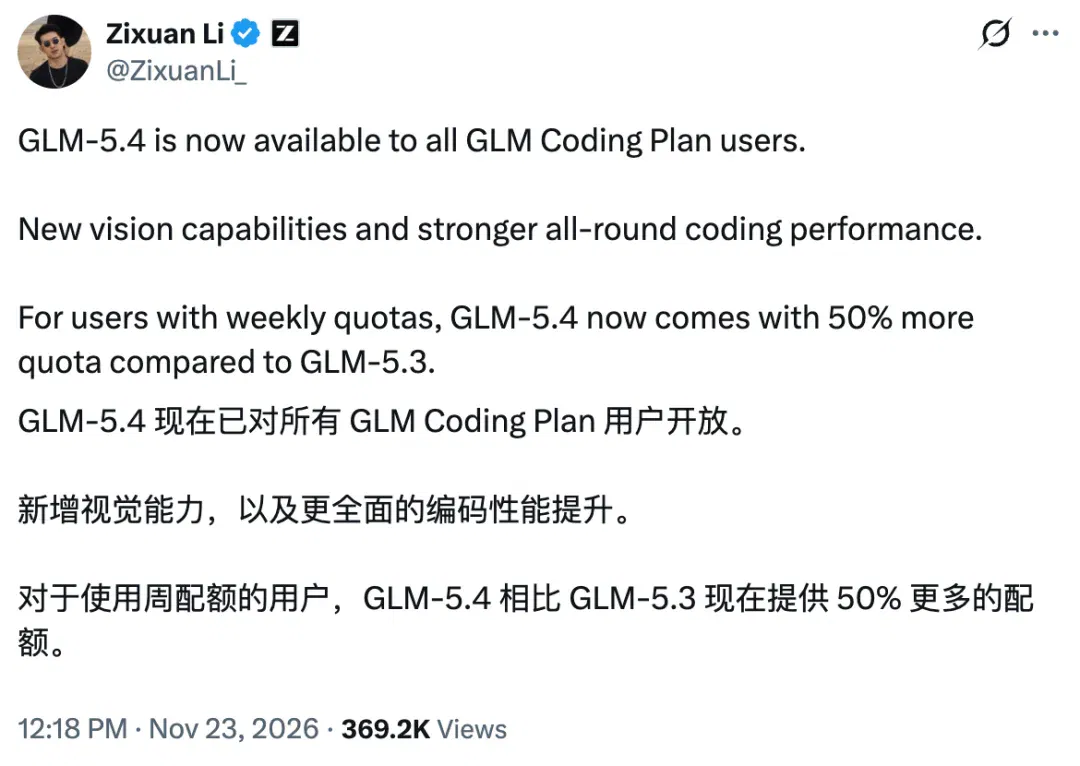
Just now, the official announcement confirmed GLM-5.4's arrival:
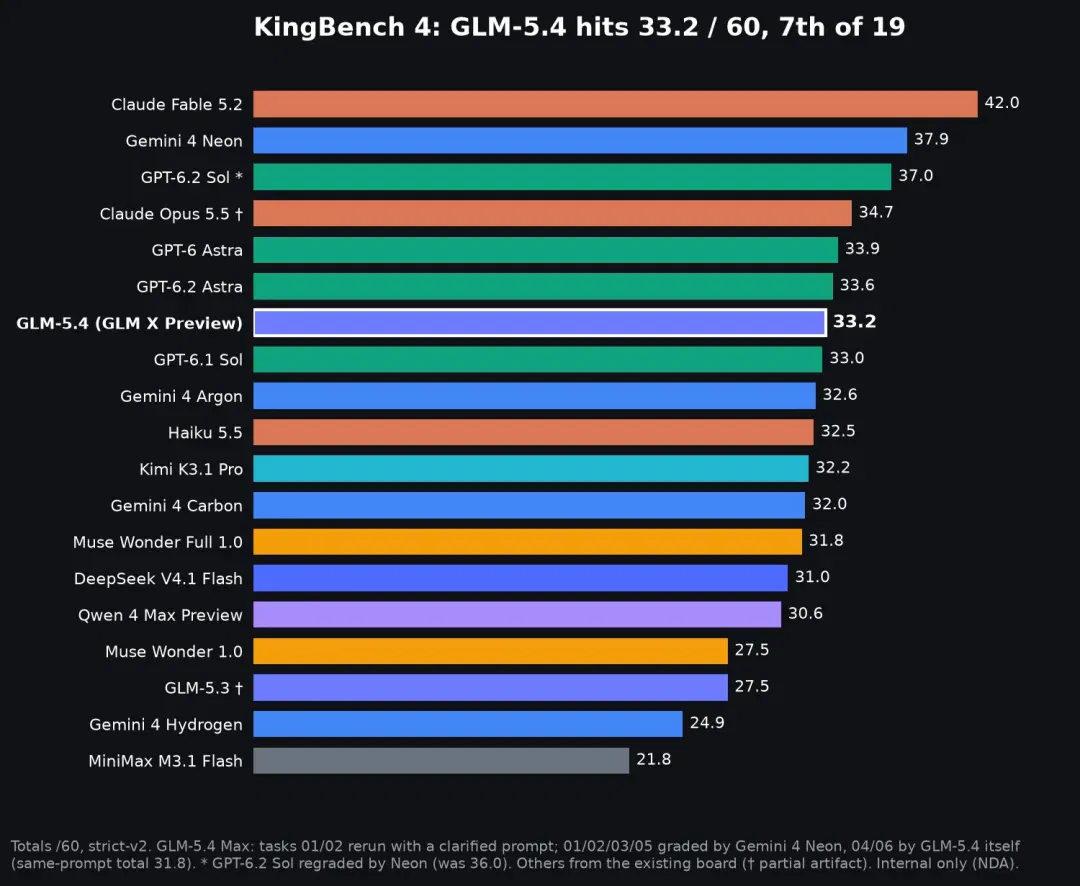
Judging from the data, this appears to be one of the best open-source models available today. The company has not yet published its own leaderboard results. According to an overseas leaderboard evaluation, GLM-5.4 ranks seventh on KingBench 4, the highest position among open-source models.
According to one overseas user's evaluation, it is 'perhaps the most meticulous model I have used,' finding bugs and security vulnerabilities in his application that other models, including Claude's flagship Fable, had missed.
Here are some interesting-looking examples to explore what the model can do.

GLM-5.4 used FreeCAD for engineering modeling to build a six-axis robotic arm, then called Blender to design and visualize its movements and synthesized audio, producing a simulation and visualization of the arm grasping a logo.

GLM-5.4's self-narrated music video, Hello world. Creator Mike used GLM-5.4 to complete the entire process from scratch: concept, arrangement, animation and visual rendering.
GLM-5.4 is Zhipu's first flagship model built on a Loop Transformer architecture. Put simply, it runs a group of layers repeatedly, each pass continuing the reasoning from the previous one, effectively creating a deeper network without increasing the parameter count. With 750B parameters, it achieves effects comparable to 2–3T-class models.
GLM-5.4 also adds native vision, supports a 1M context and substantially expands Generalized Coding capabilities. Generating videos with code, building games, doing 3D modeling and operating professional engineering software sound like jobs for separate toolchains. Now one model can connect them.
A New Architecture: Loop Transformer
A repeatedly observed pattern in large language models is that memory-intensive tasks benefit from more parameters, while reasoning-intensive tasks benefit from more effective computation. Writing code, doing mathematics and creating 3D models are fundamentally very long-chain reasoning tasks. The model must follow multi-step causal chains while preserving global logical consistency. Such capabilities are difficult to obtain simply by adding parameters.
Loop Transformer is designed for these tasks.
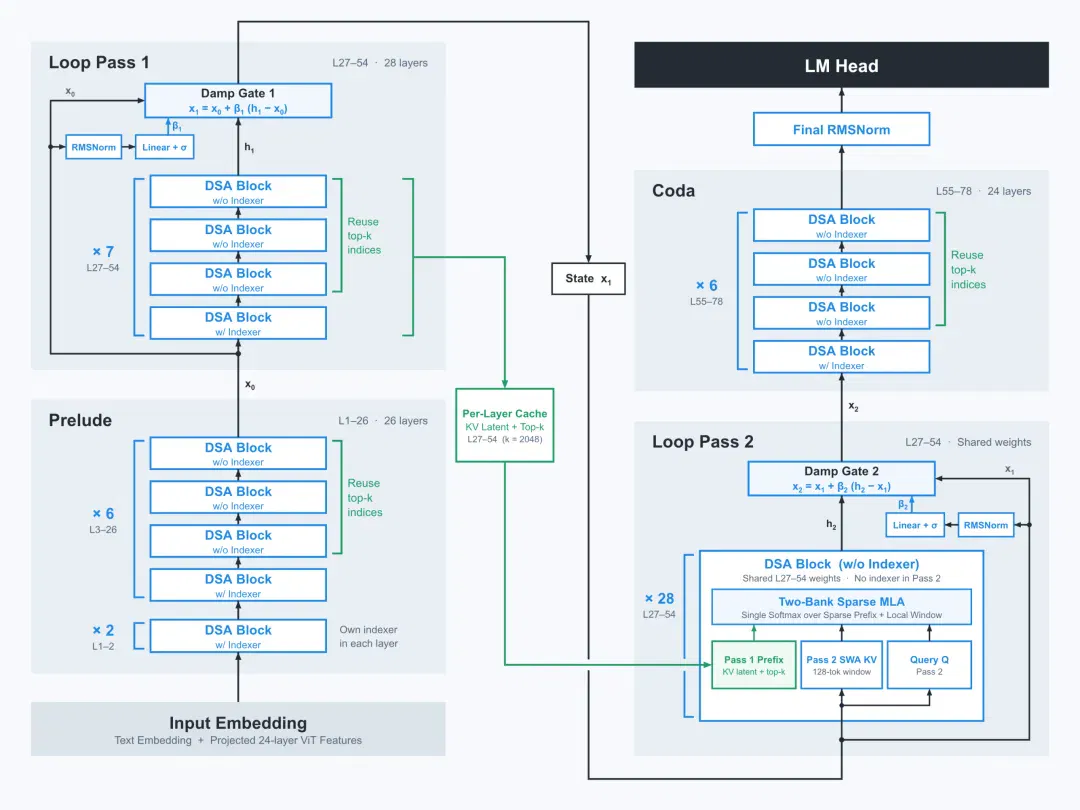
In a standard Transformer, each layer is traversed once per forward pass. A Loop Transformer instead runs a group of layers with shared weights for multiple passes, each refining the result using the hidden states from the preceding pass.
Google's Universal Transformer proposed a similar weight-sharing recurrent approach in 2018. But these lines of research remained at the laboratory stage. Despite the compute spent on training, weight-sharing models could not outperform standard models that give each layer its own parameters. They saved parameters in theory but lost performance in practice.
Zhipu took a route around that difficulty. Instead of training a looped model from scratch, it modified an already trained, standard 750B base. That preserves the vast knowledge accumulated during pretraining. Loops are introduced only during post-training, at much lower compute cost.
Specifically, GLM-5.4 runs 28 layers of the 750B base for two passes. To make looping work at this scale, the team made three key engineering changes:
Gated progressive updates. When the middle layers of an existing model become a multi-pass loop, directly overwriting the hidden state with each pass's output causes activation norms to expand excessively with the number of passes. GLM-5.4 assigns independent per-token gates to each pass, writing candidate changes back into the residual stream proportionally. After training, the gates show a clear division of labor. The first pass focuses on establishing global context, writing gently with small gate values. The second reuses that state for refinement, opening its gates to write the results fully. Gates also adjust step size dynamically according to token prediction difficulty, giving harder-to-predict positions larger first-pass updates.
A globally shared KV cache with independent sliding windows. A naive approach retains a full KV cache for each pass, multiplying GPU memory use with the pass count. GLM-5.4 divides attention by distance. Within the sliding window, each pass retains its own KV, because nearby context differs most between passes. Outside the window, all passes share one KV cache. An additional pass costs only one window's worth of KV, keeping the deployment-cost increase manageable at a 1M context.
Reusing sparse-attention indices. GLM-5.4's base uses sparse attention. Its second pass directly reuses indices generated by the first pass's indexer, adding no extra overhead. Experiments show performance nearly identical to recalculating indices on every pass.
All three designs pursue the same goal: keeping the cost of thinking for another pass as low as possible. An extra pass uses almost no additional GPU memory or retrieval cost.
Generalized Coding: Code as the Foundation of Every Capability
Another concept emphasized by GLM-5.4 is Generalized Coding. Code is moving from an exclusive tool for programmers to a universal protocol through which AI connects with software capabilities of every kind.
Since going all-in on coding in early 2025, Zhipu has continually broadened what coding means. GLM-5.3 reached agentic engineering and long-horizon autonomous development. GLM-5.4 pushes that boundary much further.
The core logic of Generalized Coding is that almost all modern creative tools expose code interfaces. Video engines have scripting APIs, 3D software has Python bindings, game engines have complete programming frameworks, and engineering software has parametric modeling languages. These interfaces used to be aimed at professional developers, with a high barrier to entry.
But if a model's coding capability is strong enough, it can operate professional tools directly through these interfaces, extending writing code beyond software development into video production, game development, engineering design, 3D modeling and other new areas.
That also explains why GLM-5.4 improves vision and coding together. Vision lets the model understand design intent and rendered results; code lets it call tools to realize them. Together, these capabilities provide a complete path from understanding requirements to delivering a finished result, without humans carrying material back and forth between tools.
Generalized Coding is redefining the boundary of being able to code. Code is no longer used only to build software: It becomes AI's hands for operating the digital world.
A model good at coding is also good at making videos, games and engineering prototypes.
Access and Next Steps
GLM-5.4 is available immediately to all GLM Coding Plan users and is also launching on coding platforms including ZCode, Trae, WorkBuddy, Qoder, CatPaw and OpenCode. Coding Plan V2, V3 and Team users receive 1.5 times the GLM-5.4 quota. The API will open after safety evaluation, and the model weights are also planned for responsible open release.
GLM-5.4 reaches up to 200 tokens per second off-peak and still provides 70–80 tokens per second at peak times. With stronger performance, higher speed and more generous quotas, try it here:
- Native Generalized Coding terminal ZCode: https://zcode.z.ai/cn
- GLM Coding Plan: https://bigmodel.cn/glm-coding
This article was originally published on the WeChat public account Synced, by Synced.
Related topics
After reading
Join the AINRK community
Read how to join the community and connect with people working in AI.
Related articles
Continue reading related topics and articles in this category.

独家!智谱AI自研多款硬件产品,携手早教代工厂布局终端 (opens in a new tab)
《读佳》获知,智谱AI正在研发多款硬件产品,型号有ZAI-P1、ZAI-M2、ZAI-N1等,其中一款设备型号ZAI-P1的产品已在2026年2月获得由工信部颁发的电信设备进网许可证,电信设备进网许可证状态为试用证,申请单位及生产企业是成都智谱华章科技有限公司(智谱AI全资子公司)。
智谱年报发布:收入结构翻转,MaaS 增长 60 倍 (opens in a new tab)
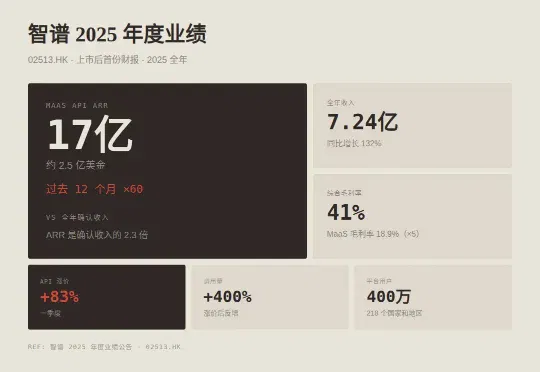
3 月 31 日,智谱(02513.HK)发布上市后首份年度业绩。2025 年全年收入 7.24 亿人民币,同比增长 132%,是国内收入规模最大的大模型公司。同时,MaaS API 平台 ARR 约 17 亿人民币(约 2.5 亿美金),过去 12 个月增长 60 倍

GLM-5深夜官宣:Pony Alpha身份揭晓,编程能力逼近Claude Opus (opens in a new tab)
2月11日深夜,智谱AI官宣新一代旗舰大模型GLM-5。之前在OpenRouter上神秘出现的"Pony Alpha",身份终于揭晓。据DoNews报道:Pony Alpha就是GLM-5的低调测试版。

曝DeepSeek春节不发大招,友商疯狂偷家 (opens in a new tab)
就在刚刚,据《南华早报》援引知情人士最新消息,智谱 AI 计划在未来两周内,也就是春节前发布其新旗舰模型 GLM-5。与此同时,MiniMax 也预计将于春节前发布 M2.2 模型,这是在原有 M2.1 基础上进行的小幅更新,重点提升编程能力。

智谱刚发布的 AI 编程工具Z Code,确实有点意思【附使用教程】 (opens in a new tab)
在 GLM-4.7 模型发布后不久,智谱又上线了一款全新理念的 AI 编程工具 Z Code。目前 Z Code 仍处于测试阶段,但在实际上手过程中,能感受到它与传统 AI 编程工具明显不同的设计思路。下载地址:https://zcode-ai.com/cn