Author tries OiiOii Motion: earnings animation draft in 11m 37s, science draft in 13m 30s
The author creates noise-cancellation, NVIDIA earnings and product-promotion videos with OiiOii Motion. Initial science and earnings drafts take 13m 30s and 11m 37s, excluding manual fact-checking and editing; review and revisions remain necessary.
“Whatever people can imagine, animation can explain.” —Walt Disney
The article reports that on October 8, Anthropic made document, slide and design features generally available in the same product update, while introducing a Claude Motion beta for Team and Enterprise users. Animation production began joining reports, presentations and dashboards among the work capabilities offered by AI assistants.
According to the article’s account of Anthropic’s release notes, material well suited to motion often ends up as static slides. The listed uses for Motion were specific: turning a quarterly report into a brief all-hands explanation, animating charts in board materials, or creating onboarding instructions for new customers.
These scenarios usually already have reports, data and explanations. What remains is to sequence the information and make changes and processes clear. In this account, Claude Motion brings motion-graphics production into work conversations, addressing the time required to create animated explanations from existing material and the inconvenience of revisions after data or interfaces change.
This approach has also reached AI animation platforms. OiiOii’s recently launched Motion likewise addresses the need to start from existing material and keep editing after a first version. Creators explain what they want in everyday language, and Motion uses code to choreograph animation, bringing images, voice-over and music into one editable project. During creation, they can request revisions conversationally or directly adjust text, clips and audio in the editor and timeline.
▍Turning active noise cancellation into a science explainer
Previously, science creators wanting to break complex knowledge into understandable stages with images, text and narration had to research the topic, storyboard it and check each segment for consistency between visuals and explanation. Common models struggle to express knowledge structures accurately and convey textual information in such short videos.
OiiOii Motion can take a creator’s science topic and have an agent retrieve relevant material automatically, saving some manual research, then use 2D diagrams and 3D animation to show structures and processes in the order of narration.
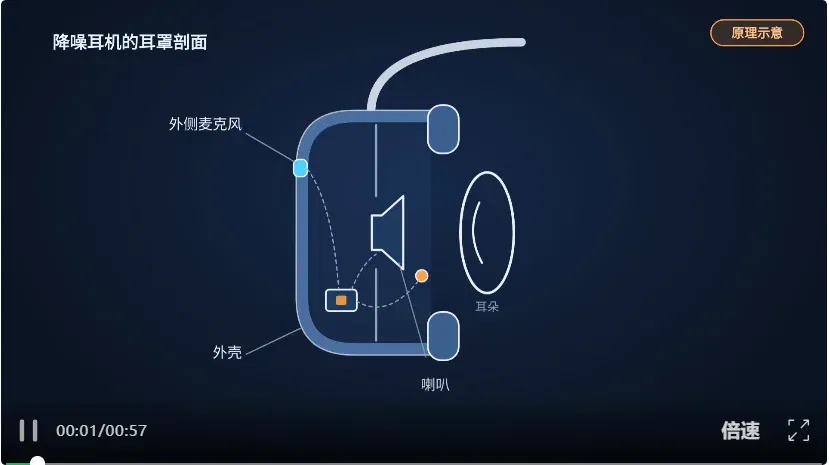
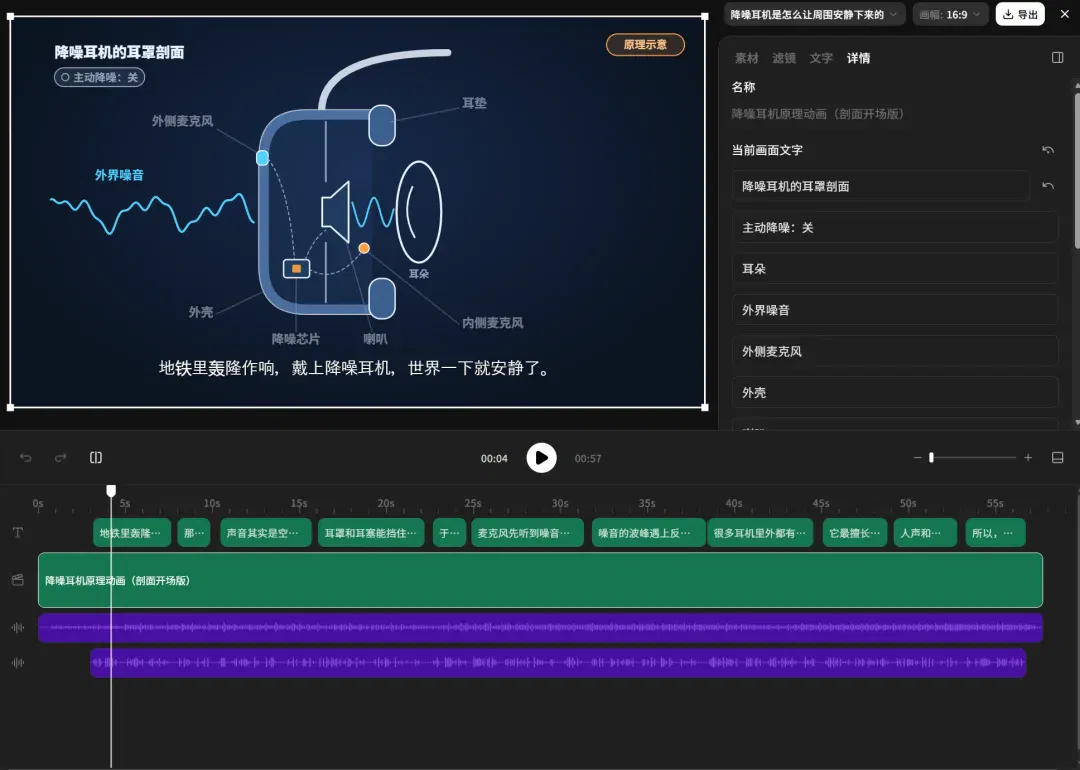
The topic this time was “How do noise-canceling headphones quiet your surroundings?” The video explained the basic process of active noise cancellation to viewers without an acoustics background. It opened with an earcup cross-section locating the microphones, noise-canceling chip and speaker, then used differently colored waveforms with Chinese narration and subtitles. The waveform visuals were labeled “schematic illustration.”
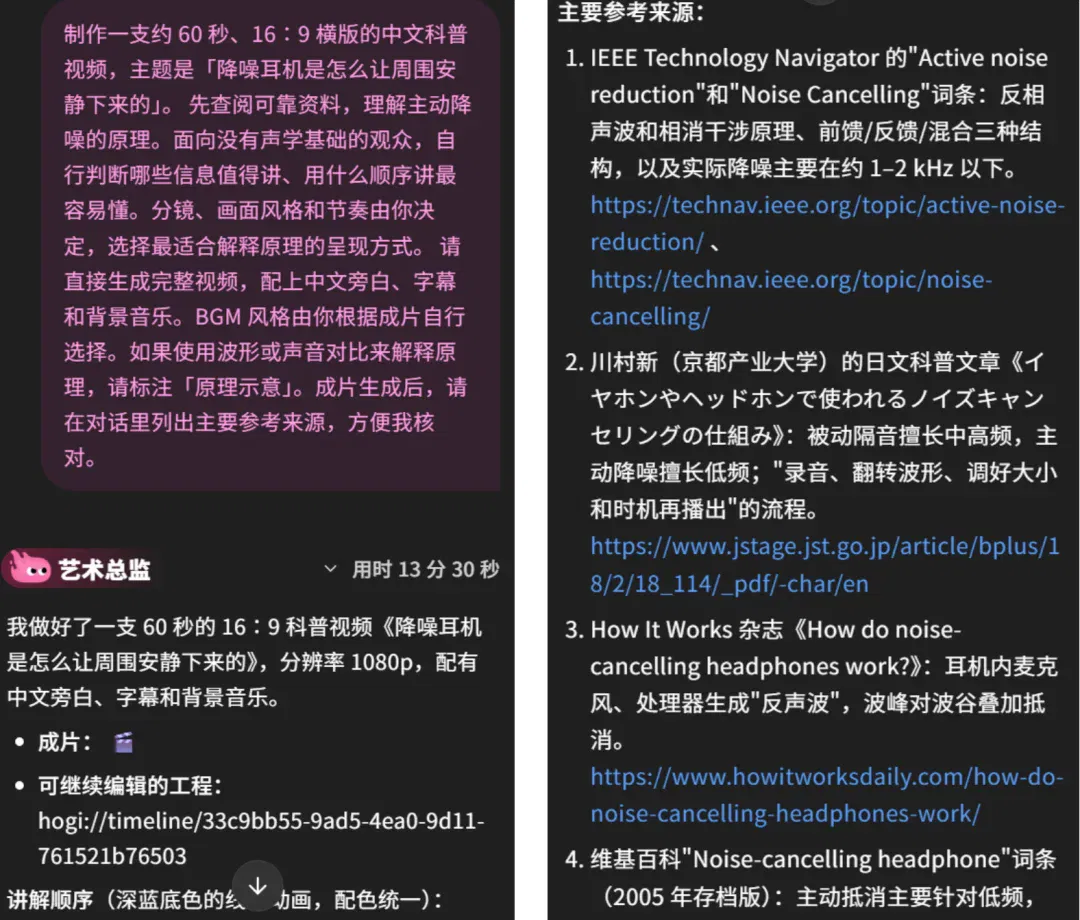
Production starts with a natural-language description. OiiOii Motion creates motion graphics in code according to the request, generating all required code itself. Creators who have never learned After Effects can use everyday language to produce a first version of motion graphics, a 3D science explainer or a product demonstration.
For the noise-cancellation explainer, the natural-language request specified approximately 60 seconds, a 16:9 landscape format, Chinese narration, subtitles and background music, with waveforms or sound comparisons labeled “schematic illustration.” Motion arranged the explanatory sequence, storyboard and visual style. Generating the first version took 13 minutes 30 seconds, producing a video, an editable project and a reference list. Its links could be used to check the narration and waveform illustrations.
Reviewing the first version revealed that the opening lacked an intuitive earcup cross-section and the ending lingered too long. Such feedback can be sent directly in the original OiiOii Motion project conversation, focusing changes on specified shots. Creators can also change on-screen text and colors, and clip order and duration on the timeline, directly in the editor.
For this revision, the creator combined the opening and ending requirements into one message. The first shot was to show a simplified earcup cross-section of unbranded over-ear headphones before explaining the principle. After the final line of narration, the picture should remain for only about a second, with a natural music fade-out and total duration still around one minute.

Those two comments were submitted directly in the original conversation. The revision took 6 minutes 52 seconds. OiiOii Motion added the opening visual, adjusted transitions and re-exported the video within the original project.
Manual adjustments followed in the editor. Titles and component labels appeared individually in the sidebar for direct text editing; subtitles, animation and audio remained on separate tracks, making it easy to locate segments and check subtitle timing against narration and visuals. The two system-reported times counted only generation and revision, excluding research verification, review and manual adjustments.
▍An animated chart breaks down NVIDIA’s latest results
Business analysis and industry reports usually present multiple datasets in static charts. Turning them into explainer videos often requires editors to reformat them and animate each element in explanatory order, a time-consuming process. Generating charts directly with general-purpose models also makes it hard to ensure accurate numbers, clear labels and proportions consistent with the source data simultaneously.
OiiOii Motion can draw animated charts in code, calculating bar heights from supplied values and placing figures and labels in the appropriate explanatory shots. New data can later be added directly to the original project, retaining the chart style and arrangement while adjusting the script and animation pacing for the revised explanation.
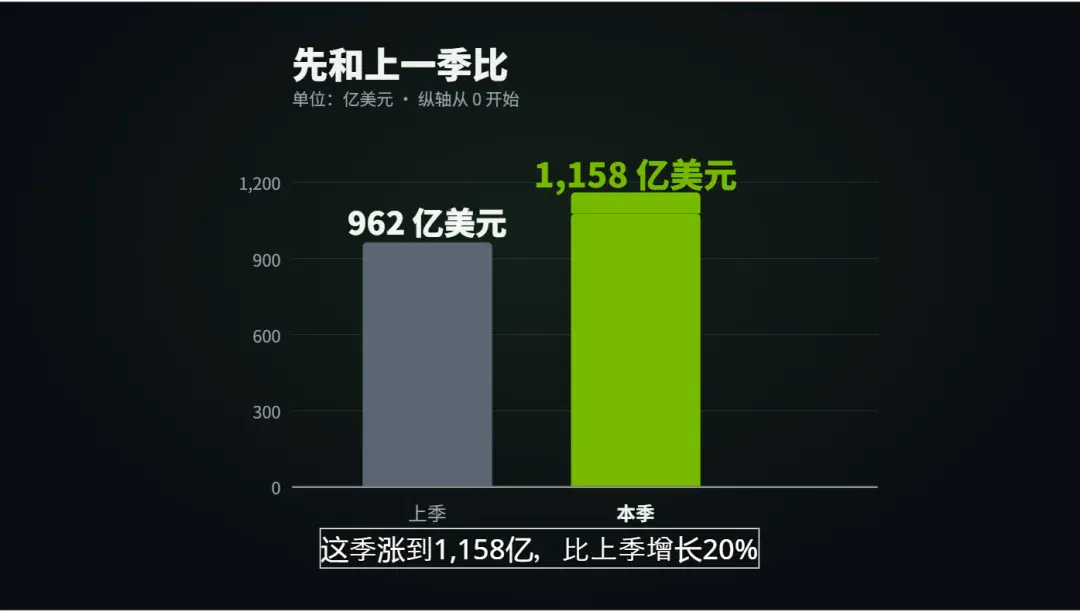
This example used NVIDIA’s fiscal 2027 third-quarter results to create a Chinese explainer answering two questions: how much revenue grew this quarter, and which businesses generated its US$115.8 billion. The first half used three bars to compare revenue a year earlier, in the preceding quarter and in the current quarter, labeling year-over-year growth of 103% and quarter-over-quarter growth of 20%. It then focused on the current-quarter bar and split it into data center and edge computing, highlighting that data center contributed about 93% of revenue.
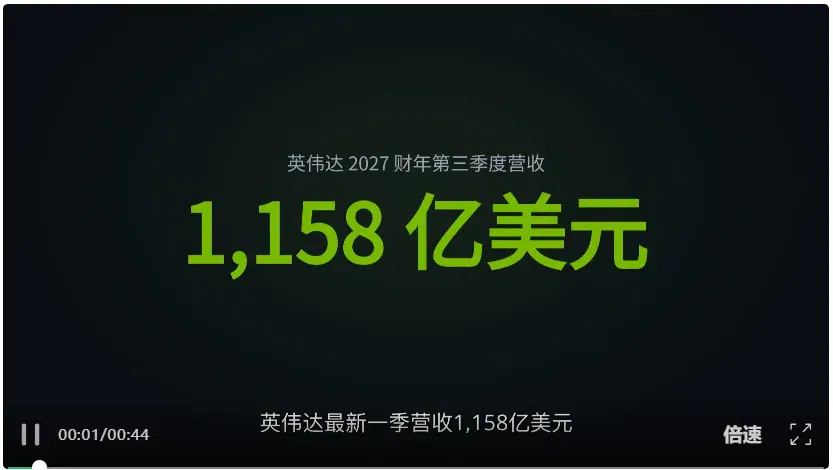
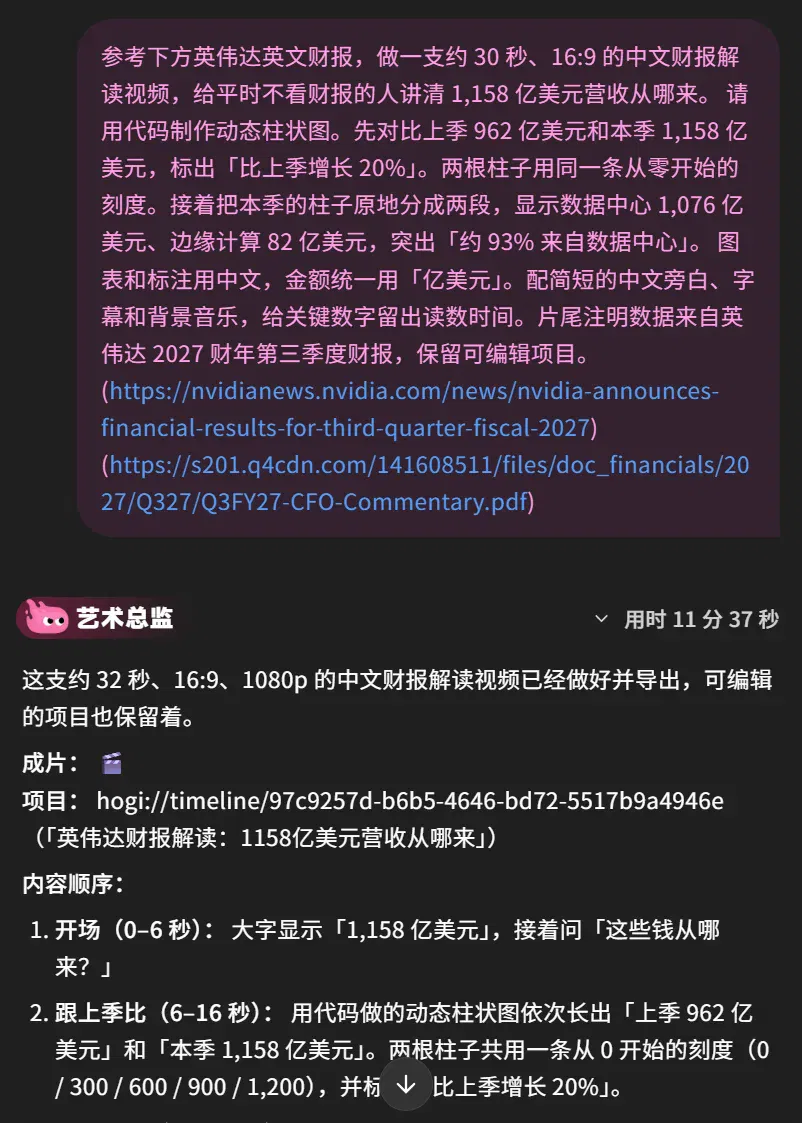
To produce it, the creator first supplied the English earnings-release link and checked figures to OiiOii Motion, requesting an approximately 30-second, 16:9 landscape video. Charts and labels were to be in Chinese, monetary amounts uniformly expressed in hundreds of millions of US dollars, and bars plotted on a shared zero-based scale. Chinese narration, subtitles and background music were included, with enough time to read key figures.
The initial request had two parts: compare the preceding quarter’s US$96.2 billion with the current quarter’s US$115.8 billion, then split the current-quarter bar in place into US$107.6 billion from data center and US$8.2 billion from edge computing.
The first version took 11 minutes 37 seconds to generate and ran about 32 seconds. It followed the initial request, showing quarter-over-quarter comparison and revenue composition. After review, the next revision added another reference point: revenue in the same quarter a year earlier. This let the video explain both the change between adjacent quarters and growth from the prior-year quarter.
The second round requested changes directly in the original project: add “same quarter last year” to the left of “previous quarter,” with US$57 billion in revenue; keep the same scale for all three bars and clearly label 103% year-over-year and 20% quarter-over-quarter growth. Subtitles and narration were to be updated together, allowing time to read the added number while leaving the revenue-composition animation in the second half unchanged.
This revision took 13 minutes 34 seconds. Motion added the third bar, regenerated the comparison segment’s narration and extended the video from about 32 to about 45 seconds. The revised content remained in the original project and was exported again.

▍From a poster’s first impression to a video’s first shot
Product promotion needs to explain two things at once: what the brand is and what the product does. Even with logos, screenshots and finished-product images ready, their sequence must be arranged and the feature explanations connected through a unified visual style.
A product promotion video in OiiOii Motion can start directly from existing assets such as brand logos, interface screenshots and finished-product images. The creator explains the selling points and desired style in natural language, and Motion uses code to arrange text, screenshots and animation, revealing the features progressively on screen.

An approximately 30-second video for sticker tool Tiezhi Miao used OiiOii Motion’s scrapbook-style collage animation. It began with orange paper and a cat-shaped logo, then spread out stickers featuring cats, foxes, penguins and other themes, interspersing product-interface shots to introduce sticker generation, splitting, editing and layout.
The title appeared on torn-edge paper, sticker samples moved with the scene, and interface screenshots accompanied feature explanations. From generating sets to separating individual stickers, adding white borders and text, and arranging and printing them, a continuous sequence illustrated the product’s uses, ending with the brand logo and product entry point.
This type of production can begin with existing screenshots, brand logos and product images. OiiOii Motion supports reference images or videos to indicate the desired style, followed by text descriptions arranging shots and motion. After generating an initial version, creators can continue adjusting copy, colors, clip order and pacing, gradually aligning product information with visual design.
A recent joint recruitment initiative by OiiOii and Guancha also invited creators to make company and product promotional videos with OiiOii Motion, offering applications for free computing resources.
▍The value of creative platforms beyond the models
Producing a complete video often requires several models working together. The article cites a16z’s The State of Generative Media 2026 as noting that a finished work typically involves multiple model calls, with one step’s output passed to the next. Visuals, dialogue, sound and post-production each need different processing, and applications must connect those steps.
OiiOii tries to bring model calls, asset organization and subsequent editing into one project, letting users proceed from an initial version through revision and delivery. As underlying models keep improving, the platform must integrate new capabilities smoothly while retaining users’ completed work for future editing.
This production approach broadens the range of projects an individual can try. Someone familiar with a topic and clear about what to communicate can first create an animated proposal, then ask design and editing professionals to refine it. Material that previously required production resources to be coordinated before work could begin may become concrete enough to discuss sooner.
Work within teams may also be redistributed. The article cites Adobe’s research on creative work as observing greater AI involvement in ideation, initial proposals and post-processing, while human work concentrates more on choosing direction, communication and responsibility for results. An animated draft gives content, design and editing colleagues something concrete to discuss; professionals still need to control narrative, visuals and delivery quality.
Continuously updated content also raises the relationship between projects and source files. One possible direction is to connect motion-graphics projects with documents and data. When source material changes, a tool could identify the visuals, subtitles and narration requiring revision and retain a change history. Doing so still requires determining which content is affected and whether the revised result matches the source files.
Access details and participation instructions are subject to official announcements: oiioii.tv
This article comes from Youxin Newin, written by Youxin Newin.
Related topics
After reading
Join the AINRK community
Read how to join the community and connect with people working in AI.
Related articles
Continue reading related topics and articles in this category.

爆肝实测四大国产AI神器!7大变态考题,逼出最野导演 (opens in a new tab)
这一周的AI视频圈,简直是神仙打架。 10月15日晚,可灵4.0全量上线,重点补强了大幅度动作和复杂运镜,单次原生生成最长拉到30秒。 全能参考也同步升级,还能组合最多15项参考素材、用10张关键帧控制画面,让人物、场景和镜头的安排更可控。 这里面最突出的特点,就是打戏这次补足了,来看效果。 另一边,有人把目标放在了长片上:给一句提示词,生成最长10分钟的完整成片。 10月21日凌晨,YC孵化的VideoGen发布首个视频模型Model 1。从剧本、对白到分镜,都交给AI规划,再生成、剪接成片;同时拿出100万美元免费额度,支持入选的创作者项目。 同一天,火山引擎上线Seedance Mana

Yoroll Launches Interactive Short-Drama Adaptation Tool; Guaranteed Deals Depend on Project Terms (opens in a new tab)
Yoroll adapts finished short dramas with branches, generated shots and compositing, illustrated by the 30-episode Clutch Time. Platform guarantees depend on tiers, exclusivity and other terms; one-click adaptation does not ensure a guarantee, reliable output or distribution income.

Siltok on local AI video workstations: Tiered inference, generation time and cost trade-offs (opens in a new tab)
Siltok says Token Station runs H3 by coordinating VRAM, RAM and SSD storage. Its internal test generates 5 seconds at 1344×768 with 20 sampling steps in under 8 minutes. The interview examines workstations starting above RMB20,000, cloud costs and payback conditions.
Dawa Technology discusses AI video's control layer: FilmOS production and Scenes AI interaction (opens in a new tab)
GeekPark interviews Dawa Technology CTO Zhu Ziwei and CPO Li Zongxing about Latent Stage, production-process data, FilmOS and Scenes AI. Local editing is said to reduce retries; revenue, cost and performance figures are company-reported, while future use cases remain plans.

Seedance 2.5 flash launches; Zhidx tests a 15-second cat parkour video (opens in a new tab)
ByteDance reports faster generation and lower prices. Zhidx tests shot transitions and text stability in a 480P clip, finding that some background signs still lose parts of their characters.