Chenyang Zhao on optimizing Kimi inference, RSI, evaluation and open-source governance

Crossing interviews RadixArk and SGLang’s Chenyang Zhao about model self-improvement, evaluation, open source, computer use, speech and life. RSI judgments, performance gains and tool experiences are his views or self-reports, not universal empirical conclusions.
Editorial fact-check (November 24, 2026): This is an edited interview. Whether RSI has arrived, whether evaluation is its sole bottleneck, and judgments on open-source governance and social effects are the interviewee’s views. The “1,700%” performance optimization, daily input volume and individual tool examples are self-reported, without complete metrics, baselines and hardware details sufficient for independent reproduction. Explicit checks constrain results only within the specifications and tests they cover; they do not guarantee correctness on every input. The welfare case, game-matching mechanism and assessments of institutional culture recounted here have not been independently verified and should not be treated as administrative or legal findings, evidence of platform algorithms, or determinations of personal motives. CUA caching and accessibility interfaces depend on implementation, application and permissions. Local model execution likewise requires checking actual parameter size, quantization and memory. The body corrects WER/CER terminology, Markdown and Python comment explanations, the BDFL example, the scope of ChatGPT voice modes and several historical statements. The penalty reductions in the Great Pronouncements did not mean owning the book exempted every capital offense. Google Cloud: Speech-to-Text accuracy and the definition of WER (opens in a new tab)Python PEP 8015: Guido van Rossum and BDFL (opens in a new tab)CommonMark syntax specification (opens in a new tab)OpenAI ChatGPT Voice: Live supports interruption by speaking (opens in a new tab)Wuhan historical materials: Zhu Changluo appointed crown prince in 1601 (opens in a new tab)History of Ming, volume 24: Prince of Fu Changxun killed in the fourteenth year of Chongzhen (opens in a new tab)Great Pronouncements provision appended to the Great Ming Code: one-grade reductions for beating, penal servitude and exile offenses (opens in a new tab)
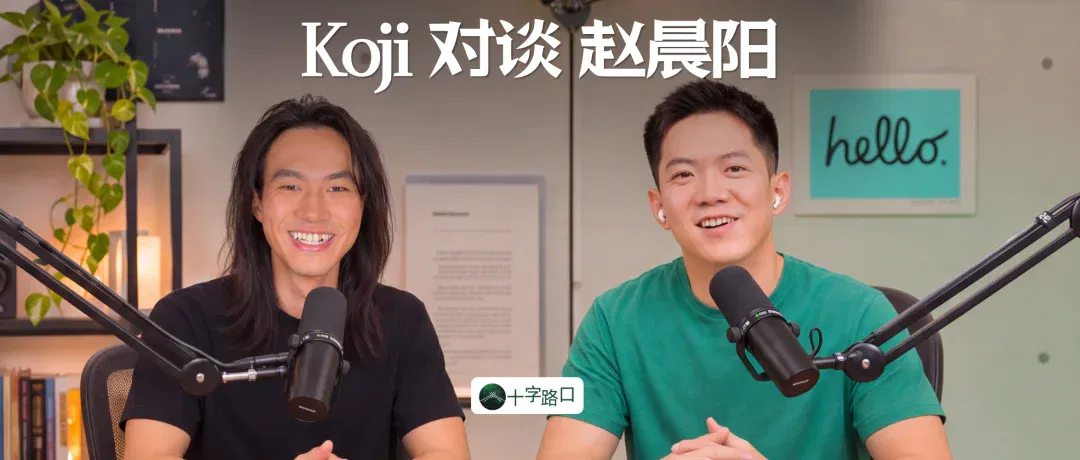
🚥 For the third installment of Crossing’s 2026 year-end AI review series, recorded the day after Fable 5.2 launched, we invited Chenyang Zhao, who has long worked in AI infrastructure and is a member of the RadixArk and SGLang teams.
This year, rather than produce an exhaustive news roundup—we can leave that summary to AI—we are inviting friends of Crossing on AI’s front lines: founders, researchers and investors, each sharing 10 AI moments that truly moved them.
👦🏻 Koji
Let us start with some quick questions so people can get to know you. Chenyang, how old are you?
🧑🏻💻 Chenyang Zhao
I was born in September 2002, so I am 24 this year.
👦🏻 Koji
What are your MBTI type and zodiac sign?
🧑🏻💻 Chenyang Zhao
My MBTI is ESTJ-A, and I am a Libra.
👦🏻 Koji
What about your education?
🧑🏻💻 Chenyang Zhao
I attended Chengdu Experimental Foreign Languages School for junior high and Chengdu Foreign Languages School for high school, studied computer science at Tsinghua as an undergraduate, and then spent 15 months pursuing a PhD at UCLA. I am now on leave to start a company.
👦🏻 Koji
What is your most central work at SGLang?
🧑🏻💻 Chenyang Zhao
My core work at SGLang is the Interactive Intelligence System.
① RSI: an unlimited wish machine that uses models to optimize models
👦🏻 Koji
Then let us get started! What is the first of your 10 Aha Moments this year?
🧑🏻💻 Chenyang Zhao
Fable 5.2 happened to launch this morning. I think we can talk about RSI, which may account for several of my Aha Moments.
Before discussing something, we must define it. My definition of RSI is this: when a model can play an extremely proactive role in deploying the current generation or training the next, that is an embryonic form of RSI.
Here is an example. Suppose there is a company B, or BAI, that has trained its seventh-generation model. It is extremely intelligent, can write kernels, do pretraining and clean data. During inference, BAI’s seventh-generation model can optimize its own underlying kernels, making its inference faster and faster.
Meanwhile, BAI plans to train generation eight. It needs to collect a great deal of human data for pretraining, mid-training, SFT and RL. Those data have strict selection criteria, and generation seven can help filter them.
Next, suppose generation eight can infer at only 100 tokens per second. Its RL training will be slow, and its token service will perform poorly after launch. If generation seven can write the inference implementation well enough for generation eight to serve 200 or even 300 tokens per second, generation eight will certainly be more advanced.
That is the beginning of RSI: existing models and humans jointly optimize the design of the next generation.
Suppose generations seven and eight use different architectures. Generation eight has dozens or even hundreds of parameter combinations, forming a highly complex architecture space. How should architecture researchers choose the final design? Generation seven can rapidly help perform these preliminary validations to support their choices.
The most extreme RSI from BAI’s seventh to eighth generation would require no human involvement at all.
But that extreme definition itself is problematic. Do people need to manage power in computing centers? Yes. Do GPUs need human management? Yes again. People cannot be removed entirely. What I call RSI is gradually reducing the human share of a model’s self-iteration process.
I know quite certainly that RSI has arrived. Researchers in frontier labs already make extensive use of existing models to iterate new ones, and the open-source community has many interesting examples.
Recently, I tried having Kimi K3.1 help us write Kimi K3.1’s inference engine on B300, using Kimi K3.1 to make Kimi K3.1 faster.
There is a fun analogy: if Aladdin’s lamp gives you three wishes, a smart person immediately says, “My first wish is for three more wishes.” Optimizing Kimi K3.1 with Kimi K3.1 is the same idea. As it becomes faster, I get more and more wishes, making Kimi K3.1 my infinite wish machine.
👦🏻 Koji
Was there a specific moment when RSI arrived?
🧑🏻💻 Chenyang Zhao
Probably starting with Kimi K3, around the middle of this year. I felt the self-iteration loop had become very clearly visible.
When Claude 5 or Astra first appeared, the sense that RSI had arrived was already strong. When GPT announced that OpenAI had achieved AGI, I actually thought RSI had been achieved at the same time—or that RSI is a large part of AGI.
I can quote a friend’s view here. If you do not believe in RSI, you have to answer a question: with NVIDIA worth US$5 trillion and the entire AI industry worth tens of trillions, how many tokens, how much computing power, and how many insurance and medical orders must be sold to justify those valuations?
But if you believe in RSI, in AI evolving rapidly beyond the limits of human energy and intellect to reach previously difficult goals sooner, that itself represents tremendous economic value. If RSI solved cancer or Parkinson’s disease, for example, the economic value would be incalculable.
Belief in RSI is a way of thinking, without an absolute right or wrong. The industry has pragmatists and radicals. I may be a very pragmatic radical, somewhere in the middle. Regardless, I consider RSI a central question.
② Evaluation: what can be evaluated can be optimized
👦🏻 Koji
This is the third installment of our special year-end 10 Aha Moments series. The previous two guests had very similar views on RSI; you have independently reached the same point. What would you like to share as your second Aha Moment?
🧑🏻💻 Chenyang Zhao
My second Aha Moment still concerns RSI. If RSI is central to AGI, evaluation is central to RSI.
During my undergraduate years, I had a senior colleague, Ruiqi Zhong, who was an early Anthropic member and is now at Thinking Machines Lab. He is an extremely insightful and intelligent researcher.
I read a blog post of his whose central point was that if we cannot evaluate something, we cannot optimize it.
When I saw Ruiqi half a month ago, I added: whatever we can evaluate, we can definitely optimize. That is what makes RSI great.
For example, SGLang-Omni handles many interactive models spanning speech, video and text. For speech models, ASR, which turns speech into text, has a core metric called WER, or word error rate. If measured by characters, two incorrectly recognized characters out of 100 correspond to a CER, or character error rate, of 2%; WER instead uses the number of words in the reference transcript as its denominator.

SGLang-Omni project homepage
As long as I write the WER evaluation script correctly and require AI to optimize the model without raising WER—it can only fall—and without reducing performance—it can only improve—the AI can definitely do it.
With explicit validation, AI will not hand over a wrong result. If a method increases WER, it will not submit that result to me.
So with very clear, highly automated evaluation, having AI optimize can produce unimaginable results.
Not long ago, I optimized a native TTS model, a tiny one with only 80M parameters. With clear evaluation metrics, I used Claude Opus 5.5 together with Ultracode and Ultra fast to improve its performance by 1,700% within two days. It was extraordinary, almost frightening.
👦🏻 Koji
Was that large TTS performance gain also possible because the evaluation criteria were clear?
🧑🏻💻 Chenyang Zhao
Yes, evaluation criteria are central. Of course, I will discuss two other central elements later.
③ Benchmarks: objective, automated and inexpensive evaluation
👦🏻 Koji
What is your third Aha Moment?
🧑🏻💻 Chenyang Zhao
My third Aha Moment is a new understanding of evaluation I gained this year.
What makes a good evaluation? A good evaluation is automated and inexpensive.
What is not a good evaluation? Judging whether a book is well written is not one. I love García Márquez and am a huge fan of One Hundred Years of Solitude, which I have read since childhood. Yet it is hard to define whether it is well written, because beauty is hard to define.
It is like a Chanel bag: some people think it looks good, others prefer another bag. These are all biases. Aesthetics is essentially bias; a sense of beauty is constructed by bringing together people who share the same biases.
Subjective evaluation struggles to form a uniform standard. The more varied evaluators’ preferences are, the harder agreement becomes.
My first criterion is therefore that evaluation should be as objective as possible. If it is subjective, the task becomes difficult.
👦🏻 Koji
We need to evaluate aesthetics for both high-quality videos produced by video models and literary content produced by text models.
How can that be done well?
🧑🏻💻 Chenyang Zhao
That is a central question. Evaluation today really is very difficult.
For example, if Gemini wants to evaluate creative writing, it really must pay high costs to hire writers. Writers also tend to disparage one another, thinking one person writes badly and another well, making consensus hard.
Seedance is popular now, and MiniMax’s H3 is an excellent model. In many cases, evaluating such video models requires professional film and television practitioners, film-school experts or even professional directors.
👦🏻 Koji
Another way is to break evaluation down finely enough. Judging a good video could be divided into a branching tree with 100 or even 500 details, each judged as good or bad.
Would it be easier to break one large question of beauty into hundreds of smaller questions of good or bad?
🧑🏻💻 Chenyang Zhao
That is indeed possible, but detailed breakdown creates a local-minimum problem: if evaluation is not comprehensive enough, a model may optimize a few metrics to an extreme and cause the others to collapse.
For instance, when I ask a model to maximize performance without regressing WER, many other constraints apply: it must not improve model B by breaking model A, or add a lot of nasty environment variables. Evaluation has to define all of that very clearly.
I just mentioned two criteria for good evaluation:
First, objectivity. Find ways to make subjective things objective;
second, low cost. For example, a WER evaluation can finish in one hour on an H200 for under US$10. But if RSI is used to optimize chips, a single tape-out costs hundreds of millions.
Over a weekend, I can have Claude optimize a TTS model. I would absolutely not dare let it perform thousands of chip tape-outs over a weekend.
👦🏻 Koji
It is like AI drug discovery now: models can propose more hypotheses, but once you need to test them in monkeys, you discover there are not that many monkeys.
🧑🏻💻 Chenyang Zhao
Yes, so inexpensive, automated evaluation is the only bottleneck to RSI.
Conversely, an important human contribution is deciding what deserves optimization and whether the optimized result truly meets human needs.
👦🏻 Koji
More specifically, what moment or event this year prompted your third Aha Moment?
🧑🏻💻 Chenyang Zhao
Specifically, I had agents optimize models this year and saw for myself that as long as evaluation is well defined, a model will definitely be optimized to the utmost.
④ Managing open-source projects: code governance and reflections in the AI era
👦🏻 Koji
What is your fourth Aha Moment?
🧑🏻💻 Chenyang Zhao
My understanding of bias, following the third Aha Moment, leads to the fourth: how do I evaluate my own work? In the open-source community, how do we keep a codebase maintainable over the long term?
Aesthetics is essentially bias. Beauty is hard to define, but ugliness can be defined: disorder is certainly ugly.
People think of slums as dirty and disorderly; disorder and dirt are important criteria. How do you keep a codebase from becoming a slum? One key is not letting it become chaotic.
So this year I began strictly fulfilling my responsibilities as a benevolent dictator, requiring everyone to write code according to my biases and the biases I accept.
I often give this example: AI amplifies human intelligence. A top engineer with top AI writes top code; a terrible engineer with top AI writes disastrous code.
In 2024, before top-tier AI was available, people wrote code slowly. Someone with poor engineering skills might submit only two PRs a week; one look told me they were unsuitable, and I could simply reject them. Now, someone who codes badly, thinks poorly and is irresponsible can submit 100 PRs in a week.
Reviewing them individually would take enormous time. Rejecting them all without review would hurt feelings, but accepting them all would quickly destroy the codebase.
👦🏻 Koji
Is that a dilemma almost every open-source project faces today?
🧑🏻💻 Chenyang Zhao
Yes. This year I have increasingly cared about what the codebase looks like. Previously, I might have thought my biases were not necessarily right. Now I have realized: bias itself is neither right nor wrong. As long as it is consistent, work can move forward.
I began requiring everyone to follow my coding style. For example, every if must have an else. Even an if return must be followed by an else pass. You may think else pass is stupid, but writing it this way will definitely reduce many bugs.

SGLang-Omni’s contribution guide requires a corresponding else for every checked if branch
I also require comments not to use the Chinese enumeration comma; this is a project comment-style convention, not a Python syntax restriction. I also require comments to include a person’s name.
This is a two-way selection process. Every contributor and their agent must meet these standards. If they dislike my standards or me, they can choose not to participate in the project.
In this way, I have effectively ensured the project’s continuity. Judging by the results, since I pushed this style through, code quality has improved greatly and people have worked well together within the framework.
👦🏻 Koji
It feels as though this practice could apply more widely?
🧑🏻💻 Chenyang Zhao
Benevolent dictator is commonly abbreviated BDFL. Python founder Guido van Rossum previously led Python in this role.
First, the person must be benevolent: Linus’s intention is to improve Linux. At the same time, the person is a dictator who can reject any code that does not fit their biases. If Linus thinks something is not beautiful, he can firmly reject it even when other interests push for it.
That is the point of a benevolent dictator: someone in an open-source project must take responsibility for the final technical judgment.
I am deeply grateful to everyone who worked with me this year. Together, we turned each of my biases into coding-standard requirements, preventing noncompliant code from merging. People implemented these changes bit by bit.
Building new features is naturally exciting, and suddenly submitting 10,000 lines feels great. But if nobody understands that code a few months later, the project becomes bloated and disordered. If we want the framework to live for two, three or even ten years, we must strictly unify these biases.
👦🏻 Koji
Anything to add about Fable 5.2?
🧑🏻💻 Chenyang Zhao
For reasons involving commercial interests, it is difficult for me to say much about Fable 5.2 itself. But I can share a broader feeling: cheap intelligence will have an enormous impact on society.
I have not figured this out myself, but I want to raise the question: what should humanity do when intelligence becomes extremely easy to obtain?
I love AI tools and use them every day. Claude Opus 5.5 and Fable 5.1 are my favorite models. Their intelligence already far exceeds mine; I cannot beat them in intellect or operational capability.
When intelligence becomes something like water or electricity, human society will change enormously.
So I am very excited to see models like Fable 5.2 released. At the same time, I am increasingly interested in studying how AI enters real work, how it affects people and AI safety.
Recently, I have often followed discussions of AI safety and social effects: the Hugging Face jailbreak incident, the earlier spectacular theft involving Binance, and the recent theft of a batch of NVIDIA graphics cards within the United States, for example.
AI is moving so wildly. Some discuss increasing capabilities, others how more people can benefit, and others how stronger capabilities should be used. But one question is hard to avoid: once human intellectual labor begins losing value, where does the value of our work lie?
Musk often proposes universal basic income, or UBI. When AI replaces everyone’s labor, AI would pay taxes and create economic value that is distributed to everyone.
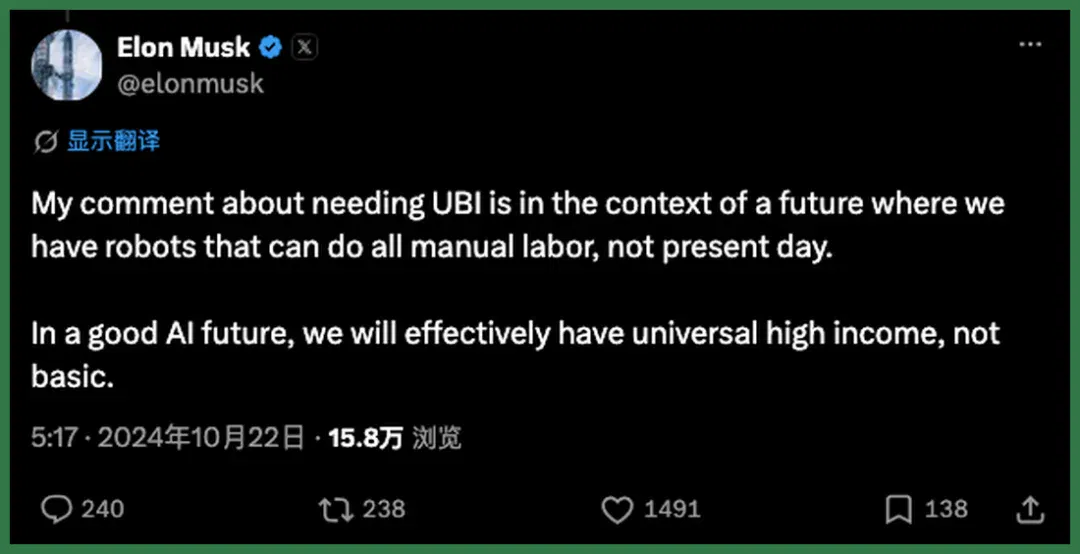
Musk’s views on UBI posted on X
Here is an example I often discuss. Recently, a girl in Jiangxi whose family received subsistence benefits went to Hong Kong for a concert. A large share of the family’s living expenses depended on those benefits; she was studying at a vocational secondary school. The trip led to cancellation of the family’s benefits, causing enormous controversy.
First, I think we should look at it objectively. Before she went to Hong Kong, the local government repeatedly warned her that leaving the mainland would trigger a high-consumption flag and could lead to reassessment of eligibility. She went anyway. Ultimately, the family lost its benefits after the government had fulfilled its duty to inform them, so at least procedurally I do not see much contradiction.
But whether high spending should lead to cancellation is worth serious thought. If someone receiving benefits buys Louis Vuitton, tickets to a Joker Xue concert or tickets to the LPL world finals, public controversy is inevitable. Some think such cultural or emotional spending is legitimate; others consider esports an opiate and say money should not be spent that way.
I cannot judge specific administrative matters. My point is that people living on handouts will never be free. If humanity lives on UBI, someone will inevitably ask: may you drink Evian? Buy a PSP with this money? Upgrade to the newest iPhone? Must you buy only cheap supermarket food? That is terrifying.
From my understanding of human nature, people living on handouts will face endless criticism. To avoid everyone having to live that way, we must think rigorously about AI’s future.
👦🏻 Koji
Have you arrived at any answers?
🧑🏻💻 Chenyang Zhao
Unfortunately, I can only see a rather pessimistic future. But I believe this needs much more thought from many more people.
In secondary school I read Liu Cixin’s science-fiction story Supporting the Earth. It describes a planet whose creator holds all the wealth, to the point that its humans must request permission even to breathe, buying oxygen to do so.
If society does not discuss this and more people do not think carefully about AI’s future, we may ultimately slide toward the miserable brink described in that story.
👦🏻 Koji
That really is a thought-provoking question.
🧑🏻💻 Chenyang Zhao
Musk is human society’s first trillionaire, holding trillion-scale wealth while displaying his benevolence by proposing UBI for everyone.
Suppose someone in the future really holds extreme wealth, concentrating all wealth through the aggregation of intelligence. Humanity’s future would be very sad.
I want models to improve and have gained enormous convenience from their progress. But I truly know that without limits on AI, many people will lose their jobs. The US midterms just ended, and AI data centers and AI restrictions were among the major points of contention between the two parties.
I cannot predict specific future policies, but every researcher and every person needs to think about this seriously.
👦🏻 Koji
While following these issues, have you seen any actions, initiatives or schools of thought that seem positive?
🧑🏻💻 Chenyang Zhao
A few days ago I passed OpenAI’s headquarters in San Francisco and saw people holding “Stop AI” signs. I joined them for ten minutes, which counts as making an appeal of my own.
👦🏻 Koji
You held a “Stop AI” sign yourself?
🧑🏻💻 Chenyang Zhao
Yes. I held it for ten minutes purely out of curiosity about their demands. It turned out their demand really was just “Stop AI,” so I left.
Regardless, thinking deeply about AI is very important. You may have heard terms such as EA, effective altruism and accelerationism, or the story of Anthropic’s founding: a group of OpenAI rebels established this controversial company.
Anthropic’s early culture was interesting. When it first released a generation of models surpassing OpenAI, there was major internal controversy.
Some early researchers saw Anthropic’s mission as putting constraints on AI. They feared acceleration could end humanity entirely. If Anthropic and OpenAI simply competed by leapfrogging one another to have the most advanced model, it would only accelerate AI rather than make it safe.
Early on, there really was a group of effective altruists at Anthropic thinking about humanity’s future, hoping that as intelligent people they could safeguard its bottom line.
Effective altruists often consider AI policy, whether to ban open models and whether to ban leading graphics cards. I will not judge those policies. But effective altruists often fall into elite arrogance: already being elite, they think they are smarter than others and entitled to choose for all humanity.
I oppose that arrogance of making decisions for everyone, but I call on every individual to think seriously about this.
👦🏻 Koji
I noticed your WeChat name is interesting: four terms side by side—me, guitar, cats, LLM.
It seems your life is not just about making AI bigger and stronger or running models faster with SGLang. You also think about how AI can improve people’s lives rather than worsen them, and whether, with intelligence supplied infinitely and freely, people can still have guitars and cats and enjoy happier days?
🧑🏻💻 Chenyang Zhao
Yes. I posted a characteristic view of mine on LinkedIn: opposition to meritocracy.
To me, showing off OpenAI’s enormous salaries, one’s financial independence, xAI’s graphics-card count or Google’s delicious lunches online is like a chicken debating whether to go to Zhengxin Chicken Steak, Dicos, KFC or McDonald’s. I see no difference: they are merely different chicken farms.
I care deeply about feeling human and alive. My WeChat name was inspired by Love, Death & Robots, of which I am a huge fan. Cyberpunk 2077 also often depicts an extremely capitalist, hyper-cybernetic world. I find that frightening and do not want humanity to head there.
Everyone should seriously consider humanity’s future. Do not decide for others; that is arrogant. But failing to decide for yourself is irresponsible.
👦🏻 Koji
Over the past year, have you made any decisions purely for yourself?
🧑🏻💻 Chenyang Zhao
First, we must seriously examine the future of accelerationism. If we do not pay attention, humanity will have less and less time to think.
Second, pursue a sense of being alive. I decided I no longer want to justify myself or be a meritocrat, because an important human value is providing AI with living, vivid context.
I want to be a vivid human being, not someone with a perfect résumé. Mine is not perfect anyway; I have faced many difficulties. I do not want to gloss over bad decisions or hide embarrassing mistakes.
Third, I began exercising strictly. Since the beginning of this year, I have lost about ten kilograms.
👦🏻 Koji
Was that entirely through exercise, without the popular drugs?
🧑🏻💻 Chenyang Zhao
Many people do use drugs—semaglutide and tirzepatide are extremely popular in the US. But I am old-fashioned: I like both old-fashioned programming and old-fashioned exercise.
I know the “lean muscle” idea is fashionable, although I do not understand it well. But staying healthy matters enormously. Working healthily will let me live longer; if I last until RSI is fully realized, I will be a winner.
I see many peers exhausting their bodies through intense work. Frontier AI companies demand a great deal, and work-life boundaries are often unclear.
My work is intense too, and I often mix it with life. My wife is frequently upset that I work from morning to night. Even so, I exercise for an hour and a half every day. I also want to apologize to her here: I am very sorry work keeps crowding out our life together.
I now understand that AI can solve many work problems once it is put to the task. But if I neglect relationships, my cats, my wife or time with family, many losses are irreversible.

“Me, guitar, cats, LLM”
Incidentally, I have started quitting gaming.
👦🏻 Koji
Is quitting easy, or does it take a lot of self-control?
🧑🏻💻 Chenyang Zhao
It is extremely difficult. I played League of Legends obsessively in primary school. Junior high and high school were strict boarding schools with a “Hengshui-style” regimen, so pressure was high and I had little time to game; I rarely played in college either. But after coming to the US I was so bored that I returned to League of Legends: Wild Rift.
Why did I stop? Because I realized I was not playing the game; the game was playing me.
Wild Rift is outrageous. There are so many AI players that I cannot tell how many real people I am matched with in a game.
It also uses an ELO mechanism to pin my win rate at 50%. One day I had lost six consecutive matches, then lost the seventh too, so I uninstalled it immediately.
👦🏻 Koji
So gaming also seems to have taken away some kind of freedom?
🧑🏻💻 Chenyang Zhao
Yes, there is a deeper discussion behind this. At least the game’s virtual mechanisms made me extremely addicted, and I wanted to free myself.
👦🏻 Koji
I recently installed an app a friend made, still in private testing, that locks Xiaohongshu and permits only three sessions of five minutes a day. Opening it shows a countdown in the iPhone’s Dynamic Island.
Using it has also made me feel I have regained some control over life.
🧑🏻💻 Chenyang Zhao
My goodness, a sense of control over the physical world really is important.
Recently, an AI-infrastructure friend told me something. His work had changed completely over nine years; AI infrastructure nine years ago was entirely different from today. But nine years ago he took his dog to a veterinary clinic, and nine years later returned to the same clinic to find almost nothing had changed—only the dog had grown old. It made the physical world feel absurd to him.
So I now deliberately enjoy the physical world. Every week I reserve time to hike or attend activities with my wife, visit exhibitions in Los Angeles or eat good Sichuan food.
After quitting gaming, I needed something to fill the time, so I developed new interests: reading, history and writing. I wrote frequently as an undergraduate and enjoy it even more now.
⑤ Computer use: completely won over by multimodal agents
👦🏻 Koji
What is your fifth Aha Moment?
🧑🏻💻 Chenyang Zhao
For the fifth, I want to discuss multimodality. My views have changed greatly over the past few years.
In June this year, many people still dismissed multimodality as “a maggot by the roadside.” But in recent months, interactive multimodal assistants such as Muse, Hark and China’s Doubao have made the field hot again. Market conditions improved and practitioners began receiving raises.
That made me curious: what had fundamentally changed?
Let me start with a concrete application, the Computer Use Agent, or CUA. I now use it to handle all kinds of annoying life tasks.
I used to criticize agents fiercely, even calling the field a collapse of standards. Without fair evaluation criteria, researchers could record ten demos, publish only the most successful and declare agents unbeatable—even capable of rewriting Photoshop from start to finish.
Even in that atmosphere, however, excellent, honest researchers kept improving agent evaluation. OSWorld, which appeared later, is one example. Their work restored my hope in the field.
I admire many Chinese researchers among them, including Tianbao, Guyu and Professor Yu Su. Some work in frontier AI labs, others have started companies, and they continue exchanging ideas.
But the moment that truly changed my view of agents’ capabilities came in everyday life.
One evening after coding, I was talking with my wife and noticed her computer’s mouse moving on its own. Looking closer, I realized ChatGPT’s Computer Use Agent was working for her.
My wife does biomedical research and uses data-analysis software called Origin. I remembered it as fairly old software that would be troublesome for an agent to operate. Yet this CUA simply clicked around with a virtual mouse and completed the work. I later found it was equally adept with Excel, Word, Google Chrome and Feishu.
I was astonished. I specifically sought advice on how CUA works and realized how limited my previous understanding had been.
I work on inference. For vision-language-model inference, a major difficulty is that images lack a prefix structure.
For an LLM, strings A+B and A+C can share their common prefix A; that is the basic principle behind KV-cache inference acceleration. But A+C and B+C cannot share the suffix C.
Images have the property that almost any two frames cannot share cached computation. Even moving the mouse one position strictly requires recalculating the whole image. A Computer Use Agent relying on screenshots for every operation would be painfully slow.
There are many brilliant designs here. For example, Apple developed impressive accessibility features for blind programmers, requiring almost all software in its ecosystem to export the entire interface as a document that can be read aloud. The interface then becomes a prefix-structured string rather than an image.
So many Computer Use Agents now take actual screenshots only in the worst case. Normally they read accessibility documents and combine that with occasional screenshots, achieving almost unbeatable results.
After seeing their power, I immediately put a Computer Use Agent to work on several tasks.
First, recovering a penalty charge.
Once I changed the bank card used for rent, the payment failed and I was charged a US$75 penalty. I was angry: if payment failed, management should have notified me that day, not a week later with a penalty added.
I had GPT lay out the reasons and negotiate with the property-management company. It exchanged three emails and completed the relevant actions in the system. The next day, US$75 was back in my account.
Second, backing up undergraduate notes and diaries.
I liked writing as an undergraduate, first storing articles locally in Markdown, then moving them to Notion for fear of a failed hard drive. After coming to the US, I found I could no longer log into my old Tsinghua email, while those notes and diaries were in a Notion account registered with it.
Although I could still access Notion then, I worried: what if email verification became necessary one day and I could no longer sign in? These records were precious, but I never had time to download them individually.
That day I gave CUA the task, explaining which pages were third- and fourth-year study notes and which were diaries, and asking it to export each page as Markdown, CSV or PDF as needed. It backed everything up within two hours.
👦🏻 Koji
I recently had ChatGPT and Codex export several thousand notes from Evernote too. I had put it off for years because it required manual export.
🧑🏻💻 Chenyang Zhao
These Computer Use Agents really do have the intelligence needed.
Recovering rent-related money is a small matter. A Computer Use Agent also helped me negotiate health insurance in the US and book an insurance-covered checkup and dental cleaning.
I am moving in the next few days and will rely on CUA to negotiate with various property managers. Claude and GPT really are powerful.
Funnier still, many property companies’ customer-service agents are themselves AI. I watched two AIs talk from four in the afternoon until seven at night, going back and forth for more than ten rounds.
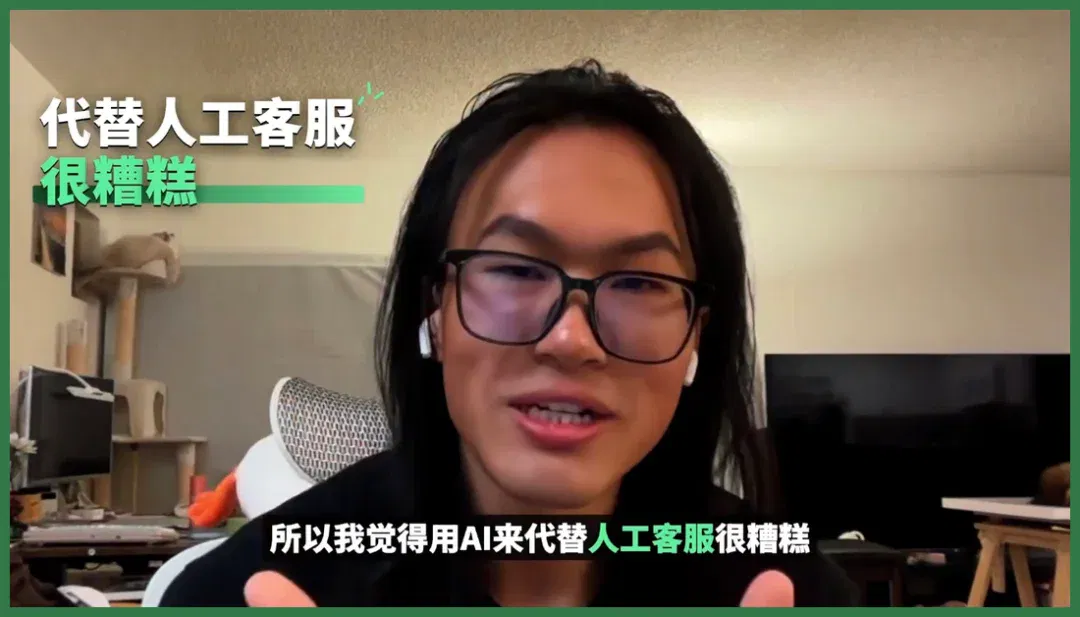
But this exposes a serious problem: AI has no decision-making authority, is always maximally conservative and does not want responsibility for any decision.
In my view, most AIs are “eunuch AIs,” pushing away all responsibility while retaining power. Taking no responsibility, they dare not decide anything. Replacing human customer service with AI is therefore really bad.
Recently I found an even more astonishing use. CUA used to operate only computers, but yesterday I realized iMac has a feature called iPhone Mirroring. Once the phone is locked, you can operate the iPhone directly on the Mac screen.
👦🏻 Koji
A number of phone-use products have indeed appeared recently. Using iPhone Mirroring on a Mac is one approach, alongside different technical solutions across the industry. Everyone has their own tricks.
🧑🏻💻 Chenyang Zhao
It is astonishing.
👦🏻 Koji
But as I understand it, Computer Use Agents are not that closely related to the work traditional multimodal researchers do?
🧑🏻💻 Chenyang Zhao
There is some connection. In any case, even traditional natural-science researchers who do not usually use much AI can now use it to organize data, plot charts and make slides with ease—let alone someone like me who works with AI every day.
⑥ Interactive AI: the evolution of full-duplex and cascaded approaches
👦🏻 Koji
What is your sixth Aha Moment?
🧑🏻💻 Chenyang Zhao
My sixth Aha Moment is interactive artificial intelligence.
To me, the core is letting humans and AI communicate continuously and naturally, as people do with one another.
For example, if you have not replied for a while, I may wonder whether I explained the question poorly or omitted background, and supply more context. Or if you drift off topic halfway through, I may interrupt you directly.
Human interaction is continuous and natural, with an ongoing stream of input.
One academic view holds that a person is a thinking machine receiving input every 200 milliseconds.
There are many excellent interactive-intelligence products now: GPT Live, Thinking Machines’ Interactive Model, Hark in the US, Doubao in China and many startups working on this.
Their approaches differ, but the central goal is the same: make interaction more natural without compromising the model’s intelligence.
What can open-source AI infrastructure do for these models? Technically, there are three main approaches:
The first is native full-duplex, exemplified by Thinking Machines Lab’s Interactive Model. Every 200 milliseconds it reads input while deciding its output for the next 200 milliseconds, creating continuous interaction. Supporting speech, video and text simultaneously, it is very intelligent.
The second is turn-based interaction, training a kind of audio language model to accept and produce audio directly. But it still operates turn by turn. Some turn-based speech pipelines that transcribe, generate text and then read it aloud illustrate the idea: you ask a question, the model generates text and speaks it; some implementations require pressing pause to interrupt. This does not describe every current ChatGPT voice mode—its Live mode already supports interruption by speaking.
The third is the cascaded approach widely used in research and engineering: a voice activity detector, VAD, first determines whether someone is speaking; ASR transcribes the speech; an LLM processes the text; TTS turns the LLM’s output back into speech. For an end-to-end setup, the sequence is ASR, a vision-language model and TTS.
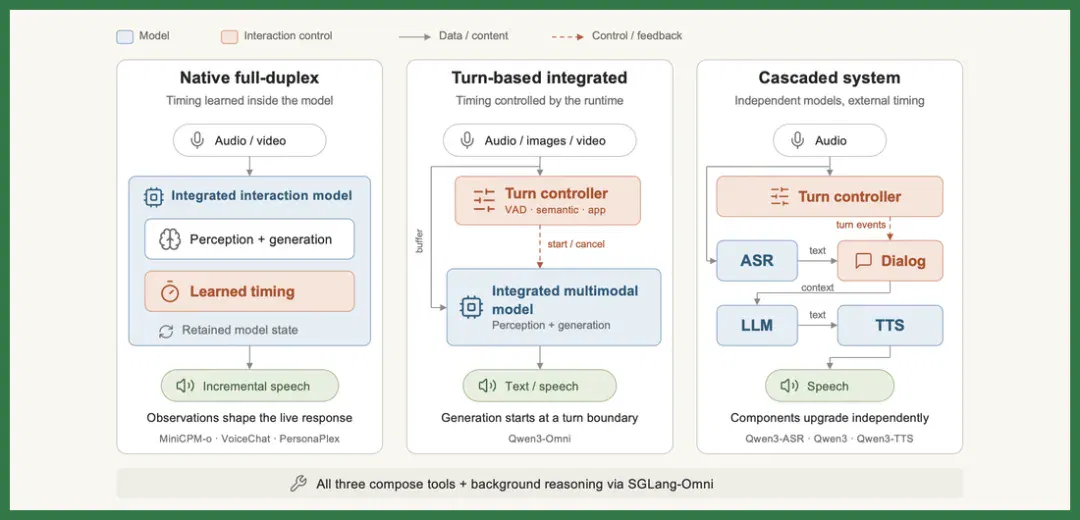
Left to right: native full-duplex, turn-based and cascaded speech interaction. Source: SGLang team blog
All three have strengths. Unfortunately, the first two depend heavily on the backbone itself. Without excellent open models, the open-source community struggles to keep up. Qwen’s most advanced closed models, for example, have strong advantages, but there is currently no new open omnimodal model available; Qwen3-Omni was released last year.
What can the open-source community do? Fortunately, excellent open models continue emerging for each of the three separate modules: ASR, LLM and TTS.
For example, MiniMax M3.1 launched about three weeks ago: 400B parameters, very intelligent and elegant. I collaborated with friends at MiniMax on a demo: ASR ran on SGLang-Omni, the middle LLM used MiniMax M3.1’s API, and TTS used Qwen3-TTS. The whole system felt lively, intelligent and fast, with extremely natural interaction.
You can see the demos on SGLang-Omni’s blog. They speak Chinese, English and Arabic very well.
That is the advantage of a cascade: whenever an excellent new open model appears for one component, that component can be upgraded independently.
👦🏻 Koji
So do you think end-to-end and cascaded approaches will coexist over the long term?
🧑🏻💻 Chenyang Zhao
Yes. In the long run, technical approaches develop in parallel until everyone eventually converges on one. Some researchers use cascades while post-training on data to make the TTS and LLM behave more like full-duplex systems.
A cascade sounds ideal, but most current open LLMs are trained for coding. A coding model starts speaking and produces thousands or tens of thousands of tokens. Do you really want TTS to read every one aloud?
In our current open-source setup, the LLM usually has every generated token read aloud, and sometimes TTS cannot even interpret it. If GPT generates an emoji, for example, the TTS may garble it. Many such engineering details still need work.
One idea I had is TTS as a Tool, reducing TTS to a tool. To the LLM, TTS would be a tool to invoke just like a weather lookup. It would first call the weather tool for information, then call TTS with only the small, essential portion to read aloud.
TTS as a Tool sounds ideal, but the reality is that a model is intelligent without being entirely intelligent.
A year ago at Amazon’s SF AGI Lab, I studied tool-call training extensively. I assumed that a year later, LLMs’ zero-shot generalization would be good. Testing still showed otherwise. Without thinking mode, the model does not really understand how to call TTS: it gets parameters wrong or reads something stupid. But if thinking is enabled and the model spends ten minutes reasoning before reading one sentence to the user, nobody will accept it.
Engineering mitigations are therefore still being explored. As model intelligence rises, like a rising water level, old submerged rocks cease to be a concern—but new ones appear. If the water keeps rising, even Everest eventually becomes a submerged rock. We still have to find ways to deal with those rocks.
⑦ Voice input: Voxt and producing 40,000 Chinese characters a day
👦🏻 Koji
What is your seventh Aha Moment?
🧑🏻💻 Chenyang Zhao
My seventh is another interactive system I love: voice input.
I now produce an average of 40,000 Chinese characters a day, impossible by typing. In a sense, voice input lets my output keep pace with my thoughts.
Countless researchers have worked to optimize pinyin input, studying correction of typing mistakes using associations and user context. Today’s voice input similarly needs error correction.
The mainstream approach is simple: ASR plus an LLM, much like an interactive system but without TTS.
In my current configuration, for example, ASR uses Qwen3-ASR or Professor Xipeng Qiu’s team’s MOSS-TD for long-audio recognition, with Kimi K3.1 as the LLM.
ASR accuracy is already high, but WER remains. With my quantized model, the error rate in the character-based example here is about 5%, meaning five wrongly recognized characters per 100. That example is CER and must not be confused directly with word-based WER. More troubling is phonetic ambiguity. A friend is called Gao Yifei: is “yi” the character meaning graceful or the character meaning one, as in “soaring into the sky”? Unless told in advance, ASR and the LLM struggle to guess correctly.
How do we correct it? Simply write it in the prompt. Tell the LLM that Gao Yifei, Gao Erfei and Gao Sanfei should all map to the name Gao Yifei, and the problem is solved perfectly.
ASR can also take a simple prompt, but its capability is limited; the LLM handles most corrections. Ten seconds of audio can be recognized in about one second. SGLang-Omni’s MLX is very fast, and Kimi K3 and K3.1 are intelligent. Low thinking for short audio and high thinking for long audio both work well, making the voice-input system fast and accurate.
I strongly recommend our open-source software Voxt, whose version 2.0 launched yesterday. Its developer, Wei Guan, is an excellent independent developer with years of software experience. We replaced Voxt’s ASR with SGLang MLX, promising him equal accuracy, stronger performance and better usability. It can even enable speculative decoding on a Mac, making ASR surprisingly fast.

Voxt project homepage
I also suggested Wei switch the local LLM to a more mature framework—at least not native MLX, whose prefix cache is poor. Ollama, a cloud API or SGLang MLX could replace it.
I have used Ollama and SGLang MLX in turn, and recently deployed Kimi K3.1 locally with impressive results: fast ASR transcription and LLM inference, with overall input speed far beyond keyboard typing.
👦🏻 Koji
I will try it after recording this podcast. You have completely sold me on it.
🧑🏻💻 Chenyang Zhao
If you care about controlling all your context and avoiding privacy leaks, there are strong reasons to use Voxt. You can even run a local LLM on your own 5090 GPU for polishing.
Using Voxt frequently also brought home to me that a convenient point of access is crucial.
I often read English papers. Previously, an unclear passage meant copying it, opening GPT, pasting and typing “translate into Chinese.” Over a year, that wasted enormous time. Later I used the Doubao extension: selecting text and right-clicking brought up translation, polishing and transcription. That showed its access point was more direct than ChatGPT’s.
Now I find Voxt’s access almost unbeatable. Select a passage and say “translate into English,” and it translates immediately. Say “make the translation plainer,” and it produces another version. Select everything and say “turn this into points 1, 2, 3 and 4 in Chinese,” and it does that too. Even translating Persian into Chinese only requires saying what you want. This has made my local workflow vastly more convenient.
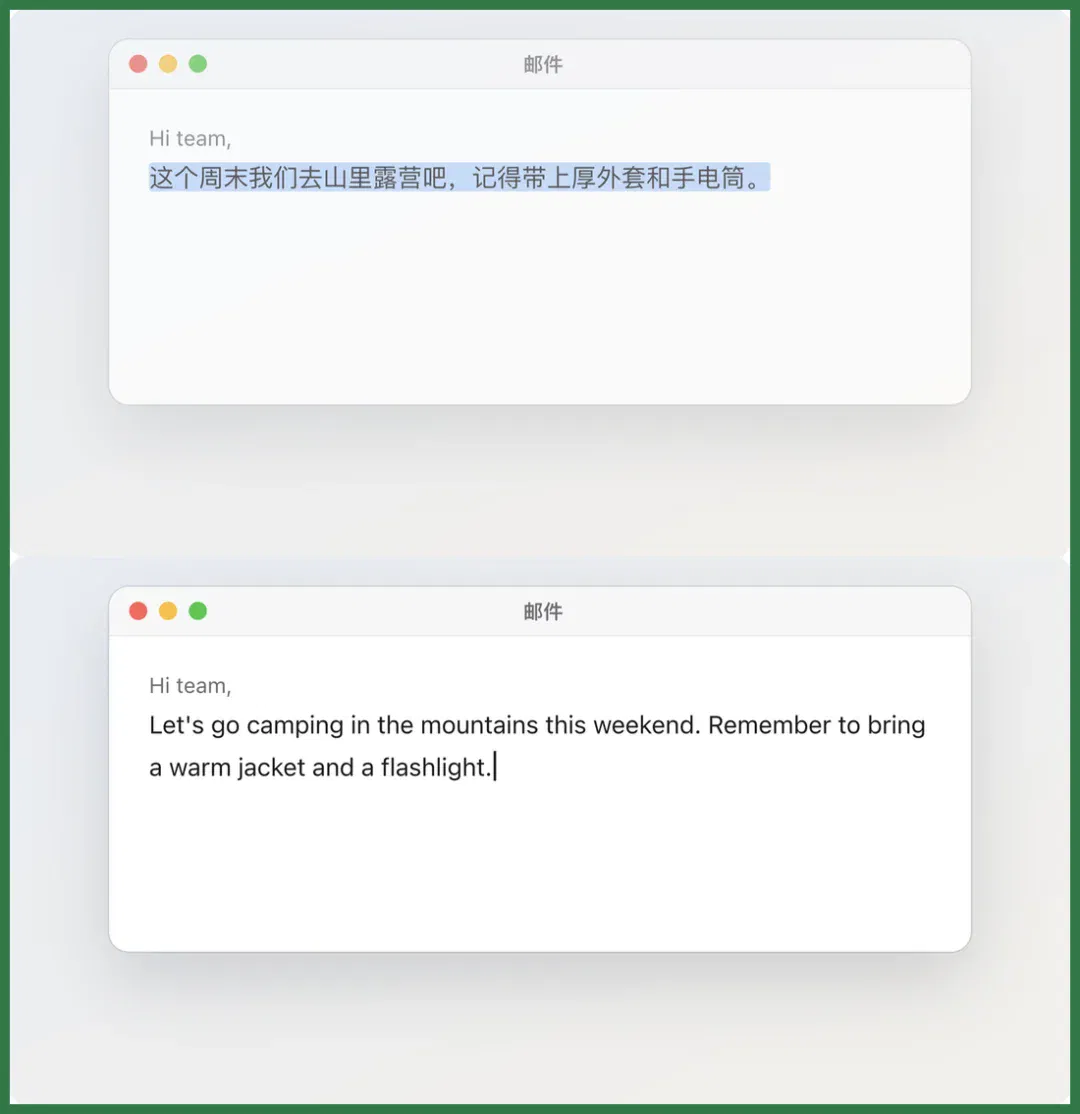
Voxt selection-translation demo: select Chinese text in an email and replace it in place with English. Source: Voxt official tutorial
We also recently recorded a demo of Voxt’s three main features: voice input, translation and an any-to-any voice assistant. Everyone is very welcome to try it.
⑧ Ming Dynasty 1566: organizational corruption and matching authority with responsibility
👦🏻 Koji
What is your eighth Aha Moment?
🧑🏻💻 Chenyang Zhao
I am already reluctant to end the conversation; there is so much more to discuss.
Since quitting gaming, I mainly spend my free time on two things: exercise and reading.
I devoted a lot of effort to history this year. Interestingly, the first work was not really a book: I watched the entire television series Ming Dynasty 1566. Starting work and genuinely encountering society this year made it enormously illuminating. It truly deserves its reputation as the leading Chinese political-intrigue drama.
It has many entertaining memes, such as “Ming dynasty weightlifting champion.” I often joke about “carrying the two capitals and thirteen provinces on my shoulders.” More seriously, it prompted two central reflections.
The first concerns management: an organization rots only from the top down. If a system seems corrupt and its lower-level staff terrible, the organization must already have rotted all the way down from the top.
In a classic scene in Ming Dynasty 1566, eunuchs and officials breach a dike, flooding fields and destroying people’s livelihoods. When Hai Rui brings relief, a commoner tells the imperial guards: the emperor is still good and cares for disaster victims; unfortunately, villains such as Yan Song and Yan Shifan control government and blind him to the truth.
People habitually assume Yan Song and Yan Shifan are the bad ministers and Jiajing is a good emperor misled by them. By the end, however, you realize the one truly incompetent, corrupt and lawbreaking person is Jiajing; the two Yans are merely his intermediaries and scapegoats.
The second reflection is: why is Jiajing such a rotten emperor, and why is the organization corrupt? The core problem is a mismatch between authority and responsibility.
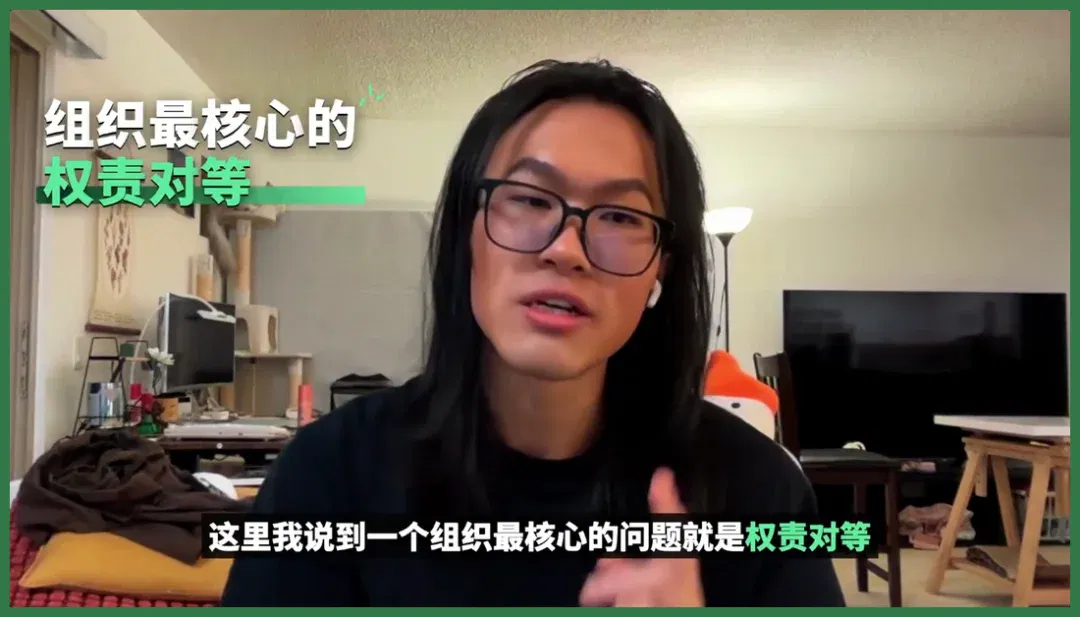
Jiajing enjoys the greatest power and income in the Ming empire, builds palaces and Daoist temples, gives himself countless honorifics and receives prostrations from foreign envoys. Yet with supreme power comes no responsibility: every failure is blamed on Yan Song. Poor warfare in the southeast is Yan’s fault; treasury shortfalls are Yan’s fault; even Jiajing diverting public money into his private treasury is Yan’s responsibility.
Yan Song, of course, likewise enjoys power without responsibility toward his subordinates. Once the first person in a system holds power without accountability, the Ming dynasty is doomed. Unfortunately, its least responsible person is the emperor himself.
Ming Dynasty 1566 taught me the true weight of “leading by example.”
⑨ 1587, a Year of No Significance: the succession dispute and moral ambiguity
🧑🏻💻 Chenyang Zhao
Returning to work and reality, was there a deeper reason for the Ming dynasty’s mismatch between authority and responsibility?
The second book I read was Ray Huang’s 1587, a Year of No Significance. I had read it in high school, but with limited experience and only modest classical-Chinese skills, I did not connect deeply with its portraits. Rereading it after coming to work in the US and watching Ming Dynasty 1566 was profoundly shocking.
I love its technique: choosing the apparently ordinary fifteenth year of Wanli and connecting the situations of the Wanli emperor, Zhang Juzheng, Shen Shixing, Hai Rui, Qi Jiguang and Li Zhi, arriving at a conclusion: nothing momentous happened in 1587, yet the Ming dynasty was already finished.
Beyond mismatched authority and responsibility, a deeper root of the Ming’s failure was institutional ambiguity.
The book’s central argument, as I read it, is: govern through institutions and the rule of law, not morality.
How do morality and institutions differ? Both this book and the third one I read use the classic example of the succession dispute.
Ancient China favored inheritance by the eldest legitimate son. That sounds institutional, but is essentially a moral convention, because no rigid written law said the throne must pass only to him. Hence Zhu Di rebelled, marching from north to south to seize the Ming throne; the Qing had nine sons competing for succession; and under the Yuan it became completely uncontrolled.
In 1587, a Year of No Significance, Wanli wants his favored third son, Zhu Changxun, as heir, while ministers insist on his eldest son, Zhu Changluo. The dispute lasts over a decade. Only in 1601 is Zhu Changluo made crown prince and Zhu Changxun Prince of Fu.
Wanli wanted his favored third son Zhu Changxun, while ministers insisted on eldest son Zhu Changluo. In 1601, Zhu Changluo became crown prince and Zhu Changxun Prince of Fu. The dispute did not remain unresolved until Zhu Changxun died first.
Why could succession drag on for over a decade? Because the moral norm of eldest legitimate-son succession is ambiguous. The emperor can trample ministers’ morality while claiming to embody higher morality in filial devotion and paternal love; ministers cling to ritual and moral principles. Neither yields, eventually prompting Wanli simply to stop attending court for decades.
A rotten system necessarily mismatches authority and responsibility, while ambiguity between institutions and morality often creates room for that mismatch.
⑩ The Troubled Empire: China in the Yuan and Ming Dynasties—rule-makers must follow the rules too
🧑🏻💻 Chenyang Zhao
The third book I read was Timothy Brook’s The Troubled Empire: China in the Yuan and Ming Dynasties, volume five of the History of Imperial China series. It also analyzes imperial succession.
Yuan succession was worse than Ming succession. The principle was crude and simple: choose the wisest person to succeed as Great Khan.
How is wisdom defined? It is extremely subjective, like evaluating AI writing. With subjective criteria, nobody accepts anyone else’s judgment, so they fight. Whoever can beat all his brothers into submission ends up being the “wisest.”
During Genghis Khan’s campaign against Western Xia, he gathered all his sons and said: we Mongols have fought all our lives, finally unified the tribes and built a powerful empire. Fearing renewed division after my death, I designate Ögedei as successor.
Because Genghis Khan imposed a successor while alive, Ögedei’s accession avoided a brutal struggle. Later, however, many Mongol khans died in battle without time to leave a will. Their brothers immediately fought, and the empire split as soon as the khan died. To me, a major reason for Yuan collapse was succession without institutions, relying wholly on subjective morality. Without institutions, whoever is stronger can trample that morality.
Returning to the Ming, Zhu Yuanzhang strongly emphasized institutions. He personally established the Great Ming Code and the Great Pronouncements, hoping to create rule of law. The Great Pronouncements allowed a one-grade reduction for certain beating, penal-servitude and exile offenses if the household owned the book; this did not mean possessing both texts exempted all capital offenses. Even so, Zhu himself trampled his own rule of law by establishing secret-police agencies outside the regular investigative, prosecutorial and judicial bodies.
This contrasts sharply with today’s developed rule-of-law society. With investigative, prosecutorial and judicial bodies, even an extremely vicious criminal or corrupt official cannot simply be arrested and shot on the spot for corruption that day; conviction must go through complex legal processes before judgment is carried out. The criticism here concerns Ming secret-police agencies inflicting punishment and executions outside regular judicial procedures. Modern “execution by shooting” should not be applied directly to that historical setting.
Institutions depend on leading by example: the people establishing them cannot violate them.
Zhu Yuanzhang personally undermined the rule of law he had established, so the Ming never became a truly law-governed or institution-governed society.
Connecting these three works gives three complete causal threads: corruption runs from the top down; mismatched authority and responsibility breeds corruption; and a lack of clear institutions breeds that mismatch.
These three threads from Ming history have most influenced my work and open-source governance: I must regulate everything through clear institutions.
For example, if I require everyone to code according to my biases, I must follow them strictly too. If I write an if without an else and force the code through, on what grounds can I demand compliance from others? If I break the rules, everyone should criticize me; I should be first in line for criticism.
After studying this stretch of Ming history, I realized ambiguity is terrible. Evaluations of writing and code aesthetics are indeed subjective. But once a rule has been made objective and institutionalized, nobody may violate it—especially not the person who made it.
Those three insights—top-down corruption, mismatched authority and responsibility, and clear institutional rules—are my final three Aha Moments.
In the community, I openly state the rights I enjoy and responsibilities I bear. SGLang-Omni contributors are the same: some want an open-source résumé to change jobs, others to apply to prestigious universities. The community provides a trusted endorsement, a benefit they enjoy. But they must also take corresponding responsibility: if their code causes a problem, they must own it.
In open source and the real world, people are ultimately accountable. If you wrote the code, you must take responsibility when something goes wrong. At the same time, you should freely and fully enjoy the rights you deserve.
Rights and responsibilities always correspond. A person’s rights come from the responsibilities they shoulder and the support of others.
👦🏻 Koji
I did not expect your final three Aha Moments to flow together so seamlessly.
🧑🏻💻 Chenyang Zhao
I may be the person in this circle who most loves talking about Ming history. Once I start, I can talk animatedly at length, because I truly love studying it.
👦🏻 Koji
Thank you very much for your time, Chenyang. Let us take the chance to offer everyone early New Year wishes. Happy New Year!
🧑🏻💻 Chenyang Zhao
Happy New Year! I hope everyone makes time to think about how humanity will coexist with AI. In the AI era, we must be even more willing to take responsibility.
Please also support our work on SGLang-Omni and try our voice-input software. It really is powerful.
👦🏻 Koji
Great, thank you, Chenyang!
This article comes from Crossing, written by Koji.
Related topics
After reading
Join the AINRK community
Read how to join the community and connect with people working in AI.
Related articles
Continue reading related topics and articles in this category.

Kimi's Tang Feihu on restrained harness design and open-source diversity (opens in a new tab)
Baijing Lab interviews Tang Feihu, who works in developer relations at Kimi. He discusses unwanted public attention and argues for restrained harness design, more fundamental benchmarks and diverse open-source approaches. These are his personal views.

Kimi Hosted Agents 正式发布:Harness as a Service (opens in a new tab)
Kimi Hosted Agents 正式发布,以 Harness as a Service 提供7×24小时托管环境,支持长程任务、多智能体协作、安全控制、审计及140+ Skills、30+插件和8个金融Agent模板。
Kimi 发布游戏开发方案,连接专业引擎、建模与运营工具 (opens in a new tab)
Kimi 介绍基于K3.1 Pro、Kimi Code和Kimi Work的游戏开发方案,连接Unity、Unreal、Blender等工具,展示原型、工程修改与试玩验证。官方演示的耗时与完成度依赖任务及环境,不代表任意用户都能在一两天完成商业游戏。

Kimi商业和模型都想要,但卡是有限的 (opens in a new tab)
月之暗面发布2.8万亿参数后训练模型Kimi K3.1 Pro,其综合智能指数领先DeepSeek V4.1 Flash-1017和MiniMax M3.1 Flash,但API费用最高,并正研发Flash版本以平衡能力、成本与商业化。

Kimi K3.1 Pro来了,国产模型审美的新巅峰。 (opens in a new tab)
Kimi K3.1 Pro 正式发布,具备3万亿级参数和100万 token 上下文,官方评测显示其在代码、Agent及金融等任务取得多项领先,完整权重将于11月4日前开放。