MiniMax reports MIM cryptanalysis results: Faster challenge attacks and candidate-scheme weaknesses
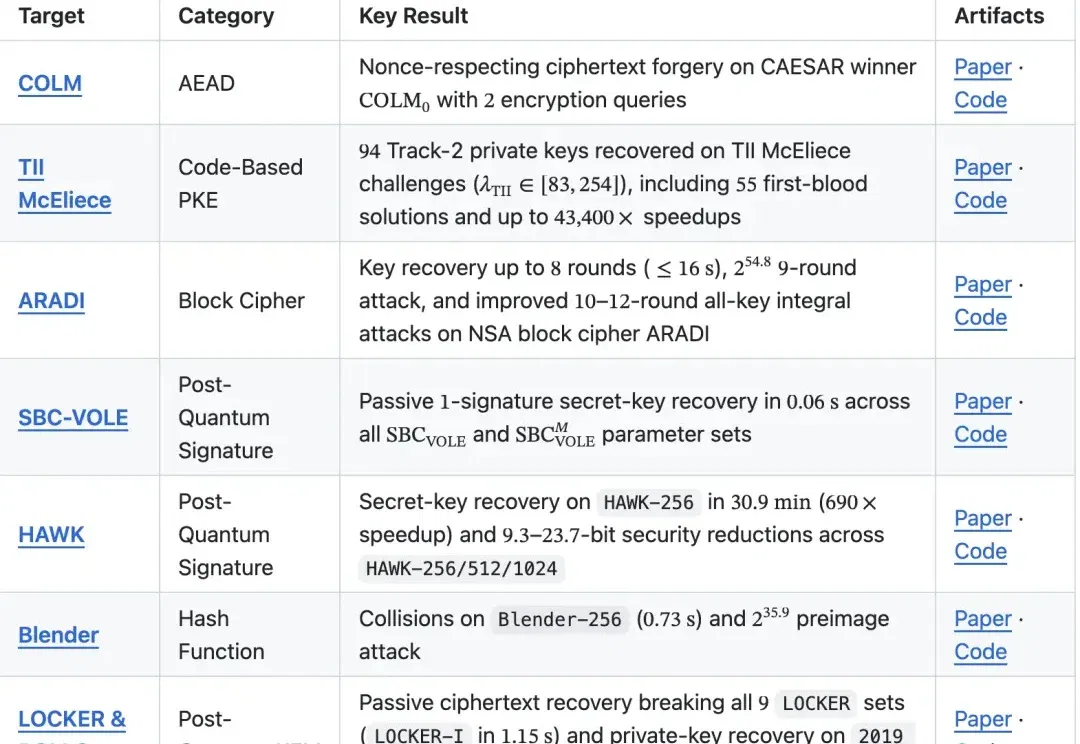
MiniMax reports eight cryptanalysis studies involving its internal model MIM. The claimed 43,400× speedup compares attack-program wall time for one TII challenge with a prior multicore implementation, not model inference against Claude or a break of all modern cryptographic standards.
Editor's verification (2026-11-24): MiniMax has released its team's research reports on specific schemes, round counts, and challenge parameters. This article has not run the PoCs or independently reproduced the results. Speedups refer to attack programs' instance-specific runtimes or core-hours, not how quickly a model generates an answer or a general capability test of Claude versus MIM. The COLM attack targets the COLM0 version specified in the report; practical ARADI key recovery concerns the stated eight rounds. These results cannot be generalized to the complete algorithm or the failure of all current standards. The classical Riemann Hypothesis has received joint confirmation from Lean and Mathlib; related fluid-equation work must be described in terms of its specific theorems and stage of scrutiny. MiniMax's official research directory (opens in a new tab) | TII McEliece report (opens in a new tab) | HAWK report (opens in a new tab) | Joint statement on the classical Riemann Hypothesis (opens in a new tab) | Terence Tao's explanation of the related developments (opens in a new tab)
November 20, 2026, was a day for the history books.
That day, Anthropic researcher Levent Alpöge announced:
I believe I have found a proof of the Riemann Hypothesis while working with Claude.
Lean subsequently confirmed that the proof had passed formal verification.
The same day also saw the release of a proof of finite-time blowup for the three-dimensional unforced incompressible Navier–Stokes equations, with a Lean formalization. Terence Tao noted that the overall strategy was fairly clear, but that the work still needed to be organized into a more proper, professionally written, human-readable proof. It should not simply be described as "the equations being proved."
Everyone was buzzing: AI for Science had reached a true "singularity moment"!
If AI has conquered pure mathematics' most famous conjecture, how long can another human fortress built on pure mathematics—modern cryptography—hold out?
On November 20, MiniMax released cryptanalysis research reports: its unreleased internal model, MiniMax's Internal Model, or MIM, had made major breakthroughs in automated cryptanalysis, reaching an internationally leading level!
MIM not only discovered several new algorithmic weaknesses but also turned multiple previously theoretical attacks into executable breaks taking seconds.
Its work on classical mathematical problems has already attracted the attention of leading teams such as Anthropic!
MIM, the cryptanalysis expert, is "a little frightening"
MiniMax released eight analysis reports with PoCs—runnable code—in one go, with results that are "impossible to ignore."
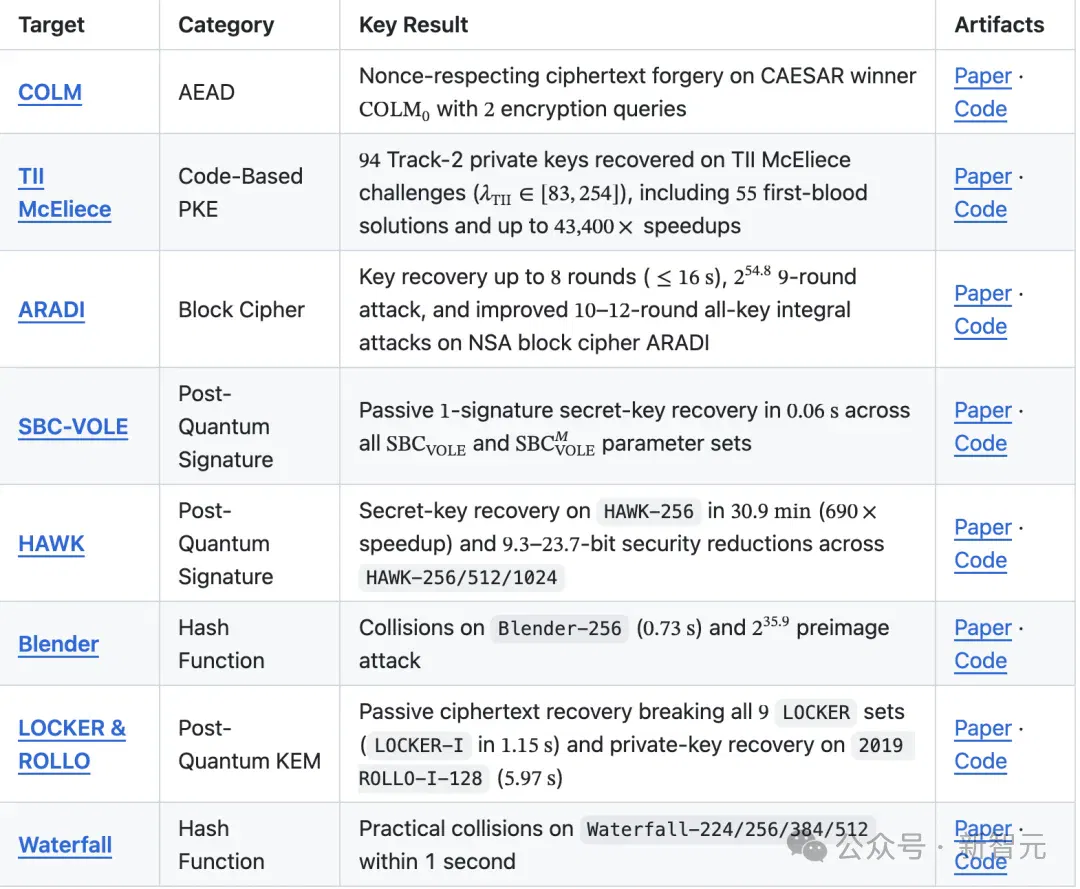
https://github.com/MiniMax-AI/Research/tree/main
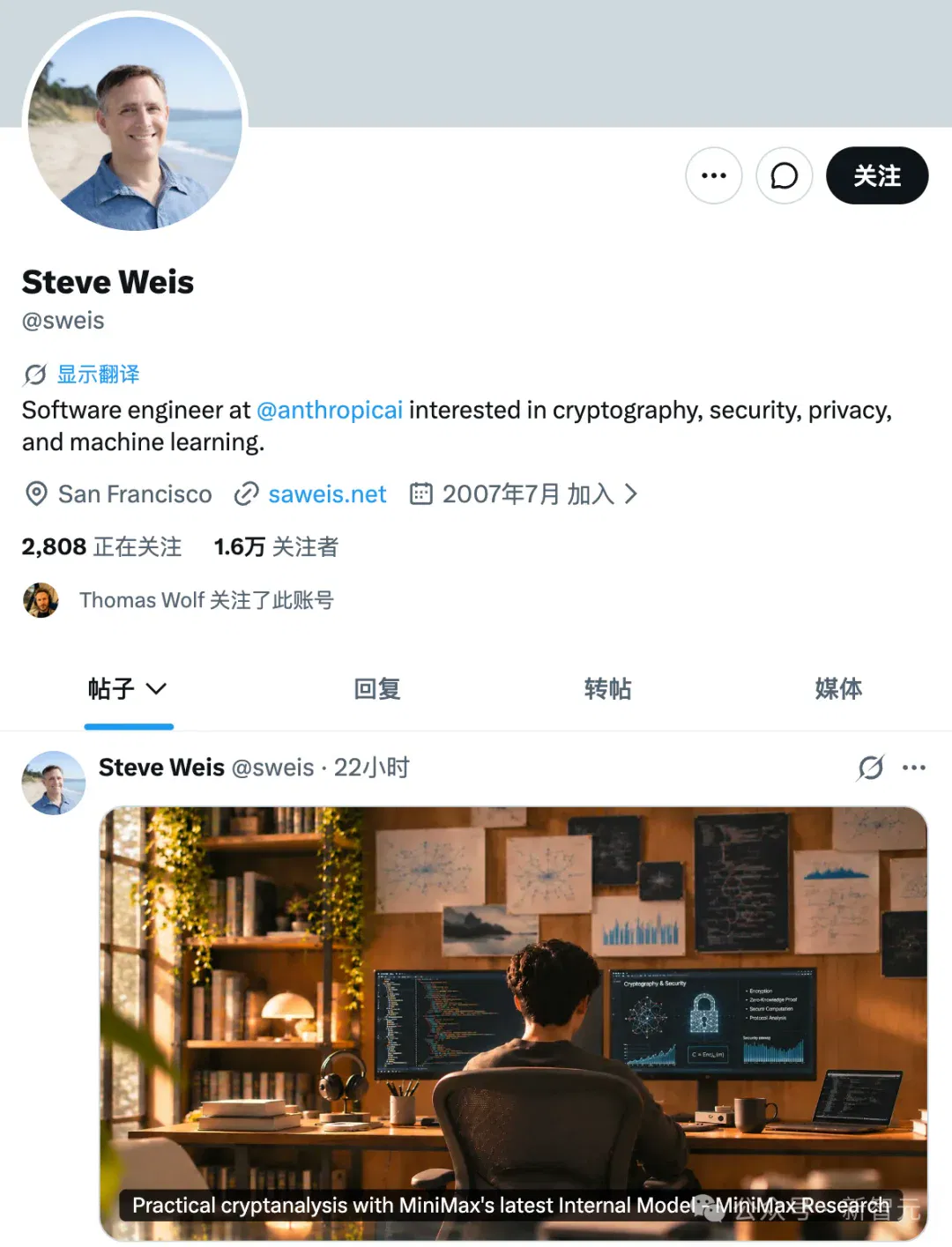
Anthropic, recently in the spotlight, has also taken notice of MiniMax.
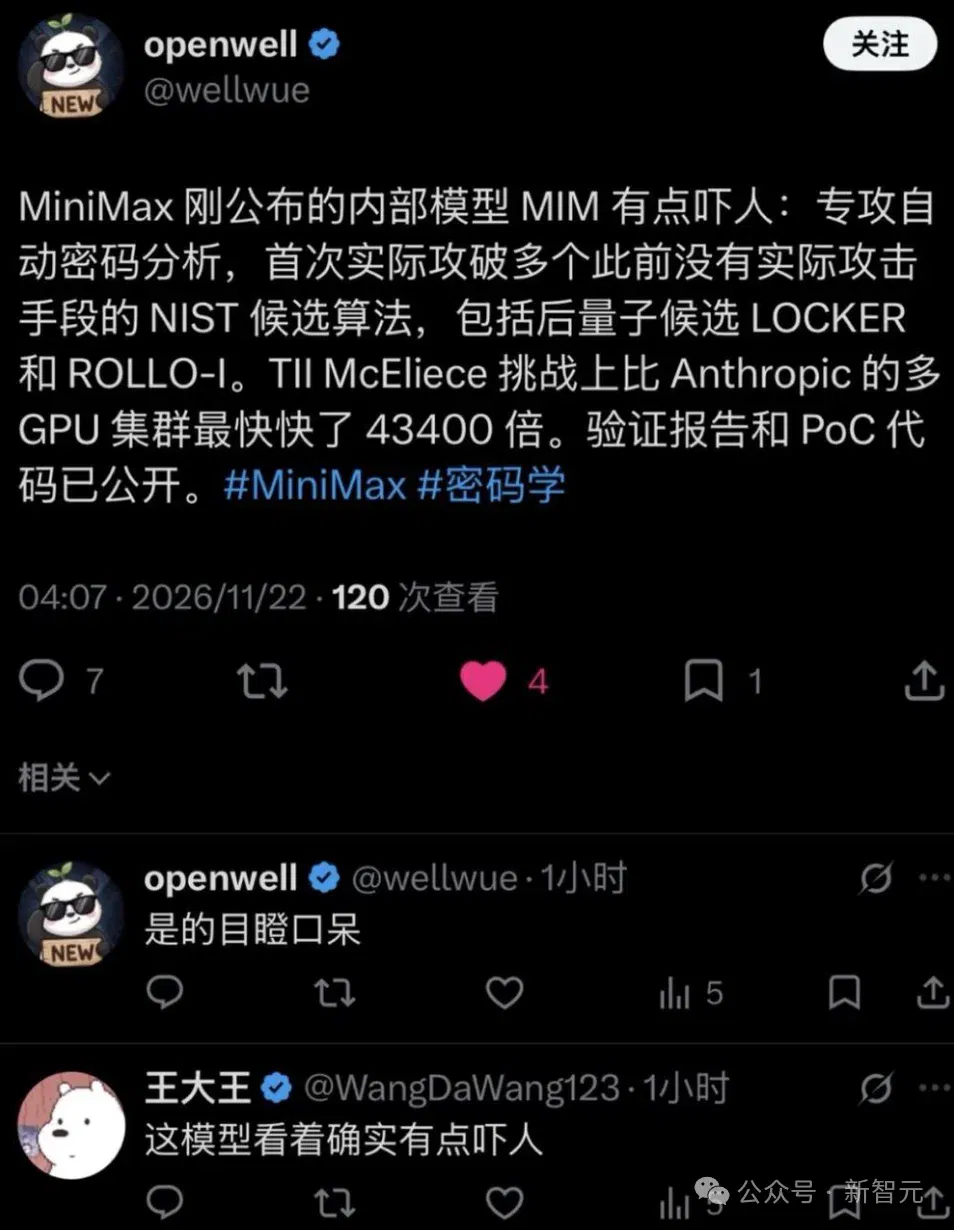
According to MiniMax's report, its attack program took 1.80 seconds on a 64-core CPU for the TII-253 challenge. Compared with an Anthropic researcher's previous 21.7-hour record on 32 threads, this represents approximately a 43,400-fold wall-clock speedup. It is not a matched-configuration comparison of Claude's inference speed or a multi-GPU cluster. The article also reports that an Anthropic engineer shared the results.
MiniMax showed clear advantages across multiple challenges.
For example, for candidate algorithms from past NIS international cryptography competitions with "no previously known practical attacks," the MiniMax model achieved the first breaks executable in seconds.
For another instance, TII-166, the existing record listed in the report was 9.2 hours on a 72-core CPU, not the baseline for TII-253 above.
MiniMax reports 5.36 seconds on a 64-core CPU for TII-166, an approximately 6,180-fold wall-clock speedup. The 43,400-fold figure and 1.80-second runtime concern TII-253. The two instances and their baselines must be understood separately.
On another complex lattice-isomorphism problem, Anthropic had run a 96-core server for nearly four hours. The MiniMax model obtained an equivalent private key in 30 minutes using just one CPU core.
MiniMax is now telling the world: Chinese teams have a seat at the AI4S table!
Why cryptanalysis?
What, exactly, makes MiniMax's breakthrough significant?
The answer is that cryptanalysis is a brutal testing ground for large models.
As one prominent online commentator put it: "Cryptography tests are brutally unforgiving, but that is precisely why I like them. Your script either recovered the key or it did not."
When looking for software vulnerabilities, we are often searching for bugs programmers made while coding.
Cryptanalysis is different: it is a game with all the cards face up.
Modern cryptographic algorithms' mathematical formulas, algebraic structures, and implementation source code are all public.
They resemble a transparent, complex set of gears: you know how every gear meshes, but the security boundary is locked by formidable "computational complexity."
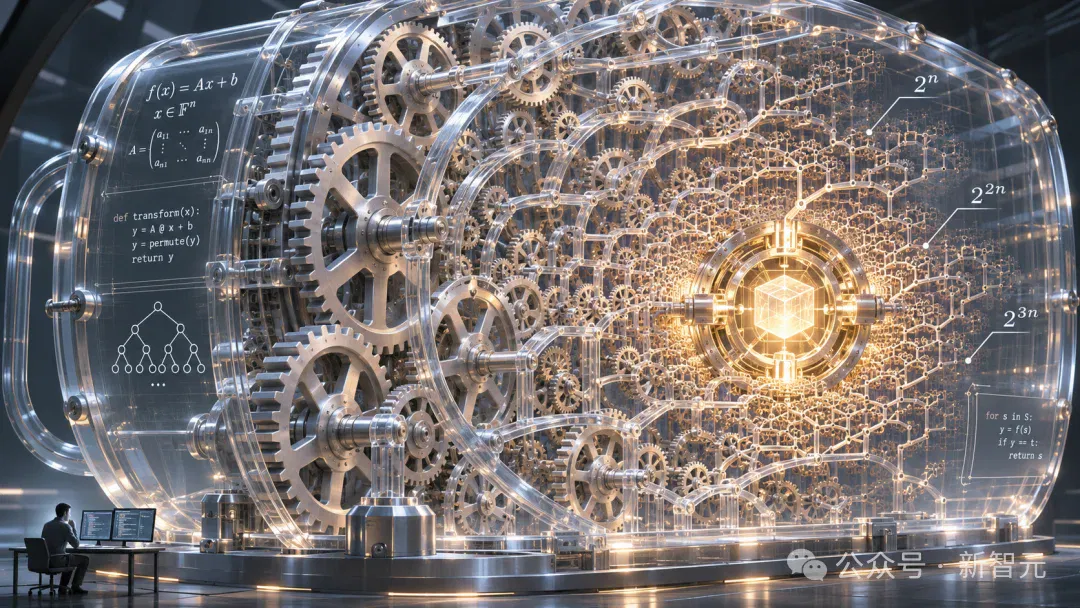
Without the correct key, even using the world's computing power for 10,000 years of brute-force search would not force a break.
For a large model to defeat it, offering an idea is not enough.
It must bridge theory and engineering—
faithfully turn hundreds of steps of advanced mathematical derivation into attack code that actually runs, and compute the answer within limited time and computing resources.
This zero-tolerance, entirely objective standard is the ultimate test of "whether AI can conduct scientific exploration."
Competing for the new throne: Taking on Anthropic with a 43,400-fold speedup
The high point is that MIM broke records previously held by Anthropic on "classical hard mathematical problems" underlying public-key cryptography.
If a cryptographic algorithm is perfectly coded and flawlessly designed, its security reduces entirely to those "classical mathematical problems" studied for decades.
Testing whether large models can untie these mathematical knots is one of the toughest measures of their fundamental mathematical reasoning ability.
The technology account @dummerspast39 summarized the results with excitement:
"BREAKING: MiniMax's newly announced model beats Anthropic's cryptographic-breaking records, with speedups of up to 43,400×!"
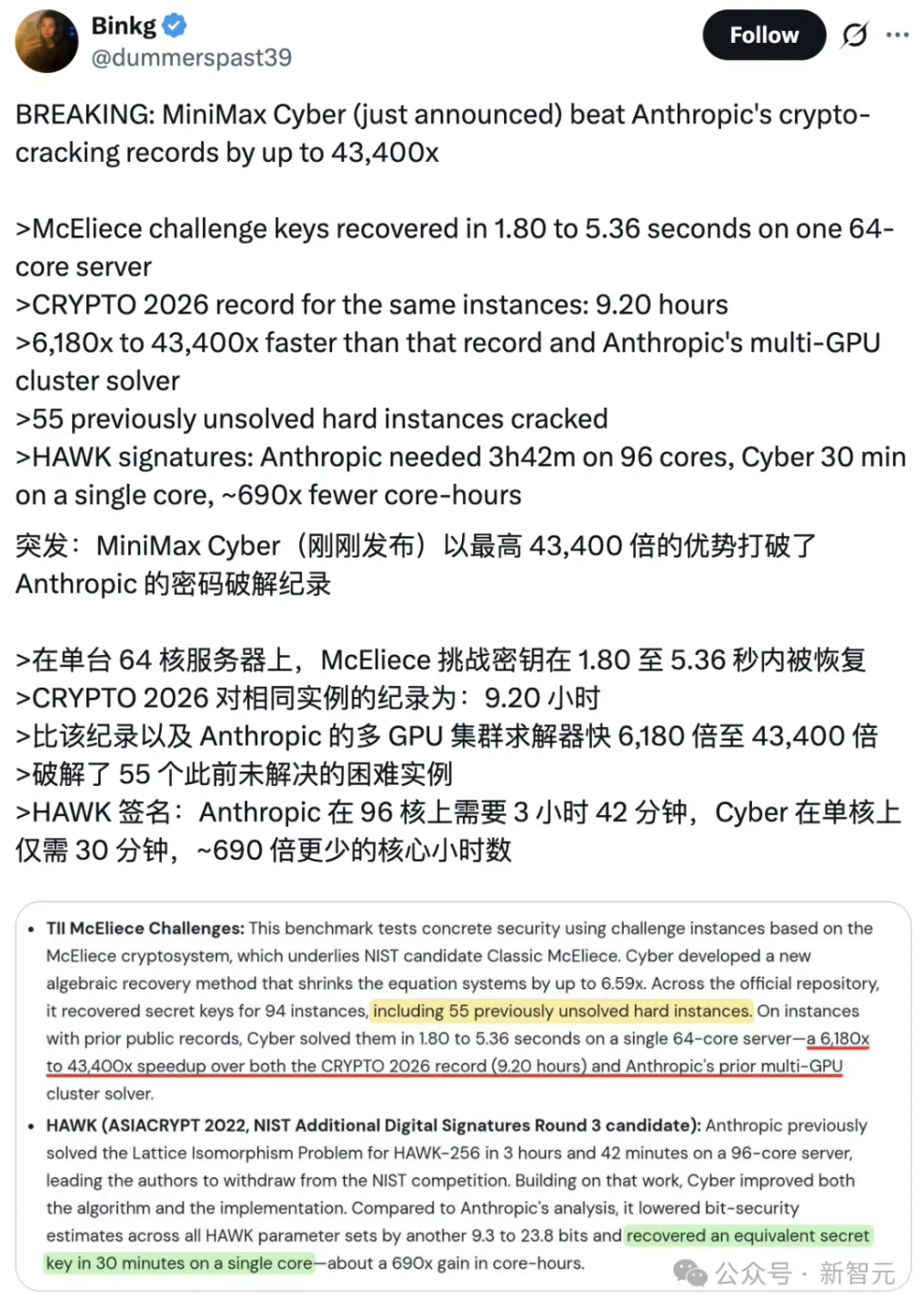
HAWK, based on the Module Lattice Isomorphism Problem, or Module-LIP, is another leading challenge for gauging security margins around core post-quantum mathematical problems.
The previous best result involved Anthropic using a 96-core server cluster for three hours and 42 minutes.
MIM took a different route, removing the original 128 troublesome distractors and making the true target key the unique shortest vector with a decisive gap of 2.
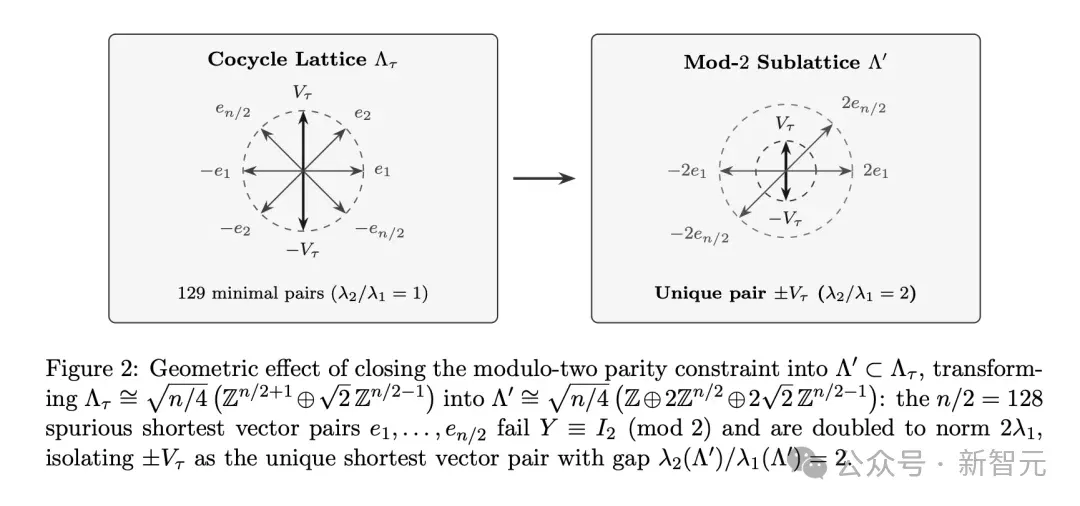
MIM's dimensional advantage: Constructing a modulo-2 sublattice removes 128 distractors and makes the target key the unique, decisively shortest vector.
MIM abandoned the conventional approach, combining "mathematical dimension reduction + engineering optimization" with almost miraculous results:
A search that had required 118 dimensions was reduced to 80!
A task that had taken a 96-core server nearly four hours was completed by MIM on a single CPU core in 30.9 minutes.
Measured in CPU core-hours consumed, MIM's solving efficiency improved by a full factor of 690.
In another challenge, the TII McEliece challenge, MiniMax reports using a single 64-core CPU server on each of TII-253 and TII-166, with runtimes of 1.80 seconds and 5.36 seconds respectively. These correspond to approximately 43,400-fold and 6,180-fold wall-clock speedups against their respective prior baselines; they must not be combined into a single speedup for one task.
MIM also solved 55 previously unsolved high-level "knots" in the challenge set in one sweep.
Note: There is no need to worry about your bank-card password. Mainstream current cryptographic standards such as AES, RSA, and SHA-256 remain solid.
The impact MIM brings to cryptography goes broader and deeper still.
Exposing human blind spots: Claiming "first blood" in NIST competitions
In cryptography, NIST's standardization competitions resemble a grand tournament of the strongest martial artists.
Algorithms surviving into later rounds have been repeatedly scrutinized for years by leading cryptographers worldwide.
To test whether large models are simply "reciting old knowledge from their training data," ETH Zurich and Anthropic jointly developed a dedicated benchmark, CryptanalysisBench.
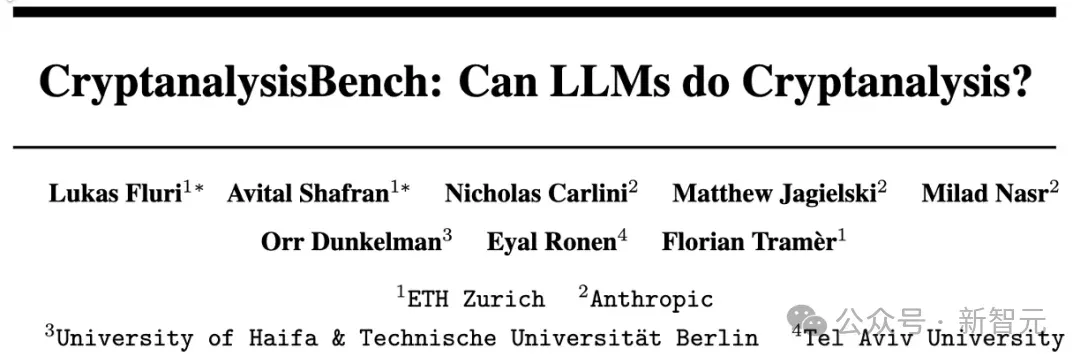
Its exceptionally difficult Tier 2 set contains 142 candidate schemes publicly evaluated by human experts, for which the academic community currently has "no known practical attacks."
MIM then delivered a decisive blow to the human experts!
Take the NIST SHA-3 hash competition candidate Waterfall-256 as an example.
Since its creation, nobody had actually broken the algorithm by constructing a "colliding pair of messages."
With MIM involved, without any hints, a single CPU core took just 0.045 seconds to generate the algorithm's first actual collision instance.
From theory to practice, AI instantly surpassed years of human progress.
The most representative examples are the NIST post-quantum candidates LOCKER-I and ROLLO-I.
LOCKER-I, for example, required constructing a matrix with 5.72×10^8 columns, consuming up to 42 PB of memory—approximately 43,000 TB. This had been an insurmountable computing barrier!
MIM displayed remarkable intuition, manipulating the coefficient matrix to unlock a hidden property.
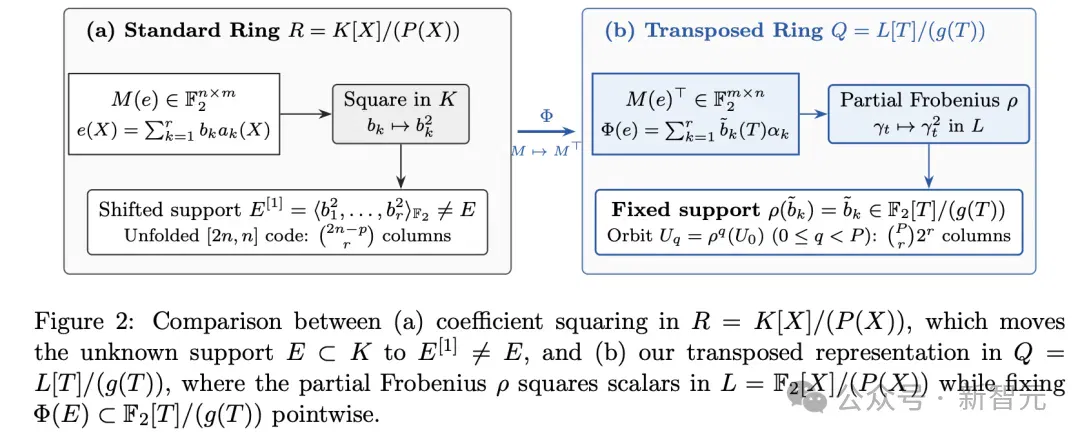
MIM's ingenious algebraic operation: Transposing the coefficient matrix unlocks a partial Frobenius map and pins down the unknown space.
The enormous matrix that had required 42 PB of memory was compressed by MIM to just 58 MB!
On 12 threads, breaking LOCKER-I takes only 1.15 seconds. For the 2019 version of ROLLO-I-128, MIM requires less than 2 MB of memory and only 5.97 seconds on one core.
This is a sheer intellectual outclassing.
The report also mentions a case concerning the reference implementation of the NIST first-round lattice-signature scheme DRS; no separate DRS report was found in the eight public MiniMax reports available for this check. The alleged mixing up of logical AND (&&) and bitwise AND (&) has not yet been verified against its source.
The claimed DRS signature forgery and runtime of 0.1 to 0.8 seconds therefore do not count as verified results in this review. Forging a signature should not be described as acquiring "the highest privileges" either.
Reaching top venues: "Even cryptographers would pause at this"
If rejected NIST candidates do not seem cutting-edge enough, MIM also turned its "blade" toward new algorithms in leading cryptography journals with rigorous security proofs.
These frontier schemes often introduce highly complex new algebraic structures. Their authors include dozens of pages of rigorous mathematical proofs, claiming resistance to various mainstream attacks.
Yet MIM found "compositional blind spots" in these seemingly airtight proofs.
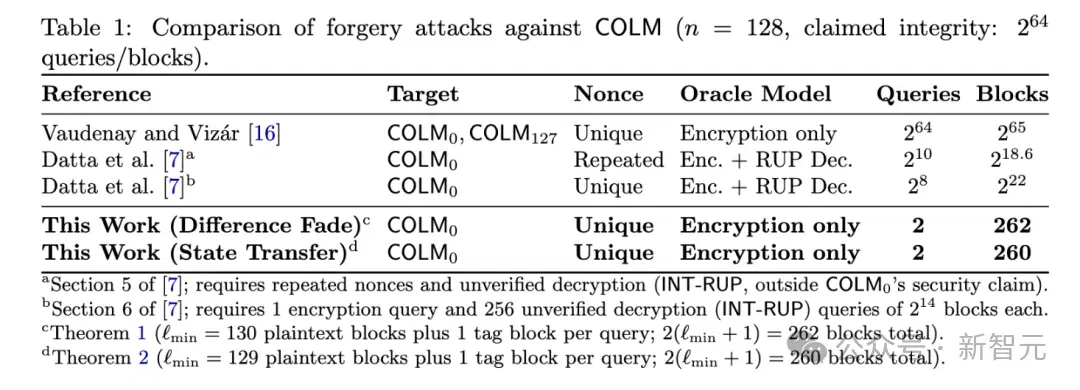
For example, COLM survived five years of demanding selection to win the CAESAR authenticated-encryption competition, with an exceptionally rigorous security proof. The algorithm was peer-reviewed and published in the leading Journal of Cryptology.
Previously, the academic community had identified no substantive threat. But MIM found two critical logical blind spots and constructed actual attacks.
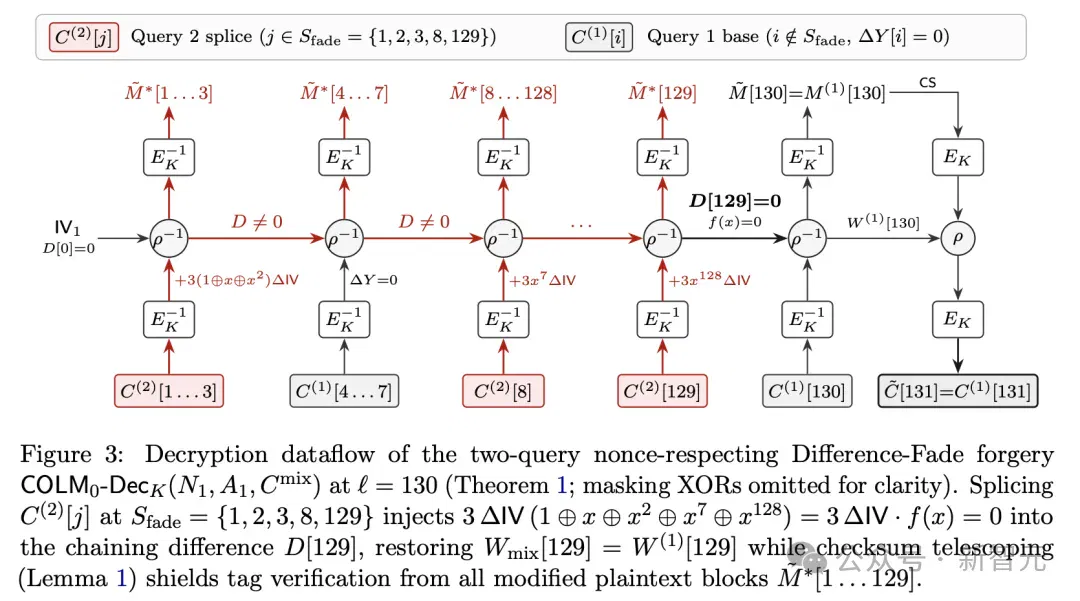
MIM's "Difference-Fade" forgery attack against COLM0: Exploiting the algebraic structure to force the difference between chained states to vanish at block 129.
In the standard setting, MIM needs just two queries to forge a valid ciphertext, breaking its defenses completely.
Another target of this decisive advance was ARADI, a low-latency algorithm released by the US National Security Agency, NSA.
The previous best result reached five rounds. By finding new algebraic structure in the public constants, MIM extended practical key recovery to eight rounds in just 2.4–16 seconds, setting new records for theoretical attacks.
As one Chinese technology blogger memorably commented: "Even cryptographers would pause at this. It is more than finding vulnerabilities: it is redefining algorithms' security boundaries."
Large-model competition enters deeper waters: AI is creating new knowledge
From Anthropic's proof of the Riemann Hypothesis to MiniMax's sweep through cryptography, the signal is clear—
the next stop for large models is AI4S.
In traditional cryptographic research, limited human energy is often the greatest bottleneck.
MiniMax has demonstrated that AI is becoming a peer reviewer capable of directly exposing predecessors' weaknesses, and even an independent scientist opening entirely new approaches.
This time, Chinese large models have not only achieved multiple breakthroughs at the frontiers of cryptography for the first time.
They have also shown that, in long-CoT and difficult mathematical and logical reasoning, Chinese AI can now compete head-on with the world's top institutions!
People overseas have commented: very impressive. They want to see what else MIM can do once MiniMax reveals the model in full.
Indeed, it is something to look forward to.
This article is from "Xinzhiyuan," by "Aeneas" and "Dawei."
Related topics
After reading
Join the AINRK community
Read how to join the community and connect with people working in AI.
Related articles
Continue reading related topics and articles in this category.

MiniMax Code lead on why review and task management matter as AI writes code (opens in a new tab)
MiniMax Code lead Ronny discusses internal adoption, context management and tool orchestration, then outlines personal-agent collaboration and task management. Figures such as 95% of code and 15% token-efficiency gains are team reports; future product forms are his views.

MiniMax 发布 H3-Image 并开放权重,支持 16 张参考图 (opens in a new tab)
H3-Image 支持文生图、参考图生成及编辑。MiniMax 公布了 4K 输出与最多 16 张参考图的能力,权重使用受其社区许可证约束。

MiniMax 闫俊杰谈推理成本、开放权重与多模态模型 (opens in a new tab)
闫俊杰在 Scottish Mortgage 播客解释低推理成本如何支持后训练,并讨论 H3 开放权重和 M3 Pro 的开发进度。访谈亦区分年化收入运行率与财报收入。

MiniMax H3 扩展开源生态:视频增强、蒸馏与商业授权 (opens in a new tab)
据报道,英伟达相关团队及Pika基于MiniMax H3探索高分辨率再生成和少步推理。文章同时分析其社区许可与单独商业授权路径;开放权重并不等于在所有地区、所有商业规模下均可免费使用。

中国的MiniMax,居然成了全日本的希望!? (opens in a new tab)
MiniMax与KAGAMIAI等日本伙伴推出H3 IP Edition,利用H3生成内容,并通过Kagami Gate管理日本IP授权、使用记录和收益分配,已有超60家公司表达采用兴趣。