Trying OpenSquilla’s model router: task tiers, model switching and costs
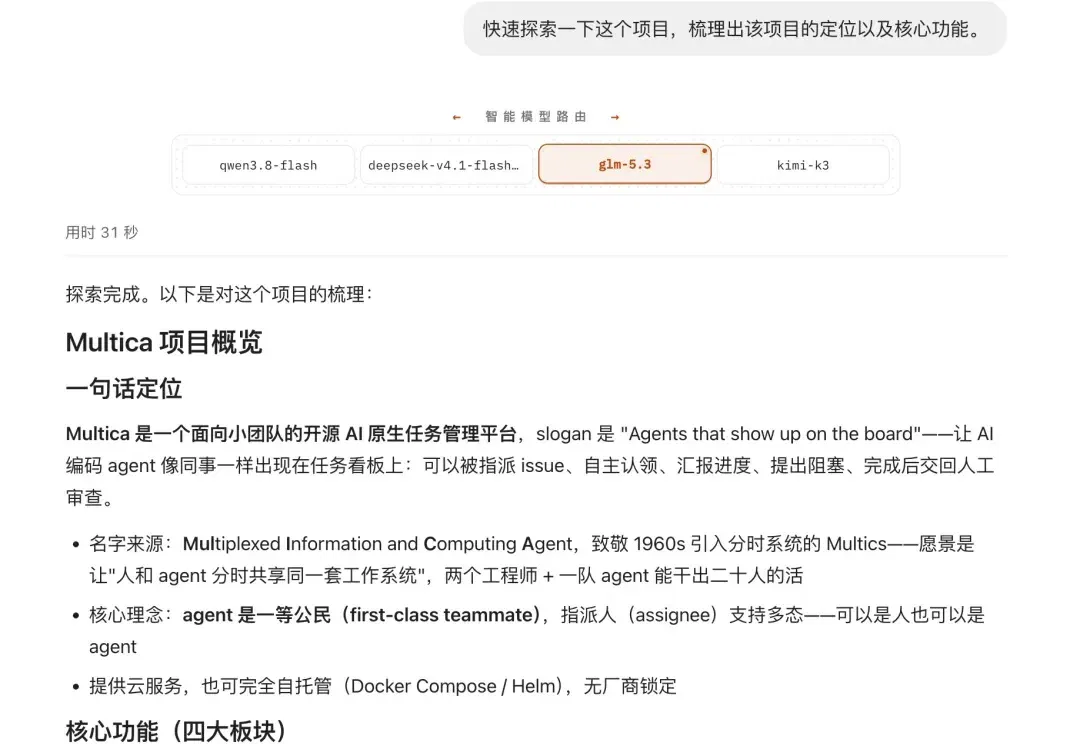
The author tests OpenSquilla on project exploration and documentation. Reported cost and quality results depend on the benchmark and model pool; monthly tier recommendations still need validation for each use case.
Editorial correction (November 19, 2026):The 99.96% figure is a score ratio against a specific PinchBench baseline. Both the framework and model pool differ; recommendations do not replace validation for your own use case.
Among Chinese models, DeepSeek writes the most natural-sounding documents, GLM-5.3 offers the best value for coding, and Kimi produces the best-looking front ends.
Almost everyone knows these supposed strengths.
Yet almost nobody consistently chooses models that way.
The reason is simple: switching models back and forth within one conversation is too much trouble.
Am I supposed to stop and decide which model to use every time I assign a task?
That soon becomes tiresome.
So most of the time, we pick the strongest model and use it for everything.
That leads to a rather absurd situation: you say “hello,” and a flagship model replies.
We use a sledgehammer to crack a nut almost every day.
Then I recently found a GitHub project called OpenSquilla. It aims to do one thing: automatically route tasks to different model tiers according to their difficulty.

/One conversation, with models that switch themselves/
It sounded interesting, so I downloaded it to try it out.
First, I sent it a simple “hello.”
Above the reply was a “smart model routing” indicator listing four models. For this task, it used qwen3.8-flash, the cheapest of the four.

Next, I asked it to quickly explore a local open-source project, Multica, and summarize its purpose and core features. This time, it automatically switched to glm-5.3.
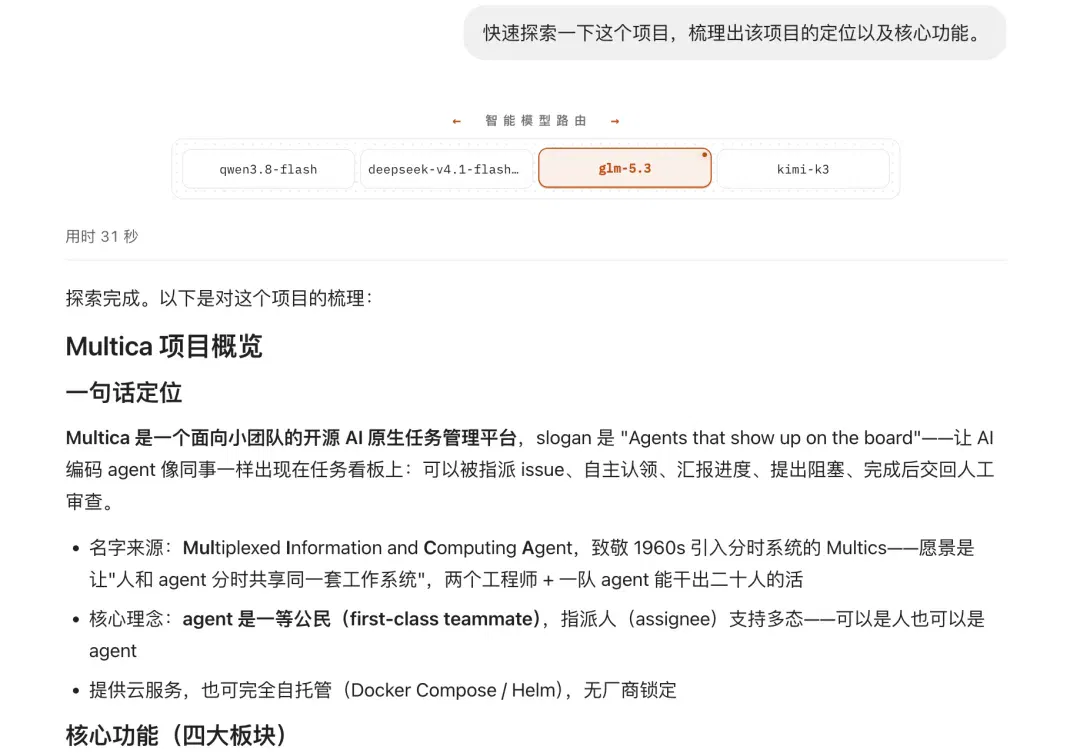
That was promising.
Then I asked it to use that information to produce an architecture document for Multica. It automatically switched back to qwen3.8-flash.
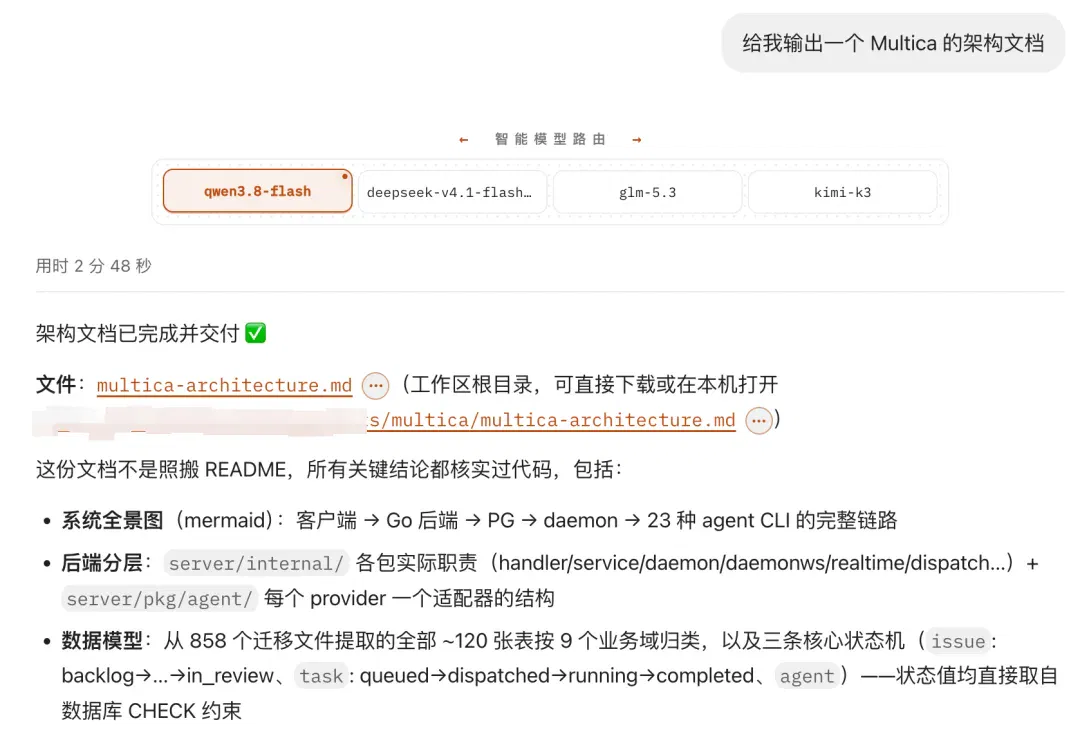
By the rule of thumb at the start, writing documents ought to be DeepSeek’s job.
Instead, it assigned the task to the cheapest of the four.
On reflection, that made sense. glm-5.3 had already worked out how the project fit together. The next step was to write up that organized information, which did not require an expensive model. The document was substantial, too: it took 2 minutes 48 seconds, included a Mermaid diagram of the overall system, and grouped around 120 tables into nine business domains.
I also checked the two models’ official prices. Per million tokens, qwen3.8-flash charged RMB 0.8 for input and RMB 2.7 for output; glm-5.3 charged RMB 8 and RMB 28. That is roughly a tenfold difference.
In this sequence, the expensive glm-5.3 was used only for the 31 seconds spent understanding the project. Document writing—the longest step and probably the most token-intensive—went to a model costing about one tenth as much.
/Choosing a model should be inexpensive, too/
At this point, I was curious about how OpenSquilla implemented automatic routing.
So I looked through the project’s paper.
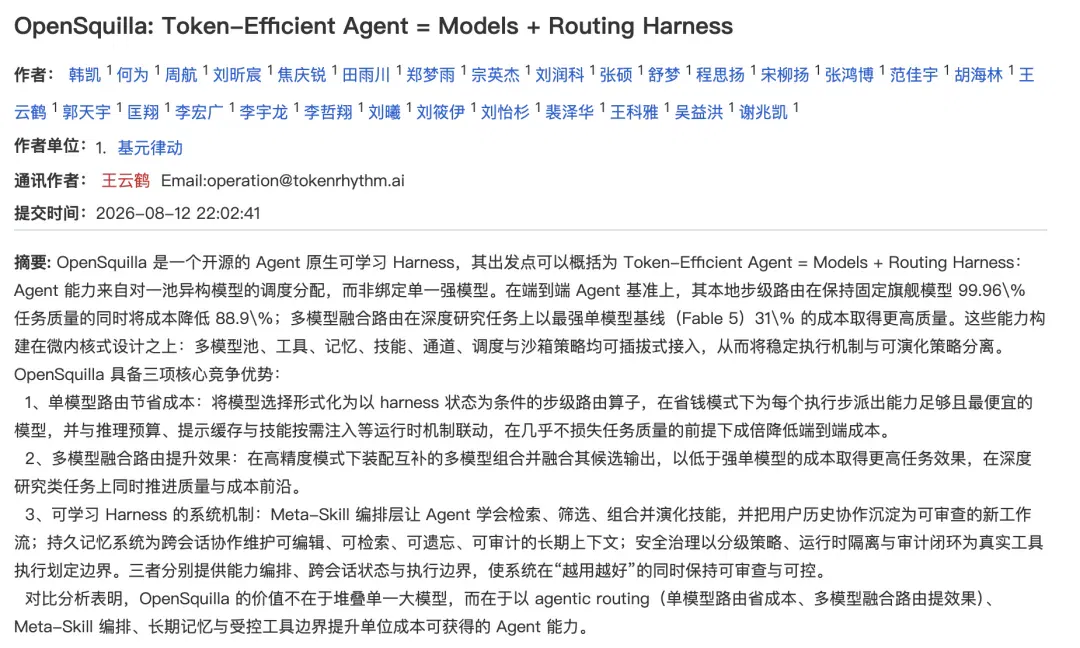
The repository reports PinchBench results covering 25 tasks. Its specified OpenSquilla model pool scored 92.51, compared with 92.55 for an OpenClaw baseline fixed to Opus-4.7: a ratio of about 99.96%. This is a ratio of baseline scores, not a 99.96% task success rate or a guarantee of quality in every setting.
The total costs in that test were $0.69 and $6.23, a reduction of about 88.9%. The comparison changes both the framework and the model pool. The entire saving cannot be attributed to local routing alone, and it does not mean the client configuration described here will necessarily achieve the same saving.
The routing process works roughly as follows. I made a simple animation to illustrate it:
First, models are divided into four capability tiers, ranging from fast and simple to highest quality. Think of four roles on a team: intern, regular employee, core specialist and expert.
A dispatcher runs on your computer and decides which role should handle each message you send.
This dispatcher consists of two small models. BERT interprets what the message is asking for; LightGBM decides which tier to assign it to.
It considers fairly simple signals: what you said, whether you included code, the length of the context and the tiers chosen in previous turns.
When you continue discussing the same task, it keeps the same tier. If you ask it to redo the work, it moves up a tier.
Why not let a large model act as the dispatcher?
Because using a large model to decide which large model to use would itself be another case of using a sledgehammer to crack a nut.
Both small models run locally. A routing decision takes a few milliseconds and consumes no paid tokens; it is handled on your own computer.
/Recommendations when new models arrive/
The more interesting part is that the roles stay fixed, while the model assigned to each role can change every month.
With models advancing rapidly, OpenSquilla says it evaluates different mainstream models each month on real tasks such as fixing code and working across apps. It looks at both results and cost, then recommends models that perform well at a low price for the next month.
November was the first round, with the following assignments.
The intern was qwen3.8-flash, the regular employee deepseek-v4.1-flash, the core specialist glm-5.3 and the expert kimi-k3—C0 through C3 in the screenshot below.
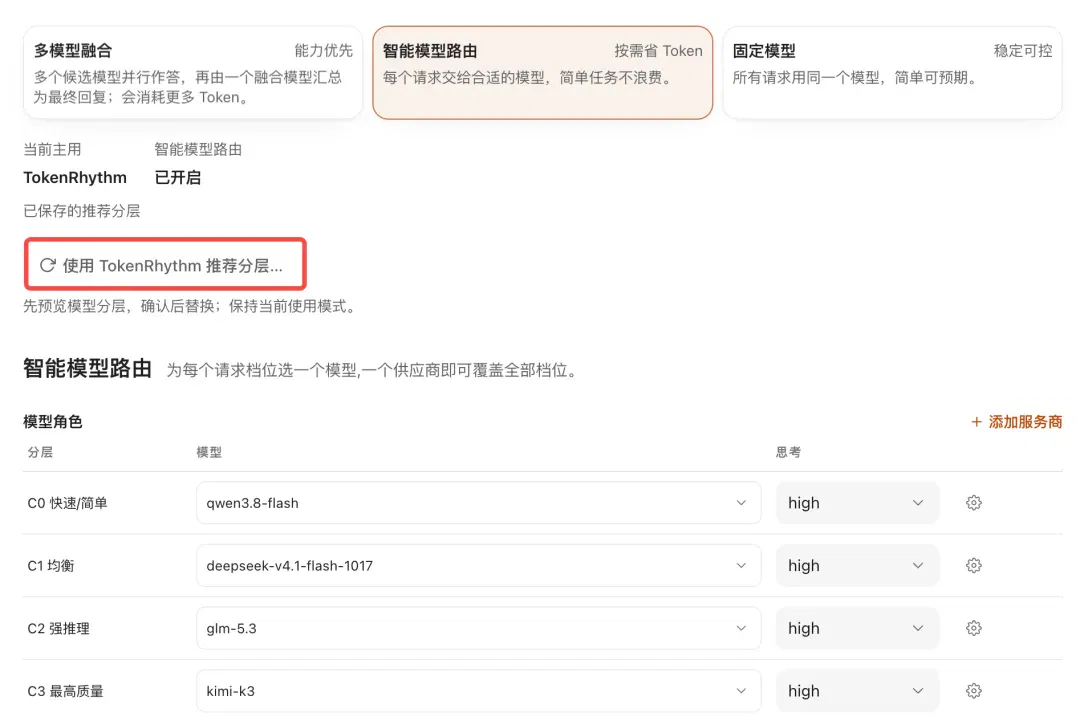
The model-routing section includes a button for using TokenRhythm’s recommended tiers. It checks once at startup and then every 24 hours.
Monthly tier recommendations can reduce repeated model-selection work. Each business still needs to assess results, cost and availability. Recommendation updates take effect after user confirmation; they do not mean new models require no independent validation.
This can help a local agent balance results and cost.
Convenient, isn’t it?
There is a prerequisite, however: you need access to every model you want the router to use. Registering with each provider, buying credits and obtaining keys would create another kind of hassle.
OpenSquilla therefore integrates TokenRhythm and OpenRouter, so a single key can provide access to all four tiers.
For example, with TokenRhythm you can buy token credits and enter the API key into OpenSquilla, or sign in through the client. The client also displays your balance and usage for the day.
OpenSquilla itself is free and open source. Model calls still cost money.
Originally published by “贾克斯的平行世界”; author: “贾克斯的平行世界”.
Related topics
After reading
Join the AINRK community
Read how to join the community and connect with people working in AI.
Related articles
Continue reading related topics and articles in this category.
热门Harness项目OpenSquilla:拯救烧token烧到绝望的Agent们,估值1亿 (opens in a new tab)
OpenSquilla 是一个开源 Agent Harness 框架(https://github.com/opensquilla/opensquilla)。它在 Agent 应用和模型之间加了一层运行中枢。OpenSquilla 由上海基元律动科技有限公司开发。基元律动成立仅几个月后,已完成首轮融资,估值高达1亿美元。

基元律动发布 NeoHorse 1.5 Flash 预览,复用多模型执行经验训练 (opens in a new tab)
团队以 Qwen3.8-Flash 为基础进行后训练,主模型 1250 亿参数、激活 60 亿。厂商评测中部分 Agent 任务分数提高,计算与数学类别下降,文章也给出四个官方案例。
AI圈杀出一匹黑马!AK分享、魔搭推荐、Agent原生模型NeoHorse-1下载破万! (opens in a new tab)
基元律动发布的Agent原生模型NeoHorse-1上线三天即在Hugging Face下载量突破1.2万次,并获AK在X推荐及魔搭ModelScope官方推荐,社区开发者已制作出面向Apple Silicon的MLX量化版本。

Agent驱动的模型训练,基元律动做了一次迈向RSI的实验 (opens in a new tab)
Agent 完成任务后,学到的经验去了哪里?

独家丨王云鹤创业估值数亿美元,押注多模型 Harness和 Agent-Native Model (opens in a new tab)
AI 基础设施公司基元律动(TokenRhythm)近日完成新一轮融资,截至目前累计融资金额达数千万美金。本轮融资由弘晖基金领投,聚合资本、尚势资本等机构参与。此前,公司已完成由 Granite Asia 领投,鼎晖 VGC、元璟资本、无限基金参与的种子轮融资。