Seekee co-founder on Latin America's AI browser market: local needs and bundled subscriptions

In an interview, Xu Leyang discusses Seekee's market choices, user research and bundled features for Latin American families' photo editing, light office work and learning needs. Download and business-scale figures are self-reported and do not equal paying-user counts.
Editorial correction (November 17, 2026): Business-scale figures are the interviewee's own statements. Subscription prices differ between the narrative and Q&A, and that discrepancy is now explicit. Generalizations about language coverage and the classification of email/calendar information have also been corrected.
Chrome has 85%, but he built a browser anyway
'However high the technological wave, business success often depends on ordinary people the major companies have yet to serve.'
At Google I/O, a Google DeepMind team gathered Asian entrepreneurs for a closed-door discussion.
Google's representatives were particularly curious about two companies, asking many detailed questions.
One was an Indian gaming-voice platform, somewhat like China's early YY voice service. The other was Seekee, the AI browser co-founded by Xu Leyang that found its main market in Latin America.
Halfway through, Xu asked Google a question: 'Besides English, which language is strongest in your model corpora and capabilities?'
After a long hesitation, the unexpected answer was Korean.
The reason was simple: Samsung, a core Google partner, supplied substantial context and language data.
That detail made everything click for Xu.
Even a global giant such as Google still has considerable hunger for training data in languages beyond English.
Seekee's accumulated Spanish- and Portuguese-language text and voice interactions in Latin America were precisely pieces the major companies had not yet picked up.
These are the gaps Chinese entrepreneurs expanding overseas are particularly good at spotting.
In the Wu Xiaobo Channel's AI Future Talk livestream, Unique Research founder Wu Wei spoke with Xu for two hours and 20 minutes.
Xu's career is representative. For his first 11 years, he worked in investment and investment banking at Silicon Valley-linked US-dollar funds and China Renaissance, observing from the sidelines. In 2021, he became an entrepreneur. His team first built Loklok, a Southeast Asian video product with over 200 million downloads and daily active users in the tens of millions. After Lunar New Year 2025, it launched Seekee in Latin America, reaching over 100 million, nearly 200 million downloads and several million daily active users in under two years.
He has now joined Genora Science, founded by Chen Danian, to lead investment and financing and work on hands-on AI venture incubation.
His entrepreneurial choices have repeatedly run against Silicon Valley's mainstream narrative: Southeast Asia and Latin America rather than intense competition in Europe, the US, Japan or South Korea; a familiar browser wrapper rather than a flashy native agent; and ready-made bundles instead of forcing users to learn prompts.
In an AI era obsessed with being cutting-edge, his logic is plain: however high the technological wave, ordinary people not yet served by major companies often determine business success.

1. Start by eliminating options: subscriptions where mortgage pressure is lower
When Xu and his partner decided to start a business in 2021, their first step was to eliminate options rather than chase trends.
China's mobile-internet growth dividend was peaking, making overseas expansion a natural choice.
But where should they begin in such a large world?
They first crossed off the US, Japan and South Korea—the very markets many overseas entrepreneurs most desired.
Those markets already had mature mobile-internet paths and business models, making entry too costly.
They also studied Africa carefully before ruling it out.
'We are running a business, not a charity.'
Xu says frankly that purchasing power there at the time was insufficient for the team to earn even basic commercial returns from traffic.
The selection process left Southeast Asia and Latin America.
Both had appealing traits: populations exceeding 600 million and still growing; a clear leading country—Indonesia, with nearly 300 million people, and Brazil, with over 200 million; and, importantly, users less caught up in China's intense competition, with strong willingness to engage with new products.
What ultimately convinced the team was local attitudes toward spending.
While China's consumer market was becoming increasingly budget-conscious, Southeast Asia and Latin America looked different.
'They do not have the same mortgage and car-loan pressures. They are cheerful, relaxed and willing to spend.'
In the conversation, Wu Wei exposed a common misconception: there is no absolute, inevitable link between how much money a person earns and how much they are willing to spend.
In Latin America and Southeast Asia, people earning 2,000 a month may spend their salary on payday, then live on consumer credit.
Spending first and paying later is itself a distinctive major local industry.
The team then made a deliberate shift between those two regions.
Its first product, Loklok, was time-filling video entertainment, launched in Southeast Asia, closer to China and culturally easier to understand. For Seekee, aimed at AI subscription revenue, it decisively crossed the ocean to Latin America.
Latin America had higher GDP per capita than Southeast Asia, while North American influence made subscriptions more familiar.
There was also a language advantage.
Southeast Asia has highly fragmented localization, with different languages across countries; Latin America is more concentrated around Spanish and Portuguese.
The interviewee believes Spanish and Brazilian Portuguese cover many users in his target markets, reducing some localization costs. Other languages and regional differences exist, however; those two languages do not cover every Latin American country or population.
Building on Loklok's promotion and acquisition experience, Seekee grew faster in Latin America than its predecessor had in Southeast Asia.
'Chrome already exists. Why do we need you?'
If going to Latin America meant avoiding stronger competition and targeting a less contested market, then making Seekee a "browser" was a thoroughly unconventional decision about the form the product should take.
'Why do we need a new browser when Chrome exists?' has been Xu's most frequently asked question over the past two years.
Chrome's overall share is almost above 70% across regions; together, the preinstalled Chrome and Safari on Android and iOS account for roughly 85%.
To outsiders, challenging such a foundational gateway seemed hopeless.
To Xu, it was an easy opportunity to understand.
First, 85% share demonstrates that browsers are mature, widely adopted products requiring no user education.
A startup need not overturn Chrome: 'Taking one or a few points of its share would already prove a great deal.'
More importantly, how can AI fit naturally into ordinary people's lives?
When starting Seekee, the team first rejected AI-native forms that were too far ahead of users.
'People like us who are sensitive to new products download and try them without promotion. Ordinary users do not wake up determined to try a new product.' Xu says any standalone app imposes relearning costs. Even excellent onboarding cannot remove the barrier of understanding it.
Browsers, meanwhile, have survived the transition from PCs to mobile without truly becoming obsolete.
When users open it, they subconsciously know, 'I can find anything on the internet here.' The "Bookmarks" and "Tabs" buttons on the page do not require lengthy explanations.
Putting AI inside a familiar wrapper minimizes the trust required.
They waited two full years for the right time to act.
As early as 2023, the team had tried putting AI features into its parent product, Loklok. But it soon discovered that the models at the time were not intelligent enough, and ordinary users were not prepared for them at all.
Only in late 2024, when major US model companies began offering foundation models as consumer products, did they see the opening for ordinary-user applications.
'Too early, and you become a casualty,' Wu observed.
Seekee follows one firm rule: never make ordinary users struggle to write prompts.
Latin American users enjoy football, music and news. They enter preferences naturally, as usual, while AI processes the request behind the scenes.
Seekee has introduced a few dozen specialized features, producing results in one tap without requiring users to structure requests.
This reminded Wu of hao123, a classic Chinese PC-era internet portal.
While the AI mainstream debated search engines becoming answer engines and assumed a blank chat box could handle everything, Seekee recognized something more basic: most ordinary users do not know what they want to search for. They are waiting for suggestions to be presented.
A family of five in Mexico City and a $12 bundle
Without visiting Latin America, product managers in Chinese office towers would probably never imagine local uses of AI.
To understand habits, Xu took the team to Mexico City for face-to-face user interviews.
Many interviewees were families, with parents arriving with two or three children.
The value became clear when handing over a phone: you could see which button made a finger hesitate, which interaction flowed and which screen suddenly confused them.
No online questionnaire captures those unconscious expressions and movements.
Three categories performed best among the dozens of features: one-tap image editing, especially among women; document conversion, transcription and meeting notes for light office work; and photo-based homework help popular with families.
Photo-based problem solving was already standard in China's mobile-internet era, but revealed an unexpected local need in Latin America.
One parent praised it, then asked: 'Printed textbooks are very expensive overseas. The older brother's books are full of notes. If you could erase the handwriting after photographing a page, couldn't I print it as a clean textbook for his younger sister?'
Combining photo-based problem solving with AI image erasure created a practical money-saving tool for families with several children.
The team immediately iterated around that scenario.
This grounded, painstaking work runs through its localization operations.
Xu says Southeast Asia is close enough for spontaneous visits, whereas Latin America is half a world away and frequent travel is difficult.
To hear the voice of the customer (VOC), team members routinely add users directly on WhatsApp and Telegram.
These contacts are not influencers, just helpful ordinary users—even someone who completed a single questionnaire.
For each country's holidays, operations teams follow an activity calendar, adapting the UI and greetings carefully in local languages.
'It costs the company little, but makes users feel the product takes them seriously.'
For monetization, Seekee uses a distinctly Chinese-internet approach.
In European, US and Latin American app stores, utility apps tend to be specialized: an image editor costs six or seven dollars a month, and a scanner or transcription app another six or seven.
Western users are accustomed to this single-function SaaS model. When Wu tried some overseas Personal Agents, the first suggestion was even: 'Shall I cancel some subscriptions you are not using?'
Seekee bundles image editing, light office tools and homework help into monthly membership. The narrative says $10–$12, while the later Q&A says under $10. The discrepancy prevents this article from establishing a single current price; actual charges depend on region, channel and the subscription page.
It resembles an AI gift bundle or lucky bag.
A user may initially have paid 7.99 just for the photo-editing feature. But while browsing around inside the browser, they may happen to use meeting notes or help with their child's homework, immediately giving them a strong feeling of extra value: 'I got a great deal.'
'They have already paid when the first feature meets their need. Once they use any of the second through fifth features, retention and engagement grow exponentially,' Xu says.
Even when agents do the work, people still want to browse
As AI improves, an unavoidable question arises: with Personal Agents everywhere, will people still need apps such as Seekee?
Wu shared his own heavy-user experience. Frequent ChatGPT Agent use reduced how often he opened a browser, because the agent used Chrome in the background. With Doubao and the Feishu CLI, he rarely opened Feishu manually, letting agents operate cloud documents and multidimensional tables. Cloud bots then brought him back to his phone, assigning work to cloud computers anytime, anywhere.
Efficiency multiplied, but side effects followed.
'AI expanded what I could do, so I started doing more and more.' Wu says tasks previously beyond reach became possible at the expense of leisure. Only pauses for model limits to reset offered a break. 'Sometimes I have not worked out what meaning or value the additional work has.'
'I feel the same,' Xu agreed. 'Before sleeping or leaving the computer, it seems a waste not to give AI something to do.'
But this is a misconception shaped by elite entrepreneurs' experience.
The logic changes when viewed from billions of ordinary people's lives.
Xu says agents will eliminate some thin utility apps and take over shallow decisions.
When Qianwen introduced ordering, for example, it first guided users toward coffee and tea. A daily latte choice is already familiar and needs no browsing; one sentence suffices.
But what about a restaurant you have never visited?
Can AI examine the menu and experience the atmosphere for you? No.
'Why will browsing and shopping always exist? Because people enjoy them.'
Xu says people fully delegate only when uninterested in an activity or so familiar with it that they want efficiency alone.
Curiosity about the unknown still creates a desire to browse, scroll and experience things personally.
Nor does all humanity agree on maximizing efficiency.
In Vietnam and Indonesia, Xu often saw people sitting by the roadside, drinking coffee and scrolling from noon through afternoon into evening.
'No wolf is chasing them, and they do not have a numbered list of tasks to finish every day.' Chinese users, trained by mobile internet into tightly organized, fragmented schedules, may struggle to imagine that slower pace's relaxation and pleasure.
Beyond habits, trust and a sense of security form another barrier to agents.
Wu says he has granted payment-related permissions to agents. Xu has opened Google email and calendar access, but not his credit card. Email and calendars can contain private information and should not be classified as semipublic merely because their uses are familiar.
He has also heard of a friend obtaining a separate limited credit card for AI to prevent runaway spending.
Models are now intelligent enough for most work, but trust is difficult to establish quickly.
Xu is therefore optimistic about local models and private local deployment. Just as households buy NAS, or network-attached storage, a mechanism guaranteeing that family information, private thoughts and life details never leave a phone, home device or local network could help ordinary users lower their guard.
Future AI may become layered: the most private memories remain local, routine intelligence is handled by local models, and cutting-edge research goes to top cloud models.
Silicon Valley's investment table and hands-on incubation
This April, Xu met investors on both US coasts and brought back firsthand impressions.
If a Chinese team wants funding from mainstream American funds from day one, first, the company should preferably be registered in Delaware in the United States rather than use the traditional Cayman Islands structure, because American capital is more receptive to the former. Second, the founders cannot be tourists shuttling back and forth; they must genuinely put down roots locally. Even if their English is perfectly adequate with AI's help, in Silicon Valley's extremely frequent in-person social gatherings, 'after someone else has shared, you have to contribute at least a few views of your own,' earning recognition within the circle through a dual perspective that crosses cultures.
He also warns that US VCs are currently both wary and skeptical of consumer ventures.
In his account, few major new consumer companies have emerged in the US recently, and even once-popular Character.ai ultimately faded.
When facing entrepreneurs from elsewhere, American investors' most direct challenge is often: 'Local teams could not make it work, so why would you, an outsider, succeed in a consumer business? What will you do if Meta casually copies it?'
Chinese teams' attention to detail in AI applications still attracts Silicon Valley's notice.
An a16z partner of Latin American heritage greeted Xu with: 'I particularly like Chinese-built apps. They are thoughtful, with interesting revenue models.'
From observing deals as an investor to co-founding products with hundreds of millions of downloads, Xu now combines both experiences at Genora Science.
Wu Wei posed a perennial fundamental question in venture capital to him: are good entrepreneurs the "chosen ones" who are selected, or can they be nurtured?
Does a person find a venture, or does a venture find its people?
Xu's answer is practical.
From the perspective of a pure early-stage VC seeking hundredfold outsized returns, the bet must be on one-in-ten-thousand "chosen ones". But in the AI era, the definition of entrepreneurship is broadening.
AI lets one person cover two or three previously separate stages. Finding an unmet need and building a sound AI business is also excellent entrepreneurship.
In the past, most incubators did little more than rent out desks. What Genora wants to do is "genuine incubation": mentors who have actually gone out and "fought the battles" themselves become deeply involved, helping young people who have clear strengths but lack crucial teammates bring a team together.
For example, if a young researcher at a major tech company who deeply understands AI technology is paired with a seasoned operator who has lived through business cycles, connecting the experienced generation with the next, an idea in a laboratory may actually grow into a thriving company.
Throughout the discussion, Xu showed unusual clarity.
While technology enthusiasts debate AGI's arrival and agents taking over the world, he keeps thinking of the Mexico City family wanting textbook handwriting erased for a younger sister, and ordinary Latin American and Southeast Asian users who know nothing of prompts but want more convenient lives.
That may be the practical meaning of his repeated call to democratize AI: great opportunities lie not only at computing's frontier but in everyday life within ordinary people's reach.
Selected interview Q&A
Q1: After 11 years in private markets, why start an overseas-product business in 2021?
Xu entered the industry around 2011, first at Silicon Valley-linked dollar funds, then China Renaissance.
Globalization was booming, PC internet was peaking and mobile internet was just beginning.
In investment banking, he worked closely with early- and middle-stage founders, repeatedly seeing ideas become products and teams expand. He saw himself as an outside co-entrepreneur.
Before leaving China Renaissance in 2021, he had studied consumer businesses for years and thought opportunities lay farther afield.
He and his co-founder immediately agreed. The latter had done well in China's mobile internet and had time and resources; Xu had completed postgraduate studies at Singapore's Nanyang Technological University and knew Southeast Asia.
They believed China's accumulated product experience and engineering talent could still be useful abroad, with a higher ceiling and users whose needs they would have to learn afresh.
Q2: Was moving from observing as an investor to operating a company a big adjustment?
He says the gap was smaller than expected because he had already been deeply involved in startups' daily work.
The difference is that however close an investor gets, they remain outside the team. Actually standing in the mud together feels different.
An impulse drove his decision: 'Entrepreneurship requires impulse.'
Asked which he prefers, he says they develop different abilities: entrepreneurship solves every detail of a large problem, while investing teaches a broad perspective.
Incubation now uses both experiences.
Q3: How did you choose overseas markets?
They first eliminated the US, Japan and South Korea because their mobile-internet development paths and business models were already mature.
Southeast Asia and Latin America remained because they shared several traits:
Both have more than 600 million people and growing populations.
Competition is less intense than in China. Users have encountered fewer products and are willing to interact.
Spending attitudes are favorable. Users face less of China's mortgage and car-loan pressure, while developed consumer finance allows spending before repayment.
His summary: cheerful, open, willing to communicate and willing to spend.
Q4: Why Latin America for Seekee, rather than Southeast Asia or Africa?
Seekee targets AI subscriptions, so purchasing power matters.
Latin America has higher GDP per capita than Southeast Asia and North American-influenced spending habits more suited to subscriptions.
They had also researched Africa; in fact, they had looked into it as early as when they were working on their previous product. Their conclusion was that purchasing power was still insufficient for traffic to generate even a basic return.
As he puts it, 'We are running a business, not a charity.'
Language is another advantage.
The interviewee prioritizes Spanish and Brazilian Portuguese for localization in his target markets. This is a product-coverage strategy, not a claim that every Latin American country and population uses only those languages.
Loklok, by contrast, faces many Southeast Asian languages and more localization diversity.
Q5: How large are the two products now?
Loklok is a medium- and long-form video product begun in 2021. In about four years it accumulated over 200 million downloads and over ten million daily active users, and is now relatively stable.
Seekee launched after Lunar New Year 2025. In under two years, it reached over 100 million, nearly 200 million downloads and several million daily active users.
Xu says Seekee grew faster because promotion and acquisition experience could be reused, also suggesting Latin America's potential.
Q6: What does localization involve?
He says app-store listing is only the first step, giving several examples.
Major holidays and festival events differ from country to country, and activities need to be run in the local language. The team creates an event calendar and writes down the points to watch for at each event; those considerations also differ from one event to another.
The product needs UI adaptations, and operations and community communications must also take local habits into account. He gave an example: if a subscription product sends you a timely piece of content on a Chinese holiday, it costs the company almost nothing, but the user feels that the product takes them seriously.
Through local partners, part-time helpers, questionnaires and interviews, colleagues add willing users directly on WhatsApp or Telegram. They are not necessarily influencers, just ordinary users who understand and appreciate the product and can answer uncertain questions directly.
Maintaining those relationships costs resources, but gradually deepens understanding of the market.
Q7: How did you conduct user interviews? Can you give an example?
The team visited Mexico City and invited users for in-person conversations.
He believes the greatest benefit of meeting face to face is that, as users use the product, you can see where they hesitate, where things go smoothly, and where they suddenly do not know what to do. These are things that are difficult to perceive online.
He cites photo-based homework help.
Many participants were families, with parents bringing two or three children. They responded well to the then-early version of the feature.
Parents valued checking answers and understanding solution methods.
They also raised a local need: printed books were expensive and older brothers' used books contained many notes.
Removing handwriting after photographing a page would produce a clean page to print for a younger sister.
The request combined education with image editing, and the team subsequently iterated around such scenarios.
Q8: Why build Seekee in 2025 rather than 2023?
They were examining AI in 2023 and tried it within Loklok; adding AI to the existing parent product was the obvious idea.
It did not work then: models were not intelligent enough and users were entirely unprepared to adopt AI features.
The turning point came in late 2024.
Several leading American model companies have turned foundation models that were originally only research results into actual products for the general public. They have begun telling users, 'Come and use them; they can solve many everyday problems.'
The team judged that the time to reach ordinary users had arrived, began serious development in late 2024, then established the company and entered Latin America.
Country-selection research was already complete, making the move straightforward.
He considers the period before 2024 too early for ordinary-user applications.
Q9: Why begin with a browser? Wasn't that unconventional?
His starting point was bringing AI to ordinary users more effectively.
Ordinary users do not proactively try new things, and every standalone app imposes learning costs.
Browsers survived both PC and mobile internet. After years of use, people need no instruction for buttons such as Bookmarks.
Browsing itself implicitly tells them they can find many things from the internet here.
He acknowledges that overly advanced product forms were the easiest proposals for the team to reject because ordinary users did not understand them.
Reaching AI through an operating system is difficult, while a specialized app requires substantial trust. A browser sits between them.
After much internal discussion during 2024 development, the team found it did not need to teach users much, validating that choice.
Q10: Why build another browser when Chrome exists?
They have repeatedly faced that question.
Research showed Android predominates in target markets. Chrome and Safari together hold about 80%–85%, with Opera and others making up the remainder.
They interpreted this as evidence that browser penetration met expectations.
They need not overturn Chrome: one or a few percentage points of its share would prove a great deal, and many products serve long-tail users.
He cites this May's Google I/O: Google's focus was connecting products through Gemini, including Gmail, Calendar and Workspace. Improving products with billion-scale audiences is itself challenging.
Startups' opportunity is delivering useful products to users.
Q11: What features does Seekee offer, and which work best?
The team has launched dozens of features around the principle that users should not struggle to write prompts.
He said that writing prompts with the structure of an academic paper is an almost impossible task for ordinary people. Doing this on users' behalf is precisely the value the product needs to provide. There are several categories where this works relatively well:
Image editing: convenient short tasks completed without long-term memory, beyond perhaps style preferences. Users tend to be women.
Light office work: document conversion, transcription and meeting notes. Since the product is mainly mobile, users are guided toward one-tap solutions or simple editing, not making PowerPoint presentations on phones.
Photo-based problem solving: for families and parents, reviving an existing need in the AI era.
Preprocessing for everyday scenarios: Latin American users enjoy watching football matches, as well as looking for music, news and information. Content for these scenarios has already been run through AI once before it is presented, so users feel that the product understands them exceptionally well when they see it.
Q12: Why not spin popular features into standalone apps?
They have not planned that.
The reason is that the traffic is already here. Since the positioning is one-stop, you have to see whether users think of you for every individual function. If they do, you have won.
The host compared it to hao123, and Xu agreed. hao123 emerged when people did not know where to look and needed things prepared for them.
He believes AI needs something similar. He himself used AI portals to see new products and evaluation entry points together.
Google and Baidu also have feeds because many users do not know what they want to find and need suggestions.
Q13: How does Seekee charge? Why bundle subscriptions? Might you unbundle or add advertising?
In this Q&A, the interviewee describes bundled monthly subscriptions costing under $10. This conflicts with the earlier $10–$12 statement. The interview does not explain regional, channel or timing differences, so neither should be treated as a verified single current price.
His comparison is that separate Latin American utility apps each tend to cost nearly $10. Combining features at a similar price creates greater perceived value.
Users pay when the first feature meets a need, he argues, and engagement multiplies whenever any second through fifth feature also does.
For example, someone paying $7.99 for feature A may discover twice the value and become less willing to leave.
He has considered unbundling: a family user might not pay six for image editing, but separate prices of 4.5 for editing and 4.5 for meeting notes could exceed a 6.5 bundle.
The team would not fragment indefinitely, probably offering two or three broad groups such as office and home.
Search naturally includes advertising, so the product earns some advertising revenue.
The experience must remain at least as good as existing search; the team values overall product quality.
The host cited about $1 billion in annualized Perplexity advertising revenue, arguing that AI users want results and subscriptions or direct result delivery will matter more.
Q14: What evidence supports your advantage in less-served language data?
He tells a story from this May's Google I/O.
DeepMind gathered Asian startup teams to discuss Google-model use and questioned Seekee and an Indian company particularly closely.
Xu asked which language beyond English had the strongest corpus and capabilities.
After hesitating, the answer was Korean, because Samsung supplied extensive context and data as a partner.
Google was interested because Seekee had substantial real-user Latin American data, including text searches and voice input. The Indian company resembled YY and held gaming voice chats covering many Indian dialects.
His conclusion is that even Google has gaps in less-served languages.
It is not that ChatGPT or Gemini cannot serve these people; they have not yet focused on them. The team's time and effort created an early advantage.
Q15: Will people still need apps in the Personal Agent era?
He observes that AI has increased time spent on laptops and PCs.
Complex office tasks were inconvenient on phones. AI lowered generation barriers, and managing several agents now has people installing software on Macs every day.
All products divide users' time. PC products also compete with mobile: watching AI closely leaves less time for short dramas.
He expects future use to become layered.
Personal assistants can handle shallow decisions, such as thin, easily downloaded utilities or familiar categories requiring no browsing.
He used Qianwen's ordering feature as an example: coffee and tea drinks were the first categories it steered users toward, because the effort involved in choosing products in these categories is low. You can simply say, 'Order me a latte from such-and-such a brand.'
Choosing a new restaurant and examining a menu cannot yet be handled entirely by AI; people still need personal experience.
Browsing and shopping are pleasures in themselves.
He adds that Chinese users have been trained by mobile internet to be orderly and efficiency-focused. Overseas users may not maximize efficiency; in Vietnam and Indonesia he saw people spend afternoons drinking coffee by the roadside.
Q16: Would you grant an agent permissions?
He would not grant complete authorization.
He has opened Google email and calendar access, but not credit-card permissions in most AI products. Email and calendars may contain sensitive personal or business information; access does not mean all processed content is public or semipublic.
He has heard of people obtaining a limited card specifically for AI and considers it a well-thought-out approach.
His question was: if all the models available today are cloud-based, would you be willing to hand over details that belong only to you, information about your family, and your innermost thoughts? You would most likely feel apprehensive.
He therefore sees an opportunity for on-device models. A mechanism assuring users that information never leaves the phone or local network could encourage authorization and make models more capable through deeper understanding.
He compares this with households buying NAS because their files remain with them.
General intelligence should still keep pace with advanced cloud models, while personal information can stay local.
Q17: How should Chinese teams prepare to raise US capital?
He offers several points:
Corporate structure: US investors prefer Delaware registration to Cayman or BVI structures, seeing it as a sign of genuine intent to operate in the US.
Local presence: investors care whether someone has a green card, has lived locally for a long time or works with local partners. The host adds that founders must not appear to be tourists.
Language: AI has removed written-communication barriers in his view; integration is the real issue. The US encourages openness and sharing. People who never contribute at events can be overlooked in a small community that remembers generous participants. A Chinese perspective can be an advantage.
He describes Silicon Valley employees at major companies already having many ideas they want to pursue and being enthusiastic about AI.
The host notes that founders often attend several gatherings in one evening; it is less relaxed than imagined.
Q18: What skepticism do overseas consumer teams face when raising US funding?
After US discussions this April, he found investors both fearful of consumer ventures and reluctant to say they did not believe in them. He heard several concerns:
Few major consumer companies have emerged in the US recently; Character.ai, a pioneer, was later integrated by a major company.
Investors ask why an outsider can succeed when local teams have not.
They worry about major companies: Meta has billions of users and could copy a feature, erasing its advantage.
Latin America reduces this concern for Seekee, but investors unfamiliar with the region may not understand how a consumer business can become large there.
The team's answer is speed and diligent iteration, while US giants are unwilling or have not yet committed substantial resources to that market.
He also describes coastal differences: Silicon Valley is open, with fluid capital; East Coast old money also wants AI exposure. Raising in the West first can encourage Eastern investors to follow, since they see more projects and capital in the West.
An a16z partner of Latin American heritage praised Chinese apps' thoughtfulness and business models in person, while retaining reservations about Seekee itself.
Elsewhere, Southeast Asia has a Singapore-centered investment ecosystem with relatively complete private/public-market pathways, complemented by Hong Kong's financial-center role.
Q19: What is Genora Science, and how does it differ from VC and traditional incubators?
Genora Science focuses on AI startup incubation. It was founded by Chen Danian, co-founder of Shanda and WiFi Master Key.
We want to help capable entrepreneurs with ideas turn concepts into independent, sustainable companies.
Compared with venture capital, we emphasize incubation from zero to one.
VC typically starts with investment. We can participate earlier: assessing direction, validating needs, finding partners and connecting markets, industry resources and funding.
Chen and I have both been entrepreneurs. We know what early teams may lack at each stage and that money alone cannot solve every problem.
Compared with traditional incubators, we focus on helping teams build the business.
Desks, events and general services are basics. More important are assembling the core team, building the product and validating market demand.
Mentorship is an important part.
Talent networks, industry events and hackathons bring people together, but turning a temporary team into co-founders requires shared direction, complementary skills and continuing adjustment.
Mentors must have fought and won real battles: hands-on experience building products and running businesses, plus willingness to invest time and resources deeply in projects.
Clarifying one issue at a critical moment can save a team many wrong turns.
We offer this support while respecting the team's operational autonomy.
Money matters, but solid team, product and market foundations make fundraising more convincing.
Genora aims to connect these stages and help entrepreneurs through the hardest early period.
Q20: Do people find ventures, or do ventures find people? Are entrepreneurs selected or developed?
Historically, he says, it is more common for people to choose what they want to do and find teammates along the way.
But the distinction is not absolute, since ventures finding people still depends on people.
His strongest lesson from entrepreneurship is execution. Many see the same opportunity; only by acting do they discover others around them acting too.
Some people are flexible and good at finding opportunities, but constantly changing ventures around the same person can also cause concern.
Selection versus development depends on perspective.
Pure VC favors selection, seeking rare people who can generate outsized returns.
But entrepreneurship's definition is changing: a sound business that missed a capital-market window is not necessarily unsuccessful.
Pairing such an entrepreneur with someone who understands capital markets might take the company further.
AI lets people expand from one stage to handling stages two, three and four, which also counts as entrepreneurship.
Selection and development are both mechanisms within an incubator, but they prefer to spend time accompanying entrepreneurs as they grow, bringing mentors' resources into the process by connecting experienced people with the next generation and passing on experience through teaching, practical help and guidance.
Whether supplying people or helping find them, he considers the task complete if it turns the team into a competent or excellent company.
This article comes from Unique Research. Author: Unique Research.
After reading
Join the AINRK community
Read how to join the community and connect with people working in AI.
Related articles
Continue reading related topics and articles in this category.
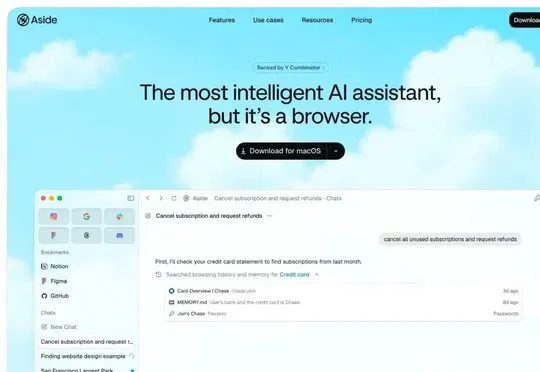
Aside’s founders describe the pivot from a sales assistant to an AI browser (opens in a new tab)
The report traces Aside’s use of Chromium, existing logins and local memory for cross-site work, alongside team-reported revenue and users four months after launch. Annualized figures are not a full year’s collected revenue; local memory does not mean offline-only operation.
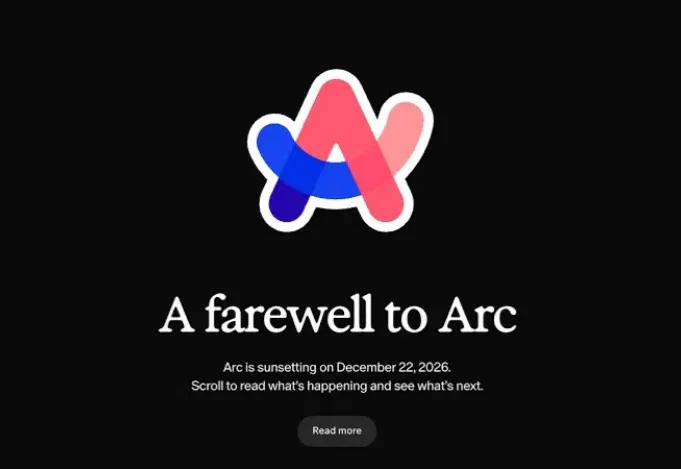
Arc 让位 AI 浏览器,WorkBuddy 则让 AI 用上了旧浏览器 (opens in a new tab)
10 月 22 日,Arc 宣布将于 12 月 22 日关闭桌面端,工程与安全团队转向新浏览器 Dia。用户可以把密码、书签、扩展和历史记录迁过去,继续使用熟悉的功能,也可以选择开启 AI。
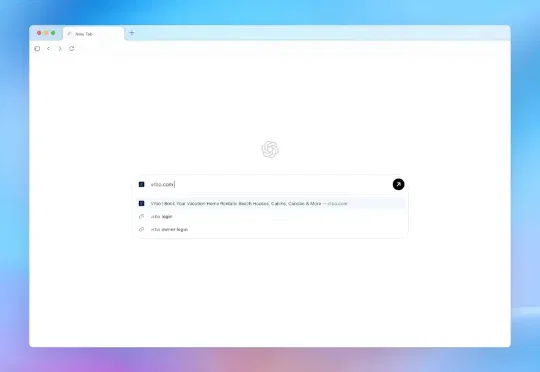
RIP:只活了292天的Atlas (opens in a new tab)
8 月 9 日,OpenAI 的 AI 浏览器 ChatGPT Atlas 正式走到了生命周期终点。从 2025 年 10 月 21 日发布,到 2026 年 8 月 9 日停止工作,Atlas 一共存在了 292 天。不到一年,这款一度被视为 OpenAI 正面挑战 Chrome 和 AI 浏览器生态的产品,就结束了自己的独立浏览器生涯。

赛博菩萨Cloudflare 发布 Kitesurf:专为 AI Agent 打造的浏览器,CPU/内存比 Chromium 低 3-7 倍 (opens in a new tab)
Cloudflare 用 12 周从零写了一个浏览器。Rust 编写,跑在自家的 Workers 边缘网络上,内存占用最多比 Chromium 省 7 倍,专给 AI agent 用,beta 期免费。名字叫 Kitesurf。官博和推文里反复念叨同一句话,Chromium 太沉了,没法给每个 agent 都发一个。
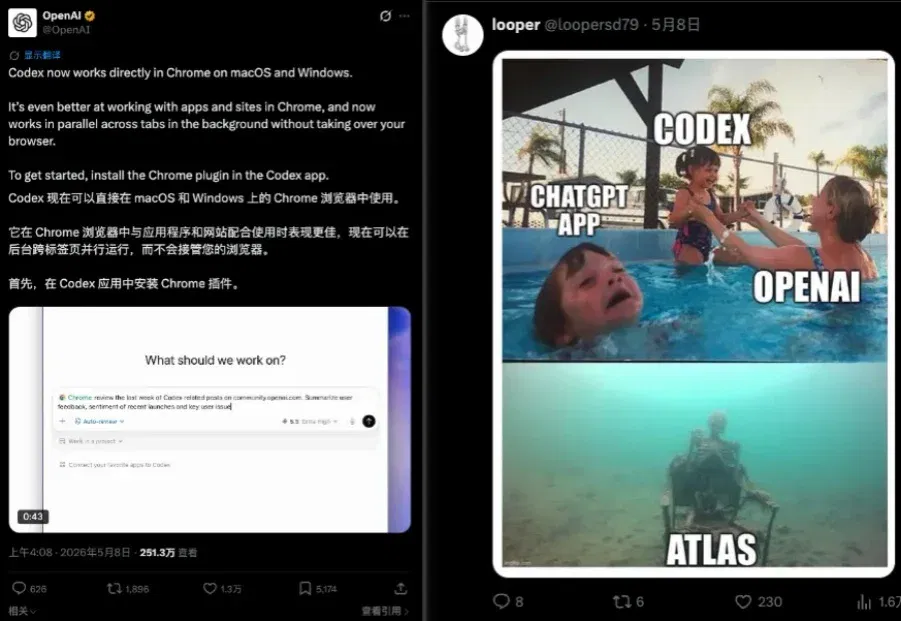
天凉了,该让 AI 浏览器破产了,OpenAI 即将关停浏览器产品 Altas (opens in a new tab)
折腾了九个月之后,OpenAI 即将彻底关停浏览器产品 Altas, 这基本不让人意外,早在五月前 OpenAI 发布 Codex 的 Chrome 插件时,就已经有群众在评论区「预演」了 Atlas 的命运。