Aside’s founders describe the pivot from a sales assistant to an AI browser
The report traces Aside’s use of Chromium, existing logins and local memory for cross-site work, alongside team-reported revenue and users four months after launch. Annualized figures are not a full year’s collected revenue; local memory does not mean offline-only operation.
Editorial correction (November 16, 2026): Revenue and growth figures are the team’s own statements. The annual figures in the article should be understood on the annualized basis described in the report; they do not mean that a full year’s revenue had already been collected four months after launch. Local memory does not mean that all inference and website interactions take place offline.
Have you ever wondered why so many AI agents claim they can do things for you, yet always get stuck at the first step when you actually use them? They either ask you to log in first, say “I cannot do that,” or require you to connect more than a dozen applications one by one. In July this year, OpenAI shut down its own AI browser, ChatGPT Atlas, and moved its web-agent functionality back into the ChatGPT desktop application. For a while, many people felt the AI-browser route was a dead end.
According to the account quoted in the article, CEO Jun Kim disclosed growth figures on November 13, four months after the product’s launch. The annual figure is an annualized description of its current revenue scale. The original material does not provide audited revenue for a complete year, so the $2 million must not be treated as a full year’s revenue already realized within four months.
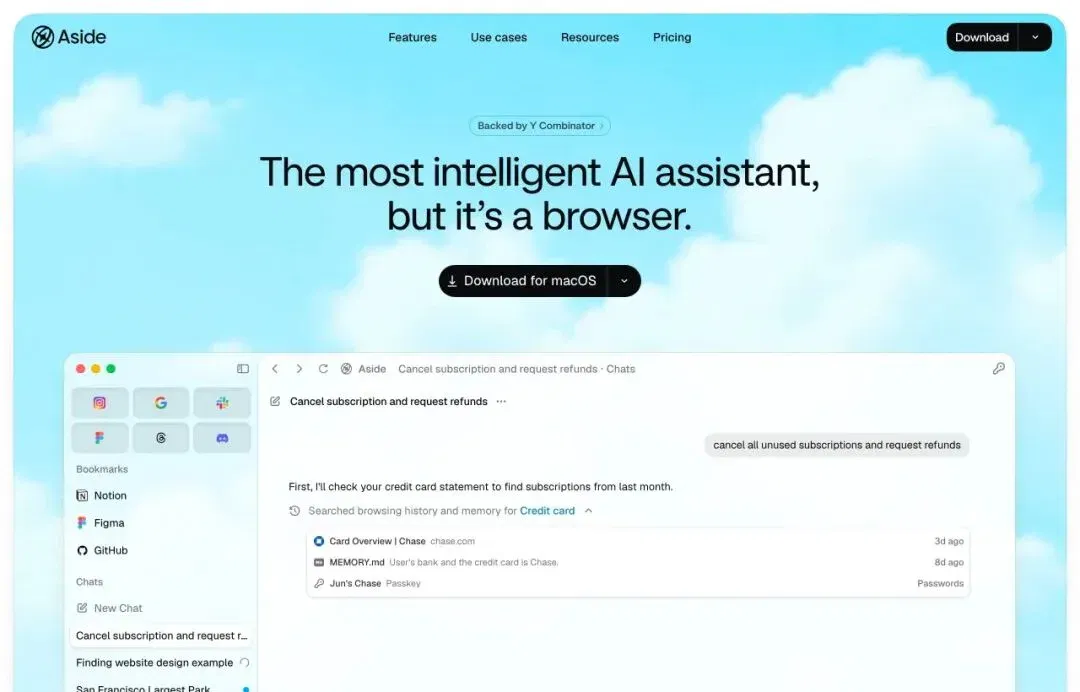
Aside’s homepage says, “The smartest AI assistant, but it is a browser.” Below, it is canceling subscriptions and requesting refunds for users. Image from Aside’s official website.
01 They applied seven times before getting into YC, where they built a sales-meeting assistant
Aside cofounder Chanhee published a long post on X in July this year explaining why they pivoted. It was titled Goodbye, YC Cluely. Cluely is a Silicon Valley company whose pitch is helping you “cheat in interviews and meetings.” Chanhee used the name to poke fun at themselves because their earliest product really did resemble Cluely.
He said the team applied seven times before finally getting into YC. Before YC, they were building a meeting-notes tool whose transcription accuracy was higher than Granola’s. To make it feel like a native application, they directly modified Chromium, the open-source code behind Google Chrome, and built a low-latency pipeline that captured system audio directly from the computer. But they soon discovered that anyone could do meeting transcription; it offered no protection against competitors. They then remembered a problem they had seen at their previous company: customers’ technical questions frequently stumped salespeople on calls, and an “I will get back to you” could leave the deal dead.
They therefore turned the product into a real-time sales-meeting assistant. Its YC description was blunt: help salespeople “cheat” on calls. While listening, the system searched company documents, Slack and earlier calls for answers. A salesperson could click “How should I answer?” and receive an answer within 800 milliseconds. It would also immediately remind them when they missed a customer’s pain point. The team calculated that many companies spent more than $60,000 a year on sales training, mock calls and tests. Their product targeted that budget, and that was also the story that got them into YC.
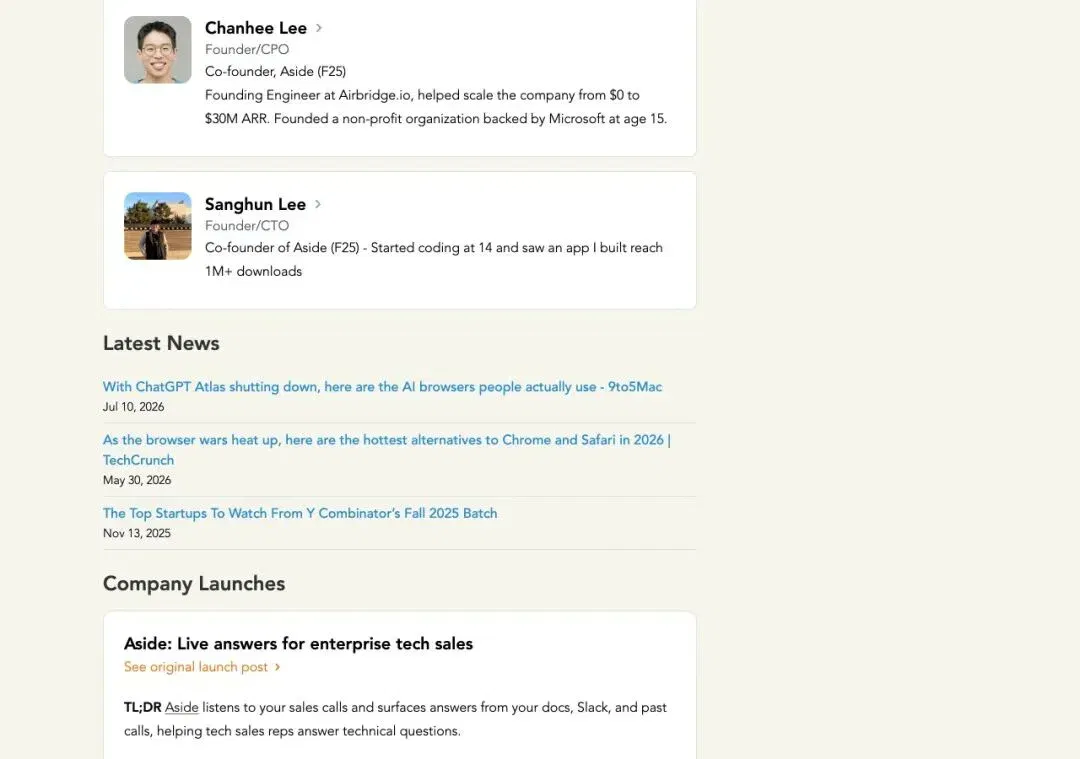
Aside’s company page on YC, showing founders Jun Kim, Chanhee Lee and Sanghun Lee, together with the sales-meeting assistant they originally launched. Image from Y Combinator.
That experience is revealing in itself. A product with a clearly stated pain point and a visible market is not necessarily the product this particular team should build. Their later pivot began precisely by stepping away from this seemingly reasonable direction.
02 After joining YC, three things went wrong at once
Chanhee said they were confident at first, but three things went wrong in succession during their three months at YC. First, customers were unwilling to hand over their information. Website and help-center content alone could not produce useful suggestions: the system needed internal documents, product specifications and past conversations. Yet even after signing NDAs and conducting pilots, companies would not entrust their most sensitive information to a newly founded small business. Without those materials, the assistant could only offer shallow answers, and customer feedback was naturally poor.
Second, customers did not care about what the team did best. Their greatest strength was polishing products to a high standard. They tried all kinds of interface positions to make suggestions useful without being distracting, and even found ways to recreate Apple-like glass effects in Chromium, but still could not find the right interface. Meanwhile, customer feedback often amounted to one question: could it be cheaper?
Third, the team burned out. This kind of product advances almost entirely through customer feedback, but their YC batch coincided with Thanksgiving and Christmas. Customers went on holiday one after another, and this was not an urgently pressing problem. Feedback became despairingly slow. By graduation, they still had no respectable results to show.
Looking at these three problems together, I think the first was actually the most damaging. In enterprise AI software, the hardest part is often obtaining customer data rather than the model itself. Persuading a company to give a new startup its internal documents may be harder than building the product. This also foreshadows what came later: Aside’s entire subsequent product was effectively a way around having to “ask customers for data.”
03 The post-graduation low helped them understand what they did best
From December last year through January this year, they went through a difficult period of “YC graduation syndrome.” Chanhee said nobody wanted to write a single line of code, they had no energy, and work was no longer interesting. But that low forced them to look back at what they had missed. They began asking: when did we move fastest? What kind of work gave us energy? What exactly was special about this team?
He reviewed the team’s development speed and found that work on the sales assistant had been a full five times slower than on the original meeting-notes tool. The simplest explanation was whether they used their own product. As he put it, customer feedback shortens the feedback cycle, but being the customer yourself makes it shorter still: you use it every day, notice what is wrong, fix it immediately and continue using it. They realized they moved fastest when making products for themselves.
The answer to what they were especially good at also gradually became clear. At YC, other founders frequently asked them for help with macOS and Chromium problems. Their CTO disliked Electron applications that did not feel sufficiently native, so he simply modified Chromium himself. They built everything from hot updating to real-time audio pipelines. Chanhee said that among roughly fifteen hundred companies across the previous ten YC batches, they knew fewer than five teams capable of modifying Chromium to that depth. People also regularly praised the design of their products and website, and whenever they posted their work on X, it gained attention.
CEO Jun’s background shows the same pattern. On his personal website, he writes that he made an operating system at twelve, thinking he could beat Bill Gates; at fourteen, he founded a developer community with fifty thousand users then and two hundred thousand now; and at seventeen, he joined South Korean marketing-data company Airbridge as a founding-team member, watching it reach $30 million in annual revenue and the pre-IPO stage. He also worked on a K-pop girl group and made an app called Cosmo for its fans. Chanhee says Jun is obsessive about details, constantly considering the most suitable product form for each problem.
I think this is the part of the story founders should remember most. After a direction fails, most teams seek a “bigger market” or a “more painful problem.” Aside did the reverse: first asking under what conditions they moved fastest and what abilities they possessed that others did not. Combining deep Chromium modification with attractive product design naturally pointed toward building a browser.
04 A joke, and the problem they could never get around
Chanhee said the team had a joke at YC: if this project failed, they would build a browser called bro. They knew how to modify Chromium and make products, so perhaps they could make a successor to Arc. Arc was a popular browser from The Browser Company, which later shifted its focus to the new product Dia. Chanhee himself was a devoted Arc user and eventually had to return to Chrome. When the sales assistant actually failed, the joke stopped being a joke.
What really made them decide was the problem they could never get around while building the sales assistant: context. Every company kept information somewhere different: Notion, GitHub, or even spreadsheets running the whole business. Each new customer meant another integration and another indexing pipeline. Eventually they asked why they could not simply use the login states, sessions and browsing history already in the browser.
He said the browser is the most-used software for most people, and most knowledge work already happens there. It holds more context about your work than almost any other application. They had several hypotheses: if a large model is a machine powered by context, more relevant context should make it much stronger; if agents work directly through the browser, users need not configure endless integrations; and if the browser makes integrations unnecessary, it could change the whole enterprise-software market built around them. Discussing these ideas brought the entire team back to life. Less than two weeks passed between shutting down the sales assistant and deciding to build a browser.
I find this approach interesting. In recent years, the default route for AI agents has been connecting APIs, building integrations and getting every application to open up to AI. But that is slow and expensive and depends on each software company’s willingness to cooperate. Aside’s idea is that people are already logged in to all these sites: rather than connecting them individually, let AI use the doorway people have already opened. This heads in exactly the opposite direction from the “ask customers for data” problem they faced with the sales assistant.
05 Five months behind closed doors produced a browser that works for you
They defined Aside around three things: a carefully polished browser like Arc, a password manager specifically for AI agents and a state-of-the-art browser agent. Then, telling almost nobody, they spent five whole months building privately. Chanhee said it sounds crazy, and it really was: Codex and Claude could not help much with the hardest parts. Chromium is a huge, twenty-year-old codebase with more than 50 GB of source, and coding agents could not reliably make deep modifications. They also built the agent architecture themselves because they did not want to produce a rough AI product. Design, meanwhile, remained where AI helped the least.
Using today’s Aside is actually straightforward. Through websites where you are already logged in, it works directly in email, dashboards, internal company tools, documents and spreadsheets. Even if something takes minutes or hours, it keeps working. It turns browsing history into local memory, learning which site to use for which job so you need not explain from scratch each time. Say, “Find the candidate I opened yesterday and help prepare an interview outline,” and it knows where to look.
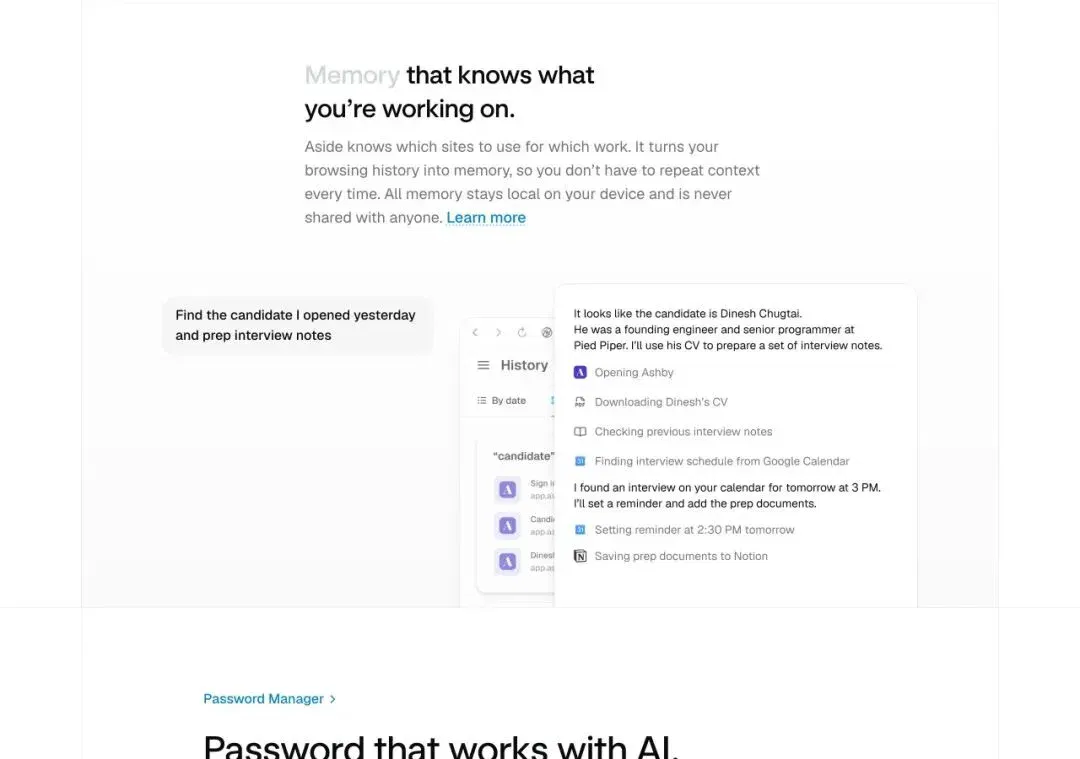
Aside’s memory feature: say, “Find the candidate I opened yesterday and help prepare an interview outline,” and it knows where to look. Image from Aside’s official website.
The website describes credential autofill, local encryption and confirmation for sensitive actions, intended to reduce credential exposure and accidental operations. What is actually visible still depends on the website, tools and execution environment. Storing memory locally also does not mean all task data stays away from remote services.
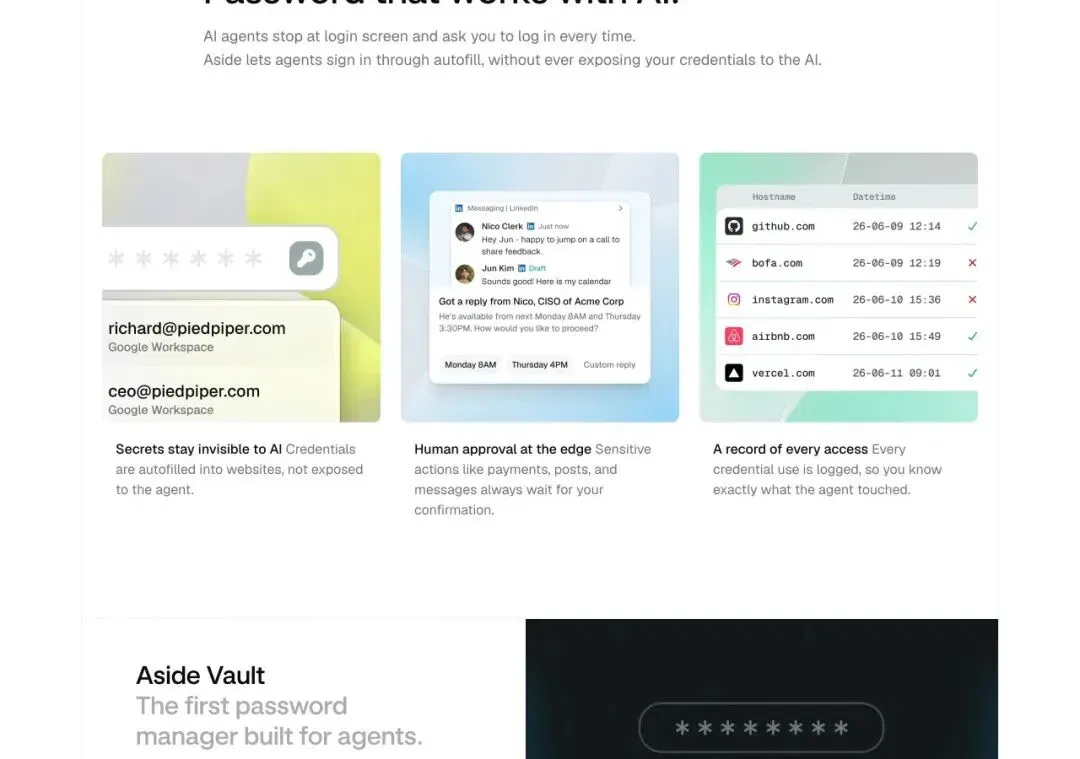
Aside’s password manager for AI agents: credentials are filled into websites rather than given to AI, sensitive actions require human confirmation, and every use is recorded. Image from Aside’s official website.
On performance, they ranked first on three browser-agent evaluations, ahead of OpenAI, Anthropic and Browser Use, and recently earned the best result on a Scale AI computer-use evaluation. Jun says they never really intended to chase leaderboards; they simply improve the experience of operating computers in the background every day so it feels smoother to users.
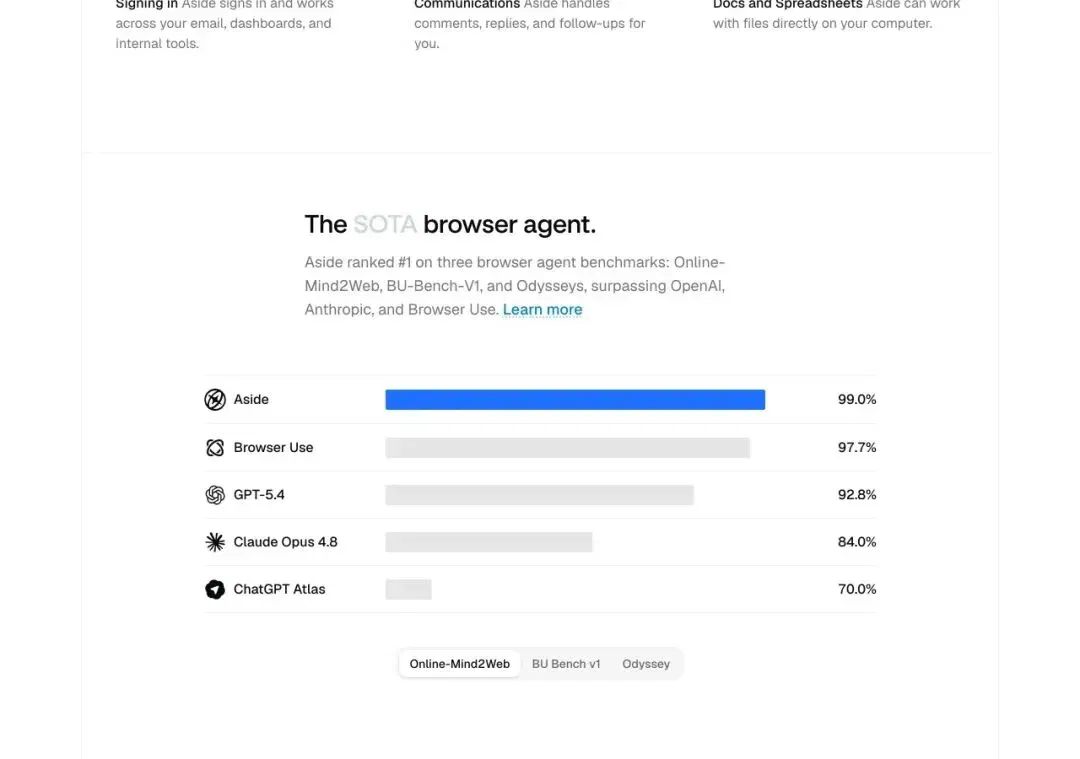
The browser-agent comparison on Aside’s website places it ahead of Browser Use, GPT, Claude and ChatGPT Atlas. Image from Aside’s official website.
Jun gave two examples himself. After he missed a flight, Aside messaged the hotel and airline, completed all the cancellations and even recovered taxes from a nonrefundable ticket. He says he did not send a single message. In another example, he calls Aside the best personal assistant for founders applying for O-1 visas or undergoing SOC 2 security certification. Even with an intermediary, you still have to find documents and fill forms yourself. Now he only clicks “Hand it to Aside,” and it finds the relevant materials across different applications and completes the paperwork.
I think these examples explain Aside better than evaluation scores. Refunding flights and preparing visa documents are not difficult, but they are tedious, involve switching among several websites, require your accounts and depend on knowing what you did previously. That is exactly where traditional AI agents perform worst, and exactly what a browser already logged into all your sites and remembering your history is best placed to do.
06 Four months after launch, the team discloses annualized revenue
After five months of private development, they ran a small closed beta and then launched publicly. Chanhee says the launch video exceeded 1.6 million views, users flooded in to try it, and the volume of feedback surprised them. They had expected interest, he says, but not that people would care so much. You could call it luck, but they made that luck themselves: honestly identifying the team’s strengths, choosing a problem suited to them, building it in a form few teams could execute well, and then committing without a route back.
The team reports annualized revenue exceeding $2 million and about 150,000 monthly active users, with the annualized figure rising from $1 million to $2 million in 33 days. These are point-in-time measures, not guarantees of subsequent realized revenue or continued growth.
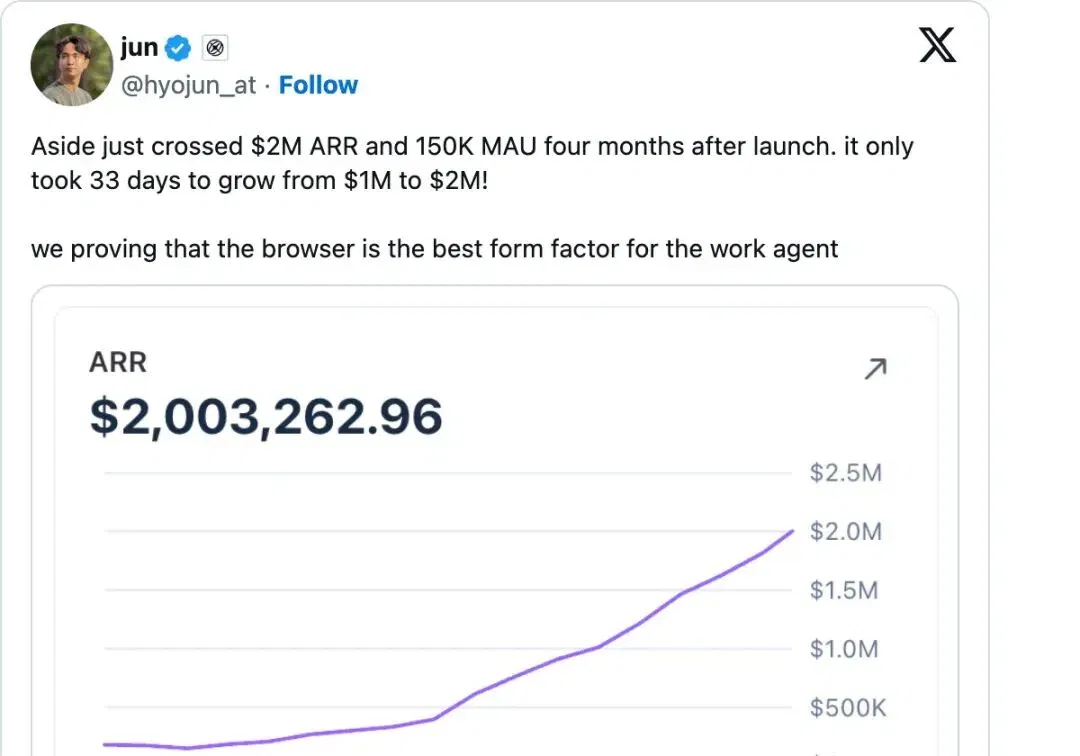
The revenue curve Jun Kim shared on X has passed $2 million on the article’s annualized basis. Image from Jun Kim’s X account.
The result is more interesting in the wider AI-browser competition. This year’s browser war is no longer about better search, but whose AI can act for users. OpenAI’s Atlas had few users and announced closure in July; Perplexity’s Comet was at one point restricted to premium members paying $200 a month; The Browser Company’s Dia continues progressing. Large companies have all tried this space, yet a small team still building a sales assistant eight or nine months earlier emerged at this moment.
For people asking, “Isn’t this just a browser?”, Chanhee says what they build next will make that question seem very outdated.
07 Did they go against YC’s advice?
Anyone familiar with YC knows its central line: “Make something people want.” Talk to users and launch quickly. Chanhee asked whether they had violated that advice. His answer is both yes and no. Yes, because they made what they themselves wanted, barely talked with users and did not launch quickly. No, because they were the users: continuously releasing internally, using the product, finding problems and fixing them. That feedback loop was faster than any user research.
He says they were sure of two things: people disliked Chrome and kept looking for alternatives, but would not switch to a browser that looked unfinished or repeatedly broke. They therefore preferred spending five months polishing it into something they wanted to use every day and could proudly show, before releasing it.
I think there is an important prerequisite here: the team must genuinely be its own target users, and demanding ones at that. Aside’s founders work in the browser every day and are themselves its heaviest users, so “making what we want” and “making what users want” are the same thing for them. But if a team builds something it would never use, such as the sales assistant they built before, no amount of polishing behind closed doors will help. In that situation, it has to listen to customers properly.
Some thoughts of my own
What moves me most about Aside is not going from $1 million to $2 million in 33 days, but how they pivoted. Many teams switch to something more fashionable after failing. Their choice rested instead on three simple questions: when are we fastest, what energizes us, and what can we do that others cannot? The answers pointed precisely to a place where large companies had not succeeded either.
I also think they made a crucially sound bet. AI agents often fail at real work not because the model is insufficiently intelligent, but because they lack context and cannot access your accounts. The browser is exactly where both are present. It knows what you use and is already logged into all your sites. Rather than making every application adapt to AI, let AI use the entry point people already use.
The risks are also obvious. Chromium underlies the browser, Google controls Chromium, and Chrome itself is incorporating Gemini. An agent using all your accounts and paying and messaging for you may struggle to rebuild trust after even one serious security incident. OpenAI shutting Atlas also shows large companies may not favor a standalone browser. Whether Aside can grow beyond 150,000 monthly active users depends on continually being more useful than others in the space between Chrome and these large companies.
For product builders, I think Aside leaves a practical question: do you possess something difficult for others to do that you personally use every day? If so, it may deserve your commitment more than chasing an apparently larger market.
Sources
• Jun Kim, Aside’s annual revenue figure passes $2 million, X, November 13, 2026. Original: https://x.com/hyojun_at/status/2121003923024867640
• Chanhee Lee, Goodbye, YC Cluely: why we pivoted to an AI browser, X, July 18, 2026. Original: https://x.com/hiddnest/status/2078506477980209258
• Aside official website. Original: https://aside.com
• Y Combinator, Aside company page. Original: https://www.ycombinator.com/companies/aside
• 9to5Mac, With ChatGPT Atlas shutting down, here are the AI browsers people actually use, July 10, 2026. Original: https://9to5mac.com/2026/07/10/with-chatgpt-atlas-shutting-down-here-are-the-ai-browsers-people-actually-use/
• TechCrunch, The browser wars aren't about search anymore, May 30, 2026. Original: https://techcrunch.com/2026/05/30/as-the-browser-wars-heat-up-here-are-the-hottest-alternatives-to-chrome-and-safari-in-2026/
This article was originally published by the Deep Thought SenseAI WeChat Official Account. Author: Deep Thought SenseAI.
Related topics
After reading
Join the AINRK community
Read how to join the community and connect with people working in AI.
Related articles
Continue reading related topics and articles in this category.

Seekee co-founder on Latin America's AI browser market: local needs and bundled subscriptions (opens in a new tab)
In an interview, Xu Leyang discusses Seekee's market choices, user research and bundled features for Latin American families' photo editing, light office work and learning needs. Download and business-scale figures are self-reported and do not equal paying-user counts.
Arc 让位 AI 浏览器,WorkBuddy 则让 AI 用上了旧浏览器 (opens in a new tab)
10 月 22 日,Arc 宣布将于 12 月 22 日关闭桌面端,工程与安全团队转向新浏览器 Dia。用户可以把密码、书签、扩展和历史记录迁过去,继续使用熟悉的功能,也可以选择开启 AI。
RIP:只活了292天的Atlas (opens in a new tab)
8 月 9 日,OpenAI 的 AI 浏览器 ChatGPT Atlas 正式走到了生命周期终点。从 2025 年 10 月 21 日发布,到 2026 年 8 月 9 日停止工作,Atlas 一共存在了 292 天。不到一年,这款一度被视为 OpenAI 正面挑战 Chrome 和 AI 浏览器生态的产品,就结束了自己的独立浏览器生涯。

赛博菩萨Cloudflare 发布 Kitesurf:专为 AI Agent 打造的浏览器,CPU/内存比 Chromium 低 3-7 倍 (opens in a new tab)
Cloudflare 用 12 周从零写了一个浏览器。Rust 编写,跑在自家的 Workers 边缘网络上,内存占用最多比 Chromium 省 7 倍,专给 AI agent 用,beta 期免费。名字叫 Kitesurf。官博和推文里反复念叨同一句话,Chromium 太沉了,没法给每个 agent 都发一个。
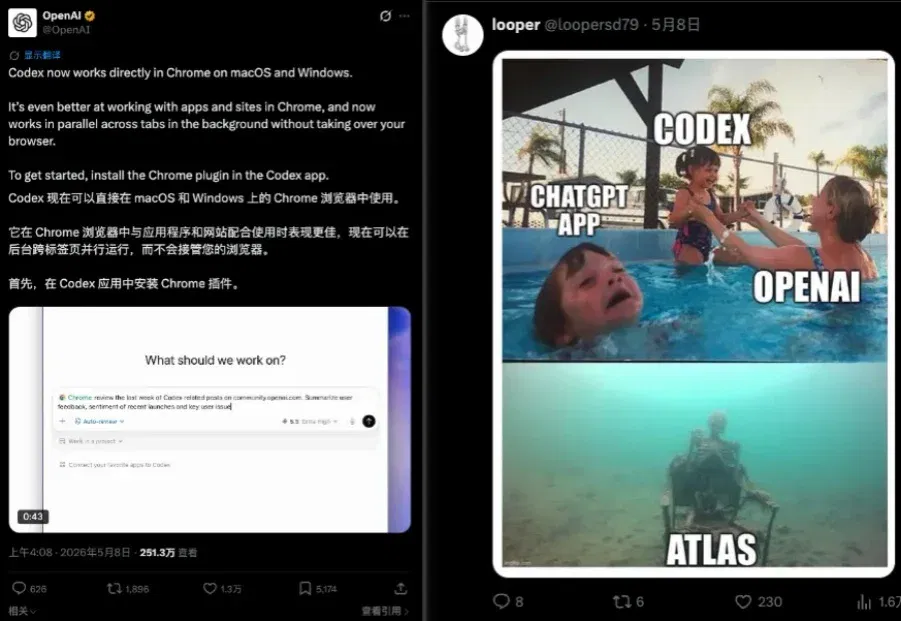
天凉了,该让 AI 浏览器破产了,OpenAI 即将关停浏览器产品 Altas (opens in a new tab)
折腾了九个月之后,OpenAI 即将彻底关停浏览器产品 Altas, 这基本不让人意外,早在五月前 OpenAI 发布 Codex 的 Chrome 插件时,就已经有群众在评论区「预演」了 Atlas 的命运。