Tencent launches Hy4 flash; Zhidx tests office work, animation and 3D tasks
The report compares API prices, internal work-task tests and creative examples for Hy4 flash. It records lower model-call costs while noting weaknesses in subtitle synchronization, structural detail, aesthetics and self-checking.
Editorial correction (November 16, 2026)Cost reductions apply to particular models, work tasks and billing settings. They do not mean every real workload or all production costs fall 95%.
Tencent's comparisons on specific internal tasks show lower model-call costs. Reductions differ by benchmark, reference model and pricing basis, and should be read with the test conditions below.
First, watch this music video.
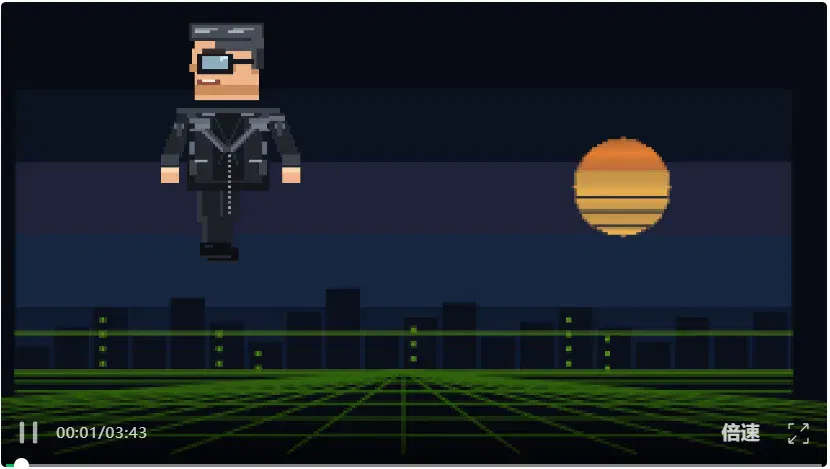
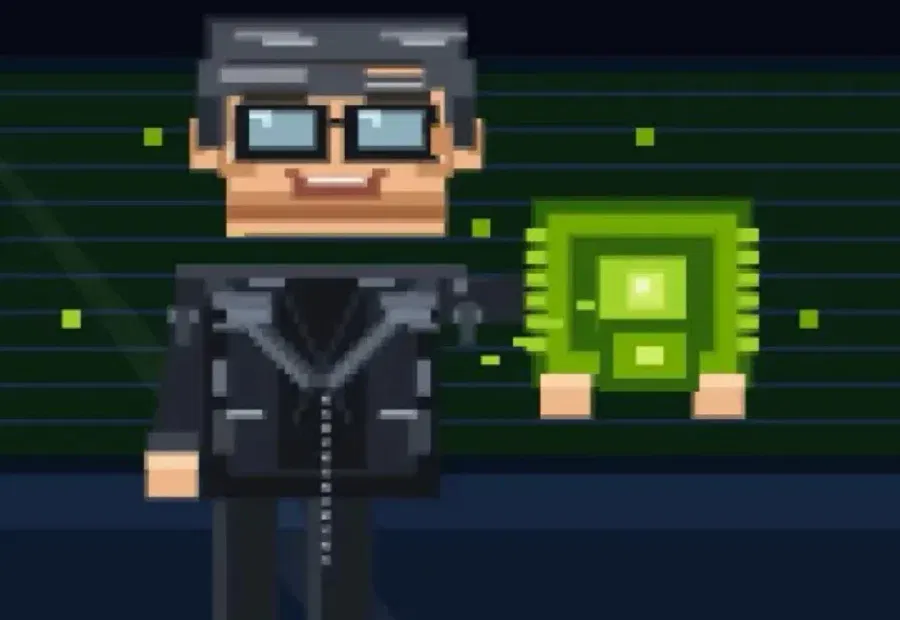
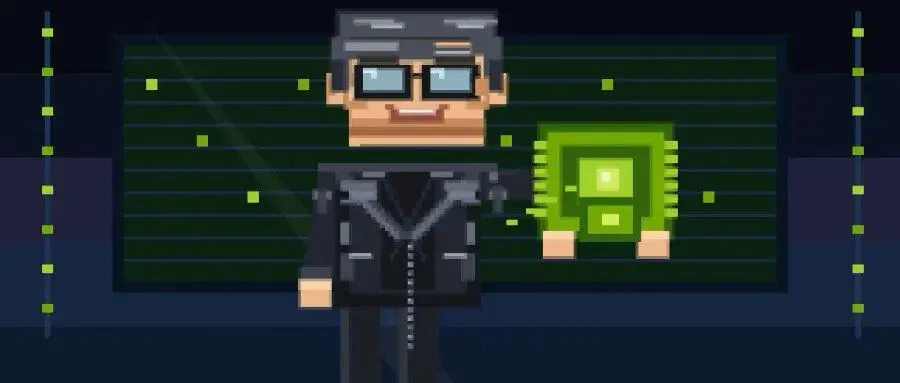
Jensen Huang, in a black leather jacket, becomes a pixel character performing to Jolin Tsai's The Sun Never Sets. At the lyric about a love postcard, he pulls out a green GPU chip.
The familiar jacket and movements capture something of NVIDIA GTC.
The video is hardly polished. Huang moves stiffly, details are rough, and even the lyric subtitles fail to match the background music accurately.
But AI created the entire video by writing code, even drawing the pixel Huang itself. The model is Tencent's newly released Hunyuan 4 flash, from Shunyu Yao's team.
Zhidx reported on November 16 that Tencent had just officially released Hunyuan 4 flash, or Hy4 flash, with 224B total and 12B active parameters, multimodal support and a million-token context window, decoding at more than 150 tokens per second.
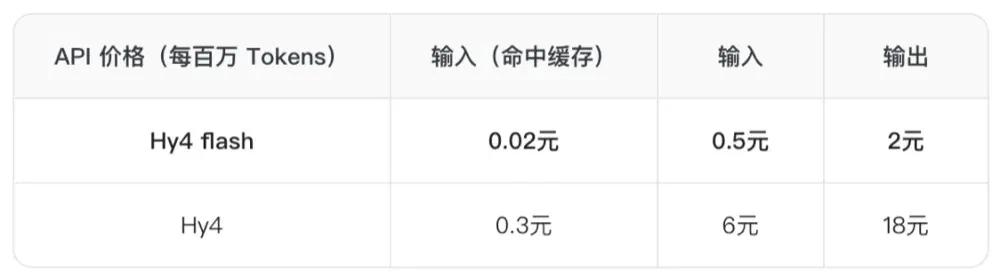
Low cost is its focus. API prices per million tokens are 0.5 yuan for input and 2 yuan for output, one-twelfth and one-ninth of full Hy4's prices. Cached input is as low as 0.02 yuan.
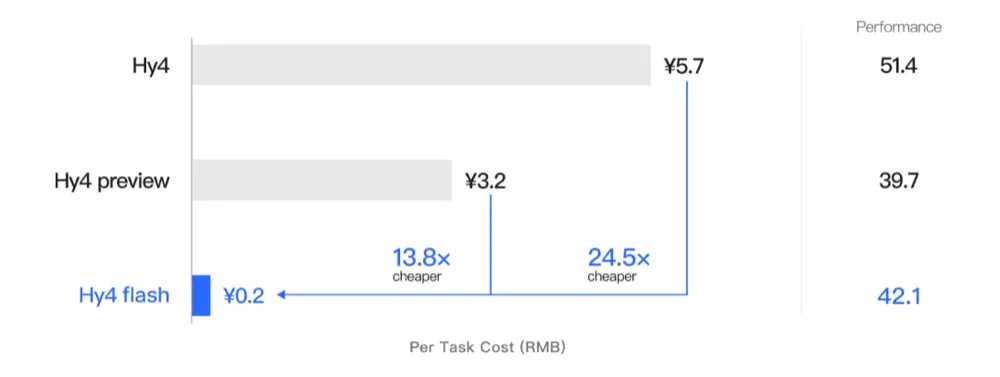
In Tencent's everyday-work evaluation, Hy4 flash outperformed the Hy4 preview at approximately 0.2 yuan per task.
Another blind test involving eighty-five internal users and 259 work tasks found satisfaction close to Claude Haiku 5.5, at just 0.26 yuan per task versus DeepSeek-V4.1-Flash-1017's 1.2 yuan, with shorter completion times too.
We tested it early in WorkBuddy. Beyond the opening Huang video, we asked it to develop The Sims 5, build a 3D tennis match, animate Beijing landmarks and use Blender to put a pelican on a bicycle.
01.
A music video for Jensen Huang
More than fifty shots in one run
For the Huang music video, I followed an AI music-video tutorial, asking the model to complete music analysis, art direction, character drawing, storyboarding and video production in sequence.
The character design also used visual understanding. I uploaded a photograph of Huang and asked it to use his hairstyle, glasses and black leather jacket to create a cute pixel character.

The model not only generated the character's appearance, but also made a dedicated interactive character-preview page. On this page, I could switch between five orientations, twelve expressions and twelve actions for Jensen Huang, and could also have him pick up a GPU chip, a microphone or a laptop.
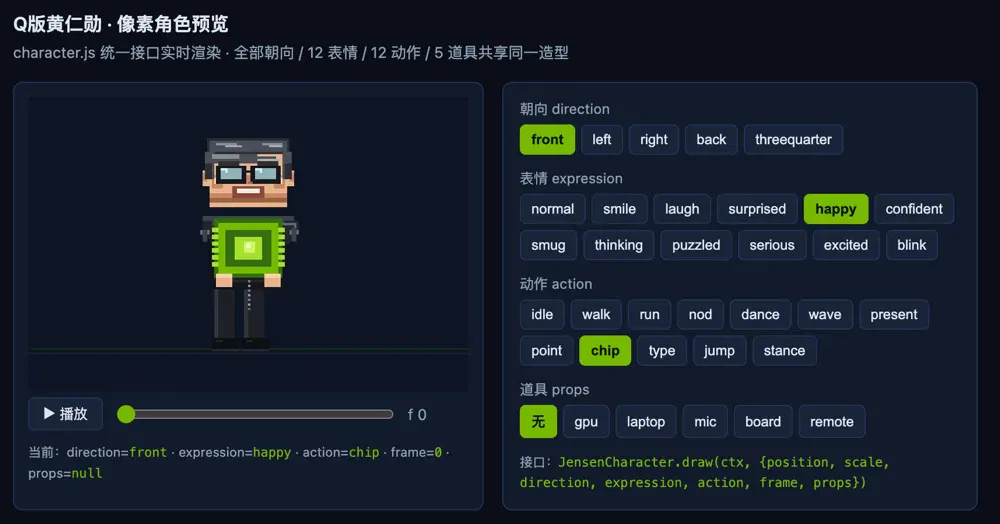
As you can see, the character's short gray-black hair, glasses and black leather jacket have all been retained. The lapels and silver-gray zipper on the clothing are also clearly visible, and the overall appearance is reasonably recognizable.
Next, it designed a story around the song's rhythm and lyrics, generating a storyboard overview with more than fifty shots.
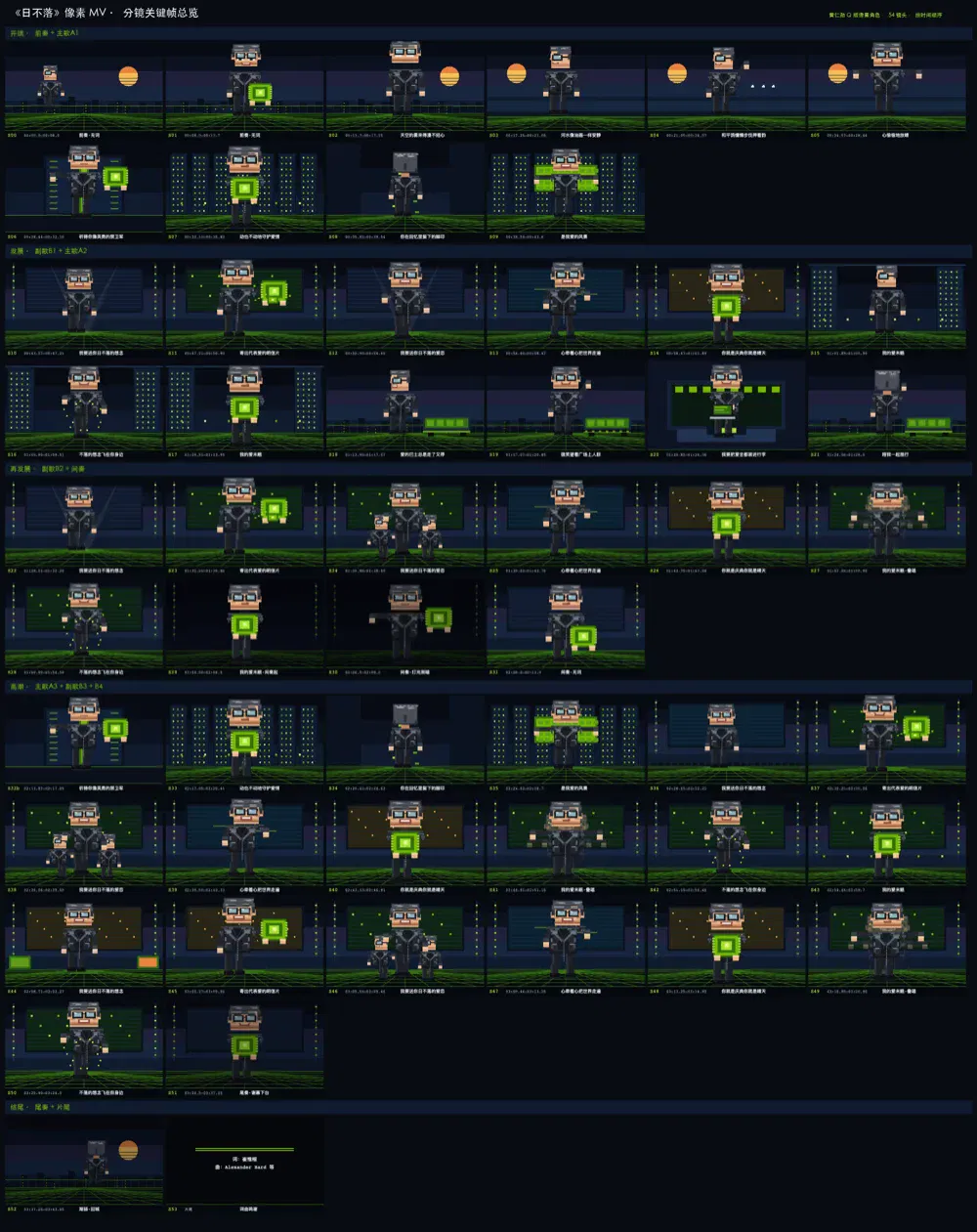
It then wrote animation code from those storyboards and assembled the opening video.
The finished piece has several clear weaknesses.
First, insufficient visual detail, with somewhat stiff character motion and some rough transitions.
More obvious is subtitle misalignment. Despite explicit instructions to use the lyric timeline and check synchronization during export, the final subtitles still failed to follow the music accurately.
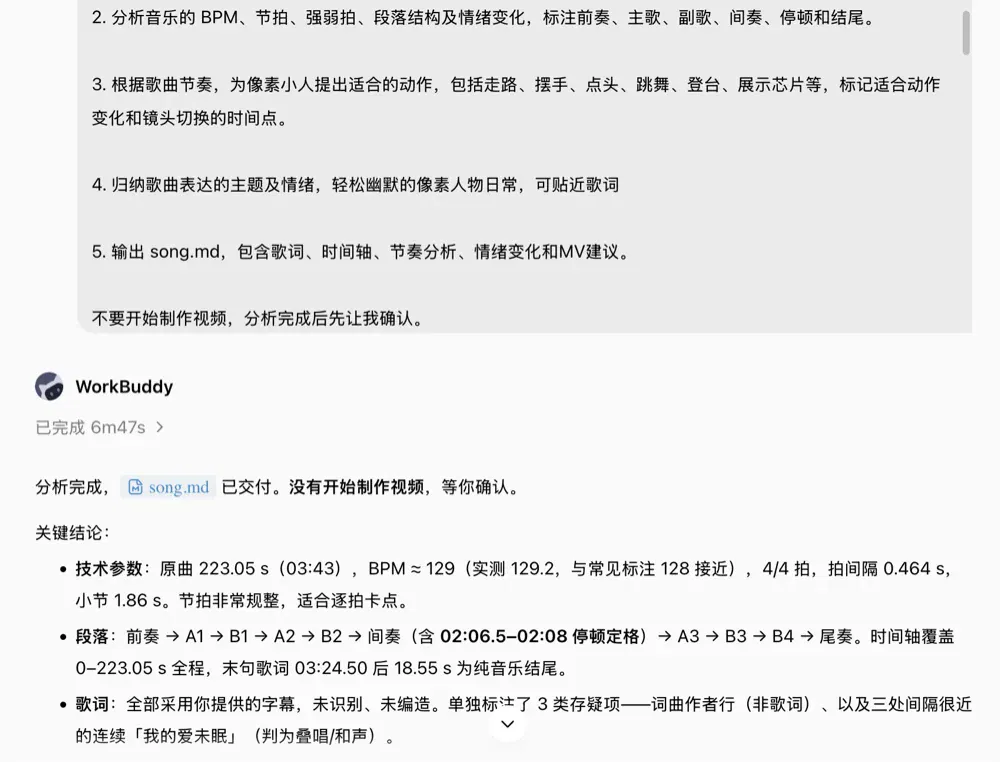
Overall, the model completed an entire set of long-horizon tasks, from character design and storyboard planning to animation production and video export. However, there is still room for further refinement in visual detail and audio-video synchronization.
02.
One prompt for The Sims 5 and a 3D tennis court
Using Blender directly too
Beyond the music video, I tested complex frontend development, 3D scenes and cross-tool tasks with Hy4 flash.
(1) Building The Sims 5 from one sentence
First, I asked for a version of The Sims 5 with visuals and gameplay.
Unexpectedly, it produced a playable simplified version.
An isometric house with three family members sits in the center. The left displays hunger, energy, entertainment, social and hygiene states in real time; the right shows character information.
Players can click on furniture to arrange actions, or enable automatic living to let the characters move and act on their own. The top of the page offers options such as pause, speed multipliers and build mode, while the area below also records the character's behavior.
Of course, this is a long way from the actual game The Sims. The characters are merely simple cartoon figures, and the furniture is made up of relatively basic geometric shapes. Both the room structure and the game visuals are extremely rudimentary.
Nevertheless, the model has already implemented basic gameplay such as changes in characters' needs, autonomous behavior and interactions with furniture, rather than merely producing a static page that looks like a game.
(2) A 3D tennis match, but players miss the ball
Next came a harder task: create a complete 3D tennis match. The prompt required it not only to build facilities such as the court, stands and clubhouse, but also to implement the players' serves, back-and-forth rallies and match scoring, as well as different court-surface materials and switching between camera angles.
The model ultimately produced an interactive 3D tennis game.
We could switch panoramic, tracking and close-up views and adjust speed, court type and day/night settings.
The pixel-style court included stands and clubhouse facilities, with players and balls moving continuously.
But on closer inspection, quite a few bugs could still be found. For example, an implausibly positioned flagpole appeared near the court. The two players seemed to be exchanging shots back and forth, but sometimes their rackets did not touch the tennis ball at all. The bodies of some spectators in the stands were also fused with their seats.
(3) A GitHub skill, but distorted Beijing landmarks
We asked it to use GitHub's perspective illusion skill to produce a ten-second animation of Beijing landmarks.
It needed to place the Temple of Heaven's Hall of Prayer for Good Harvests, a Forbidden City corner tower, CCTV headquarters, China Zun and the Bird's Nest at different depths, with the camera passing through them in sequence.
It completed the video and automatically added background music with a traditional Chinese character.
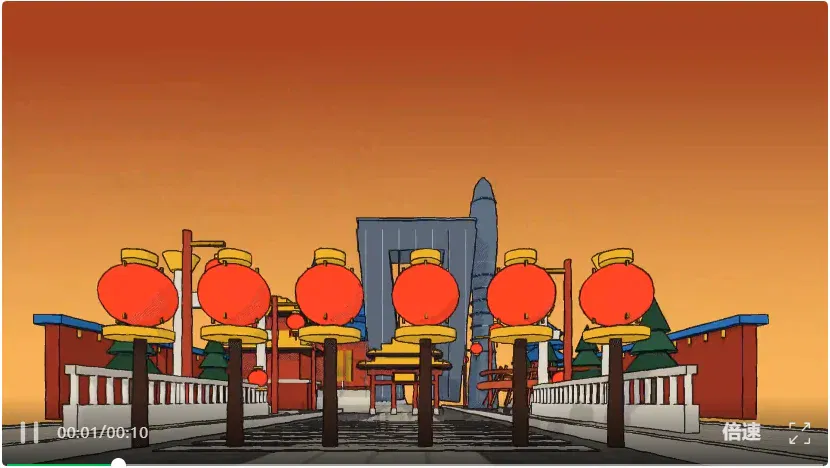
The buildings were less successful. The Hall of Prayer and China Zun were broadly recognizable, but CCTV's famous trouser-like silhouette was badly distorted, and other landmarks were hard to identify.
Camera motion and transitions largely met the request, but complex architectural geometry remained difficult.
(4) A rainy-night convenience store below Mount Fuji, with a pleasing atmosphere
Next we requested a Japanese convenience-store street corner on a rainy night, presented as a 3D miniature freely rotatable, draggable and zoomable.
This looked relatively good. The store, vending machines, bicycle, streetlights and corner railings were present. Pink-purple neon, rain and reflections on wet pavement created an anime-like rainy-night atmosphere.
The model implemented free rotation and zoom, allowing us to view the entire miniature street scene from different angles. Compared with AI-generated 3D scenes that currently look particularly good, it still falls short in artistic detail and overall aesthetics.
(5) Blender puts a pelican on a bicycle
Finally, we asked it to operate Blender, writing a script through the Blender Python API for an approximately sixteen-second pelican-cycling animation.
It successfully built the pelican, bicycle and walkway scene.
The video also included tracking shots and close-ups as requested.
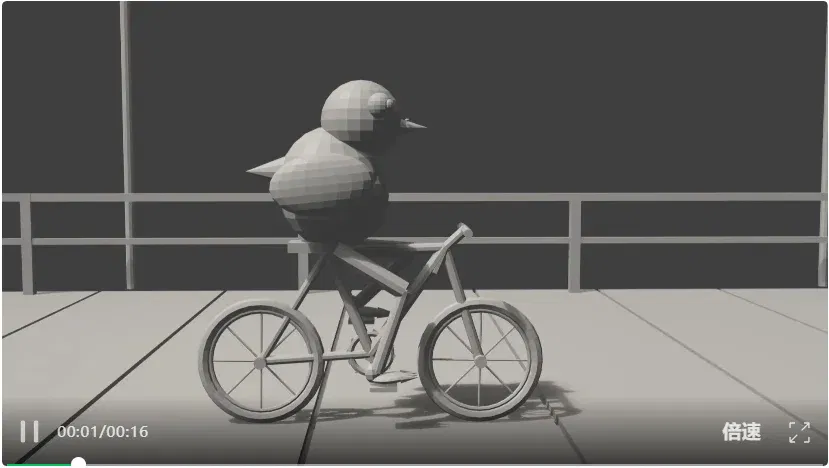
But the overall image was rough. The pelican and bicycle used simple geometry, and some frames had almost no material color, resembling unstyled white models.
This also has to do with our prompt: we specified the character's actions and camera movement, but did not explicitly request a color scheme or a style for the scene's materials.
The pedaling looked good. Although the pelican's wings never touched the handlebars, its webbed feet alternated with the pedals.
Writing Blender code took approximately twenty-six minutes, followed by more than twenty minutes of rendering, nearly fifty minutes total. We used a Mac, so rendering time also depended on local hardware.
The model not only generated the script but ran it in Blender and exported video. At least it can control professional 3D software through code to make basic animation.
Its strongest feature in these tests was completing multiple steps continuously and connecting different tools.
Its weaknesses were also clear: first, detail, with visuals, models and materials mostly merely recognizable; second, aesthetics, with shots, colors and composition heavily dependent on prompts; third, complex architecture, human bodies and machinery, which distorted more as complexity increased; fourth, self-checking, since it could not identify the problems itself.
As a model positioned in the Flash category, it can already complete quite a few complex coding and creative tasks. If the generated content is to be used directly as finished work, there are still many aspects that require manual debugging and adjustment.
03.
Less than 0.3 yuan per task
Blind-test satisfaction near Claude Haiku 5.5
Tencent also released comparisons with DeepSeek, Claude and GLM, emphasizing the cost of completing the same task.
First, look at WorkIndex, Tencent's self-built evaluation set for everyday work. This evaluation covers eight categories of everyday work tasks, including PPT creation and modification, document editing, spreadsheet repair, audio and video processing, and visual understanding.
Hy4 flash scores approximately 42 on WorkIndex, above the Hy4 preview's 39 but below full Hy4's 51.
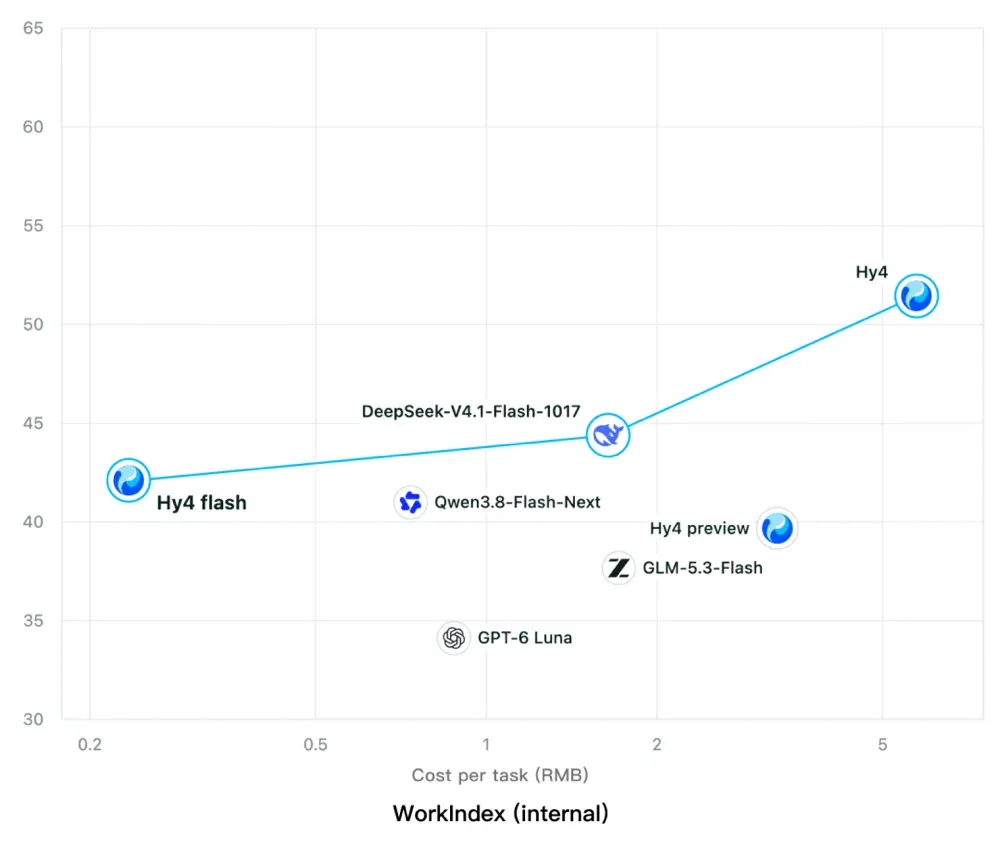
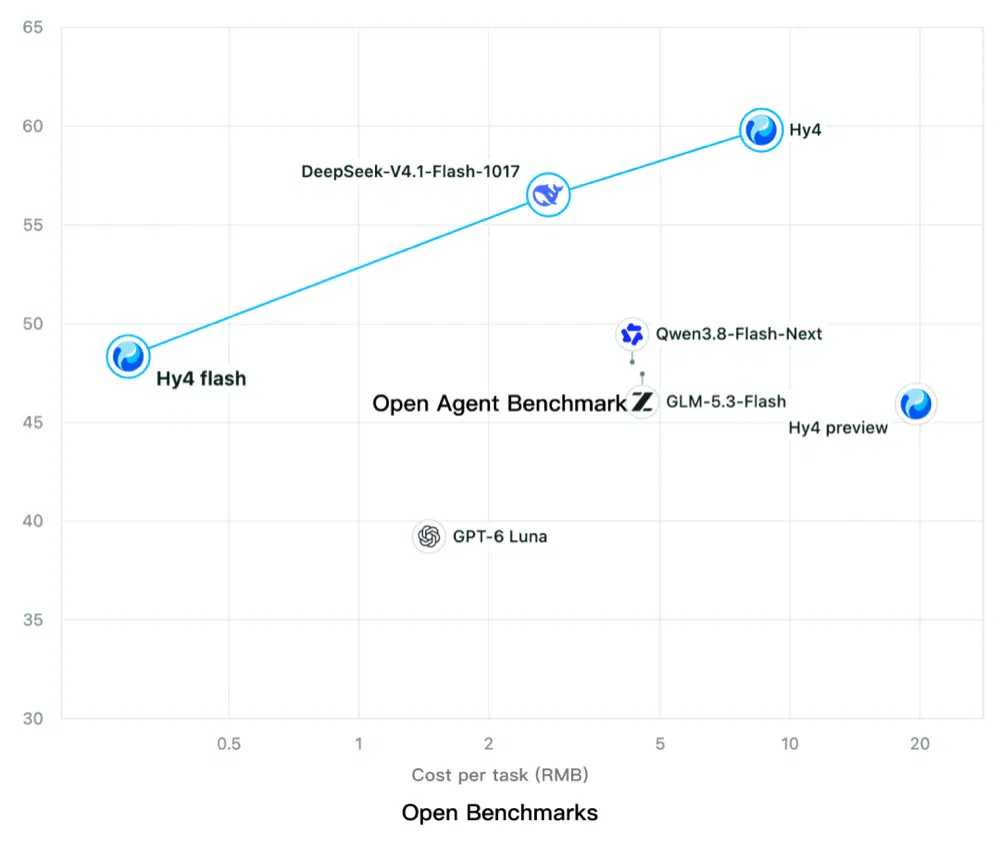
▲Performance and cost on internal and external tasks.
Average task cost is approximately 0.2 yuan for flash, 3.2 for the preview and 5.7 for full Hy4.
More specifically, on PPTGenBench presentation generation, flash scores 54.2 versus the preview's 52.3; on PPTCoEditBench collaborative editing, the scores are 74.0 and 71.5 respectively.
Complex software engineering still shows a substantial gap between flash and the full version. On Terminal-Bench 4.0, flash scores 19.2 versus 44.4; on ProgramBench, 16.0 versus 30.0.
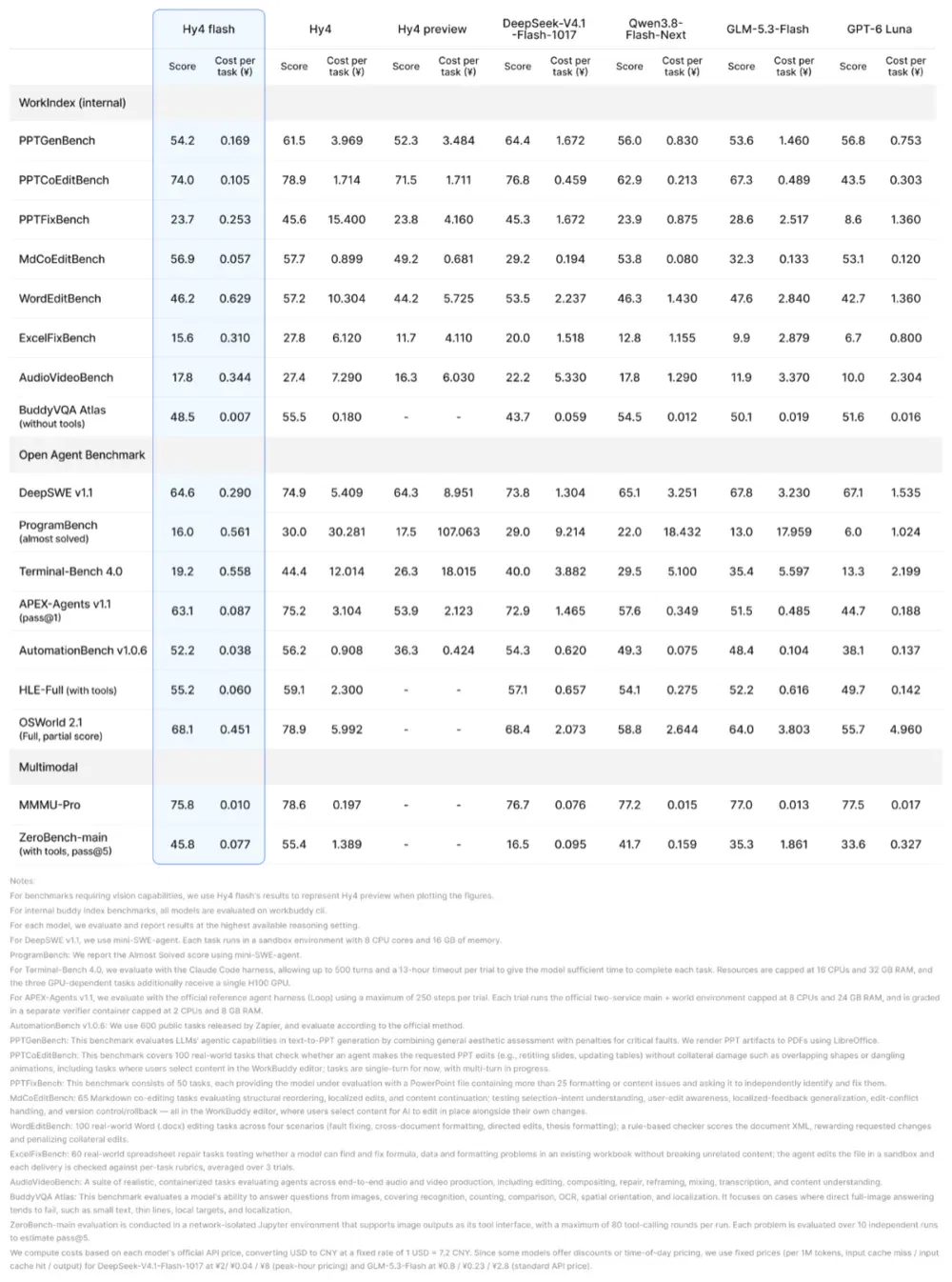
▲Detailed public-agent and multimodal benchmark comparisons.
Tencent also organized a blind test on real work tasks. This test invited 85 internal WorkBuddy users to evaluate a total of 259 everyday work tasks across 27 categories, comparing user satisfaction with the models' outputs, end-to-end task time and cost.
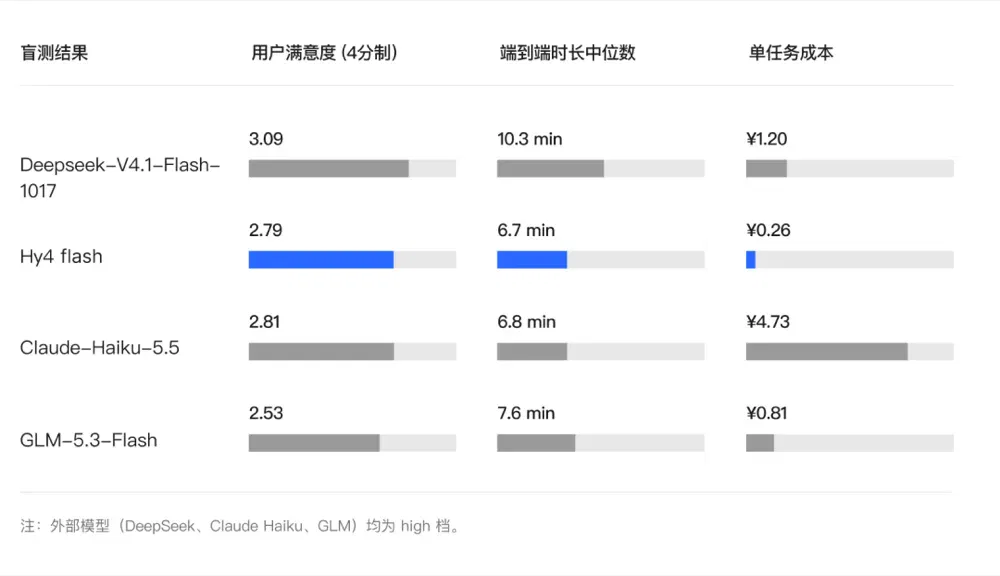
On a four-point satisfaction scale, Hy4 flash scored 2.79, nearly matching Claude Haiku 5.5's 2.81, above GLM-5.3-Flash's 2.53 but below DeepSeek-V4.1-Flash-1017's 3.09.
Hy4 flash's median end-to-end task time was 6.7 minutes, shortest among the four. Claude Haiku 5.5 took 6.8 minutes, GLM-5.3-Flash 7.6 and DeepSeek-V4.1-Flash-1017 10.3.
Per-task costs were 0.26 yuan for Hy4 flash, 4.73 for Claude Haiku 5.5, 1.20 for DeepSeek-V4.1-Flash-1017 and 0.81 for GLM-5.3-Flash.
In this test, flash trailed Haiku 5.5 by only 0.02 satisfaction points at approximately one-eighteenth the task cost.
04.
Input costs one-twelfth of full Hy4
How does a 224B model reduce costs?
Standard prices per million tokens are 0.5 yuan for input, 2 yuan for output and 0.02 yuan for cached input.
Full Hy4 charges 6, 18 and 0.3 yuan respectively. Flash's prices are one-twelfth, one-ninth and one-fifteenth as much.
Tencent says flash has 224B total parameters, including 64B Engram parameters, but activates only 12B for inference.
During pretraining, hybrid attention, LatentMoE and Engram reduce KV Cache size to one-sixth of full Hy4's and one-twenty-fourth of Hy3's, lowering long-context memory costs.
During post-training, Tencent first improves capability through Hy4 self-distillation, then uses reinforcement learning to reduce end-to-end task output length by 50%, cutting generated tokens needed for completion.
Deployment uses Megakernel, 4-bit quantization and dflash optimizations. Tencent says decoding exceeds 150 tokens per second, supporting low-cost deployment at scale. It plans to open-source Hy4 flash and continue iterating.
For usage scenarios, Tencent recommends the flash version for everyday tasks such as deep search, document processing, PPT generation, simple front-end presentations and Computer Use. For more complex tasks such as long-horizon software engineering, it recommends the full Hy4 release, which has a higher capability ceiling.
05.
Conclusion: A price battle among lightweight models
Tencent wants a place in it
If the full Hy4 release is Tencent's “calling card” for competing with leading open-source flagship models, Flash is intended to direct its efforts toward cheaper, more frequently used scenarios.
Competitors are already lined up. DeepSeek V4.1 Flash is an important lightweight-market player.
In Tencent's blind test, DeepSeek-V4.1-Flash-1017 still scored higher for satisfaction, but flash completed the tasks more cheaply and quickly.
Taking our hands-on tests into account, Hy4 flash can already complete some complex creative and development tasks through code. However, the generated content still falls short in refinement and aesthetics, and the model's ability to check its own work also remains inadequate.
As lightweight models increasingly enter office work, development and content-creation settings, whether a model can complete tasks at a sufficiently low cost is becoming another focus of competition among vendors.
This article was originally published by Zhidx. Author: Jiang Yu.
Related topics
After reading
Join the AINRK community
Read how to join the community and connect with people working in AI.
Related articles
Continue reading related topics and articles in this category.
首发实测!鹅厂刚开放的「元宝搜索」,给开发者减负了!(附福利激活码) (opens in a new tab)
AI 搜索靠不靠谱这件事,是时候单独拿出来说一下了。
腾讯Q3资本开支814亿元,称WorkBuddy日Token用量居国内首位 (opens in a new tab)
腾讯三季报显示营收2073.36亿元、资本开支814.33亿元。公司称WorkBuddy日活超1000万,按用户每日大语言模型Token消耗总量居国内首位;报道还讨论云业务增收与AI投入对盈利、现金流的影响。

Leiphone reports Li Muqing left Tencent to become Qiming Daren co-CEO (opens in a new tab)
The report traces his roles at Yitu, Tencent Youtu and Tencent Cloud, saying he joined the education AI company after leaving Tencent in September to advance its business.
Tencent launches Yuanbao Search web app with WeChat accounts and AI summaries (opens in a new tab)
Zhidx tests the independent search entry point, authoritative sources, WeChat content, and structured cards, also noting limits in video freshness, link availability, and advertising observations.
姚顺雨在科学峰会上介绍腾讯 Hyra 2.0 和自主实验室设想 (opens in a new tab)
腾讯科研团队展示多智能体分工、模型训练和数学研究案例,并据报道讨论建设自主科学实验室的计划。