Comparing valuations and annualized revenue in a list of private AI companies
Tencent Technology reviews Deedy Das's selection of thirty companies across models, infrastructure and vertical applications. The figures combine financing valuations, annualized revenue and period revenue on differing dates and accounting bases, rather than one audited census.
Editorial correction (November 16, 2026)This list selects and compiles public and estimated data; it is neither a uniformly audited dataset nor a global census. Valuation divided by annualized revenue is a revenue multiple, not a price-to-earnings ratio, and revenue is not profit.
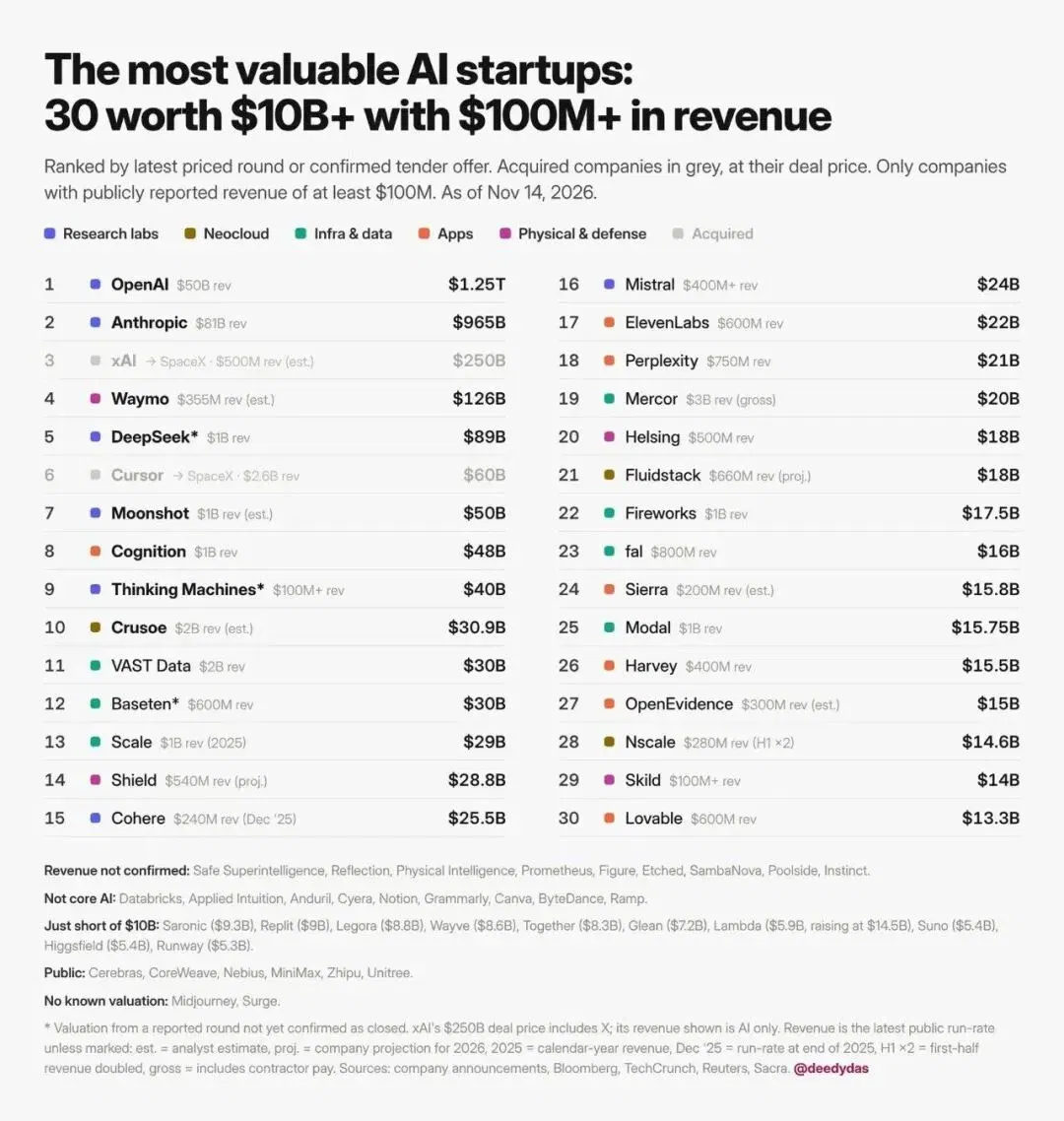
On November 15, Deedy Das (@deedydas), a partner at longtime Silicon Valley venture firm Menlo Ventures, posted a global AI company valuation and revenue ranking.
Founded in 1976, Menlo Ventures is among Silicon Valley's oldest venture firms, with investments including Uber and Chime. It has recently focused on AI, backing Anthropic, Lovable, Modal and others.
Menlo also invested early in Anthropic, joining its 2023 Series C and establishing a $100 million AI fund together in 2024.
As of November 14, the list covers private AI companies valued above $10 billion with publicly reported annualized revenue above $100 million. Thirty companies meet both conditions.
The gap separating the leading duopoly from the rest has widened further. OpenAI continues to lead at a valuation of approximately $1.25 trillion, followed closely by Anthropic at about $965 billion. The two have already established a substantial distance from other competitors.
But ranking by annualized revenue reverses their positions: Anthropic has overtaken OpenAI. Although both companies have pulled away from other competitors in valuation, their revenue competition has taken a new turn.
China's DeepSeek and Moonshot enter the top ten. DeepSeek ranks fifth at $89 billion and Moonshot seventh at $50 billion. The list places both companies' annualized revenue around $1 billion.
The United States still dominates overall: twenty-three of thirty companies span foundation models, AI coding, compute cloud services and more. China has two, with the other five from Canada, France, Germany, Britain and Sweden.
01
The duopoly leads by a wide margin
A year ago, OpenAI was far ahead.
At the end of 2025, OpenAI's annualized revenue was approximately $20 billion versus Anthropic's $9 billion, more than twice as much.
In 2026, Anthropic began growing much faster. OpenAI reached approximately $50 billion annualized by the end of September; Anthropic reached $81 billion by the end of October. Over ten months, Anthropic's increase was approximately eight times its earlier annualized revenue, while OpenAI's was about 1.5 times its earlier level. The former challenger had overtaken it on revenue.
Actual revenue also shows the change. In the third quarter, Anthropic generated approximately $17 billion and OpenAI $10 billion. Cloud-platform revenue accounting still differs, but Anthropic's growth this year is striking.
Both retain strong leads. Competition at the top of foundation models has entered trillion-dollar valuation territory.
More notably, Anthropic is using this momentum to pursue an IPO.
On November 10, it announced an IPO range of $70–78 a share, with a Nasdaq listing expected November 19 under ANT. At the high end, fully diluted valuation could reach approximately $1.4 trillion, well above May's $965 billion private valuation.
OpenAI chose differently, previously saying it would not list in 2026 and delaying its IPO to 2027. On November 6, it completed an initial approximately $11 billion tranche at a $1.25 trillion valuation, with the full round potentially reaching $20 billion.
A year earlier, OpenAI clearly led in models, users and commercial revenue. Anthropic has now overtaken it in revenue growth and is preparing to list first.
02
Chinese companies break through
Chinese AI companies have entered this global high-valuation list too.
DeepSeek ranks fifth at $89 billion with approximately $1 billion in revenue; Moonshot ranks seventh at $50 billion with similar revenue. Both are top-ten representatives of Chinese foundation-model companies.
Dividing these valuations by annualized revenue gives multiples of approximately 89 for DeepSeek and 50 for Moonshot. P/E uses profit, not revenue, as its denominator, so these are not forward P/E ratios. Valuation dates and revenue definitions may also differ.
Beyond US and Chinese companies, Canada's Cohere is valued at $25.5 billion with approximately $240 million annualized revenue; France's Mistral at $24 billion with over $400 million.
German defense-AI company Helsing ranks twentieth at $18 billion, with approximately $500 million annualized revenue. British compute-infrastructure company Nscale ranks twenty-eighth at $14.6 billion with around $280 million. Sweden's AI development platform Lovable takes thirtieth at $13.3 billion with $600 million.
03
Major acquisitions begin
Two gray-highlighted entries stand out: xAI and Cursor.
Their transaction valuations are $250 billion and $60 billion respectively, both marked as joining the SpaceX group. xAI's valuation includes social platform X, but the listed $500 million revenue covers only AI.
Cursor, another acquired company, is a fast-growing AI coding-tool business valued in the transaction at $60 billion, with approximately $2.6 billion revenue. Its revenue exceeds many more highly valued foundation-model companies on the list.
These two transactions concern foundation models and AI application products respectively, showing leading companies expanding their business boundaries through capital consolidation. Connections among model R&D, application products and commercialization channels are strengthening further, and AI competition is beginning to extend beyond individual products and technical capabilities into larger business ecosystems.
04
Infrastructure: revenue growth and profitability challenges
Although foundation-model companies occupy the top of the valuation rankings, another group worth watching provides compute, data and inference services to the entire AI industry: infrastructure companies. As demand for model training and application deployment grows, their revenues are also beginning to reach substantial scale.
First are direct compute suppliers.
Crusoe builds AI data centers and cloud services, with a $30.9 billion valuation and approximately $2 billion revenue. Fluidstack supplies GPU resources and cloud services, valued at $18 billion with expected revenue around $660 million.
These companies' businesses share similarities with traditional cloud providers, but they build infrastructure around AI training and inference. This requires sustained, substantial investment in GPUs and data centers, while also securing long-term customer contracts.
Second are data-infrastructure companies.
VAST Data is valued at $30 billion with approximately $2 billion revenue, providing large-scale enterprise storage and management. Scale AI is valued at $29 billion with around $1 billion in 2025 revenue, focusing on training data, annotation and model evaluation.
As AI models continue developing toward complex reasoning, multimodality and agents, training-data quality, data-processing efficiency and model evaluation are becoming increasingly important. VAST Data and Scale AI find commercial opportunities in data storage and management, and data production and processing, respectively.
Third are rapidly growing inference-service platforms.
Baseten is valued at $30 billion with approximately $600 million revenue; Fireworks AI at $17.5 billion with around $1 billion; Modal at $15.75 billion with around $1 billion; and fal at $16 billion with around $800 million.
They help developers and enterprises deploy and run models more cheaply and efficiently. fal particularly focuses on image, video and other generative-model inference.
Compared with large-model companies, these infrastructure businesses can simultaneously serve multiple model and application vendors and support different technical approaches. As more AI applications enter actual operation, model-call volumes, compute consumption and data-processing demand all have the potential to keep growing.
That does not, however, mean infrastructure is necessarily a more stable business. Compute providers face high capital expenditure, while inference-service platforms must cope with continually falling model-call prices and competition from major cloud providers. Whether growing demand ultimately becomes profit remains a challenge these companies will have to face.
05
Applications diverge further
Compared with foundation models and compute infrastructure, the application layer presents a different competitive landscape. Although company valuations are generally lower than those of leading model businesses, some application companies already show striking revenue growth and valuation multiples.
High-frequency coding, voice and search applications reached scale first.
Cognition, behind coding agent Devin, is valued at $48 billion with around $1 billion annualized revenue. ElevenLabs' voice generation and agents support a $22 billion valuation and over $600 million annualized revenue. AI search company Perplexity is valued at $21 billion with estimated annualized revenue around $750 million.
Founded in 2024, Lovable lets nonprogrammers develop software through natural language. It is valued at $13.3 billion with approximately $600 million annualized revenue.
More notable changes are occurring in verticals such as law, medicine and enterprise services.
Legal-AI company Harvey is valued at $15.5 billion with over $400 million annualized revenue. It serves 80% of the top one hundred US law firms, assisting with contract review, research and due diligence.
Customer-service agent company Sierra is valued at $15.8 billion. Its representative outcome-based model charges for problems actually solved, such as successfully handling a post-sale inquiry, rather than simply software seats or tokens. In late October it announced over $400 million annual recurring revenue, doubling in five months.
Medical-AI platform OpenEvidence provides verified doctors free clinical-research and medical-information search, monetized through pharmaceutical-industry advertising. Sacra estimates annualized revenue around $300 million, at a $15 billion valuation.
What these companies share is that they are beginning to enter stages of work previously performed by professionals such as lawyers, doctors and customer-service staff. Rather than merely providing an AI chat tool, they need to understand industry rules, connect to customers' existing enterprise systems and even redesign their workflows.
That makes application valuations more interesting. Simple calculations from the list show some vertical-AI companies valued at tens of times annualized revenue, above many compute-infrastructure firms. Investors are no longer looking only at how many software subscriptions can be sold. They also consider how large a professional-services market these companies could take on in the future.
Other research reflects the trend. Leonis Capital's November 11 report, 2026 AI 100, increases vertical-AI representation from twenty-eight companies last year to forty across medicine, law, finance and other fields.
The AI application market is differentiating more rapidly. As foundation-model capabilities continue to improve, the functional advantages of general-purpose AI applications become easier to copy. Products that simply package model capabilities struggle to maintain high valuations over the long term.
By contrast, capital markets are beginning to favor companies rooted in vertical industries, with distinctive data and barriers based on professional expertise. Such businesses usually need long-term accumulation of industry experience, customer trust and business processes. Once they become deeply embedded in core operations, customers' switching costs also rise.
Under the threat of models absorbing everything, this may be the application-layer opportunity for AI startups.
This article was originally published by the WeChat account Tencent Technology. Author: Tencent Technology.
Related topics
After reading
Join the AINRK community
Read how to join the community and connect with people working in AI.
Related articles
Continue reading related topics and articles in this category.
2026 国内新增独角兽全梳理:3 天一家、AI 和机器人占了一半,DeepSeek 估值最高 (opens in a new tab)
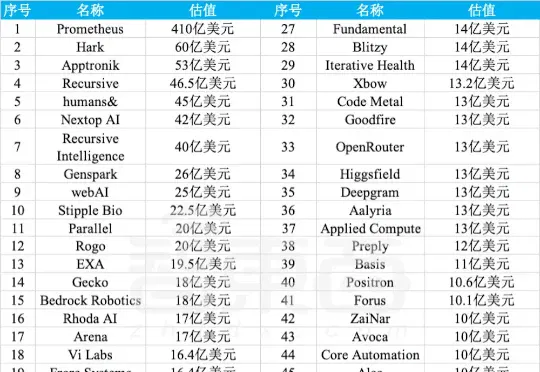
截至 2026 年 7 月 1 日,IT 桔子独角兽数据库信息显示,中国共有 517 家在榜独角兽企业,总估值约 2.39 万亿美元。从估值结构看,呈典型的金字塔分布——57.3% 集中在 10 至 20 亿美元区间,30.8% 在 20 至 50 亿美元,50 亿以上 62 家(12.0%),其中 500 亿美元以上的超级独角兽仅 5 家:
赢麻了!半年83家独角兽诞生,六成是AI公司 (opens in a new tab)
据外媒TechCrunch 7月5日报道,截至今年6月底,美国已有83家获得风险投资支持的初创企业成功跻身独角兽阵营,其中与AI相关企业就有51家,半年累计融资金额超过520亿美元(约合人民币3532亿元)。

万字深度:硅谷正疯狂豪赌这63家神秘AI实验室|亮马桥小纪严选 (opens in a new tab)
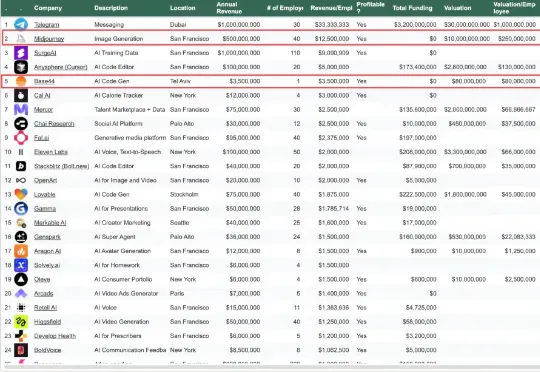
2026 年 5 月 6 日,Menlo Ventures 合伙人 Deedy Das (@deedydas) 发布了他自 2025 年 11 月以来不断收集的市场版图,帖子很短,但名单很长,核心数据如下:
建议AI创业者都关注这个「一人独角兽」公司榜单 (opens in a new tab)
这几天饼干哥哥都在杭州云栖大会,这一届的阿里AI大会,有一种经济上行的感觉,人是真的多,有几次论坛都挤不进去 例如这个AI Coding的交流 今天下午参加了MuleRun的论坛,坐在前排老老实实的听

比 YC 还强!AI Grant 是如何挖掘出Perplexity、Pika、Cursor 等独角兽的?|内附百家项目名单 (opens in a new tab)
从 Cursor 到 Perplexity,从 Pika 到 Granola,硅谷多家未来独角兽背后,站着同一个早期捕手:AI Grant。