AI4AI survey uses three decisions to distinguish research automation from autonomy
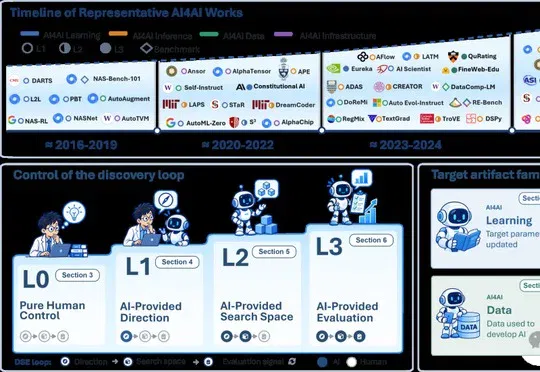
A Nankai University and Zhongguancun Academy team analyzes control over AI development through search direction, search space and evaluation signals, discussing evidence for multigenerational gains and independent validation.
You ask AI to automatically design a new inference algorithm: it can read papers, write code, run experiments, and keep revising its approach based on the results.
It looks as though the entire research process has been handed over to AI.
But if humans pose the research question, define the scope of permitted changes, and set the criteria for judging success, how many research decisions does AI really control? Is it running experiments for people, or has it begun to decide how research should be done?
Recently, a joint team from Nankai University and Zhongguancun Academy presented a survey that breaks AI research and development into three key decisions: search direction, search space, and the evaluation signal. On this basis, it introduces the L0–L3 framework for sources of control.

Paper page: https://www.preprints.org/manuscript/202610.2999
Project homepage: https://ai4ai-research.github.io/
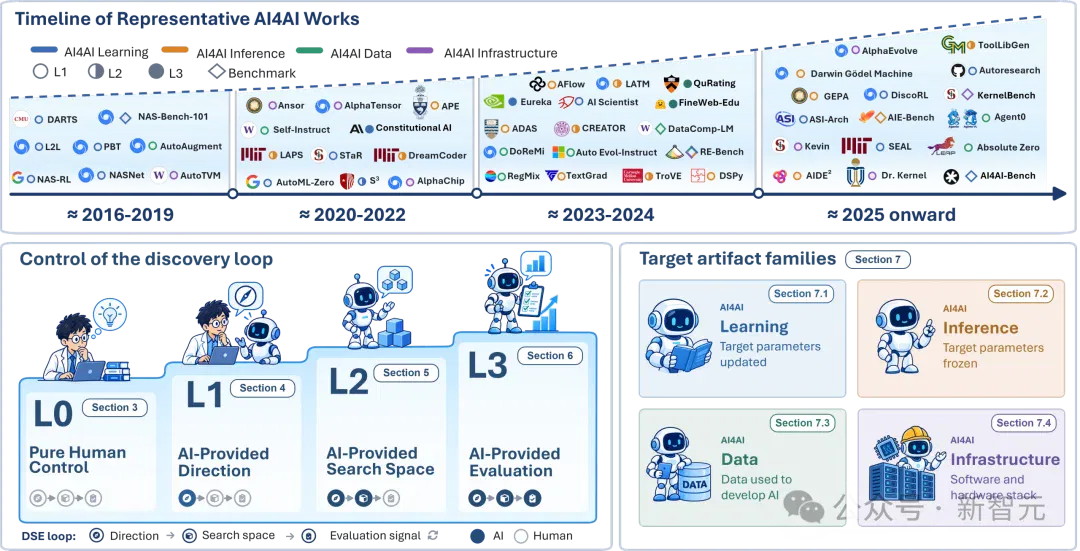
Figure 1: An overview of AI4AI research. Starting from control over research, the paper reviews representative work, the L0–L3 sources of control, and four application branches: learning, inference, data, and infrastructure.
Automating research does not mean automating research decisions
Start with a concrete example. Suppose AI is searching for a better reasoning strategy for a large language model. It can automatically generate candidate methods, modify programs, and run benchmarks. But what should it explore next? Which parts is it allowed to change? And on what basis should a new method be judged better?
These three questions may look like different steps in a research-and-development workflow, but they actually correspond to three different forms of control. Only by separating them can we accurately describe the responsibilities AI takes on in research.
What should be researched next?
Suppose an experiment finds that the model generates a very long reasoning process, yet its accuracy does not improve. Should the next round reduce ineffective steps, change the intermediate representation, or adjust the strategy for generating candidate answers?
This determines where research resources go and belongs to the search direction (SearchDirection, D). If AI can diagnose bottlenecks from the experimental history, propose hypotheses, and actively choose the next intervention, it is no longer merely executing an experimental plan supplied by humans.
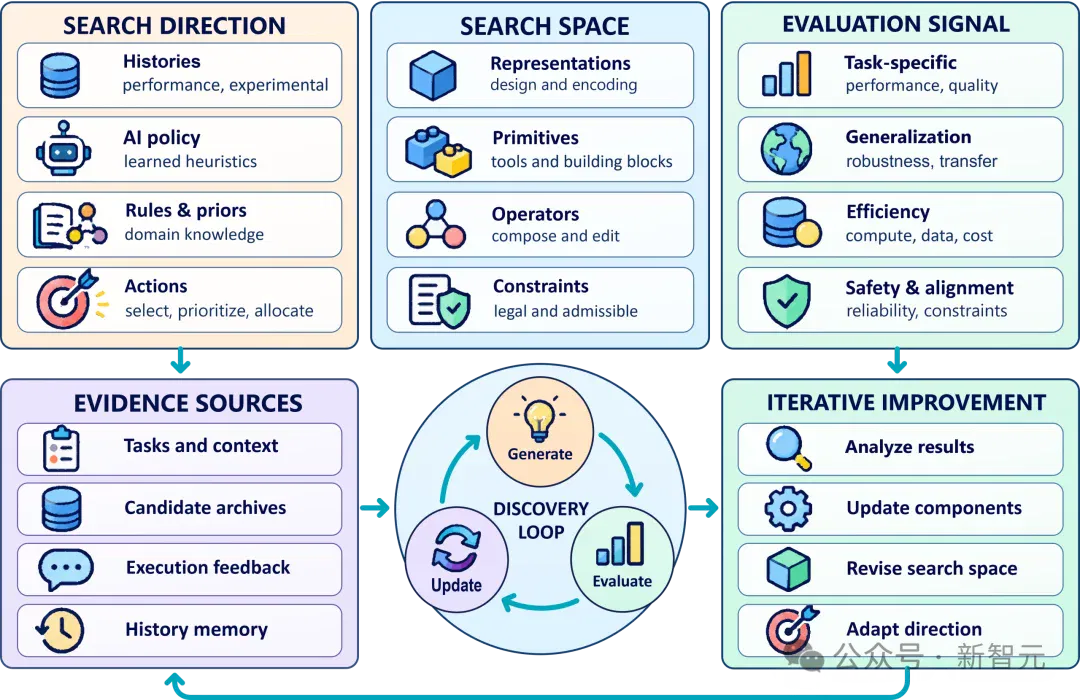
Figure 2: The three decisions in the discovery loop. Search direction determines what to explore, search space determines which approaches may be explored, and the evaluation signal determines how results are judged.
What is it allowed to try?
Search space
Even if AI can propose a research direction, it may still be able to search only within a space defined in advance by humans. For example, is it allowed to modify only prompts, or can it rewrite reasoning modules, design new algorithmic components, and even redefine how those components are combined?
This belongs to the search space (Search Space, S). It includes not only representations and available modules, but also valid compositions, editing operations, and admission constraints. The search space determines which algorithms can be expressed and also affects whether AI can find valuable approaches within a limited budget.
What counts as success?
Evaluation signal
One new inference method is more accurate, but uses three times the inference cost; another is faster, but performs substantially worse on difficult tasks. Which one should the system keep?
The evaluation signal (Evaluation Signal, E) determines what is regarded as progress, including test tasks, reward functions, judgment rules, aggregation methods, and acceptance thresholds. If AI can construct or substantially modify these evaluation mechanisms, it influences more than candidate approaches: it also influences the criteria for success in the research itself.
L0 to L3
Describing where control over research comes from
Based on the three decisions, the survey proposes four ways of allocating control.
L0 | Humans or external rules supply all three decisions. For example, researchers list the sequence of experiments, adjustable parameters, and scoring rules in advance, while the program carries them out.
L1 | AI decides how to search next. Take FunSearch as an example: the system refers to existing programs and their scores to propose code changes for the next round. Humans provide the scope of permitted changes and the testing program.
L2 | AI changes the approaches that can be searched. For example, DreamCoder extracts reusable subroutines from existing solutions and adds them to its program library. When it encounters new tasks later, the system can use these new building blocks to construct solutions. Evaluation is still supplied externally, while the search direction may be decided by humans or AI.
L3 | AI supplies an evaluation signal that actually influences training or selection. For example, Eureka generates executable reward functions and uses them to guide robot-policy training. Humans may still set the task; what AI helps decide is which behaviors receive rewards during training.
These distinctions make research contributions easier to see clearly. Even when systems all generate a piece of code, one may be choosing a new direction to explore, another may be constructing a tool library for subsequent research, and another may be writing a reward function that determines which candidates are kept or discarded.
Four branches
Which parts of AI is AI improving?
In addition to analyzing the sources of decisions, the survey organizes AI4AI into four branches according to what is being improved: learning, inference, data, and infrastructure.
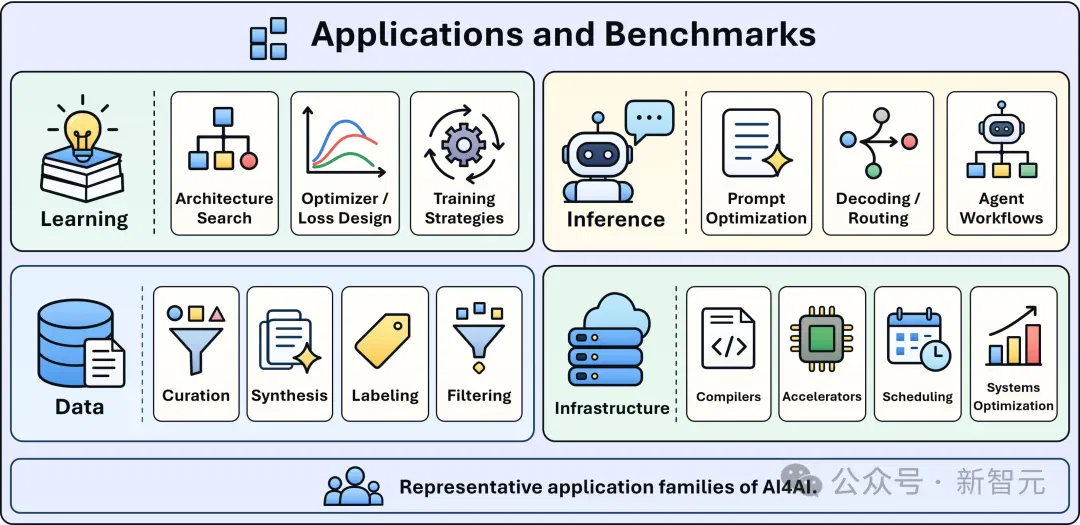
Figure 3: The four research branches of AI4AI: learning, inference, data, and infrastructure. They concern different objects of improvement, but all can be analyzed using the three-decision framework.
AI4AI Learning: discovering better training methods
AI4AI Learning concerns research-and-development processes that update the target model's parameters, including architectures, optimizers, learning rules, training procedures, and adaptation methods.
For example, AutoML-Zero makes learning algorithms themselves the objects of search, combining given mathematical primitives to form and evolve programs. Researchers need to examine both the performance of the resulting algorithms and which design materials and constraints still come from humans.
AI4AI Inference: improving how models use their capabilities
AI4AI Inference concerns improvements made while the parameters of the target model and adapters remain frozen. Prompts, agent workflows, tool libraries, context strategies, and allocation of inference-time compute can all become research objects.
For example, DSPy optimizes the instructions and examples in program modules, while DreamCoder learns program components that can be reused in subsequent tasks.
AI4AI Data: discovering more effective ways to organize data
AI4AI Data concerns data selection, mixing, augmentation, synthesis, and curriculum scheduling. DoReMi, for example, uses a proxy model to optimize the mixing weights of different data domains.
The value of this kind of work needs to be tested under a common training protocol: with the same training process, does replacing the data strategy with the discovered one consistently benefit the model? The costs of constructing and processing the data should also be included in the comparison.
AI4AI Infrastructure: optimizing the computing systems that support AI
AI4AI Infrastructure covers areas such as operators, compiler scheduling, parallel execution, and hardware design. The survey lists AlphaEvolve's optimization applications for matrix-multiplication tiling heuristics and TPU arithmetic circuits.
This reminds us that the next advance in AI may also come from more efficient computational implementations, allowing the same resources to support more experiments.
The four branches answer "what does AI improve?" The control framework answers "which decisions are made by AI?"
Only by combining the two can we compare AI4AI systems that have different objectives and different implementations.
The next step
Toward AI-driven superintelligence
The survey proposes several questions that merit further research.
If a space can express good algorithms in theory, does that mean AI can find them within a realistic budget?
There may be a large gap between the two.
Imagine that a system can modify any Python program. Its expressive range is broad, but each edit may affect many interdependent details. If common computations are encapsulated as reusable components, and the connections between components are made explicit, the same algorithm may be represented in a shorter, clearer way, while the search also gains different paths for making changes.
The new abstractions, primitives, and composition rules discussed in the paper can shorten the descriptions of useful approaches, change search neighborhoods, or rule out invalid combinations. These changes do not necessarily expand the set of algorithms that can theoretically be expressed, but may make valuable approaches easier to discover in practice.
Improvements to a space can therefore include both expansion and compression. Spaces that retain useful possibilities while reducing meaningless combinations are also worth exploring.
Validating such a contribution requires holding the search procedure and compute budget fixed or matching them, comparing human-designed spaces with AI-constructed spaces, and including the cost of constructing those spaces. A high-scoring approach ultimately selected must also be analyzed alongside candidate validity, diversity, search costs, and performance on new tasks.
For automated algorithm design, this provides a clear research angle: beyond improving the quality of each proposal, we can also study how to organize candidate approaches so that a limited number of experiments is more likely to produce valuable discoveries.
How to confirm genuine progress when AI participates in evaluation
When AI begins to construct tests, rewards, or judgment rules, it also influences the research process's judgment of "what is worth keeping."
Suppose a system improves both programs and tests, and after several iterations the pass rate keeps rising. This result may come from improved program capabilities, or from the tests becoming easier. Internal scores alone cannot distinguish between these possibilities.
The survey therefore emphasizes that evaluators may improve alongside the research, but an independent validation path must be retained. Hidden tests, executable checks, independent experiments, or real outcomes obtained after a delay can all provide external evidence. Which one to use depends on the value claimed for the discovery.
This also explains why "using a different model to score it" is not enough to guarantee independence. Candidate generators and evaluators may share biases, which need to be assessed through error analysis and intervention experiments.
On this basis, AI4AI evaluation should go beyond a single best result: how many resources the discovery process used in total, whether failed experiments are included in the cost, whether the approach still works after switching tasks, how many times humans intervened, and whether the conclusions remain stable across multiple runs all affect our judgment of the results.
Together, this evidence answers a practical question: after control over research is handed to AI, are the resulting gains reliable, and are they worth their cost?
Recursive self-improvement requires evidence across generations
The phrase "toward AI-discovered superintelligence" in the paper's title refers to a conditional, long-term research direction.
The key concept is recursive self-improvement: one round of improvement enhances the system's ability to produce subsequent improvements. For example, the system discovers reusable algorithmic components that let the next round of research explore more effective approaches under the same budget; or it improves experimental mechanisms so that subsequent research can identify unproductive directions more quickly.
Establishing such evidence requires examining both the current artifacts and the mechanisms that produce improvements. A better result in one round, or a system continuously modifying several versions, is not sufficient on its own to prove that research capabilities are continuing to grow.
The paper proposes testing recursive gains through multi-generation experiments, fixed or retained external evaluations, baselines under the same budget, and transfer to unseen tasks. Earlier improvements can also be selectively rolled back to see whether subsequent gains disappear with them, thereby assessing the causal connection between the earlier and later stages.
This also makes research memory important. Experience worth passing on should include hypotheses, implementations, experimental conditions, reasons for failure, and applicability boundaries, so that subsequent systems can test, reuse, and correct existing findings.
Only when one discovery can help the next, and that help withstands independent validation, is there a basis for the sustainable accumulation of AI's research capabilities. How far AI4AI can go depends on whether such gains continue to hold across tasks and generations.
References:
https://www.preprints.org/manuscript/202610.2999
This article comes from the WeChat official account "Xinzhiyuan," by "Xinzhiyuan."
Related topics
After reading
Join the AINRK community
Read how to join the community and connect with people working in AI.
Related articles
Continue reading related topics and articles in this category.

ConvexLLM connects speech to language models through frozen text embeddings (opens in a new tab)
Researchers at CUHK-Shenzhen and Microsoft propose C-Gate, mapping audio into convex combinations of frozen text embeddings. The paper reports VoiceBench gains against its listed open-model baselines, while audio understanding and transcription still involve trade-offs.

CWM2.0 open-sources generative rendering with a 30-minute racing demo (opens in a new tab)
Teams from Ant, Westlake University and Zhejiang University use a structured Proxy to control scene state and Invoker-Render to generate visuals, releasing eight-GPU streaming inference. The long demo and 140 evaluations cover specified scenes, not arbitrary stable worlds.

Ankole outlines multi-user agent architecture: events, permissions and organizational memory (opens in a new tab)
The team describes its Business Harness design for fast and slow paths, shared state, Actor orchestration and dynamic permissions. Formal verification covers the modeled core permission state machine; it does not replace security checks of the full deployment, external interfaces or implementation.

openJiuwen presents a Harnessless approach for reusing AgentOS execution tools (opens in a new tab)
openJiuwen uses app-development and swarm demos to show how built-in harness capabilities support sessions, tools and app management. Applications still define business rules and permissions; remote deployment and some capabilities remain planned or exploratory.

Ask-to-Distill optimizes training questions using teacher–student distribution signals (opens in a new tab)
UIUC and collaborators propose A2D, training a question generator with frozen teacher–student disagreement and compatibility signals before on-policy distillation. The paper reports gains in math, code and agent tasks; its learning-value proxy has limits.