Endless Frontier releases Fx-Bio-1031 weights, reports bioinformatics benchmark and workflow tests
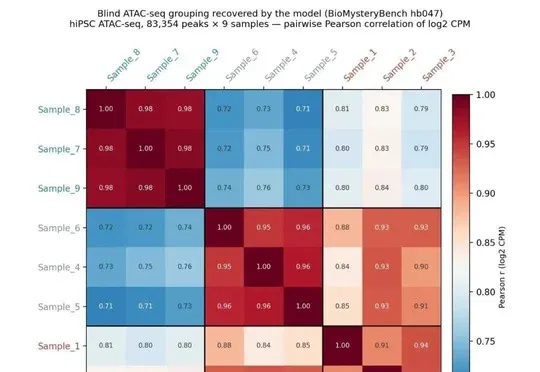
The team reports multi-attempt results for its bioinformatics post-trained Qwen model and shows cohort, unlabeled-sample and data-QC cases. Findings remain limited to the stated tasks and systems.
Editorial correction (November 16, 2026): The benchmark results are reported by the release team under its own framework, and Pass@k is a multiple-attempt metric. The cases are computational research, not clinical validation of causality or treatment efficacy. Local deployment also requires checking resources, network-connected tools, and permissions.
Over the past six months, if you have closely watched Silicon Valley's very top AI labs, you will have noticed that a lightning-fast encirclement of the "life sciences" has quietly taken shape:
- In April this year, OpenAI made the first blockbuster move, releasing a domain-specific reasoning model built especially for the life sciences, GPT-Rosalind (rapidly followed by GPT-Rosalind-5.5, built on GPT-5.5), and simultaneously introduced a demanding bioinformatics evaluation benchmark;
- In May this year, Google followed closely with Gemini for Science;
- In June this year, Anthropic formally launched an AI workbench for researchers, Claude Science.
From underlying domain-specific models and evaluation standards to research workbenches, the world's leading AI companies have, within just six months, made the life sciences one of their main battlegrounds for testing the substance of AGI and RSI, and have all begun building across the full stack.
However, when this frontier wave reaches practical reality, China's life-sciences community and developers face two unavoidable barriers in actual deployment:
On the one hand, overseas domain-specific bioinformatics models such as GPT-Rosalind are highly closed. More importantly, these models do not necessarily directly meet Chinese research groups' and pharmaceutical companies' needs for local deployment, data security, and adaptation to their operations;
On the other hand, bioinformatics itself has a high barrier of specialist expertise. Faced with sequencing data that can run to millions of rows, experimental samples with missing labels, and analysis pipelines involving multiple statistical tests and complex tool calls, general-purpose foundation models often still need specialist knowledge, toolchains, and execution environments working together to reliably complete real research tasks.
A general-purpose model doing bioinformatics is like reciting a medical encyclopedia: on the surface, it answers terminology questions fluently, but once it enters a real sandbox, it throws errors and crashes.
With a domain-specific RSI model, doing bioinformatics means throwing the model straight into a command line and millions of rows of raw, noisy data: it writes its own scripts, queries databases, and performs cross-validation. Those who cannot get the workflow running can only watch the generational gap widen with each new generation.
Today, Endless Frontier officially releases the weights of its bioinformatics large model Fx-Bio-1031.
The model was developed for professional bioinformatics tasks, targeting the direction explored by specialist models such as OpenAI's GPT-Rosalind, and makes its full model weights available. Fx-Bio-1031 has now successfully run biomedical dry-lab experiments.
On Anthropic's BioMysteryBench benchmark, Fx-Bio-1031 achieved 70.59% Pass@5 on the Difficult subset, far ahead of GPT-6-Astra (47.06%) and Claude Opus-5 (52.94%) under the same framework. In comparison, Fx-Bio-1031 exceeded them by 23.53 and 17.65 percentage points, respectively.
On BiomniBench, which tests capabilities across the full workflow of complex scientific analysis, Fx-Bio-1031's Pass@3 also reached 89.50%.
Faced with difficult tasks that even human experts find challenging, it is no longer a "literature Q&A machine" that can only recite gene terminology. It can write code, install software, query databases, and perform cross-validation, and even, after computing a significant result, proactively put itself through 14 rounds of "devil's interrogation."
First, the scorecard: opening a generational gap in the deep end where human experts get stuck
Why is bioinformatics such a brutal touchstone for testing the true quality of AI agents?
In Anthropic's BioMysteryBench, models cannot pass simply by retrieving ready-made conclusions about the original datasets. Instead, they are placed directly into real biological data and Linux tool environments to complete a series of complex analysis tasks. These tasks cover whole-genome sequencing (WGS), single-cell transcriptomics (scRNA-seq), chromatin accessibility (ATAC-seq), metagenomics, and proteomics.
The model must act like a real computational biologist: examine raw files itself, fetch annotations from NCBI and Ensembl, write multistep statistical scripts, and discard an approach and start again if it does not work.
Under the team's unified agent-evaluation framework, Fx-Bio-1031 delivered the following results:
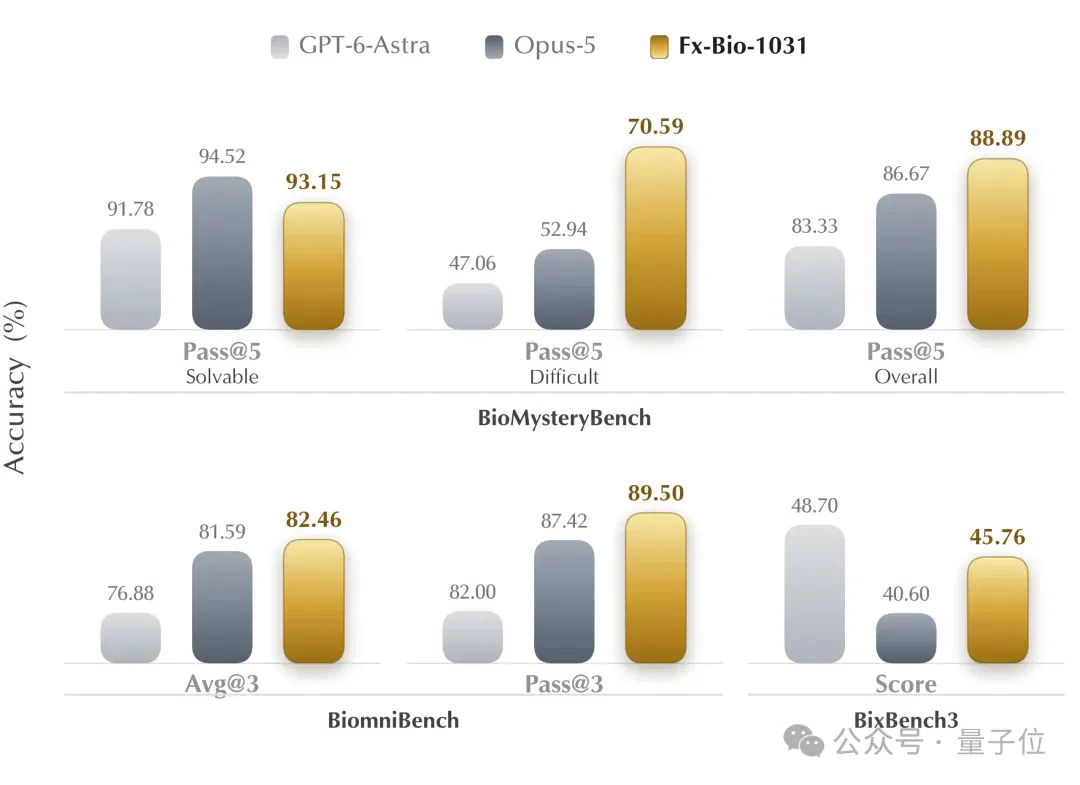
The data in the figure come from the model card uploaded by the release team and its internal evaluation framework, rather than independent official verification by the Hugging Face platform. Pass@k denotes a success metric under a given attempt budget and cannot be equated with the success rate of a single run.
Look closely at this figure: the most striking numbers appear in Difficult (the difficult subset).
When questions fall within the subset solvable by human experts (Solvable), top models are locked in an elite contest above 90%. But once they enter the deep waters of Difficult, requiring dozens of steps of long-horizon reasoning, evidence pieced together from multiple sources, and tasks where even human experts can fail, GPT-6-Astra and Opus-5 immediately fall below or stall around a 50% pass rate.
Fx-Bio-1031, meanwhile, shoots straight to 70.59%, leading by 17.65 to 23.53 percentage points.
A genuine generational gap between models never appears on questions that hand out easy points. It appears in extreme tasks with incomplete conditions, extremely low signal-to-noise ratios, and problems that can keep humans thinking hard for days.
Five application scenarios: what pain points can a Chinese open-weight bioinformatics model solve?
Beating difficult benchmarks is only the first step.
For hospital clinical teams, university research groups, biotech pharmaceutical companies, and contract research organizations (CROs) that continually generate enormous amounts of data every day, what truly matters is whether AI can enter real research processes, handle different kinds of omics data, complete complex tasks from data quality control and statistical analysis to validation of results, and integrate these capabilities into existing research workflows.
Drawing on specialist bioinformatics analysis, tool-calling capabilities, and a local sandbox runtime environment, Fx-Bio-1031 focuses on the following five application scenarios:
1. Drug discovery and clinical oncology cohort mining (target and biomarker validation)
It supports pharmaceutical companies in performing gene co-mutation/mutual-exclusivity analysis, investigating resistance mechanisms, identifying patient subgroups, and rechecking survival associations across large clinical sequencing cohorts in a locally deployed private environment.
After a new batch of clinical samples is enrolled, the full pipeline can be rerun with one click, automatically carrying out more than ten sensitivity analyses and compressing target-project scoping research that would previously require weeks on a bioinformatics team's schedule into a matter of hours.
2. Integrated multi-omics analysis and dissection of molecular mechanisms (universities and research institutes)
It covers whole-genome (WGS), bulk transcriptomic (Bulk RNA-seq), single-cell transcriptomic (scRNA-seq), epigenetic (DNA methylation, ATAC-seq, ChIP-seq), and proteomic data.
From "screening for methylation changes in promoter regions" to "gene-expression association analysis and functional pathway enrichment," the model can run the full evidence chain end to end, from raw-matrix cleaning and statistical tests to generation of publication-quality figures and reports.
3. Pathogen tracing, metagenomic mining, and quality-control troubleshooting (disease control, clinical testing, and sequencing service providers)
Given anonymous clinical isolates, intestinal infection samples, or large volumes of environmental metagenomic data, the model can automatically quality-check and repair underlying dirty FASTQ/MAF data, precisely identify viral/bacterial species and serotypes, such as norovirus subtypes and flagellar antigen formulas, and pinpoint resistance genes or signals of novel defense systems amid complex background noise.
4. Investigating experimental anomalies, reconstructing blind tests, and additional analyses for peer review (wet-lab and dry-lab collaboration)
When wet-lab work encounters confused sample labels or interference from batch effects, or a journal reviewer asks the demanding question "would the conclusion still hold with different statistical criteria or additional negative controls?", researchers can give the problem and data directly to the model. It can cross-validate with public databases such as NCBI, Ensembl, and COSMIC to quickly complete blind-test tracing and supplementary experiments.
5. A foundation for bioinformatics automation agents and customized pipeline development (the AI+Bio developer ecosystem)
With its 512K extended context and strengthened tool-calling capabilities, developers can connect Fx-Bio-1031 directly to research-agent workbenches such as DP Technology's BioMaster or internal enterprise LIMS systems, building automated bioinformatics pipelines that can autonomously write code, install software, diagnose errors, and deliver auditable reports.
Why can this foundation reach the front lines of industry and even cross disciplinary boundaries?
First, exceptional value for money, built specifically for private local deployment (keeping data within the organization).
The current model card distinguishes the 125B MoE backbone from components such as embeddings and MTP, and lists the language portion as 180B in total. The 6B figure refers to active parameters in the MoE backbone and cannot be used to estimate the memory or storage requirements of all the weights.
Thanks to the relatively small number of activated parameters, the computation needed by Fx-Bio-1031 during inference is relatively manageable, helping reduce inference costs. Hospital departments, university research groups, and pharmaceutical companies can privately deploy it in local server rooms without an exorbitantly expensive compute cluster.
Private deployment can reduce external transfers, but the configuration of network-connected databases, tools, logs, and permissions still needs to be checked. It cannot automatically guarantee that data will never leave the organization or device.
Second, it goes beyond bioinformatics: with RSI-OS, it can rapidly transfer to myriad scenarios.
Bioinformatics is only the first touchstone for this self-evolving system. What the model truly learns during training is a general problem-solving paradigm: "breaking down vague requirements, calling tools, cross-validating, and correcting its own mistakes."
The team hopes to extend its workflows and self-improvement methods to other fields. Cross-domain performance still needs validation on independent tasks, and low-cost automatic transfer cannot be guaranteed.
Three demanding cases in action: "frightening execution ability" that even non-biologists can understand
Why can Fx-Bio-1031 take on these five demanding scenarios?
The team opens up three runs from evaluations and real blind tests, explaining in plain language how difficult the problems are and then showing how the model breaks through.
Case 1: a significant result is only the beginning; it then gives itself 14 "stress tests"
In plain language:
1. When pharmaceutical companies develop cancer drugs, their greatest fear is a "false positive": calculations appear to show that two cancer genes are "like fire and water" (mutually exclusive), but the conclusion collapses when the filtering criteria change.
2. In this task, AI first calculates from nearly two thousand hospital records that "these two genes really are mutually exclusive." But rather than rushing to submit its answer, it proactively reformulates the criteria in 14 stringent ways and repeatedly checks the calculations.
In data science and bioinformatics research, one sentence is particularly feared:
"If you change the statistical criteria, does this significant pattern still hold?"
Often, a supposed "major discovery" simply happens to sit at a particular filtering threshold. To verify whether a conclusion is robust, researchers have to start over and reselect samples, adjust inclusion criteria, and rerun the full set of tests.
In a breast-cancer clinical-cohort task (BiomniBench da-18-7), the task is to investigate whether ESR1 mutations and RAS/MAPK pathway alterations "tend to coexist" or are "mutually exclusive" in HR+/HER2− breast-cancer patients after endocrine therapy.
Fx-Bio-1031 starts with 1,918 messy sample records, removes exact duplicates from the MAF file, and precisely identifies 762 distinct patients. Its core finding is that the pathway-alteration rate is only 7.1% in patients with ESR1 mutations, far below the 19.5% in wild-type patients (odds ratio OR=0.317, p=0.0011). A further 100,000 permutation trials confirm a strong signal of "mutual exclusivity."
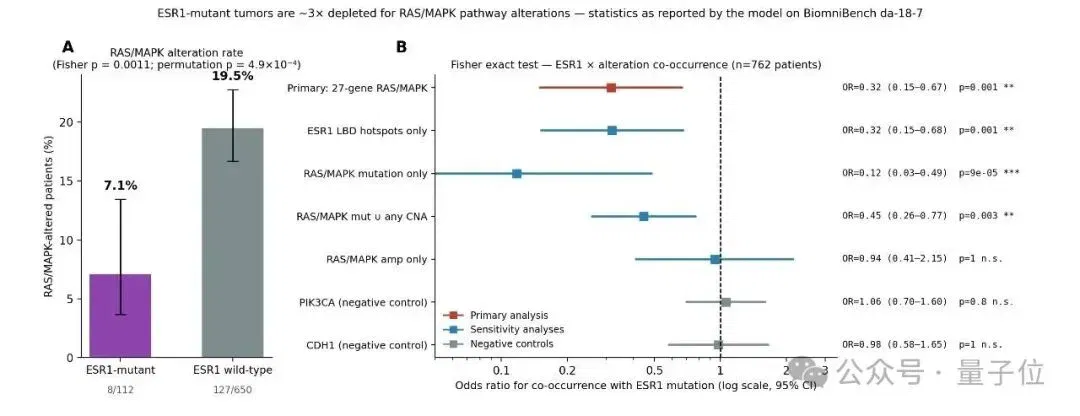
△ Association analysis of ESR1 mutations and RAS/MAPK pathway alterations. The left compares alteration rates between the two patient groups; the right shows the primary analysis, representative sensitivity analyses, and negative controls.
An ordinary model would already have submitted its answer after calculating the p-value. But Fx-Bio-1031 next did something exceptionally demanding: it proactively subjected its own conclusion to 14 sensitivity analyses and set up negative controls.
It tried narrowing the mutation range to specific hotspots (LBD hotspots); it tried excluding copy-number alterations and looking only at point mutations; it tried looking only at gene amplification (amp only); and it even proactively brought in PIK3CA and CDH1 as negative controls (Negative controls).
In the end, it delivered not only a statistically significant conclusion, but also a clearly drawn "map of the conclusion's boundaries": under the vast majority of stringent settings, the mutual-exclusivity effect remained rock solid. But once the definition of alterations became too broad, or only gene amplification was counted, statistical significance disappeared.
So it not only calculates accurately; it also has an exceptionally clear understanding of "where the boundaries of the conclusion lie."
Case 2: nine samples with every label stripped away; how does cross-database reasoning solve the "blind-test mystery"?
In plain language:
1. The labels have disappeared from all nine sample tubes in the laboratory. All that is known is that three contain water (the control group), while the other six received one of two drugs, A or B.
2. AI first compares the internal data and sorts the most similar-looking samples into three groups, with three tubes in each. It then goes to external databases itself to find "which direction cells change after A or B is added," brings this hard external evidence back for comparison, and restores the identities of all nine unlabeled samples.
Consider a difficult blind-test question from Anthropic's BioMysteryBench (hb047).
The team gives the model nine ATAC-seq samples from human induced pluripotent stem cells (hiPSCs), without any group labels. The raw data involve 110,559 chromatin-accessibility peaks (peaks).
The question gives only one clue: six samples were treated with two class I HDAC inhibitor drugs, while the other three are untreated blank controls.
Identify which is which.
How can they be identified without labels? Fx-Bio-1031's first step is to look inward for structure: after filtering out low-signal noise, it calculates pairwise correlations for the nine samples across 83,354 loci, neatly clustering the nine samples into three groups with three replicates each.
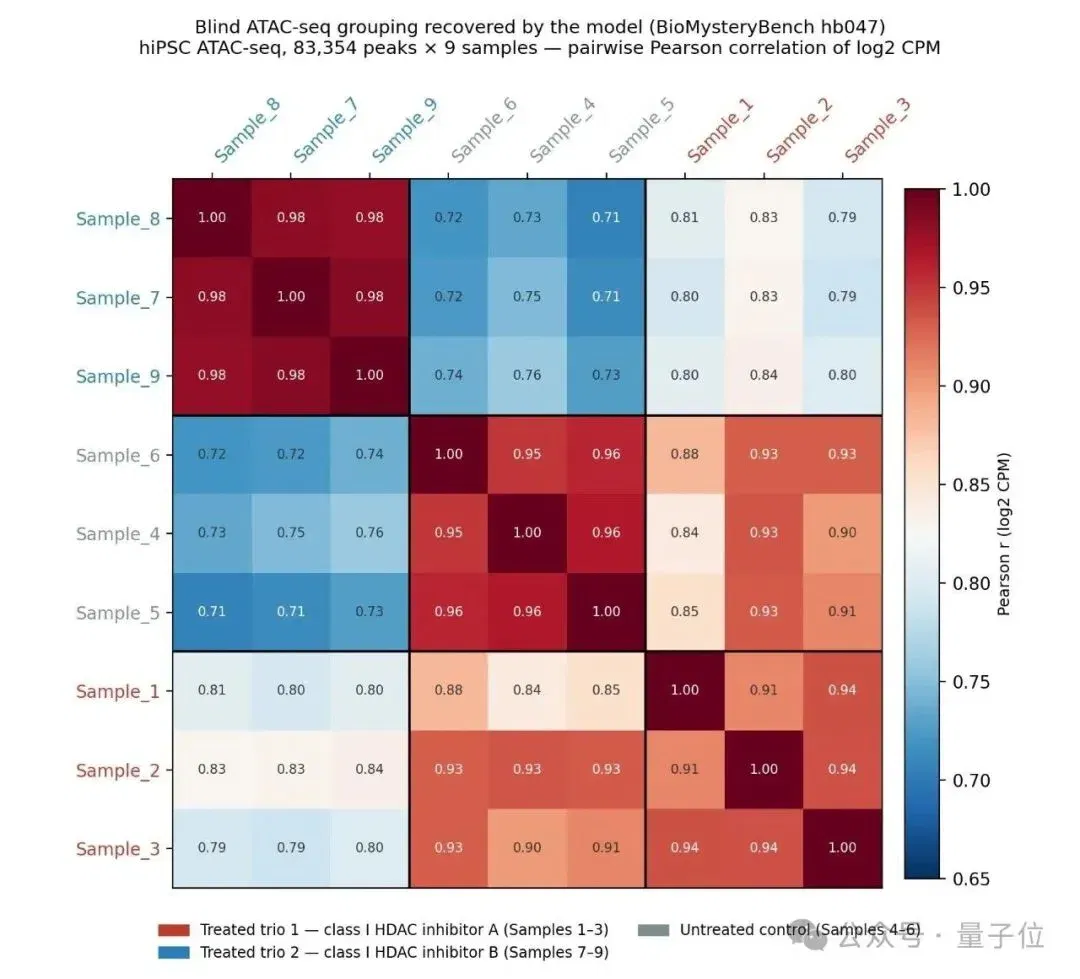
△ A correlation heatmap of nine unlabeled ATAC-seq samples. The model combines sample clustering with public drug-response data to infer the experimental groups.
But the real difficulty comes in the second step: after clustering them into three groups, which group is the untreated control? Even a genius could not guess from similarities within the data alone.
At this point, Fx-Bio-1031 displays remarkable research intuition. It moves beyond the current files, proactively retrieves genome annotations and public data on known transcriptional responses to HDAC inhibitors, links accessible peaks to genes, and uses "the externally known direction of biological responses" as its yardstick, then compares shifts peak by peak to check whether the responses of the two drug-treatment groups are consistent. It ultimately settles the question, reconstructing the two drug-treatment groups and one blank-control group.
Case 3: 2.06 million variants and 76 consecutive operations; even low-level bugs in the raw files cannot escape its notice
In plain language:
This case analyzes contributions from mutational signatures in a cohort. That is not equivalent to identifying the leading cause of all breast cancers; still less can cohort statistics directly establish causality for an individual.
2. Automatic mine-clearing: a real user uploaded a bacterial-sequencing file with a low-level defect (a misaligned data format). Ordinary software crashed when it ran, but AI precisely identified and removed the corrupted row, ran through 258 consecutive steps, and delivered a flawless report.
When the scale of the data is pushed to the limit, or the raw data themselves contain "traps," can the model still hold steady?
In another difficult task, the input consists of 2,700 tumor samples, 2.06 million single-nucleotide variants (SNVs), and 96 mutation channels. No reference library or algorithm is specified, and the task is to identify the COSMIC SBS mutational signature with the highest contribution in the aggregated breast-cancer cohort statistics.
Fx-Bio parses the mutation matrix and SBS reference-signature profiles in its local test environment, performs non-negative least-squares (NNLS) mathematical fitting, calls official tools for cross-validation, then performs 200 Bootstrap resampling iterations and cross-version checks. It completes 76 analysis operations and precisely identifies the answer.
In a bacterial-sequencing analysis test conducted on the BioMaster platform, the model needs to infer the strain's flagellar H antigen formula from the input sequencing reads (raw sequencing read segments), equivalent to precisely typing an unknown bacterium's identity.
During low-level data quality checks before starting the analysis, Fx-Bio spots an extremely hard-to-spot engineering bug: in the last record of the R2 sequencing file, the length of the base sequence does not match the length of the quality values at all!
It proactively writes a script to remove the corrupted record, then calls the specialist tool SeqSero2 to make the prediction. When the first run throws an error along the way, it immediately diagnoses the problem itself and repairs the pipeline. It completes all 258 steps consecutively in 34.5 minutes and ultimately delivers a fully traceable report.
The underlying engine: from BigBang to Fx-Bio, Endless Frontier's "three-layer RSI" evolutionary flywheel
How can a model display the intuition and engineering resilience of a seasoned researcher in such a detail-intensive, demanding specialist field with so little room for error?
The answer lies in the core conviction that Endless Frontier has consistently followed: RSI (Recursive Self-Improving, meaning recursive self-improvement).
The article describes developments this year, from legendary Google veteran Jeff Dean leaving to found Discovery Loop to a group of Chinese scholars in Silicon Valley founding Recursive Superintelligence, as the world's very top AI minds betting on the same thing: the pace at which human experts set questions and grade answers has fallen far behind large models' appetite for evolution.
The only way to break through is to let AI iterate on AI itself.
- Ordinary fine-tuning is like drilling the answers to past question banks: the question types are fixed, the reference answers are already there, and if an answer is wrong, another adjustment to the parameters is all that is needed.
- Ordinary fine-tuning and self-evolving training each have their own conditions of applicability. The comparison here concerns the team's training approach; it cannot establish that other methods only memorize answers or all fail as soon as the task changes.
In August this year, Endless Frontier released BigBang-V1, using frontier scientific data that were 100% autonomously synthesized, verified, and evolved by AI to make "data-layer RSI" work, enabling a 35B model to compete head-on with trillion-parameter models on multiple difficult scientific-research benchmarks.
This time, with Fx-Bio-1031, Endless Frontier pushes the self-evolution engine further: it decomposes the large research loop, which is difficult to close in a single step, into an interlocking three-layer RSI flywheel of "evaluation + data + environment," in which progress can compound.
The evaluation layer (AI participates in testing what counts as good)
Together with DP Technology's BioMaster team, the team builds an internal independent-validation system around typical bioinformatics tasks and complex workflows, focusing on model performance in data processing, tool calls, multistep analysis, and review of results.
Within a complete system comprising the model, tools, and sandbox, 114 internally constructed complex tasks are run independently for three rounds, totaling 342 task runs and more than 20,000 model requests.
The data layer (AI creates its own questions to target weaknesses)
Following BigBang's approach to data-layer evolution, AI is deeply involved in generating, solving, and reviewing training tasks.
Based on general capability weaknesses revealed by the internal independent-validation set, rather than external public evaluation benchmarks, such as drift in statistical criteria across batches and broken multistep evidence chains, the system autonomously evolves training trajectories using publicly available, compliant research literature and real bioinformatics workflows. All external public benchmarks, such as BioMysteryBench and BixBench3, are strictly reserved as zero-contact final blind-test exams and are not used for any training, fine-tuning, or adjustment of data-synthesis strategies.
The environment layer (AI participates in refining tools and environments)
This is a particularly promising part of bioinformatics. During iteration, the model does more than learn knowledge: it begins trying to write and repair bioinformatics analysis scripts and work with a continually evolving agent runtime framework (Harness), so that the "arsenal" and execution environment available for the next round of model tasks become stronger together.
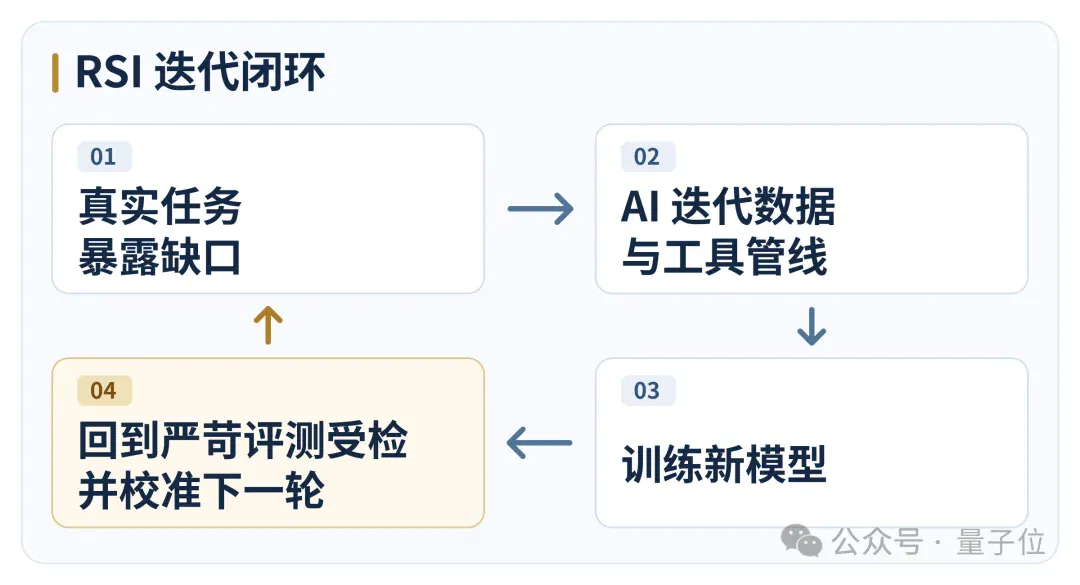
Why choose bioinformatics as the first stop for evolving this three-layer flywheel?
Because its literature is the most varied, its data the most fragmented, and its reasoning chains the longest, while code-execution results and statistical tests can also be reviewed and recomputed.
Automation can take on some task-construction and checking work, but expert review, evaluation reliability, compute, and real experiments remain constraints. This does not justify declaring that the limits of human experts' capacity have been overcome.
Endless Frontier defines this underlying engine, which connects the three-layer "evaluation–data–environment" loop, as RSI-OS (a recursive self-evolving operating system).
It is precisely through RSI-OS's continuous self-evolution pipeline, together with the underlying compute and training-engineering support from DP Technology's high-performance machine-learning platform Trisol, that Fx-Bio-1031 can converge rapidly and keep evolving through high-frequency iterations over enormous numbers of complex tasks.
Full model weights released: making the bioinformatics foundation controllable and usable
Today, Endless Frontier formally makes the full model weights of Fx-Bio-1031 available:
- Base architecture: deep RSI post-training based on Qwen3.8-Flash-Next
- Extended context and thinking mode: the release configuration natively supports a 512K context window, enough to accommodate extremely long tool-call trajectories, multiple complete papers, and large-scale omics statistical outputs
- A ready-to-use ecosystem: full model weights, tokenizer, processor configuration, and generation configuration (under Qwen Community License 1.0; if you need to use this model or a derivative model commercially, consult and comply with the relevant commercial-authorization terms of the Qwen community license in advance)
📦 Model weights and evaluation details: https://huggingface.co/endless-frontier/Fx-Bio-1031
Endless Frontier was initiated by an academician of the Chinese Academy of Sciences, with Shanghai Jiao Tong University, the Shanghai Algorithm Innovation Research Institute, and DP Technology jointly incubating it.
The founding team brings together leading researchers and engineers from academia and industry. Core team members Siheng Chen and Linfeng Zhang previously led teams that developed the scientific foundation model Innovator and the general-purpose research agent SciMaster.
If your research group or R&D team has a set of omics data and wants to recheck a key biological association, investigate puzzling experimental groups, or fully automate a frequently used bioinformatics analysis pipeline, you are welcome to bring your real problem to Endless Frontier for discussion and begin joint validation with a task whose results can be checked.
Contact Endless Frontier: pr@endlessfrontier.tech
Join Endless Frontier's model-trial community early and bring scientists and developers together for face-to-face exchange.
This article comes from the WeChat official account "QbitAI," by "QbitAI."
Related topics
After reading
Join the AINRK community
Read how to join the community and connect with people working in AI.
Related articles
Continue reading related topics and articles in this category.

姜宇辉的AI分身:知识助手与“另一个自己”之间 (opens in a new tab)
南方周末通过学者、用户与Second Me创始人的访谈及记者试用,观察AI分身的学术辅助、情感连接和商业化尝试,也呈现知识可靠性、人格边界、版权与隐私方面的疑虑。

智动未来据报完成亿元级Pre-A+融资,资金用于产线与服务机器人部署 (opens in a new tab)
机甲觉醒报道,智动未来宣布完成亿元级Pre-A+轮融资,由中美绿色基金领投、南曦创投联合领投,资金拟用于广州产线、服务场景部署和世界模型研发。“智子世界”仍属技术预览,商业化效果待更多应用数据检验。

范式智能介绍Phai-A1与Phai-M1,强调国产算力后训练优化 (opens in a new tab)
范式智能介绍面向代码与Agent场景的Phai-A1,以及面向真人影视的音画同步模型Phai-M1。公司展示了单卡运行和视频生成能力,并称模型在昇腾平台完成专项后训练优化。
腾讯Q3资本开支814亿元,称WorkBuddy日Token用量居国内首位 (opens in a new tab)
腾讯三季报显示营收2073.36亿元、资本开支814.33亿元。公司称WorkBuddy日活超1000万,按用户每日大语言模型Token消耗总量居国内首位;报道还讨论云业务增收与AI投入对盈利、现金流的影响。

黄仁勋离任后:硅谷101访谈英伟达的技术、供应链与组织挑战 (opens in a new tab)
硅谷101采访半导体、科技与投资人士,讨论黄仁勋离任后CUDA生态、系统整合、供应链、开源投入和组织传承的潜在变化。产业放缓、估值折扣及人才流失判断属于受访者观点。